
SDP: Revisiting the "Belief" Issue from the Self-Life-Mind Perspective

This paper is part of the Strategic Developmental Psychology (SDP) project.
by Oliver Ding
June 13, 2026
About two weeks before writing this article, I noticed that a friend had been sharing a series of articles and materials about a profound transformation in her belief system — what she called "reinstalling her internal operating system." With her consent, I began analyzing her experience using the World of Activity toolkit and the Self-Life-Mind (SLM) model.
The original research report was written in Chinese and runs to over 40,000 characters. It is a full-length case study covering the complete analytical journey, including detailed theoretical comparisons, extended framework discussions, and multiple rounds of analysis. An English summary of original version of that report was published titled Rebuilding the Living Coordinate: A Case Study Summary.
This paper focuses on the Self-Life-Mind (SLM) model. First, we explore how the SLM schema approaches the "belief" issue. Second, we review how the SLM schema operates as a meta-framework, providing the structural principle that organizes how World of Activity engages the research topic and the case in the first place.
Contents
1. Introduction
2. The "Belief" Issue: Beliefs and Belief Systems
2.1 Three Approaches to "Belief" in the Literature
2.2 Belief System as the Relevant Unit
2.3 Belief System Transformation: An Illustration
3. SLM's Heuristic Questions for Belief System Research
3.1 Four Units of Analysis, Reoriented
3.2 How Existing Frameworks Answer These Questions
3.3 What the Comparison Reveals
3.4 SLM's Relationship to These Frameworks
4. Quinn's Case: The Research Material
5. Theory to Practice: The Three-Way Coordination
5.1 How SLM Organizes the Analysis
5.2 The Frameworks Deployed and Why
6. World of Activity in Action: Key Analytical Moments
6.1 The first moment: identifying the structural nature of the third collapse
6.2 The second moment: seeing the zero-th belief
6.3 The third moment: understanding why Quinn's mentor succeeded where coaching had not
7. World of Activity and Other Frameworks: A Comparative Assessment
8. Practice to Theory: What the Case Feeds Back to the Framework
8.1 Internalized versus Native Components
8.2 Cultural Ecology and the Missing Externalization Pathway
8.3 Situational Differentiation of the Same Capacity
9. Conclusion
9.1 SLM as Meta-Framework for a Research Topic
9.2 The Three-Way Coordination as an Instance of Weave the Theory
Postscript: The Researcher's Own Living Coordinate
References
1. Introduction
The previous paper in this series, Revisiting the "Self" Issue from the Self-Life-Mind Perspective, addressed a foundational problem in the psychological study of selfhood: the tripartite confusion that has required the self to serve simultaneously as ontological presupposition, empirical variable, and explanatory construct. The proposed solution — treating Self, Life, and Mind as analytically distinguishable but ontologically inseparable aspects of an indivisible whole — dissolves the measurement paradox and provides a meta-framework capable of accommodating diverse theoretical traditions without collapsing into any one of them.
This paper takes up a parallel problem in a different domain. Just as "self" is a concept that psychology has studied intensively without achieving theoretical convergence, "belief" is a concept that appears across cognitive science, decision science, clinical psychology, and neuroscience — each discipline approaching it differently, each generating genuine insights, and none providing a framework adequate to the full range of phenomena that the concept is asked to explain.
The specific phenomenon that motivates this paper is belief system transformation in the context of life development: the process by which the underlying logic that drives a person's choices, actions, and self-understanding undergoes fundamental reorganization. This is not a topic that any single existing framework addresses fully. It sits at the intersection of psychology, philosophy, and the study of human development — precisely the intersection that the Self-Life-Mind (SLM) schema is designed to illuminate.
This paper has a dual task. The first is substantive: to show how the SLM framework approaches the "belief" issue, generating heuristic questions that existing frameworks cannot fully answer and providing a structural container within which the relevant concepts and methods can be organized. The second is methodological: to demonstrate, in a single sustained case, the two pathways the previous paper identified as built into the SLM framework — Path 1 (theory to practice) and Path 2 (practice to theory) — through a three-way coordination among a knowledge framework (World of Activity, together with its allied Creative Life Theory), a research topic (belief system transformation), and case material (Quinn's story). Throughout this coordination, the SLM schema operates as a meta-framework — not as one of the three coordinated elements, but as the structural principle that organizes how World of Activity engages the research topic and the case in the first place.
The paper proceeds as follows. Section 2 distinguishes belief from belief system and introduces the phenomenon of belief system transformation through a concrete illustration. Section 3 shows how the SLM framework generates heuristic questions for belief system research and assesses how three general approaches to belief respond to them. Section 4 introduces Quinn's case as the research material. Sections 5 and 6 demonstrate Path 1 — theory to practice — as World of Activity's existing toolkit is brought to bear on the case. Section 7 offers a comparative assessment of the World of Activity approach against other case-relevant frameworks. Section 8 demonstrates Path 2 — practice to theory — developing three findings that the case feeds back to the framework. Section 9 concludes.
2. The "Belief" Issue: Beliefs and Belief Systems
2.1 Three Approaches to "Belief" in the Literature
The concept of belief occupies a prominent but contested position across multiple disciplines. Before introducing the analytical framework this paper employs, it is necessary to survey the major approaches to belief in the existing literature — and to identify what each illuminates and what each leaves in the dark.
The propositional attitude approach (cognitive science and analytic philosophy) treats beliefs as mental states in which a person holds a proposition to be true. On this account, to believe something is to represent the world as being a certain way. Beliefs are relatively discrete, can be evaluated for logical consistency and evidential grounding, and are in principle revisable when confronted with contradicting information. Research in this tradition focuses on how beliefs are formed, how they interact with perception and memory, and under what conditions they are updated. The emphasis is on the individual belief as a unit of analysis — a proposition that can be identified, tested, and potentially replaced.
The probability estimate approach (decision science and behavioral economics) treats belief primarily as a probability estimate that feeds into the calculation of expected utility. On the standard rational actor model, beliefs are the agent's assessments of how likely various states of the world are; they serve as inputs to decision-making rather than as objects of study in their own right. More recent developments, such as the theory of belief-based utility advanced by Loewenstein and Golman, have complicated this picture by showing that beliefs — particularly beliefs about one's own value, future prospects, and identity — are not merely instrumental inputs but direct sources of experienced utility. People actively manage their information intake to protect beliefs that feel good to hold, even at the cost of accuracy. This is a significant advance, but the unit of analysis remains the individual belief or belief cluster, not the system as a whole.
The generative model approach (cognitive neuroscience and computational science) recasts belief in terms of the brain's predictive mechanisms. Drawing on predictive processing frameworks and active inference theory, researchers in this tradition argue that beliefs are not stored propositions awaiting retrieval but dynamic, hierarchically organized models that the brain uses to generate predictions about incoming sensory input. What we call a belief is better understood as a prior expectation that actively shapes perception from the top down. This framework captures something that the propositional and probabilistic accounts miss: the systemic, self-reinforcing character of deeply held beliefs. However, it remains a framework grounded in neuroscience and computational biology — it describes the biological mechanisms through which beliefs operate, not the lived structure of a person's self-understanding and life development. As established in the previous paper in this series, neural data belong to the Life dimension within the SLM framework: they inform our understanding of the biological substrates that enable Life to shape Self and provide material for Mind, but they operate at a different level of description than the structural analysis this paper pursues.
Each of these three approaches has generated genuine insights. Each also has genuine limits. None of them is designed to answer the question that motivates this paper: what is the underlying logic that simultaneously organizes a person's self-understanding (Self), their practical engagement with the world (Life), and their interpretive framework (Mind) — and how does that logic undergo fundamental transformation?
2.2 Belief System as the Relevant Unit
What Quinn's case confronts us with — and what we mean by "belief system" in this paper — is not a single belief, however deeply held. It is the underlying logic that simultaneously defines how a person understands herself (Self), how she acts in the world (Life), and how she interprets her experience (Mind). This is not a cluster of related propositions, nor a set of probability estimates, nor a high-level prior in a generative hierarchy. It is the operating logic of the entire Self-Life-Mind whole.
Quinn herself called it her "internal operating system" — a phrase that captures something important. An operating system is not a program that runs on a computer; it is the system that determines how all programs run. A person can change their goals, their strategies, their self-descriptions, and their social roles — all content-level changes — while the operating system underneath remains untouched. Quinn's first two collapses and recoveries were exactly this kind of change: new positioning, new goals, new insights, all running on the old logic. What changed in 2024 was different in kind.
This kind of belief system does have precursors in the psychological literature, though they appear under different names. The concept of core beliefs in Cognitive Behavioral Therapy (CBT) points in this direction: foundational assumptions about the self, others, and the world that shape automatic thoughts and intermediate beliefs downstream. Acceptance and Commitment Therapy's (ACT) notion of cognitive fusion — the condition in which a person is so identified with their thoughts that the thoughts constitute reality rather than representing it — captures something similar. The key shared orientation is this: the relevant unit for understanding certain kinds of psychological change is not the individual belief but the system within which beliefs operate. It is with frameworks at this level — rather than with the propositional, probabilistic, or neuroscientific traditions — that this paper is primarily in dialogue.
2.3 Belief System Transformation: An Illustration
Before introducing the analytical framework, it is useful to ground the concept of belief system transformation in something concrete. The following table is drawn from the original Chinese case study report (Ding, 2026) and maps Quinn's own intuitive language against the SLM framework's theoretical terms.
| Quinn's Intuitive Language | SLM Theoretical Correspondence |
|---|---|
| "Don't hard-link meaning through the head" | The belief system problem cannot be addressed at the Mind layer's Conception dimension alone; purely cognitive approaches cannot reach the level where the problem is located |
| "Body-mind separation" | The SLM system has lost coherence; Self, Life, and Mind are no longer mutually constituting |
| "Give space to the system" | Belief system reorganization requires the Life layer's practices to genuinely stop; the system needs room to restructure |
| "Surrender" (always in quotation marks) | Rebuilding the Curation meta-function: releasing top-down control to allow new integration to emerge |
| "Trust your heart" | The Essential Difference is the only reliable foundation for reconstruction; it cannot be given from outside |
| "Existence itself is value" | The Self layer shifts from a conditional to an unconditional foundational assumption |
What this table reveals is striking: Quinn's intuitive language, developed without any theoretical framework, maps with remarkable precision onto the SLM framework's structural distinctions. She sensed, from inside her experience, that the problem was not a mistaken proposition but a system-level failure. She sensed that cognitive approaches alone ("hard-linking through the head") could not reach it. She sensed that the reconstruction required Life-layer changes ("give space"), Mind-layer changes ("surrender" as Curation rebuilding), and Self-layer changes ("trust your heart," "existence itself is value") — and that all three had to shift together.
This is the phenomenon we call belief system transformation. It is what the SLM framework is adopted to analyze.
3. SLM's Heuristic Questions for Belief System Research
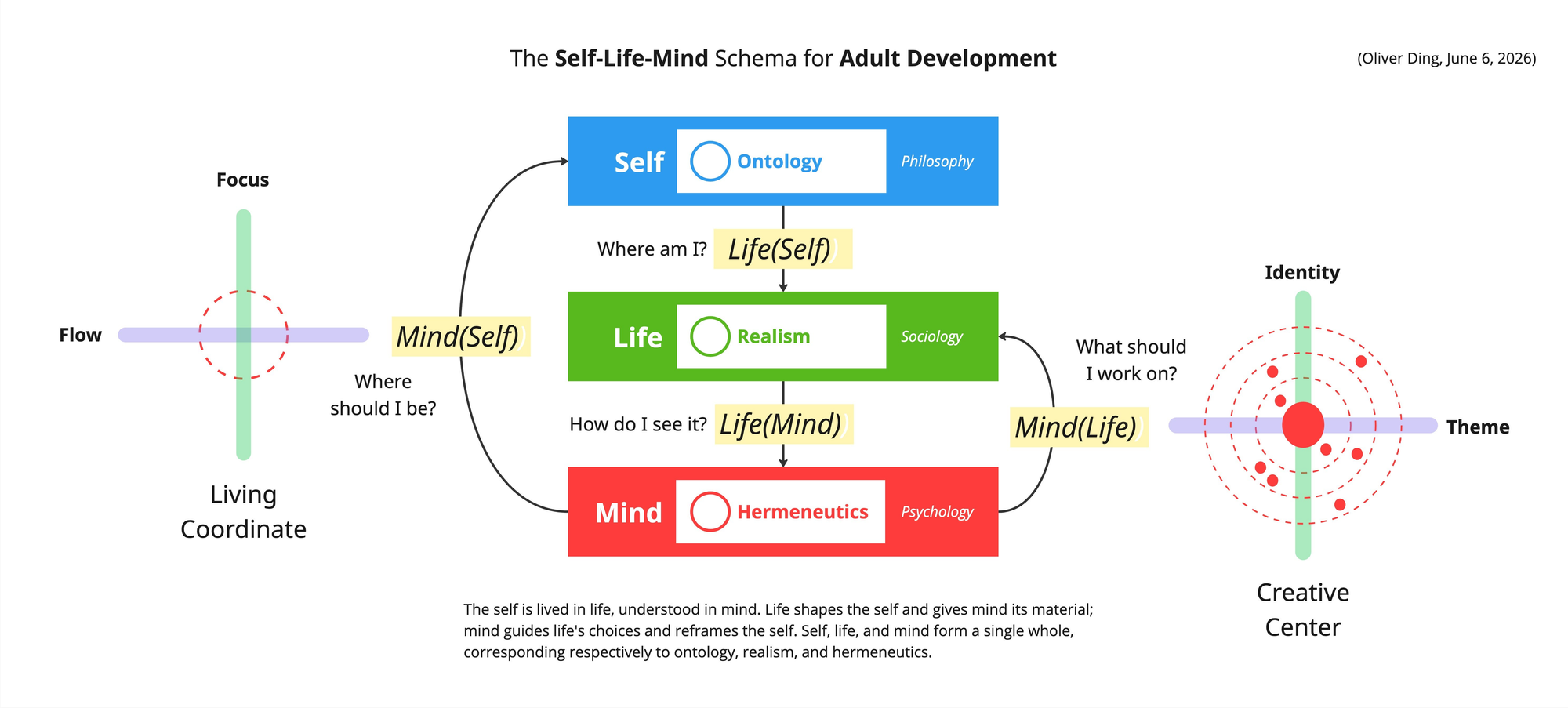
The elegance of the SLM solution lies in a simple but crucial move: analytical distinction without ontological separation. Rather than requiring the self to serve simultaneously as ontological presupposition, empirical variable, and explanatory construct—the source of the tripartite confusion diagnosed above—the SLM schema distinguishes three analytical aspects of the same indivisible whole: Self, Life, and Mind. These are not separate “levels” or “layers” of the person. They are three ways of looking at the same living unity, each highlighting a different dimension of what is always already a self-in-life-through-mind.
The self is always lived in concrete life situations and always interpreted through mind. Life events are always experienced by a self and always filtered through mind. Mind operations always belong to a self and always refer to life. To emphasize this inseparability, the SLM schema as a whole is a unit of synthesis.
However, a unit of synthesis cannot be directly measured or manipulated in empirical research. It is too rich, too holistic. To make empirical investigation possible, the researcher needs units of analysis—specific, operationalized cuts into the synthetic whole that serve as entry points for data collection and interpretation.
3.1 Four Units of Analysis, Reoriented
As established in the previous papers in this series, the SLM framework generates four units of analysis. Each unit pairs two of the three aspects while holding the third as background, and each generates a characteristic heuristic question:
- Life(Self) unit: Where am I? — How do objective life circumstances locate and shape the self?
- Mind(Self) unit: Where should I be? — How do the norms, values, and ideals carried by the mind orient the self?
- Life(Mind) unit: How do I see it? — How does the mind interpret the events and circumstances of life?
- Mind(Life) unit: What should I work on? — How do mental interpretations translate into practical action?
When these four units are brought to bear on belief system research — specifically, on the question of how belief systems are organized, maintained, and transformed — they generate a set of more specific questions:
- Life(Self) for belief systems: What life circumstances gave rise to this belief system? What social environments, roles, relationships, and events shaped its formation? What material and relational conditions are sustaining it now?
- Mind(Self) for belief systems: What foundational assumption about the self is at the core of this belief system? What does the person believe, at the most basic level, about their own worth, nature, and mode of selfhood?
- Life(Mind) for belief systems: What interpretive framework does this belief system provide? How does it filter perception, determine what counts as evidence, and organize the meaning of experience?
- Mind(Life) for belief systems: What practical orientations does this belief system generate? What patterns of action, goal-setting, and engagement with the world does it drive?
These four questions do not replace the heuristic questions of the original SLM framework; they are the original questions as applied to a specific research domain. Together, they map the belief system as a Self-Life-Mind whole — which is precisely what the relevant phenomenon requires.
3.2 How the Three Approaches to Belief Answer These Questions
Before turning to frameworks specific to belief system transformation, it is worth asking how the three general approaches to "belief" introduced in Section 2.1 — the propositional attitude approach, the probability estimate approach, and the generative model approach — respond to the four heuristic questions just identified. This comparison operates at the level of the research topic itself, independent of any particular case.
The propositional attitude approach is, by construction, oriented toward the Life(Mind) unit: it asks how a person's mind represents and evaluates propositions about the world, and how those representations are formed, tested, and revised. It has relatively little to say about the Mind(Self) unit — the foundational assumptions a person holds about their own nature and worth — because propositional attitudes are typically treated as belonging to a generic cognitive apparatus rather than to a particular Self with a developmental history. It has essentially nothing to say about the Life(Self) unit — the role of social circumstances, relationships, and material conditions in shaping which propositions a person comes to hold — and very little to say about the Mind(Life) unit, since the translation from belief to action is treated as a separate problem (the domain of motivation or volition) rather than as part of the belief's own structure.
The probability estimate approach is oriented toward the Mind(Life) unit: its central concern is how beliefs (as probability estimates) combine with preferences to generate decisions and actions. The belief-based utility extension adds a partial answer to the Mind(Self) unit — it recognizes that some beliefs (about one's own worth, one's prospects) are held not because they are accurate but because holding them is itself valuable to the self. But this remains partial: it explains that self-relevant beliefs have a special status without offering an account of the Self as an ontological ground from which such beliefs arise. The approach has little to say about the Life(Self) unit and almost nothing to say about the Life(Mind) unit in the sense relevant here — how a person's overall interpretive framework, rather than any specific belief, organizes their experience.
The generative model approach comes closest, among the three, to addressing the systemic character that the Life(Mind) unit and Mind(Life) unit questions require — because a generative model is, by definition, a hierarchically organized system in which high-level beliefs shape the interpretation of everything below them. It offers a genuine mechanism for understanding why deeply held beliefs are resistant to change (the cost of revising high-level priors) and why belief systems can feel like "the operating system" rather than "a program." However, as noted in Section 2.1, this approach operates at the level of neurobiological mechanism. It does not, in itself, address the Mind(Self) unit in developmental terms — what is distinctive about this person's Self, what their Essential Difference is, how it persists through transformation — nor does it address the Life(Self) unit in terms of social structures, relational circles, and life trajectories. These are not technical limitations that could be solved with more computational power; they are questions that belong to a different level of description.
3.3 What the Comparison Reveals
The comparison across these three approaches reveals a consistent pattern: each approach is well-suited to one or two of the four units and related heuristic questions and has little to offer on the others, and none addresses the Mind(Self) and Life(Self) questions in the developmental, person-specific sense that belief system transformation requires.
This is not a criticism of these approaches on their own terms. Each was developed to answer a different kind of question, within a different disciplinary context, and each has produced genuine knowledge within that context. The point is structural: none of the three approaches to "belief" surveyed in Section 2.1 was designed to address belief system transformation as a whole-person developmental phenomenon. Doing so requires a framework that can hold the Life(Self) question (what circumstances shaped this belief system and what sustains it now), the Mind(Self) question (what foundational self-assumption sits at its core, and what is this person's distinctive Essential Difference), the Life(Mind) question (how does this belief system organize the interpretation of experience), and the Mind(Life) question (what patterns of action does it generate) — together, as aspects of a single whole, rather than as four separate research programs.
This is the gap that the World of Activity framework — an existing body of work that, guided here by the SLM meta-framework's heuristic questions, turns out to be well suited to this task — can fill. The next section turns to frameworks that are more directly engaged with belief system transformation in the developmental sense — Quinn's own intuitive language, the framework she drew on during her reconstruction, and two established clinical approaches — and asks the same four questions of them, this time in dialogue with the case material itself.
3.4 SLM's Relationship to These Frameworks
The SLM framework's relationship to frameworks that answer its heuristic questions — whether the general approaches discussed in Section 3.2 or the more case-specific frameworks discussed in Section 7 below — is not one of competition or replacement. It is a relationship of meta-level organization.
SLM is content-neutral. It does not specify what theory of the self is correct, what the content of a healthy belief system should be, or what methods should be used to support transformation. What it specifies is the structure of the inquiry: that any adequate analysis of belief system transformation must attend to all four heuristic questions, and that answers to those questions must be held together as aspects of an indivisible whole rather than treated as independent variables.
This content-neutrality has an important implication for how the four heuristic questions are answered. The answers can come from existing frameworks — IOS language (Quinn's own intuitive language), Singer's surrender concept, CBT's cognitive restructuring techniques, ACT's defusion practices, and so on — each contributing to one or more of the four questions. Or they can come from other existing frameworks that happen to be well suited to the questions at hand, even if those frameworks were developed for entirely different purposes.
In the present case study, the answers come primarily from the World of Activity framework and its allied Creative Life Theory — bodies of work that are, from the perspective of the academic mainstream, new frameworks with which most readers will be unfamiliar. This is worth being explicit about: World of Activity and Creative Life Theory are not standard references in the psychological literature. They have been developed by the present author over many years of work on life development, creative practice, and knowledge organization — work that long predates this case study and was not undertaken with belief system research specifically in mind. What this paper demonstrates is that these existing frameworks, brought into contact with the heuristic questions SLM generates for belief system research, turn out to address several of the gaps left open by the frameworks surveyed in Section 3.2. This is a discovery made through application, not a result of purpose-built design.
The openness of the SLM meta-framework means that other researchers, working within the same structural constraints, could deploy different frameworks to answer the same heuristic questions. The structure of the inquiry is shared; the specific theoretical tools are not mandated.
4. Quinn's Case: The Research Material
A full account of Quinn's case is available in the companion article Rebuilding the Living Coordinate: A Case Study Summary (Ding, 2026b), to which readers are referred for detail. What follows here is a focused account that highlights the features of the case most directly relevant to the theoretical discussion.
Quinn is a female entrepreneur, born in 1992, who built a career development and personal growth community called EduPlus while living on the U.S. West Coast and serving a primarily mainland Chinese user base. She describes the first eighteen years of her life as those of "a typical good student living inside an exam-based evaluation system" — a period in which her self-worth was built entirely on external performance metrics. This equation — value equals achievement equals recognition — was never examined, only enacted. It persisted through graduate study abroad, through professional success in the United States, and through the founding and growth of EduPlus.
Between 2021 and 2024, Quinn experienced three major collapses. The first two were resolved through coaching support and strategic repositioning — what the World of Activity framework calls "rescuing the center." Each time, the platform found new direction and momentum returned. Looking back from 2024, Quinn would recognize that these recoveries had occurred entirely within the old system's logic. The deepest layer — what she eventually named "the zero-th belief" — had not been touched: I need to prove that I am excellent.
The third collapse was different in kind. There was no dramatic breaking point — instead, a slow, grinding loss of drive. She could look back at her original motivation, still recognize it as meaningful, and find herself unable to generate any energy from it. This was not a crisis that could be resolved by finding a new direction. The engine itself had stopped generating fuel.
The turning point came in August 2024, during a week-long Zen-style meditation retreat. In conversation with her mentor — a figure with deep roots in Chinese contemplative practice — she saw something she had not been able to see before. The concept of "lifestyle entrepreneurship" that she had identified as her positioning was genuine. But the way she had been deploying it — wanting to prove that "our camp" could match the commercial results of "their camp" — had been running on the old proving logic. The zero-th belief was still operating, now wearing new clothes.
The reconstruction unfolded over several months through two primary channels. The first was her mentor's direct recognition of her essential quality: "Quinn has one enormous strength — a particularly pure quality of genuineness. Every question she has ever asked me has been her real question." He then gave her permission to trust it: "Trust your heart. You won't die." The second was her encounter with Michael Singer's The Surrender Experiment — which she had first read in 2023 without fully understanding, then revisited after a week spent at Singer's community in Florida. When she wrote about "surrender" in her own posts, she consistently placed the word in quotation marks: she was borrowing a symbol, not adopting a cosmology.
Two years later, in May 2026, Quinn was in the late stages of pregnancy. She had set down EduPlus as a high-intensity operation in October 2025 — not because it failed, but because she heard from inside that it was time to return to life. She described her current state as "rooted in the soil — that kind of grounded, concrete happiness."
This is the case material. The question now is how the SLM meta-framework organizes the analysis of it.
5. Theory to Practice: The Three-Way Coordination
As established in the previous paper in this series, the SLM framework operates through two built-in pathways: Path 1, in which a researcher selects ontological assumptions and analytical tools and uses them to guide the analysis of Life and Mind phenomena, and Path 2, in which the resulting findings feed back to evaluate, revise, or extend the assumptions and tools themselves. Sections 5 and 6 of this paper demonstrate Path 1 in operation; Section 8 demonstrates Path 2.
5.1 How SLM Organizes the Analysis from Behind
The coordination demonstrated in this section involves three visible elements: the World of Activity framework (together with its allied Creative Life Theory), the research topic (belief system transformation), and the case material (Quinn's story). Each element constrains and enriches the others. The SLM schema does not appear as a fourth element alongside these three. It operates behind World of Activity, as the meta-framework that gives World of Activity its structural questions in the first place.
SLM contributes the structural questions — the four heuristic questions derived from the four units of analysis — that organize World of Activity's engagement with the case. These questions do not determine in advance what will be found; they specify what dimensions of the phenomenon need to be investigated. In this case, the four questions become:
- What life circumstances gave rise to Quinn's belief system, and what conditions sustained it? [Life(Self) unit]
- What foundational assumption about herself was at the core of her old system, and what replaced it? [Mind(Self) unit]
- What interpretive framework did her old system provide, and how did the new one differ? [Life(Mind) unit]
- What patterns of action did the old system drive, and how did those patterns change? [Mind(Life) unit]
The World of Activity approach is what actually answers these questions. It is the framework that does the visible work — deploying FFCC, Genidentity, Curativity of Mind, the Strategic Agency Framework, and the other tools discussed in Section 5.2 — while SLM remains in the background, ensuring that the four questions are asked in the first place and that the answers are held together as aspects of a single whole rather than treated as independent findings.
The research topic — belief system transformation — contributes the substantive focus. It tells the researcher what to look for in the case material and what theoretical conversation to enter. In this case, it directs attention to the moment of transformation, the process of reconstruction, and the structural difference between the old system and the new one.
The case material contributes the empirical content that tests and extends the framework. Quinn's story is not merely an illustration of what World of Activity already says. It is the site where the framework meets reality — where its questions are answered in ways that were not anticipated, and where new questions emerge that World of Activity had not previously asked.
The coordination among these three elements is dynamic, not linear. The SLM-derived questions direct World of Activity's attention to the case material; the case material generates findings that exceed the questions; those findings feed back to the research topic (enriching the understanding of belief system transformation) and to World of Activity itself (generating new theoretical problems, taken up in Section 8 as Path 2). SLM, sitting behind World of Activity throughout, is what makes this flow coherent rather than ad hoc.
5.2 The Frameworks Deployed and Why
The SLM meta-framework's heuristic questions do not themselves answer the questions they pose. They direct the researcher toward frameworks that can answer them. In this case, the analysis drew on a set of pre-existing frameworks from the World of Activity system and its allied Creative Life Theory — tools developed over years of prior work on life development and creative practice, well before this case was encountered. What is important to understand is that these frameworks were not selected as a complete package in advance; rather, as each heuristic question was posed, a specific existing tool from the toolkit turned out to be well suited to answering it.
For the Life(Self) question — what life circumstances gave rise to Quinn's belief system and what conditions sustained it — the analysis needed a framework for understanding how a person's Center (the stable core of their creative and professional life) is organized and can collapse. The FFCC model (Flow-Focus-Center-Circle) from the World of Activity framework provided this. It allowed the analysis to describe Quinn's third collapse not as a mood problem or a motivation problem but as a structural event: the Center had lost its inner sustaining logic and began to regress toward Flow. The concept of Living Coordinate — the underlying logic that answers "Where am I?" and "Where should I be?" — named the target of the transformation: not any particular element of Quinn's life, but the operating logic that organized the whole.
For the Mind(Self) question — what foundational assumption about herself was at the core of her old system — the analysis needed a framework for understanding the self's distinctive core and how it persists or is suppressed through transformation. The Genidentity framework from Creative Life Theory provided this. It distinguished between Essential Difference (the structural characteristic that makes this person distinctively herself, persisting across time) and Situated Dynamics (the specific expressions of that core in different contexts). This distinction allowed the analysis to identify what remained constant through Quinn's transformation — her Essential Difference of "genuineness" — and what changed: the relationship between that core and the logic through which it was enacted.
For the Life(Mind) question — how Quinn's belief system filtered perception and organized the meaning of experience — the analysis needed a framework for understanding the interpretive function of the Mind layer in detail. The Curativity of Mind framework from Creative Life Theory provided this. It distinguishes four dimensions of Mind: Perception (how experience is sensed), Conception (how experience is conceptualized), Action (how understanding motivates engagement), and Curation (the meta-function that integrates the other three into a coherent whole). This framework allowed the analysis to describe precisely how Quinn's old belief system operated across all four dimensions — what it allowed her to see, how it framed what she saw, how it drove action, and how it wove all incoming experience into the same story.
For the Mind(Life) question — what practical orientations Quinn's belief system generated — the analysis needed a framework for understanding how beliefs translate into action across different domains of activity. The Strategic Agency Framework from Creative Life Theory provided this. It maps nine capability dimensions across the SLM three layers: Anticipating and Performing at the Self layer; Discovering, Producing, Unfolding, Modeling, and Storytelling at the Life layer; Curating and Perceiving at the Mind layer. This framework allowed the analysis to show, in precise terms, how Quinn's transformation reorganized her entire capability landscape — not just her stated goals but the full texture of how she engaged with the world.
Two additional frameworks were deployed for specific analytical purposes. The Dual Center pattern from the FFCC model addressed the structural complexity of Quinn's situation at the time of the analysis: she simultaneously maintained a light-touch professional community and was building a new life organized around her expected child. The Enterprise Development framework from Creative Life Theory addressed the relationship between Quinn's Living Coordinate transformation and the parallel evolution of EduPlus as a creative enterprise — showing that the two were not separate processes but aspects of the same underlying reorganization.
6. World of Activity in Action: Key Analytical Moments
The deployment of these frameworks did not produce a mechanical mapping of Quinn's story onto theoretical categories. It produced a series of analytical moments — specific points where the framework illuminated something that would otherwise have remained invisible. Three such moments are particularly significant.
6.1 The first moment: identifying the structural nature of the third collapse
Quinn's first two collapses had been resolved by "rescuing the center" — adjusting direction, finding new positioning. Her third collapse resisted this resolution. The FFCC model provided the analytical language to explain why. The first two collapses were events at the Center level: external shocks disrupted the platform's direction, and coaching support and repositioning restored it. The third collapse was different in kind: the Center's inner sustaining logic had exhausted itself. The Living Coordinate — the operating system that had been running beneath the Center — had run out of genuine fuel. No repositioning could address this because the problem was not at the Center level; it was at the level of the Living Coordinate itself.
This distinction — between rescuing a Center and rebuilding a Living Coordinate — is invisible without the FFCC framework. With it, the structural nature of Quinn's third crisis becomes analytically clear, and the appropriate response becomes correspondingly clear: not targeted intervention at the symptom level, but a fundamental reorganization of the underlying logic.
6.2 The second moment: seeing the zero-th belief
In August 2024, Quinn saw something she had not been able to see before: beneath all the legitimate motivations she could articulate for her work, there was a zero-th belief that she had never acknowledged — I need to prove that I am excellent. The Genidentity framework allowed the analysis to describe this moment with precision. The concept of Essential Difference identified what was genuine — her quality of "genuineness," which was real and had always been there. The concept of Situated Dynamics identified what had been contaminated — the way her genuine Essential Difference had been hijacked by the proving logic in every context, including the new positioning of "lifestyle entrepreneurship."
This distinction between Essential Difference (clean) and Situated Dynamics (contaminated) is one of the analytical contributions the Genidentity framework makes that no other framework in the comparison provides. It allows the analysis to hold together two things that might seem contradictory: that Quinn's Essential Difference was genuine all along, and that her belief system was running on a distorted logic. Both are true, and the Genidentity framework has the conceptual resources to show how.
6.3 The third moment: understanding why Quinn's mentor succeeded where coaching had not
Quinn received professional coaching support during both her first and second collapses. The coaching was valuable; she came through both crises. But looking back, she recognized that the coaching had operated within the old system's logic — it helped her find new directions and reframe specific patterns, but it did not touch the zero-th belief.
Her mentor did something structurally different. He did not help her find a new direction. He identified her Essential Difference — "genuineness" — and reflected it back to her. "Trust your heart. You won't die." This was not a Mind-layer intervention (reframing a belief) or a Life-layer intervention (changing a behavior). It was a Self-layer act: recognizing the person's distinctive core and returning it to her as a foundation.
The Genidentity framework makes this structural difference visible. Without it, the difference between what coaching provided and what her mentor provided might appear to be a difference of depth or skill. With it, the difference is seen as structural: different kinds of support address different layers of the SLM whole, and the transformation Quinn needed required Self-layer engagement — specifically, the recognition and return of her Essential Difference.
7. World of Activity and Other Frameworks: A Comparative Assessment
Section 3 compared three general approaches to "belief" against the four heuristic questions, at the level of the research topic itself. This section returns to those same four questions, but now in dialogue with frameworks that engage directly with belief system transformation in the developmental sense — and with Quinn's case as the grounding material.
The comparison includes four such frameworks: the Internal Operating System (IOS) metaphor that Quinn herself used, Singer's Surrender Experiment framework that she drew on during her reconstruction, Cognitive Behavioral Therapy (CBT), and Acceptance and Commitment Therapy (ACT). Having traced the World of Activity framework in action through Quinn's case in Sections 4 through 6, we are now in a position to set these four alongside it — not framework by framework, but as a whole-system comparison.
The Internal Operating System (IOS) metaphor is Quinn's own intuitive language for her experience. It is not a professional framework but a set of first-person insights developed through lived experience. As such, it is remarkably sensitive to the Life(Self) question: IOS language consistently points to the role of concrete life conditions (the retreat, stopping work, "giving space") in enabling belief system change. It is also sensitive to the Mind(Self) question in an implicit way: the metaphor of "reinstalling" acknowledges that the problem is at the system level, not the content level. However, IOS language has no systematic account of the Life(Mind) or Mind(Life) questions — it describes the phenomenon powerfully but cannot analyze it.
Singer's Surrender Experiment framework provides a language of release: releasing control, trusting life's flow, serving the moment rather than the self's preferences. It addresses the Mind(Self) question in a specific way — the self's "ego" (small self) is identified as the source of suffering, and the prescription is to transcend it. It also addresses the Mind(Life) question, albeit with a particular orientation: right action follows from surrender, not from deliberate planning. However, Singer's framework has significant limitations. It offers no account of the Life(Self) question — the role of social environments, relational circles, and material conditions in shaping and maintaining belief systems. It also imposes a specific content on the Mind(Self) question (the cosmological claim that the universe provides optimal outcomes for those who surrender), which many practitioners — including Quinn herself, who consistently placed "surrender" in quotation marks — cannot fully accept.
Cognitive Behavioral Therapy (CBT) is the most developed clinical framework for working with belief-level phenomena. It addresses the Mind(Self) question through its concept of core beliefs: foundational assumptions about the self that generate intermediate beliefs and automatic thoughts. It addresses the Mind(Life) question through its behavioral experiments and homework assignments. And it addresses the Life(Mind) question, at least partially, through its attention to how life events trigger automatic thoughts and activate core beliefs. However, CBT's treatment of the Life(Self) question is thin: it attends to life circumstances primarily as triggers for cognitive processes, not as structural conditions that shape the belief system's formation and maintenance. And CBT's interventions work primarily through the Mind layer's Conception dimension — identifying and restructuring cognitive content — which Quinn's own experience suggests cannot reach the level at which belief system transformation occurs.
Acceptance and Commitment Therapy (ACT) represents a significant advance over classic CBT in one crucial respect: it abandons the assumption that the contents of problematic beliefs can simply be replaced through cognitive restructuring. Instead, ACT focuses on changing the relationship between a person and their thoughts — cognitive defusion — and on values-directed action in the presence of difficult inner experiences. ACT addresses the Mind(Self) question through its concept of the observer self (self-as-context), which provides a stable vantage point from which thoughts and feelings can be witnessed without being identified with. It addresses the Mind(Life) question through its emphasis on committed action guided by values. However, ACT's treatment of the Life(Self) question remains relatively thin: social context and relational conditions appear primarily as arenas for values-directed action, not as structural conditions that shape the belief system. And ACT has no systematic account of how a person's Essential Difference — the distinctive core that persists through transformation — relates to the reconstruction process.
None of these four frameworks has a systematic account of what we might call the Genidentity dimension of belief system transformation: the question of what is distinctive about this particular person, what Essential Difference persists through the transformation, and how the reconstruction should be organized around that core rather than around a generic therapeutic goal. This is the gap that the World of Activity framework, deployed in Sections 4 through 6, was designed to fill.
The following table summarizes the comparison across all five approaches, including the dimensions that the case analysis brought into focus.
| Dimension | IOS | Singer | CBT | ACT | World of Activity |
|---|---|---|---|---|---|
| Life(Self) question coverage | Strong (intuitive) | Absent | Partial | Partial | Systematic (FFCC, Circle, Living Coordinate) |
| Mind(Self) question coverage | Strong (intuitive) | Strong (specific content) | Strong (core beliefs) | Moderate (observer self) | Systematic (Genidentity, Living Coordinate) |
| Life(Mind) question coverage | Partial | Absent | Moderate | Moderate | Systematic (Curativity of Mind) |
| Mind(Life) question coverage | Absent | Moderate | Strong | Strong | Systematic (Strategic Agency) |
| Genidentity / Essential Difference | Implicit ("trust your heart") | Absent | Absent | Partial (values) | Central and explicit |
| Social Circle as structural condition | Implicit | Absent | Minimal | Minimal | Central (Circle in FFCC) |
| Development orientation | Practice wisdom | Spiritual framework | Clinical restoration | Clinical flexibility | Life development |
| Starting point | Lived experience | Ego transcendence | Dysfunction | Dysfunction | Genidentity and Living Coordinate |
| Content neutrality | Yes (no prescribed content) | No (cosmological claims) | Partial (specific techniques) | Partial (specific techniques) | Yes (meta-framework) |
| Enterprise / creative work dimension | Absent | Absent | Absent | Absent | Present (Enterprise Development) |
Several observations emerge from this comparison.
First, IOS — Quinn's own intuitive language — is in some respects the most sensitive of all the frameworks to the actual texture of belief system transformation. It attends to social conditions (the retreat community, the Circle), it points to the Self layer (the system level, not just the content level), and it recognizes the limits of purely cognitive approaches. This is consistent with what the first paper in this series noted about practical wisdom sometimes outrunning theory. The IOS language, however, cannot analyze what it senses; it points without being able to map.
Second, Singer's framework makes a genuine contribution at the Mind(Self) unit — the direct confrontation with the ego's proving logic. But its imposition of specific cosmological content (the universe provides optimal outcomes for those who surrender) limits its applicability, and its absence of Life(Self) analysis (the structural role of the Circle and material conditions) is a significant gap. Quinn's own handling of Singer — always placing "surrender" in quotation marks, extracting the concept as a symbolic tool rather than accepting the full framework — is itself a demonstration of how IOS and World of Activity together process the limitations of Singer.
Third, CBT and ACT represent serious, evidence-based frameworks with genuine contributions at the Mind(Life) and, to a lesser degree, the Life(Mind) and Mind(Self) units. Their limitation, from the World of Activity perspective, is not their methods but their starting point: both begin from dysfunction and aim at restoration or flexibility. They do not begin from a person's distinctive core — their Essential Difference — and work outward from there. This makes them powerful tools for addressing specific symptoms but less adequate for the kind of whole-system developmental transformation that Quinn's case exemplifies.
Fourth, the World of Activity framework's distinctive contribution lies in its systematic coverage of all four heuristic questions, its explicit attention to the social Circle as a structural condition, and its centering of the Genidentity dimension. These are not minor additions; they are what allow the analysis to explain the structural difference between Quinn's first two collapses (which coaching could address) and her third (which required something different).
8. Practice to Theory: What the Case Feeds Back to the Framework
Sections 5 and 6 demonstrated Path 1: SLM's heuristic questions directed World of Activity's existing tools toward Quinn's case, and those tools answered the questions with considerable precision. This section demonstrates Path 2 — the reverse direction. The coordination does not flow only from framework to case. It also flows back: the case material generates findings that exceed what World of Activity anticipated, raising new theoretical questions that the World of Activity toolkit — and, at a deeper level, the SLM principle organizing it — must now address. Three such findings emerge from Quinn's case.
8.1 Internalized versus Native Components
Standard accounts of how belief systems form — including the internalization-externalization principle in Activity Theory — emphasize the process by which external cultural resources are taken in, transformed, and made one's own. On this account, the components of a person's belief system are internalized from the social and cultural world they inhabit: learned from books, modeled on mentors, constructed through deliberate practice.
Quinn's case introduces a complication. Her Essential Difference — "genuineness" — was not internalized from any external source. Her mentor did not give it to her. What he did was see it and reflect it back: he recognized something that was already present before the transformation, that persisted through the collapse and rebuilding, and that became the center of the new system. In the language of the framework: this was an activation of a Perceiving capacity, not a content transfer.
This suggests that the components of a belief system — and more broadly, the components of a Living Coordinate — may have two distinct sources. Internalized components are acquired through social interaction, cultural frameworks, and relational exposure — the components that standard internalization accounts describe well. Native components are present before the internalization process begins, awaiting recognition and activation rather than acquisition. They are not constructed; they are discovered.
The practical significance is considerable. A belief system reconstruction that operates only at the internalization level — providing new frameworks, new concepts, new models — may miss the most important work: creating conditions for native qualities to become visible and to be returned to their owner as a foundation. Quinn's mentor understood this intuitively. The professional coaching Quinn received during her first two collapses, valuable as it was, was doing something different.
This distinction raises a theoretical question that existing frameworks in psychology have not adequately addressed: what is the status of native components in a belief system? How do they persist through transformations that radically reorganize other components? What conditions allow them to surface? These are questions the World of Activity framework can hold, but that require further theoretical development to answer.
8.2 Cultural Ecology and the Missing Externalization Pathway
Quinn's belief system reconstruction drew on resources from multiple cultural traditions: her mentor's community with roots in Zen practice, Singer's synthesis of Indian Vedanta and American spirituality, and the international coaching tradition. These resources were adequate for one task: dissolving the old proving logic, creating conditions for inner stillness, and allowing the native quality of "genuineness" to surface.
What they were less equipped to provide was a pathway for externalizing that quality into sustained social practice — a symbolic framework for translating "genuineness" as an inner state into an articulable and durable way of being in the world with others. Quinn's persistent difficulty in naming what she was doing — her ongoing search for words that could precisely capture her work ("lifestyle entrepreneurship," "new individual," neither quite right) — may be related to this gap. She could live the quality. She could not yet fully name the practice.
This observation introduces a research direction that the World of Activity framework has not previously developed systematically: the relationship between belief systems and cultural ecologies. The symbolic resources available in a person's environment — the traditions, communities, texts, and frameworks they can draw on — shape not only what beliefs they can access but what aspects of their inner life they can successfully externalize and sustain in practice. Cultural ecologies differ in what they are equipped to provide, and the gap between what a person can live and what they can name and transmit is a structurally significant phenomenon that deserves systematic investigation.
8.3 Situational Differentiation of the Same Capacity
The third finding emerges from a careful look at one of the Strategic Agency Framework's capability dimensions — specifically the Modeling capacity — across two different situational domains in Quinn's case.
In her business practice, Quinn demonstrates highly developed Modeling capabilities: she has systematically articulated frameworks for analyzing user needs, developed and iterated product models across multiple cohorts, and built a transferable methodology for lifestyle entrepreneurship. In her contemplative and inner development practice, by contrast, she strategically refuses Modeling — "don't hard-link meaning through the head" — treating conceptual framework-building as a potential obstruction to genuine transformation.
This is not a contradiction. It is a differentiation: the same person, with the same underlying capabilities, deploying them differently across different situational domains because the domains call for different orientations. Business practice calls for explicit framework-building; contemplative transformation calls for the suspension of framework-building in favor of direct experience.
The theoretical significance is that capabilities in the Strategic Agency Framework cannot be assessed as globally present or absent in a person. They are always deployed in situational contexts, and the same capability may be highly developed in one context and strategically underdeveloped in another. This means that adequate capability analysis requires tracking not only which capabilities a person has but how those capabilities are differentially deployed across the situational domains of their World of Activity — a methodological requirement that the framework's current tools do not yet fully address.
9. Conclusion
9.1 SLM as Meta-Framework for a Research Topic
This paper has demonstrated how the SLM meta-framework approaches a research topic — belief system transformation — that sits at the intersection of multiple disciplines without being fully addressed by any of them.
The approach has three characteristic moves. First, it generates heuristic questions from the four units of analysis that map the phenomenon structurally: questions about the Life(Self), Mind(Self), Life(Mind), and Mind(Life) units of belief systems. Second, it uses those questions to assess existing frameworks — identifying their contributions and their limits with respect to each dimension. Third, it deploys specific frameworks (in this case, from the World of Activity system and Creative Life Theory) to answer the questions that existing frameworks leave unresolved.
The SLM meta-framework's content-neutrality is essential to this approach. By not prescribing the content of the self, the structure of a healthy belief system, or the methods that must be used, it remains open to diverse theoretical traditions while providing the structural discipline that prevents the analysis from becoming merely eclectic. Different researchers, working within the same structural constraints, could deploy different specific frameworks. The structure of the inquiry is shared; the theoretical tools are not mandated.
This is what it means for SLM to function as a meta-framework for a research topic: it does not replace existing frameworks but reorganizes the conversation among them, identifying where each contributes, where each falls short, and what new frameworks or concepts are needed to fill the gaps.
9.2 The Three-Way Coordination as an Instance of Weave the Theory
The second conclusion concerns method — and here it is worth situating the three-way coordination within a broader framework that the present author has developed for understanding theoretical activity itself: the Weave-the-Theory framework.
That framework identifies four "weave-points" where theoretical work crystallizes: Theme, Model, Concept, and Principle. A Theme is a concrete site of engagement — a case, a story, a lived situation, often carrying its own intuitive metaphors. A Model is a knowledge framework brought to bear on that site — a structured set of tools for analysis. A Concept is the research-level object that the analysis is ultimately about — the theoretical category that the case illuminates. A Principle is the meta-level commitment that organizes the whole inquiry — the most general statement of what kind of thing is being studied and how.
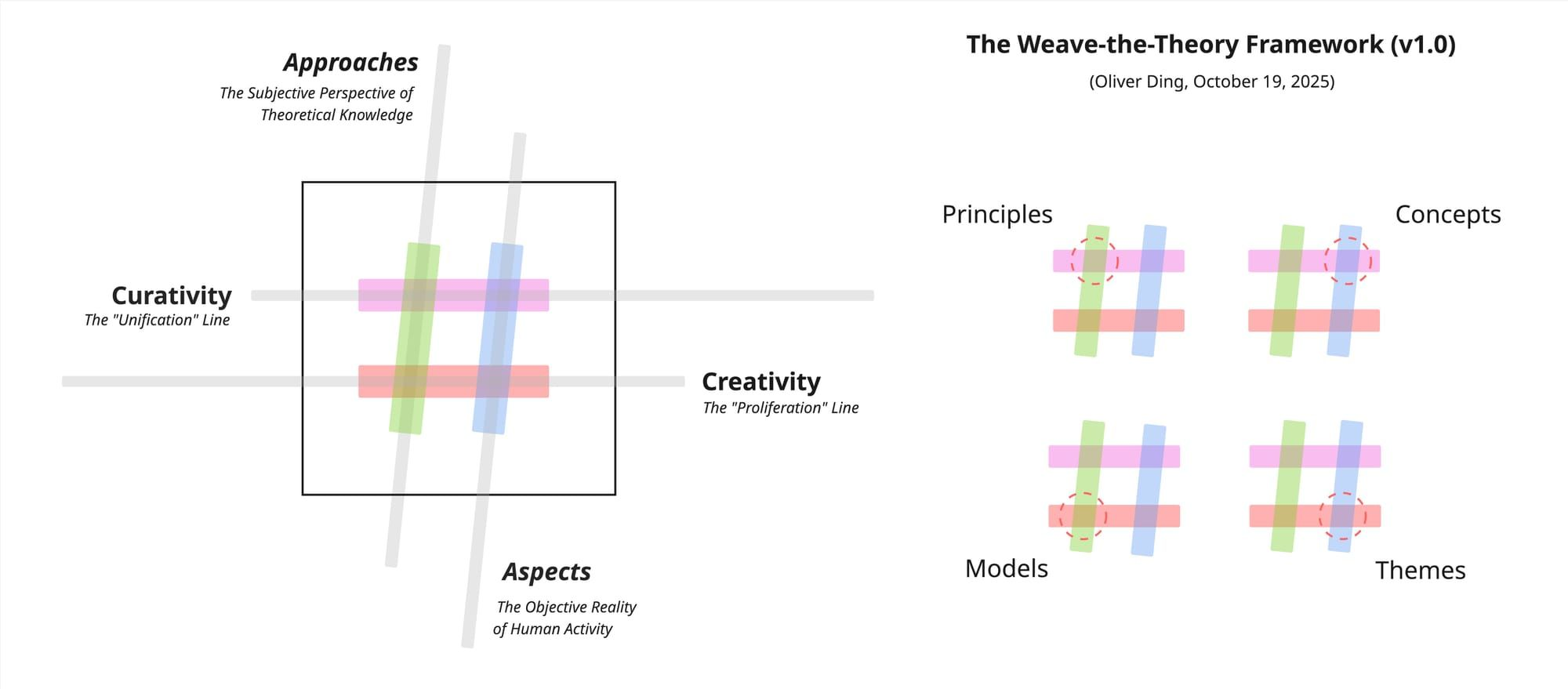
The three-way coordination demonstrated in this paper is an instance of exactly this structure. Quinn's story — and the intuitive metaphor of "reinstalling the internal operating system" that she used to describe it — is the Theme. The World of Activity toolkit, with its constituent frameworks (FFCC, Genidentity, Curativity of Mind, the Strategic Agency Framework, Enterprise Development, the Dual Center pattern), is the Model brought to bear on that theme. Belief system — and more specifically, belief system transformation in the context of life development — is the Concept that this analysis is ultimately about. And the SLM schema, with its claim that Self, Life, and Mind are inseparable aspects of an indivisible whole, is the Principle that organizes the entire inquiry.
Seen this way, Path 1 and Path 2 — the two pathways demonstrated in Sections 5–6 and Section 8 — are simply what Weave-the-Theory looks like when traced through time: Path 1 is the movement from Principle and Model toward Theme (the Model is applied to illuminate the Theme); Path 2 is the movement back from Theme toward Concept and Principle (what the Theme reveals reshapes how the Concept is understood and, potentially, how the Principle itself is refined). The two frameworks describe the same dynamic at different levels of generality: Path 1/Path 2 names the directionality of the SLM feedback loop specifically, while Weave-the-Theory names the more general structure — Theme, Model, Concept, Principle — within which that loop operates.
Seen this way, this paper is not introducing a new method so much as demonstrating, in a specific instance, a structure that has been under development across a broader body of work. The three-way coordination is what Weave-the-Theory looks like when Theme, Model, Concept, and Principle are brought into alignment around a single case. The procedure is replicable not because it is a new technique invented for this paper, but because it is a structural pattern — Theme meets Model, Model addresses Concept, Concept is organized by Principle — that recurs whenever theoretical activity engages seriously with a concrete case.
The three theoretical findings developed in Section 8 — the internalized/native distinction, the cultural ecology gap, and the situational differentiation of capabilities — are products of this weave. They emerged because the Theme (Quinn's story) was rich enough, and the Model (the World of Activity toolkit) was applied carefully enough, that the encounter generated insights exceeding what either the Theme or the Model could have produced alone. This is what it means for a weave to be generative rather than merely illustrative: the Concept (belief system) and the Principle (SLM) are themselves advanced by the encounter, not merely applied to it.
Future applications of the same weave — different Themes, drawing on different Models from the World of Activity and Creative Life Theory toolkits, organized around different Concepts but always under the same Principle — will generate different findings. Their accumulation is how Strategic Developmental Psychology (SDP) develops: not by deductive elaboration from the Principle alone, but through repeated, careful weaving of Theme and Model around the Concepts that matter for human development.
Postscript: The Researcher's Own Living Coordinate
This paper has been about Quinn's belief system — what it was, how it transformed, and what the transformation reveals about belief systems in general. But there is a question the paper has not asked, and that belief system research as a field rarely asks of itself: what about the belief system of the person doing the analyzing?
Every theory of the self carries, somewhere inside it, an answer to the Mind(Self) question — what a person should be, what counts as health, maturity, or genuine development — that the theorist holds for themselves, often without having examined it as such. A theorist who builds a framework around "psychological flexibility" has, at some point in their own life, found flexibility to matter. A theorist who builds a framework around "authenticity" has, at some point, found that quality to matter for themselves, in a way that shaped what they then went looking for in the world. This is not a flaw to be corrected. It may be unavoidable: a person's Living Coordinate is the lens through which they see, and a lens cannot easily see itself.
What makes this worth pausing on is not the fact of the lens but its scale of consequence. An ordinary person's Living Coordinate shapes their own life and, through their relationships, the lives of a relatively small circle of people around them. A theorist's Living Coordinate, once it is encoded into a framework, a diagnostic category, a therapeutic technique, or a widely read book, becomes part of the cultural ecology within which countless other people — clients, students, readers, future theorists — come to understand themselves. The asymmetry is not in kind but in degree, and the degree is large. A belief about what the self fundamentally is, or should be, that begins as one person's largely unexamined assumption can end up organizing the inner lives of people who will never know where it came from.
This is precisely the dynamic Section 8.2 identified at the level of an individual's cultural ecology — what is present and what is absent in the resources a person draws on shapes what they can become. The same dynamic operates one level up, at the level of theoretical traditions themselves. A field's cultural ecology of belief-about-the-self is built, layer by layer, out of individual theorists' largely unexamined Living Coordinates — and that ecology then becomes the resource (or the limitation) available to everyone who comes after.
None of this argues for an impossible standard — that theorists must first achieve some complete self-understanding before they are permitted to theorize. There is no such vantage point, for theorists any more than for Quinn. What it argues for is a standing obligation that scales with influence: the more a person's ideas are positioned to shape how others understand themselves, the more seriously that person needs to hold the possibility that their own Living Coordinate is doing some of the work — quietly, in the choice of what counts as a healthy outcome, a mature self, a successful transformation — and the more carefully they need to listen when their framework's blind spots are pointed out by those it was meant to serve.
The SLM framework's claim to content-neutrality is not exempt from this. The choice to treat Self, Life, and Mind as inseparable rather than separable, to insist on holism rather than reduction, to prefer frameworks that can hold multiple traditions in dialogue rather than frameworks that adjudicate between them — these are themselves commitments, and they did not arise from nowhere. Naming this is not a confession of failure. It is simply an acknowledgment that the reflexive question this postscript raises applies to the present work as much as to any other, and that taking the question seriously is part of what responsible theoretical work, at any scale of influence, now requires.
References
Ding, O. (2026). Blooming Like a Flower: Reinstalling the Inner Operating System — A Case Study [Chinese-language research report, over 40,000 characters]. Activity Analysis Center.
Ding, O. (2026b). Rebuilding the Living Coordinate: A Case Study Summary. Activity Analysis Center. https://www.activityanalysis.net
Ding, O. (2026c). SDP: Two Diagrams about the Self-Life-Mind Schema. Activity Analysis Center. https://www.activityanalysis.net/self-life-mind/
Ding, O. (2026d). SDP: Revisiting the "Self" Issue from the Self-Life-Mind Perspective. Activity Analysis Center. https://www.activityanalysis.net/the-self-issue/
Ding, O. (2026e). Weave the Theory (Possible Book, v1.0). Activity Analysis Center. https://www.activityanalysis.net/weave-the-theory/
Golman, R., Hagmann, D., & Loewenstein, G. (2017). Information avoidance. Journal of Economic Literature, 55(1), 96–135.
Hayes, S. C., Strosahl, K. D., & Wilson, K. G. (2012). Acceptance and commitment therapy: The process and practice of mindful change (2nd ed.). Guilford Press.
Singer, M. A. (2015). The surrender experiment: My journey into life's perfection. Harmony Books.
Young, J. E., Klosko, J. S., & Weishaar, M. E. (2003). Schema therapy: A practitioner's guide. Guilford Press.
Note: This paper is the third in the SDP series, following "SDP: Two Diagrams about the Self-Life-Mind Schema" and "SDP: Revisiting the 'Self' Issue from the Self-Life-Mind Perspective." The companion case study summary, "Rebuilding the Living Coordinate: A Case Study Summary," provides a fuller account of Quinn's case for readers who wish to consult it alongside this paper.
v1.0 — June 13, 2026 — 10,555 words