
A Thematic Conversation on Finding the Coordinate

This article is an excerpt from Lake 42: The Great Confluence, originally titled "Chapter One: Alice's Coordinate".
by Oliver Ding
February 10, 2026
The full content of Chapter Four: Anchoring the Center of Lake 42 can be found in A GAP Project and a Generative Confluence Journey
This book documents a six-month journey of theoretical development from June to December 2025. It is the third in a trilogy applying the Creative Life Curation method to my own creative life:
- Homecoming: A Thematic Trip and the World of Activity Approach (1974–2014)
- Wonder and Wander: Revealing The Evolving Knowledge Enterprise (2019–2025)
- Lake 42: The Great Confluence (June-December 2025)
On the first day of 2026, I walked around a lake near my home with my wife. As we reflected on the past year, I revisited my long journey of writing and curating more than 42 possible books, drafts not published yet, between 2019 and 2025.
That evening, a new idea emerged: the lake could serve as an ecological metaphor for what had gradually taken shape through these 42+ possible books — a point of convergence rather than a destination.
On January 2, 2026, I started the Lake 42 project with a thematic card. The creative clue is “The Great Confluence,” echoing my experience of unfolding a “Generative Confluence” journey from June to December 2025.
This book aims to share the story of the Generative Confluence journey.
It begins with a conversation.
1
On September 7, 2025, I released Homecoming: A Thematic Trip and the World of Activity Approach as my first Kindle book.
Homecoming is part of a six-month journey of developing Creative Life Theory (v3.0), which was guided by the Self-Life-Mind meta-framework. The book focuses on the “Flow — Focus — Center — Circle” schema and the World of Activity approach, corresponding to the “Creative Self” theme, which is located at the “Self” layer.
After closing the Homecoming project, I moved to introduce the Enterprise Development Framework, which I explained in a 10,833-word article. The Enterprise Development Framework corresponds to the “Creative Enterprise” theme, which is located at the “Life” layer.
Meanwhile, after sending Homecoming to several friends, I had a thematic conversation about the book with a friend, which inspired my creative journey dramatically.
In this chapter, I will use Alice as the pseudonym of a friend of mine, whom I knew ten years ago. The last deep conversation between us happened in 2021 when I wrote The ECHO Way book draft and developed an application model for her.
On October 9, 2025, I received an email from Alice, in which she mentioned her interest in conceptual frameworks.
Dear Oliver,
Thank you so much for sharing your new book Homecoming with me. It brought back many memories of our exchanges and reflections over the past decade — especially the time when you first introduced the concept of “curation,” which gave me a lot of inspiration and prompted deep reflection. Over the years, I’ve continued to digest and extend those early ideas, and they’ve benefited me greatly.
Reading your new book, I’m deeply moved to see the continuity and evolution of your thinking throughout these years. I found the concept of the “World of Activity” particularly resonant — it speaks strongly to those of us who are constantly acting and thinking across cultures and regions. We come from certain cultural backgrounds, yet continually encounter and integrate with new ones. In the current AI era, this cultural interplay and sense of futurity feel even more intense. I very much agree with your idea of using “the right conceptual frameworks” and “the right containers” to integrate and align our actions more effectively.
I’m now based in […] and have been working on projects related to cross-cultural bridging. It’s a pleasure to see your latest intellectual work, and I’d love to have an online conversation with you. Would you be available sometime next week or the week after? We could schedule a Zoom chat.
Thanks again for sharing your book — it’s truly inspiring.
Wishing you all the best,
Alice (pseudonym)
We had a ZOOM chat on October 10, 2025. After briefly reviewing Homecoming, I moved to its context, Creative Life Theory (v3.0), and the Self-Life-Mind meta-framework. I also shared the five-stage Enterprise Development Framework.
At the end of the chat, Alice mentioned that she has been working on curating her ideas into a life operational system for a long time. This resonated with my work on knowledge curation and developing tacit knowledge. However, we didn’t have enough time to discuss it deeply.
2
The day after the chat, I sent an email sharing several relevant articles with Alice. I explained that Creative Life Theory v2.0 was developed specifically for knowledge creators, and I suggested using a meta-framework — such as the Self-Life-Mind schema — as a foundation for organizing her ideas into a systematic knowledge framework.
Alice replied to my email on October 19, 2025:
Dear Oliver,
Thank you so much for our conversation last week — I truly gained a lot from it. I’m deeply impressed by your ability to elevate various “activities” to a theoretical level and to summarize and express them in such a systematic way. That’s a rare and admirable skill.
As I mentioned during our talk, I’ve also long had a personal wish — to do something similar to what you’ve done: to reflect on and organize the experiences of my own life, to systematize my thoughts and feelings, and to turn them into my own kind of “Operating System.”
My experiences span from India, Turkey, Brazil, and the U.S. to […] and […] — each phase has carried its own unique meaning and story. I may be more inclined toward a narrative or story-based form of expression, yet I also hope to find a way to integrate structure and storytelling — to make the stories more organized, and the structure more human.
I’m very curious about your own writing process — especially how you move from early conceptualization to actually publishing a book. How did you begin, and how did you plan the whole process?
If possible, I’d love to hear your advice — for example:
How can I start organizing my life experiences and reflections into a system that has theoretical grounding?
Could your “Self–Life–Mind” or “Thematic Enterprise” framework serve as a reference for structuring my stories?
And how do you personally move step by step through the writing and publishing process?
Your creative work has made me realize that writing is not only a means of expression, but also a process of constructing one’s own system of thought. I truly hope to learn from your experience — and, in time, to find my own path along this journey.
With sincere thanks,
Alice
Alice’s questions really resonated with me; however, I didn’t want to answer them with a list of rough suggestions. I replied on October 20, 2025, proposing a more collaborative approach.
I outlined the trajectory from life experiences to creative themes, from themes to conceptual systems, and from systems to mental platforms — the path of Thematic Enterprise development. I explained my historical-cognitive method of creativity research and suggested we explore this together through a series of conversations.
There was an interesting difference in our language: while Alice spoke of building a “Life Operating System,” I used the term “Mental Platforms.”
What does a “life operation system” look like? It is a metaphor. When a person uses a metaphor to say something, we need to figure out what the actual meaning the person wants to express behind the metaphor.
What Alice wants to build may look like Ray Dalio’s Principles since she mentioned that the “body is important for life development” idea in our chat. She may have wanted to list similar principles for herself.
Or, she just wanted to make a knowledge framework to abstract her cross-cultural experience, which was considered the most exciting part of her life.
Some people tend to curate their knowledge and beliefs, assigning them to several categories of life. This conceptual structure could support them in making decisions, engaging in interpersonal interactions, and managing work and family responsibilities, among other areas. While these people turn these abstract cognitive structures from implicit knowledge into explicit knowledge, many others don’t work on writing out this personal operating system; instead, they just use it naturally.
Some people do this job by themselves, or with help from self-help books, or online websites. Other people take formal psychological tests to get professional intervention.
3
In early November, our thematic conversation moved to the “Thematic Trip” theme. At that time, Alice was planning a trip. On November 10, 2025, she sent an email mentioning her goal of developing a concept system for further professional development.
Dear Oliver,
[…]
I’d like to take this opportunity to ask you a more systematic question. In your theories, practices, and writing, you have built such a clear framework and self-consistent system — you are a true “thought leader.”
As I look at my long-term career development and academic positioning, I am wondering how I can follow your lead. How can I crystallize my personal experience into a clear ‘Disciplinary Coordinate’ and ‘Knowledge Positioning’?
[…]
Specifically, I am reflecting on two things: If I were to systematize my direction, where would it fit on the map of academic or professional fields? And how can I build a ‘Professional Entry Point’ for myself — one that has intellectual depth but can also continue to grow over time?
I value our conversations deeply and would love to explore this foundational positioning with you.
Alice’s use of terms like “Disciplinary Coordinate” and “Knowledge Positioning” provided a breakthrough. Her request was much sharper than just building a “personal operating system” — she was looking for a place in the larger world of ideas. To help me understand her better, she also shared a list of 20 themes that ChatGPT had generated based on her resume.
Later, she went on her trip, and I focused on editing a new book draft titled Developmental Projects: The Project Engagement Approach to Adult Development. By November 30, the manuscript was complete.
What’s interesting is that this work was deeply intertwined with our ongoing thematic conversation. On December 2, I sent a thank-you letter to Alice. In the email, I shared a significant breakthrough.
While reflecting on her search for a “disciplinary coordinate,” my mind drifted back to 2021. I revisited the Global-fit model I had originally developed for her cross-cultural innovation projects — a framework also known as The ECHO Way. I realized that this model could bridge my new thoughts on Developmental Projects with the broader World of Activity approach, eventually leading to the Cultural Projection Model.
This moment of re-engagement was transformative. Inspired by this insight, I began expanding the old model with my recent research on agency and social contexts. In my message to Alice, I explained how this new model theorizes the creative dialogue between individual agency and collective culture, bridging mental platforms and cultural frameworks, creative enterprises, and social activities.
The “thematic conversation” between Alice and me inspired me to return to the past thematic space and “re-engage” with old creations that are relevant to the present thematic conversation.
4
At the end of the December 2 email, I returned to her situation of finding a coordinate. I suggested that the various topics we had discussed could be understood through the Self — Life — Mind meta-framework:
- Mind: Her interest in developing a “personal operating system” was essentially about building a Mental Platform and a conceptual system.
- Life: Her cross-cultural living, family visits, and recent travels were concrete Life Activities. This layer focuses on how to manage Developmental Projects.
- Self: Her question about her future position in the knowledge ecosystem was a quest for Self-direction.
I explained to her that while these three layers might seem separate, they are actually deeply interconnected, with ideas and experiences constantly flowing and evolving between them.
Then, I shared a crucial realization that had emerged from our dialogue: the theme of “Finding the Coordinate, Generating the Confluence.” Using the language of the World of Activity approach, I described this as the birth of a “Creative Center.” I told her:
Looking back at my own journey in June 2025, I realized that after years of developing three different theoretical traditions, I finally anchored a new ‘Center.’ These three traditions are like three dimensions passing through a single origin; they continue along their own paths, but they now rotate around this new coordinate to generate a new enterprise: Creative Life Theory (v3.0).
I pointed out that my recent book drafts were actually systematic explorations of these different layers: Homecoming explored the Self, Developmental Projects focused on Life, and Ecological Formism (completed on November 7) tackled the Mind.
In contrast, I suggested that Alice was currently in the stage of “Finding the Coordinate” — searching for that specific point that would anchor her future Creative Center. I thanked her for the connection, as her questions had provided the vital spark for this entire conceptual synthesis.
On December 4, 2025, Alice replied to my email with a message full of resonance. She shared how deeply moved she was by the Self — Life — Mind framework and the concept of the “Creative Center.”
She wrote:
"I read your email several times, and each time it brought a different sense of clarity. The framework you shared didn’t just categorize my questions; it gave me a profound sense of being 'seen' and 'positioned.' It turns out that my confusion wasn't just about professional skills, but about finding a home for my 'Self' within my 'Life' and 'Mind.' Seeing how you anchored your own Creative Center by weaving together three different theoretical traditions was incredibly inspiring."
Alice’s feedback confirmed that the meta-framework was not just an abstract academic exercise. It was a powerful tool for Creative Life Curation, capable of transforming a person’s scattered experiences into a coherent life narrative.
She described my previous email as a “profound field of intellectual energy” that helped her see the hidden thread in our long-term dialogue. For Alice, the Self — Life — Mind framework and the concept of the Mental Platform arrived at the perfect moment. She shared:
Your framework made me realize that I am exactly in the stage you described: ‘Finding the Coordinate.’ I am trying to find that specific anchor point for my actions over the next decade. Before this, my experiences felt ‘granular’ — scattered pieces of a puzzle. But your logic of Life Themes, Mental Platforms, and Developmental Projects gave me the structural language to integrate them.
She began to use this “structural language” to map her own journey:
- Life: Her decade of cross-cultural migration and career transitions.
- Self: Her role as a bridge between Cross-cultural Leadership and AI × Sustainability.
- Mind: Her emerging multi-lingual and multi-cultural lenes, which I interpret as a “mental platform.”
Alice concluded her email by noting that “certain ideas can only be born within long-term, cross-cultural dialogues.” She saw my theoretical insights as one of her most important “intellectual gifts” of the year, echoing my own gratitude for the inspiration she provided.
5
Our conversation didn’t just help Alice; it inspired me to continue developing a model for understanding the unfolding journey of Generative Confluence. It proved that the search for a coordinate is not a solitary academic task, but a collaborative process of naming and framing one’s place in the world.
However, in December 2025, I was busy on the journey of unfolding. So I didn’t have time to work on the conceptual thinking of reflecting on the unfolding. I just engaged in the journey and earned the embodied experience.
In the first half of December, I wrote several theoretical articles to set the foundation for The Curativity of Mind: Mental Curation, Mental Platforms, and Mental Moves, which was released on December 13, 2025. In the second half of the month, I worked on Meta-frameworks: Creative Heuristics for Individual and Social Development, which marked the end of the Creative Life Theory v3.1.
Both book drafts are about concept systems, mental platforms, and cultural frameworks. The unfolding of my journey was in parallel with my conversation with Alice during the past several months.
But where did this pattern of “Finding the Coordinate” and “Anchoring the Center” originate? The answer takes us back to June 2025 — before my conversation with Alice.
It begins with a discovery.
6
In June 2025, I discovered the “Theorizing Creative Life” theme from my journey between 2014 and 2025, and classified it into four phases:
- Early Phase: The Ecological Practice Approach (2014–2020)
- Middle Phase: The Project Engagement Approach (2019–2024)
- Late Phase: Creative Life Theory (2022, 2023, 2025)
- A New Beginning: Philosophy and Culture (2025)
Using the Self-Life-Mind schema, I created the “Theorizing Creative Life” Landscape on June 2, 2025. See the diagram below.
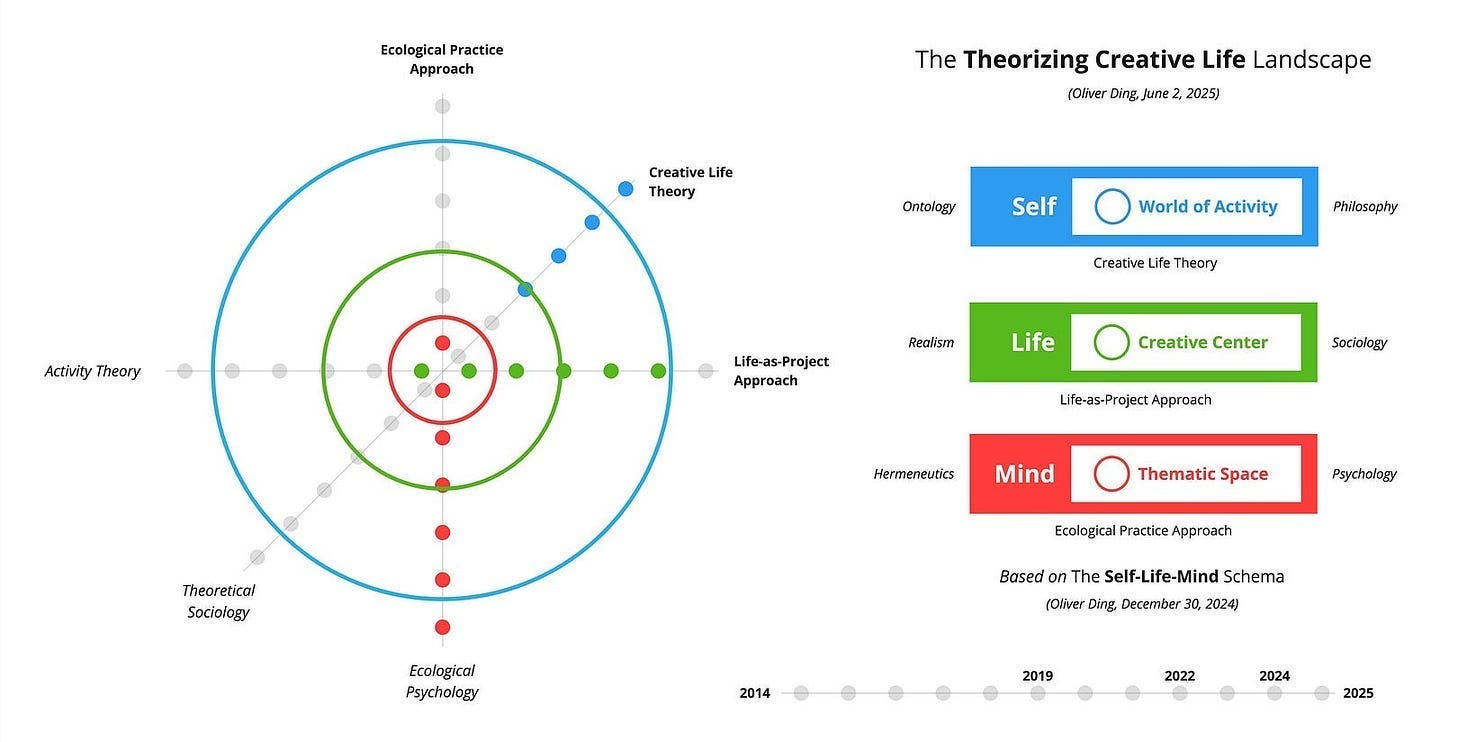
On June 2, 2025, after making the “Theorizing Creative Life” model, I saw a new, meaningful whole. This new whole goes beyond Creative Life Theory v2.0. It might be called Creative Life Theory v3.0, or a new name.
I continued making a new diagram to present the interaction between three theoretical approaches. See the diagram above.
Suddenly, I was shocked by the pattern within the diagram. The new landscape represents a 3+1 structure, revealing a new pattern I didn’t notice in my creative journey.
Over the years, I maintained boundaries between these three theoretical approaches because they are influenced by different theoretical traditions.
My engagement with these traditions is neither a matter of inheritance nor linear expansion. Instead, I treat each as a creative resource — a reservoir of concepts, metaphors, and structural tensions that can be activated in context-specific knowledge work. This dialogical strategy is at the core of Creative Life Theory and is elaborated in one of my book drafts, Mapping Creative Dialogue.
Although I even did several creative dialogues to make new knowledge frameworks, I never thought about integrating them into one.
However, the “Theorizing Creative Life” landscape presents a new pattern to me. At some point, a set of related ideas has already been curated as a new, meaningful whole. It emerged as a new approach, not replacing any of the old approaches.
The three approaches could still be developed by following their original trajectory. The new one starts at a coordinate origin, defining a position of a new center, with the potential to grow into a new theoretical enterprise.
Inspired by geography, I named this pattern Generative Confluence.
Unlike traditional confluence in geography, where streams merge and lose their individual identities, the term “Generative Confluence” is used in Creative Life Theory with a new meaning.
It describes a pattern where ideas inspired by distinct theoretical approaches evolve from separate into interconnected, generating a new center for a brand-new possible theoretical enterprise. As the new one emerges, the original theoretical approaches still keep their developmental trajectories.
The Generative Confluence pattern goes beyond the Creative Dialogue pattern, where some new ideas are born from dialogue between two theoretical approaches.
7
Shortly afterward, I published The Footbook of Generative Confluence on Possible Press in June 2025.
In that Footbook, I introduced “Generative Confluence,” which describes the creative pattern where distinct theoretical approaches, such as the Ecological Practice Approach, the Life-as-Project Approach, and Creative Life Theory, intersect and generate a new central theoretical enterprise while maintaining their original developmental paths.
From June to December 2025, I further unfolded the “Generative Confluence” journey, developing Creative Life Theory from version 3.0 to v3.1.
Within six months, this unfolding creative journey of Generative Confluence was directly observed in my real-life practice. The process has proven far more complex — and far more generative — than I had anticipated six months ago.
After launching the “Lake 42” thematic card, I reflected on the six-month journey and discovered eight movements that could capture the complexity of my journey.
- #0 — Awareness from Flow
- #1 — Finding the Coordinate
- #2 — Anchoring the Center
- #3 — Scaling the Focus
- #4 — Sustaining the Streams
- #5 — Catalyzing Curation
- #6 — Revealing the Landscape
- #7 — Setting the Enterprise

Two key movements are Finding the Coordinate and Anchoring the Center, which are core themes of the conversation between Alice and me. In the final mode, these two themes are defined as follows:
- Finding the Coordinate refers to searching for a meta-framework to serve as a Life Coordinate for a person to answer the questions “Where am I?” and “Where should I be?”
- Anchoring the Center refers to searching for a meta-framework to support a potential focus in transforming into a creative center by curating relevant creative elements together.
Both movements require searching for a meta-framework, understood as a conceptual system, yet the meta-framework serves different purposes in each case. The process of searching can lead to encountering, resonating with, echoing, applying, inspiring, modifying, curating, rejecting, critiquing, remixing, and creating, among others. These various activities of engaging with conceptual systems are sources of diverse forms of human life and cultural innovation.
In my journey of the Generative Confluence from June to December 2025, the World of Activity approach and the Flow-Focus-Center-Circle schema were the meta-framework of my life coordinate, while the Self-Life-Mind framework was the meta-framework to anchor a new creative center.
8
While working on the Lake 42 project, the primary challenge has been to develop a general model of the “Generative Confluence” pattern and incorporate it into my existing knowledge system.
On January 9, 2026, I addressed this challenge by developing an intermediate framework, called the Living Coordinate Model, to connect the Theorizing Creative Life Landscape diagram (a situational model) with the Life Coordinate Framework (a meta-framework), forming a hierarchy of models:
- Meta-framework: Life Coordinate Framework
- Framework: Living Coordinate Model
- Situational Model: Theorizing Creative Life Landscape
Later, I tested by developing several new situational models. More details can be found in Chapter Ten: Living Coordinate.
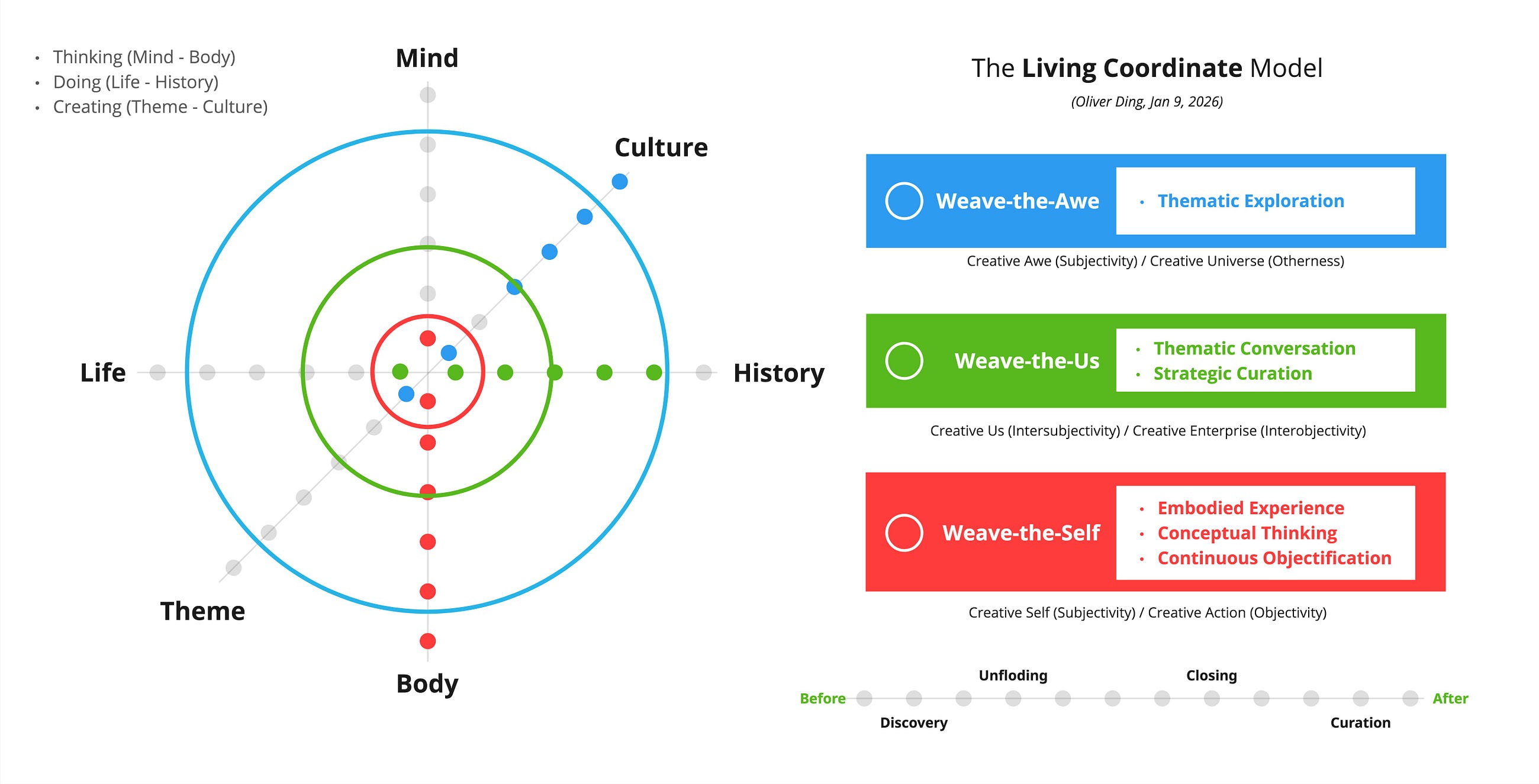
During this period, I kept a conversation with Alice. At the end of chapter 10, readers will find a Living Coordinate Model I developed for Alice.
The three-layer hierarchical structure establishes a knowledge system of Life Coordinate. In this way, while I can keep the uniqueness of my case of unfolding a Generative Confluence, we also have a general model for turning my example into a knowledge model for readers to explore.
This is the opening of a living show to unfold a journey of Generative Confluence.
The next eight chapters trace how distinct theoretical streams — Ecological Practice, Project Engagement, Creative Life Theory — converged to generate a new center, while each continued flowing along its own path. This is not a story of synthesis or integration, but of generative confluence: the emergence of something new that does not consume what came before.
After setting the stage, the next chapter will return to June 2025, exploring how I found my life coordinate for this journey. But the story really begins earlier — on May 31, 2025, when an insight emerged from the flow of everyday life.
v1.0 - February 10, 2026 - 3,917 words