
A Journey of Finding the Coordinate

This article is an excerpt from a chapter of Lake 42: The Great Confluence, originally titled "Chapter Three: Finding the Coordinate".
by Oliver Ding
January 22, 2026
More stories from Lake 42:
- Chapter One: Alice's Coordinate
- Chapter Four: Anchoring the Center
- Chapter Ten: The Living Coordinate Model
On the morning of June 23, 2025, I completed Container Thinking and prepared to leave for China. My mind was clear, ready to engage with a new flow. But I was also carrying something specific: the World of Activity toolkit, freshly developed just days earlier.
Until then, World of Activity remained largely theoretical — a set of diagrams, concepts, and frameworks. I had tested it briefly in casual reflections, but never systematically, never with the depth and scope of a full life narrative. At that time, I didn’t know when to test the framework.
From late June to July 2025, I traveled to China, spending most of my time in Fuzhou, also known as Foochow. Before moving to the U.S., I had lived in Fuzhou for nearly 20 years. This journey became a deeply meaningful re-engagement with familiar places, old friends, and the memories that had shaped my earlier life.
At the beginning of the trip, I revisited Wuyi Mountain, searching for a symbolic object that had inspired my son Peiphen’s name. This moment led me to re-read my 2015 autobiography, A Freesoul.
More specifically, I reunited with an old friend from Beijing, and together we explored the city. One of my classmates served as our guide. In this process, I rediscovered his deep knowledge of local culture and his refined character.
Immersed in this rich experiential context, I began connecting the World of Activity approach with my situational experiences. Eventually, a normal trip became a thematic trip. I tested the framework in the wild — not in a controlled research setting, but in the messy reality of homecoming, family reunions, old friendships, and the emotional complexity of returning to one’s origins after decades away.
1
I was born in 1974 in a small village called Pengdun, which is about 12 miles from Jianyang, a small town near the Wuyi Mountains in northern Fujian (note 1).
Although I grew up in Jianyang, next to the Wuyi Mountains, my previous visit to Wuyi Mountain was during my middle school graduation year, when I was 14. Now, I brought my two children to visit — one is 15 years old, the other 13.
One of the main attractions of Wuyi Mountain is Tianyou Peak. That day, I took some photos. One photo, taken halfway up the mountain looking back, left a particularly deep impression on me. It captured the complex feelings I experienced at that moment. The mountain path was steep; looking back, I saw peaks surrounding me and winding blue waters. At that instant, the emotions of reaching middle age surged in my heart.
At the top of Tianyou Peak, there is only a simple Taoist temple — nothing particularly special besides that. However, all who climb Tianyou Peak, and indeed all who climb mountains everywhere, know that reaching the summit is not the meaning of climbing. The climbing itself is the meaning.
At that moment, the principle of Being by Doing resurfaced in my mind.
As early as 2021, while reviewing various approaches to creativity research in psychology, I proposed the theoretical claim of “Process as Product,” suggesting that creativity research should shift from creative outcomes to creative processes, and even to the life courses of creators themselves. This early insight planted the seed for Creative Life Theory.
In early 2022, while working on the Life Discovery project and developing the Life as Project framework, I examined developmental psychologist Robert Kegan’s work on the conflict between sociocultural demands placed on individuals and their mental capacity development. This led me to propose Being by Doing as a principle of the Life as Project framework.
In late 2024, I began studying philosophy, attempting to provide a foundation for the concept of Self at the ontological level of Creative Life Theory. Chinese philosopher Lao Siguang placed the concept of “I” within activity to understand it. He argued that the Self is pure activity, beyond all determined relations, and therefore cannot be predetermined. What the Self becomes depends on how the Self acts. Because the Self is not within any conditional series, it has no limitations. Yet because it is not determined, there is no guarantee of what the Self will become. Therefore, the realm of the Self can manifest in myriad forms.
Lao’s proposition transforms “being” into “activity,” understanding existence through activity, dissolving traditional metaphysical assumptions about “substance” or “entity.” This proposition perfectly supports my concept of Being by Doing.
According to Lao’s proposition, the realm of the Self can manifest in myriad forms. This precisely aligns with the intention of Creative Life Theory. Creative Life Theory emphasizes the creative dimension of human life, a dimension that is undoubtedly manifold in its manifestations.
However, here we face the theoretical challenge that phenomenologist Husserl encountered regarding the lifeworld. Since people’s lifeworlds are diverse and varied in countless forms, how can we establish a theory to understand the patterns within them?
Husserl’s solution was to distinguish between the morphology and ideation of the lifeworld. As Dan Zahavi notes in his interpretation of Husserl’s phenomenology, although the lifeworld is characterized by its concrete, perspectival, and relative nature, Husserl believed it nevertheless possesses a basic, invariant, morphological structure that can be theoretically examined.
Inspired by Husserl’s insight, in 2023, I proposed the preliminary concept of Ecological Formism, based on the schema of [Variable — Quasi-invariant — Invariant — Invariant Set], distinguishing four forms: [Framework — Derived Form — Basic Form — Ecological Network]. In recent theoretical developments, I positioned Ecological Formism as an important theoretical resource for Creative Life Theory v3.0, supporting the development of the World of Activity Model.
Building on this schema, on May 25, 2025, I developed a hierarchical structure for the World of Activity approach. This model is illustrated in the diagram below.
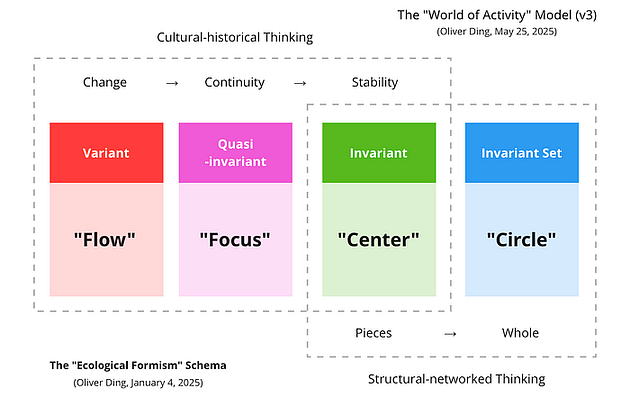
The Word of Activity Model (the Flow-Focus-Center-Circle schema) serves the Life(Self) unit of analysis for the Ecological Formism framework. It offers a model to support the Being by Doing principle.
Later, in September 2025, I selected the picture as the cover image of Being by Doing: World of Activity and Creative Life Theory (v3.0).
The Being by Doing manuscript, which presents Creative Life Theory v3.0, does not offer a set of principles or laws about creative life. Rather, it represents a stage of development in the thematic enterprise of “Theorizing Creative Life.” It provides a series of formal frameworks for researchers and practitioners to conduct empirical research and reflective practice within their own specific creative fields.
The development of the World of Activity Approach during the trip, and the Kindle book titled Homecoming: A Thematic Trip and the World of Activity Approach, are real examples of the Thematic Enterprise framework and Creative Life Theory v3.0 in action.
2
A special task of the Wuyi trip was to visit a significant object — Peifeng Academy — at the site of Zhizhi An.
Peifeng Academy, an abandoned old academy in my village, has shaped me profoundly from childhood to the present. This academy was called Peifeng Academy, of which, in my early years, only the entrance archway remained. It was originally built in 1776 (the 41st year of the Qianlong reign).
On the archway were two pairs of engraved couplets, one of which read:
Upper line: To cultivate great talents who master both theory and practical wisdom — how could one be content with excelling in just a single skill and call oneself a true sage?
Lower line: To ascend to the flourishing age of Tang and Yu — only by living up to the Five Cardinal Relationships can one truly be counted among the people of moral learning.
When I was older — studying in the county town, later in the provincial capital, and even after I began working — whenever I returned home and passed by the academy’s gate, I would pause and gaze at the couplet for a long time. The older I grew, the longer I would stand there looking up at it. I once photographed the couplet and uploaded it to the very first personal online photo album I created.
In 2004, I created a category on my blog for reading notes and named it “Peifeng Academy.” At that time, I wrote: I love this couplet and hope it can serve as my motto. On the path of self-cultivation — ‘extensive learning, careful inquiry, thoughtful reflection, clear discernment, and steadfast practice’ — it can be a guiding light.
Years later, the archway was sold by residents to people in Wuyi Mountain to restore an old Taoist temple called Zhizhi An. Today, the archway serves as the temple’s main gate, with the original four characters “Peifeng Academy” replaced by “Zhizhi An.” In 2010, when my first child was born, we named him Peiphen in memory of the academy.
I do not know who, centuries ago, composed this couplet — what his name was, or the experiences that shaped his life. What was on his mind when he wrote these words? Clearly, this centuries-old meme has found its carrier in the present, and has even been successfully passed on to the next generation.
The couplet on Peifeng Academy’s archway deconstructs the two characters of Peifeng into a portrait of the ideal Confucian scholar-gentleman. The upper line subtly resonates with the idea that “a true gentleman is not a mere tool” (junzi bu qi, note 4), critiquing education that focuses solely on technical skill. The lower line presents the Confucian ideal of cultivating inner virtue while engaging in governance and social responsibility (nei sheng wai wang, note 5). The phrase “people of moral learning” (mingjiao zhong ren, note 6) reflects a corrective stance popular during the rise of the Qian-Jia scholarly movement, addressing the excesses of the textual evidential school (kaozheng, note 7).
This cultural reflection also opens a window into my childhood World of Activity. Peifeng Academy, the couplet, and the archway itself became thematic objects around which my early experiences and imagination were organized, revealing the primordial situatedness of my formative years.
This memory has been documented in my 2015 autobiography: A Freesoul. The day of the Wuyi trip, I, together with my son Peiphen and our family of ten, visited Peifeng Academy at the site of Zhizhi An. This remarkable moment inspired me to revisit my 2015 autobiography.
3
Back in Fuzhou, I began the systematic testing. I reopened my 2015 autobiography, A Freesoul, but this time through the lens of the Flow-Focus-Center-Circle schema. The question was methodological: Could this theoretical framework reveal patterns in biographical material that remained invisible in chronological narration?
The answer emerged immediately in the story of my father’s maps.
My father worked as the village administrator, responsible for accounting. Later, he moved to Jianyang to join the county’s economic affairs office. Following that, he took charge of several township enterprises, including a tea farm and tea-processing facility, as well as a public water plant.
When revisiting the autobiography I wrote ten years ago, I suddenly realized that the seed of the World of Activity had already been planted in the section about my father’s maps.
In my childhood home, there was a large, bright red lacquered cabinet with intricate carvings. It was a great source of joy for me. Inside, my father kept the travel maps he brought back from his trips and some of his favorite books.
As a young boy, I loved opening the cabinet doors, pulling out the bottom drawer, and taking out the maps my father had treasured for years. The only maps I still clearly remember are those of Suzhou and Wuxi — two cities he had visited during his youth and kept as souvenirs. He traveled to Beijing, Shanghai, Suzhou, Wuxi, Hangzhou, and Nanjing, but never beyond those places. Although my father seldom took these maps out to look at, I could sense how deeply he cherished these keepsakes from the Jiangnan region.
As I grew older, I had the opportunity to travel extensively and developed a passion for exploration. In 2003, I visited Suzhou and imagined following my father’s footsteps. Beyond the old gardens depicted on those vintage maps, I saw a city transformed — with the Suzhou New District, the Singapore Industrial Park sprouting like new wings, the then-world-leading company UTStarcom, and BenQ, a brand championing joyful technology. While my father’s vision was forever locked within the small drawer holding the old Suzhou map, my vision of Suzhou was far broader than just a few gardens.
My father could never have imagined that I would travel so far, nor does he know how much further I will go. The unknown world now beyond his imagination, yet my desire for the unknown will always be kindled by those old maps of Suzhou.
My father died before I wrote the autobiography. His World of Activity has been permanently closed. His world — the places he could reach, the maps he treasured — defines the boundaries of his life course. For him, those cities and the journeys were the full extent of his lived experience.
In contrast, my own World of Activity has expanded far beyond those limits, both geographically and conceptually. The maps that once contained my father’s world now serve as a springboard for my own exploration of unknown territories — physical, intellectual, and cultural.
This contrast highlights a fundamental insight of the World of Activity approach: each person’s World of Activity is shaped by what they can engage with, influence, and imagine. It is not fixed but evolves as we move through life, driven by curiosity and the expanding boundaries of our experience.
As the World of Activity model shows, each person’s World of Activity could connect with others through shared focuses, centers, and circles. My father’s maps — what I now call Thematic Objects — have traveled from his World of Activity to mine.
Ten years ago, I didn’t use the term World of Activity in A Freesoul. However, I was already reflectively conveying the message, based on practice.
Ten years later, I reflected on the autobiography and my life course in a theory-based manner. The journey unfolded and led me to discover the seven forms of the World of Activity.
4
As I continued applying the schema to different life phases, something unexpected happened. The framework didn’t just illuminate my biography — my biography pushed back, revealing structures the framework hadn’t anticipated.
Through careful examination of my autobiography and present experiences, seven distinct forms of World of Activity emerged. Each form demonstrates different emphases within the Flow-Focus-Center-Circle schema:
- Hometown: Primordial Situatedness (Center-focused analysis)
- Alien Land: Geographical Expansion (Center dynamics emphasis)
- Domain: Professional Development (Center evolution patterns)
- Internet: Digital Engagement (Circle formation and expansion)
- Foreign Land: Cultural Reconstruction (Multi-center emergence)
- Inheritance: Generative Anticipation (Circle perspective shift)
- Homecoming: Spatio-temporal Emergence (Flow-focused integration)
These weren’t theoretical categories I had designed. They emerged from the biography itself and my experiences when viewed through the schema. Theory and life were in genuine dialogue.
The “Primordial Situatedness” form captures childhood in rural Pengdun through the simplest possible Center structure: Hometown (Home). The analysis reveals how the most basic World of Activity operates with a single, encompassing Center that contains all early life experiences. Here, Center analysis shows the foundational container structure, where Hometown serves as the outer boundary and Home provides the core organizing principle for experiences of warmth, support, and primary cultural formation.
The “Geographical Expansion” form refers to the transition from village to city life in Fuzhou, which introduces the first dual-center structure. The Center analysis reveals how geographical movement necessitates organizational adaptation: Surviving Centers (academic requirements, basic adaptation) emerge alongside Thriving Centers (creative activities like the Cape of Good Hope Poetry Society). This form demonstrates how Centers must differentiate to handle both survival needs and growth opportunities in new environments.
The “Professional Development” form describes how my professional identity formation through advertising and investment consulting shows how Centers evolve in complexity. The dual-center structure transforms from Surviving vs. Thriving to Continuous vs. Native Centers. Continuous Centers represent the transfer of past experiences, knowledge, and lifestyle into new contexts, while Native Centers emerge from new environments through local relationships, cultural understanding, and situated practice. This form illustrates Center adaptation and integration processes.
The “Digital Engagement” form emphasizes that digital technologies fundamentally transform the Circle. While maintaining dual-center dynamics (Continuous vs. Native), this form demonstrates how Circles expand beyond geographical boundaries. The analysis focuses on how participation in open-source communities, blogging platforms, and global networks creates new Circle configurations that transcend physical location, connecting individual Centers to digital communities of practice.
The “Generative Anticipation” form emerged from encounters with classmates and their children, shifting focus to Circle analysis across generations. Rather than examining individual Center development, the analysis reveals how thematic objects (a cassette tape of a poetry collection), thematic ideas (creative freedom, work-for-work philosophy), and thematic social networks create intergenerational Circles. The emphasis moves from individual Center dynamics to multi-generational Circle formation and transmission.
The “Homecoming (Spatio-temporal Emergence)” form concentrates on Flow analysis within compressed experiential time. The homecoming trip integrates multiple temporalities (2005, 2015, 2025) and spatialities (Houston, Wuyi Mountain, Fuzhou) within an intensive Flow experience. The analysis reveals how Flow can become generative when it moves dynamically between Aion Space (meaning-making) and Chronos Space (operational activity), creating emergence through spatial-temporal complexity.
The Flow-Focus-Center-Circle schema operates within a deeper meta-framework that moves from Change → Continuity → Stability, and simultaneously from Pieces → Whole. As illustrated in the World of Activity model, Flow represents the domain of Change (Variant experiences), Focus emerges in the realm of Continuity (Quasi-Invariant patterns), Center stabilizes as Invariant structure, and Circle achieves the greatest Stability as Invariant Sets.
One of the most significant discoveries in this analysis is how Centers from earlier forms continue to influence and shape later developments, embodying this dual progression from change to continuity to stability, and from pieces to whole. This continuity represents a crucial developmental principle: nothing in the World of Activity truly disappears; instead, earlier Centers transform, migrate, or provide foundations for new organizational structures that achieve greater stability over time.
5
In the days following July 12, I gathered with old classmates in Fuzhou and explored the city with my friend from Beijing. A friend from afar also mailed me his portfolio of creative works.
These present-moment dialogues and exchanges sparked abundant new insights, inspiring extensive mental journeys that moved back and forth between past, present, and future. The conversations created a rich experiential space where memory, immediate experience, and anticipation converged and informed one another.
I started writing daily notes to deepen the theory-practice connection. Later, the writing project was named “The World of Activity of a Freesoul” project.
As my trip unfolded, my writing also followed. After finishing my reflection on the autobiography, I completed Part III of the project. Then, I moved to paying attention to the present, and new insights emerged, leading to contents for Part V, “The Evolution of Thematic Enterprise,” and Part VI, “The Flourishing of Mind-Heart.”
A Freesoul ends with my life course around 2013. In my later daily notes, I briefly recorded episodes from my creative journey after that year, especially the emergence of my most recent projects.
During the trip, a friend came from Beijing to visit me. Together we explored the historic district of Sanfang Qixiang and visited the former residence of Yan Fu (note 4). This friend had once played a key role in localizing Wikipedia into Chinese — translating its structure, defining entries in terms of the Chinese knowledge system, adapting community rules, and creating some of the earliest Chinese-language pages. His very first article? “Yan Fu.” When I asked him why, he replied that it was the theme of East–West Dialogue that had inspired him.
After Sanfang Qixiang, we visited the Fujian Museum and strolled under the dense shade of trees by West Lake Park. I asked his impression of Fuzhou. Surprisingly, he compared it with Xi’an. Xi’an, though historically rich, felt disconnected from the present. Fuzhou, on the other hand, was vibrant in modern history — its many famous figures and events deeply intertwined with the nation’s fate. He felt much closer to Fuzhou’s history.
Most importantly, he said that the East–West dialogue that began a century ago is far from over. It continues, with our generation as the protagonists.
This conversation inspired me to write a note, highlighting in particular a recent project that seeks to connect Agency, a central concept in Western sociology, with Mind–Heart, a core concept in Chinese philosophy. This project directly echoed the theme of East–West Dialogue. Part VI of The World of Activity of a Freesoul took this theme as its central focus, framing nine aspects of strategic agency as a way to understand Agency within the World of Activity approach.
This part forms the conclusion of the project and resonates with the late theme of my trip.
On July 25, I met with a classmate at a café to discuss various topics related to Creative Life Theory. Several years earlier, his mother had encouraged him, before her passing, to seek meaning in life beyond the busyness of enterprise. Since then, he had embraced photography as the central theme of his creative life, transforming himself from a successful businessman into a creative environmental photographer.
Our discussion reflected on the developmental journey of his creative life and anticipated the strategic orientation of his future. Based on our conversation, I opened the thematic map of the “Nine Aspects of Agency” and identified a particularly prominent aspect of his agency, recommending an action strategy built around it.
6
By the end of the trip, I had written 138,352 words in Chinese. Combined with the original 2015 autobiography, the total came to nearly 211,145 words. The newest version, v2.1, is about 217,665 words.
I edited it as a new Chinese book draft titled Freesous in Fuzhou: Theme, Enterprise, and World of Activity.
Unfortunately, the original was written in Chinese. After returning to the U.S., I started rewriting it in English. The result is an English book: Homecoming: A Thematic Trip and the World of Activity Approach. It was released as a Kindle book on September 7, 2025.
While most materials are based on my Chinese notes, the English book is not a translation of the Chinese book draft. For example, in the Chinese one, it has six parts, and I wrote notes on the World of Activity approach, and relevant ideas such as the Social Form framework, the Thematic Enterprise framework, and the Strategic Agency framework. In the English one, I will focus on the trip itself and the World of Activity approach. Other topics will be explored in other future books.
Homecoming is a book about how the 2025 “I” employs theory-based reflection to reflect on the practice-based reflection that the 2015 “I” made about my past self. This experience of biographical engagement has been extraordinary! I hope this book can share both my method and the joy I discovered in it, encouraging readers to embark on their own journey of biographical engagement.
As Chinese historian Qian Mu once said, what we cannot forget is our real life (note 1). This homecoming trip proved to be a perfect voyage — I was fortunate to reconnect with people, events, and places I had been unable to forget over the years. Those individuals, experiences, and locations I recorded in my autobiography ten years ago were, naturally, among the unforgettable elements of my life. Due to time constraints, however, this creative work based on the journey remains imperfect. The fourth section of the original Chinese manuscript, concerning the evolution of social forms, was left incomplete. Yet this imperfection is an indispensable part of life itself.
Inspired by ecological psychology, activity theory, and phenomenological sociology, I approach Mind from an ecological perspective, integrating thinking with doing. This trip involved mental movements across multilayered spatial trajectories and temporal dimensions — reflecting, interpreting, and connecting life experiences across different scales of time and space.
The completion of Homecoming marked more than finishing a book. It represented the full cycle of testing a theoretical framework in biographical reality and discovering that the framework itself was transformed by the encounter.
World of Activity began as a concept. Through this journey, it became a Life Coordinate — tested, refined, and validated not through academic research, but through the lived experience of homecoming.
On September 20, 2025, I released a new book draft, Being by Doing: World of Activity and Creative Life Theory (v3.0), curating a collection of articles reflecting the creative journey and the landscape of Creative Life Theory (v3.0).
Based on the Self-Life-Mind schema, the book is organized around a main question:
How does a person achieve a creative life and creative development?
The main question is further divided into three sub-questions:
- How does a Creative Self develop?
- How does a Creative Center develop?
- How does a Creative Mind develop
The title of the book, Being by Doing, appeared as a principle of the Life as Project approach, which I worked on in the first half of 2022. Later, I developed the Universal Reference model and the concept of World of Activity in the second half of 2022.
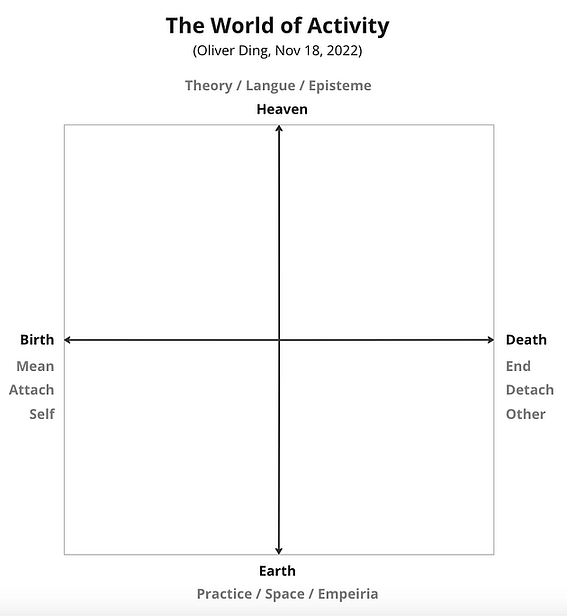
Now, I find the connection between these two concepts. The “Being” is linked to “Human Being,” understood as People. In ancient Chinese culture, the essence of a person refers to the life course of a person. To understand a person, one needs to understand the activities of their life. Initially, the concept of World of Activity was defined by the “Heaven — Earth — Birth — Death” schema (see the diagram below). Life is about everything between Birth and Death.
If we connect Being by Doing and the concept of World of Activity, then the notion of “Life (Self)” becomes easier to understand. To be a creative self, a person needs to engage in creative activity. Doing creative projects brings the creative self from projection to actualization. This echoes what Howard Gruber says, “To be oneself one must do these things; to do these things one must be oneself.”
Being by Doing! There is no division between Creative Self and Creative Life.
7
Through the Homecoming project, World of Activity had become my Life Coordinate. But the most profound discovery was this: when I used it to review my autobiography, I found traces of this framework already present in my early life — long before I had consciously developed it.
The deepest insight emerged: the essence of creative life is Creative Engagement with Givenness.
Four types of givenness bound every World of Activity:
- Birth: beginning
- Death: ending
- Heaven: language, culture
- Earth: environment, geography
But these aren’t just constraints. They’re the eternal sources of creative possibility.
Looking back through my autobiography, the patterns were clear:
- My adolescent poetry was creative engagement with linguistic givenness — though I didn’t have this vocabulary then, I was already exploring the generative possibilities of language and cultural forms.
- My experience of the Min River was engagement with environmental givenness — the geographical reality of my hometown shaped not just where I lived, but how I understood place and belonging.
- The transmission of Peifeng’s name to my son was engagement with birth-death givenness — connecting past, present, and future through the continuity of thematic objects.
These weren’t conscious applications of a framework. They were lived experiences. Yet when I reviewed them through the World of Activity lens, a coherent narrative emerged — one that connected my early life to my present creative work.
This continuity was confirmed two months later. On September 24, 2025, I sent an email to a mentor and several friends. At the end of my brief on Creative Life Theory (v3.0), I made a list of my theoretical enterprises. Almost all of them could be located within these four types of givenness.
The pattern held: from adolescence to middle age, from unconscious engagement to conscious curation, the same fundamental structure organized my creative life.
This brings us to the heart of what a Life Coordinate means.
In Chapter Two, I found a theoretical coordinate through the Self-Life-Mind schema — a meta-framework for organizing knowledge and theory. That was a cognitive tool, an intellectual positioning system.
A personal Life Coordinate is different. It’s not just a conceptual framework for building theories or knowledge frameworks. It’s a mental platform that synchronizes three dimensions simultaneously:
- Worldview: How you understand reality
- Life Orientation: What direction you’re heading
- Life Purpose: Why you’re on this path
This synchronization cannot be achieved through theoretical reasoning alone. It requires the integration of life experience and cognitive development — exactly what happened in Fuzhou, and the whole journey of my life.
Why does a creative person need a Life Coordinate?
Because without it, a person’s World of Activity remains diffuse, reactive, and fragmented. You flow with circumstances, respond to opportunities, accumulate experiences — but lack the organizing principle that transforms scattered actions into a coherent life trajectory.
A Life Coordinate doesn’t eliminate uncertainty or guarantee success. But it provides:
- Orientation in complexity: When facing multiple possibilities, a clear sense of direction
- Continuity through transitions: When life phases shift, structural consistency
- Curation across domains: When different centers emerge, coherent coordination
Most importantly, a Life Coordinate enables what I call “strategic life development” — the capacity to make choices not just based on immediate circumstances, but aligned with a deeper understanding of who you are, where you came from, and where you’re heading.
But this raises a crucial question: is a Life Coordinate something you find once and use forever?
Finding my Life Coordinate was not a one-time event. Looking back, I realize it was a journey spanning decades — from unconscious engagement in adolescence to conscious framework development in 2023 to lived validation in 2025. This temporal complexity led me to a crucial insight: Life Coordinates are not static. Drawing on the Ecological Formism framework, I distinguish three temporal forms:
- Invariant: A meta-framework used across one’s entire life course
- Quasi-invariant: A meta-framework used for several years
- Variant: A situational coordinate for a specific period
My own journey involved all three. Earlier frameworks served as quasi-invariant coordinates. The World of Activity framework, developed in 2023 and tested in 2025, is becoming an invariant coordinate — but that status is earned through sustained engagement, not declared at the outset.
This dynamic view has practical implications. Readers might wonder: must I create my own meta-framework, as you did?
My answer: Creating one’s own meta-framework is one path, but not the only path. The process of searching for a Life Coordinate can take many forms: encountering, resonating with, echoing, applying, inspiring, modifying, curating, rejecting, critiquing, remixing, and creating existing frameworks.
These various modes of engagement with conceptual systems are themselves sources of diverse forms of human life and cultural innovation. The challenge is not in creating versus adopting, but in finding genuine fit — a coordinate that can synchronize your worldview, life orientation, and life purpose.
The movement of finding a life coordinate is not a pure solo cognitive process, but a weave of several processes:
- Thematic Exploration
- Thematic Conversation
- Strategic Curation
- Embodied Experience
- Conceptual Thinking
- Continuous Objectification
These six operations are also called the Living Way of Concept. Even the concept of “Finding the Coordinate” follows this pattern in my creative journey:
- Thematic Exploration: the “Finding the Coordinate” theme became a focus
- Thematic Conversation: I discussed “Finding the Coordinate” with friends
- Strategic Curation: Place several case studies and models together; develop an intermediate framework to connect a situational model and a meta-framework.
- Embodied Experience: I visited the series of diagrams I created on June 2, 2025
- Conceptual Thinking: Separate the “Finding the Coordinate” and the “Anchoring the Center” movement; clarify different functions of the same 3D coordinate diagram.
- Continuous Objectification: I created the Living Coordinate model diagram on January 9, 2026.
More details can be found in [Meta-framework] The Living Coordinate Model (2026).
8
Finding the Coordinate was Movement #1. But a coordinate is just a point of orientation, a beginning rather than a completion.
The real work lay ahead: anchoring a new creative center using this Life Coordinate as a foundation. From September to December 2025, I would engage in a series of movements — Anchoring the Center, Scaling the Focus, Sustaining the Streams — that would unfold the Generative Confluence I had glimpsed in June.
But standing in Fuzhou that summer, having tested World of Activity in the wild and discovered it was more than a framework — it was a Life Coordinate rooted in fifty years of living — I was ready for what came next.
Notes
- Pengdun (彭墩), about 12 miles from Jianyang (建阳), is a small town near the Wuyi Mountains (武夷山脉) in northern Fujian (福建).
v1.0 - January 22, 2026 - 5,582 words