
Supportive Life Discovery (v2.0): The Mid-life Curation Edition

Experiencing a Watershed: Reconnecting Past, Present, and Future
by Oliver Ding
June 24, 2026
Mid-life development is a dual reconstruction process of career trajectory and life meaning, in which the Living Coordinate emerges as a watershed of structural reorientation.
Introduction
In April 2026, while revisiting a series of articles and projects developed over the past decade, I found myself returning to a simple but powerful idea: the watershed.
At first, I used the term to reflect on significant turning points in my own journey—moments that, in retrospect, seemed to divide a “before” from an “after.” Yet as I continued revisiting and rebuilding these materials, a different realization emerged.
Not everyone experiences an obvious watershed.
Many experienced professionals spend years building careers, developing expertise, supporting organizations, and navigating responsibilities. Their lives may not contain a dramatic event that clearly separates one chapter from another. Yet after eight, ten, or even twenty years of professional practice, many begin to ask deeper questions:
How did I arrive here?
What themes have shaped my journey?
What resources, experiences, and aspirations have I accumulated along the way?
What possibilities might be waiting beyond my current horizon?
These questions do not necessarily arise from crisis. They often emerge from experience itself.
This realization inspired the development of Supportive Life Discovery (v2.0): The Mid-life Curation Edition.
The program is built around a simple proposition: a watershed does not have to be something we discover only in hindsight. It can also be something we intentionally experience.
Through a structured process of reflection, thematic exploration, life curation, and future-oriented discovery, participants are invited to reconnect their past, present, and future. Rather than merely looking back on their journey, they are encouraged to create a meaningful pause—a space for reorientation, renewal, and possibility.
Whether or not participants can identify a dramatic turning point in their lives, this program offers an opportunity to experience a watershed of their own: a moment for making sense of where they have been, appreciating where they are, and imagining where they might go next.
Experiencing a Watershed: Reconnecting Past, Present, and Future
As a serial creator and a lifelong thinker, I am passionate about intellectual development and life reflection. Initially, I was influenced by Chris Argyris’s action science and Donald Schön’s Theory in Practice and The Reflective Practitioner. I wrote my first learning autobiography in 2015 and was attracted to biographical studies. In 2016, I developed a framework called Career Landscape, inspired by Activity Theory, Communities of Practice, and other ideas. I also developed a series of tools: the Learning Autobiography Guide, Learning & Reflective Cards, Learning & Reflective Canvas, Learning & Reflective Monthly Report Template, etc. Later, I renamed it The Talent Circle: the Activity‑Achievement (AA) model.
The AA model (2016) was my early knowledge curation work. It was born from a 1:1 life reflection coaching project. To explain a client’s life and career experience, I developed the AA model for that case. On October 11, 2022, I shared the model on LinkedIn, noting that it was developed for people with a high Need for Achievement (n‑Ach), not for everyone.
If we use October 2018 as a watershed (as in the chronicle), we see the difference between the AA model and my recent creations. Before October 2018, my creative identity was a practitioner; the method behind the AA model was knowledge curation, and the project’s purpose was to serve the client. After October 2018, my creative identity shifted to a theorist; my method changed to knowledge creation, paying attention to original theoretical concepts and using fewer external resources. The purpose of my knowledge projects became to serve the public knowledge ecosystem.
Watersheds are not only found in one’s own intellectual history. They also appear in the lives of those we support. I recently encountered a striking example in a coaching engagement that, in retrospect, mirrors the structure of my 2016 client work — and reveals the same logic of a before‑and‑after reorganization.
Interestingly, I recently had a coaching engagement with Maya, a professional coach with a psychology background who is considering writing her first book. The engagement unfolded across three phases: an initial email exchange, a follow‑up via messaging, and a ninety‑minute video conversation on April 9, 2026.
As a supporter, I used the Supportive Life Discovery (SLD) approach to guide the engagement — specifically as an instance of the Achievement Chain in action: Flow → Focus → Coordinate → Center → Circle.
Supportive Life Discovery is concerned not with a specific thematic domain but with the full arc of a person’s life discovery process. The central question of this case is therefore broader than “how does Maya’s book get written?” It is: What is happening in Maya’s World of Activity, and what does genuine support look like at this moment in her development?
The FFCC framework — in its expanded seven‑dimension form (Forms, Moves, Methods, Themes, Identities, Opportunities, Achievements) — provides the analytical backbone. The seven dimensions are not applied mechanically but used as a diagnostic lens: each illuminates a different aspect of Maya’s situation and the support it calls for.
The graduate program was the watershed event that reorganized Maya’s World of Activity.
Before: Maya’s World of Activity had a coherent configuration. Her Center was organized around coaching practice. Her Circle consisted of clients, colleagues, and professional peers — a network that confirmed and extended her coaching identity. The Circle and Center were mutually reinforcing: she was known as a coach, she worked as a coach, she thought of herself as a coach.
After: The graduate program introduced Maya to an entirely different Circle. Academic communities, research traditions, cross‑cultural thinkers, and scholars whose own Centers were organized around inquiry, writing, and theory — these became part of her social world. And with this new Circle came, implicitly, new possibilities for her Center.
In SLD terms, this is the classic dynamic by which the Circle changes the Center: the Circle does not simply expand; it changes in kind, and in doing so, it begins to ask new questions of the existing Center. Is this center still the right one? Is life coaching the full expression of what you are capable of? What would a larger center look like?
Maya could not yet articulate these questions. But she felt their pressure as paralysis — as the inability to write the book that publishers were asking for. What looked like a writing problem was a World of Activity problem. The Circle had changed. The Center had not yet caught up.
A Program for Mid-life Professionals
Maya’s case inspired me to revisit the 2016 case. At that time, I focused on the learning autobiography practice and learning narrative. The client wrote a learning autobiography, and then we had a structured Q&A via email. After collecting enough facts about the client’s life and career, I developed the Activity‑Achievement Model (2016), represented with a conceptual deck. Based on the model, I also wrote a long report explaining the client’s learning and career development.
Although I did not have a video session with the client in 2016, that 1:1 life reflection coaching engagement can be seen as a case of what I now call Supportive Life Discovery (SLD) in 2026.
Ten years ago, my method was learning autobiography and learning narrative, and my model was the Activity‑Achievement Model. Ten years later, my method is called the L3D approach (Learn‑Discover‑Design‑Deliver), and my model is the FFCC schema. However, these two cases are the same type of activity: Supportive Life Discovery.
By curating the two cases together, I made a new version of the Supportive Life Discovery model. This version is framed as the Mid‑life Curation edition, since it sets concrete actions for the L3D sections:
- Learn: Learning Autobiography
- Discover: Thematic Conversation
- Design: Developmental Project
- Deliver: Possible Book
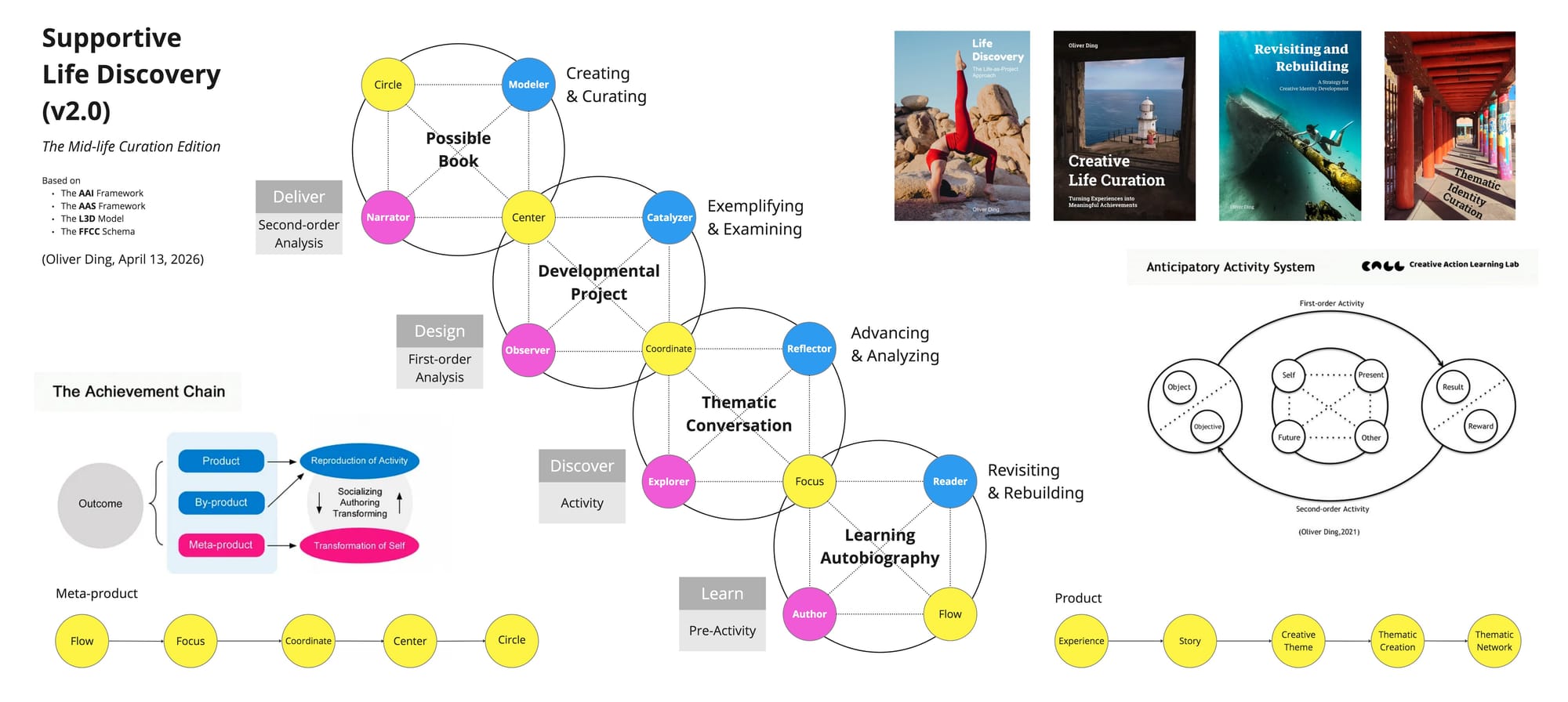
This model also has a watershed: Finding a Coordinate. The achievement chain of the model considers five types of outcomes: Flow, Focus, Coordinate, Center, Circle. The moment of finding a Coordinate is the watershed of the program.

Before that moment, the engagement focuses on reflective thinking. After the engagement shifts to actual actions.
To my surprise, the Supportive Life Discovery project now has a ten‑year history.
Learn: Learning Autobiography
The purpose of the first phase is Learn.
Learning has a dual meaning in this context. On the one hand, participants learn about themselves by revisiting their own life history. On the other hand, supporters learn about the participants by engaging with the traces, stories, and materials that document their developmental journey.
The primary roles in this phase are therefore Author and Reader. Participants act as authors of their own developmental narrative, while supporters act as attentive readers seeking to understand the person's life trajectory, experiences, aspirations, and achievements.
The central object of this phase is the Learning Autobiography.
The idea originated from my own learning autobiography practice developed years ago. In Supportive Life Discovery, however, Learning Autobiography functions as a metaphor rather than a fixed textual genre. Participants are not required to produce a formal autobiography. Instead, the goal is to assemble and curate materials that help make their developmental journey visible and understandable.
Such materials may include:
- journals and diaries
- blog posts and newsletters
- personal essays and memoirs
- project portfolios
- photographs and artifacts
- audio recordings and videos
- social media reflections
- other meaningful traces of experience
Written texts are generally preferred because they are easier to review and analyze. However, audio and video materials are equally valuable, although they often require additional effort to be transcribed and interpreted.
The objective of this phase is not to produce a final autobiographical document. Rather, it is to engage in a practice of revisiting and rebuilding.
Participants are invited to return to earlier moments of their lives and careers. Through this process, they often rediscover people, projects, ideas, places, artifacts, and unfinished aspirations that had faded into the background of everyday experience. Some of these elements may reveal new significance when viewed from the present context.
The guiding question is therefore not simply:
"What happened?"
but also:
"What deserves to be revisited, reinterpreted, and possibly rebuilt?"
This phase begins with Flow.
Life histories often appear as a vast stream of memories, experiences, and stories. Participants frequently arrive with an abundance of material and many possible directions for exploration. Through the process of learning autobiography, both participant and supporter gradually identify recurring patterns, emerging interests, and meaningful threads.
The movement from Flow to Focus marks the developmental achievement of this phase.
When thematic focal points begin to emerge from the flow of experiences, the engagement becomes ready for the next stage: Thematic Conversation.
Discover: Thematic Conversation
The purpose of the second phase is Discover.
This is the central practice of Supportive Life Discovery and the core stage of the L3D approach. While the Learn phase focuses on revisiting developmental traces, the Discover phase focuses on exploring their meaning, significance, and future implications.
The primary roles in this phase are Explorer and Reflector.
Participants are primarily invited to act as Explorers, actively investigating their experiences, aspirations, questions, and possibilities. Supporters primarily act as Reflectors, helping participants notice patterns, articulate emerging insights, and make sense of what is being discovered.
These roles are complementary rather than fixed. Both participants and supporters may alternate between exploration and reflection throughout the engagement.
The central practice of this phase is Advancing & Analyzing.
Advancing refers to the forward movement of thematic conversations. Through purposeful dialogue, participants deepen their understanding of selected themes, uncover new questions, identify previously unnoticed connections, and generate new insights. The conversation is not merely reflective; it is developmental. Each exchange seeks to move the inquiry forward.
Analyzing refers to the ongoing process of documentation, reflection, interpretation, and conceptualization. Throughout the engagement, supporters record observations, identify recurring themes, and introduce relevant knowledge models to facilitate structured analysis and dialogue. Analytical work helps transform isolated insights into a more coherent developmental understanding.
The supporter plays a particularly important role in guiding the movement between advancing and analyzing. Exploration generates new material; analysis provides structure and orientation. Together, they create a dynamic process of discovery.
The specific format of thematic conversation is flexible and depends on the circumstances of the engagement. Conversations may take place through:
- video meetings
- face-to-face sessions
- email exchanges
- written reflections
- asynchronous messaging
- combinations of multiple formats
Similarly, the duration of the process may range from a single intensive engagement to a longer developmental journey extending over several months.
What matters most is not the medium but the intention: the conversations are organized around a small number of significant themes that deserve sustained exploration.
This phase begins with Focus.
By the end of the Learn phase, participants and supporters have usually identified several thematic focal points emerging from the participant’s developmental history. These themes become the starting points for deeper inquiry.
The developmental achievement of this phase is Coordinate.
Through sustained exploration and reflection, participants gradually develop a set of coordinates that help orient their future development. A Coordinate is not simply a goal, a plan, or a vision. It is a reference structure composed of dimensions, orientations, distinctions, and developmental directions that can guide future action and interpretation.
The emergence of a Coordinate represents the watershed of the entire Supportive Life Discovery process.
At this point, participants are no longer merely revisiting their past or exploring possibilities. They begin to establish a position from which future movement becomes meaningful and coherent.
Depending on the situation, a Living Coordinate may take two forms.
The first form involves a person's foundational belief system, worldview, or life orientation. In such cases, the Coordinate functions as a deep organizing principle that may influence development over many years.
The second form is more project-oriented. It helps participants identify the center of a creative, professional, or developmental journey. Such Coordinates may have a shorter lifespan and serve as temporary reference systems for a specific project, transition, or period of exploration.
In both forms, the Living Coordinate serves the same purpose: it provides an orienting structure through which participants can reconnect their past experiences, present circumstances, and future possibilities.
Design: Developmental Project
The purpose of the third phase is Design.
This phase begins from the Coordinate established in the Discover stage. The Coordinate provides an orienting structure, while the Design phase translates it into lived development through concrete action.
The central objective is to anchor, activate, and expand the Coordinate through one or more Developmental Projects. In this process, the Coordinate is no longer only a conceptual reference; it becomes an enacted creative center.
This phase is typically long-term and extends beyond the Supportive Life Discovery program itself. Most of the work takes place in participants’ real-life contexts—professional, creative, academic, or personal—where actual projects are carried out.
Within the program space, participants and supporters collaboratively design Developmental Projects and adopt the roles of Observer and Catalyzer. The participant remains the primary agent of action, while the supporter provides catalytic support through observation, reflection, and strategic input.
Developmental Project Structure
Each Developmental Project is organized around three types of outcomes:
- Product
- By-product
- Meta-product
The Product refers to the intended, explicit output of the project, such as a publication, framework, prototype, or creative work.
The By-product refers to emergent outcomes that arise during the process but are not originally planned. These are not treated as secondary; they are often important sources of insight and creative development.
The Meta-product refers to outcomes of the participant’s own development generated through the project. These include changes in thinking, capability, orientation, and identity. In this sense, the project does not only produce external outputs, but also transforms the participant as a developing system.
Both Product and By-product function as creative elements that contribute to the unfolding of the Living Coordinate. The Coordinate acts as a multidimensional reference space that absorbs and reorganizes these elements into a coherent developmental field.
Through this process, the Coordinate gradually becomes a lived and populated creative center.
From Coordination to Observation
As the Design phase unfolds, interaction shifts from intensive dialogue to reflective observation. Instead of continuous thematic conversation, the focus moves toward observing the evolution of Developmental Projects in real time.
The supporter primarily acts as an Observer and Catalyzer, offering reflection and input when needed, while the participant carries forward the main trajectory of action.
This marks a transition from dialogue-centered exploration to action-centered unfolding.
Exemplifying & Examining
A key practice in this phase is Exemplifying & Examining.
The supporter also engages in their own developmental work, making their practice visible as a lived example of how Developmental Projects are designed and adjusted over time. Participants can observe how decisions are made, how uncertainty is navigated, and how projects evolve in practice.
At the same time, the supporter examines the participant’s unfolding projects, identifying patterns and emergent structures within the Living Coordinate.
Together, Exemplifying & Examining creates a reciprocal developmental field in which both sides engage in parallel processes of becoming.
Through this phase, the Living Coordinate is no longer a conceptual orientation. It becomes an enacted center of activity—expressed, tested, and expanded through lived developmental work.
Deliver: Possible Book
The purpose of the fourth phase is Deliver.
This phase shifts the developmental process from lived experience and project enactment toward external articulation and public-facing expression. It is organized around the relationship between Center and Circle, where the Circle refers to the participant’s broader social and professional network, and the Center refers to the emerging creative core formed through the previous phases.
In this phase, the Living Coordinate is no longer only enacted through developmental projects. It is now communicated, represented, and shared within a broader social field.
Roles: Narrator and Modeler
Two complementary roles define this phase: Narrator and Modeler.
The Narrator focuses on storytelling—articulating the developmental journey as a coherent narrative that can be understood, shared, and experienced by others.
The Modeler focuses on conceptual construction—translating lived experience into structured frameworks, models, and conceptual representations.
Together, these roles create a form of narrative-model integration, where storytelling and conceptualization reinforce each other rather than operate separately.
Core Practice: Creating & Curating
The central practice of this phase is Creating & Curating, with a particular emphasis on curation.
Throughout the entire Supportive Life Discovery process, materials are continuously generated and collected—reflections, conversations, project notes, artifacts, drafts, and observations. In the Deliver phase, these distributed materials are brought together through a curatorial process.
Curation here is not simply organization. It is an act of selection, structuring, and re-presentation that transforms fragmented developmental traces into a coherent body of work.
The Possible Book
The key output of this phase is the Possible Book.
Like the Learning Autobiography in the first phase, the Possible Book is rooted in personal practice. However, within Supportive Life Discovery, it functions as a guiding metaphor rather than a strict publishing requirement.
The Possible Book is a curated account of the participant’s journey through the program. It documents learning, discovery, design, and creation across all phases, transforming them into a coherent narrative and conceptual structure.
In practical terms, the Possible Book is envisioned as a substantial document—typically at least 250 pages in scope. It is not primarily designed as a formally published book, but as a structured record of lived development.
Its form may vary significantly depending on the participant’s intention and capacity. Some versions may lean toward narrative reconstruction, while others may emphasize conceptual frameworks, diagrams, or hybrid forms combining text and model.
The emphasis is not on publication, but on objectification: making one’s developmental process visible, tangible, and examinable.
From Center to Circle
The Deliver phase completes the movement from Center to Circle.
What began as personal traces (Learn), became thematic structures (Discover), and evolved into enacted developmental projects (Design), is now articulated into forms that can circulate within a broader social and intellectual environment.
Through this process, the Living Coordinate becomes not only a personal orientation system, but also a communicable and shareable structure.
In this sense, the Possible Book serves a final function: it allows lived experience to become an object of reflection—not only for others, but for the participant themselves.
It is through curation that the developmental process becomes visible, and through visibility that it becomes intellectually and socially meaningful.
The Achievement Chain
The Supportive Life Discovery framework operates through two interconnected achievement chains: the product line and the meta-product line.
The product line describes the transformation of lived experience into thematic and conceptual outputs:
Experience → Story → Creative Theme → Thematic Creation → Thematic Network
This chain represents the development of externalizable outcomes across the four phases of SLD. It moves from raw experience to structured narrative, from narrative to thematic formation, from themes to creative production, and finally to an integrated thematic network.
The meta-product line describes a different dimension of development: the evolution of the participant’s World of Activity.
This evolution is represented through the FFCC model:
Flow → Focus → Coordinate → Center → Circle
In this system, the inclusion of Coordinate is essential, as it connects the L3D framework with FFCC and serves as the key transition point between thematic development and activity-structural transformation.
Together, these two achievement chains operate in parallel. The product line generates thematic outputs, while the meta-product line reflects the ongoing reconfiguration of how a participant organizes experience, meaning, and action.
In this sense, Supportive Life Discovery is not only a system for producing knowledge artifacts, but also a system for transforming lived activity structures.
Living Coordinate as Watershed
According to my recent observations and a series of case studies, I have come to understand that the Living Coordinate represents a critical challenge in mid-life development.
Unlike early-career phases, where direction is often externally provided or structurally constrained, mid-life individuals typically face a different condition: they have accumulated experience, capabilities, and fragmented trajectories, but these elements often require rebuilding rather than simple integration.
This introduces a dual challenge. On one hand, there is the challenge of career development and professional direction. On the other hand, there is a deeper challenge concerning life meaning, identity, and orientation itself. In this sense, mid-life development is not only a professional question, but also a question of how life is to be reconfigured as a whole.
This dual condition is consistent with long-standing observations in developmental psychology regarding mid-life transitions.
It is also the reason why Supportive Life Discovery is designed as a structurally complex program: it must simultaneously address both dimensions.
This is where the notion of the watershed becomes essential.
A watershed is not merely a retrospective identification of turning points. It is a structural reconfiguration point in which a person’s World of Activity begins to reorganize around a newly emerging coordinate system.
From this perspective, the Living Coordinate is not only a conceptual model within Supportive Life Discovery. It is also a mid-life developmental threshold—a point at which lived experience is actively rebuilt into a coherent orientation structure.
Within the FFCC model, this transition can be understood as the emergence of Coordinate between Focus and Center:
Flow → Focus → Coordinate → Center → Circle
While Flow and Focus describe experiential and thematic emergence, Coordinate marks the first moment in which experience becomes structurally orientable. It is the point at which a person can begin to locate and reconstruct themselves within their own developmental space, rather than only moving through it.
This is why the Living Coordinate functions as a watershed.
Before the emergence of a Coordinate, experience remains distributed: events, roles, projects, and memories exist in fragmented form. After the emergence of a Coordinate, these elements begin to reorganize into a directional field that can guide interpretation, action, and future development.
In this sense, the watershed is not an external event, but an internal reconfiguration of structure.
It is the moment when lived experience becomes a reconstructed World of Activity.
A Note on Structure: Non-linear System in a Linear Format
Although Supportive Life Discovery is presented in four sequential phases—Learn, Discover, Design, and Deliver—the program is not intended as a strictly linear developmental model.
The linear format is used only to support clarity and practical engagement.
In reality, each phase activates a different configuration of the underlying FFCC system (Flow, Focus, Coordinate, Center, Circle). These dimensions are not used sequentially, but dynamically, depending on the stage of engagement.
This means that while participants move through a clear sequence of activities, the developmental logic of the program remains non-linear and system-based.
The four phases function as contexts for reconfiguration, rather than fixed steps in a linear progression.
Knowledge Sources
The Supportive Life Discovery program is grounded in the World of Activity approach, particularly the following frameworks:
- AAI Framework
- AAS Framework
- L3D Framework
- FFCC Schema
It also builds on a series of unpublished Possible Books:
- Life Discovery (2022)
- Creative Life Curation (2022)
- Thematic Identity Curation (2025)
- Revisiting and Rebuilding (2026)
v1.0 - June 24, 2026 - 4,198 words