
Thematic Supportance: Curation, Narrative, and Meaning

From lived experiences to creative themes
by Oliver Ding
June 24, 2026
The concept of Thematic Supportance is a by-product of developing the RelationField Framework (v3.0). It was developed to discuss Social Support within RelationFields.
This article aims to explore the connection between Thematic Supportance and Creative Life Curation (2022), Strategic Life Narrative (2025), and GO Theory (2026)
It present a master theme under my multi-year creative journey: How does individual life experience transform into collective cultural meaning?
Contents
Preface
Three Scenes, One Question
Part 1: Theoretical Foundations — What Is Thematic Supportance?
1.1 From Supportance to Thematic Supportance
1.2 The Unintended Nature of Thematic Supportance
1.3 Lived Experience in Three Orders
1.4 Why Thematic Supportance Cannot Be Taken Away
1.5 Why Creative Life Curation Matters
Part 2: Three Cases — Thematic Supportance in Different Ecological Conditions
2.1 Case 1: Yan Fu's Chair — Thematic Supportance in a Cultural Heritage Setting
2.2 Case 2: Aria — Thematic Supportance in Situational Space Under Duress
2.3 Case 3: Viktor Frankl — Thematic Supportance in Extreme Ecological Compression
2.4 The Spectrum of Conditions Across the Three Cases
Part 3: Thematic Supportance in the Context
3.1 A Significant Aspect of Social Life
3.2 Thematic Supportance and Creative Thematic Curation
3.3 Thematic Supportance and Strategic Life Narrative
3.4 Thematic Supportance, RelationField, and Go Theory
Conclusion
A Gift That Cannot Be Taken
References
Preface: Three Scenes, One Question
Scene 1. Fuzhou, China, 2025. I visited the former residence of Yan Fu (1854–1921), the late-Qing translator who introduced Western thought to China through his translations of Huxley, Mill, and Smith. In the living room of the house, I noticed a wooden chair and took a photograph of it. The chair is ordinary—a piece of furniture from the late nineteenth century. But it is preserved, displayed, and visited. It carries something that ordinary chairs do not.
Scene 2. Bali, 2006. A woman—whom I will call Aria—is detained in a police cell for 42 hours. The cell is sparse—no belongings, no connection to the outside world. Yet inside this cell, she discovers something unexpected: her body is confined, but her consciousness moves freely. "My mind is very free," she later writes, "free to go wherever it wants."
Scene 3. Nazi Germany, the 1940s. A man is imprisoned in a concentration camp. His family is gone, his profession is erased, his future is annihilated. Everything has been taken from him—except, he later realizes, one thing. He writes: "Everything can be taken from a man but one thing: the last of the human freedoms—to choose one's attitude in any given set of circumstances, to choose one's own way." His name is Viktor Frankl. Later, he wrote Man's Search for Meaning, founded logotherapy, and became a cultural resource for millions.
Three scenes. Three different historical moments. Three different ecological conditions. Yet they ask the same question—the master theme of this article:
Under what conditions can individual experience—even the most painful, the most deprived—become a shared resource of meaning for others?
This is the foundational question of Creative Life Theory: the transformation of individual life experience into collective cultural meaning. In this article, I introduce Thematic Supportance as a concept that opens this transformation process for analysis. I trace its roots to the 2021 model of Supportance, establish its distinctiveness as a subtype of Supportance that belongs to the "unintended" category and is grounded in the human capacity for symbolization of lived experience, and show its connections to Curation (Creative Life Curation, 2022), Narrative (Strategic Life Narrative, 2024/25), and the mechanisms of cultural development (Weave the Culture, 2025/26).
The argument proceeds in four parts. Part 1 establishes the theoretical foundations of Thematic Supportance—its definition, its distinction from social support, and its embodied ground in the human capacity to symbolize one's own lived experience. Part 2 examines three cases—Yan Fu's chair, Aria, and Viktor Frankl—as different ecological conditions under which Thematic Supportance operates, with particular attention to who performs the Curation. Part 3 traces the operational mechanisms through which Thematic Supportance is transformed into Creative Themes: Strategic Curation and Generative Narrative. Part 4 positions Thematic Supportance within the broader theoretical network of Creative Life Theory, showing its interfaces with CLC, SLN, and Weave the Culture.

Part 1: Theoretical Foundations — What Is Thematic Supportance?
1.1 From Supportance to Thematic Supportance
In October 2020, I introduced the concept of Supportance as a new member of the Ecological Practice approach. The concept was inspired by James J. Gibson's ecological psychology, particularly his concept of Affordance. Gibson defined affordance as what the environment offers the animal—what it provides or furnishes, for good or ill. A horizontal, flat, rigid surface, for example, affords support, standing, and walking.
I extended this logic from the natural environment to the social environment. Drawing on a passage in Gibson's The Ecological Approach to Visual Perception—"the surface affords support"—I coined the term Supportance to refer to the potential supportive action possibilities offered by a social environment (Ding, 2021).
As I wrote in the 2021 article:
"The concept of Supportance refers to potential supportive action possibilities offered by a social environment. It is inspired by Ecological psychologist James J. Gibson's concept of Affordance, which refers to potential action possibilities offered by environments. Both concepts are potential action possibilities. However, the concept of Affordance can be applied to both animals and humans, and Gibson uses it for talking about visual perception. In order to discuss potential supportive action possibilities between a person and other people and social environments in general, I coined the term Supportance." (The Concept of Supportance, Part 1.2)
The 2021 article established a crucial distinction between Supportance and Social Support. Social support, as typically theorized, is something one person provides to another—it is dispensed by the provider and received by the recipient. Supportance, by contrast, is something perceived and actualized by the receiver. Person A may not intend to support Person B, yet Person B can nevertheless perceive and actualize a Supportance that Person A's presence, knowledge, or activity indirectly offers. The decisive act is located in the receiver's perception and actualization, not in the provider's intention. Without this distinction, Supportance collapses into a mere synonym for social support; with it, the concept opens a genuinely different analytical space.
"From the perspective of Supportance, 'support' means not only intended support but also unintended support. Intended support: Person A intends to give some support to person B. Unintended support: Person A doesn't intend to give some support to person B, but person B actualizes some supportances which are offered by Person A. Both intended support and unintended support require Perception and Capability from Person B; however, unintended support doesn't require Intentionality from Person A." (The Concept of Supportance, Part 2.3)
The 2021 article also introduced the Actualization of Supportances model, a three-phase structure through which Supportance moves from potential to actual:
- Phase 1: Perception — the transformation between Potential and Actual. The person perceives a Supportance offered by the social environment.
- Phase 2: Action — the transformation between Challenge and Response. The person acts to actualize the Supportance.
- Phase 3: Curation — the transformation between Individual and Collective. The person curates the experience of actualizing Supportances into a meaningful whole.
"Social Actions are dynamic processes of Actualization of Supportances. Since Supportance is potential, if we don't talk about its actualization, then this concept doesn't have any value. Once we pay attention to the actualization of supportances, we see a new creative space for developing a new theory of social actions." (The Concept of Supportance, Part 3)
It is within this framework that I locate Thematic Supportance. Thematic Supportance is a specific subtype of Supportance—one that refers to the potential action possibility of symbolizing one's lived experience into a Creative Theme. It is Supportance that carries "thematization potential"—the potential to be transformed through Curation into a Creative Theme that can be shared, transmitted, and woven into cultural frameworks.
Unlike other forms of Supportance that offer emotional comfort, material resources, or practical assistance, Thematic Supportance offers something else: the possibility of extracting meaning from one's own experience. It is not a resource given by the environment, but a structure embedded in the experience itself—waiting to be perceived and actualized through Curation.
A note on terminology. Throughout this article, I use "Curation" in the broader sense established in Creative Life Curation (Ding, 2022)—the ongoing practice of curating life experience into meaningful themes, projects, and narratives across time. At the micro level, the specific operation of transforming a single lived experience into a single Creative Theme is more precisely called conception: the extraction of an abstract concept from a concrete experience. However, since this micro-operation is always embedded within the larger arc of a person's life curation, I retain "Curation" as the umbrella term, with "conception" naming the specific moment of thematization at the point of experience.
1.2 The Unintended Nature of Thematic Supportance
Because Thematic Supportance belongs to the "unintended" category of Supportance, it does not require any external subject to "give" it. This distinguishes it decisively from Social Support.
| Concept | Depends on Provider's Intention? | Theoretical Implication |
|---|---|---|
| Social Support | Yes — someone intentionally gives support to another. | Can be withdrawn—the provider can stop giving. |
| Supportance (general) | No — it is an objective action possibility in the social environment, regardless of intention. | Covers both intended and unintended forms. |
| Thematic Supportance | No — and it belongs essentially to the unintended category. | Requires no "giver." Cannot be withdrawn by any external agent. |
This is a critical point. Thematic Supportance requires no cooperation, permission, or intention from any other person. It is not granted by a benefactor, approved by an institution, or enabled by a system. It emerges directly from the structure of the experience itself—from the encounter between the subject and the situation they are living through.
Once an experience occurs, its Thematic Supportance exists as an objective potential within that experience. It can be perceived, actualized, and curated—or it can go unnoticed. But its existence is not dependent on anyone else's will.
1.3 Lived Experience in Three Orders
Thematic Supportance is based on the human capacity for symbolizing lived experience. But what does "lived experience" mean in this context? To avoid conflating different ways of encountering experience—direct, mediated, and derivative—I distinguish three orders.
First-order lived experience is direct, immediate. The subject is present, living through an event, a situation, a life. This is the origin: where experience happens, where the body moves through space, where a life unfolds. The subject may also curate their own experience as it unfolds or shortly after—naming it, framing it, giving it form. In this sense, thematic objects can be produced within first-order experience: a photograph taken on a journey, a journal entry written in the moment, a creative work born from lived experience. These are not merely traces left behind; they are acts of meaning-making that happen while the experience is still alive. But even when the subject does not curate their own experience, first-order experience leaves behind material traces—ordinary residues that may later become thematic objects through the curation of others.
Second-order lived experience is mediated by the traces of first-order experience. The subject does not live the original experience, but encounters it through what remains: visiting a preserved residence, sitting in a space once occupied, handling an object once used. Here, curation can also occur—material traces left by another can be transformed into thematic objects —the chair is no longer just a chair; it becomes "Yan Fu's chair," placed in a context that connects it to a theme. The thematic object produced in second-order experience is distinguished from that produced in first-order experience not by its form, but by its origin: it is shaped by distance, by encounter with another's life, by the texture of mediation. The encounter itself—the visit, the observation, the act of preserving—also generates new ecological traces, which may serve as traces for future encounters.
Third-order lived experience operates on already-symbolized materials—themes, stories, theories, frameworks produced by others. The subject engages with what has already been formed and produces new symbolic responses: new themes, new stories, new theoretical extensions. Because thematization is never final, this process can continue indefinitely, with new meanings emerging from the same sources over time.
The distinction between the three orders is not about what kind of products emerge. All three orders can produce Creative Themes. The difference is in the nature of the encounter: is the subject engaging with life itself (first-order, through direct living), with the traces of life (second-order, through what remains), or with already-symbolized materials (third-order, through what has already been formed)?
Thematic Supportance is the potential for symbolization that can be perceived and actualized at any of these levels. It is grounded in the human capacity to encounter lived experience—whether directly, through its traces, or through already-symbolized materials—and to bring it into new forms of meaning.
As I noted in the 2022 Semiotic System Diagram for Creative Life Curation, the core challenge of Creative Life Curation is precisely this:
"Turning Experiences into Themes... This is the critical part of Creative Life Curation." (A Semiotic System Diagram for Creative Life Curation, Part 2)
The question was always there, but the mechanism was not yet named. Thematic Supportance names what makes "Turning Experiences into Themes" possible—the presence, within experience itself, of a potential for symbolization.
1.4 Why Thematic Supportance Cannot Be Taken Away
The most significant theoretical implication of the above distinctions is this:
Thematic Supportance is grounded in the human capacity to reflect on and symbolize one's own lived experience. This capacity varies among individuals—some are more practiced, others less—but the capacity itself cannot be externally deprived. It does not change according to external will.
External forces can regulate what a person experiences—they can restrict movement, remove resources, inflict pain. They can compress the affordances available in the environment and impoverish the niche—Gibson's term for the set of all affordances available to an animal in its environment—in which one lives. But once experience occurs, the Thematic Supportance within it exists as an objective structure of that experience. External forces cannot revoke the symbolization potential that a subject perceives in their own lived experience.
This is the embodied ground of Creative Life Theory: transformation from individual experience to collective culture is possible under any condition, because the capacity that enables it is not subject to external control.
In ecological language:
- Affordance can be compressed — physical action possibilities can be reduced to a minimum.
- Niche can be impoverished — the total set of affordances can be nearly erased.
But Thematic Supportance cannot be eliminated—because it does not come from outside. It comes from the subject's encounter with their own experience, and the human capacity to symbolize that encounter.
As I will show in the cases that follow, it is precisely under conditions of extreme compression—when all other forms of support have been withdrawn—that Thematic Supportance can be perceived with the greatest intensity, generating Creative Themes of the highest density and widest transmissibility.
1.5 Why Creative Life Curation Matters
The preceding sections established the conceptual ground of Thematic Supportance: its definition as a subtype of Supportance carrying thematization potential; its unintended nature; its roots in the human capacity to encounter lived experience through traces; and its embodied ground in a capacity that cannot be taken away.
This brings us to a closing observation.
All experience is history. The moment it happens, it becomes the past. Even our own first-order experience—the life we have lived—is no longer directly accessible after it passes. We cannot step back into it. We can only approach it through traces: memories, objects, photographs, writings, spaces, the material residues of what was once lived.
This is why the preservation of ecological traces and the symbolization built upon them become so important. If we do not preserve traces, there is nothing to return to. If we do not symbolise them, they remain mute—present but without meaning.
Thematic Supportance names the potential action opportunity embedded in these traces: the possibility of thematising them, of bringing them into new forms of meaning. It reveals that even when an experience is over, the traces it left behind still carry the potential for creative meaning-making. The capacity to perceive and actualise this potential is precisely what cannot be taken away—it is the embodied ground of human symbolisation.
This is where Viktor Frankl's insight finds its ecological and embodied foundation. Frankl wrote: "We cannot avoid suffering but we can choose how to cope with it, find meaning in it, and move forward with renewed purpose." In another passage, he observed: "In some ways suffering ceases to be suffering at the moment it finds a meaning."
What Frankl called "finding meaning" is, in the language of Creative Life Curation, the act of turning a fragment of lived experience—even the most painful—into a new meaningful whole. Each time a person "finds meaning," they have performed a Curation operation: they have taken a piece of experience, activated its Thematic Supportance, and brought forth a Creative Theme. And every new Creative Theme is, by definition, a new meaningful whole—a configuration of experience that did not exist before.
Thematic Supportance provides the ecological and embodied foundation for Frankl's meaning-making. The ecological condition is this: experience leaves traces, and these traces carry the potential for thematisation—a potential that exists whether or not it is perceived. The embodied condition is this: the capacity to perceive and actualise this potential is grounded in the living body's encounter with those traces, whether through direct memory or through the material residues of another's life. Frankl's "will to meaning" is not a purely psychological drive; it is grounded in the structure of human experience itself—the structure that Thematic Supportance names.
Creative Life Curation is the theory and method for doing exactly this: capturing, preserving, and activating traces, and transforming them into Creative Themes that can be shared, transmitted, and woven into culture. It provides a framework for moving from the passive accumulation of experience to the active construction of meaning—for turning what has been lived into what can be passed on.
The gift of Thematic Supportance, then, is not that it gives us meaning. It is that it reveals a deeper truth: the potential for meaning-making is always there, in the traces of what has been lived—waiting to be activated, named, and passed on.
Creative Life Curation is how we answer that call.
Part 2: Three Cases — Thematic Supportance in Different Ecological Conditions
The three cases presented in this part share the same theoretical structure—perception of Thematic Supportance through lived experience, actualization through action, and Curation into Creative Theme. However, they differ in one critical dimension: who performs the Curation.
In the 2022 Creative Life Curation framework, I recognized that individuals can curate both their own life experience and the life experience of others.
This distinction is central to understanding the three cases. In Yan Fu's case, the initial thematization—the transformation of an ordinary chair into a thematic object—was performed by others (the museum curators who preserved the residence and embedded it in a symbolic system). The visitor's subsequent Curation built upon this prior thematization. In Aria's and Frankl's cases, by contrast, the thematization was performed by the subjects themselves—they curated their own lived experience directly.
This distinction does not undermine the unity of the three cases under the Thematic Supportance framework. Rather, it reveals an important theoretical dimension: Curation can be executed by the owner of the life experience, or by others. Both forms are legitimate expressions of Creative Life Curation, and both depend on the same underlying mechanism—the perception and actualization of Thematic Supportance embedded in lived experience.
2.1 Case 1: Yan Fu's Chair — Thematic Supportance in a Cultural Heritage Setting
Yan Fu (1854–1921) was a Chinese translator and intellectual who introduced Western thought to China through his translations of works by Huxley, Mill, and Smith. His translations were not merely linguistic transfers but conceptual transformations—he coined new terms that shaped Chinese intellectual discourse for generations. His former residence in the Sanfang Qixiang (Three Lanes and Seven Alleys) of Fuzhou is preserved as a museum.
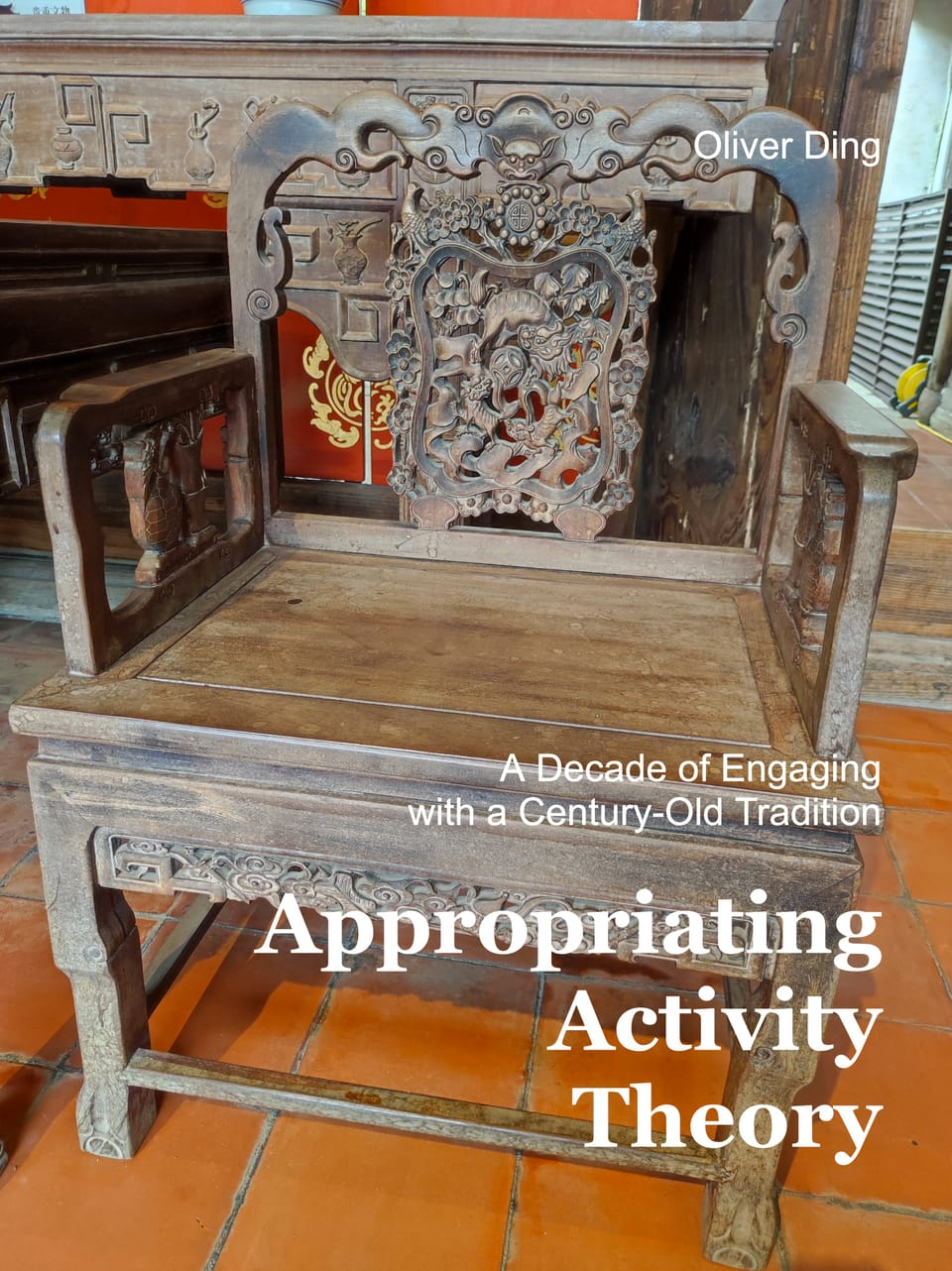
The chair in Yan Fu's former residence is the prototype case for Thematic Supportance. The full story is documented in "A Chair from a Hundred Years Ago" (Ding, 2026c). The case reveals a two-layer Curation structure.
First Layer: Curation by the Museum (Thematization of a Physical Object)
The chair began as an ordinary physical object—a piece of furniture from the late nineteenth century. Its transformation into a thematic object did not happen automatically. It was the result of a Curation act performed by the museum curators who preserved Yan Fu's residence and opened it to the public.
By placing the chair in the context of "Yan Fu's former residence"—a space already saturated with the meaning of his life and work—the curators embedded the chair in a symbolic system. The chair ceased to be merely a physical object; it became a thematic object. It now carried the theme of "East-West dialogue" that Yan Fu's life embodied. The entire residence, in fact, functions as a giant thematic object, with the theme of cross-cultural intellectual encounter embedded into its spatial structure.
This first-layer Curation is critical: it prepared the chair to offer Thematic Supportance to future visitors. A visitor who arrives at the residence does not encounter "a wooden chair" in the abstract. They encounter "Yan Fu's chair"—an object already thematized, already carrying a history of meaning.
Second Layer: Curation by the Visitor (Activation of Thematic Supportance)
In the summer of 2025, I visited Yan Fu's former residence. I photographed the chair—not with any specific purpose, but as an act of "appreciative photography," moved by its aesthetic presence. The photograph sat in my archive for several months.
In Sepetember 2025, I was preparing a new column on "Appropriating Activity Theory" for the Activity Analysis Center. I needed a cover image. The photograph of Yan Fu's chair surfaced from my archive. It was a perfect match—not because of its aesthetic qualities, but because it visually embodied the theme of the column: how concepts move across cultural boundaries, how one generation appropriates the intellectual resources of another.
I selected the photograph as the cover. I wrote the column. The chair, the photograph, and the theoretical frame were woven together. The chair triggered a further theoretical reflection: it led me to revise the Ap-Re-Co framework, extending it from a purely retrospective temporality to include prospective temporality.
The chair, in its afterlife, became a theoretical object—not just a thematic object, but an object that actively shaped theoretical thinking.
"The chair I photographed in appreciation, the chair that became a cover, the chair that triggered a theoretical reflection, the chair that now closes this book — these are not four different chairs. They are four moments in the life of a single object that has been repeatedly activated, each time in a context its maker could not have anticipated." (Ding, 2026c)
The Role of Thematic Supportance
The chair's Thematic Supportance—the possibility of engaging with "East-West dialogue" as a living theme—was not "given" by the chair alone. It was made available through the first-layer Curation (the museum's preservation and thematization) and perceived through the second-layer Curation (the visitor's photographing, selecting, and theorizing). The museum's act of preservation was an act of Curation that transformed the chair from a physical object into a thematic object. The visitor's act of selection and integration was an act of Curation that transformed the thematic object into a theoretical symbol.
This case shows that Thematic Supportance can attach to material objects when those objects have been thematized through Curation—whether by the owner of the life experience or by others. It requires the object's preservation, the availability of contextual knowledge, and a subject prepared to perceive the symbolization potential. Once the encounter occurs, the Thematic Supportance is there, waiting to be activated.
2.2 Case 2: Aria — Thematic Supportance in Situational Space Under Duress
Aria is a woman from East Asia who relocated to Bali in her mid-thirties to start a new life. Over the following years, she experienced a marital breakdown, a protracted legal battle, and personal crisis. During this period, she was detained for 42 hours in a police cell.
Unlike the Yan Fu case, where the initial thematization was performed by others, Aria is the owner and curator of her own life experience. She perceives Thematic Supportance directly from her lived experience and curates it into Creative Themes through her own writing and practice.
From the 2021 framework's perspective, her situation involved the progressive dismantling of her sources of support, across multiple dimensions:
- Affordance: her physical freedom was restricted.
- Social Support: her partner became adversarial.
- Institutional Support: the legal system became hostile.
- Informational Support: her public voice was constrained.
Yet she perceived Thematic Supportance within this situation. In her detention cell, she discovered something she later described as "consciousness free to go wherever it wants." The physical compression created the condition for a different kind of perception.
The actualization of these Thematic Supportances followed the three-phase structure of the 2021 model. In the Perception phase, she perceived, in the immediacy of her lived experience—the detention cell, the experience of riding on the beach, the natural environment—the potential for symbolization embedded in each. These were not later reflections; they were direct apprehensions of possibility within the experience itself.
In the Action phase, she engaged with these possibilities through embodied practice: meditation, painting, riding.
In the Curation phase, she transformed these experiences into shareable forms: public articles, a travel program, and frameworks for others.
The Creative Themes that emerged from these Curation operations include:
- "Soul Power" — the recognition of inner resources independent of external conditions.
- "Brief intensity" — the principle that a short, concentrated experience can generate sustained good feeling.
- "Gap, Grace, and Gift" — the name she gave to her travel program, a curated experience designed to share the Thematic Supportance she had found in Bali with others. The title reflects the three movements of her journey: the gap of displacement and crisis, the grace of encountering unexpected support, and the gift of passing it forward.
Unlike the Yan Fu case, where Thematic Supportance was attached to a material object in a preserved cultural setting, Aria's Thematic Supportance emerged from multiple sources across a situational space under duress. Her source of support was partially dismantled, but not entirely eliminated. The natural environment of Bali, animals, and spiritual practice remained as sources of Supportance, through which she perceived and actualized Thematic Supportances.
This case demonstrates the multiple-source configuration of Thematic Supportance. The 2021 model's third phase, Curation, is precisely this operation: the person can actualize multiple supportances from more than one source and make a configuration of supportances into a meaningful whole (The Concept of Supportance, Part 3.3).
2.3 Case 3: Viktor Frankl — Thematic Supportance in Extreme Ecological Compression
Viktor Frankl was a psychiatrist imprisoned in Nazi concentration camps during World War II. His family, profession, and future were annihilated. The ecological conditions were extreme:
- Affordance was compressed to the minimum—bare survival, forced labor, constant threat of death.
- Niche was impoverished—virtually no action possibilities beyond survival responses.
Like Aria, Frankl is the owner and curator of his own life experience. He perceived Thematic Supportance directly from his lived experience and curated it into a Creative Theme that has become a cultural resource for millions.
Frankl describes his discovery in his later work:
"Everything can be taken from a man but one thing: the last of the human freedoms—to choose one's attitude in any given set of circumstances, to choose one's own way."
This was not a "purely internal" discovery in a vacuum. It was a discovery made within a specific situational space—the concentration camp—through embodied, lived experience of deprivation, suffering, and observation of fellow prisoners. The camp was his situational space, just as Yan Fu's residence was the situational space for the visitor, and Mauritius was Aria's situational space.
What Frankl perceived was a Thematic Supportance embedded in the structure of extreme deprivation itself: the possibility that even when all external action is foreclosed, the subject can still choose their response to what is done to them.
The actualization of this Thematic Supportance followed the three-phase structure of the 2021 model. In the Perception phase, he perceived, in the immediacy of his lived experience in the camp, the possibility that response to what is done to him remained open even when all other action possibilities were foreclosed.
In the Action phase, he experimented with maintaining meaning, particularly through imagination of future reunion with his wife—a deliberate practice of choosing response under extreme conditions.
In the Curation phase, after liberation, he wrote Man's Search for Meaning and developed Logotherapy (meaning-centered therapy), transforming his lived experience into a Creative Theme that became a shared cultural resource for millions.
The Creative Theme that emerged from this Curation is the "Will to Meaning" —the proposition that the primary motivational force in humans is the search for meaning, and that this search can be sustained even in the most extreme conditions.
This case shows that Thematic Supportance does not require any material carrier. It can be directly embedded in the encounter between the subject and the structure of extreme situations. The concentration camp—like the detention cell, like the cultural heritage site—is a situational space in which Thematic Supportance can be perceived and actualized.
2.4 The Spectrum of Conditions Across the Three Cases
The three cases share the same theoretical structure—perception of Thematic Supportance through lived experience, actualization through action, Curation into Creative Theme—but they differ in two critical dimensions: the ecological conditions of the situational space, and who performs the Curation.
These cases form a spectrum. At one end, Yan Fu's chair represents Thematic Supportance in a stable cultural heritage setting where affordances are intact and the Curation that created the thematic object was performed by others. The museum curators preserved the residence and embedded the chair in a symbolic system. The visitor's subsequent Curation—photographing, selecting as a cover, integrating into theory—builds upon this prior thematization.
At the other end of the spectrum, Frankl's concentration camp represents Thematic Supportance in an extreme setting where affordances are compressed to near-zero and the Curation was performed by the subject himself. Frankl did not wait for others to thematize his experience. He perceived Thematic Supportance directly in the structure of extreme deprivation itself and curated it into a Creative Theme that has become a cultural resource for millions.
Aria's experience occupies the middle ground. Her affordances were partially compressed—some freedoms restricted, others (nature, animals, spiritual practice) remaining accessible. Her Leeway was partially dismantled, but not entirely eliminated. This allowed her to perceive and actualize multiple Thematic Supportances across her experience and configure them into a coherent new Life Coordinate—all curated by the subject herself.
The critical distinction revealed by this comparison is not about the presence or absence of Thematic Supportance—it is present in all three cases. Rather, it is about who performs the Curation. In the 2022 Creative Life Curation framework, I recognized that individuals can curate both their own life experience and the life experience of others. This distinction is now given concrete form through these three cases.
What unites them is this: in each case, Thematic Supportance was perceived and actualized through the same fundamental capacity—the human capacity to symbolize one's own lived experience (in the case of Aria and Frankl) or to engage with the symbolized experience of others (in the case of the visitor to Yan Fu's residence). The condition of the situational space shaped what kind of Thematic Supportance was available, how it was perceived, and how it was curated. But it did not determine whether Thematic Supportance was available. It was available in all three cases, because experience itself—any experience—carries the potential for symbolization, and Curation—whether performed by the self or by others—is the operation that actualizes this potential.
Part 3: Thematic Supportance in the Context
Over the past several years, I have worked with multiple theoretical traditions. Inspired by them, I developed several relatively independent knowledge frameworks. At the same time, I have also carried out cross-boundary connections between concepts across these frameworks.
The concepts of Curativity (2019) and Supportance (2020) belong to the Ecological Practice Approach. Both are inspired by Gibson's ecological psychology and focus on a range of potential action opportunities. Creative Life Curation (2022), while an application of Curativity, focuses specifically on how creators extract Creative Themes from life experience and use them for creative production. I place it within Creative Life Theory (v1.0, 2022).
The intersection between these two knowledge systems is Strategic Life Theory, which explores how creators develop strategic agency to navigate and advance their thematic enterprises. Within this framework, Creative Life Curation was extended into Strategic Life Narrative in 2024-2025.
By the end of 2025, my creative focus shifted from Knowledge Engagement to Cultural Development. The creator's thematic enterprise was no longer just a knowledge system but a cultural enterprise. This new direction is supported by GO Theory as a developmental platform, which in turn supports multiple theoretical projects, including Anticipatory Cultural Sociology, Cognitive Hydrology, Strategic Developmental Psychology, Platform Ecology, and others. What these projects share is a focus on how concept systems function and take effect in specific dimensions of social life.
Across all these projects, a central theme runs through them all:
How does individual life experience transform into collective cultural meaning?
The concept of Thematic Supportance not only extends Supportance Theory but also adds a key link between lived experience and Creative Themes—providing them with an ecological and embodied ground. In doing so, it contributes directly to the central theme of my theoretical work and supports all of these projects.
3.1 A Significant Aspect of Social Life
In 2022, while working on developing Creative Life Theory (v1.0), I made a curated framework to connect three different theoretical approaches, showing three paths of creative life.
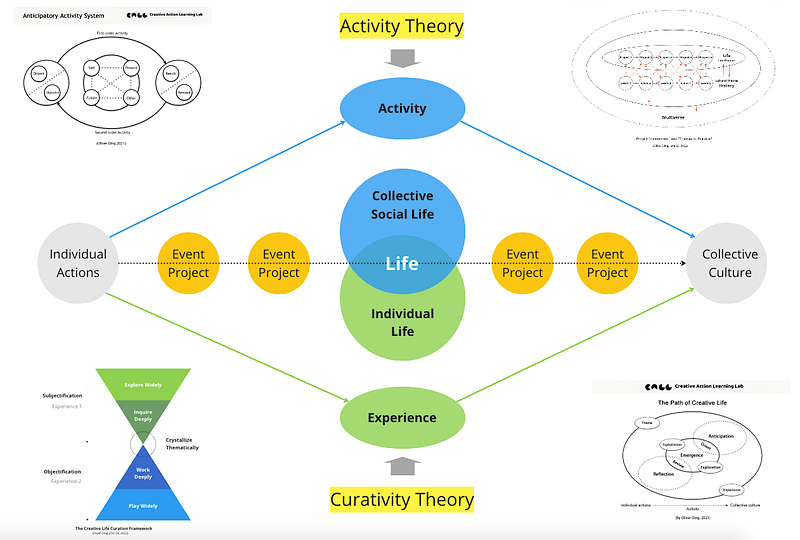
The above diagram highlights three theoretical approaches:
- Activity Theory
- Curativity Theory
- The Project Engagement approach
It also shows the following four frameworks:
- The Anticipatory Activity System (AAS) framework
- The Life—History Complex
- The Creative Life Curation framework
- The Path of Creative Life
The primary theme of the diagram is a significant aspect of creative life:
the transformation between Individual Actions and Collective Culture

Originally, I only considered “Activity” as the mediation of the transformation in 2021. However, I realized that this is one path of creative life. If we adopt more theoretical perspectives, we can find more paths to the creative life.
- Path 1 — Activity Theory
- Path 2 — Curativity Theory
- Path 3 — Project Engagement
At that time, I adopted Ping-keung Lui’s theoretical sociology as a reference frame to curate three paths and four frameworks together.
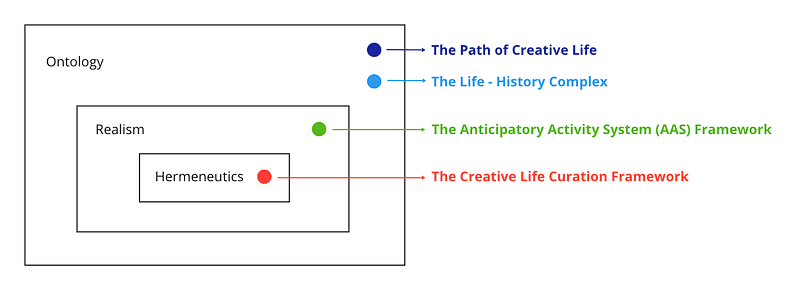
The diagram uses Lui’s nested structure to connect my four frameworks. It’s clear that these frameworks are located at different layers.
- Ontology: The Path of Creative Life and The Life — History Complex
- Realism: The Anticipatory Activity System (AAS) Framework
- Hermeneutics: The Creative Life Curation Framework
If we put Thematic Supportance in this framework, then it should be located in the middle between Realism and Hermeneutics because it connects real actions of creating new themes and perceiving the Thematic Supportances.
3.2 Thematic Supportance and Creative Thematic Curation
Creative Life Curation (2022) addressed the question from the perspective of "turning experiences into themes"—the individual's work of extracting meaning from their own experience. The core question was: how do we curate our life experience into Creative Themes that can be shared? The framework recognized that individuals can curate both their own life experience and the life experience of others—a distinction now given concrete form through the three cases in this article.
The primary model of Creative Life Curation book draft is the Creative Thematic Curation model.
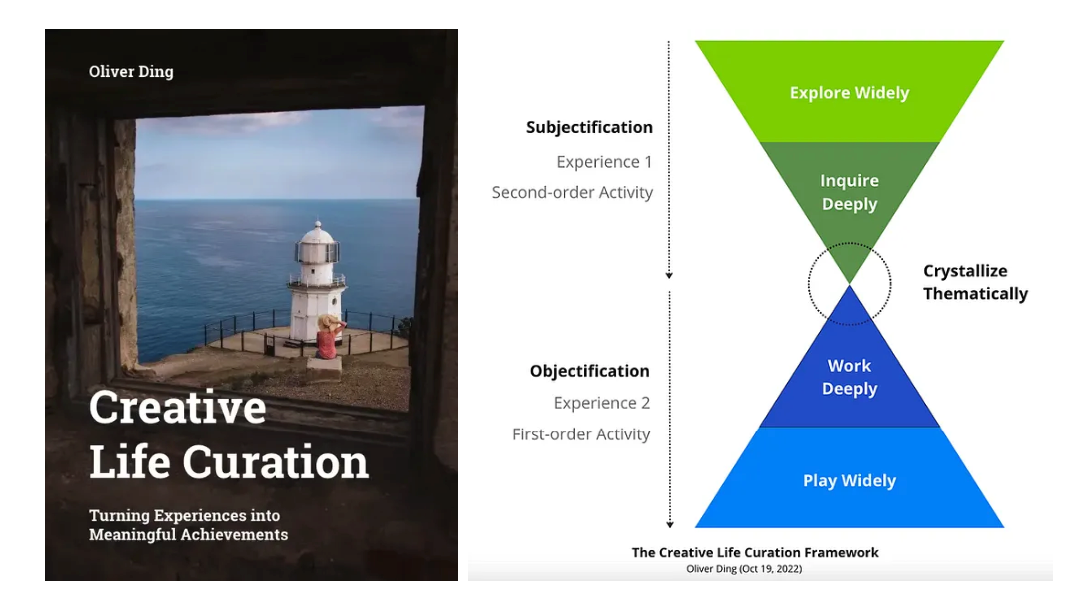
The model uses five stages to understand the development of a thematic enterprise.
- Explore Widely
- Inquire Deeply
- Crystallize Thematically
- Work Deeply
- Play Widely
It also highlights two tendencies:
- Subjectification - Experience 1: turning the world into a person’s experience. This echoes Second-order Activity.
- Objectification - Experience 2: turning the person’s experience into artifacts for the world. This echoes First-order Activity.
These terms link to General Curation Framework and the Anticipatory Activity System (AAS) framework.
The key transformation between Experience 1 and Experience 2 is Crystallize Thematically – the process of discovering a match between individual life themes and collective cultural themes.
If we connect Thematic Supportance to the Creative Thematic Curation framework, it offers the ecological and embodied ground to all five stages of the model. The capacity to perceive Thematic Supportance—the symbolization potential embedded in lived experience—is what makes each stage possible:
- Explore Widely: the ability to perceive Thematic Supportance across diverse sources of experience.
- Inquire Deeply: the ability to engage with Thematic Supportance through sustained attention and action.
- Crystallize Thematically: the ability to actualize Thematic Supportance into a Creative Theme that bridges individual and collective meaning.
- Work Deeply: the ability to build upon crystallized themes through continued practice.
- Play Widely: the ability to share and adapt themes across different contexts and audiences.
Thematic Supportance, in this sense, is not one additional stage in the model. It is the underlying condition that enables the entire process—the embodied ground upon which the work of Creative Life Curation is built.
3.3 Thematic Supportance and Strategic Life Narrative
From November 2024 to January 2025, I worked on the Strategic Life Narrative project, which serves as a continuation of the 2022 Creative Life Curation book draft. The project follows a nested structure — Strategic Life Narrative (Creative Life Curation) — establishing an ontological foundation for understanding how creators navigate their creative lives.
Throughout 2023 and 2024, I practiced the Creative Life Curation method personally, accumulating firsthand case materials. At the same time, I developed Creative Diagramming and Thematic Space Theory, two methodological projects that informed a series of Creative Life Curation case studies. The Strategic Life Narrative project synthesizes insights from these cases and expands the original five units of analysis into twelve thematic rooms, organized into three groups: Theme (Clues, Themes, Concepts, Frameworks), Practice (Actions, Projects, Dialogue, Journey, Landscape), and Space (Works, Centers, Platforms).
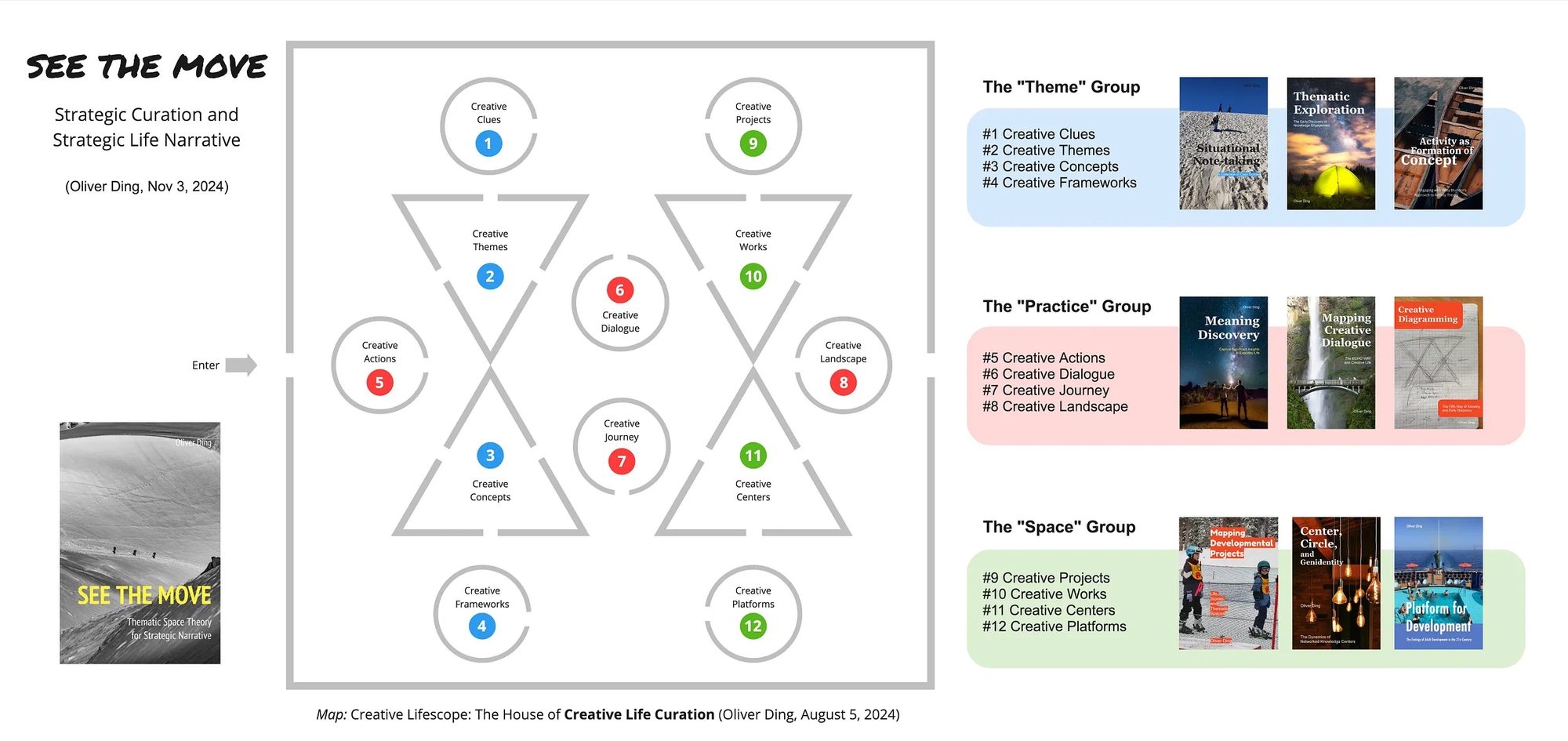
The difference between Creative Life Curation and Strategic Life Narrative can be summarized in three key aspects:
- Purpose — Creative Life Curation extracts themes from individual experiences and refines them into creative resources, leading to the production of works. Strategic Life Narrative focuses on the strategic development of the individual — anticipating the future, capturing significant insights, and forming actionable next steps.
- Temporal Structure — Creative Life Curation primarily organizes past experiences. Strategic Life Narrative requires considering multiple temporal modes: past, present, and future.
- Interpersonal Interaction — Creative Life Curation starts as personal reflection and gradually expands to interpersonal collaboration. Strategic Life Narrative assumes a background of interpersonal engagement and communication from the outset.
These differences place Strategic Life Narrative within Strategic Life Theory — a broader framework concerned with how creators develop strategic agency to navigate and advance their thematic enterprises.
Methodologically, the recently developed RelationField framework (v3.0) offers a basic unit of analysis for Strategic Life Theory:
Subject - Subject (Subject - Object)
It incorporates a R-S-N-C mechanism, highlighting four aspects: Relation, Supportance/Support, Narrative, and Curation. While R and S refer to aspects of social environments, N and C refer to aspects of strategic agency.
Through this lens, Thematic Supportance appears as a key link between the two: it is a form of Supportance that is perceived and actualized through Narrative and Curation, connecting the relational field in which one lives to the strategic work of shaping one's creative life.
The Strategic Agency Framework, also part of Strategic Life Theory, features nine aspects of strategic agency: Anticipating, Performing, Discovering, Producing, Modeling, Unfolding, Storytelling (Narrative), Curating (Curation), and Perceiving.
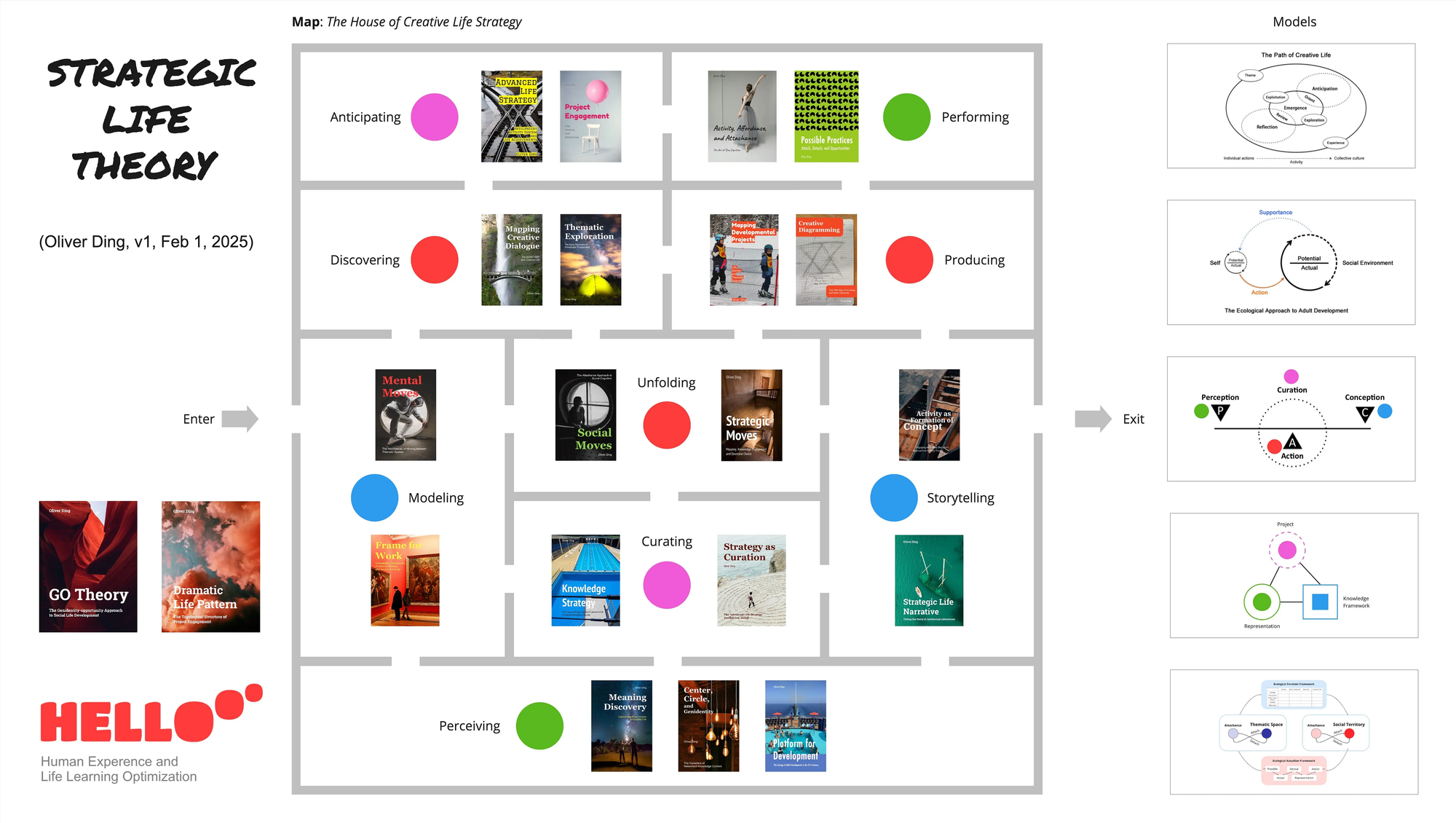
In the context of Thematic Supportance, several of these are directly relevant:
- Perceiving: the detection of Thematic Supportance in lived experience.
- Storytelling/Narrative: narrative and communication shape how Thematic Supportance is appropriated — the perspective from which it is perceived and framed. At the same time, the Creative Themes that emerge from appropriating Thematic Supportance have a reciprocal influence on narrative and communication, providing new material, new angles, and new stakes for storytelling.
- Curating/Curation: this is the key operational act through which Thematic Supportance is appropriated — the selection, configuration, and transformation of fragments into meaningful wholes. It also extends beyond the initial act of thematization, encompassing the ongoing work of curating Creative Themes into larger projects, frameworks, and cultural forms.
In this larger landscape, we see the position of Thematic Supportance and the RelationField Framework (v3.0) — not as isolated concepts, but as connecting points between the ecological foundations of lived experience and the strategic work of cultural creation.
3.4 Thematic Supportance, RelationField, and Go Theory
In early 2026, I used GO Theory to name the recently developed meta-theory as a theoretical platform to support all of my theoretical enterprises. Go Theory itself includes several frameworks as foundations, one of which is the HLS framework, defining an ontology of the social life world.
In recent months, I developed a series of concepts for the GO Theory project. Eventually, the following four concepts became my primary focus:
- Weave-points
- Living Coordinates
- Thematic Spaces
- RelationFields
On June 16, 2026, I placed these four concepts on the landscape of the HLS framework. The landscape made it clearer that they represent four units of analysis for the social life world.
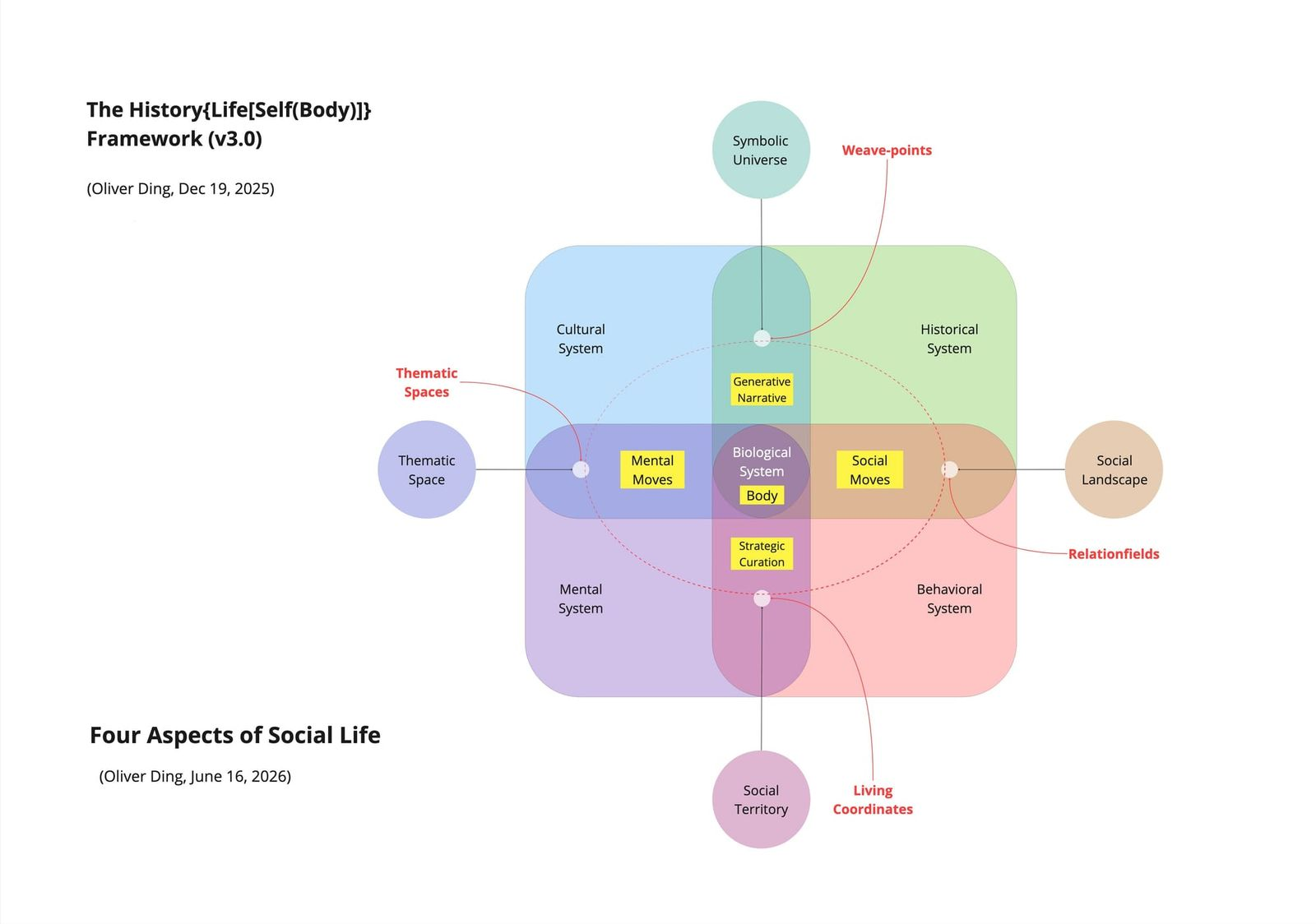
At that time, I knew that it was time to publicly use the term Gejunction to name the same thing behind these four concepts.
Within GO Theory, I define a Gejunction as a Unit of Synthesis. It is not a unit obtained through decomposition and analysis. Rather, it is a unit constituted through the synthesis of multiple dimensions of social life.
A Gejunction can be understood through four aspects.
- Thematic Spaces represent the thematic aspect. They reveal what a particular social life configuration is about and how attention, interest, and commitment become organized around a theme.
- Weave-points represent the symbolic aspect. They identify points where concepts, narratives, values, and meanings become woven together within a broader symbolic universe.
- RelationFields represent the relational aspect. They capture the intersubjective configurations through which people, resources, opportunities, and social environments are constituted.
- Living Coordinates represent the territorial aspect. They describe how a person becomes situated within a concrete life world.
These four aspects are not separate entities. They are four analytical perspectives on the same social unit.
A Gejunction appears as a Thematic Space when viewed from a thematic perspective. It appears as a Weave-point when viewed from a symbolic perspective. It appears as a Relationfield when viewed from a relational perspective. It appears as a Living Coordinate when viewed from a territorial perspective.
The ontological foundation of this formulation is the HLS Framework. Within HLS, social life unfolds across four interconnected dimensions: Symbolic Universe, Thematic Space, Social Landscape, and Social Territory. Gejunction does not belong exclusively to any one of these dimensions. Instead, it emerges at their intersection.
For this reason, Gejunction should not be understood as a static structure. It is continually generated and transformed through five mechanisms:
- Mental Moves
- Generative Narratives
- Project Engagement
- Social Moves
- Strategic Curation
These mechanisms contribute to the ongoing formation of thematic spaces, weave-points, relationfields, and living coordinates. Together they explain how agency and structure become intertwined within social life.
In this large context, Thematic Supportance is located at the RelationField section, corresponding to Social Landscape and Social Moves. It also connects to Strategic Curation and Generative Narrative through other units of analysis.
This connection will be explored in more detail in a separate article. Here, I note only that Thematic Supportance is not an isolated concept. It is the first step in a longer chain of cultural transformation.
Conclusion: A Gift That Cannot Be Taken
This article began with three scenes. Let us now return to them.
The chair in Yan Fu's former residence. The chair has survived for over a century. It has been preserved, displayed, and visited. But its survival alone does not explain what it offers. What it offers—the possibility of engaging with "East-West dialogue" as a living theme—depends on a visitor arriving with the capacity to perceive it. That capacity is not different in kind from what Aria brought to her detention cell, or what Frankl brought to the concentration camp. It is the capacity to perceive, in lived experience—whether one's own or another's—the potential for meaning, and to curate that perception into a form that can be shared with others.
The detention cell in Mauritius. Aria's body was confined, but her consciousness moved freely. This discovery was not a psychological trick or a denial of suffering. It was a perception of Thematic Supportance embedded in the experience of confinement itself. The cell could not "withhold" this potential from her. Once she was in the cell and perceived the possibility, it was hers. The external forces that put her there could not take it away.
The concentration camp. Frankl's situation was more extreme than Aria's, but the mechanism was the same. The camp could take everything else, but it could not take the possibility of choosing one's response. The Thematic Supportance within the experience was not a "consolation" or an "illusion"—it was a real action possibility embedded in the structure of the situation. Frankl perceived it, actualized it, and curated it into a Creative Theme that has become a cultural resource for millions.
These three cases, across different ecological conditions and different configurations of who performs the Curation, demonstrate the same fundamental structure:
Thematic Supportance is not given by the environment. It is perceived in experience. Its existence does not depend on anyone's permission, intention, or cooperation. It is grounded in the human capacity to symbolize one's own lived experience—a capacity that external forces can regulate (by shaping what one experiences) but cannot revoke (by eliminating the potential for meaning in experience).
Creative Life Theory's meta-question—"How does individual life experience transform into collective cultural meaning?"—finds its embodied ground in this capacity that cannot be taken away. The transformation is not guaranteed; it requires perception, action, and curation. But it is always possible, because the raw material for the transformation—Thematic Supportance—is always present in lived experience. And the Curation that actualizes this potential can be performed by the owner of the experience or by others—both are expressions of the same human capacity to turn life into meaning.
This is not a theory of optimism that denies suffering. It is a theory of possibility that recognizes the structure of human experience itself. What Frankl described as the "will to meaning" finds its ecological and embodied ground in Thematic Supportance—the recognition that even in suffering, the potential for meaning-making remains embedded in lived experience. The capacity to find meaning in suffering is not a consolation prize. It is the embodied ground upon which any life—in any condition—can become a source of meaning for others.
v1.0 - June 24, 2026 - 8,193 words