
Preface: One World, Many Dreams
Strategic Developmental Psychology
by Oliver Ding
July 5, 2026
This is the Preface of a new possible book: Strategic Developmental Psychology: Situation, Genjunction, and Supportive Self-Actualization.
1
On April 10, 2026, I released the landscape of Strategic Developmental Psychology (v1.2). In that article, I reviewed the seed of the SDP project and its historical development. A diagram was designed to represent three focuses and five orientations of SDP.
Some ideas of v1.2 of SPD were by-products of the Anticipatory Cultural Sociology (ACS) project. Inspired by the ACS's sign, I also design a sign for the SDP project.
The SDP sign, finalized on April 9, 2026, consists of three concentric, center-aligned elements:
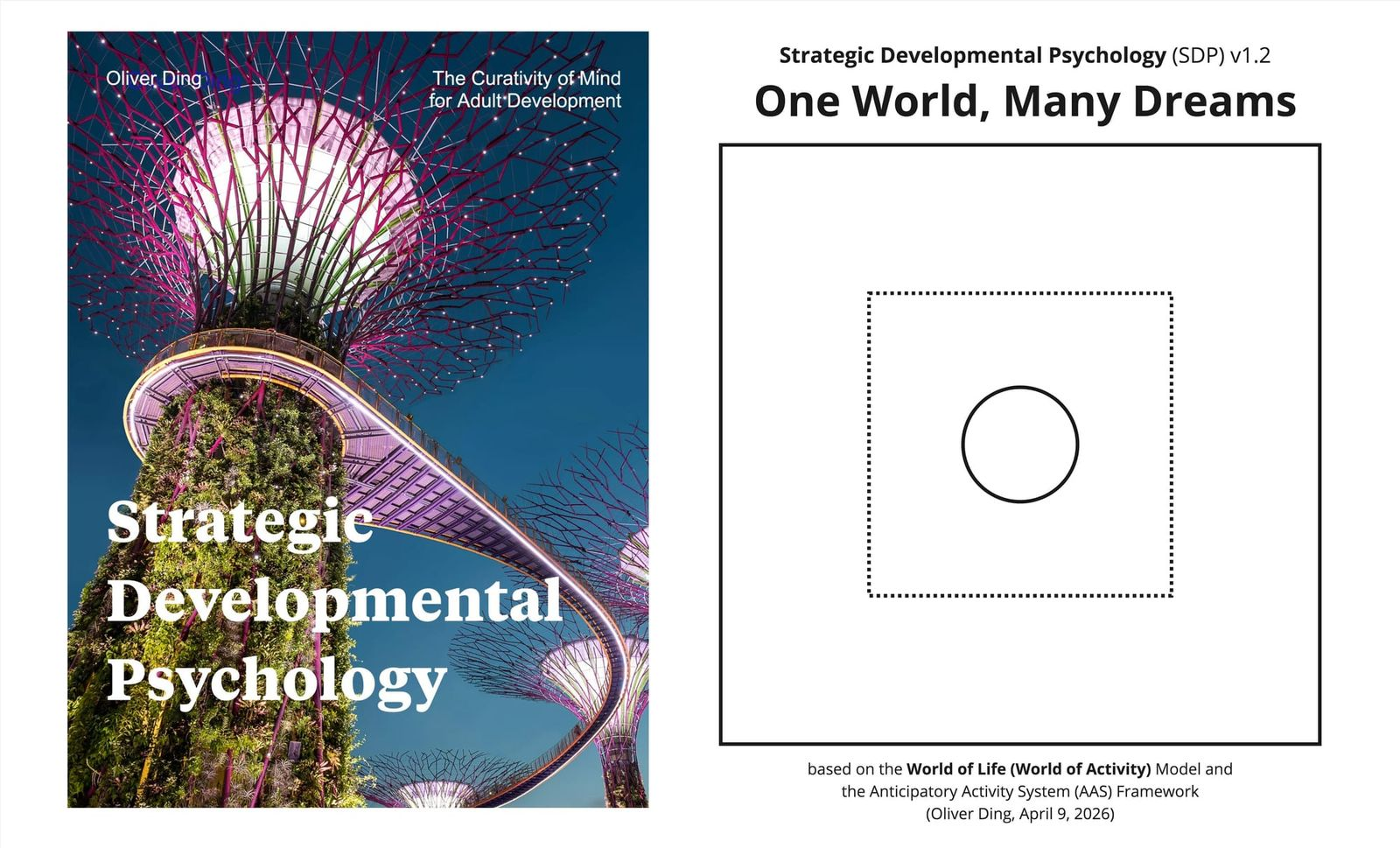
- Outer solid square — World of Life: the shared boundary of the social world
- Inner dashed square — World of Activity: each person's creative space, elastic and variable in size
- Solid circle, centered — the core of AAS: Self–Other–Present–Future
One World, Many Dreams.
The tagline requires careful interpretation. "Dream" here does not refer to the unconscious material of psychoanalytic tradition — Freud's dream as a window onto repressed desire. Nor does it refer to the short-term goals of action psychology, the proximal targets that motivate behavior in the near term. SDP's "Dream" points to something harder and longer: a person's conscious, sustained anticipation of a future they want to make happen, together with the long-term commitments that orient their life toward it.
The kinds of dreams SDP is interested in are the kind that require strategy precisely because they are difficult. Creating a new cultural enterprise. Developing a new theoretical discipline. Building something that does not yet exist and cannot be achieved through a simple sequence of planned steps. This is why "Strategy" needed to be brought into developmental psychology at all. Losing weight is a goal; it requires motivation and technique, not strategy in the deeper sense. But developing a new cultural enterprise — building it from a vague anticipation into a structured, sustainable trajectory — requires something more specific: Strategic Frameworks that orient decisions across time, Mental Platforms that support sustained creative work, and a clear understanding of what a Developmental Enterprise is and how it grows. These three concepts define the core of SDP's theoretical concern.
SDP is not interested in psychological health as a topic in itself. But it is deeply interested in the person who is developing a new theory of psychological health, or building software that changes how people access mental health support. How does such a person develop mental platforms and strategic frameworks? How do they advance their enterprise across years and decades? These are SDP's questions.
2
Within the context of developmental psychology, the closest antecedent to SDP's use of "dream" is Daniel Levinson's work. In his 1978 book The Seasons of a Man's Life, Levinson introduced "The Dream" as a central construct in adult development — a loosely articulated vision of what one's life could become, formed in early adulthood, that serves as a vital source of meaning and direction. Unlike Freud's unconscious dreamwork, Levinson's Dream is conscious, forward-oriented, and deeply intertwined with the choices a person makes about work, relationships, and identity. He observed that this Dream often gets compromised or set aside during the years of building a stable life structure, only to resurface in midlife as a source of both distress and possibility — a signal that the old structure no longer fits and that something fundamental needs to be reexamined.
Levinson's insight was genuine and valuable: he recognized that a person's long-term anticipatory orientation toward their own future is not a peripheral curiosity but a central driver of adult development. He also saw that this orientation is not static — it can be buried, lost, and later recovered. These observations laid important groundwork.
Where SDP parts ways with Levinson is in the narrative he built around the Dream. Levinson's framework implicitly suggests a particular life script: the Dream emerges in early adulthood, is suppressed during the middle years of "settling down," and resurfaces in midlife as a demand for reconciliation or compensation. This is a single dramatic arc — one that maps neatly onto his broader "seasons" stage theory, but one that imposes a universal temporal template onto lives that do not, in fact, follow any such uniform schedule.
SDP takes a different view. The Dream, in our framework, is fundamentally about creative achievement — the sustained, deliberate effort to bring something new into the world that carries one's signature. And creative achievement does not require a single script. It does not require an early-life origin story followed by a midlife recovery. Creative insight can emerge at any stage of life — in one's twenties, forties, or sixties. What matters is not when it appears, but what happens next. Turning an insight into an achievement requires navigating a complex landscape of factors: the stage of one's career trajectory, the availability of supportive resources and relationships, the structural opportunities afforded by the social world, the capacity to build and sustain mental platforms over time. Some people arrive at their defining creative project early and sustain it for decades. Others find it late, after multiple detours. Still others live multiple creative lives in succession. There is no normative timeline.
This is precisely where strategy becomes relevant. Because if development followed a single predictable arc, you would not need strategy — you would only need patience. But when creative development is contingent on a dynamic interplay of personal, relational, and situational factors, and when these factors vary profoundly across individuals, then you need a way of thinking that helps a person understand their own unique configuration and act within it. That is what SDP offers: not a map of the seasons, but a framework for navigating the specific, irrepeatable landscape of one's own life — with its own constraints, its own resources, its own timing, and its own Dream.
3
The seed of SDP was planted in 2022, with the manuscript Advanced Life Strategy: Anticipatory Activity System and Life Achievements — the final volume in a four-book series that constituted my Creative Life Theory (v1.0). That series was never intended as a general theory of adult development. Its audience was narrower and more specific: knowledge creators — people whose lives are organized around the sustained production of novel cultural, intellectual, or practical contributions. The book aimed to provide a reference map for these creators, charting a path from creative insight to creative achievement.
In that manuscript, I proposed that life achievement — for knowledge creators, at least — is structured by three irreducible complexities.
The first is the "relevance" complexity. It concerns the Self–Other relationship — the support structure of life development. No creative achievement is produced in isolation. Every creator works within a network of others: mentors who open doors, peers who offer critical feedback, audiences who confer recognition, collaborators who share the load. The dynamics of this support structure can be understood through a sub-framework I developed called the Typology of Relevance — a way of mapping who matters, in what way, and at what stage of a creative trajectory.
The second is the "performance" complexity. It concerns the Competency–Challenge relationship — the basic structure of achievement itself. Creative work is not a single act but a sustained engagement: you bring a certain set of competencies to bear on a challenge that exceeds what you already know how to do. This unfolding dialectic between what you can do and what the work demands of you can be modeled through the Developmental Project Model, another sub-framework that traces how projects grow, stall, and transform as the creator grows alongside them.
The third is the "anticipation" complexity. It concerns the Past–Present–Future relationship — the temporal structure of development. A creative life is not a sequence of discrete events but a continuous process of looking back, acting now, and reaching forward. The anticipatory orientation — how a person models possible futures and lets those models shape present action — is central to how creative achievement unfolds. This temporal structure is captured by the Anticipatory–Performance Model, a framework for understanding how prediction and action interlace across time.
These three sub-frameworks are not independent modules. They are unified by a single overarching framework: the Anticipatory Activity System (AAS) .
The AAS framework draws on multiple theoretical resources — Activity Theory, Robert Rosen's Anticipatory System theory, and Relevance Theory — but its core concern is a specific structure: Self, Other, Present, Future. It models how a person, embedded in relationships and situated in time, orients toward what is not yet here and acts to bring it into being.
An Anticipatory Activity System has two parts. First-order Activity is the work of performing — executing tasks, producing outputs, engaging with the immediate demands of the present. Second-order Activity is the work of discovering — stepping back to ask what is worth doing, what might be possible, what future deserves to be pursued. In the context of life development, these correspond to Life Performance Activity and Life Discovery Activity — the ongoing dance between doing and reorienting, between executing and questioning.
At the heart of the AAS framework is what I call the Transactional Anticipatory System — a model of how the "Self–Other–Present–Future" configuration operates as a dynamic whole. It is a way of seeing that every creative act is simultaneously a performance (what I do now), a response (to others and to the world), and an anticipation (of a future I am trying to bring about).
This brings us to the concept of Predictive Models.
Robert Rosen, the founder of Anticipatory System theory, defined an anticipatory system as one that "contains an internal predictive model of itself and of its environment, which allows it to change state at an instant in accord with the model's predictions pertaining to a later instant." A reactive system merely responds to what has already happened. An anticipatory system's present behavior is shaped by its model of what is coming.
Rosen's theory is elegant but abstract. For the purposes of life strategy, I had to ask a more concrete question: What do predictive models actually look like in a creator's life?
I distinguished between two types. The General Predictive Model is a person's mind and knowledge — the entire cognitive infrastructure they bring to any situation. The Particular Predictive Model is developed for a specific project: a diagram, a mental map, a written plan, a tacit sense of how this particular endeavor is likely to unfold. Some creators keep these models internal; others externalize them as tools for thinking and communication. What matters is that they function as orienting devices — ways of anticipating what the future might require and adjusting present action accordingly.
4
That was 2022. Since then, these ideas have continued to develop.
The 2022 framework identified three irreducible complexities — Self–Other, Theme–Culture, and Life-history — unified by the Anticipatory Activity System (AAS) framework.
But as I reviewed the 2022 framework through the lens of the LARGE Method in early 2026 — the meta-method that governs all methods within the GO Theory platform — I noticed something the original three had overlooked. There was a fourth: Mind–Body.
In the 2022 manuscript, I had introduced Predictive Models as a technical concept within the AAS framework, but I had left the broader question of how the mind organizes knowledge and sustains strategic work to the psychologists. That assumption did not last. Over the following years, I developed The Curativity of Mind — a systematic account of mental moves, mental curation, and mental platforms as the infrastructure of creative agency — and explored Ecological Strategic Cognition, a study of how strategic thinking operates within thematic spaces. Together, they filled the gap.
The four complexities now stand as:
| Complexity | Core Relationship | What It Addresses |
|---|---|---|
| Relevance | Self–Other | The relational structure of development |
| Performance | Theme–Culture | The achievement structure of creative work |
| Anticipation | Life-history | The temporal structure of a life |
| Cognitive | Mind–Body | The cognitive architecture of the actor |
The following is a brief outline of the key developments; each is elaborated in the relevant chapters of this book.
For the relevance complexity — the Self–Other relationship — three interconnected developments reshaped the foundation.
- The Three-layer Model of Self replaced the unitary, present-moment conception of self with a stratified view: Sub-individual, Individual, and Supra-individual.
- The RelationField Framework introduced a new unit of analysis — Subject–Subject (and its derivative, Subject–Object) — moving beyond the individual-as-container to see relationships as fields of mutual constitution.
- And Supportance Theory matured from a nascent concept into a full theoretical framework, offering a systematic account of how others enable, constrain, and co-shape a creator's trajectory.
For the performance complexity — the Competency–Challenge relationship — several new tools and methods emerged.
- The Activity-Enterprise-Platform triad offers three distinct views of creative work: Activity as the external, historical sequence of events; Enterprise as the internal, developmental trajectory of an individual creator's sustained project-based work; and Platform as the enabling, structural infrastructure that supports the work of many other creators.
- Supportive Life Discovery provides a method and practice for exploring supportive life discovery, forming the core of the second-order activity within AAS.
- Dramatic Life Pattern offers a series of project-engagement patterns and a self-study method for discovering new patterns.
- The Curativity of Mind supplies a set of models — mental moves, mental curation, mental platform — for developing strategic agency.
- And the Five-ring Orientation model highlights five fundamental orientations: Weave, Discover, Design, Deliver, and Learn.
For the anticipation complexity — the Past–Present–Future relationship — the temporal dimension is now situated within the broader framework of the diachronic–synchronic interweaving. This has given rise to gejunction as a new integrative unit within SDP, with four distinct faces:
- as a RelationField, it is a structure of Subject–Subject (Subject–Object) relations;
- as a Living Coordinate, it is a position within the person's own developmental territory;
- as a Weave-point, it is a symbolic site where concepts, narratives, values, and meanings become woven together;
- and as a Thematic Space, it is a cognitive container where attention, interest, and commitment become organized around a theme.
For the cognitive complexity — the Mind–Body relationship — several developments have taken shape:
- The Curativity of Mind supplies a set of models — mental moves, mental curation, mental platform — for developing strategic agency.
- Ecological Strategic Cognition offers a study of how strategic thinking operates within thematic spaces, organized around the concept of strategic themes (objects + operations) and grounded in Thematic Space Theory.
- Strategic Agency presents the study of action patterns derived from empirical life cases, identifying recurring patterns and the strategic responses they afford.
- And Strategic Mind presents the study of cognitive structures derived from the AAS framework, identifying nine aspects of strategic cognition.
5
The expansion from three to four complexities was not the only development. Over the past several years, my work on adjacent theoretical projects — each with its own trajectory — has matured to the point where it no longer stands apart from SDP but feeds directly into it.
The Ecological Practice Approach, which reached v4.0 in 2025, centers on a series of theoretical concepts about action opportunities. In late June 2026, I completed a manuscript titled Supportance: Self, Other, and Possible Support, which systematically explores supportance as a specific type of potential supportive action opportunity offed by social environments. What began as a project inspired by ecological psychology has now, in its mature form, found its way back into psychology through SDP.
Similarly, my work in the tradition of Activity Theory — pursued under the banner of Life-as-Activity (v3.0) — has recently been consolidated in two manuscripts: Weave the Life and Weave the Theory. Activity Theory, with its insistence on activity as a long-term, historically situated unit of analysis, offers something that North American psychology, with its focus on short-term actions and behaviors, has largely lacked: a conceptual vocabulary for understanding development at the scale of a life. The Activity–Enterprise–Platform triad — one of the tools that emerged from this line of work — is built precisely on this long-term conception of activity. It gives SDP a vocabulary for understanding how a creator's sustained, project-based trajectory (Enterprise) and the enabling infrastructure that supports others (Platform) relate to the historical sequence of their work (Activity).
These projects were not originally conceived as contributions to SDP. They had their own questions, their own trajectories. But as they matured, their concepts turned out to be exactly what SDP needed — not as imports from outside, but as convergences from neighboring territories. Together, they point toward a new arc in SDP's development: from Gejunction (where a life's critical intersections become visible), through Actualization of Opportunity (the recognition and enactment of possibility), to Strategic Cognition (the mental and ecological capacities that make strategic action possible). It is, in essence, a theory of how a person moves from seeing their situation to acting within it.
6
Most importantly, at the meta-framework level, we have developed a series of foundational frameworks that constitute the theoretical infrastructure of SDP.
- Self-Life-Mind has long been a heuristic tool within SDP, and has recently been used to re-examine core psychological concepts such as self, belief system, situation, and development.
- World of Activity offers an ecological perspective on the largest category of individual activity and its morphological structure; its FFCC model (Flow-Focus-Center-Circle) has generated multiple empirical case studies in adult development.
- GO Theory — formerly the HLS Framework (v3.0, 2025), now called The World of Life (World of Activity) Approach — provides an ontological grounding for social life.
- Ecological Formism addresses the epistemological level, attending to four layers of knowledge: variables, quasi-invariants, invariants, and invariant sets.
- And the LARGE Method (v3.0, 2026) serves as the meta-method governing all methods within the GO Theory platform.
These developments are elaborated in the chapters that follow. They did not replace the original AAS framework. They enriched it, adding new layers of precision while preserving the core insight that creative life is an anticipatory, relational, and performative enterprise.
And what is the purpose of navigating all of this — situation, gejunction, anticipatory modeling, relational support? The book's title names it: Supportive Self-Actualization. It is SDP's answer to the question of what development is for. Reconceived within the three-layer architecture of Self (Sub-individual, Individual, Supra-individual) — developed through the structure of Persons Acting in Concert and navigated within the social ecology of the World of Life — it is the ongoing anticipatory activity by which a Self, accompanied by another, moves from ecological potential to enacted actuality. It is what the entire strategic apparatus of SDP ultimately serves.
This returns us to where we began: the Dream. How do people actually realize their dreams? Call that the Levinson Problem — setting aside his seasonal framework. SDP is a response to that problem. And now the Dream has an academic name: Supportive Self-Actualization. In this manner, the Dream is a strategic development activity that unfolds in a supportive environment.
7
This book is not the first in this journey. Between 2022 and 2025, I wrote a series of new manuscripts, each extending or refining a piece of the framework.
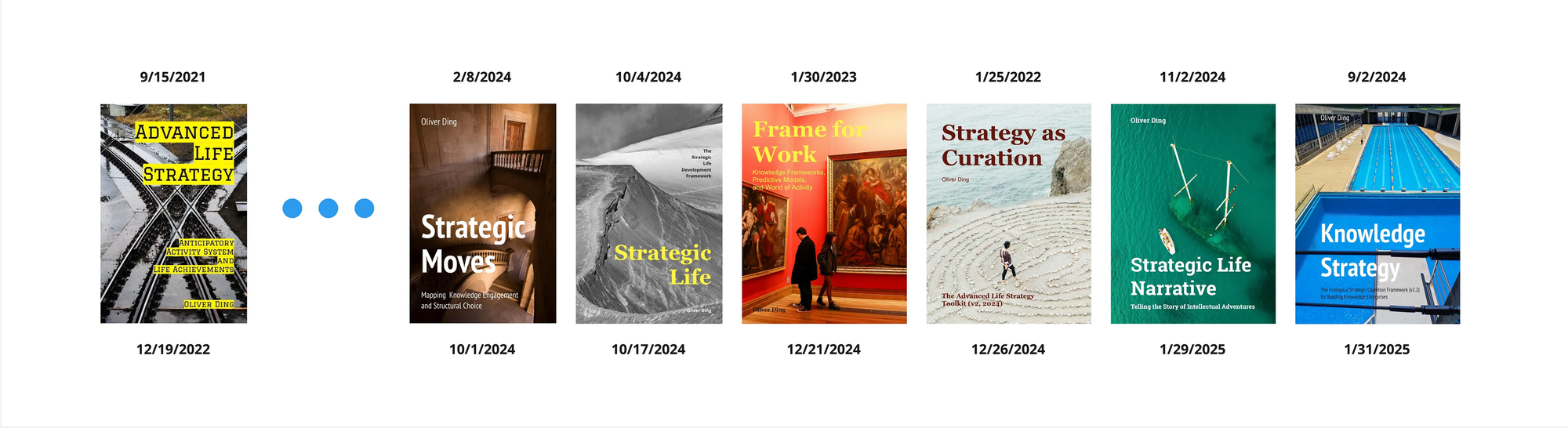
By 2025, these had been curated into a more coherent body of work under the title Strategic Life Theory — a natural evolution from Creative Life Theory (v1.0), with the same focus on knowledge creators but with a richer conceptual apparatus. More details can be found in The Journey of Strategic Life Theory (V1, 2025) and its Landscape.
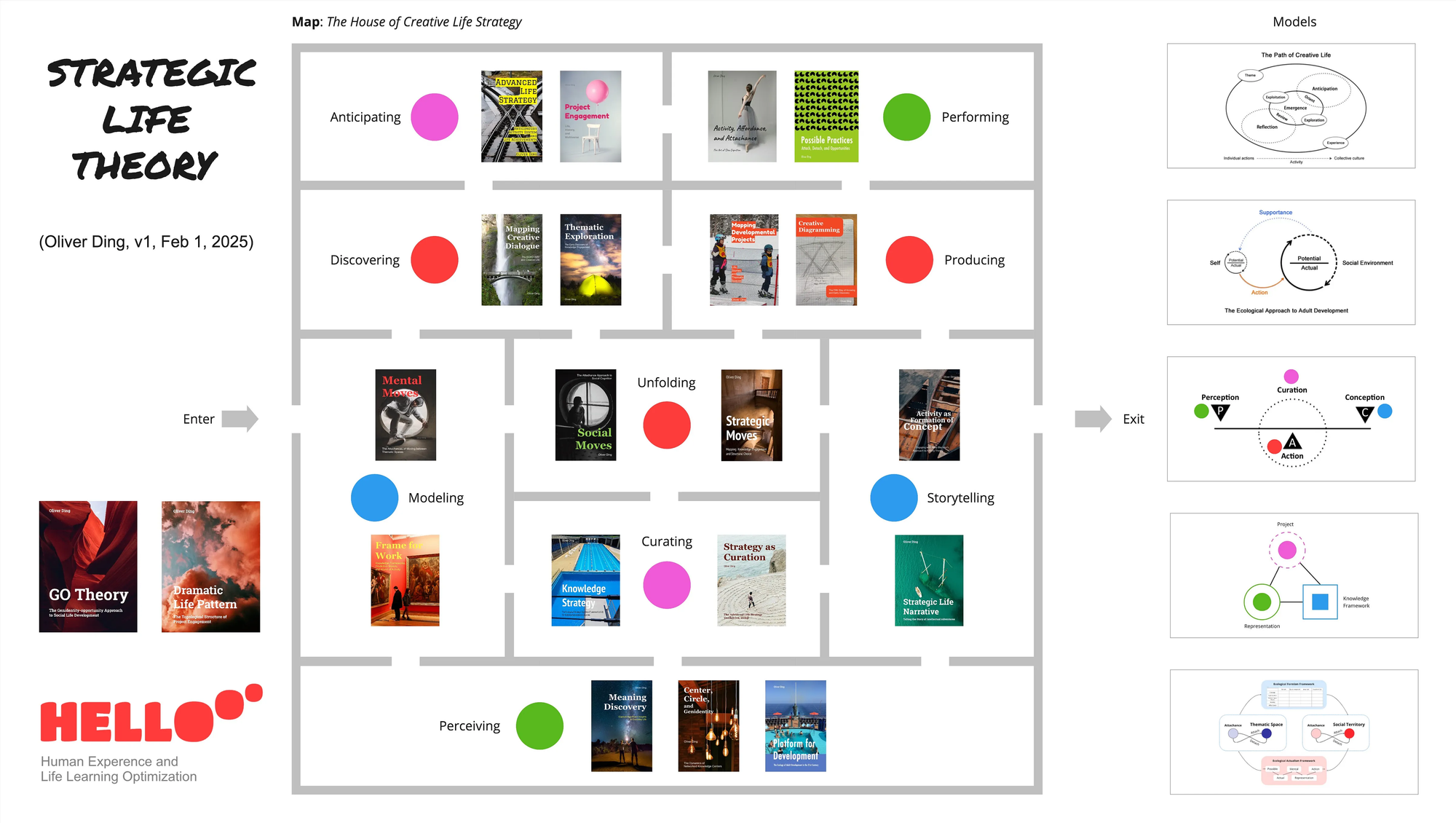
The present book continues this trajectory. But it also moves to a different level — what I think of as the Meta-theory level. The chapters that follow do not simply apply the AAS framework or elaborate its sub-frameworks. They step back to examine the theoretical architecture itself: the definition of "Self" and its multiple registers; the methods for studying life patterns; the relationship between concept systems, belief systems, and strategic frameworks. These are not settled questions. Many of them remain open. They are not the answers SDP has already produced; they are the directions SDP is still exploring.
I mention this not as a confession of incompleteness, but as a statement of intent. Strategic Developmental Psychology is not a closed system. It is a developing enterprise — and like all developmental enterprises, it carries within itself the seeds of its own revision. Some of the frameworks introduced here will be refined in future work. Some may be replaced. That is not a weakness. It is the structure of any theoretical project that takes development — not just as its subject matter, but as its own mode of being — seriously.
What you hold in your hands is not the final word. It is an account of where SDP stands at this moment — and an invitation to see where it might go next.
v1.0 - July 5, 2026 - 3,523 words