
SDP: Revisiting the "Situation" Issue from the Self-Life-Mind Perspective

by Oliver Ding
July 5, 2026
This paper is part of the Strategic Developmental Psychology (SDP) project.
This paper works with four things at once, and it is worth naming all four before the formal argument begins.
The first is a meta-framework: the Self-Life-Mind (SLM) schema, introduced in an earlier paper in this series. SLM does not, by itself, answer any empirical question. It supplies a vocabulary — units of analysis versus a unit of synthesis — that is used throughout this paper to diagnose where existing psychological theories fall short, without committing to what should replace them.
The second is a debate: psychology's long argument over situation, most visible in personality psychology's person–situation debate, but recurring, this paper argues, in different vocabulary across at least two other major controversies in the discipline. Parts 2 through 4 take this up directly.
The third is a related but distinct concept: environment. Environment followed an almost entirely separate disciplinary path from situation — rooted in the study of behavior and cognition rather than personality — and turns out to have produced, in ecological psychology's transactionalism, a genuine historical alternative to situation's decompositional method. That alternative has never generalized beyond its own institutional bounds. Part 5 takes this up.
The fourth is a question that motivates the whole inquiry but is not answered here: what would it take for psychology to have a proper theoretical concept of strategy? Part 6 closes by returning to this question and points to where its answer is worked out.
Contents
1. Introduction
2. Three Debates, One Divide
2.1 A Common Axis: Stability versus Dependency
2.2 The Person–Situation Debate
2.3 The Nomothetic–Narrative Debate
2.4 The Brain–Environment Debate
3. A Self-Life-Mind Analysis of the Three Debates
3.1 Units of Analysis and the Unit of Synthesis
3.2 The Person–Situation Debate Revisited
3.3 The Nomothetic–Narrative Debate Revisited
3.4 The Brain–Environment Debate Revisited
3.5 Summary: Situation as a Unit of Analysis, Not of Synthesis
4. What the Comparison Reveals
4.1 The Anti-Dualist Heuristic as a Diagnostic Lens
4.2 A Gradient, Not Three Separate Problems
4.3 The Shared Assumption None of Them Drops
5. From Situation to Environment
5.1 Ecological Psychology versus Environmental Psychology
5.2 Root Metaphors and the Genealogy of Isolation
5.3 Interactionism versus Transactionalism as a Unit-of-Analysis Distinction
5.4 Barker's Warning and the Differentiation Pattern
5.5 Subjective Complexity, Ecological Complexity, and the Limits of Institutional Quarantine
6. Conclusion
6.1 What the SLM Lens Reveals
6.2 An Open Question: What Would This Mean for a Theory of Strategy?
References

1. Introduction
The two previous papers in this series addressed, in turn, the "self" issue and the "belief" issue. Revisiting the "Self" Issue diagnosed a tripartite confusion in which the self is asked to serve simultaneously as ontological presupposition, empirical variable, and explanatory construct, and proposed the Self-Life-Mind (SLM) schema — Self, Life, and Mind as analytically distinguishable but ontologically inseparable aspects of a single whole — as a way out of the confusion. Revisiting the "Belief" Issue took up a parallel problem in a different domain, showing that no existing account of belief — propositional, probabilistic, or generative — was built to address belief system transformation as a whole-person developmental phenomenon, and that SLM's heuristic questions could organize an existing toolkit (World of Activity, Creative Life Theory) to fill the gap.
This paper takes up a third issue: situation. Psychology's history contains several deep and recurring controversies, in personality psychology, in the study of identity and explanation, and in cognitive science, that on the surface look like disputes about entirely different subject matter but that share a common underlying structure — a structure this paper argues has never been properly resolved, because it has never been examined through a lens capable of holding a person's self, life, and mind together as a single unit rather than pulling them apart.
The argument proceeds in five stages.
- Part 2 reviews three of psychology's most consequential internal debates — the person–situation debate in personality psychology, the nomothetic–narrative debate over modes of psychological explanation, and the ongoing brain–environment debate in cognitive science — and shows that all three are regional expressions of a single deeper divide.
- Part 3 uses the Self-Life-Mind (SLM) meta-framework's own vocabulary — units of analysis versus a unit of synthesis — to revisit all three debates in turn, showing that each is a distinct case of the same underlying error.
- Part 4 applies the anti-dualist heuristic already developed elsewhere in this body of work (in the analysis of Activity Theory's genidentity) to ask, of each debate, whether and how the divide was resolved, and finds that even where resolution was achieved, a shared methodological assumption was never dropped.
- Part 5 traces that assumption to its deeper roots — a split among psychology's guiding world views, and a historical alternative, ecological psychology's transactionalism, that resisted the assumption but never generalized beyond the study of physical and social environments.
- Part 6 concludes, and closes with an open question this diagnosis raises for theory development elsewhere.
2. Three Debates, One Divide
Psychology's history contains several deep and recurring controversies that, on the surface, look like disputes about different subject matter — personality, modes of explanation, cognition — but that share an underlying structure. This section reviews three of them.
2.1 A Common Axis: Stability versus Dependency
Before examining the debates individually, it is worth naming the axis they share: is the relevant explanatory locus internal and stable, or external and situationally dependent? Trait psychology says the person carries stable dispositions; situationism says behavior is a function of the immediate context. The paradigmatic mode of explanation seeks universal, phylogenetically inherited mechanisms; the narrative mode says psychological meaning is a historically and culturally specific construction. Classical cognitivism says cognition is computation internal to the brain; ecological and enactivist approaches say cognition is constituted in the coupling between organism and environment. In each case, one pole locates the explanation inside a bounded, temporally stable unit; the other locates it in the organism's ongoing relation to something outside itself.
This is not a coincidence of vocabulary. It is the same epistemological fault line running through three different regions of the discipline, each region having developed its own name for the same disagreement.
2.2 The Person–Situation Debate
Personality psychology's foundational assumption — that stable traits (measured, for instance, by the Big Five) predict behavior across situations — was directly challenged by Walter Mischel's 1968 book Personality and Assessment. Mischel's central empirical finding was that cross-situational consistency correlations for personality traits rarely exceeded about 0.3 — the so-called "personality coefficient" — suggesting that situational factors, not stable dispositions, were doing most of the explanatory work in predicting behavior.
The first response was Endler and Magnusson's interactionism: behavior is a joint function of the person and the situation, modeled statistically as a person × situation interaction term. This was a genuine advance, but it left the underlying dualism intact — person and situation remained two independent variables entered into the same equation, not two aspects of a more fundamental unity.
A deeper resolution came later, with Mischel and Shoda's (1995) Cognitive-Affective Personality System (CAPS) and its behavioral elaboration in Fleeson's Whole Trait Theory. CAPS redefined personality itself: rather than a fixed disposition, a person's personality is the stable if-then signature of how they behave across different situation types — this person behaves one way under condition A and another way under condition B, and it is the pattern of variation itself, not any single behavior, that is stable and distinctively theirs. This is a genuine instance of the anti-dualist move: person and situation are no longer external to each other, competing for explanatory credit, but are woven into a single higher-order unit — the if-then profile — of which each is now an internal moment.
But the story does not end with CAPS. In parallel, the study of situations developed into a dedicated research specialty in its own right, most visibly documented in The Oxford Handbook of Psychological Situations (Rauthmann, Sherman, & Funder, 2020) — thirty-one chapters, more than fifty contributors. Notably, the handbook does not present this as a break from personality psychology: its own framing describes the psychological assessment of situations as "a new and rapidly developing area of research, particularly within the fields of personality and social psychology" — a specialization organized around situation itself, but still housed within, not split off from, the disciplines that produced the original debate. Even so, even as "behavior is a function of an interaction between the person and situation" had become a truism, the situation side of that truism had been comparatively under-theorized, and this specialty set out to correct the imbalance.
What did that correction look like in practice? Rauthmann's own DIAMONDS taxonomy — Duty, Intellect, Adversity, Mating, Positivity, Negativity, Deception, Sociality — decomposes any given situation into eight measurable dimensions, in direct structural parallel to the Big Five's decomposition of personality into five trait dimensions. Situational psychology, in other words, did not escape the decompositional assumption that trait psychology had always carried. It reproduced that assumption on the other side of the ledger. Whatever distinctiveness the specialty won for itself was a distinctiveness of subject matter, not of method.
2.3 The Nomothetic–Narrative Debate
The clearest staging of this debate is not a paper about identity but a paper about modes of explanation itself. Jerome Bruner's (1986) Actual Minds, Possible Worlds argued that human cognition operates through two fundamentally different modes: the paradigmatic (or logico-scientific) mode, which seeks formal propositions subject to empirical test and organizes explanation around general, context-independent laws; and the narrative mode, which organizes experience into particular, temporally structured, meaning-laden stories. Bruner's claim was explicit and strong: the two modes are complementary but irreducible to one another — neither can be translated into the other without losing what made it distinctive.
Evolutionary psychology (Tooby and Cosmides, 1992; Buss, 2019) is the paradigmatic mode's most ambitious recent instantiation within the study of the mind. Its explanatory strategy is thoroughly nomothetic: human psychological mechanisms — mate preferences, kin altruism, threat detection, and the like — are treated as domain-specific, computational adaptations shaped by natural selection, holding across individuals and cultures by virtue of a shared evolutionary history. The explanatory arrow points backward to a universal ancestral environment, not forward or inward to any particular life.
Narrative psychology, in the tradition Bruner helped found and that Sarbin and others extended, takes the opposite starting point: the phenomena that matter most about a psychological life — its meaning, its coherence, its direction — are not explained by universal mechanism but constructed, through the stories a person builds about their own particular, historically and culturally situated existence. Where the nomothetic mode explains by subsuming the particular case under a general law, the narrative mode explains by rendering the particular case intelligible on its own terms.
The most influential integration of the two modes, within personality psychology specifically, comes from Dan McAdams's tripartite model (McAdams, 1995; McAdams & Pals, 2006). The model distinguishes three layers: dispositional traits (temperament-level, closest to what a nomothetic, evolutionarily informed account addresses), characteristic adaptations (situated, contextualized goals and strategies), and integrative life narratives (the culturally and historically shaped story a person constructs to give their life coherence). By nesting the nomothetic layer inside a larger, narratively organized architecture — rather than treating paradigmatic and narrative explanation as two rival accounts of the same phenomenon — McAdams performs the same anti-dualist move already seen in CAPS: what Bruner had declared irreducible becomes, in this architecture, two layers of a single hierarchically organized system.
This resolution is now close to a working consensus within academic personality psychology; McAdams's model appears in the field's standard textbooks. But Bruner's original claim of irreducibility has not disappeared from the wider discourse. The nomothetic/narrative divide persists vigorously outside the specific context in which McAdams resolved it — most visibly in the recurring public friction between evolutionary psychology and its critics, who continue to object, in essentially Brunerian terms, that a universal mechanism cannot do justice to a meaning that only a particular history can carry. The gap between an achieved theoretical integration in one subfield and its incomplete diffusion elsewhere is itself worth noting: a resolution can exist and still fail to dissolve the dualism at the level of the discipline's wider self-understanding.
2.4 The Brain–Environment Debate
Classical cognitivism treats cognition as computation performed by the brain on internal representations, with the body and environment supplying inputs and receiving outputs but playing no constitutive role in cognitive processing itself. Gibson's ecological psychology rejected this picture at the root, arguing that perception is direct — that an organism picks up affordances, action possibilities structured into the environment itself, without the mediation of internal representation. The "4E" movement that followed (embodied, embedded, enacted, extended cognition — Clark, Varela, Thompson, Rosch, and others) generalized Gibson's challenge into a broad research program contesting the brain-bound picture of mind.
Of the three debates surveyed here, this is the least settled and the most actively contested. The predictive processing and Free Energy Principle literature (Friston, Clark, Hohwy) has become the primary site where reconciliation is being attempted — and the attempts themselves have split into competing camps, with predictive coding (Hohwy) keeping explanatory priority with the brain and predictive processing (Clark) extending it to the whole embodied organism.
A recent and instructive case is Candeloro, Napolione, Tolone, and Sacco's (2026) paper, "The Yinyang of Cognition," which argues that the apparent opposition between predictive processing and enactivism dissolves once the two are recognized as operating at different levels of analysis, serving different explanatory purposes — a relationship the paper calls perspectival complementarity: each approach illuminates what the other underemphasizes, and neither is reducible to the other. This is, in the vocabulary developed elsewhere in this body of work, a dual-aspect monism move: not the introduction of a wholly new third element (as CAPS introduced the if-then signature, or McAdams introduced the three-layer architecture), but a reframing in which two apparently rival accounts become two internally related perspectives on one underlying process.
Unlike the person–situation debate (where CAPS provides a fairly settled resolution, alongside a still-decompositional research specialty devoted to situations) and the nomothetic–narrative debate (where McAdams's model has achieved something close to disciplinary consensus, even if the wider discourse lags behind), the brain–environment debate remains genuinely open. There is no comparably settled resolution — only an active, ongoing argument about what form a resolution should take.
3. A Self-Life-Mind Analysis of the Three Debates
3.1 Units of Analysis and the Unit of Synthesis
The SLM framework, introduced in the first paper of this series, distinguishes two kinds of unit. A unit of synthesis is the indivisible whole — Self, Life, and Mind as inseparable aspects of one living reality. A person is never, in lived experience, a bare Self detached from Life, nor a Life unfolding without a Mind interpreting it, nor a Mind operating without a Self whose mind it is; the three are given together, and SLM treats this togetherness — not any one of the three terms alone — as the primary unit.
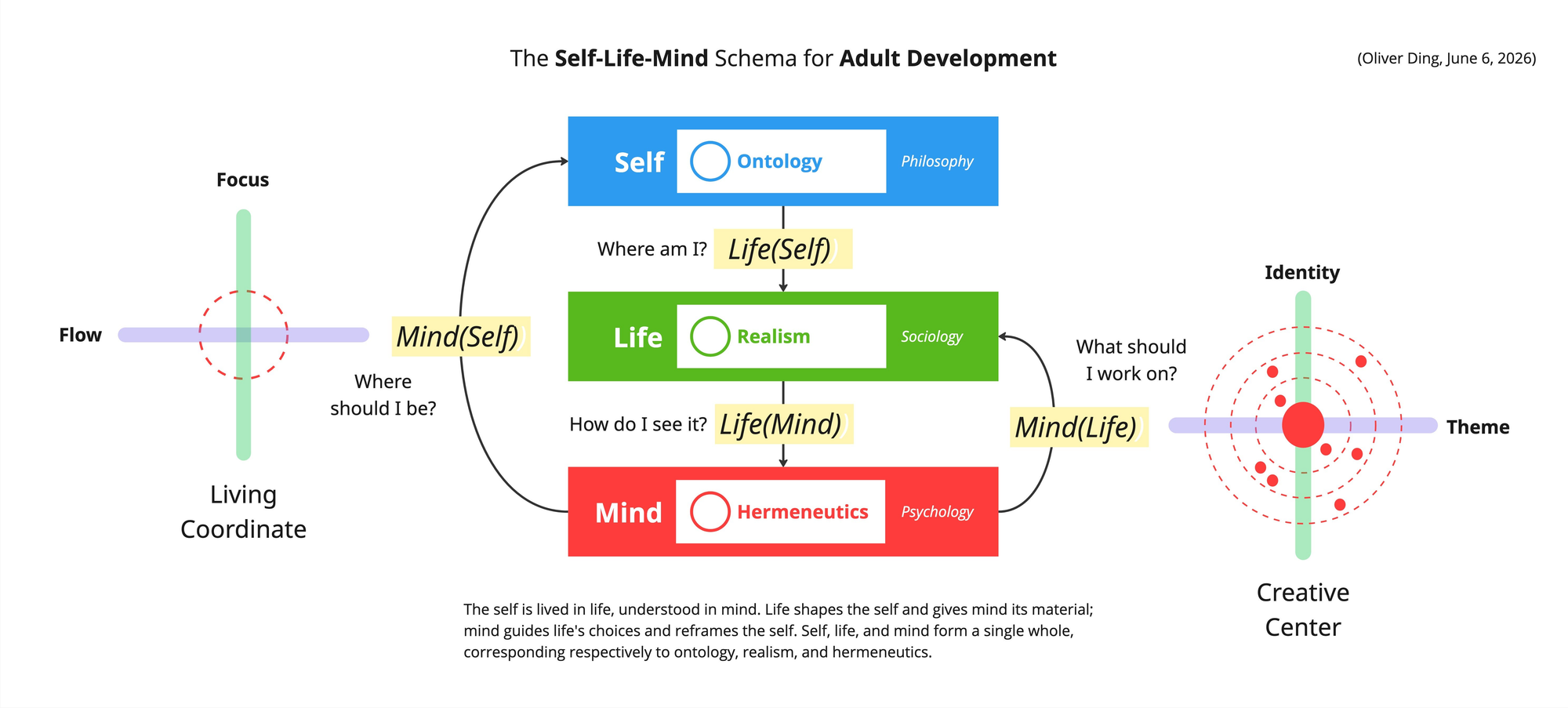
A unit of analysis, by contrast, is one of four operationalized cuts into that whole. Each unit is named container(containee): the outer term names the aspect exerting the shaping action, the inner term names the aspect being shaped. Life(Self) — where am I? — Life acts on Self, locating it within objective circumstances. Mind(Self) — where should I be? — Mind acts on Self, orienting it by norms and ideals. Mind(Life) — how do I see it? — Mind acts on Life, interpreting and constructing it. Life(Mind) — what does this call me to work on? — Life acts on Mind, feeding it material and setting its agenda. Each of the four units is a legitimate and useful cut; a research program organized around any one of them can generate real findings. What a unit of analysis cannot do, by construction, is stand in for the unit of synthesis it was cut from. Mind(Life) tells us how a person construes their circumstances without telling us how those circumstances are, in turn, reshaping what the mind is able to construe; Life(Self) tells us where a person objectively stands without telling us what that standing calls on them to think or do. The four units are partial views; the unit of synthesis is the whole they are views of.
These four are examples, not an exhaustive inventory. They are the paired, two-term cuts most directly relevant to the analysis that follows, but they are not the only way a unit of analysis can fall short of the unit of synthesis. A theory can also isolate a single term altogether — treating Self, Life, or Mind as a self-sufficient object of study with no paired term at all, rather than as one side of a container-containee relation. The sections that follow will encounter this more extreme case directly: classical trait theory treats Self alone, and evolutionary psychology treats Mind alone, neither one paired with anything. A single-term isolation of this kind is, in a sense, the most severe form a unit of analysis can take — not merely a partial cut of the whole, but a cut that drops two of the three terms entirely.
This distinction — units of analysis versus a unit of synthesis — is the vocabulary the following three sections use to revisit each of the debates reviewed in Part 2 in turn.
3.2 The Person–Situation Debate Revisited
The person–situation debate's history traces a single trajectory across the four units.
Classical trait theory, in its strong and historically decisive form — the form that provoked Mischel's challenge — is best described as a hypothesis about Self alone, held apart from Life rather than analyzed in relation to it. Its implicit answer to "who am I" is self-sufficient: whatever life circumstance a person is in, their behavior is the expression of a fixed disposition that belongs to Self and Self only. Life's variability is treated as noise surrounding a fixed signal, not as something that must be explained together with the signal. Self and Life are, on this construal, severed from the outset.
Mischel's situationist challenge, read through SLM, is not simply "situation matters more than trait." It is better understood as an insistence that Self cannot be analyzed while Life is held constant — that the low cross-situational consistency correlations are evidence of exactly this severing error. The challenge pulls the analysis back toward the Life(Self) unit: behavior must be understood as a function of how life circumstances locate the self, not as an expression of self in isolation.
CAPS's resolution can now be stated precisely. The if-then signature is not merely "a new unit"; it is the recognition that Life(Self) itself is the correct, integrated unit of analysis for personality. A person's personality just is the stable pattern of self-response across varying life circumstances, comprehended together — not two separable factors (a person-variable and a situation-variable) entered into a statistical interaction term, but one relational unit from the start.
The subsequent emergence of situational psychology as a dedicated research specialty then performs a further, and in some ways more revealing, move. Having established that situation deserves theoretical attention in its own right, this specialty does not remain within the integrated Life(Self) unit CAPS had achieved. It exits to the Life unit alone — building a taxonomy of situations (DIAMONDS) that describes life circumstances independent of any given self's traits, dispositions, or behavior. This is, in effect, a mirror-image repetition of trait theory's original error. Where trait theory isolated Self and set Life aside, situational psychology isolates Life and sets Self aside.
The symmetry is worth stating plainly: the debate's history moves from one decompositional error (Self alone), through a genuine resolution (Life(Self) as an integrated unit, via CAPS), and then drifts back into the opposite decompositional error (Life alone, via the specialized study of situations). The unit of analysis that actually resolves the dualism — Life(Self), held together — is neither of the two poles the debate has spent a century oscillating between.
3.3 The Nomothetic–Narrative Debate Revisited
Evolutionary psychology, in SLM terms, isolates Mind alone — not Mind acting on Self or on Life, but Mind treated as a self-standing universal architecture, prior to and independent of any given Self or any given Life circumstance. Its central claim is that mind consists of domain-specific modules shaped by natural selection, holding across every particular self and every particular life by virtue of a shared species history. This is a hypothesis about Mind alone, in exactly the sense that classical trait theory is a hypothesis about Self alone: both isolate one term of the SLM whole and treat the other two as irrelevant to what is essential about it.
Bruner's narrative mode does not perform a comparable isolating move. Where evolutionary psychology detaches Mind from Self and Life, Bruner's contribution works from within a unit that was never severed in the first place. His claim operates simultaneously across two directions: Mind(Life) — mind's interpretive, constructive engagement with life — is not homogeneous; it takes two irreducible forms, the paradigmatic and the narrative. And which form is called for is not fixed by Mind alone: it depends on Life(Mind) — how life's own dynamic, particular, temporally structured character feeds into and shapes which interpretive mode mind reaches for. A particular, historically situated event solicits narrative rather than paradigmatic construal precisely because of what that event, as a piece of a particular life, actually is. Bruner does not isolate a unit; he articulates the internal richness and bidirectionality of a unit — Mind(Life) together with Life(Mind) — that was already whole.
McAdams's resolution, read this way, is the only one of the three debates' resolutions that draws on more than two of SLM's units at once, and it does so through nesting rather than fusion. Dispositional traits are the domesticated remainder of evolutionary psychology's isolated Mind — the same universal-mechanism claim, demoted from a self-sufficient theory of personality to one layer within a larger structure. Characteristic adaptations sit at Life(Self) and Mind(Self) together: the situated goals and coping strategies a particular self forms in response to particular life circumstances, evaluated against internalized norms. Integrative life narratives are Mind(Life) and Life(Mind) jointly at work: the self's own narrative construction of its life, itself shaped by what that life has actually contained. McAdams's architecture is not a fusion of two isolated units into one, the way CAPS fuses Self-alone and Life-alone into Life(Self). It is a nesting of one isolated unit (Mind) inside a structure that already spans the remaining units. This is why McAdams's resolution, alone among the three, gestures toward something close to the full Self-Life-Mind unit of synthesis — not by naming it as such, and not by achieving full synthesis, but by achieving layered inclusion where the other two debates achieve, at best, a fusion of exactly two terms.
3.4 The Brain–Environment Debate Revisited
Classical cognitivism isolates Mind(Life) as a one-way directional unit — mind's construction of an internal model of the world — while denying that Life(Mind), the reverse direction, does any real constitutive work: environment supplies input, and the brain's internal computation does everything that matters. This is a partial isolation, distinct in kind from evolutionary psychology's isolation of Mind alone: cognitivism does not detach Mind from Life altogether, but it insists the relationship between them runs one way only, mind acting on life's data, never life acting back to constitute what mind is.
Gibson's ecological psychology and 4E cognition assert the missing direction. Affordances are perceived directly, Gibson argued, because the environment already contains, in its own structure, the action-possibilities an organism needs; there is no gap for internal representation to bridge. This is a claim that Life(Mind) is not merely real but constitutive: life's structure enters into and partly constitutes what cognition is, not merely what cognition happens to be about.
The Yinyang paper's resolution is, in this light, the least complete of the three. Where CAPS fuses two isolated units into a genuinely new one (Life(Self)), and McAdams nests one isolated unit inside an already broader, multi-unit structure, "perspectival complementarity" does not fuse or nest Mind(Life) and Life(Mind) at all. It leaves them as two separate, mutually irreducible units, each valid at its own level of analysis, without offering any single unit of synthesis that holds both together. This is consistent with the diagnosis in Part 2: the brain–environment debate remains the least resolved of the three, and the SLM analysis now shows precisely why. Its most recent proposed resolution is not a synthesis at all, but a disciplined agreement to keep switching between two units of analysis, neither reducible to the other and neither yet woven into a third.
3.5 Summary: Situation as a Unit of Analysis, Not of Synthesis
Read together, the three cases show that "situation," across all three debates, is without exception a unit-of-analysis concept, not a unit of synthesis — and a concept that, at different moments in each debate's history, gets pinned to a different single unit (Self alone, Life alone, Mind alone, Mind(Life), Life(Mind)) rather than ever being allowed to range across all four simultaneously. Each debate's most successful resolution moves toward — but never fully reaches — the complete unit of synthesis: CAPS fuses exactly two terms into one; McAdams nests one isolated term inside a broader but still incomplete structure; the brain–environment debate has not yet managed even a fusion, let alone a nesting.
4. What the Comparison Reveals
4.1 The Anti-Dualist Heuristic as a Diagnostic Lens
Elsewhere in this body of work — in the analysis of Activity Theory's genidentity — a recurring coordination mechanism was identified across a century of theoretical development: each major contributor inherited a dualism, exposed its inadequacy, and resolved it by introducing a third element that transformed the binary opposition into an internally related whole. Two variants of this move were distinguished: neutral monism, in which a genuinely new third element is introduced (Vygotsky's mediation, Blunden's Project), and dual-aspect monism, in which the two poles are reframed as two perspectives on one underlying process (the Outside–Inside resolution via Engagement).
Applying this same lens to the three debates reviewed in Part 2 is instructive, because it reveals that psychology's various subfields have, largely without naming what they were doing, been performing exactly this operation — with uneven success.
The person–situation debate resolved through a neutral-monism move: CAPS's if-then signature is a genuinely new unit, not a perspective on person or on situation but a third thing — the pattern of covariation between them — that neither person-focused nor situation-focused analysis, on its own, could name. The nomothetic–narrative debate resolved through a structural move that is closer to nesting than to either pure variant: McAdams's three layers are not exactly two perspectives on one process (dual-aspect monism), nor exactly one new emergent unit (neutral monism), but a hierarchy in which the nomothetic layer becomes an internal moment within a larger narratively organized architecture. The brain–environment debate, still unresolved as a settled matter, is nonetheless being approached, in its most recent attempts, through a dual-aspect monism move — perspectival complementarity across levels of analysis.
4.2 A Gradient, Not Three Separate Problems
Placed side by side, the three debates form a gradient rather than three independent case studies. The person–situation debate is the most fully resolved, complete with a settled research specialty devoted to the situation side within personality and social psychology. The nomothetic–narrative debate has an academically consensual resolution that has not yet fully permeated the wider discourse. The brain–environment debate is the least resolved: a live, contested frontier where competing resolution strategies are still being tested against each other.
This gradient itself deserves attention. It suggests that psychology's various subfields are not randomly distributed with respect to the anti-dualist operation; they are at different points along the same developmental trajectory, working out the same underlying epistemological problem at different speeds and with different degrees of success.
4.3 The Shared Assumption None of Them Drops
But the more important finding is what the three debates share even in their most successful resolutions: none of them, at any point, drops the assumption that the external, situational, environmental pole can be — indeed, must be — approached by decomposition.
CAPS's if-then signature presupposes a taxonomy of situation types against which the pattern is measured — and situational psychology, once it became independent, produced exactly this taxonomy in the DIAMONDS framework, decomposing "situation" into eight orthogonal dimensions in direct structural mimicry of the Big Five. McAdams's characteristic-adaptations layer treats context as a set of situated goals and coping strategies, themselves decomposable and codeable. The predictive processing literature treats "environment" primarily as a source of sensory input whose statistical structure the organism's generative model is built to predict — environment as signal, decomposable into its statistical regularities.
In other words: even the discipline's most sophisticated resolutions of its internal dualisms have resolved the person side of the equation into something richer and more holistic (an if-then signature, a three-layer self-narrative architecture, a whole embodied organism), while leaving the situation/environment side of the equation in its original, decomposable, variable-based form. The dualism has been repeatedly re-fought and partially won on the side of the person; it has never been fought at all on the side of the situation.
5. From Situation to Environment
Parts 2 through 4 have been about situation — more precisely, about the specific concept of situation that developed inside personality psychology, culminating in the psychological-situation research specialty traced in Part 2.2. But situation is not the only word psychology has used to name the pole standing opposite the person. English has a closely related word that has followed an almost entirely separate disciplinary path: environment.
Unlike situation, environment did not develop primarily inside personality psychology. Its home has always been closer to the study of behavior and cognition — the behaviorist's environment supplying stimuli, the ecological psychologist's environment structured with affordances, the cognitive scientist's environment supplying the sensory data a generative model is built to predict. This is, in fact, the very ground Part 2.4 already covered, under a different name: the brain–environment debate.
5.1 Ecological Psychology versus Environmental Psychology
Before turning to the deeper philosophical lineage behind this second word, one distinction inside the environment literature itself needs to be made precise, because "ecological psychology" and "environmental psychology" are often run together despite naming two different things.
Ecological psychology (Barker, Gibson) is the broader theoretical stance — closer to a root metaphor or world view in Pepper's sense, discussed in 5.2 — that treats the organism and its surroundings as a single relational system from the outset. Environmental psychology (Craik, Proshansky, Stokols), by contrast, is a specific applied research tradition that differentiated out of the ecological lineage from the 1960s onward (traced in full in 5.4), focused on the physical and built environment specifically — architecture, urban design, workplace layout — and does not, on its own, necessarily carry ecological psychology's stronger transactional commitment.
A researcher can work in "environmental psychology" while still treating the environment as an external variable acting on an otherwise bounded individual — precisely the decompositional, interactional move Part 4.3 diagnosed. The word "environment," in other words, offers no methodological guarantee by itself; it names a shared subject matter that both the isolating and the relational root metaphors traced below have made their home in, much as "situation" has.
With this distinction in place, the deeper question can be asked properly. The shared assumption identified in Part 4.3 is not a local accident of method. It has a much older philosophical lineage, and psychology's own history contains a genuine alternative to it that has never displaced the mainstream. The rest of this part traces both — the deeper roots of the assumption, and the alternative tradition that grew up alongside it, under the name of "environment" rather than "situation."
5.2 Root Metaphors and the Genealogy of Isolation
Stephen Pepper's (1942) World Hypotheses identified four root metaphors underlying any conceptual system: formism (the world as forms and essences), mechanism (the world as machine), contextualism (the world as historical event), and organicism (the world as developing organism). A genealogy of psychology's specific theoretical lineages, tracing each school back through the philosophical tradition it draws on, shows how these four root metaphors have actually distributed themselves across the discipline's history.
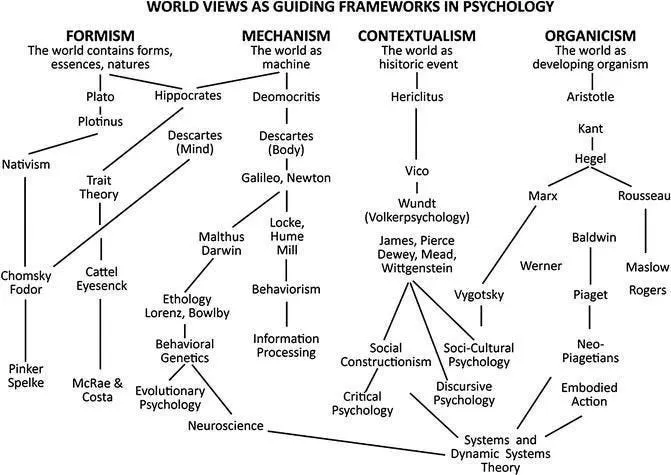
The formist lineage runs from Hippocrates and Plato through Descartes' rendering of Mind as a separate substance, into trait theory (Cattell, Eysenck) and onward into the nativist program (Chomsky, Fodor, and, more recently, Pinker and Spelke) that treats mental structure as a fixed, pre-given form rather than something built through relation.
The mechanist lineage runs from Hippocrates and Democritus through Descartes' Body, Galileo and Newton, into Darwin and Malthus, and from there into ethology (Lorenz, Bowlby), behavioral genetics, and evolutionary psychology, converging with a separate mechanist branch — Locke, Hume, Mill, behaviorism, information processing — in contemporary neuroscience. Evolutionary psychology, traced this way, sits precisely at the intersection of these two root metaphors: it inherits formism's commitment to fixed, essential structure (a universal mental architecture) and mechanism's commitment to explaining that structure as the output of a law-governed causal process (natural selection acting on discrete modules). Both root metaphors, whatever else divides them, treat their object as something whose essential nature can be specified without reference to any relation it stands in. This is the deep philosophical ancestry behind the isolating move Part 3.3 identified in evolutionary psychology's treatment of Mind, and behind trait theory's parallel isolation of Self.
The contextualist lineage runs from Heraclitus through Vico and Wundt's Völkerpsychologie, into the pragmatist line — James, Peirce, Dewey, Mead — and from there into social constructionism, critical psychology, socio-cultural psychology, and discursive psychology. This is Bruner's own ancestry: a lineage built from the outset around the historically particular event rather than the timeless form, which is why Part 3.3 found Bruner's narrative mode performing no isolating move at all, but rather working from within a relation contextualism had never severed.
The organicist lineage runs from Aristotle through Kant and Hegel, branching into Marx and Rousseau, and from there into Vygotsky on one side and Baldwin, Werner, Piaget, and embodied cognition on one branch, Maslow and Rogers on another. This lineage is worth pausing on, because it is not philosophically homogeneous in its consequences. It supplies both the developmental, potential-actual vocabulary this body of work draws on directly through Vygotsky, and the teleological self-actualization tradition (Maslow, Rogers) that a separate paper in this project has argued mistakes a developmental process for movement toward a fixed final state. Organicism, in other words, contains an internal tension between its anti-teleological, process-oriented strand and its teleological, end-state-oriented strand — a tension worth naming rather than assuming away, since SDP draws on the former while explicitly setting the latter aside.
One further feature of the genealogy deserves notice: its separate lineages do not stay separate all the way down. Evolutionary psychology and neuroscience (from formism and mechanism), embodied cognition (from organicism), and dynamic systems approaches converge, by the genealogy's own account, on a shared endpoint — systems and dynamic-systems theory. Whether this convergence marks a genuine emerging synthesis across previously separate root metaphors, or merely a shared mathematical vocabulary papering over deeper differences, is a question this paper does not resolve. But the convergence itself is a datum worth registering: it suggests the isolating and relational lineages traced here are not necessarily condemned to permanent separation.
5.3 Interactionism versus Transactionalism as a Unit-of-Analysis Distinction
Harry Heft (2012), reviewing the foundations of ecological psychology, sharpens the contextualist/organicist inheritance into a distinction that speaks directly to this paper's central concern. Heft identifies transactionalism as a world view distinct from mere interactionism, and defines the two by their unit of analysis. The interactional world view treats "the individual as a bounded, independent entity, operating separately from the surrounding, while subject to influences from outside its boundaries" — precisely the unit-of-analysis structure this paper has been calling a decompositional cut: a self-sufficient term, merely acted upon from outside, its boundary treated as already settled before any relation is considered. The transactional world view instead takes "the person-environment dynamic system" itself as the unit of analysis, with its components "operating in a relational, interdependent manner, rather than as independent entities." This is, in ecological psychology's own vocabulary, close to a description of what Part 3 has been calling a unit of synthesis rather than a unit of analysis — arrived at independently, decades earlier, and applied specifically to the person-environment relationship.
It is worth being careful about exactly where this achievement sits within SLM's four units, because Heft's own framework does not make the ontological commitment SLM makes when it posits Self. Ecological psychology's "individual" or "organism" is a perceiving, acting entity engaged with its immediate surroundings; it is not, in Heft's own terms, a persisting Self with a history and an identity extended across time — that commitment belongs to a different theoretical tradition (personality psychology's), one ecological psychology has never needed to make and has generally declined to make. This means the interactional/transactional distinction should not be read as landing on the Self-Life axis at all. It belongs, instead, to the Life-Mind axis: the "individual" in Heft's interactional world view is closer to a Mind treated as bounded and independent, merely receiving influence from Life rather than being co-constituted by it — the same one-directional isolation Part 3.4 identified in classical cognitivism's treatment of Mind(Life). And the transactional world view's "person-environment dynamic system" is, correspondingly, a description of Life(Mind) and Mind(Life) achieving genuine reciprocity — the same claim Part 3.4 credited to Gibson's own affordance theory directly. Heft's transactionalism, in other words, is not a separate achievement alongside Gibson's; it is the general theoretical articulation, in the vocabulary of world views, of the same specific move Gibson made in his account of direct perception.
This repositioning matters, because it makes the limits of transactionalism's scope precise rather than approximate. Because ecological psychology's unit of analysis operates on the Life-Mind axis and never posits a persisting Self at all, it has no structural place for personality — which requires exactly the kind of enduring, cross-situational Self that CAPS's Life(Self) resolution addresses — nor for the long-run developmental trajectory of an individual life, which requires a Self capable of carrying a history and a potential dimension forward through time. This is not a scope ecological psychology chose to set aside; it is a consequence of never having made the ontological commitment that would let the question arise. Ecological psychology remains, by its own design, a theory of short-timescale behavior and experience — the immediate coupling of perception and environment — rather than a theory of the longer-run standing a person occupies across a life. The fuller Self-Life-Mind unit of synthesis this paper's diagnosis calls for accordingly needs transactionalism's genuine Life-Mind reciprocity, together with a treatment of Self of the kind CAPS supplies on the Life(Self) axis and Vygotsky's potential-actual vocabulary supplies on the developmental axis — three separate contributions, none of which, on its own, was ever built to supply the others.
5.4 Barker's Warning and the Differentiation Pattern
Roger Barker, one of ecological psychology's founders, made the case for transactionalism's distinctiveness with unusual force. Writing in 1968 — the same year as Mischel's Personality and Assessment — Barker argued that ecological and experimental methods are not merely different in degree but different in kind, because "experimentation by arranging conditions according to the concerns of the experimenter destroys the very thing an ecological investigation seeks to determine" (Barker, 1968/1989, p. 356). Decomposition, on this view, is not a neutral simplification of a complex whole; it is an operation that eliminates the very relational structure an ecological approach exists to study. Barker went further still, arguing for the need of an eco-behavioral science independent of psychology altogether — not a specialty within the discipline, but a separate science alongside it.
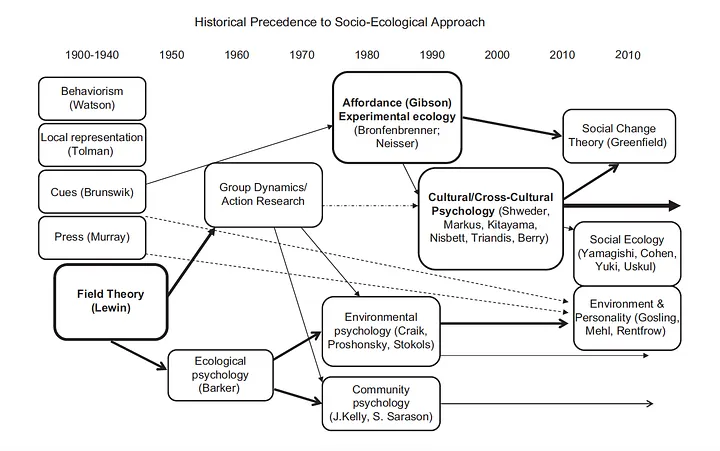
The historical record of what actually happened traces a rich and specific pattern of institutional differentiation, quite unlike anything the person–situation debate produced. Five early-twentieth-century strands — behaviorism (Watson), local representation (Tolman), cues (Brunswik), press (Murray), and field theory (Lewin) — set the stage between 1900 and 1940. Lewin's field theory proved to be the pivotal transactional strand: it fed directly into both Group Dynamics/Action Research and into Barker's own ecological psychology from the 1950s onward. From ecological psychology, two further traditions differentiated by the 1960s and 1970s: environmental psychology (Craik, Proshansky, Stokols) and community psychology (Kelly, Sarason).
By the 1980s, the confluence of these transactional strands with Brunswik's earlier emphasis on cues produced Gibson's ecological theory of affordance and the experimental ecology of Bronfenbrenner and Neisser — a second major node, from which cultural and cross-cultural psychology (Shweder, Markus, Kitayama, Nisbett, Triandis, Berry) and, later, social change theory (Greenfield) descended. From the 2000s onward, these branches converged further still into social ecology (Yamagishi, Cohen, Yuki, Uskul) and the study of environment and personality (Gosling, Mehl, Rentfrow).
Over a century, in other words, the transactional lineage differentiated into at least seven distinguishable research traditions, several of which achieved real institutional presence of their own — their own journals, their own divisions, their own doctoral training. This is precisely what situational psychology, traced in Part 2.2, never did: it remained a single, undifferentiated specialty inside personality and social psychology, producing one taxonomy (DIAMONDS) rather than a differentiated family of traditions. Yet — and this is the crucial observation — not one of these seven traditions ever renamed itself as a general-purpose alternative to "situation" for psychology at large. Each remained bounded to its own named domain — physical environment, community, culture, social change — rather than exporting its transactional unit of analysis into the personality, evolutionary, or cognitive debates examined in Part 2. Barker's hoped-for independent eco-behavioral science never arrived at the scale he imagined; what arrived instead was a family of successful but content-bounded specialties, each transactional within its own walls and silent outside them.
There is a further, and in some ways more telling, wrinkle to Barker's own reception. Even as behavior setting theory differentiated into the sub-fields traced above, its standing within mainstream psychology itself remained comparatively marginal. Scott (2005), in an article aptly titled "A Powerful Theory and a Paradox: Ecological Psychologists After Barker," documents exactly this: the theory "has been affirmed in a number of places, including other behavioral sciences, but has not as yet moved into mainstream psychology." Heft himself has made a similar observation, noting that Barker's discoveries remain comparatively under-appreciated within psychology and developmental science proper, while being taken up productively within embodied cognitive science and enactivism — fields outside psychology's own disciplinary walls entirely.
This is a different institutional fate than the differentiation pattern traced above, closer to an old adage: the flowers bloomed on the far side of the wall, fragrant to passersby, while going largely unnoticed by the gardener who planted them. Architecture, urban planning, transportation design, and embodied cognitive science all found transactionalism immediately usable, because their own working problems already required treating a person and their surroundings as one system. Psychology's own core subfields, whose working problems are built around decomposable variables, did not — which is itself a small but pointed illustration of the paper's central claim: adopting a theory is not simply a matter of its being available, but of a receiving field's own methodological taste already being prepared to use it.
5.5 Subjective Complexity, Ecological Complexity, and the Limits of Institutional Quarantine
A distinction worth drawing at this point, building on the pattern traced above rather than quoted from any single source: subjective complexity — the complexity of the mental world: feelings, tastes, values, beliefs — has remained the default focus of psychology at large. In SLM's vocabulary, subjective complexity is what Mind(Self) and Mind(Life) register from the inside: it is the register a person's own self-report most directly captures, and the register decompositional methods are built to measure. Ecological complexity — the complexity of the interaction between a person and their world — has remained the specialized concern of a comparatively small ecological wing of the discipline. Consistent with 5.3's finding, this is a partial approach to a person's overall standing: it squarely addresses the Life(Mind) axis, the standing itself rather than a person's feelings about it, but — like transactionalism generally — it does not, on its own, reach the Self side of the whole a full theory of standing would eventually need.
Oishi and Graham (2010) document a related pattern directly relevant here: psychology has moved through successive historical "waves" of ecological movement — moments when a Bronfenbrenner, a cultural psychology, a social ecology has surged forward to reassert the importance of ecological complexity against the discipline's default subjective focus.
Read alongside the differentiation pattern in 5.4, these waves take on a specific institutional meaning: each wave differentiates into its own bounded specialty, achieves real standing within that specialty, and leaves the discipline's core theoretical concepts — personality, cognition, emotion — largely unaffected. Psychology has, in this sense, repeatedly rediscovered and repeatedly re-solved the problem of ecological complexity, in one corner of the discipline after another, without ever letting that solution reshape how its central concepts are built. As long as ecological complexity remains institutionally quarantined in this way, its transactional unit of analysis never gets the chance to inform how the rest of the discipline's central concepts are theorized — strategy very much included.
6. Conclusion
6.1 What the SLM Lens Reveals
Three of psychology's most consequential internal debates — person–situation, nomothetic–narrative, brain–environment — share a single unresolved axis: internal stability versus external, situational dependency. Viewed through SLM's own vocabulary, "situation" in every one of these debates functions as a unit of analysis, never a unit of synthesis: at different moments in each debate's history it is pinned to a single isolated term (Self alone, Mind alone) or to one direction of a two-term relation (Life(Self), Mind(Life), Life(Mind)), but it is never allowed to range across the full Self-Life-Mind whole.
Even the debates' most sophisticated resolutions only partially close this gap — a fusion of exactly two terms here, a nesting of one isolated term inside a broader structure there — and none reaches full synthesis. This asymmetry descends from a much older split among psychology's guiding world views, between root metaphors that treat their object as definable without reference to any relation (formism, mechanism) and those that do not (contextualism, organicism).
Ecological psychology's transactionalism shows that a genuine alternative — a unit of analysis built from the outset as a relational whole — has existed in psychology's own history for over a century, differentiating into a rich family of its own research traditions. But this alternative, properly located, achieves reciprocity only on the Life-Mind axis; it never posits a persisting Self at all, and so has no structural place for personality or for the long-run developmental trajectory of an individual life. It has never generalized beyond the specific, named domains — environment, community, culture — within which each of its descendant traditions took root, and it could not, on its own terms, supply the Self that a fuller synthesis requires.
6.2 An Open Question: What Would This Mean for a Theory of Strategy?
This diagnosis was not undertaken for its own sake. It was prompted by a question that falls outside psychology's existing debates entirely: why has psychology never developed a proper theoretical concept of strategy — a construct with the same standing as emotion, cognition, or personality, rather than a mere operational label attached to specific coping or decision techniques?
The analysis above suggests, without yet answering, where the difficulty lies. A theory of strategy would need to treat a person's overall standing as a genuine unit of synthesis, spanning Self, Life, and Mind together, in exactly the sense this paper has shown "situation" has never been treated across any of psychology's major debates — including, so far, within transactionalism's own more limited and institutionally bounded domain.
Of everything reviewed here, ecological psychology is the most natural place to look first for that unit, and it is worth saying plainly why before setting the question aside for the companion paper. Strategy is, by its nature, a thoroughly relational concept: strategic action is inseparable from the ongoing interaction between a person and the standing they occupy, in a way that has no obvious home in a purely dispositional account of the person or a purely situational account of the surround. Ecological psychology's transactionalism, of everything surveyed in this paper, comes closest to this requirement by its own design — its unit of analysis was built, from the outset, to resist exactly the decompositional move that has kept the rest of psychology from developing a proper concept of strategy.
But 5.3 already showed the specific reason it cannot simply be adopted as-is: transactionalism achieves reciprocity on the Life-Mind axis without ever positing a persisting Self, and a theory of strategy cannot dispense with Self any more than it can dispense with Life or Mind — strategic action is always someone's, sustained across occasions, not merely a moment of organism-environment coupling.
Ecological psychology is the closest available candidate and the clearest illustration of what is missing from it at the same time. What such a unit would need to consist of, whether it can be built by extending transactionalism to include Self or requires something new, and what it would mean, concretely, to think about strategy on this foundation: these questions are taken up in a companion paper.
References
Altman, I., & Rogoff, B. (1987). World views in psychology: Trait, interactional, organismic, and transactional perspectives. In D. Stokols & I. Altman (Eds.), Handbook of environmental psychology (Vol. 1, pp. 7–40). Wiley.
Barker, R. G. (1989). Ecological psychology: Concepts and methods for studying the environment of human behavior. Stanford University Press. (Original work published 1968)
Bruner, J. S. (1986). Actual minds, possible worlds. Harvard University Press.
Buss, D. M. (2019). Evolutionary psychology: The new science of the mind (6th ed.). Routledge.
Candeloro, G., Napolione, A., Tolone, O., & Sacco, P. (2026). The Yinyang of cognition: Predictive processing and enactivism as perspectival complementarity. University G. d'Annunzio of Chieti-Pescara. SSRN.
Ding, O. (2026a). SDP: Two Diagrams about the Self-Life-Mind Schema. Activity Analysis Center. https://www.activityanalysis.net/self-life-mind/
Ding, O. (2026b). SDP: Revisiting the "Self" Issue from the Self-Life-Mind Perspective. Activity Analysis Center. https://www.activityanalysis.net/the-self-issue/
Ding, O. (2026c). SDP: Revisiting the "Belief" Issue from the Self-Life-Mind Perspective. Activity Analysis Center. https://www.activityanalysis.net/the-belief-issue/
Endler, N. S., & Magnusson, D. (1976). Toward an interactional psychology of personality. Psychological Bulletin, 83(5), 956–974.
Fleeson, W. (2004). Moving personality beyond the person-situation debate. Current Directions in Psychological Science, 13(2), 83–87.
Heft, H. (2012). Foundations of an ecological approach to psychology. In R. M. Ryan (Ed.), The Oxford handbook of human motivation. Oxford University Press.
McAdams, D. P. (1995). What do we know when we know a person? Journal of Personality, 63(3), 365–396.
McAdams, D. P., & Pals, J. L. (2006). A new Big Five: Fundamental principles for an integrative science of personality. American Psychologist, 61(3), 204–217.
Mischel, W. (1968). Personality and assessment. Wiley.
Mischel, W., & Shoda, Y. (1995). A cognitive-affective system theory of personality. Psychological Review, 102(2), 246–268.
Oishi, S., & Graham, J. (2010). Social ecology: Lost and found in psychological science. Perspectives on Psychological Science, 5(4), 356–377.
Pepper, S. C. (1942). World hypotheses: A study in evidence. University of California Press.
Rauthmann, J. F., Sherman, R. A., & Funder, D. C. (Eds.). (2020). The Oxford handbook of psychological situations. Oxford University Press.
Scott, M. M. (2005). A powerful theory and a paradox: Ecological psychologists after Barker. Environment and Behavior, 37(3), 295–329.
Tooby, J., & Cosmides, L. (1992). The psychological foundations of culture. In J. H. Barkow, L. Cosmides, & J. Tooby (Eds.), The adapted mind: Evolutionary psychology and the generation of culture (pp. 19–136). Oxford University Press.
Vygotsky, L. S. (1978). Mind in society: The development of higher psychological processes. Harvard University Press.
v1.0 — July 7, 2026 - 8,993 words