
Supportance and The Weave-the-Project Framework (v1.0, 2025)

A connection between Supportance Theory and the Project Engagement Approach
Oliver Ding
July 2, 2026
This article is part of a possible book: Supportance: Self, Other, and Possible Support (v1, 2026).
The Project Engagement Approach is a project-centered social theory inspired by Andy Blunden's notion of the "project as a unit of analysis of activity." It aims to establish the concept of the "Project" as a theoretical foundation for cross-disciplinary research, creative dialogue, and deep reflection.
In May 2024, I developed version 3.1 of the Project Engagement approach. While version 1.0 focused on the Developmental Project Model, version 3.0 expanded this by curating a range of knowledge frameworks to explore project-oriented social ecology.
A key concept introduced in version 3.1 is the Social Landscape. It first emerged as an operational concept for designing the House of Project Engagement, serving as a map for narrative and reflection.
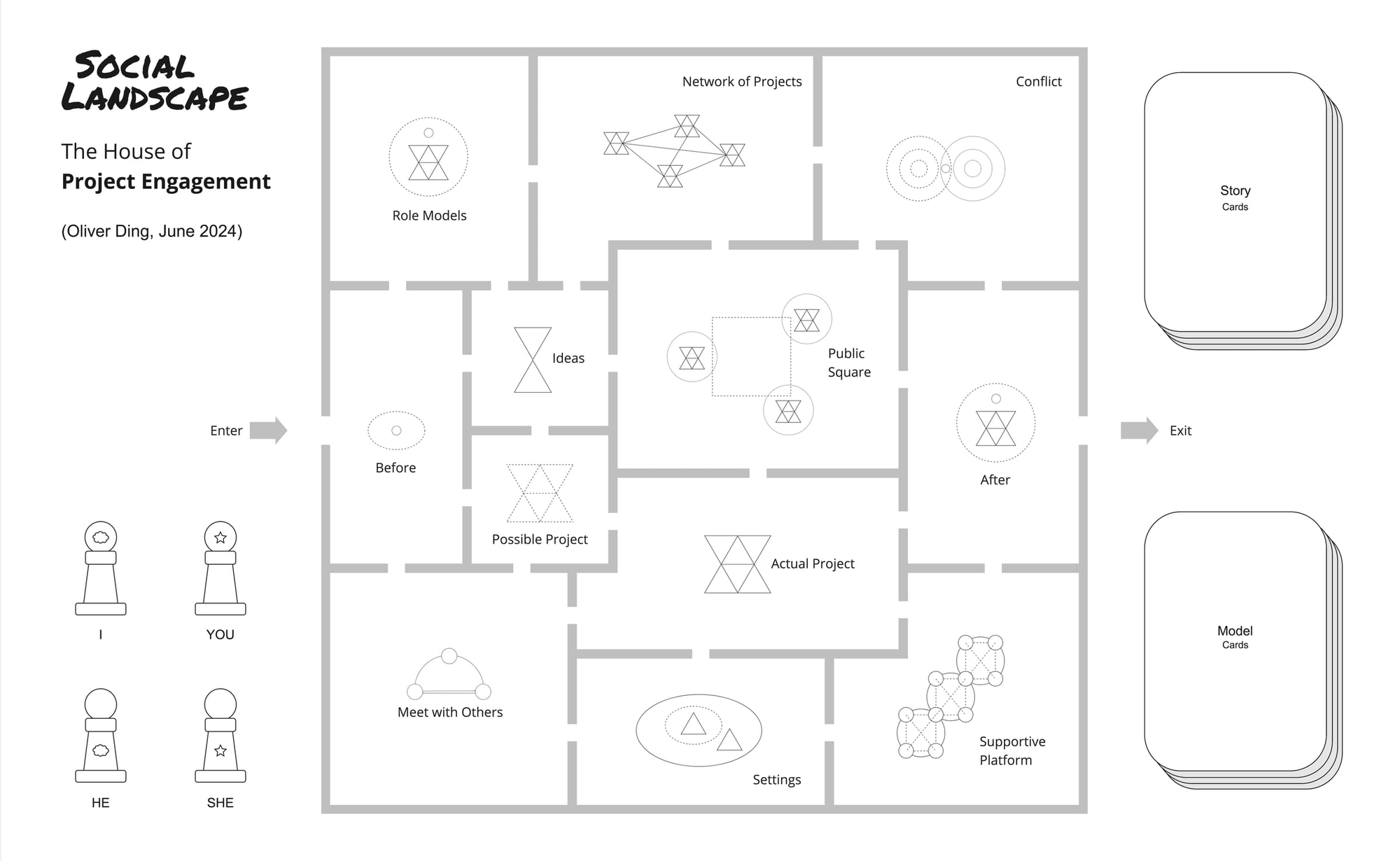
Over time, the concept evolved into a theoretical construct referring to the social environments and settings in which project-related activities take place.
Furthermore, the House of Project Engagement inspired the design of a series of thematic maps and knowledge maps, as well as the development of the “Map – Move – Model – Method – Meaning” schema and its associated methodology.
Ultimately, the concept of Thematic Space became a significant element within the Project Engagement Approach.
On March 18, 2205, I worked on a Knowledge Engagement project and introduced a new multi-layered thematic map, designed to structure different layers of knowledge engagement.
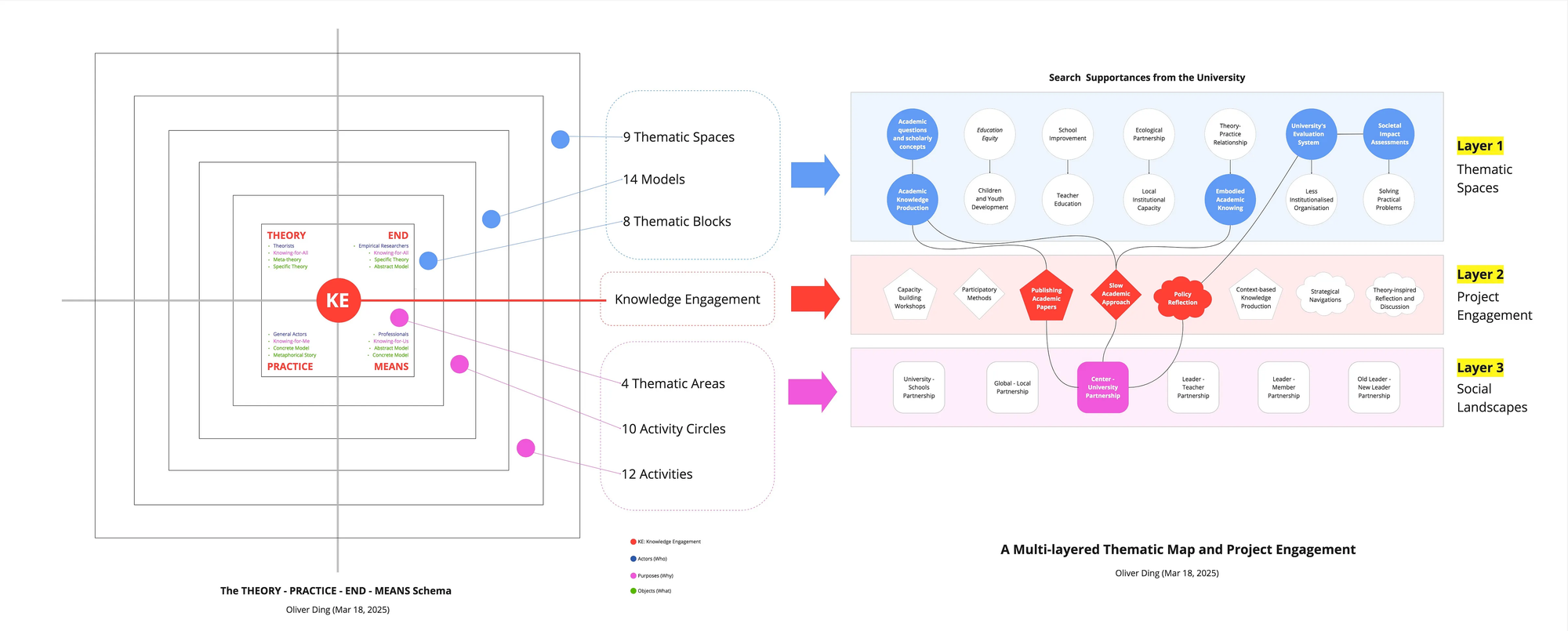
In the diagram above, I highlighted three layers:
- Layer 1: Thematic Spaces
- Layer 2: Project Engagement
- Layer 3: Social Landscape
Since the Knowledge Engagement project is an application of the Project Engagement Approach, this three-layer structure naturally reflects on the approach itself.
The Weave-the-Project Framework integrates these three concepts seamlessly (see the diagram below).
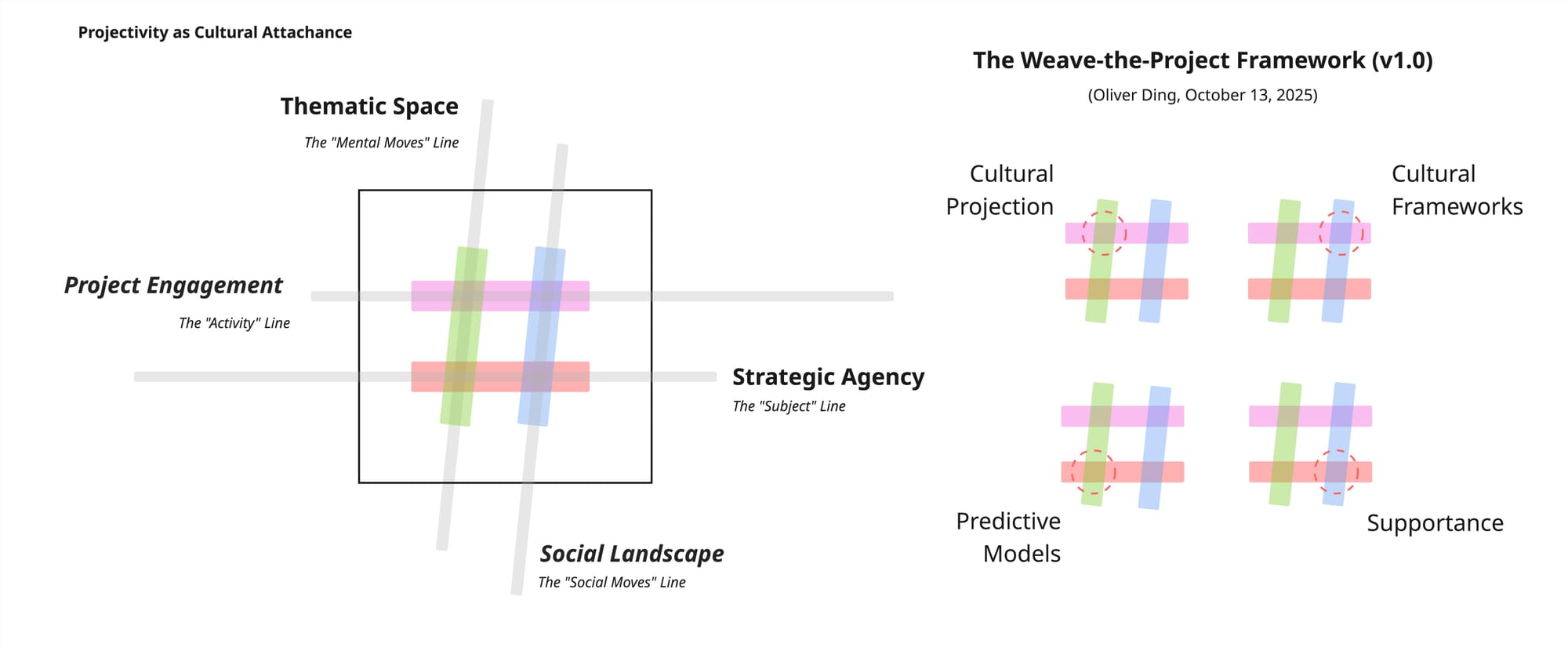
In the diagram above, the concepts of "Thematic Space" and "Social Landscape" serve as the two synchronic dimensions, while the two diachronic dimensions correspond to Project Engagement and Strategic Agency.
The four Weave-points represent the following four concepts:
- Thematic Space × Project Engagement = Cultural Projection
- Thematic Space × Strategic Agency = Predictive Models
- Social Landscape × Project Engagement = Cultural Frameworks
- Social Landscape × Strategic Agency = Supportance
Five of my book drafts are related to this framework:
- Mental Moves: The Attachance Approach to Ecological Creative Cognition
- Social Moves: The Attachance Approach to Social Cognition
- Strategic Moves: Mapping Knowledge Engagement and Structural Choice
- Frame for Work: Knowledge Frameworks, Predictive Models, and World of Activity
- Meta-frameworks: Creative Heuristics for Individual and Social Development
- Supportance: Self, Other, and Possible Support
Case Study: Search for Supportances
Over the past several years, I have been seeking a more general approach to understanding the concept of the Social Environment and Supportance.
From 2022 to 2024, I developed a set of concepts related to Attachance, a core concept of the Ecological Practice approach. In 2023, I applied Attachance to develop an ecological approach to social cognition, resulting in a multi-level map for understanding knowledge, activity, and environment.
In 2025, I suddenly realized that this set of concepts related to Attachance Theory could also be applied to Supportance-based Development.
A Knowledge Center
In early March 2025, a friend shared her latest research project with me, which focuses on a knowledge center addressing educational equity in China. The research is an in-depth case study of the knowledge center’s 20-year partnership with local schools and communities. My friend and her colleague explore the partnership’s origins, evolution, impact, and challenges, identifying it as a multi-level and multidimensional relationship. Their approach goes beyond the conventional focus on teacher and administrator professional development, addressing complex and systemic equity issues.
After reading their draft paper, I realized that these types of partnerships align with what I called Platform-ship in my 2021 book draft, Platform for Development. Moreover, these partnerships can be understood as forms of Social Landscapes within the Social Landscape Framework, which I developed in 2024.
This insight inspired me to develop a three-level map — based on their paper — to discuss Supportance-based Development. See the diagram below.
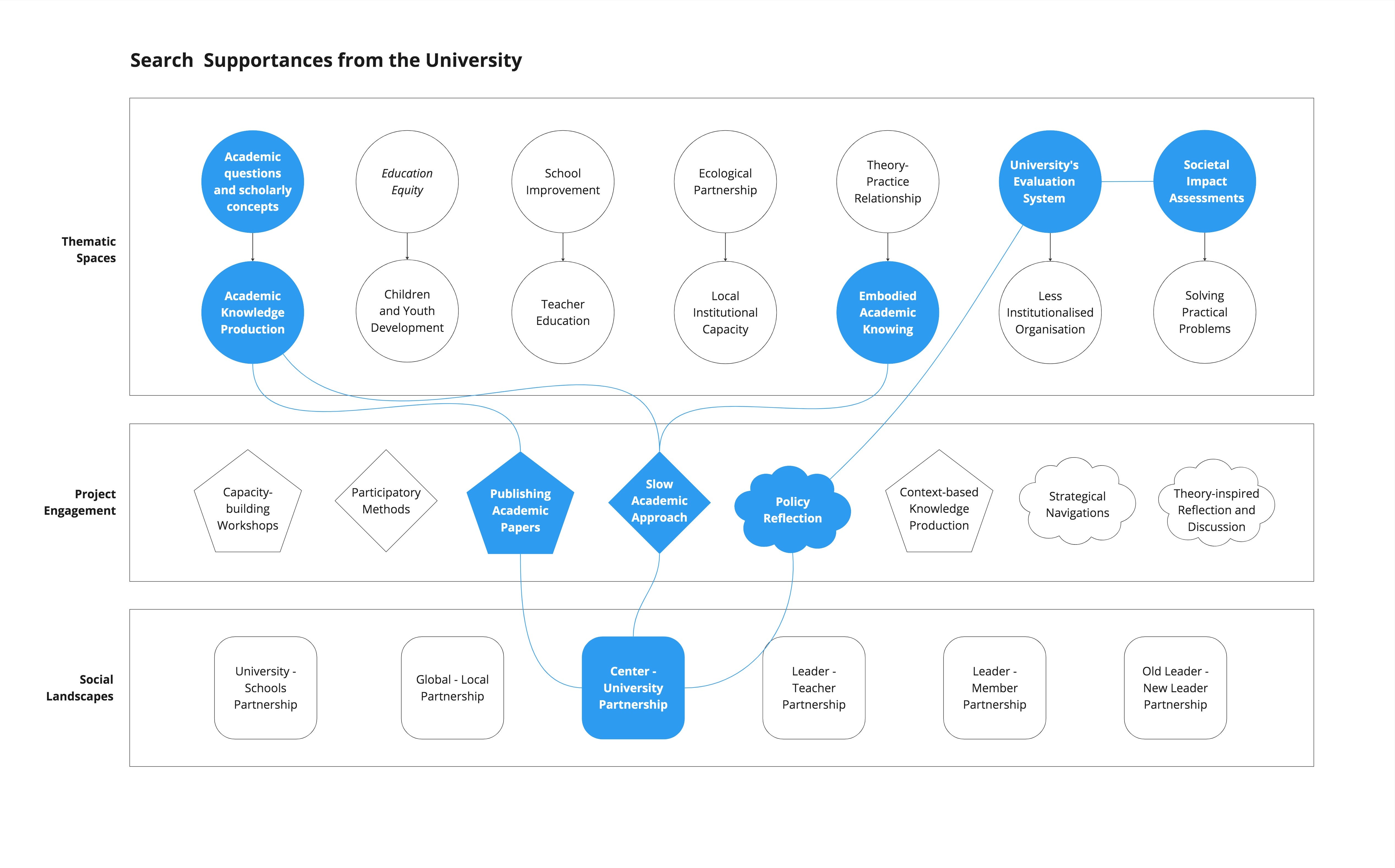
The map above defines three levels related to knowledge, activity, and environment using the following concepts:
- Thematic Space
- Project Engagement
- Social Landscape
Thematic Space
A Thematic Space refers to a cognitive space where a person’s ideas, activities, and practices revolve around a particular theme. A theme can take various forms, such as an established theory (e.g., “Activity Theory”), a general concept (e.g., “Platform,” “Life”), or an idea somewhere in between(e.g., “Design Thinking,” “UX”).
In the map above, a circle refers to a Thematic Space.
Project Engagement
Project Engagement refers to the ongoing process of initiating, joining, and leaving projects.
In the map above, a pentagon refers to a specific type of project, a diamond refers to a specific method, and a bubble refers to a specific form of thinking.
Social Landscape
A Social Landscape refers to the structures and dynamics of social environments, acting as maps that guide social actors through various domains of social life. In the map above, a square refers to a specific type of partnership.
In this case study, I focus on several types of partnerships, considering them as Platform-ship within the Platform-for-Development framework. In the paper, I found that the creator of the knowledge center is embedded in the following partnerships:
- University — School Partnership
- Global — Local Partnership
- Center — University Partnership
- Leader—Teacher Partnership
- Leader — Member Partnership
- Old Leader — New Leader Partnership
At the levels of Project Engagement and Thematic Space, certain entities are connected to those at the Social Landscape level. For example, I use blue to highlight entities related to the Center—University Partnership.
Using the map above, we can examine the creative life of the creator of the knowledge center. If we collect more data and plot them on the map, we can see the journey of mental moves between thematic spaces, social moves between projects, and strategic moves between social landscapes.
From the perspective of Support-based development, the creator of the knowledge center was continuously searching for supportances from the Center — University Partnership and other partnerships for 20 years.

v1.0 - July 2, 2026 - 1,049 words