
Preface: One World, However Diverse

The Journey of Developing Supportance Theory
by Oliver Ding
July 4, 2026
The new possible book Supportance: Self, Other, and Possible Support was released on June 30, 2026. This preface was written afterward.
In March 2019, I completed the draft of my first theory book, Curativity: The Ecological Approach to General Curation Practice, exploring one of my key life themes: Curation. A by-product of that book was a beta version of the Ecological Practice Approach, originally named the Gibson–Lakoff–Schön Approach, drawing on the theoretical contributions of James J. Gibson, George Lakoff, and Donald Schön.
In May 2020, I drafted After Affordance: The Ecological Approach to Human Action, which established v1.0 of the Ecological Practice Approach. This draft introduced the "germ-cell" version of the approach, centered on three key concepts: Affordance, Attachance, and Containance. Later that year, in October, I introduced the concept of Supportance—extending the framework to specifically address the domain of social environments.
This book tells the story of what happened next: six years of testing, applying, colliding with, and eventually rebuilding that single concept, until it became something I could no longer treat as one theoretical instrument among others. It became a way of asking, again and again, a single question in different settings: what does a social environment offer a person, and how do we know?
The Ecological Practice Approach aims to extend James Gibson's ecological psychology from natural environments into social life, and the concept of Supportance was my key step in that mission—my own answer to a question Gibson's own vocabulary left unanswered: what is the analogue of Affordance for the social environment? How I arrived at that answer, and everywhere it subsequently led, is the subject of the pages that follow.
Since 2020, I have been exploring Supportance across different fields—Platform Ecology, Theoretical Activity, and Intimate Relationships. Over time, I realized that developing Supportance Theory was, in effect, a theoretical enterprise of modeling social environments.
In 2021, while working on the Platform for Development book draft, I established a model that explicitly linked self, social environment, and supportance, drawing on Vygotsky's Zone of Proximal Development and its actual–potential distinction. That model became the foundation for all subsequent work on modeling social environments. From there, as I tested supportance in different fields, each required me to describe the kind of social environment I was examining—leading to a series of models developed across time:
- 2020: Infoniche
- 2021: Developmental Project
- 2021: Developmental Platform
- 2022: Lifesystem
- 2022: Knowledge Center
- 2023: World of Activity
- 2024: Evolving Knowledge Enterprise
- 2025: Theory as Enterprise
- 2026: RelationField
Though the Ecological Practice Approach centers on the people–environment relationship, I did not begin with a theory of social environment. Instead, I worked on developing a series of affordance-like concepts to describe different types of potential action opportunities—Curativity, Attachance, Supportance, Projectivity, and Genidentity—and then tested them across various fields.
In the past several years, this journey produced a series of book drafts, documenting the outcome of the approach and of each concept. Some of them:
- Container Thinking (2025): The Ecological Practice Approach (v4.0)
- Curativity (2019): The Ecological Approach to General Curation Practice
- Pieces, Whole, and Curativity (2025): Curativity Theory in the Field
- Ecological Practice Design (2022): The Lifesystem Approach to Everyday Life Innovation
- Platform for Development (2021): The Ecology of Adult Development in the 21st Century
- Developmental Projects (2025): The Project Engagement Approach to Adult Development
- Inside, Outside, and Projectivity (2024): The Project Engagement Approach (v3.0)
- Mental Moves (2023): Attachance, Volume 1
- Social Moves (2023): Attachance, Volume 2
- Strategic Moves (2024): Attachance, Volume 3
The recently developed Supportance–RelationField framework—particularly its application to the field of Intimate Relationships—inspired me to edit this new book, reflecting on the development of Supportance Theory and its current landscape. Unlike earlier book drafts, which focused on whole frameworks or other individual concepts, this is the first book to treat Supportance Theory as a subject in its own right.
This new book marks a watershed:
- Before: the "Supportance Theory" journey, focusing on theoretical development
- After: the "Supportance Analysis" journey, focusing on applications
This watershed is also a milestone for the Ecological Practice Approach and the GO Theory project. The completion of Supportance Theory establishes a foundation for other theoretical enterprises within the GO Theory platform—for example, the Supportance–RelationField framework has been adopted as part of the concept of Gejunction, which will become a foundational framework for the Strategic Developmental Psychology (SDP) project.
This book is organized into seven parts:
- Preface: One World, However Diverse
- Part 1: The Concept of Supportance
- Part 2: Modeling Social Environments
- Part 3: Women's Search for Supportance
- Part 4: Theoretical Platform
- Part 5: Supportive Life Discovery
- Part 6: Thematic Supportance
- Part 7: The Concept of Leeway
- Epilogue: The Future of Supportance Analysis
The structure of the book follows a cumulative logic. Part 1 establishes the conceptual foundation: what supportance is and how it differs from adjacent concepts. Part 2 turns to the environments in which supportance operates, presenting a series of models developed across different fields and years. Parts 3 and 4 then apply this conceptual and environmental framework to two contrasting domains: intimate relationships (Part 3) and theoretical platforms (Part 4)—the personal life world and the knowledge world. Part 5 explores a specific practice—Supportive Life Discovery—that sits at the intersection of these domains, showing how supportance can be deliberately designed to facilitate life transitions. Part 6 introduces Thematic Supportance, a distinctive subtype that operates through the symbolization of lived experience, linking individual experience to collective culture. Part 7 closes the book with Leeway—the ecological total of supportances—which reframes the entire framework from the perspective of the whole rather than its parts. The Epilogue then looks forward to the future of Supportance Analysis as an applied field.
This book is for those who are interested in how we find, recognize, and build the supports that make life possible—in our relationships, our work, and the worlds we inhabit.
For the detailed contents of each part—what each chapter argues, and how the parts speak to one another—I refer the reader to the book's Introduction.
What follows here is a different kind of account. It is the story of how Supportance Theory itself came to be: not the theory as a finished structure, but the six-year journey of building it.
I have selected fourteen stories from that journey and organized them into three waves of development—an early wave, a middle wave, and a late wave—each with its own rhythm, its own kind of discovery, and its own way of returning to the same question.
The First Wave
Five months, closing in March 2021
I started reading ecological psychology around 2014. By 2019, that reading had grown into the Ecological Practice Approach itself, first given shape in the draft of Curativity. What the approach did not yet have, at that point, was a concept of its own—its vocabulary was still a curated toolkit, borrowed from Gibson, Lakoff, Schön, and others. The concept of Supportance is where that changed.
I had been searching for it, in an unfocused way, for about two years after I finished the draft of Curativity.
It took about five months to develop the concept properly, once the search became a real project.
The concept of Supportance was born on October 27, 2020, shortly after I wrote the Ecological Practice Approach Toolkit on October 19, 2020. I had several rounds of private discussion with friends over the following months. On December 13, 2020, I published the Platform-for-Development (P4D) Framework (v1.0), applying the concept of Supportance to build the framework—this was also a test of the concept itself. From December 26, 2020, to February 3, 2021, I set the project aside to work on Project-oriented Activity Theory. I returned to P4D on February 9, 2021. On March 12, 2021, I wrote a long article introducing the concept of Supportance in full.
The concept of Supportance means that the Ecological Practice Approach had transformed from a curated toolkit into an original theoretical framework. This was a major milestone for the approach.
What follows are seven stories from those five months.
1
I needed a unit of analysis. Grounded in Gibson's ecological psychology, but reaching beyond it, I set out to establish "social environment" as a legitimate unit of analysis in its own right.
Some actions a person can accomplish alone. These concern only the relationship between people and the natural, physical, technological environment—call this individual action. Other actions need at least one other person's support—call this intersubjective action. Still others need indirect support from an organization or some other social entity—call this institutionalized action. The latter two are both about the relationship between people and social environments, not natural ones.
Why insist on this distinction? Because the social environment has things the natural environment does not: rational agency, language, ownership, and the capacity for remote presence. A rock or a tool has none of these. A person does.
Gibson himself resisted splitting the world this way:
"This is not a new environment—an artificial environment distinct from the natural environment—but the same old environment modified by man. It is a mistake to separate nature from the artificial as if there were two environments: artifacts have to be manufactured from natural substances. It is also a mistake to separate the cultural environment from the natural environment as if there were a world of mental products distinct from a world of material products. There is only one world, however diverse, and all animals live in it, although we human animals have altered it to suit ourselves. We have done so wastefully, thoughtlessly, and, if we do not mend our ways, fatally." (1979/2015, p.122)
I follow his stance: natural, physical, and technological environments remain, for me, one whole. But to discuss the diversity within that one world, I still needed a concept like social environment—a new unit of analysis, built on Gibson's own philosophical ground rather than against it.
Once the unit of analysis moves from natural environments to social ones, Affordance—Gibson's own term—no longer covers the whole territory. It needs a counterpart: something for the social side of "one world, however diverse." That gap is what Supportance was built to fill.
2
Now I needed a name. That meant stepping outside the existing vocabulary of Ecological Psychology altogether, and coining a genuinely new term.
The Ecological Practice Approach pursues two goals: expanding Ecological Psychology from native, natural environments to modern digital ones, and expanding it from a perception-centered psychological analysis to a social-practice analysis. In May 2020, my draft of After Affordance: The Ecological Approach to Human Action made progress on the first goal, but not the second—which is why I gave it the more cautious subtitle "human action" rather than something explicitly social. Eventually I realized that reaching the second goal meant stepping outside Ecological Psychology's own vocabulary altogether, and building a new concept from scratch.
The idea came in October 2020, while re-reading Gibson's The Ecological Approach to Visual Perception—in the very chapter where he gives his classic example of Affordance:
"If a terrestrial surface is nearly horizontal (instead of slanted), nearly flat (instead of convex or concave), and sufficiently extended (relative to the size of the animal) and if its substance is rigid (relative to the weight of the animal), then the surface affords support. It is a surface of support, and we call it a substratum, ground, or floor. It is stand-on-able, permitting an upright posture for quadrupeds and bipeds. It is therefore walk-on-able and run-over-able. It is not sink-into-able like a surface of water or a swamp, that is, not for heavy terrestrial animals. Support for water bugs is different." (1979/2015, p.119)
I had read that passage many times before, always for what it said about Affordance. This time, one ordinary word inside it caught my attention instead: support. I coined a new term, Supportance.
I think of this move as a Gibsonian trick—after what Howard Becker, in Tricks of the Trade, calls a "Wittgenstein trick": reading a familiar text not for the author's intended meaning, but as raw material for one's own thinking. James March makes much the same point about scholarship in general: that the evocation of new meaning across disciplinary and linguistic boundaries is not a shortcut to apologize for, but one of the genuine pleasures of intellectual work.
But a new word is not yet a concept. Andy Blunden's distinction between word meaning and concept meaning made that clear to me: a word only realizes a concept within the context of some actual activity, some actual project—it does not carry the concept in itself. By late October 2020, Supportance had a name. It still had to prove itself against something real.
3
The concept still needed testing—some piece of real life against which I could check whether it actually held up. A game with my sons became that test.
The scene itself belongs to 2020, played out in the months around the concept's own birth.
In 2020, I often went to a nearby museum with my two sons. They loved playing a creative game in the courtyard, which the ground of the courtyard—covered with gravel and studded with large, well-spaced stone slabs—made possible. My two sons loved jumping from one stone slab to another, and eventually they invented a game they called "Jump-Jump-Jump."
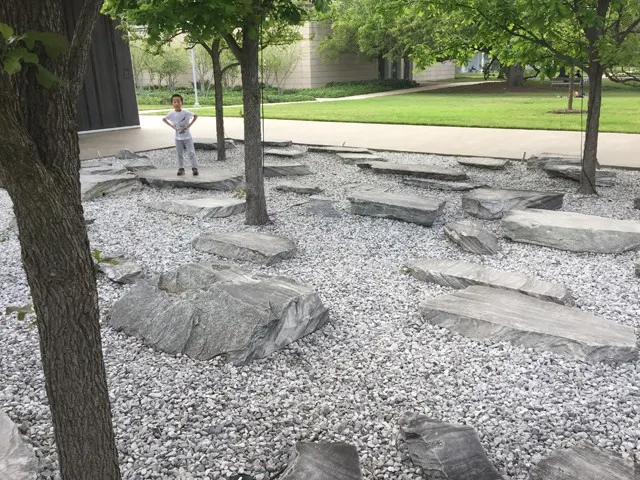
The rule of the game: (1) Player A has to jump from one stone slab to another; (2) Player B has to follow the first player and try to catch him; (3) if Player A is caught by Player B, or steps onto the gravel, he fails—Player B must also be careful not to step onto the gravel; (4) if a player fails, both players have to go to a rock in the corner of the courtyard and restart the game.
Sometimes I joined the game and played with them. They really wanted me to play with them. Sometimes I refused to join, in order to walk around instead.
From the perspective of Affordance Theory, the stone slabs—as a physical environment—offer jumping, for my sons and for me. But Affordance Theory does not explain the game of Jump-Jump-Jump itself, because that game is about social action.
What about the concept of Supportance? I realized it was exactly suited to explaining Jump-Jump-Jump, because I—as a social environment—offer support for my sons to play the game. The Supportance of support-for-playing "jump-jump-jump" is offered by me.
Moreover, the combination "Affordance—Supportance" turned out to be a perfect frame for explaining Jump-Jump-Jump and similar social actions, because we have to attend to both physical environments and social environments at once.
I noticed that my own behavior had two states: play with them, or not play with them. This is what I call the Selectivity of Perceiving. I then realized that these two states meant there was a transformation between potential and actual—what I call the Selectivity of Thinking. This confirmed the concept of Supportance for me, because it shares the same logic as the concept of Affordance.
Later, I returned to this scene and applied the 3I model to it:
- Initiator: My two sons and me
- Initiatee: Oliver Ding
- Act: We play the game "Jump-Jump-Jump."
- Idea: While the stone slabs afford jumping, I offer support-for-playing for my sons.
- React: I use this creative play to test the concept of Supportance.
The full mechanics of the 3I model—Initiator, Initiatee, Act, Idea, React, and the Double Selectivity that runs through them—are laid out elsewhere; what matters here is only that the model held.
4
Until then, Supportance had lived only in a slide deck and a handful of private conversations. In early 2021, I set out to write a proper long-form article introducing the concept to the world, and settled on two strategies: open with an image that could carry the concept into a reader's imagination, and position Supportance against "social support"—an established research topic—marking clearly, from the outset, how the two differ.
In 2020, I had used a certain photograph for a design project. In 2021, it acquired a new meaning for me. In March 2021, I used it as the opening of the article.

Two women are standing on a beach by the sea, carrying a large picture frame. It is a normal scene. How can such a scene be used for theoretical development?
Consider it as a minimal collective activity. There are at least three people present: the two women carrying the frame, and a photographer taking the picture. Any one of these three is an indispensable component of the activity. Without the photographer, no one would come to take this picture. If there were only one woman, she could not carry such a large picture frame, and the shooting activity—taking this specific photo—could not be accomplished.
That was the image. For the second strategy, I turned to the picture again: the story I have just told could easily lead a reader toward the familiar notion of "social support." Traditionally, researchers pay attention to the effect of social support on health, quality of life, and mental health. I wanted to discuss "social support" in a broader, more general sense—starting from how it differs from what I meant by Supportance.
Suppose there were only one woman and a three-year-old girl at the scene. The woman could not hold the picture frame, because the little girl does not have the strength to help her. The woman would then have to look for potential support from others with the corresponding capacities.
This is what Supportance names: not simply the plea for help, but the structured possibility of it—already present in the situation, waiting on someone able to perceive it and act. Working out that difference from social support in full was the task of the article's next section.
5
The same article then turned to a different task: establishing Supportance as a meta-concept, and working out how a concept pitched at that level could even be tested.
I considered the Ecological Practice Approach itself a meta-theory, and Supportance its newest meta-concept. To test it, I selected three intermediate concepts, each tied to a different type of practice, and examined how Supportance related to each.
The method came from Dave Elder-Vass's (2010) work on social ontology. His argument, in brief: the relationship between a metatheory and the theories built on it runs in both directions. We validate a theory by testing its implications against the world; by the same logic, we can validate a metatheory by testing its implications for the theories it makes possible—and revise it if it fails, just as readily as we would revise a failed theory. Applied to my own case: a meta-concept earns its value by what it lets us build at the intermediate level, not by definitional fiat.
The root word of Supportance is support, so the first intermediate concept I had to reckon with was Social Support itself—already a well-populated research field. Social scientists trace it to concerns about industrialization and the disintegration of face-to-face community ties. Psychologists trace it to attachment theory and the caregiving bond between infant and parent. Exchange theorists treat it as a matter of resources—love, status, information, goods—traded between people over time. It is a rich field, and not one I thought I could improve on directly.
But Supportance and Social Support are not quite the same thing. Supportance is a meta-concept, pitched at the level of potential action possibilities in general, not tied to any one operational program of measurement or intervention. It concerns the relationship between people and social environments as such, where Social Support research concerns mental health and well-being specifically. And if we read "social" in "social support" more broadly than just the interpersonal, we can redraw it as three types—Individual-to-Individual, Institution-to-Individual, and Institution-to-Institution—since any institution, after all, is made of individuals and acts through their decisions. This broader reading pushes back against what Derek Layder called the reductionist tendency in social psychology: explaining social phenomena only through subjective states or dyadic bonds, rather than through the wider social forces that shape them.
Read through Supportance, all three types of social support turn on the same transformation: potential becoming actual. And this transformation opens a further distinction that would matter throughout everything that followed—between intended support, where Person A means to help Person B, and unintended support, where Person A has no such intention, but Person B perceives and actualizes a Supportance in Person A's presence or activity anyway. Both kinds require perception and capability on Person B's side; only the intended kind requires intention on Person A's side.
This is why, through the rest of that year, my main task became writing Platform for Development—a manuscript organized around a single intermediate concept, the Developmental Platform, whose job was to test, in practice, whether Supportance could do the work I hoped it would.
6
While writing Platform for Development—the manuscript whose first version, P4D v1.0, I had published on December 13, 2020, and to which I returned on February 9, 2021—I needed a proper theoretical account of what "development" meant, in order to link it to Supportance. I found it in Lev Vygotsky's Zone of Proximal Development (ZPD):
"…the distance between the actual developmental level as determined by independent problem solving and the level of potential development as determined through problem solving under adult guidance or in collaboration with more capable peers." (Vygotsky, 1978, p.86, originally Vygotsky, 1935, p.42)
The core of the ZPD, for my purposes, is this actual–potential structure. I generalized it: replacing the "Teacher—Student" relationship with "Self—Other," while keeping the same underlying dynamic of Actual—Develop—Potential. From this, I define Development as the transformation between the potential self and the actual self, through interaction with others—a structure close to what Hazel Rose Markus and Paula Nurius called "possible selves," though I arrived at it from a different direction, through Gibson and Vygotsky rather than through cognitive psychology.
Inspired by the generalized ZPD diagram, I built a new diagram linking Social Environment and Supportance directly to this model of development: a person's development is the transformation between the Potential Self and the Actual Self, and this process is linked to the transformation between Supportance—the potential action possibilities offered by the social environment—and Actual Action.
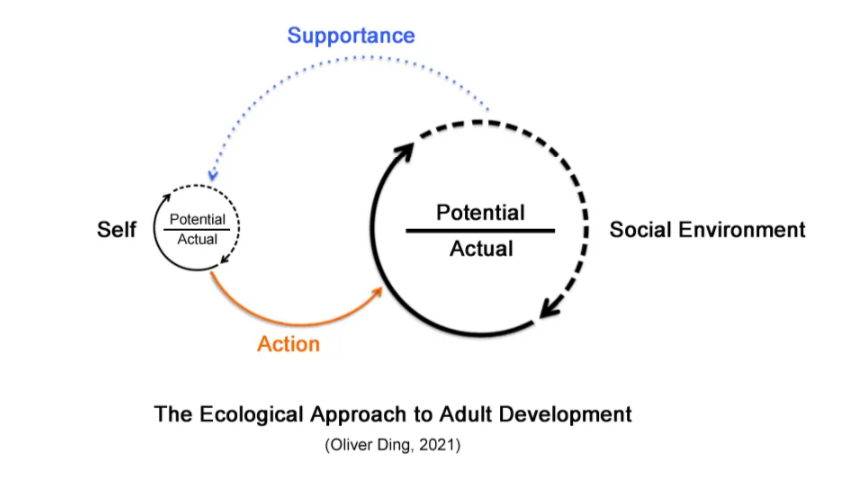
This model established a new theoretical foundation for adult development. In Platform for Development, the concept of the Developmental Platform was introduced as a special type of social environment built on exactly this foundation.
7
What I needed next was a working combination—Affordance and Supportance as a pair I could use in different ways across different models. This is also where the first wave closes, by March 2021, with the completion of Platform for Development.
Take Infoniche, the model I built to explain the internal structure of a platform. There, Affordance handles the analysis of the platform's basic material environment, while Supportance handles everything else—the potential support that comes from the platform's own people and their activity, its platform-ba. Take, instead, the Concept-Fit model, built to explain platform innovation. There the same pair reappears in a different guise: Affordance corresponds to a platform's technological concept, Supportance to its cultural concept.
The general logic behind both: Affordance is assigned to the platform itself—as the basic environment, a platform offers ecological affordances to its users and stakeholders. By actualizing those affordances, people take real actions, which form activities; people and their activities form a platform-ba; and it is the platform-ba, in turn, that offers Supportances to people.
Why keep the two concepts separate, rather than simply calling this all "Social Affordance," as some scholars do? Because Affordance is about one-sided agency—the natural or material environment has none of its own—while Supportance is about two-sided agency, since the social environment does. I do not think the concept of Agency should be stretched from humans to non-humans just to make the two fit under one name. Keeping them apart let me keep Affordance intact while developing Supportance as its own thing.
Expanded to incorporate Activity—a set of actions—the picture becomes two hierarchical loops: an Affordance–Supportance loop at the potential level, and an Action–Activity loop at the actual level, corresponding to each other: Affordance–Action, Supportance–Activity.
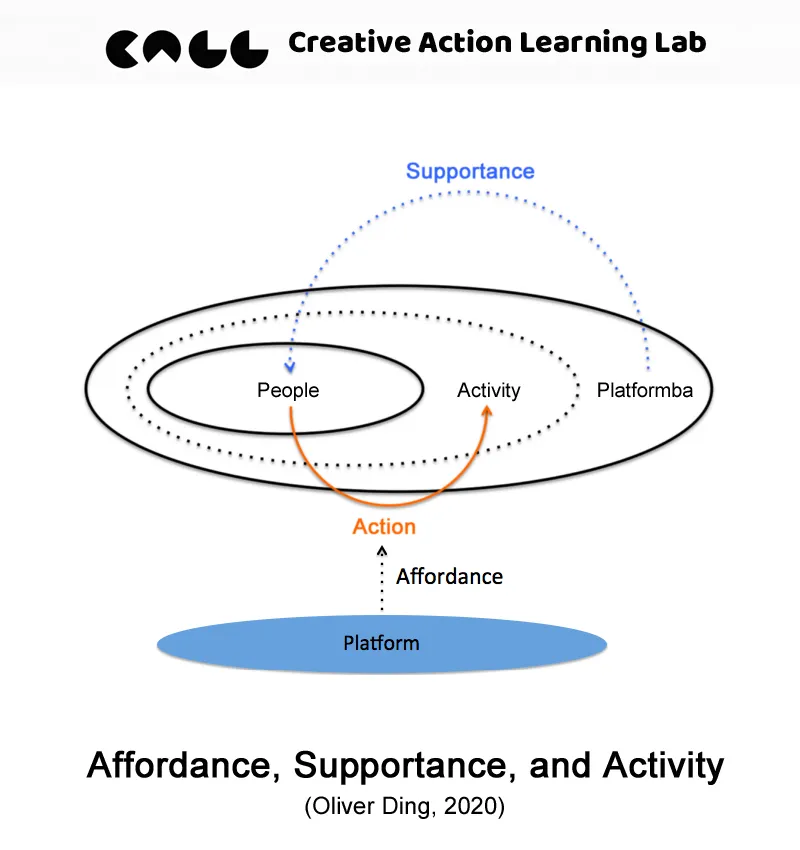
By curating Ecological Psychology, the Ecological Practice Approach, and Activity Theory together, this model set the theoretical foundation for the Platform-for-Development framework, and for Platform Ecology in general.
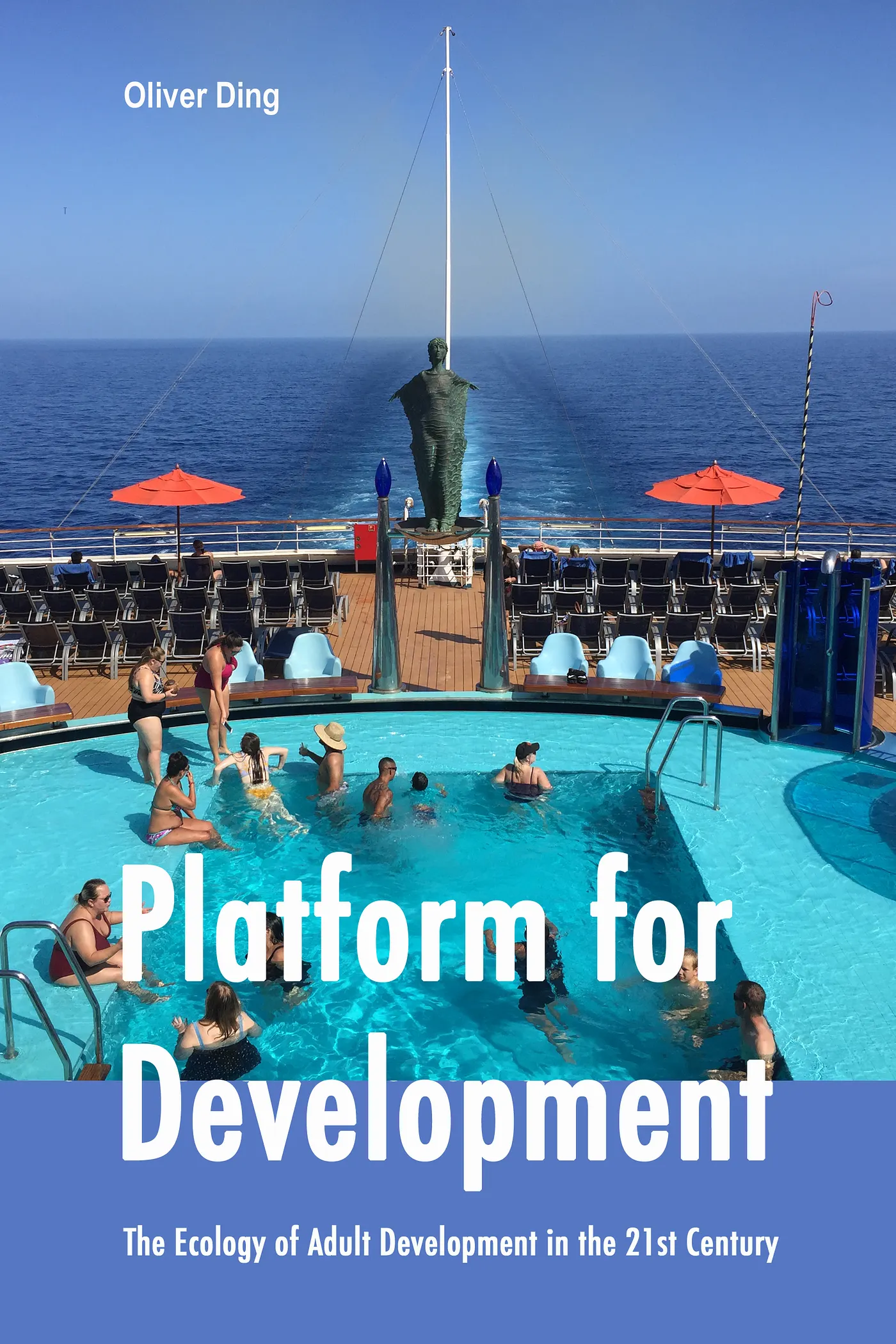
By March 2021, with the Platform for Development draft complete, the concept of Supportance was fully established. The first wave of its development had come to a close.
The Middle Wave
Empirical frameworks, mid-range models, and theoretical dialogue
Once Supportance was established, in March 2021, the center of gravity in this story shifts. What follows is not really about Supportance itself anymore. It is about the mid-range frameworks the Ecological Practice Approach went on to produce—and Supportance, folded in alongside Affordance and the approach's other concepts, does its work quietly, in the background, guiding and explaining empirical research and applied reflection, rather than standing at the center of attention.
This shift also sits inside a larger pattern. For many years I have followed several theoretical traditions at once, and let each shape the knowledge frameworks I built under its influence. Looking back, my intellectual life across 2014 to 2025 moved through three overlapping centers of gravity, not strictly in sequence but shifting in emphasis: an early phase (2014–2020) centered on Psychology, especially Ecological Psychology; a middle phase (2019–2024) centered on Sociology, especially activity-based social practice theories; and a late phase (2022, 2023, 2025) centered on Philosophy, especially questions of self and subjectivity.
Between 2022 and 2025, specifically, my own center of gravity was no longer the Ecological Practice Approach or Supportance. It had moved to the Project Engagement Approach, inspired by Activity Theory, and to what I call Knowledge Engagement—the transformation of theme into concept into framework, which treats theoretical activity itself, and the other kinds of knowledge activity around it, as an object of inquiry in its own right.
The story that carries this part of the book is Lifesystem—a mid-range framework built around Supportance, developed in the middle of that shift. In its own internal structure, it carries the conflict, and the creative dialogue, that came from living inside such a crowded intellectual life at once.
8
On April 2, 2021, I sat with two diagrams side by side.
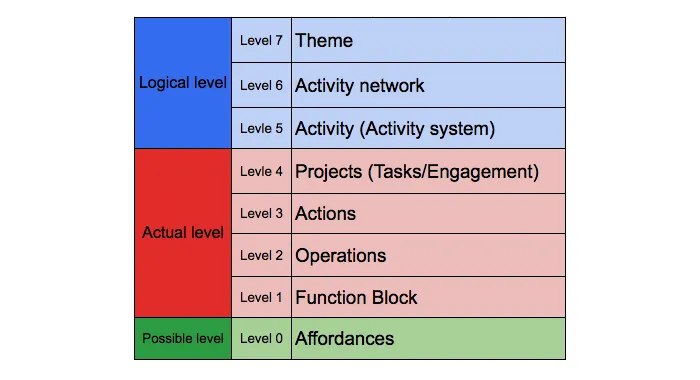
One was an eight-level hierarchy of human activity and social practice—a side-product of "Activity U (VI)," an article I had published the previous September, reviewing how activity theorists structure the layers of practice, topped by a level borrowed from the anthropologist Morris Opler and grounded, at the bottom, in Gibson's own Affordance. Eight levels are too many to hold in view at once, so I had also sorted them into three types: a logical (or ideal) level, an actual level, and a possible level. It was this three-part sorting, more than the eight levels themselves, that carried over into the new diagram.
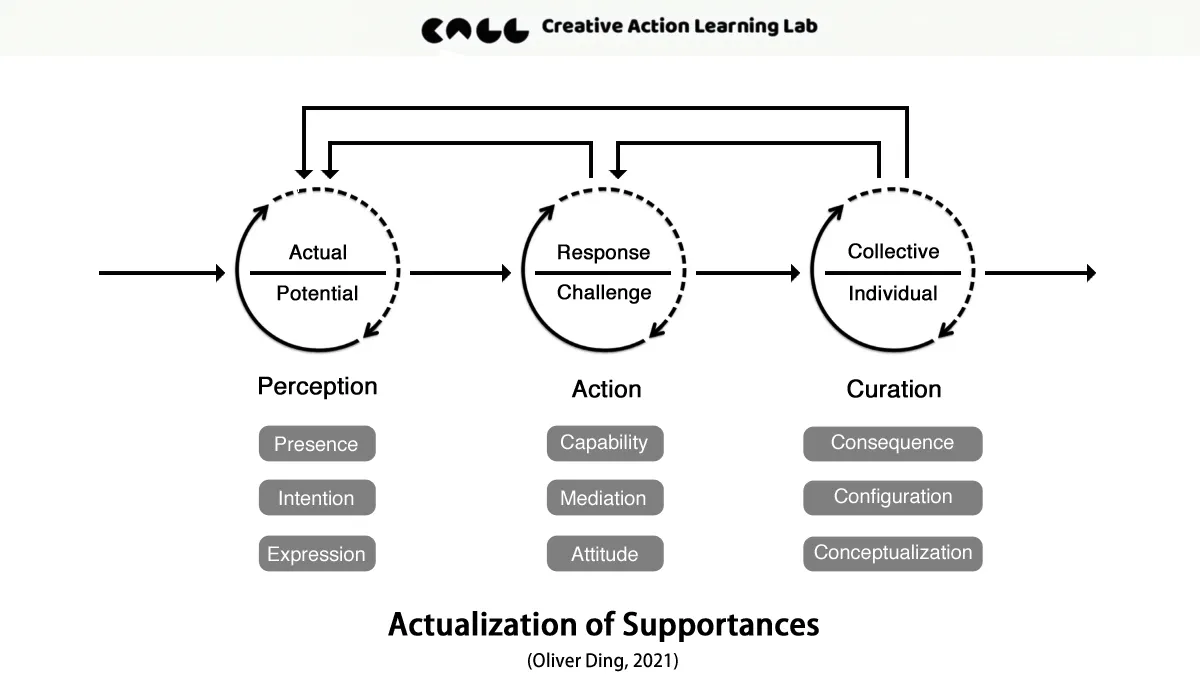
The other was the Actualization of Supportances model, from the long article I had finished writing three weeks earlier. It has three phases, each its own transformation: Perception, the transformation between Potential and Actual, where a person perceives a Supportance offered by the social environment; Action, the transformation between Challenge and Response, where the person acts to actualize it; and Curation, the transformation between Individual and Collective, where the person curates the experience of actualizing supportances into a meaningful whole.
I did not merge them into one. I drew on elements from both to build something new: a third diagram.
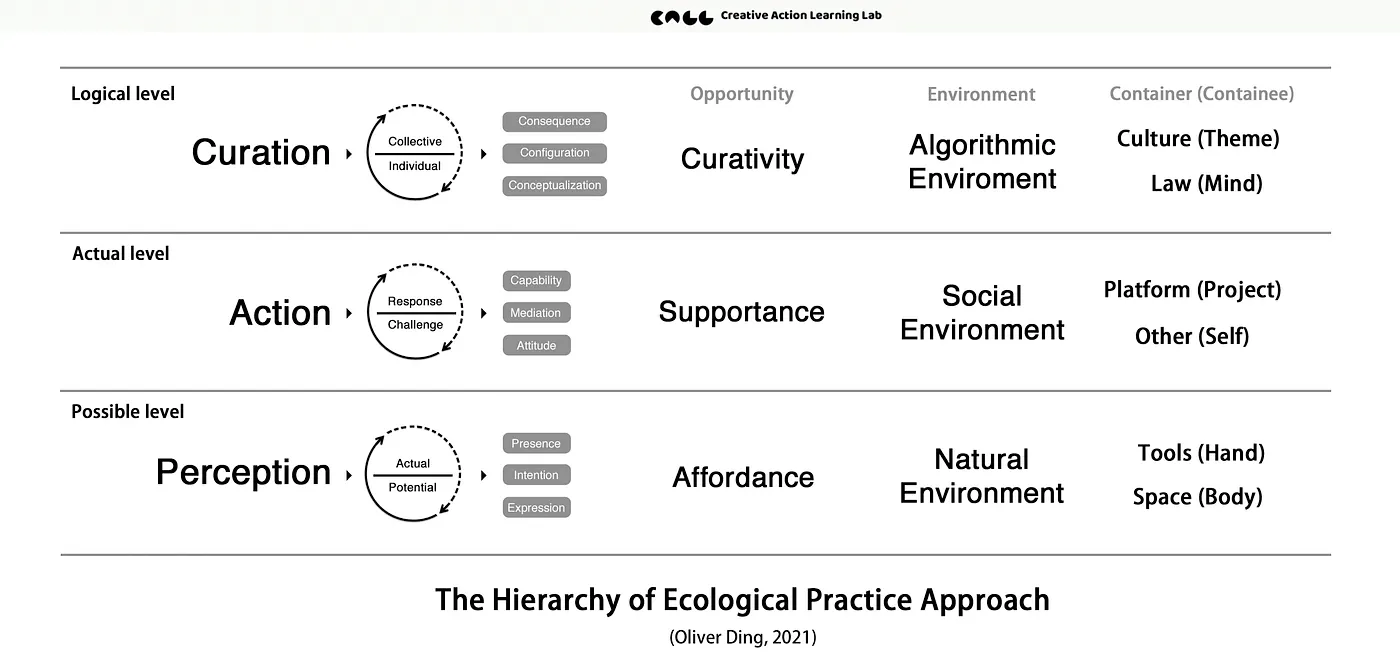
What came out the other side was a new diagram in its own right, with three rows—and I remember the feeling of looking at it finished: this is really a complete theoretical enterprise now. The two source diagrams did not disappear into it; they went on existing in their own articles, on their own terms. What the new diagram did was cross a level from one against a phase from the other, and in doing so, it brought a third concept into the picture that neither source diagram had mentioned at all: Curativity, the concept I had built two years earlier, in 2019.
At the Logical level, the phase is Curation—the transformation between Collective and Individual, broken further into Conceptualization, Configuration, and Consequence. This is where Curativity sits, tied to what I called the Algorithmic Environment, and to the container pair Culture (Theme) and Law (Mind).
At the Actual level, the phase is Action—the transformation between Challenge and Response, broken further into Capability, Mediation, and Attitude. This is where Supportance sits, tied to the Social Environment, and to the container pair Platform (Project) and Other (Self).
At the Possible level, the phase is Perception—the transformation between Potential and Actual, broken further into Presence, Intention, and Expression. This is where Affordance sits, tied to the Natural Environment, and to the container pair Tools (Hand) and Space (Body).
This was the first time Curativity, Supportance, and Affordance stood side by side in a single picture, as three parallel answers to the same question—what does an environment make possible?—asked of three different kinds of environment at once.
That diagram is what I now think of as the birth of the "Hierarchy" version of the Ecological Practice Approach.
On April 26, 2021, I wrote "The Development of Ecological Practice Approach," looking back over how the approach had grown through three successive versions: the "Toolkit" version (2019), when it was still a curated set of borrowed concepts; the "Germ-cell" version (2020), built around Affordance, Attachance, and Containance; and this new Hierarchy version, organized around the diagram just described.
At the time, I believed this theoretical enterprise had reached a satisfying close.
9
As I mentioned earlier, I started paying serious attention to ecological psychology around 2014. I was not only reading Gibson and Roger Barker's own theoretical work; at the very same time, I was watching my two children—then at kindergarten age—wherever we went. Over several years I took a great many photographs and wrote a great many notes, without any clear sense of what they were for.
Around 2019, this habit of watching found a specific object. My son had joined a skate-learning program at a local ice-skating rink, and I had a good opportunity to watch the program as a participant. When my son first stood on the ice, he did not seem uncomfortable, and I assumed that was normal. I was wrong. One day, a new class started, and a child cried loudly the moment he stood on the ice, desperate to escape it. His mother grabbed his body and pushed him toward the teacher; the child fell to the ice and cried even harder.
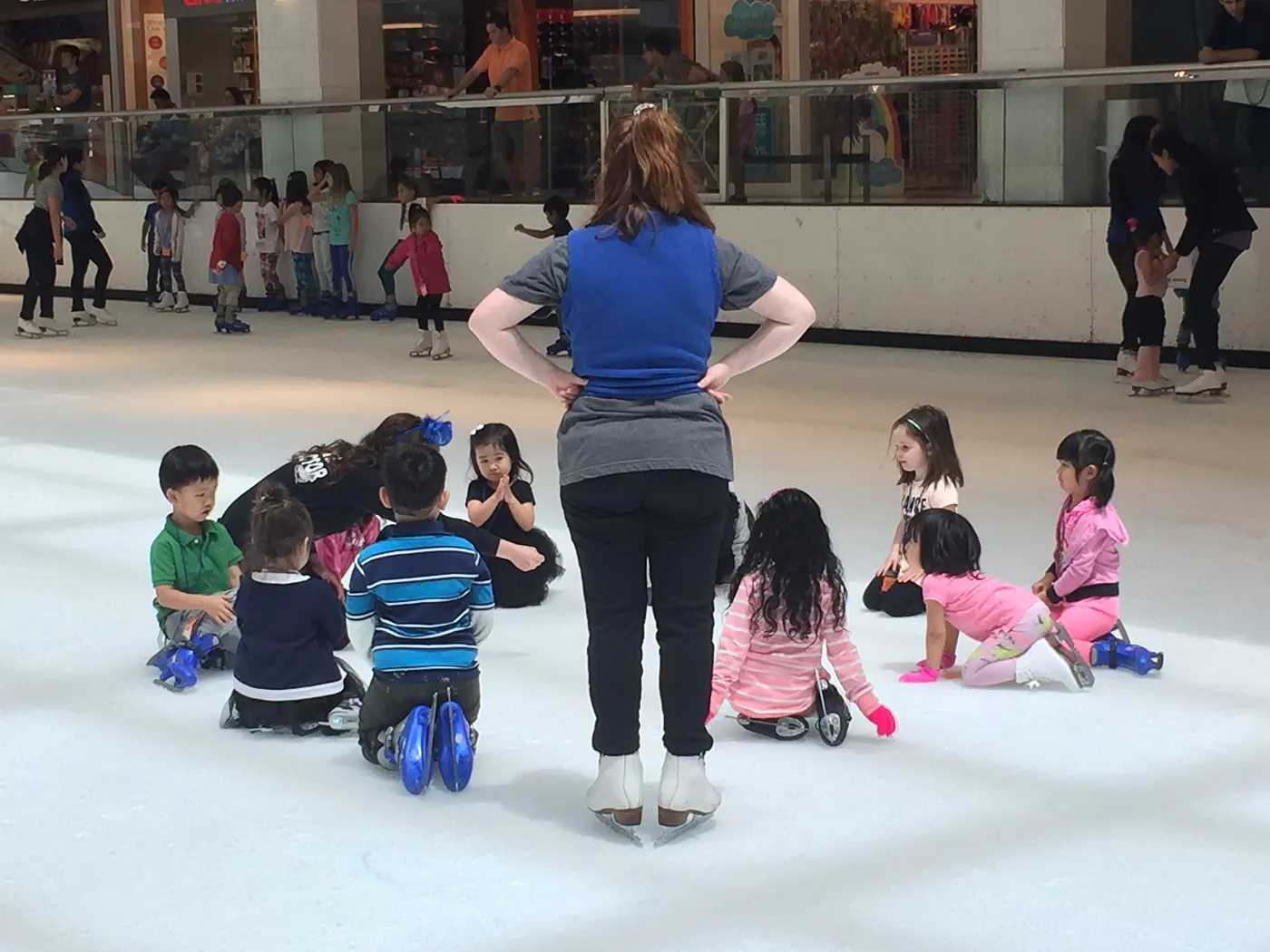
This was the defining moment. It gave the years of casual observation a clear purpose: not photographs and notes for their own sake, but material for ecological observation. I kept watching, more deliberately now.
At the time, I did not know what all those earlier photographs and notes were actually for.
In 2020, when the concept of Supportance was born, I wrote a private document of more than a hundred pages—a conceptual deck, not a polished article—proposing the Lifesystem framework: a way of applying the Affordance–Supportance combination to empirical research. The ice-skating case, and the photographs I had taken of it, became my concrete illustration of what the concept meant. That document was never meant for publication; it surfaced only in conversations with friends. A year later, on October 1, 2021, I wrote a proper long article introducing the framework in full, under the title "Lifesystem: Modeling Ice Skating and Other Social Practices".
In that article, I wrote: "This article almost ends the long journey of the ecological practice approach. The Lifesystem framework is the final piece of the approach. The theoretical work is done." I did not know, at the time, that the exploration was nowhere near finished. I kept advancing these concepts for years afterward, and by 2025 they had grown into a v4.0 version of the approach.
I adopted Anticipatory Systems Theory as the framework's foundation, treating the "lifeway—lifeform" hierarchical loop as an anticipatory system. Both Lifeway and Lifeform are parts of this single whole.
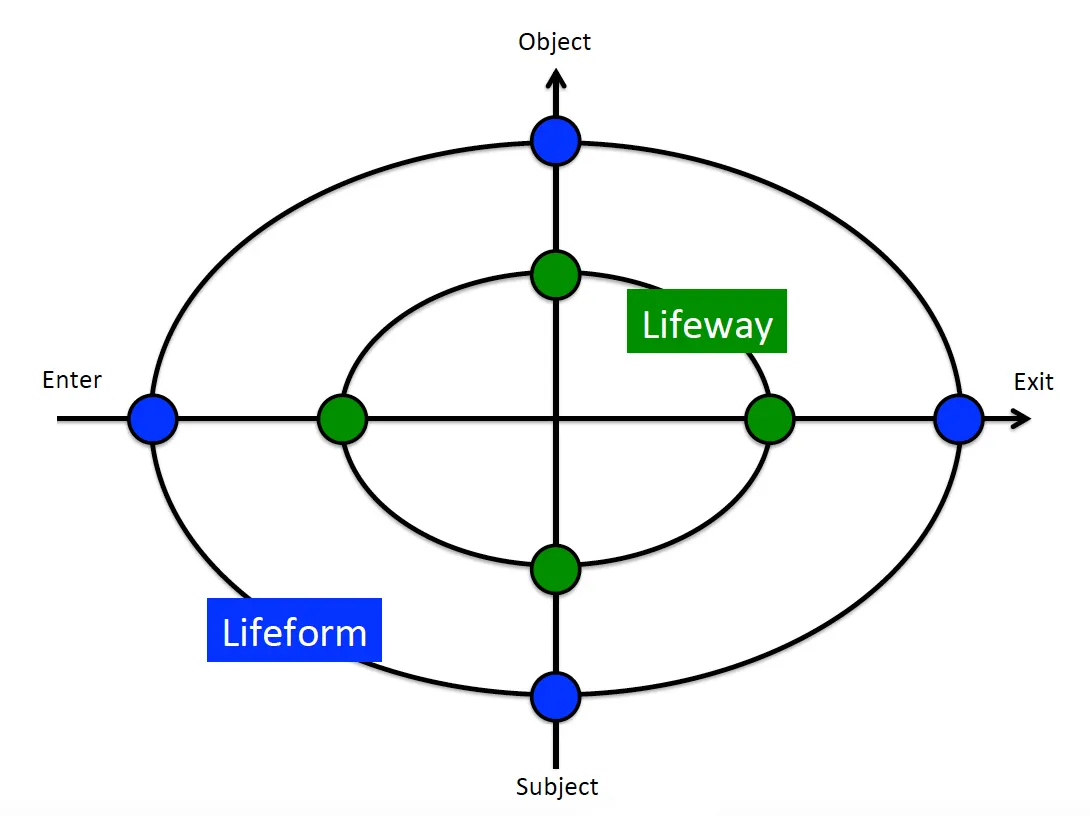
The term "Lifeway" is inspired by Gibson's own writing: "The natural environment offers many ways of life, and different animals have different ways of life." I use "Lifeway" to refer to the human–material engagement, related to the physical environment and Affordance.
The term "Lifeform" is inspired by Ludwig Wittgenstein: "It is easy to imagine a language consisting only of orders and reports in battle…And to imagine a language means to imagine a form of life…Here the term 'language game' is meant to bring into prominence the fact that the speaking of language is part of an activity or a form of life." I use "Lifeform" to refer to the human–human engagement, related to the social environment and Supportance.
The pair "Lifeway—Lifeform" was developed in 2019, while I was working on Curativity: The Ecological Approach to General Curation Practice. Lifesystem treats the Lifeway–Lifeform loop and the Affordance–Supportance loop as a single whole system, defining a new unit of analysis.
The framework's newest pair of concepts, Material Adaptability and Social Adaptability, came out of applying it to Career Development that same June: Material Adaptability is a person's competence in actualizing affordance, Social Adaptability their competence in actualizing supportances.
On May 17, 2022, I brought all of this together into a book draft, Ecological Practice Design: The Lifesystem Approach to Everyday Life Innovation. This was not a minor footnote to the Hierarchy version. It was the point where the Ecological Practice Approach, and the concept of Supportance within it, first proved through Lifesystem that they could carry sustained empirical and applied work—well beyond the ice rink where the whole framework had started. It marked a real milestone in this theory's development: not just for Lifesystem, but for what Supportance itself could now be shown to do in practice.
Finishing that draft, I also felt something more personal: the sense of having walked in a circle. My study of ecological psychology had always been prompted by ordinary life situations—by watching my children, by a boy crying on the ice. Those situations gave me theoretical insight. And now that insight had turned into a knowledge framework, Lifesystem, built to be carried back into life situations again.
10
In early 2022, I realized there was a conflict between two frameworks I had developed within the Ecological Practice Approach: the Infoniche framework and the Lifesystem framework.
In February 2022, I was comparing Lifesystem against two other frameworks, each drawn from a different theoretical source, as part of a toolkit for a Life Discovery Activity. Because those other two frameworks came from clearly different traditions, their differences from Lifesystem made sense to me.
But the comparison inspired me to also compare Lifesystem with Infoniche, since these two shared the same theoretical approach. To my surprise, I found a real difference between them. The basic unit of the Lifesystem framework is "Lifesystem," used to understand human practice and social life. The basic unit of the Infoniche framework is "Person—Environment," used to discover potential action opportunities for the person.
In February 2022, I asked myself: if I could only pick one of these two to represent the Ecological Practice Approach, which would be the better choice? This was, in effect, a question about the identity of the Ecological Practice Approach. I did not have an answer at the time.
In fact, the internal conflict between the Infoniche and Lifesystem frameworks was a symptom of an external conflict between the Ecological Practice Approach and Activity Theory. Lifesystem had been built with a hybrid method: half of it was inspired by Activity Theory's own concepts, such as the "Subject—Object" connection. I had also drawn on several social-practice models as references while developing it. The outcome was unambiguous: Lifesystem was, in effect, another social-practice model, not a pure ecological one.
Two years later, in May 2024, while working on a project about the genidentity of a knowledge system, I returned to this internal conflict as a case study, and finally resolved it.
In May 2022, I had developed the Platform Genidentity framework to address exactly this kind of question—the "Identity" of a Knowledge System and a Knowledge Center. The Ecological Practice Approach considers the world as a nested container system: things move between different containers. For any particular thing, its trajectory is what I call its Lifeflow. This raised a theoretical question: how can a thing keep its uniqueness over time? To answer it, I borrowed the philosopher Kurt Lewin's concept of Genidentity—his term for the continuity of an object across successive phases of its own development, where two things are not identical because they share properties, but because one has developed from the other.
Lewin developed the idea to compare different branches of science. I read it instead as a "topology of identity" with temporal dynamics, and turned it into an operational definition I could actually use: a thing's Genidentity is defined by Essential Differences together with Situated Dynamics.
Applying this framework to the Ecological Practice Approach as a Knowledge System, my concern about the Infoniche–Lifesystem conflict turned out to be a concern about the Genidentity of the approach itself.
Some knowledge entities—such as primary concepts—are the Theoretical Foundations of the approach, defining its Essential Differences from other approaches. Others—such as practical knowledge frameworks—are its Theoretical Applications, offering solutions adapted to Situated Dynamics.
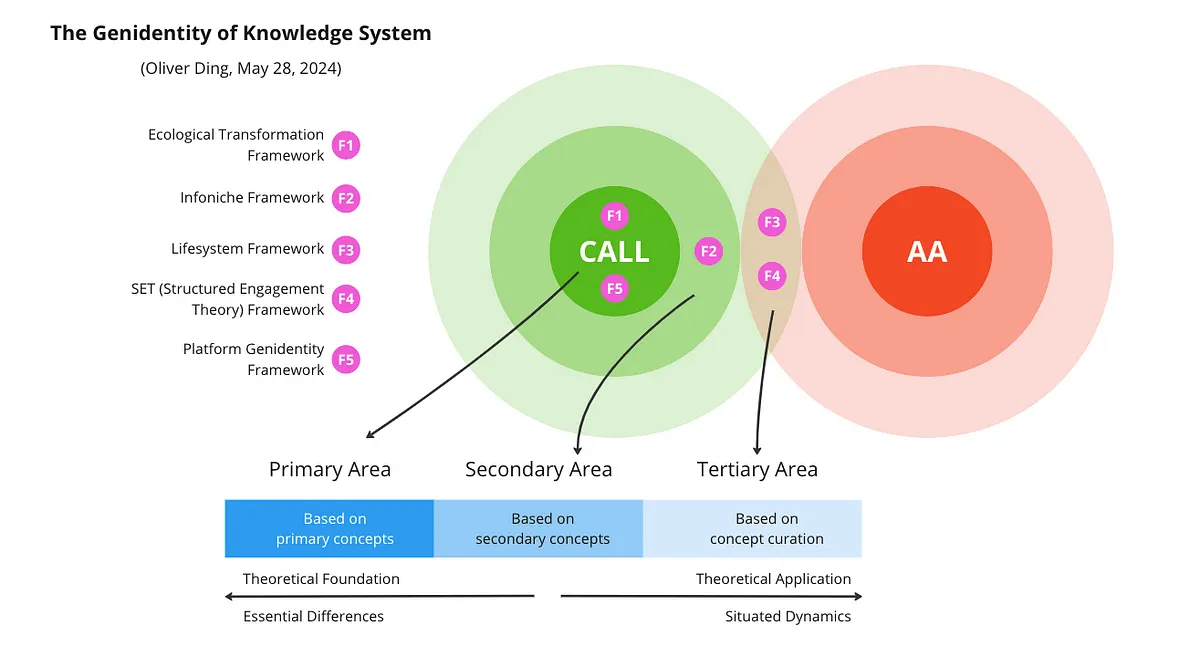
I sorted five knowledge frameworks into a Primary Area (F1, the Ecological Transformation Framework, based on Attachance; F5, the Platform Genidentity Framework, based on Genidentity), a Secondary Area (F2, the Infoniche Framework, based on Infoniche), and a Tertiary Area (F3, the Lifesystem Framework v1.0, based on "Lifesystem/Lifeway/Lifeform" and "Subject/Object"; F4, the SET framework, inspired by Activity Theory and Behavior Setting Theory). Both F3 and F4 were built through Concept Curation, for conducting empirical research and practical reflection.
This Genidentity case study taught me something about dialogue between theoretical enterprises more broadly. For the core members of a theoretical enterprise, what matters most is the internal consistency of the concept system—so knowledge elements at the edge naturally carry less weight than those at the center, and the closer an element sits to the center, the more homogeneous its origins must be. The more heterogeneous an element's origin—the more it draws from other theoretical enterprises—the more likely it is to be placed at the periphery.
But from the perspective of empirical researchers or practitioners in applied fields, there is no such obligation to any one theoretical enterprise. What matters to them is whether a framework is close to the object they want to investigate, not whether the framework is theoretically homogeneous or heterogeneous. This is why a hybrid framework like Lifesystem—mixing concepts from two knowledge systems—can still be readily accepted by that audience. The dialogue between a theoretical enterprise and a body of knowledge turns out to be a genuinely interesting phenomenon: different vantage points, different commitments, yield different understandings of the very same conflict.
The Late Wave
Generative confluence, the GO Theory platform, and the modeling of social environments
In 2025 and 2026, my creative journey changed shape.
From June to December 2025, I completed a Generative Confluence—a process in which, after several years of following three separate theoretical traditions while carefully guarding each one's boundaries, I gathered a set of knowledge elements produced through the dialogue among them into a single new creative center, which then developed, over six months, into a new theoretical platform, providing foundational support for my larger theoretical enterprise.
The three older theoretical traditions did not disappear; they continued developing along their own separate lines.
The new center, when it was born in June 2025, still carried the name Creative Life Theory, but under a new version number, v3.0. By early 2026, I had given it a new name: GO Theory—the World of Life (World of Activity) Approach.
The recent developments of Supportance Theory unfolded within this new landscape.
11
In May 2025, I completed and edited two book manuscripts, Weave the Life and Weave the Theory. One part of that work collected a series of articles on the development of Activity Theory as a theoretical enterprise—tracing its path since 2000, and the way several scholars, in the course of developing their own theoretical enterprises, had also contributed to the development of that shared tradition. In writing these articles, I brought the concept of Supportance together with the concept of Theoretical Platform. This was, in a sense, simply an application—an application, in a new domain, of a case already made in the 2021 draft of Platform for Development.
But there was something distinctive here. A theoretical tradition is a very particular kind of platform. It exists in the form of the theoretical thinking created by earlier contributors—as concepts, knowledge frameworks, diagrams, and research methods. And in the course of this case study, I also found that using different knowledge frameworks to understand the development of the same theoretical tradition would yield different models of its supportance.
There is a further principle here, drawn from Weave the Life's account of Life-as-Activity (v4.0): the distinction and transformation between inside and outside. If we merely gaze at a theoretical tradition, without doing anything connected to it, we remain outside it—and it, in turn, remains outside our own world of activity. The moment we do something connected to it, we enter its inside—and it, in turn, enters our world of activity, becoming a theoretical platform that supports us as we develop our own theoretical enterprise.
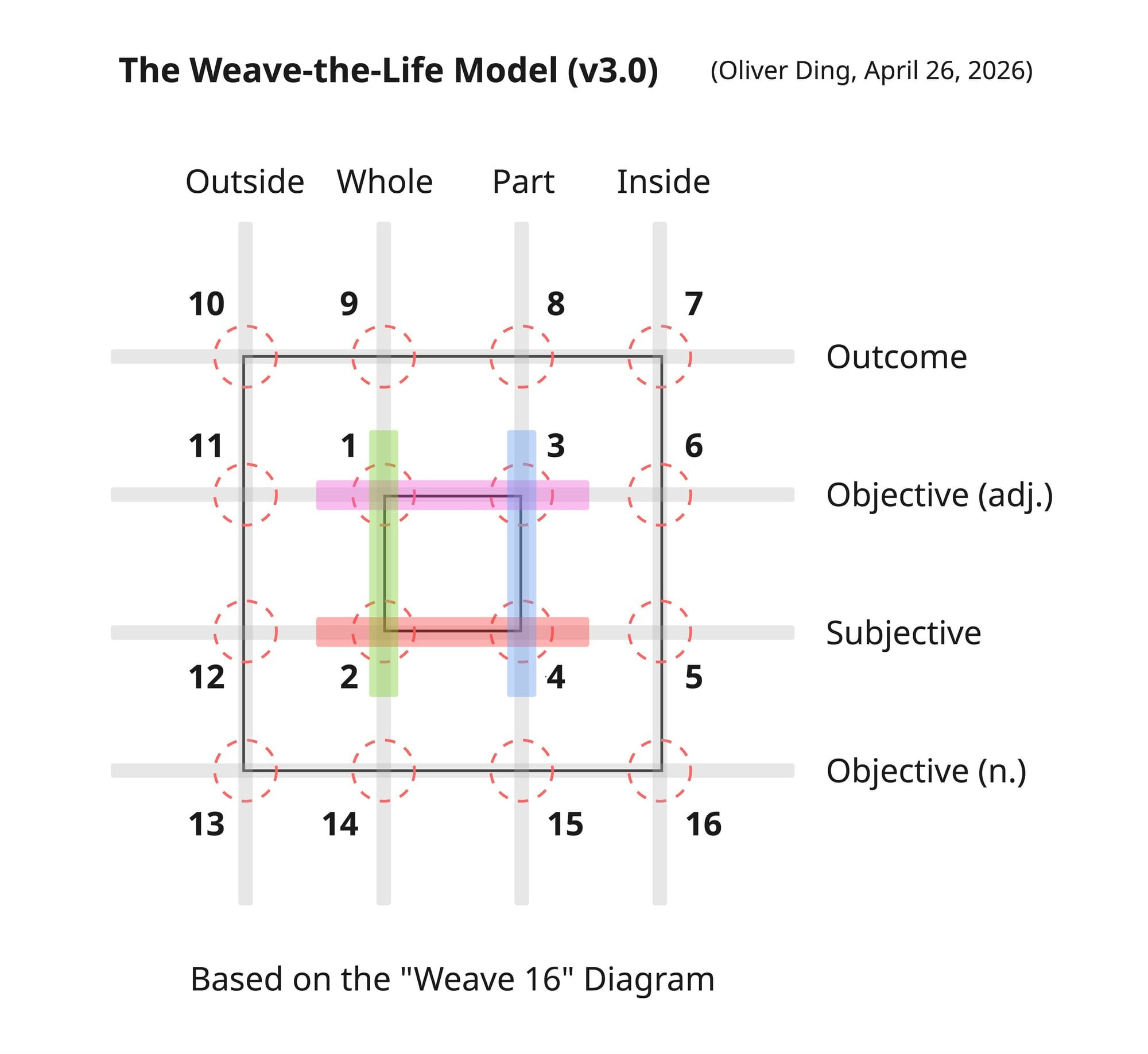
This inside/outside distinction and transformation opens a new, two-faced theoretical view of the social environment. On one side, we move across the boundary of some social environment, from outside it to inside it; at the very same time, it moves across the boundary of our own, individually-viewed world of activity, from outside to inside.
12
The recent development of the RelationField framework is tightly bound up with Supportance, and it brought about a new round of creative work on Supportance Theory itself. It was in the course of discussing the case of Yan Fu's chair that I developed the concept of Thematic Supportance.
In the summer of 2025, I visited the former residence of Yan Fu (1854–1921), the late-Qing translator who introduced Western thought to China through his translations of Huxley, Mill, and Smith, in the Sanfang Qixiang (Three Lanes and Seven Alleys) district of Fuzhou. In the living room of the house, I noticed a wooden chair, ordinary in itself—a piece of furniture from the late nineteenth century—but preserved, displayed, and visited. It carries something ordinary chairs do not carry. I photographed it, not for any particular purpose, but as an act of what I later called "appreciative photography," moved simply by its aesthetic presence. The photograph then sat in my archive for several months.
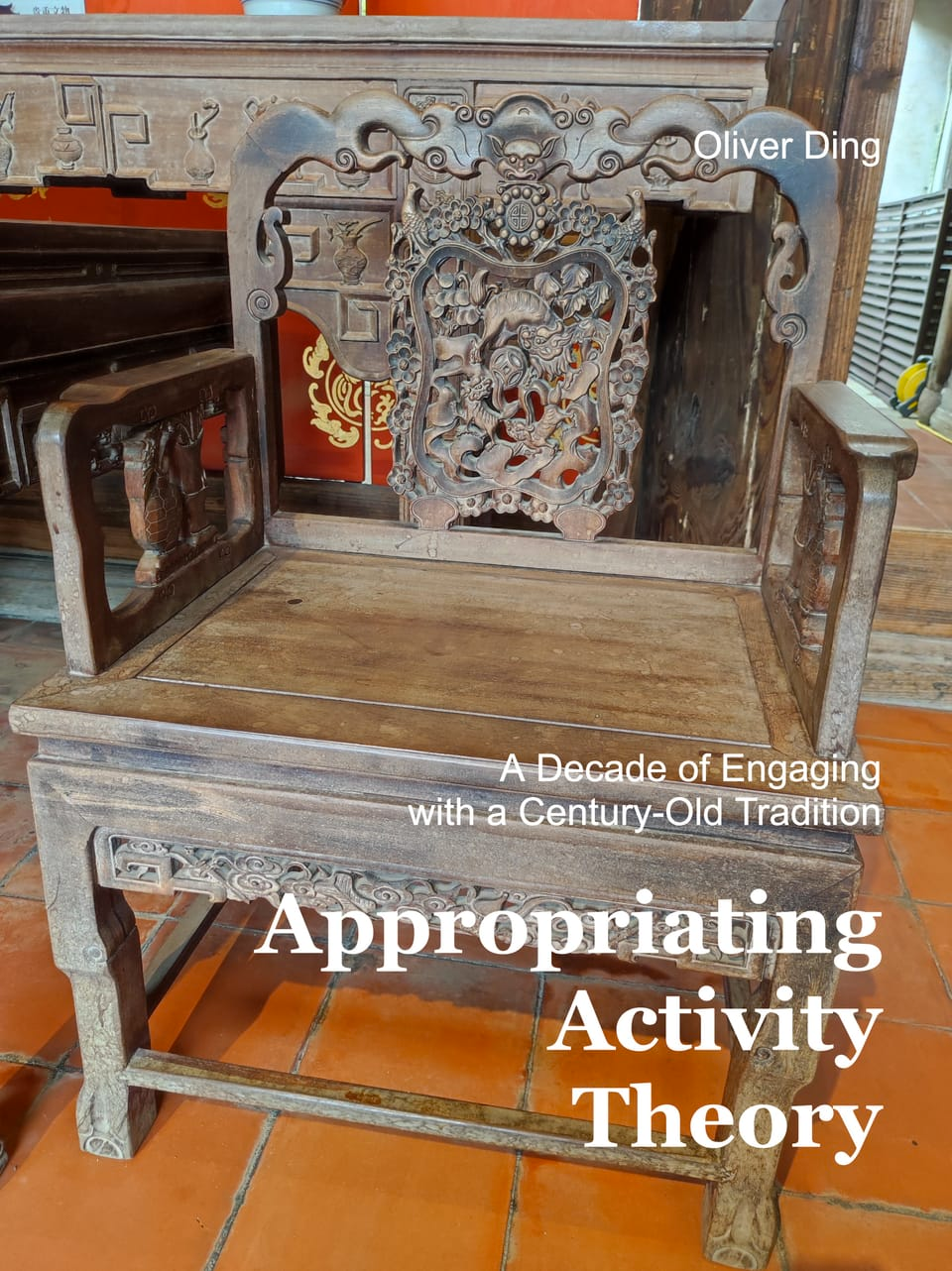
In September 2025, I was preparing a new column, "Appropriating Activity Theory," for the Activity Analysis Center, and needed a cover image. The photograph of Yan Fu's chair surfaced from the archive. It was a perfect match—not for its aesthetic qualities, but because it visually embodied the theme of the column itself: how concepts move across cultural boundaries, how one generation appropriates the intellectual resources of another. I selected the photograph as the cover and wrote the column. The chair, the photograph, and the theoretical frame were woven together. The chair went on to trigger a further theoretical reflection of its own: it led me to revise the Ap-Re-Co framework, extending it from a purely retrospective temporality to one that also includes a prospective temporality. In its afterlife, the chair had become not merely a thematic object, but a theoretical object—one that actively shaped my theoretical thinking. As I later wrote:
"The chair I photographed in appreciation, the chair that became a cover, the chair that triggered a theoretical reflection, the chair that now closes this book—these are not four different chairs. They are four moments in the life of a single object that has been repeatedly activated, each time in a context its maker could not have anticipated."
The case revealed a two-layer curation structure. The first layer belonged to the museum: the chair began as an ordinary physical object, and its transformation into a thematic object was the result of a curatorial act performed by the people who preserved Yan Fu's residence and opened it to the public. By placing the chair within "Yan Fu's former residence"—a space already saturated with the meaning of his life and work—the curators embedded it in a symbolic system. It ceased to be merely a physical object and became a thematic object, carrying the theme of East–West dialogue that Yan Fu's life embodied; the whole residence, in fact, functions as a single, vast thematic object. This first-layer curation was what prepared the chair to offer Thematic Supportance to future visitors—a visitor arriving at the residence does not encounter "a wooden chair" in the abstract, but "Yan Fu's chair," an object already thematized, already carrying a history of meaning. The second layer belonged to me, the visitor: photographing, selecting, and eventually theorizing.
The chair's Thematic Supportance—the possibility of engaging with East–West dialogue as a living theme—was not simply "given" by the chair alone. It was made available through the first layer of curation, and perceived and actualized through the second. This is what let me see that Thematic Supportance can attach to a material object once that object has been thematized through curation, whether by the owner of the life experience or by others.
I trace Thematic Supportance back to the original 2021 model of Supportance—it is a specific subtype of it, one that refers to the potential action possibility of symbolizing one's own lived experience into a Creative Theme. It is Supportance that carries "thematization potential"—the potential to be transformed, through Curation, into a Creative Theme that can be shared, transmitted, and woven into cultural frameworks. And because it belongs to the "unintended" category of Supportance, it requires no external subject to "give" it: it does not depend, as Social Support does, on the will or cooperation of a provider. It emerges directly from the structure of the experience itself.
13
Two weeks ago, I read a woman's blog—I will call her Aria—and learned of her journey through marriage and divorce. One event stood out: she was detained in a police cell for forty-two hours. The cell was sparse—no belongings, no connection to the outside world. Yet inside it, she discovered something unexpected: her body was confined, but her consciousness moved freely. "My mind is very free," she later wrote, "free to go wherever it wants."
Her story sent me back to reflect on what World of Activity, as a theoretical program, had accomplished so far, and where its limits lay. In last year's Homecoming manuscript, I had analyzed my own life course, drawing on an autobiography I had written from a reflective-learning perspective; many of the models and insights I derived there carried clear limitations. When I shared that manuscript with several women friends, I had already found myself curious what different insights would emerge if a woman's life were read through the World of Activity model.
This cross-cultural love story taught me something specific: everything I had explored in Homecoming concerned centers of a non-intimate kind. The centers of intimate relationships—romantic love, marriage—had never appeared in my empirical insight. Nor had a high-conflict situation like a divorce lawsuit ever entered my theoretical scope. What I had explored in Homecoming under the "Left–Right" relationship was always a movement from stranger to shared interest, to friendly collaboration—never the movement from intimacy to conflict.
This experience led me to do three things. First, I brought Heinz Kohut's concept of the selfobject, from self psychology, into Supportance Theory, proposing three types of selfobject supportance within intimate relationships; I then extended this typology with a further set of supportances drawn from family sociology, organized around functional dimensions, together forming a typology of supportance for the domain of intimate relationships. Second, I searched out academic literature on high-conflict divorce litigation, and encountered a rich and largely unfamiliar world; drawing especially on one doctoral dissertation, I wrote an article on how Supportance can become alienated. Third, I noticed that after her divorce case concluded, Aria had begun a new life, part of which involved designing a spiritual-exploration travel program built on local tourism resources where she lived. Her creative response gave me a further insight: how an individual, once some supportances have been alienated, can develop new supportances along other dimensions. One of those dimensions is Thematic Supportance—how a creative theme can be drawn from the experience of a life course. This connected directly back to the Creative Life Curation work I had done earlier.
Out of these reflections, I wrote a set of notes and then three public articles: "Supportances in Intimate Relationships: A Theoretical Framework," "The Alienation of Supportance: The RelationField of High-Conflict Divorce (HCD)," and "Thematic Supportance: Curation, Narrative, and Meaning." Of these, Thematic Supportance itself had actually emerged from the previous round of creative work, earlier that same month, together with the RelationField framework; it had already made its first, unnamed appearance the month before, in Weave the Theory's case study of Activity Theory, though I had not yet used the term explicitly there.
Once these articles were finished, I realized that this particular round of creative work on Supportance had pushed the theory forward more than any single prior episode. So, while the momentum was still there, I went back through the entire developmental history of the theory and edited the book you are now reading.
14
Editing this new book has itself been a process of revisiting the whole arc of this theoretical exploration. Looking back across these years of work on a single concept, I have come to see that what I was actually doing was never just about that one concept. I was, again and again, modeling social environments. Each time, in response to whatever situation I found myself in, I built a knowledge framework describing a particular type of social environment, constructed a model of it, and wove the concept of Supportance into that model.
On June 30, 2026, I released the draft of this book on the Activity Analysis Center website. On July 2, I wrote an email to a friend who has been watching my creative journey for many years, telling her about the new book. At that point, I had not yet written this preface. I was still inside the journey, not yet standing outside it. In that email, I wrote down a principle I had not formulated before—something I did not even realize was waiting to be said:
Relationship as environment. Activity as environment. Entering and exiting as opportunity; fit as achievement.
Those words did not come from a moment of deliberate theoretical design. They came from the simple act of telling a friend what the journey had felt like. Only afterward did I realize that I had just done what this book itself describes: I had looked back at six years of traces and found, embedded in them, a principle that had been there all along without my having a name for it. That is what Thematic Supportance is: the act of perceiving, in one's own lived experience, a possibility of meaning—and crystallizing it into something that can be shared.
I have arrived at a principle I did not have words for at the start: relationship as environment, activity as environment. Entering and exiting as opportunity; fit as achievement.
The traditional way of understanding "social environment" tends to reach for fairly rigid social structures—family, organization, community, party, city. What I am describing is different. To say relationship is environment is to treat the relationship itself as a form of social environment. To say activity is environment is to treat the activity itself, likewise, as a form of social environment. If we reach for a metaphor here, what I am really describing is a social container—something that holds a person within it. Once we say relationship is a container, and activity is a container, the idea becomes easy to hold onto. And once we adopt the metaphor of the social container, it becomes easy to understand the boundary of a social environment, and equally easy to understand why entering and exiting that boundary is itself an opportunity. Fit, in turn, carries two layers of meaning: the fit between a person and a social environment, and, within one and the same social environment, the fit between one person and another.
These principles correspond to the basic unit of analysis in the RelationField framework:
Subject–Subject (Subject–Object)
Subject–Object models activity as environment; Subject–Subject models relationship as environment. Together, they form a RelationField—and a RelationField, in itself, is a social environment.
This breakthrough, I think, owes something to a shift I made earlier this year, moving my attention from knowledge engagement toward cultural development. Once that creative space opened up, I was no longer confined by earlier boundaries; I could move into more territories, see a richer world, and that richer world, in turn, fed back into the expansion of my own theoretical system.
This new book, in this sense, brings Supportance Theory to a natural close. I think of what comes after it as Supportance Analysis—oriented toward further empirical research, case studies, and intervention design, a body of work now open to many hands, not only my own.
Postscript: Self-referential Supportance
In editing this book, and in revisiting the developmental history of Supportance Theory, I discovered that I had, without quite meaning to, carried out a very particular kind of curation operation. I had used the concept of Thematic Supportance—a theoretical tool I had only formally introduced in June 2026—to look back on fourteen key moments across the past six years, in which I had developed Supportance Theory.
This is not first-order experience: I was not living through some new event. Nor is it second-order experience: I was not encountering the traces left behind by someone else. It is a re-thematization of a trace that had already once been thematized by myself. I call this Self-referential Supportance.
Self-referential Supportance is a subtype of Thematic Supportance, referring to a particular structure: the subject takes their own past, already-thematized traces—articles, notes, models, book drafts—as an object of perception, and identifies within them a form of support—the sense that "this journey is meaningful, comprehensible, and transmissible"—which they then, through an act of Curation, symbolize into a new Creative Theme.
Its distinctiveness lies in three things: strictly speaking, it is neither the perception of someone else's Thematic Supportance, nor the direct, first-hand thematization of one's own experience—it is the re-thematization of one's own, already-thematized traces; the source material is the subject's own past traces, not someone else's traces or an abstract symbol; and the person who performs the Curation is the same person who owns the experience—both the possessor of the experience and the curator of its traces.
These fourteen stories, when they happened, did not feel to me like a single, meaningful arc. It was only Self-referential Supportance—only the act of looking back at them through the lens of Thematic Supportance—that let this arc become visible at all.
What matters about Self-referential Supportance is not that it is "my story." What matters is that it reveals a more general structure: any theorist, in the course of their own theoretical development, can perceive a particular kind of support—the cognitive tension of discovering that "this theory can explain itself"—and symbolize that tension into a new theme.
Viktor Frankl's concentration-camp experience was symbolized into "Will to Meaning." Aria's experience in a detention cell was symbolized into "Soul Power" and "Gap, Grace, and Gift." My own theoretical journey has been symbolized, here, into "Self-referential Supportance" itself. The three cases share the same underlying structure; what differs is only the order of the source material: an extreme, first-hand experience of deprivation, in Frankl's case; a first-hand experience of duress, in Aria's case; one's own already-thematized traces, in mine.
Once "Self-referential Supportance" was written down, defined, and placed within a theoretical framework, it completed its own transformation—from "my personal experience" into "a cultural resource that others can borrow." It no longer belongs only to me.
This is the full circuit of Thematic Supportance: experience becomes trace, trace becomes theme, theme is passed on. Self-referential Supportance is a particular node within that circuit—the node at which the circuit itself becomes an object that can be observed and described.
This closing section was never part of the original plan for this preface. It grew, naturally, out of the moment when, having just finished sorting through fourteen stories, I suddenly recognized what I was actually doing: I was using Thematic Supportance to analyze my own theoretical history. That recognition is itself the first instance of Self-referential Supportance—it proved its own existence by using itself.
If you are reading this book, and you have ever had a similar experience—looking back at the traces your own past has left behind, and recognizing within them a form of meaning—then you have already perceived Self-referential Supportance. Now you have a name for it.
That name is this book's gift to you, drawn from my own journey.
v.1.0 - July 4, 2026 - 9,920 words