
The Actualization of Thematic Supportance as a Creative Action

Supportance Theory and Creative Life Theory
by Oliver Ding
July 3, 2026
This article is part of a possible book: Supportance: Self, Other, and Possible Support.
Contents
Part 1: The 3i Model of Creative Action
1.1 The Creative Action Analysis Method
1.2 Double Selectivity: Perceiving and Thinking
1.3 Act, React, and Opportunity
1.4 Why the 3i Model Matters for Thematic Supportance
Part 2: The Early Naming—Two Cases from 2020
2.1 Gibson's Creative Writing
2.2 My Kids' Creative Play
Part 3: The Recent Actualization—Two Nested Creative Actions
3.1 Aria's Actualization of Thematic Supportance
3.2 Oliver's Perception of Aria's Creative Action
3.3 Oliver's Theoretical Developmental Episode
3.4 The Nested Structure
3.5 Three Orders of Experience and Nested Actualizations
Part 4: The Chain of Creative Actions
4.1 The Sequence Pattern
4.2 Why This Matters
The previous article Thematic Supportance: Curation, Narrative, and Meaning established Thematic Supportance as a theoretical concept: the potential action opportunity of symbolizing lived experience into a Creative Theme. The article grounded this concept in three cases spanning different ecological conditions, demonstrating that lived experience itself carries the potential for meaningful symbolization.
But from the perspective of Creative Life Theory, this theoretical establishment is only part of a larger story.
Every actualization of Thematic Supportance is a Creative Action.
When a person encounters their lived experience and perceives within it the potential for thematization—and then performs the work of curation to symbolize that experience into shareable themes—they are not merely applying a theoretical concept. They are enacting a Creative Action: an encounter between their lived situation (initiating act) and their selective perception and creative thinking (response).
This article uses the 3i Model of Creative Action to examine this relationship. The 3i Model was developed in 2020 specifically to analyze how ideas are born through encounters between an initiator's creative act and an initiatee's creative response. What becomes clear through applying this model is that the development of Supportance Theory itself has been shaped by a sequence of Creative Actions—each one an actualization of Thematic Supportance at a different level, with different ecological conditions, and increasing complexity.
The cases begin in 2020, when I first encountered Gibson's affordance theory and my sons' creative play, and I perceived the potential for a new concept: Supportance. They continue through the development of Supportance Theory over six years. And they crystallize in June 2026, when I encountered Aria's curation of her lived experience, which revealed what had been missing from my theoretical understanding and triggered a restructuring of the entire framework.
This article traces these Creative Actions—early, intermediate, and recent—using the 3i Model as the analytical instrument. In doing so, it demonstrates that theoretical development and the actualization of Thematic Supportance are not separate processes. They are the same process, viewed from different angles.
Part 1: The 3i Model of Creative Action
In 2020, I worked on the Action-based Creativity project, which is the seed of Creative Life Theory. At that time, I developed a series of knowledge frameworks to connect individual daily experience at the micro-level and collective culture at the macro level. The 3I model is one of these frameworks.
1.1 The Creative Action Analysis Method
At that time, the primary model in this series was named the NICE Way (the N.I.C.E framework). N stands for normal actions, I stands for Imagined actions, C stands for creative actions, and E stands for exemplary actions.
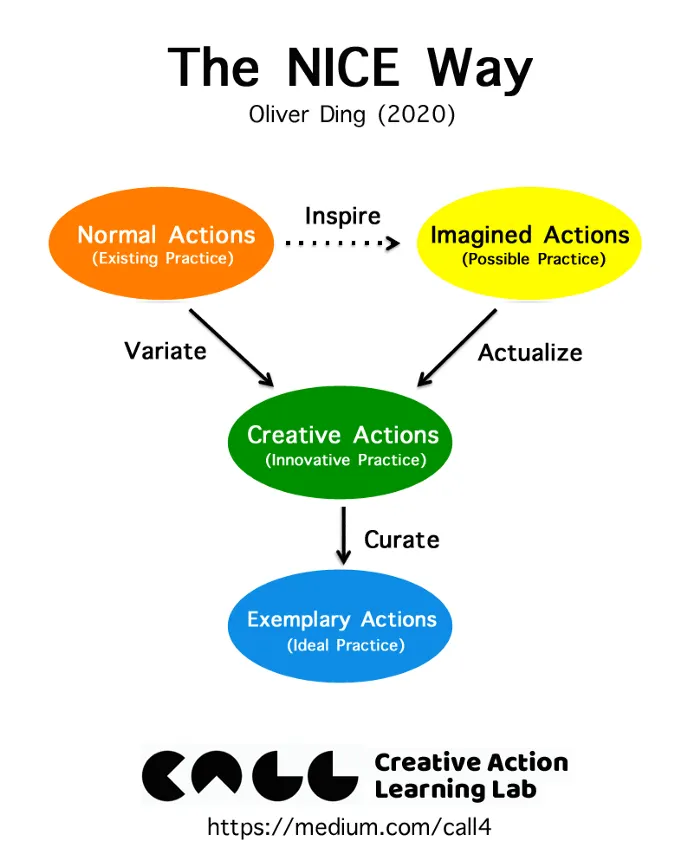
I also identified four types of transformation processes within Action-based creativity.
- Variate: from normal actions to creative actions
- Inspire: from normal actions to imagined actions
- Actualize: from imagined actions to creative actions
- Curate: from creative actions to exemplary actions
At the micro-level, the basic unit of analysis is Creative Action. I use the following 3i model to understand it. As the diagram below shows, the 3I model has three core entities which are idea, initiator, and initiatee. It also considers two types of events: act by the initiator and react by initiatee. Finally, the model considers the platform as the context of entities and events.
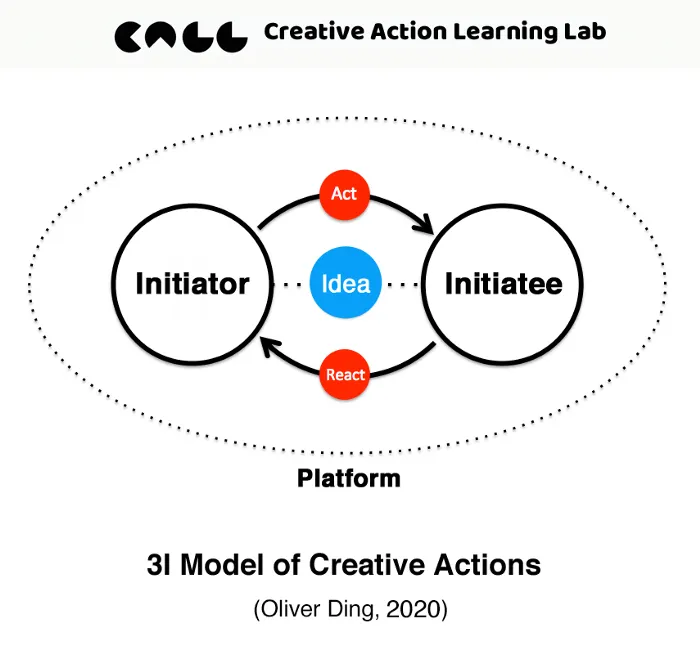
Initiator refers to a person who initiates an act that makes “a grand opening” of a creative action.
Initiatee refers to a person responds to the initiator’s “call-to-action. For most intended creation actions, it is easy to identify the Initiator and the Initiatee behind a creative action. However, it is not easy to do the same analysis on unintended cases.
Act is the initiator's creative action.
React is the initiatee's response, which operates through Double Selectivity:
- Selectivity of Perceiving: What elements from the initiator's act are attended to? What stands out? What gap or potential is recognized?
- Selectivity of Thinking: What conceptual or creative response crystallizes from what is perceived? What idea emerges?
For intended creation actions, the initiator might specify what initiatees should do while unintended creation actions don’t have such strong intentions.
Idea is the theoretical or creative concept that emerges from the react process. I consider it has three elements including name, form, and content.
Platform is the context—physical, social, digital—within which the act and react occur.
1.2 Double Selectivity: Perceiving and Thinking
I also adopted the concept of “Double Selectivity” from Curativity Theory to expand the 3i model.
My approach is inspired by James J. Gibson’s ecological psychology. According to Harry Heft, the theoretical root of Gibson’s ecological psychology is William James’ Radical Empiricism. Inspired by Heft, I adopted the concept of Selectivity from Radical Empiricism.
Heft (2012) pointed out, “…in radical empiricism, knowing refers most fundamentally to a functional relation in experience between a knower and an object known. The defining characteristic of knowing is selectivity. Through knowing processes, structure is selected out of, or differentiated from, immediate experience. It is now time to consider the products of selective processes. To use James’s terminology, two products of the selectivity of knowing processes are percepts and concepts.”(p.37)
In order to develop Curativity Theory, I used “Double Selectivity” to describe the foundation of curating. Now, I will expand it to describe two sub-processes of “React”.
- First sub-process: the Selectivity of Perceiving
- Second sub-process: the Selectivity of Thinking
According to Heft, “Perceiving is an action that entails selection of a flow of immediate experience out of the potential ground that is pure experience. Thinking or conceiving entails, in turn, selecting and fixing particular parts of this perceptual flow. Through this process, concepts are carved out of immediate perceptual experience at a remove from action and are abstracted from it. Abstracting from the immediate flow of experience makes it possible for the knower to isolate, and then to classify or otherwise manipulate, these extracted ‘moments.’ This cognitive capability enlarges the knower’s epistemic potential in incalculable ways. ”(pp.39–40)
For Curativity theory, the orientation of selection is turning pieces into a whole. It requires perceiving and thinking of something as a container for things-in-pieces. For the 3i model, the orientation of selection is turning daily experience into theoretical concepts for developing metatheories.
1.3 Act, React, and Opportunity
The original 3i model also has an element called “Platform”. Later, I used “Context” to replace “Platform”. On March 5, 2022, I developed the Optimal Context Canvas for the Ecosystem-for-Development framework.
There are many theories and models about ecosystems. The Ecosystem-for-Development approach focuses on the “Individuals — Opportunities — Ecosystems” relationship.
For Ecosystem builders, the Optimal Context Canvas offers a landscape view of an ecosystem with a brand new typology of social contexts.
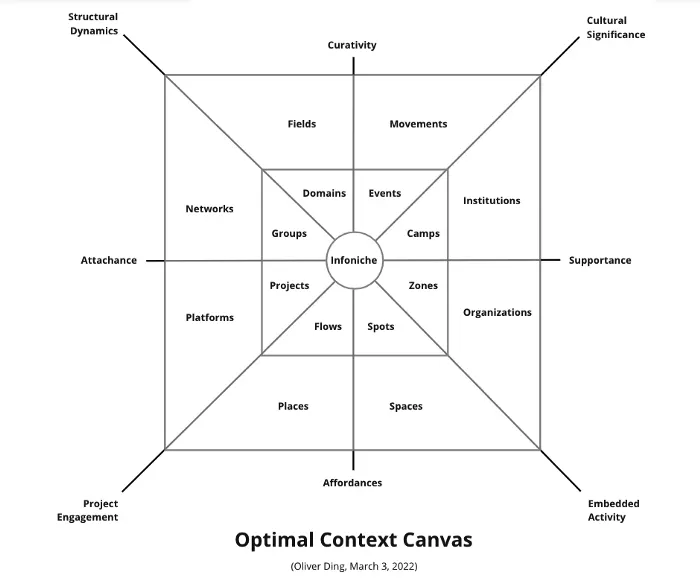
This canvas and the Ecosystem-for-Development framework directly connect Creative Life Theory and the Ecological Practice Approach.
In this light, the "Act" can be understood as "Giving Opportunity," the "React" as "Taking Opportunity," and the "Idea" as the "Opportunity" itself.
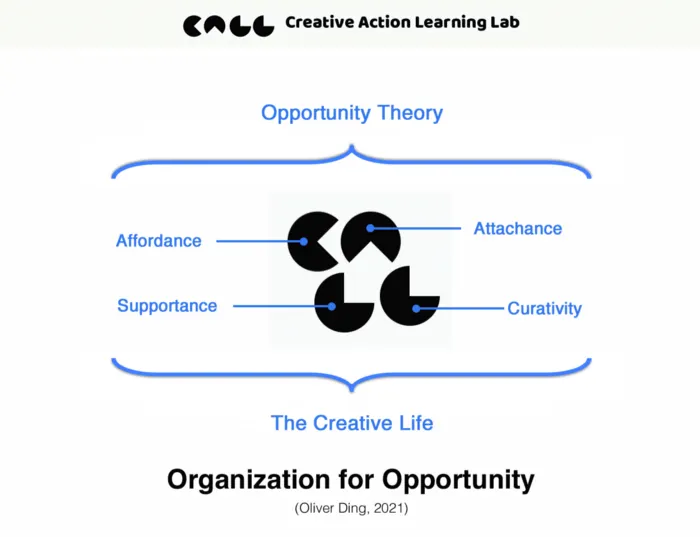
In the diagram above, we see Supportance, one of four type of opportunities.
1.4 Why the 3i Model Matters for Thematic Supportance
The 3i Model reveals something crucial: ideas are not born in isolation through pure reflection. They are born through encounters with others' creative work.
When someone performs a Creative Action—writes something, plays a game, curates an experience—they initiate an act. Another person, encountering that act, performs selective perception (noticing what stands out, what gap is revealed) and selective thinking (conceiving what concept would explain this). From that encounter, a new idea crystallizes.
This is precisely how Thematic Supportance entered Supportance Theory. Not through abstract theorizing, but through a sequence of Creative Actions and their careful analytical responses.
Part 2: The Early Naming—Two Cases from 2020
In October 2020, I coined a term called Supportance and developed it as a new meta-concept that offers a new perspective on social support and other social phenomena. I considered it as a starting point for a new theory of social action. You can find more details in The Concept of Supportance.
From the perspective of the 3i model, I built Supportance Theory by reacting to two creative actions.
- Gibson’s creative writing
- My kids’ creative play
2.1 Gibson's Creative Writing
First, I got an idea for the new concept when I was reading Gibson’s book The Ecological Approach to Visual Perception in October 2020. I have been reading the book many times. The book has a chapter that presents the theory of Affordance. One day, I found the classical example of Affordance Gibson offered had a new meaning for me.
Initiator
James J. Gibson
Initiatee
Oliver Ding
Act
Gibson wrote a classical example of Affordance in 1979.
If a terrestrial surface is nearly horizontal (instead of slanted), nearly flat (instead of convex or concave), and sufficiently extended (relative to the size of the animal) and if its substance is rigid (relative to the weight of the animal), then the surface affords support. It is a surface of support, and we call it a substratum, ground, or floor. It is stand-on-able, permitting an upright posture for quadrupeds and bipeds. It is therefore walk-on-able and run-over-able. It is not sink-into-able like a surface of water or a swamp, that is, not for heavy terrestrial animals. Support for water bugs is different. (1979/2015, p.119)
Idea
The Surface affords support.
React
Inspired by Gibson’s writing, I coined a new term: Supportance.
The Selectivity of Perceiving
Usually, people use this example for understanding the concept of Affordance. Since I had read the book many times, I didn’t have to do it in this way. I paid attention to one sentence “…the surface affords support…” and the word “support.”
The Selectivity of Thinking
I realized I could coin a new term—Supportance—and develop it as a theoretical concept.
As James G. March mentioned, the evocation of meaning is a natural product of crossing disciplinary, cultural, national, and linguistic boundaries. He says, “Nevertheless, for those who see the creative beauty generated by the wanderings of ideas, the magic and mystery of language is a wonder of intellectual discourse. Scholars celebrate the evocation of new meanings that arise when others discover, not exactly what they thought they meant when they wrote their words or characters but rather what the words or characters themselves might be imagined to mean.” (2008, p.140)
However, the new term is not a real concept even though it has its own word meaning. I need to find its concept from the real-life world. I was lucky because I quickly solved it by reacting to a second creative action initiated by my two sons.
2.2 My Kids’ Creative Play
In 2020, I often went to a nearby museum with my two sons. They loved playing a creative game called “Jump-Jump-Jump” in the courtyard of the museum. See the picture below. The ground of the courtyard is covered with gravel, and there are many large stone slabs well-spaced on it.
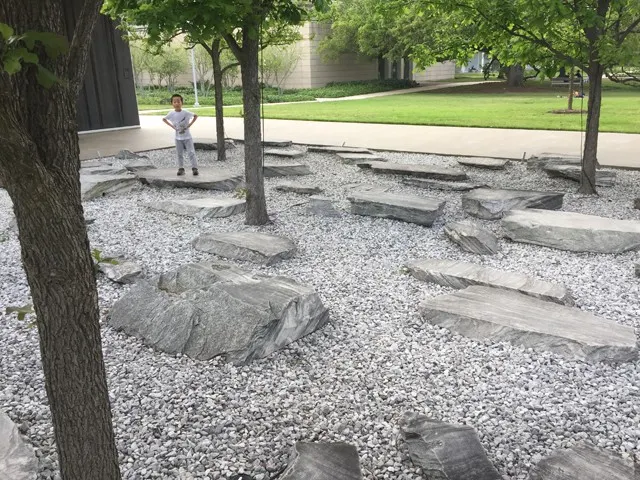
My two sons loved jumping from one stone slab to another one. Eventually, they invented the game “Jump-Jump-Jump”.
The rule of the game is 1) Player A has to jump from one stone slab to another one; 2) Player B has to follow the first player and try to catch him; 3) if Player A is caught by Player B, or steps onto the gravel, he fails. Player B must also be careful not to step onto the gravel; 4) If one play fails, both players have to go to a rock in the corner of the courtyard and restart the game.
Sometimes I joined the game and played with them. They really wanted to play with me. Sometimes, I refused to join the game in order to walk around.
From the perspective of Affordance Theory, these stone slabs (as a physical environment) offer jumping for my sons and me. However, Affordance Theory doesn’t apply to the game of “Jump-Jump-Jump” because it is about social actions.
How about the concept of Supportance? I realized it is suitable to explain the game “Jump-Jump-Jump” because I (as a social environment) offer support for my sons to play the game. The Supportance of support-for-playing “Jump-jump-jump” is offered by me.
Moreover, the combination of “Affordance — Supportane” is a perfect framework for explaining the game of “Jump-Jump-Jump” and similar social actions because we have to pay attention to both physical environments and social environments.
The insight was discovered in 2020. On August 12, 2021, I applied the 3I model to this case.
Initiator
My two sons and me
Initiatee
Oliver Ding
Act
We play the game “Jump-Jump-Jump”.
Idea
While stone slabs afford to jump, I offer support-for-playing for my sons.
React
I use this creative play to test the concept of Supportance.
The Selectivity of Perceiving
I noticed that my behavior had two states: playing with them, or not.
The Selectivity of Thinking
I realized that these two states of my behavior mean there is a transformation between potential and actual. Thus, I confirmed the concept of Supportance because it shared the same logic as the concept of Affordance.
Part 3: The Recent Actualization—Two Nested Creative Actions
Six years later, in June 2026, I encountered Aria's curation of her lived experience, which revealed what had been missing from my theoretical understanding and triggered a restructuring of the entire framework. This experience inspired me to develop the concept of Alienation of Supportance. Finally, it also led the new possible book, Suppotance: Self, Other, and Possible Support.
There are two creative actions of actualization of thematic supportance, nested together in a journey of theoretical development.
3.1 Aria's Actualization of Thematic Supportance
Ten days ago, I read a woman's blog (whom I will call Aria) and learned her journey of marriage and divorce. One event stood out: she was detained in a police cell for 42 hours. The cell is sparse—no belongings, no connection to the outside world. Yet inside this cell, she discovers something unexpected: her body is confined, but her consciousness moves freely. "My mind is very free," she later writes, "free to go wherever it wants."
Her story inspired me to explore Intimate Relationships and High-Conflict Divorce (HCD), resulting in a series of new articles on the concept of Supportance and the RelationField framework.
The Act: Aria's Lived Experience
Aria is a woman from East Asia who relocated to Bali in her mid-thirties to start a new life. Over the following years, she experienced a marital breakdown, a protracted legal battle, and personal crisis. During this period, she was detained for 42 hours in a police cell.
Unlike the Yan Fu case, where the initial thematization was performed by others, Aria is the owner and curator of her own life experience. She perceives Thematic Supportance directly from her lived experience and curates it into Creative Themes through her own writing and practice.
Aria's Selectivity of Perceiving
From the perspective of Supportance Theory, her situation involved the progressive dismantling of her sources of support, across multiple dimensions:
- Affordance: her physical freedom was restricted.
- Social Support: her partner became adversarial.
- Institutional Support: the legal system became hostile.
- Informational Support: her public voice was constrained.
Yet she perceived Thematic Supportance within this situation. In her detention cell, she discovered something she later described as "consciousness free to go wherever it wants." The physical compression created the condition for a different kind of perception.
The actualization of these Thematic Supportances followed the three-phase structure of the 2021 model. In the Perception phase, she perceived, in the immediacy of her lived experience—the detention cell, the experience of riding on the beach, the natural environment—the potential for symbolization embedded in each. These were not later reflections; they were direct apprehensions of possibility within the experience itself.
Within this lived experience—difficult, painful, constraining—Aria perceived something: potential for meaningful symbolization. She perceived that even in the extremity of her situation, her lived experience carried themes that could be extracted and shared.
Aria's Selectivity of Thinking
While engaging with these possibilities through embodied practice: meditation, painting, riding, she developed specific creative themes:
- "Soul Power" — the recognition of inner resources independent of external conditions.
- "Brief intensity" — the principle that a short, concentrated experience can generate sustained good feeling.
- "Gap, Grace, and Gift" — the name she gave to her travel program, a curated experience designed to share the Thematic Supportance she had found in Bali with others. The title reflects the three movements of her journey: the gap of displacement and crisis, the grace of encountering unexpected support, and the gift of passing it forward.
Unlike the Yan Fu case, where Thematic Supportance was attached to a material object in a preserved cultural setting, Aria's Thematic Supportance emerged from multiple sources across a situational space under duress. Her source of support was partially dismantled, but not entirely eliminated. The natural environment of Bali, animals, and spiritual practice remained as sources of Supportance, through which she perceived and actualized Thematic Supportances.
Aria's Actualization
By curating her lived experience into these shareable themes—through her narratives on social media, through her spiritual tourism program, through her willingness to name and structure what she had lived—Aria actualized Thematic Supportance. She perceived and enacted the potential for symbolization that her lived experience carried.
Aria did not need to know the theoretical name "Thematic Supportance"—she was doing what the concept describes.
3.2 Oliver's Perception of Aria's Creative Action
Aria's story inspired me to work on two projects: a private project and a public project.
Based on Aria's blog posts, I conducted a case study, based on the World of Activity Approach and the Supportance-RelationField Framework. The outcome was a private document, only for my personal reflection, not for public sharing.
Inspired by the case study, I did more research on related topics such as Intimate Relationships and High-Conflict Divorce (HCD), expanding Supportance Theory and the RelationField framework to these new fields. The outcome was a new possible book: Supportance: Self, Other, and Possible Support (v1, 2026).
Act: Aria Shared Her story via Curated Narratives
Aria wrote a series of blog posts to share her life story, built curated narratives.
React: Oliver Read Aria's Curated Narratives
I encountered Aria's accumulated posts and narratives—traces of her lived experience that she had already curated into shareable form.
My Selectivity of Perceiving
As I read through Aria's creative curation, I perceived something in my own theoretical work: multiple absences.
- Intimate relationships had never appeared as centers of activity in my theoretical analysis. I had extensively theorized non-intimate centers (knowledge work, organizational life, projects), but romantic relationships and their dissolution—a primary domain of human life—remained theoretically unexamined.
- High-conflict situations had no place in my relational theory. My analysis covered only positive trajectories: stranger → shared interest → cooperation. The reverse trajectory—intimacy → conflict → dissolution—and the distinctive dynamics of high-conflict situations were absent.
- Aria's lived and curated experience revealed exactly what my theory could not yet explain. Until I encountered Aria's case, I had not paid close attention to the relationship between Supportance Theory and creativity.
This perception of absence was precise because Aria's Creative Action revealed it.
My Selectivity of Thinking
From this perception of gaps, I conceived three theoretical responses, leading to a major theoretical development of Supportance Theory.
3.3 Oliver's Theoretical Developmental Episode
I reacted to Aria's act with three theoretical responses, forming a theoretical developmental episode in the ongoing development of Supportance Theory.
First: Developing the Concept of "Alienation of Supportance"
In Aria's experience, I perceived how supportances that had previously structured her life were systematically alienated:
- Relationship supportances deteriorated—intimacy became hostility
- Institutional supportances became adversarial (the legal system, meant to protect, became a weapon)
- Economic supportances became entangled with conflict
This revealed a new theoretical concept: Alienation of Supportance —the degradation, withdrawal, or corruption of previously available supportances.
Second: Verifying Thematic Supportance
More fundamentally, I perceived that Aria, in the extremity of her circumstances, was actualizing the very mechanism that Thematic Supportance theory names. Despite the alienation of external supportances, she was perceiving and enacting the potential for meaningful symbolization within her lived experience.
The concept of Thematic Supportance was born before I encountered Aria's story. Her actualization served as verification: the concept works. It explains what she was doing.
Third: Grounding Creative Life Curation
Through Revisiting-Rebuilding, I returned to my 2022 framework Creative Life Curation and perceived that it had been missing something: an ecological ground. Creative Life Curation asked "how do we curate experience into themes?" but never explained "why this is possible."
Aria's lived actualization showed the ground: lived experience itself carries symbolization potential.
My Actualization
By perceiving these gaps and conceiving these theoretical responses, I actualized a deeper understanding of Thematic Supportance. I was not merely applying an existing concept. I was perceiving, through Aria's Creative Action, what Thematic Supportance enabled and made possible. I was enacting the potential that Aria's example revealed.
3.4 The Nested Structure
What becomes clear is that these are two Creative Actions nested within each other:
Level 1 (Aria's Creative Action):
- Act: Live through experience, perceive potential for symbolization, curate into themes
- Selectivity: Perceive themes within pain; think how to share them
- Actualization: Enact the potential for thematization
Level 2 (Oliver's Creative Action):
- Act: Aria shared her story via curated narratives
- React: Oliver read Aria's curated Narratives
- Selectivity: Perceive theoretical gaps revealed by Aria's work; think about what concepts would explain what Aria did and what my framework was missing
- Actualization: Perceive and enact a deeper understanding of Thematic Supportance, rebuild existing frameworks
Neither Creative Action is separate from the other. Aria's actualization of Thematic Supportance created the conditions for Oliver's Creative Action. Oliver's Creative Action was a response to Aria's Creative Action—not to the underlying experience itself, but to her curation of that experience into shareable form.
3.5 Three Orders of Experience and Nested Actualizations
This nested structure of two Creative Actions corresponds directly to the distinction between three orders of lived experience:
First-order lived experience: Direct, immediate encounter with lived situation. The subject is present, living through the event.
In Aria's case, first-order lived experience is her actual living—marriage, conflict, legal battles, pain, perception of themes, curation into narratives.
Aria's actualization of Thematic Supportance occurs at the first-order level. She lives the experience and perceives within it the potential for symbolization. She does not need external theoretical framework. She is perceiving and enacting potential embedded in her lived experience itself.
Second-order lived experience: Mediated encounter with traces of others' lived experience. The subject does not live the original experience, but encounters it through curated material—narratives, stories, published accounts.
In Oliver's case, second-order lived experience was the encounter with Aria's accumulated posts, narratives, and curated themes—the traces of her first-order lived experience that she has already processed and made shareable.
Oliver's actualization occurs at the second-order level. He does not live Aria's pain or legal battles. He encounters her curation—the themes she has extracted ("Soul Power," "Brief Intensity," "Gap-Grace-Gift"). Through this encounter with second-order material, he perceives theoretical gaps in his own framework and conceives new theoretical responses.
The distinction between first-order and second-order actualizations reveals something important: Thematic Supportance operates at both levels, but the nature of what is actualized differs.
At the first-order level, Aria actualizes Thematic Supportance directly—she perceives and enacts the potential for symbolization within her own lived experience.
At the second-order level, Oliver actualizes a deeper theoretical understanding of Thematic Supportance—he perceives and enacts the potential for theoretical insight that Aria's already-curated work reveals.
One is lived actualization. The other is theoretical actualization. But both are Creative Actions, and both involve selective perception and selective thinking in response to potential.
This is how theoretical development actually happens: through encounters with others' Creative Actions, through selective perception of what those actions reveal, and through careful thinking about what concepts would explain them.
Part 4: The Chain of Creative Actions
Looking back at the three cases—Gibson (2020), Jump-Jump-Jump (2020-2021), and Aria (2026)—a pattern becomes visible.
2020: Simple dyadic Creative Action
- Initiator: Gibson (or my sons)
- Initiatee: Oliver
- Act: Write about affordance / play a game
- React: Perceive, think, conceive
- Idea: Supportance concept
2026: Complex sequential Creative Actions
- Initiator: Aria (lives and curates)
- Initiator's Act: Perform Creative Action of Actualization of Thematic Supportance
- Initiatee: Oliver (perceives Aria's act and performs new Creative Action)
- Initiatee's Act: Perceive gaps, think theoretically, conceive new categories
- Initiatee: The broader theoretical framework (Creative Life Curation, Supportance Theory, etc.)
- React: Rethinking on Supportance Theory and other theoretical frameworks, and rebuilding them
- Ideas: Alienation of Supportance + verification of Thematic Supportance + ecological grounding of Creative Life Curation
4.1 The Sequence Pattern
What has become clear over six years of cases is that Creative Actions are not isolated events but form chains and sequences.
In 2020, the Creative Actions were relatively simple: single dyadic encounters (Gibson ↔ Oliver, sons ↔ Oliver) generated single crystallized ideas (Supportance).
By 2026, the pattern had become more complex: nested and sequential Creative Actions, where each action builds on prior frameworks, reveals what those frameworks lacked, and triggers rebuilding work that enriches multiple frameworks simultaneously.
4.2 Why This Matters
This sequential, nested pattern reveals that theoretical development is not linear accumulation. It is a complex ecology of Creative Actions, each one an actualization of Thematic Supportance at a different level.
The 3i Model is itself an ecological form—a simple relational structure (Act–Idea–React) through which Thematic Supportance moves from potential to actualization. Its key insight is that creativity can occur anywhere: in the Act, in the React, or in the sequence that connects them. My multiple readings of Gibson illustrate this. The Act (his text) stayed the same; my Reacts varied. Early readings aimed at faithful interpretation; the 2020 reading selectively perceived "support" against the grain and thought it into a new direction. That variation—the capacity to respond differently to the same Act—is where creativity enters theoretical work.
The early cases (2020) showed how Supportance as a concept was born through Creative Actions. The recent case (2026) shows how actualization of Thematic Supportance generates complex chains of Creative Actions that reshape the entire theoretical enterprise.
This is not something that could have been planned or predicted in 2020. It emerges from the lived practice of theoretical work—from encounters with others' creative work and the careful, selective response to those encounters.
v1.0 - July 3, 2026 - 4,456 words