
Supportance: Self, Other, and Possible Support (v1, 2026)
A Possible Book about Supportance Theory
by Oliver Ding
June 29, 2026
In March 2019, I completed the draft of my first theory book, Curativity: The Ecological Approach to General Curation Practice, exploring one of my key life themes: Curation. A by-product of the book was a beta version of the Ecological Practice Approach, originally named the Gibson-Lakoff-Schön Approach, drawing from the theoretical contributions of James J. Gibson, George Lakoff, and Donald Schön.
In May 2020, I drafted After Affordance: The Ecological Approach to Human Action, which established the v1.0 version of the Ecological Practice Approach. This draft introduced the “germ-cell” version of the approach, centered on three key concepts: Affordance, Attachance, and Containance. Later that year, in October, I introduced the concept of Supportance—extending the framework to specifically address the domain of social environments.
The Ecological Practice Approach aims to extend James Gibson's ecological psychology from natural environments into social life. The concept of Supportance is a key step in this mission. Gibson defined affordance as what the environment offers the animal — what it provides or furnishes, for good or ill. Affordance implies complementarity: it exists neither in the environment alone nor in the organism alone, but in the relational encounter between them.
Affordance applies to the natural environment. The question I faced was: what is the analogous concept for the social environment — for the action possibilities that human-to-human relationships and social structures make available? To answer this question, I coined a new term: Supportance, defined as the potential supportive action opportunities offered by the social environment. Like affordance, it is relational and ecological: it exists neither in the environment alone nor in the person alone, but in the encounter between a subject and the structured social world. Unlike affordance, it specifically concerns human-to-human interaction, and therefore introduces the intentional/non-intentional distinction that arises when both parties have agency.
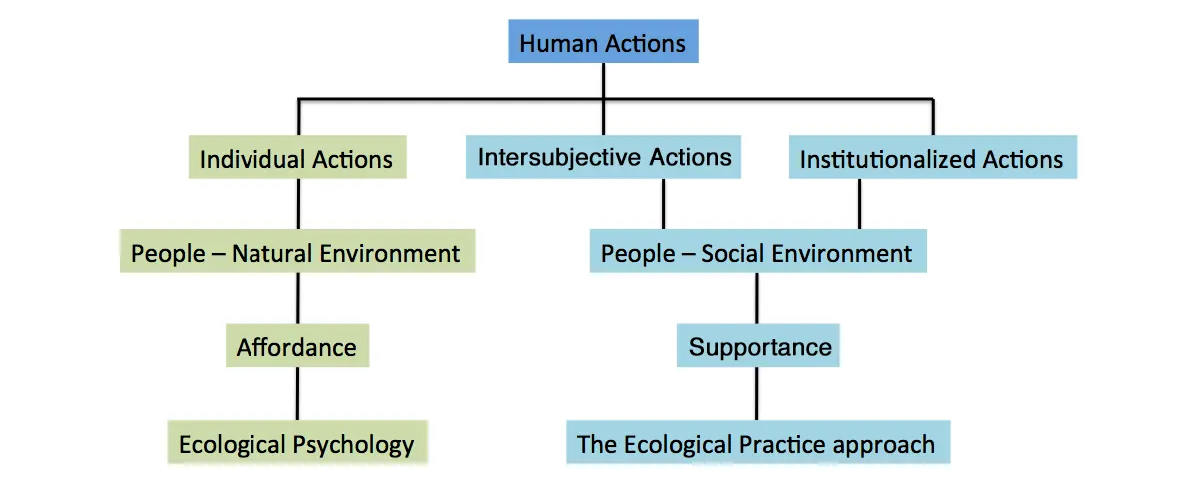
Since 2020, I have been exploring Supportance across different fields — Platform Ecology, Theoretical Activity, and Intimate Relationships. Over time, I realized that developing Supportance Theory was, in effect, a theoretical enterprise of modeling social environments.
In 2021, while working on the Platform for Development book draft, I established a model that explicitly linked self, social environment, and supportance, drawing on Vygotsky's Zone of Proximal Development and its actual-potential distinction. That model became the foundation for all subsequent work on modeling social environments. From there, as I tested supportance in different fields, each required me to describe the kind of social environment I was examining — leading to a series of models developed across time:
- 2020: Infoniche
- 2021: Developmental Project
- 2021: Developmental Platform
- 2022: Lifesystem
- 2022: Knowledge Center
- 2023: World of Activity
- 2024: Evolving Knowledge Enterprise
- 2025: Theory as Enterprise
- 2026: RelationField
Though the Ecological Practice Approach centers on the people–environment relationship, I did not begin with a theory of social environment. Instead, I worked on developing a series of affordance-like concepts to describe different types of potential action opportunities — Curativity, Attachance, Supportance, Projectivity, and Genidentity — and then tested them across various fields.
In the past several years, this journey produced a series of book drafts, documenting the outcome of the approach and of each concept. Some are featuted below:
- Container Thinking (2025): The Ecological Practice Approach (v4.0)
- Curativity (2019): The Ecological Approach to General Curation Practice
- Pieces, Whole, and Curativity (2025): Curativity Theory in the Field
- Ecological Practice Design (2022): The Lifesystem Approach to Everyday Life Innovation
- Platform for Development (2021): The Ecology of Adult Development in the 21st Century
- Developmental Projects (2025): The Project Engagement Approach to Adult Development
- Inside, Outside, and Projectivity (2024): The Project Engagement Approach (v3.0)
- Mental Moves (2023): Attachance, Volume 1
- Social Moves (2023): Attachance, Volume 2
- Strategic Moves (2024): Attachance, Volume 3
The recently developed Supportance-RelationField framework — particularly its application in the field of Intimate Relationships — inspired me to edit this new book, reflecting on the development of Supportance Theory and its current landscape. Unlike earlier book drafts, which focused on whole frameworks or other individual concepts, this book is the first to treat Supportance Theory as a subject in its own right.
This new book marks a watershed:
- Before: the "Supportance Theory" journey, focusing on theoretical development
- After: the "Supportance Analysis" journey, focusing on applications
This watershed is also a milestone for the Ecological Practice Approach and the GO Theory project. The completion of Supportance Theory establishes a foundation for other theoretical enterprises within the GO Theory platform — for example, the Supportance-RelationField framework has been adopted as part of the concept of Gejunction, which will become a foundational framework for the Strategic Developmental Psychology (SDP) project.
This book is organized into seven parts:
- Preface: One World, However Diverse
- Part 1: The Concept of Supportance
- Part 2: Modeling Social Environments
- Part 3: Women's Search for Supportance
- Part 4: Theoretical Platform
- Part 5: Supportive Life Discovery
- Part 6: Thematic Supportance
- Part 7: The Concept of Leeway
- Epilogue: The Future of Supportance Analysis
The structure of the book follows a cumulative logic. Part 1 establishes the conceptual foundation: what supportance is and how it differs from adjacent concepts. Part 2 turns to the environments in which supportance operates, presenting a series of models developed across different fields and years. Parts 3 and 4 then apply this conceptual and environmental framework to two contrasting domains: intimate relationships (Part 3) and theoretical platforms (Part 4) — the personal life world and the knowledge world.
Part 5 explores a specific practice — Supportive Life Discovery — that sits at the intersection of these domains, showing how supportance can be deliberately designed to facilitate life transitions. Part 6 introduces Thematic Supportance, a distinctive subtype that operates through the symbolization of lived experience, linking individual experience to collective culture. Part 7 closes the book with Leeway — the ecological total of supportances — which reframes the entire framework from the perspective of the whole rather than its parts. The Epilogue then looks forward to the future of Supportance Analysis as an applied field.
This book is for those who are interested in how we find, recognize, and build the supports that make life possible — in our relationships, our work, and the worlds we inhabit.
Preface
- One World, However Diverse - 9,920 words
It is the story of how Supportance Theory itself came to be: not the theory as a finished structure, but the six-year journey of building it.
I have selected fourteen stories from that journey and organized them into three waves of development—an early wave, a middle wave, and a late wave—each with its own rhythm, its own kind of discovery, and its own way of returning to the same question.
Part 1: The Concept of Supportance
The first question any theory must answer is: what is it?
Supportance Theory begins with a conceptual invention — a new term for a phenomenon that existing language could not quite capture. The term was not coined for novelty's sake. It emerged from a specific theoretical puzzle: how to extend James Gibson's ecological psychology from the natural environment to the social world. Gibson gave us affordance — what the environment offers the animal. But when we turn from the physical environment to human relationships, what is the analogous concept? What does the social environment offer?
The concept of supportance answers this question. It names the potential supportive action possibilities offered by a social environment — possibilities that may or may not be intended by others, but that a person can perceive and actualize for themselves. This is not social support, which flows from giver to receiver. Supportance flows from perception to action, through the subject's engagement with their social world.
Part 1 establishes the conceptual foundation of Supportance Theory through two chapters. Chapter 1 presents the core theoretical statements that define supportance as a distinct concept, distinguish it from adjacent terms, and build the framework's internal architecture through the lens of meta-supportance. Chapter 2 steps back to show where these ideas came from — a selection of historical documents and reflections that trace the evolution of supportance within the broader development of the Ecological Practice Approach.
Together, these chapters offer both a destination and a path: they define what supportance is, and they show how this definition was reached.
Chapter 1: Ontological Invention — Coined a New Term
- The Concept of Supportance: An Ecological Approach to Social Support and Beyond (March 2021) - 38 min
- Meta-Supportance for Development: The Ecological Formism Perspective (2025) - 20 min
This chapter presents two foundational articles that establish the concept of supportance and its theoretical architecture.
The first article, "The Concept of Supportance: An Ecological Approach to Social Support and Beyond" (March 2021), is the definitive founding statement of Supportance Theory. It addresses a foundational question: why coin a new term rather than adopt existing ones such as "social affordance"? The article argues that "social affordance" extends Gibson's term too thinly into the social domain, losing the specificity that human interaction requires.
It then establishes the relationship between supportance and social support. Social support is an established intermediate concept, operating at the actual level of support that is given and received. Supportance, by contrast, operates at the potential level: it is a meta-concept that highlights the aspect of potential action possibilities from social environments. This distinction opens a new analytical space. When the concept of supportance is applied to social support, it introduces a new layer — the transformation from potential to actual — and reveals that support can be actualized through two pathways: intended support (when a person intentionally provides support) and unintended support (when a person perceives and actualizes support from someone who never intended to offer it). Both pathways require the receiver's perception and capability, but only intended support requires the provider's intentionality.
The article also introduces the Actualization of Supportances model, a three-phase structure (Perception—Action—Curation) that describes how potential supportances become actual resources for action. This model became a core framework for all subsequent work in Supportance Theory.
The second article, "Meta-Supportance for Development: The Ecological Formism Perspective" (2025), approaches the concept from a different angle. Adopting the ecological formism perspective — a framework for analyzing subject-object relations — it identifies four types of meta-supportance: Subject-Focused, Object-Focused, Mutual, and Continuous. Each type describes a different kind of relationship between subject and object, and each generates a different quality of supportance. This framework broadens the concept beyond individual experience and situates it within a larger ecology of relationships, providing a structure for analyzing how supportances operate at different scales and across different contexts.
Together, these two articles form the ontological core of the book. They define what supportance is, how it works, and why it matters.
Chapter 2: Historical Archive — A Slow Cognition Journey
- The Ecological Practice Approach in Feb 2020
- [Archive] The Supportance of Platform (Oct 27, 2020) - 7 min
- The Development of Ecological Practice Approach (April 2021) - 15 min
- Container Thinking (book, v1.0, 2025): The Ecological Practice Approach (v4.0) - 20 min
The theoretical architecture built in Chapter 1 did not appear fully formed. It emerged gradually across several years of writing, thinking, and testing — often in fragments, recorded in emails, working notes, and book drafts.
Chapter 2 collects a selection of these archival materials. They are not theoretical statements in the polished sense of Chapter 1. They are documents of a process: records of how the concept of supportance took shape, how it evolved in response to different problems and contexts, and how its parent framework — the Ecological Practice Approach — developed alongside it.
The earliest piece, "The Ecological Practice Approach in Feb 2020," provides a snapshot of the approach from its early months — written before supportance was introduced, it shows the landscape into which the concept would later arrive.
[Archive] The Supportance of Platform (October 2020) — A working note originally sent as an email to a philosopher of mind specializing in ecological cognition, outlining an initial plan for developing the concept of supportance. The plan was not fully followed — but the email remains as a record of where the journey began.
"The Development of Ecological Practice Approach" (April 2021) offers a review of the approach's first year with supportance as a core concept, tracing how the framework evolved after the term was introduced.
The chapter closes with Container Thinking (2025), a complete book draft that represents the Ecological Practice Approach at its most mature (v4.0), showing how far the framework has come since supportance was first named.
Taken together, these documents do not replace the systematic theory of Chapter 1. They complement it. They show that a theory is not only a structure of ideas but also a living process — a journey of discovery, revision, and cumulative insight.
Part 2: Modeling Social Environments
Supportance began as a concept, not as a theory of social environments. The initial question was simple: what is the ecological analogy for support in social life world? The answer came in the form of a definition — supportance as potential supportive action opportunities offered by the social environment. But a definition alone does not tell you how the concept works in practice.
In 2021, while working on the Platform for Development book draft, I established a model that explicitly linked self, social environment, and supportance. Drawing on Vygotsky's Zone of Proximal Development and its actual-potential distinction, the model defined development as the transformation between the potential self and the actual self through interaction with others — linked to the corresponding movement from supportance to actual action. Development became a double movement: the self moves toward actualization, and the environment moves from potential to actual support. The Platform for Development book introduced the Developmental Platform as a social environment designed to facilitate this double movement. This model became the foundation for all subsequent work on modeling social environments.
From that point on, as I tested supportance in different fields, a pattern emerged. Each field required me to describe, in some detail, the kind of social environment I was examining. What does it mean for a platform to support development? What does it mean for a theoretical tradition to function as a developmental platform? What does it mean for an intimate relationship to become a hostile relationfield? I was not setting out to build a general theory of social environments. I was trying to understand the specific environments in which supportance was being perceived and actualized.
Part 2 presents this record, tracing how these models developed across time — from early frameworks for action and interaction, through platforms and knowledge communities, to more recent frameworks for mapping social landscapes and relational fields. Each model was developed for a particular purpose, but together they tell a broader story: the gradual discovery that supportance cannot be understood without a language for the environments in which it appears.
Chapter 3: Self, Social Environment, and Supportance
- Vygotsky’s “Ecological Mind” and a New Approach to Adult Development (2021) - 8,834 words
This chapter presents the foundational model that established the relationship between self, social environment, and supportance.
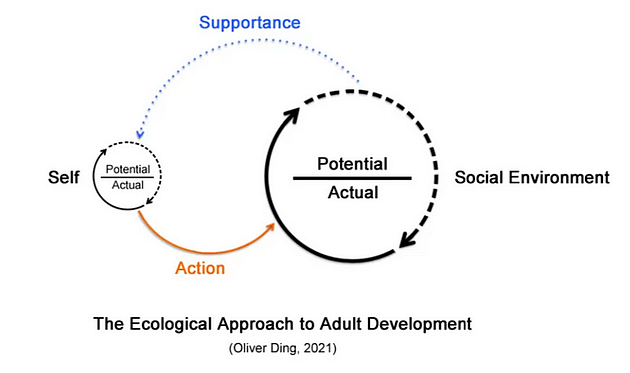
Drawing on Vygotsky's Zone of Proximal Development and the distinction between potential and actual development, the model defines development as the transformation between the potential self and the actual self through interaction with others, linked to the corresponding movement from supportance to actual action. This chapter establishes the theoretical groundwork for all subsequent chapters in Part 2.
Chapter 4: Zone, Camp, and Project
- Zone, Camp, and Project - 1,620 words
- The Ecological Camp Framework (2018) - 2,671 words
- Kids are Our Teachers (2018)
- Developmental Project Model (2021)
- The Living Way of the “Developmental Project” Concept (2025) - 9,095 words
This chapter presents early explorations of social environments that predate the concept of supportance. During this period, I was developing a framework to bridge Gibson's body-scale environment and Roger Barker's behavior settings, using the Infoniche framework to name these early efforts. The framework included units of analysis such as spot, zone, camp, and ba. The 2020 book draft After Affordance dedicated a full chapter to introducing this model. Later, in 2021, I added the project as a new unit of analysis to the framework.
Chapter 5: Infoniche and Developmental Platform
- The Developmental Platform (Feb 25, 2021) - 23 min
- Platform, Platform-ba, and Platform Ecology (Feb 14, 2021) - 17 min
- Platform as Infoniche (Feb 26, 2021) - 37 min
- The Infoniche Model (Apr 24, 2021) - 9 min
- The Supportive Cycle (v1.0, Feb 9, 2021) - 17 min
After the concept of supportance was introduced, I used it to redefine the Developmental Platform — a concept first developed in the 2021 book draft Platform for Development. Within this framework, the Infoniche model became a tool for understanding the internal structure of the Developmental Platform.
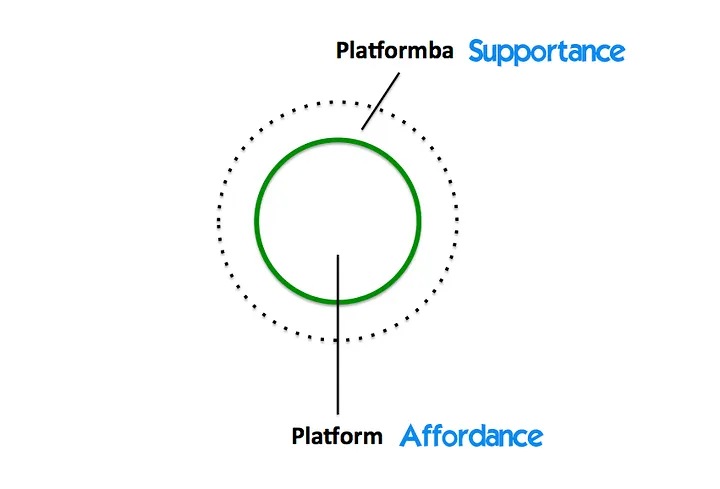
Together, the Developmental Platform and Infoniche models established the foundation for the Platform for Development book draft, providing a systematic account of how platforms support adult development through structured supportances across multiple levels.
Chapter 6: Lifesystem
- Lifesystem: Modeling Ice Skating and Other Social Practices - 2021 - 28 min
- Ecological Practice Design (Book) - 2022 - 14 min
- A Possible theme called “Life Coordinate” - 2023 - 10 min
- Creative Life Coordinate - 2025 - 17 min
Supportance is part of the Ecological Practice Approach, a meta-theory that formed by Supportance and other concepts. In order to connect Theory and Practice, I developed the Lifesystem Framework as an intermediate instrument to guide research and reflection. Detailed can be found in the first article (2021) and the Ecological Practice Design book (2022).
The core of Lifesystem framework is a nested model: Lifeway and Lifeform, which corresponds precisely to the nested hierarchical loops of Affordance and Supportance. Lifeway refers to the human-material engagement related to physical environment and ecological affordances, while Lifeform refers to the human-human engagement related to social environment and supportance.
In later theoretical development, the Life Coordinate dimension of this framework was detached and further elaborated, eventually becoming the Creative Life Coordinate framework (2025), which now serves the distinct purposes of Creative Life Theory (v3.0).
Chapter 7: Knowledge Center and Theoretical Enterprise
- Center, Circle, and Genidentity (book, v1, 2024) - 27 min
- Wonder and Wander: Revealing The Evolving Knowledge Enterprise (book, v1, 2025) - 9,839 words
- Strategic Life Narrative: Telling the Story of Intellectual Adventures (book, v1, 2025)
This chapter examines the structure of knowledge-centered environments. It presents models for understanding how knowledge centers sustain long-term intellectual activity, how knowledge enterprises evolve across time, and how individuals navigate the strategic dimensions of intellectual life through narrative and engagement. The chapter collects three book drafts that document the outcomes of this line of inquiry.
Chapter 8: Thematic Space and Social Landscape
- Supportance-based Life Development (March 2025) - 38 min
- Mental Moves: The Attachances of Moving Mental Elements (book, v1, 2023)
- Social Moves: The Attachance Approach to Social Cognition (book, v1, 2023)
- Strategic Moves: Mapping Knowledge Engagement and Structural Choice (book, v1, 2024)
- Castle and Forest: The Landscape of Concept-related Knowledge Engagement (book, v2,0, 2025)
From 2022 to 2024, I developed a set of concepts related to Attachance, a core concept of the Ecological Practice approach. In 2023, I applied Attachance to develop an ecological approach to social cognition, resulting in a multi-level map for understanding knowledge, activity, and environment.
In 2025, I realized that this set of concepts could also be applied to Supportance-based Development. The insight came from reading a friend's research on a knowledge center addressing educational equity in China — a 20-year partnership with local schools and communities. This case led me to develop a three-level map — Thematic Space, Project Engagement, and Social Landscape — as a framework for understanding how supportance operates across different scales of social life.
The chapter collects the core article that introduced this framework, along with several book drafts that extend the Attachance framework and the Thematic Space model across different domains.
Chapter 9: RelationField and World of Activity
- RelationField (v3.0): A Model of Social Appropriation (2026) - 4,355 words
- The Ap-Re-Pro-Co Framework (v2.0, 2025) - 14 min
- A Chair from a Hundred Years Ago (2026) - 1,377 words
- World of Activity: Center as RelationField and the Dual-Center Pattern (2026) - 4,495 words
This chapter presents the most recent development in modeling social environments: the RelationField framework.
The concept began as a suspended name — a term that surfaced in my notes in late 2025 but remained unused. It was only through a real journey — a visit to Yan Fu's former residence, a photograph of a chair, a book cover, and a chain of reflections — that the concept came into focus. The RelationField framework offers a unit of analysis — Subject-Subject (Subject-Object) — that captures the nested structure of social engagement, organized through four dimensions (Relation, Support, Narrative, Curation). It describes not only what a social environment offers, but also how it is narrated, curated, and passed forward.
The chapter also extends the World of Activity framework — developed through a series of inquiries between 2022 and 2026 — by integrating RelationField with its FFCC (Flow-Focus-Center-Circle) model. This integration introduces three theoretical extensions: a structural distinction between Intimate Centers and Non-Intimate Centers; the framing of Center as a RelationField; and the incorporation of the Anticipatory Activity System (AAS) framework to capture the temporal and dynamic logic of Center operations. Together, these frameworks provide a language for describing how social environments are structured, how they are experienced, and how they transform over time.
Part 3: Women's Search for Supportance
The first two Parts of this book established the conceptual foundation of supportance and the models for describing the social environments in which it operates. The move to Part 3 shifts the center of gravity from theory to life.
This Part applies the Supportance-RelationField framework to the domain of intimate relationships — a domain that differs fundamentally from the contexts in which the framework was originally developed. Supportance Theory grew out of Platform Ecology and the study of Developmental Platforms: social environments designed to support adult development through structured landscapes of potential action opportunities. The RelationField framework was worked out through the analysis of public cultural life: historical figures, intellectual traditions, and the social mechanisms through which a completed life continues to offer thematic supportance to those who come after.

Intimate relationships are neither of these. They are not public but private; not historical but immediate; not curated for strangers but lived between particular people who have chosen each other and are changed by that choice. The supportances available within an intimate relationship are not thematic — they are psychological, practical, economic, existential. They involve being seen and not being seen; being sustained and being undermined; finding in another person a ground of security or discovering that the ground has given way.
The two chapters in this Part examine intimate relationships from complementary angles.
Chapter 10: A Typology of Supportances in Intimate Relationships
This chapter presents a systematic framework for understanding what intimate relationships offer. Drawing on Heinz Kohut's self psychology and its concept of the selfobject, the chapter identifies three psychological supportances — Mirroring, Idealizing, and Twinship — that sustain the cohesion and vitality of the self. Drawing on family sociology, it identifies a second group of functional supportances — Economic, Parenting, Social Capital, Informational, Domestic, and Companionship — that sustain the practical and social fabric of shared life. Together, these two groups form a typology of what intimate relationships make possible when they are functioning well.
Chapter 11: The Alienation of Supportance
- The Alienation of Supportance: The RelationField of High-Conflict Divorce (HCD) - 9,915 words
This chapter examines what happens when intimate relationships break down. Drawing on empirical data from a doctoral study of nine court-involved therapists working with High-Conflict Divorce (HCD) cases (Soal, 2025), it traces the complete life cycle of an HCD RelationField — from internal fracture, through institutional intervention, to comprehensive alienation, and finally to termination through exhaustion. The chapter identifies a central theoretical phenomenon: the alienation of supportance — the systematic transformation of supportance from positive to negative, from enabling constructive engagement to enabling destructive opposition. This extreme case serves as a stress test of Supportance Theory's core assumptions, revealing both the framework's explanatory power and the directions for further development.
Part 4: Theoretical Platform
Part 3 examined intimate relationships — a domain in which supportance is sought through private, immediate, and existential engagement with another person. This Part turns to a very different kind of social environment: theoretical platforms.
The distinction between the two Parts is not merely topical. It reflects a deeper structural difference in how supportance is organized and actualized. In intimate relationships, the source of supportance is a person — a partner, a parent, a child — and the supportance flows through emotional attunement, practical coordination, and shared life. In theoretical platforms, the source of supportance is a tradition, a community, a body of conceptual resources — and the supportance flows through intellectual engagement, conceptual appropriation, and the gradual construction of a knowledge enterprise.
Both are domains in which individuals search for and actualize supportance. But the conditions, mechanisms, and outcomes differ fundamentally.
This Part presents a series of case studies and theoretical analyses that examine how theoretical platforms function as social environments for creative work. The chapters move from a general framework for understanding platform supportance, through detailed case studies of how multiple contributors have engaged with Activity Theory as a developmental platform, to a personal account of how the author himself has appropriated supportances from multiple theoretical traditions over the course of a decade.
Chapter 12: Platform, Enterprise, and Supportance
- Supportance Analysis: How a Theoretical Platform Supports Creative Work - 8,197 words
- Generative Confluence: Theoretical Activity, Theoretical Enterprise, and Theoretical Platform - 6,899 words
This chapter establishes the theoretical foundation for Part 4. The first article, "Supportance Analysis: How a Theoretical Platform Supports Creative Work," presents an overview of three distinct forms of theoretical platform: the established theoretical tradition (Activity Theory), the possible platform (a theoretical enterprise awaiting broader engagement), and the self-built platform (a platform constructed by the contributor themselves). Together, these three forms illuminate the different ways in which theoretical work becomes a site of supportance. The second article, "Generative Confluence: Theoretical Activity, Theoretical Enterprise, and Theoretical Platform," traces the origins of the "activity-platform-enterprise" triad, providing a deeper theoretical grounding for the framework used throughout this Part.
Chapter 13: Engaging with a Theoretical Tradition
- The Journey of Activity Theory and CHAT (Since 2000) - 13,858 words
- Revisiting the Genidentity of Activity Theory - 11,320 words
- Yrjö Engeström: One Center, Multi-voices, and Multi-moves - 10,569 words
- Bonnie Nardi: Engaging with a Theoretical Tradition - 7,165 words
- Clay Spinuzzi: Mediating Concept and Network of Activity - 13,935 words
This chapter presents a set of case studies originally developed for the Weave the Theory book draft. They examine Activity Theory as a theoretical tradition, focusing on its development since 2000, and trace how multiple contributors have engaged with it as a platform for their own knowledge enterprises.
The case studies cover Yrjö Engeström, Bonnie Nardi, and Clay Spinuzzi — each representing a distinct pattern of engagement. Engeström's pattern is social and systemic, building the tradition through collective institutional work. Nardi's pattern is curatorial and network-building, contributing a distinctive second founding through translation and synthesis. Spinuzzi's pattern is dialogical, operating through sustained encounters with adjacent traditions.
Each contributor, working from their own position, capabilities, and intellectual interests, perceived different supportances from the tradition and actualized them in different ways — developing knowledge enterprises of distinct styles and directions. These enterprises, in turn, constituted the concrete processes through which Activity Theory continued to develop, wave after wave, from the 2000s onward.
Chapter 14: Weave the Enterprise
- Appropriating Activity Theory (Possible Book, 2026) - 3,071 words
- Engaging with Others for Developing Anticipated Identity - 12,943 words
This chapter shifts from examining others' engagement with theoretical platforms to examining the author's own.
The first article is the introduction to a book draft titled "Appropriating Activity Theory," which documents a decade-long journey (2015–2025) of engagement with Activity Theory, showing the micro-operations through which an individual appropriates supportances from a theoretical platform.
The second article, "Engaging with Others for Developing Anticipated Identity," presents six case studies of the author's sustained engagements with Howard Gruber, Roger Barker, Michael Cole, Andy Blunden, Ping-keung Lui, and Robert Kegan. Originally framed through the lens of creative identity development, these case studies are here re-read through Supportance Theory: each engagement represents a site where theoretical supportance was perceived, actualized, and woven into the author's own developing knowledge enterprise.
Part 5: Supportive Life Discovery
Life Discovery is a theme I first explored in 2022, in the course of developing the concept of Second-order Activity within the Anticipatory Activity System (AAS) framework. At that time, the focus was on the activity itself — on how individuals engage in exploratory, future-oriented activity that is not about executing a known objective but about discovering what the next objective might be.
In 2026, I revisited this theme and rebuilt it as "Supportive Life Discovery" — a shift that brings the relational and environmental conditions of discovery into the foreground. From the Supportance-RelationField perspective, a "Supportive Life Discovery" practice indicates a particular RelationField between a supporter and an explorer. Whether designed or emergent, it is a high-Supportance RelationField: an environment structured to offer action opportunities that enable exploratory activity.
This Part collects a series of articles exploring this theme. They do not yet constitute a systematic theoretical framework. They are, rather, a record of exploration — tracing how the focus has moved over time, from the structure of activity to the design of supportive environments for discovery. Together, they show a direction: how might we design high-Supportance RelationFields for life discovery and other kinds of challenges?
Chapter 15: Thinking
- The Activity Circle (Oliver Ding, 2017) - 2017
- A Typology for Anticipatory Activity System - 2022
- Psychological Counseling Platform: A Case Study of “Social Moves” - 2023
- Exploring the theme of "Supportive Life Development" - 2025
- Supportive Self-Actualization as Anticipatory Activity - 2026 - 12,554 words
This chapter presents a set of articles that reflect the conceptual evolution of the theme. Written between 2017 and 2026, they trace the movement from early frameworks such as the Activity Circle, through the development of the Anticipatory Activity System typology, to explorations of psychological counseling platforms as sites of supportance, and finally to the recent reframing of supportive self-actualization as anticipatory activity. Though these articles do not yet offer a systematic theoretical framework for Supportive Life Discovery, they document a useful trajectory — a gradual shift of focus from the Self-Other relation to the broader conditions of Supportive Self-Actualization.
Chapter 16: Doing
- Before, After, and Watershed - April 2026 - 3,051 words
- [Case Study] When the Circle Changes the Center - April 2026
- Supportive Life Discovery (v2.0): The Mid-life Curation Edition - 4,198 words
This chapter tells a single story across three articles.
In April 2026, a video session with Maya offered a concrete opportunity to practice Supportive Life Discovery in action. That session prompted me to look back — to recall a similar engagement years earlier, conducted through email correspondence with a friend, helping her explore her own life and career development. The connection between past and present gave shape to a future direction. The experience of the Maya session and the reflections it triggered led to a revised model: Supportive Life Discovery v2.0, framed as the Mid-life Curation Edition. In designing v2.0, I framed it as a watershed experience — an experiment in supportance design, testing how a structured RelationField might facilitate transformative discovery.
The three articles in this chapter trace this arc. The first reflects on the logic of watershed moments — before and after — across both the author's own intellectual history and the Maya engagement. The second documents the actual video session with Maya, conducted using the v1.0 version of the model. The third presents the v2.0 version that emerged from the experience, reframing SLD as a concrete practice for mid-life curation.
Together, they show how a single thread — supporting another person's life discovery — connects past, present, and future. They also reveal the richness of supportance within a RelationField: even when a RelationField is intentionally designed to support an explorer such as Maya, it can simultaneously offer unexpected supportance to the supporter. The Maya session did not only serve her discovery — it prompted me to revisit past experiences, redesign the model, and pursue a new wave of exploration. The recent inquiries and this very book, in many ways, are part of the ripple effect of that experience.
Part 6: Thematic Supportance
The preceding Parts of this book examined supportance in various domains — intimate relationships, theoretical platforms, and supportive life discovery. Each domain required its own language for describing the social environment and the forms of supportance available within it.
This Part turns to a different kind of supportance altogether. Thematic Supportance does not come from a person, a platform, or a designed intervention. It comes from experience itself — from the encounter between a subject and a lived situation, and from the human capacity to symbolise that encounter into a theme that can be shared, transmitted, and woven into culture.
The concept of Thematic Supportance was first developed in 2026 as part of the RelationField framework's expansion. It was a by-product of analysing how material objects — such as a chair in a scholar's former residence — become thematic objects that carry meaning across time. But the concept quickly revealed its broader significance: it names the mechanism through which individual lived experience becomes collective cultural meaning. It is the link between what a person lives and what a culture inherits.
This Part is organised in two chapters. Chapter 17 presents the core theoretical statements and case studies that establish Thematic Supportance as a distinct phenomenon. Chapter 18 situates Thematic Supportance within the larger theoretical context — its connections to Creative Life Curation, Strategic Life Narrative, and the broader framework of cultural development.
Chapter 17: From Lived Experiences to Creative Themes
- Thematic Supportance: Curation, Narrative, and Meaning - 2026 - 8,193 words
- Following the Theme (2026): A 42-Post Journey in Reflection - 2026 - 1,167 words
- A Chair from a Hundred Years Ago - 2026 - 1,377 words
- Thematic Development Study - 2026 - 4,130 words
This chapter presents the core of Thematic Supportance theory. The first article, "Thematic Supportance: Curation, Narrative, and Meaning," is the foundational statement of the concept. It establishes Thematic Supportance as a subtype of Supportance — the potential action opportunity of symbolizing lived experience into a Creative Theme — and demonstrates its operation through three cases that span different ecological conditions: a cultural heritage site (Yan Fu's chair), a situation of duress (Aria's detention), and an extreme condition of compression (Viktor Frankl's concentration camp).
The second article, "Following the Theme," reflects on the creative process behind the concept's development. The third article, "A Chair from a Hundred Years Ago," tells the full story of the Yan Fu chair — the case that first revealed the mechanism of Thematic Supportance. The fourth article, "Thematic Development Study," examines how themes develop across time and how this process can be studied systematically.
Chapter 18:Thematic Supportance in the Context
- The Actualization of Thematic Supportance as a Creative Action - 2021
- Three Paths of Creative Life and A Semiotic System - 2022
- Creative Life Curation (Possible Book, v1) - 2022
- Strategic Life Narrative (Possible Book, v1) - 2025
This chapter places Thematic Supportance within the broader framework of creative life theory and cultural development. From the perspective of Creative Life Theory, every actualization of Thematic Supportance is a Creative Action. The first article uses the 3i Model of Creative Action to examine this relationship.
The 3i Model was developed in 2020 specifically to analyze how ideas are born through encounters between an initiator's creative act and an initiatee's creative response. What becomes clear through applying this model is that the development of Supportance Theory itself has been shaped by a sequence of Creative Actions—each one an actualization of Thematic Supportance at a different level, with different ecological conditions, and increasing complexity.
Other articles introduce Creative Life Curation — the practice of curating life experience into Creative Themes — and Strategic Life Narrative — the strategic work of narrating one's intellectual journey. These frameworks provide the conceptual ground for understanding how Thematic Supportance is not merely perceived but actively woven into a life's work.
Part 7: Leeway and Niche
Part 7 closes the book with Leeway — the ecological total of supportances — which reframes the entire framework from the perspective of the whole rather than its parts.
Chapter 19: The Concept of Leeway
- Leeway: The Ecological Total of Supportances - 2026 - 5,356 words
- Weave 2.0: Synchronic Line, Diachronic Line, and Living Coordinate - 2026 - 5,552 words
- Gejunction: Toward a Unit of Synthesis for Social Life - 2026 - 1,249 words
This chapter presents the reclaimed concept of Leeway as the ecological total of supportances. The first article, "Leeway: The Ecological Total of Supportances," traces the concept's evolution from its original use as a bridge concept to its reclaimed role as the ecological counterpart to Gibson's niche. It establishes Leeway simply as the totality of supportances in a person's social environment.
The second article, "Weave 2.0: Synchronic Line, Diachronic Line, and Living Coordinate," documents the earlier usage of Leeway as a bridge concept. The third article, "Gejunction: Toward a Unit of Synthesis for Social Life," introduces the gejunction framework — whose emergence rendered the earlier Leeway model redundant, thereby freeing the term to be reclaimed for Supportance Theory.
Chapter 20: Niche, Infoniche, and Leeway
- The Affordance - Supportance Loop - 2021 - 17 min
- The Affordance — Supportance Cycle - 2023 - 8 min
This chapter traces the lineage from Gibson's concept of Niche to the emerging framework of Leeway.
Before Leeway was reclaimed for Supportance Theory, I had already been exploring how Affordance and Supportance work together as a pair. The two articles in this chapter, "The Affordance - Supportance Loop" and "The Affordance — Supportance Cycle," document these early explorations — showing how the two concepts, when combined, provide a complete framework covering both material and social environments.
With the introduction of Leeway, this line of inquiry finds its natural extension. Gibson's Niche names the totality of affordances in an organism's environment. My earlier Infoniche framework had already begun integrating affordance and supportance. Leeway now completes the triad by offering a symmetrical counterpart to Niche — a term for the totality of supportances in a person's social-material environment. Together, Niche, Infoniche, and Leeway form a coherent conceptual lineage that bridges the ecological psychology of natural environments and the social ecology of human development.
Chapter 21: The Landscape of Ecological Opportunity
- The “Difference — Conversion — Opportunity” Schema - 2025 - 12 min
- The House of Ecological Practice - 2024 - 2024 - 18 min
- Four Positive Frontiers of Project Engagement - 2026 - 3,526 words
Building on the "Container (Containee)" model, the Ecological Practice Approach introduces a set of concepts to explore the relationship between human actors and their environments — both physical and social — particularly the opportunities for action that emerge in these contexts.
Since 2019, the Ecological Practice Approach has been developing a family of core concepts, each describing a distinct type of action opportunity. Supportance is one among them. This chapter presents a panoramic view of this conceptual landscape — a broader context within which Supportance is situated, alongside Affordance, Attachance, Projectivity, and Curativity. The relationship between Leeway and this family of concepts remains a direction for future exploration.
The first article, "The 'Difference — Conversion — Opportunity' Schema" (2025), offers a general model of ecological opportunity. Prior to this, each action opportunity concept had been developed in isolation; this schema was the first synthesizing effort, providing a unifying framework for understanding how different types of opportunities emerge and operate.
The second article, "The House of Ecological Practice" (2024), presents a concise overview of the full set of action opportunity concepts: Affordance, Attachance, Supportance, Projectivity, and Curativity.
The third article, "Four Positive Frontiers of Project Engagement" (2026), situates four of these concepts — Affordance, Attachance, Supportance, and Curativity — within the broader framework of GO Theory, showing their specific positions and functions in the theoretical landscape.
Epilogue
- The Future of Supportance Analysis - 2026 - 888 words
v1.0 - June 30, 2026 - 6,763 words