
World of Activity: Center as RelationField and the Dual-Center Pattern

A Theoretical Extension of the FFCC Model
by Oliver Ding
June 27, 2026
The World of Activity approach, developed through a series of empirical and theoretical inquiries between 2022 and 2026, provides a comprehensive toolkit for understanding the scope and dynamics of a person's life activities. Its leading model is the FFCC schema—Flow, Focus, Center, Circle—which organizes the World of Activity around four basic ecological forms (Ding, 2025).
Recent work on Supportance Theory and the RelationField framework (v3.0) has extended the analytical reach of this toolkit into domains that had previously received less attention: intimate relationships, relational dynamics, and the structural conditions under which Centers collapse or transform. These developments have revealed a limitation in the FFCC model's earlier formulations: while the model describes Centers as sustained creative activity, it does not distinguish between fundamentally different types of Centers—those organized around intimate relationships and those organized around professional, creative, or intellectual pursuits.
This article addresses this limitation by introducing three theoretical extensions to the World of Activity framework:
- Extending the Dual-Center Pattern – Homecoming identified dual-center configurations within the non-intimate domain (Surviving/Thriving, Continuous/Native). This article introduces a structural axis that cuts across the entire World of Activity: Intimate Centers vs. Non-Intimate Centers. These two types of Centers operate under fundamentally different dynamics—different driving logics, different resilience under pressure, and different pathways of collapse and reconstruction.
- Center as RelationField – The FFCC schema describes Centers but does not explain the relational texture of a Center—what makes it sustainable, what causes it to collapse. By framing Center as a RelationField, we gain the analytical language to describe Center dynamics through the RelationField toolkit.
- Bringing AAS into the World of Activity Toolkit – The Anticipatory Activity System (AAS) framework provides the temporal and dynamic logic that complements the FFCC + RelationField structure. Dual-center configurations are two AAS systems operating in parallel—one oriented toward Life Discovery (Second-order Activity) and the other toward Life Performance (First-order Activity).
This theoretical extension of the FFCC Model is labeled as World of Activity (v2.1), following the v2.0 which released in April 2026.
Part 1: The FFCC Schema and the Dual-Center Pattern
1.1 World of Activity and the FFCC Model
The World of Activity approach provides a lens through which we can examine human experience across multiple temporal and spatial scales, utilizing a series of knowledge frameworks. From the perspective of the Ecological Practice Approach, "World of Activity" is understood as a broad life container—a space in which we can observe the structure and developmental patterns of life activities. It also functions as a thematic space where related knowledge elements can be curated together (Ding, 2025, Introduction).
Its leading model is the FFCC schema, which organizes the World of Activity around four basic ecological forms:
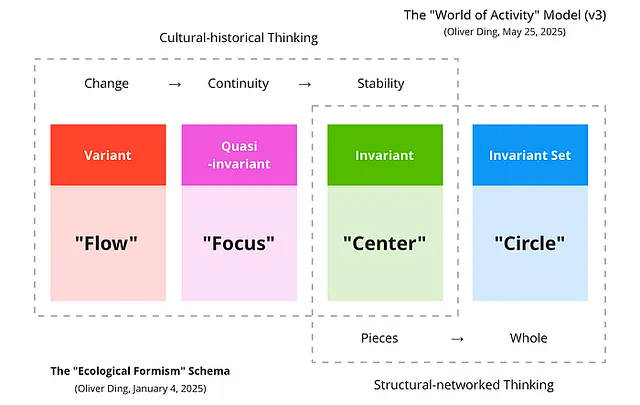
Flow – the ongoing stream of everyday experience, undifferentiated and moving. It is the raw material from which all development proceeds.
Focus – the emergence of thematic concentration that gives direction to the flow. When scattered activities begin to coalesce around a shared theme, Focus emerges.
Center – the organizing core around which creative activity stabilizes. Centers are not what we pay attention to; they are what we actively develop, maintain, and build our activities around. As the World of Activity Toolkit (v2.0) defines it: "Center (the organizing core around which creative activity stabilizes)" (Ding, 2026a).
Circle – the network of connected Centers—the social ecology within which individual Worlds of Activity find their fullest expression. Circles link personal Centers to collective enterprises, forming communities, movements, and cultural phenomena.
These four forms are not sequential stages. They are simultaneously active aspects of any creative life—each shaping the others, each visible from a different angle.
The FFCC schema is Invariant within the World of Activity framework: it does not change across contexts, cultures, or historical periods. It is the stable foundation upon which all other analytical layers are built.
The World of Activity Toolkit (v2.0) articulates this foundation through a four-layer structure:
| Layer | Content | Function |
|---|---|---|
| Invariant | FFCC Schema (Flow-Focus-Center-Circle) | The stable ontological foundation |
| Quasi-invariant | A series of movements, described with the FFCC vocabulary | Cross-human developmental patterns |
| Variant | Situational life events and themes (open category) | Open category for new cases |
| Invariant Set | Other Ecological Forms | Connection to the broader Ecological Formism framework |
The Quasi-invariant layer contains thirteen themes derived from three empirical sources (the Regular Group, Lake 42, and Homecoming). Among these, Balancing the Centers – holding two structurally opposed Centers simultaneously – is particularly relevant to the present discussion, as it names the dual-center configuration that appears repeatedly across different life stages (Ding, 2026a).
1.2 The Dual-Center Pattern
Homecoming: A Thematic Trip and the World of Activity Approach (2025)—a case study of the author's own life trajectory—identified seven distinct forms of the World of Activity across different life stages.
Among the most significant findings was the repeated appearance of dual-center configurations (Ding, 2025):
| Life Form | Center A | Center B |
|---|---|---|
| Alien Land (geographical expansion) | Surviving Center (academic adaptation) | Thriving Center (creative activities) |
| Domain (professional development) | Continuous Center (past expertise transferred) | Native Center (new competencies from new environment) |
| Foreign Land (cultural reconstruction) | Surviving + Continuous + Reflective Centers | Thriving + Native + Constructive Centers |
These dual-center configurations demonstrated remarkable evolutionary consistency across life stages. The fundamental Surviving vs. Thriving pattern provided the template for all subsequent configurations. Each pair represented a functional distinction within a single relational domain—different ways of organizing one's professional, creative, or intellectual life.
The Quasi-invariant layer of the World of Activity Toolkit formalizes this pattern through the theme Balancing the Centers, defined as "holding two structurally opposed Centers simultaneously—the opposing-complementary dynamics of Surviving/Thriving, Continuous/Native, and similar dual-center configurations" (Ding, 2026a).
1.3 Intimate Centers vs. Non-Intimate Centers
While Homecoming's analysis revealed the functional diversity of dual-center configurations, all of its dual-center discussions were confined to the non-intimate domain. The Centers analyzed were knowledge centers, career centers, creative centers—never intimate relationships such as marriage, parenting, or close friendship.
Recent work on the RelationField framework and Supportance Theory has opened a new analytical axis: the distinction between Intimate Centers and Non-Intimate Centers. This distinction is not merely a functional distinction within a single domain; it is a structural distinction that cuts across the entire World of Activity.
Intimate Centers are Centers organized around deep emotional involvement and sustained presence: romantic partnerships, parent-child relationships, and close friendships that function as family. Their defining features are high emotional involvement, sustained physical and psychological presence, mutual vulnerability and recognition, and relational continuity valued for its own sake.
Non-Intimate Centers are Centers organized around thematic focus and sustained building: career centers, knowledge centers, creative centers, and professional communities. Their defining features are thematic concentration on a domain of practice, sustained action toward building something in the world, recognition based on achievement and contribution, and relationality organized around shared objects of work.
These two types of Centers operate under fundamentally different dynamics:
| Dimension | Intimate Centers | Non-Intimate Centers |
|---|---|---|
| Primary logic | Emotional connection | Thematic achievement |
| Resilience under pressure | Can survive extreme crisis if the relation is unconditional | Collapses quickly under external pressure; requires stability |
| Collapse mechanism | Supportance alienation | Resource depletion or loss of meaning |
| Reconstruction pathway | Rebuilding RelationField through new Supportance sources | Re-establishing thematic focus and sustained action |
This distinction has significant implications for the FFCC model. When we analyze a person's World of Activity, we must now ask: what type of Center is this? The answer determines how we understand its dynamics, its vulnerabilities, and its potential for development.
Part 2: Center as RelationField
Part 1 established the FFCC schema as the invariant foundation of the World of Activity framework, and introduced the distinction between Intimate Centers and Non-Intimate Centers as a structural axis for analyzing dual-center configurations. But the FFCC schema, while describing what a Center is, does not provide a language for describing the relational texture of a Center: what sustains it, what erodes it, what causes it to collapse or transform.
This Part introduces a mediating concept—Center as RelationField—that connects the FFCC model with the RelationField-Supportance framework. Through this mediating concept, the RelationField toolkit become available for describing Center dynamics.
2.1 The RelationField v3.0 Framework
The RelationField framework (v3.0) provides a model for analyzing the relational texture of social environments. Its core unit of analysis is:
Subject–Subject (Subject–Object) = RelationField
A relationfield consists of a kernel—the relation between a subject and an object (person or thing)—and an outer ring—how that relation is carried, narrated, and transmitted among subjects (Ding, 2026b). The framework dissects a relationfield through four dimensions:
- R (Relation) – What type of connection exists between the subject and the other? Cooperative, adversarial, supportive, neutral? This dimension establishes the foundational structure of the relationfield.
- S (Support/Supportance) – What Supportances are available in the relation? Supportance is not social support (which depends on the giver's intention) but potential supportive action possibilities that the receiver can perceive and actualize.
- N (Narrative) – How does the subject interpret the ongoing activities within the relationfield? What is happening, what does it mean, and what role does the subject play in it? N is the subjective meaning-making dimension through which the subject makes sense of the activities they are engaged in.
- C (Curation) – How does the subject select, organize, and present the experience? In ordinary contexts, Curation preserves memories and transmits meaning across time; in adversarial contexts, Curation can mutate into evidence-construction and strategic storytelling (Ding, 2026c).
A crucial feature of the RelationField framework is the ontological status of its four dimensions. R (Relation) and S (Supportance) are environmental properties—they describe the structural features of the relationfield that exist prior to and independent of any particular subject's engagement. N (Narrative) and C (Curation) are actor properties—they depend on the subject's active participation, interpretation, and selection.
This is not a mere analytical convenience. It reflects the fundamental duality of the relationfield: the social environment and the actor who operates within it are not two separate things but two sides of the same phenomenon. The actor's ongoing activities within the relationfield continuously constitute the social environment (relationfield) they are deeply embedded in. The environment, in turn, shapes what the actor can perceive and actualize.
This is what I mean by the principle: relation is environment, environment is relation.
The R-S-N-C model provides a precise language for describing how a Center's relational texture changes over time. A Center is not a static entity—it is a dynamic relationfield whose R, S, N, and C dimensions can shift independently or together.
2.2 Center as RelationField
With the R-S-N-C model in place, we can now state the central theoretical proposition of Part 2:
A Center is a RelationField.
The FFCC schema defines Center as the organizing core around which creative activity stabilizes—but this definition does not explain what sustains the activity, what makes it meaningful, or why a Center can persist in some conditions and collapse in others. The RelationField framework provides the missing relational texture.
When we understand Center as RelationField, the R-S-N-C dimensions become available for describing Center dynamics:
- What kind of relations constitute this Center? (R)
- What Supportances sustain or erode it? (S)
- How is this Center narrated by its participants? (N)
- How is its experience curated and transmitted? (C)
This proposition does not replace the FFCC definition—it deepens it. "Sustained action" becomes explicable through the Supportance dimension (S). "Ongoing curation" becomes explicable through the Curation dimension (C). The Center's resilience becomes explicable through the Relation dimension (R) and the Narrative dimension (N).
2.3 The Alienation of Supportance in Center Collapse
The RelationField framework identifies a specific mechanism of Center collapse that is particularly relevant to Intimate Centers: the alienation of Supportance.
Supportance Theory distinguishes between positive Supportance (enabling action possibilities that sustain development and relational maintenance) and negative Supportance (action possibilities that have been captured for attack) (Ding, 2026c).
In the context of intimate relationships, Supportance alienation takes a specific form. Drawing on Heinz Kohut's self psychology, three types of psychological Supportance can be identified:
| Supportance Type | Positive Form (Intact) | Alienated Form |
|---|---|---|
| Mirroring | Being seen, recognized, and affirmed | Systematic devaluation; denial of the other's reality |
| Idealizing | Relying on a stable, trustworthy other | Representing the other as fundamentally unreliable or dangerous |
| Twinship | Deep resonance of shared values and experience | Fundamental difference framed as irreconcilable |
The alienation mechanism is precise: each Supportance does not disappear—it is reversed. The same recognition that once validated now invalidates. The same stability that once grounded now threatens. The same resonance that once connected now separates.
This is not a "loss" of Supportance in the sense of resource depletion. It is the transformation of enabling structures into disabling ones. The alienation of Supportance is the mechanism by which a Center collapses from within.
In addition to psychological Supportances, intimate relationships also involve functional Supportances: Economic, Parenting, Social Capital, Informational & Cognitive, Domestic & Practical, and Companionship & Belonging. Under conditions of Supportance alienation, these too are captured by attack—economic resources become instruments of control, parenting becomes a legal battleground, social networks become camps of loyalty and betrayal (Ding, 2026b).
2.4 The R-S-N-C Transformation in Center Collapse
A Center collapse can be traced through all four dimensions of the RelationField:
R (Relation): The relation type flips—from cooperative to adversarial, from supportive to hostile. This flip is not gradual but structural; it is triggered by events that fundamentally redefine the nature of the relation.
S (Supportance): Supportance is systematically alienated—positive action possibilities become negative weapons. Mirroring becomes gaslighting; idealizing becomes threat; functional supports become instruments of control.
N (Narrative): The shared narrative fractures into mutually exclusive, irreconcilable accounts. Each party constructs a story in which they are the victim and the other is the perpetrator. Narrative deadlock sets in—no narrative can be falsified by the others.
C (Curation): Curation mutates from preserving meaning to constructing legal evidence. Emails become exhibits; therapy notes become ammunition; personal writings become material for legal arguments (Ding, 2026c).
This four-dimensional analysis demonstrates that Center collapse is not the disappearance of an entity—it is the systematic transformation of a relationfield from enabling to disabling. The Center-as-RelationField proposition provides the analytical language for this transformation.
Part 3: Center Change and the Anticipatory Activity System (AAS)
3.1 Dual-Center Pattern and AAS
The dual-center pattern identified in Part 1, and the Center-as-RelationField proposition developed in Part 2, both point toward a deeper structural logic: the Anticipatory Activity System (AAS).
The AAS framework, introduced in Advanced Life Strategy (2022), provides a precise account of how a person's activity organizes itself across time. At the heart of AAS is a distinction between two types of activity:
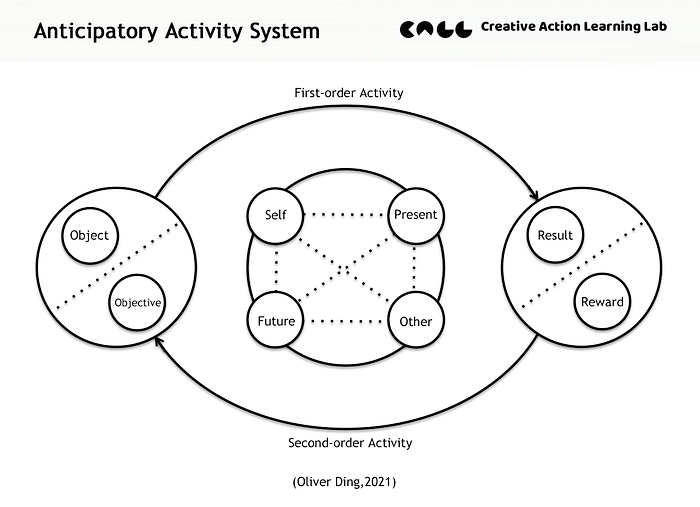
First-order Activity is goal-directed: you know what you are trying to achieve, and you act toward it. The objective is clear, the object is defined, and the activity is oriented toward performance and results.
Second-order Activity is something different—it is the activity of discovering what your goal should be in the first place. Before you can pursue a direction, you need to find it. Before you can commit to a project, you need to understand what kind of project is worth committing to (Ding, 2026d).
These two modes of activity are not competing orientations—they form a self-referential loop. The outcome of Second-order Activity produces the Significant Insights that give direction to First-order Activity. The outcome of First-order Activity generates the results and rewards that feed back into Second-order Activity. They are not rivals. They are the two halves of a single system that refers back to itself (Ding, 2026d).
The AAS framework's core structure—Self, Other, Present, and Future—maps directly onto the FFCC schema:
| AAS Dimension | Corresponding FFCC Element |
|---|---|
| Self | The person whose World of Activity is being analyzed |
| Other | Significant others who enter the Center's activity, constituting the RelationField |
| Present | The current Flow and Focus — the "where I am now" |
| Future | The anticipated Center — the "where I am going" |
A crucial clarification is needed here regarding the AAS dimension of Other. In the AAS framework, Self-Other relations focus on significant others. In the FFCC framework, however, “Other” needs to be distinguished into two types: (1) significant others who participate in the Center's activity and constitute the RelationField, and (2) general social others who appear at the Circle level as part of the broader social network. The AAS framework's Self-Other structure is concerned with the former—the significant others with whom the individual engages in anticipatory interaction—rather than the general social network as a whole.
The relationship between the dual-center pattern and the AAS framework requires careful articulation, as it operates at multiple scales rather than as a simple one-to-one correspondence.
First, the AAS framework can be applied at different scales of analysis. If an individual's World of Activity contains multiple distinct Centers, each Center can be understood both as a RelationField and as an AAS system in its own right.
Second, empirical observation from Homecoming suggests that dual-center configurations tend to exhibit a characteristic functional differentiation. As described in Part 1.2, Center A tends toward stability and conservation—it focuses on First-order Activity. Center B tends toward exploration and growth—it focuses on Second-order Activity. This is an empirical pattern, however, not a structural necessity.
Third, and most importantly, each individual Center itself can be understood as an AAS system, with its own internal distinction between First-order Activity and Second-order Activity.
This dual-AAS configuration is what the Quasi-invariant theme Balancing the Centers describes at the level of the FFCC schema. The AAS framework provides the dynamic logic that explains why dual-center configurations persist across life stages: because they are structurally necessary for the self-referential operation of the larger AAS.
3.2 Life Performance and Life Discovery
Applied to individual development, the First-order/Second-order distinction becomes the distinction between Life Performance and Life Discovery:
- Life Performance is First-order Activity: executing within a known framework, following a clear Objective with a defined Object, delivering results that can be recognized and rewarded.
- Life Discovery is Second-order Activity: exploring new directions, discovering what one's Objective should be in the first place, finding one's Living Coordinate.
Crucially, these two modes are not tied to specific types of Centers. Both Life Performance and Life Discovery can occur within either Intimate Centers or Non-Intimate Centers.
In an Intimate Center, Life Performance appears as the daily work of maintaining a relationship, managing a household, or fulfilling parenting responsibilities. Life Discovery in the same Center appears as exploring what the relationship means, renegotiating its terms, or discovering new ways of being together.
In a Non-Intimate Center, Life Performance appears as executing projects, delivering outcomes, and building a career within an established domain. Life Discovery in the same Center appears as exploring new thematic directions, identifying new questions, or redefining one's professional identity.
The two modes stand in a dynamic relationship. Life Discovery generates the Significant Insights that give direction to Life Performance; Life Performance produces the results and rewards that create the conditions for further Life Discovery. They are not rivals—they are the two halves of a self-referential system that refers back to itself.
This clarification is important for our analysis of the dual-center pattern. When a person holds two Centers simultaneously, the two Centers are not simply “one for Discovery, one for Performance.” Rather, the person may be engaged in Discovery in one Center while performing in the other—or engaged in both modes within each Center, at different times or in different proportions. The dual-center configuration creates a structural condition in which Discovery and Performance can be distributed across Centers, each enabling the other through the self-referential loop of the AAS system.
3.3 Family as a Developmental Platform
The AAS framework reveals a specific configuration that has not been fully theorized in the World of Activity approach: the family as a Developmental Platform.
A Developmental Platform is a social environment that provides systematic, structured Supportance for individual development. It offers not occasional support but sustained scaffolding: physical space, practical resources, knowledge frameworks, and a community of practice (Ding, 2021).
A well-functioning family is a Developmental Platform of a distinctive kind. It provides:
- A physical and emotional container that enables Second-order Activity (exploration, discovery, vulnerability)
- A relationalfield in which Self-Other-Present-Future structures are worked out in practice
- A continuity that extends across time—making long-term Life Discovery possible
The family's distinctive character as a Developmental Platform lies in its relation to the AAS system. Marriage and family are typical AAS structures—they are constituted by the simultaneous presence of Self-Other-Present-Future. A well-functioning family supports the AAS mechanism's positive operation: members engage in Second-order Activity (exploration, discovery), the outcomes of which feed into First-order Activity (performance, building), and the rewards of that activity enable further exploration. This self-referential loop, when functioning well, creates a virtuous cycle of development.
When a family collapses, the Developmental Platform is withdrawn or alienated. The loss of the platform forces the individual into an extended period of Life Discovery conducted under extreme conditions—without the relational safety that normally makes exploration possible. The individual must rebuild not by finding a new platform but by developing the capacity to discover new sources of Supportance on their own (Ding, 2026c).
This analysis reveals that the family as a Developmental Platform is not merely a context for individual development—it is a structural condition for the operation of the AAS system at the level of the life course.
Conclusion
This article has introduced three theoretical extensions to the World of Activity framework:
First, the distinction between Intimate Centers and Non-Intimate Centers introduces a structural axis that had been implicit in the FFCC framework but never formally articulated. This axis is not a functional distinction within a single domain; it is a property distinction that cuts across the entire World of Activity. Intimate Centers and Non-Intimate Centers operate under fundamentally different dynamics—different driving logics, different resilience under pressure, and different pathways of collapse and reconstruction.
Second, the proposition "Center as RelationField" provides the analytical language to describe Center dynamics through the R-S-N-C dimensions. The FFCC schema tells us that a Center exists; the RelationField framework tells us what kind of Center it is and how its relational texture changes.
Third, the incorporation of AAS into the World of Activity toolkit provides the temporal and dynamic logic that the FFCC + RelationField structure alone cannot supply. AAS explains why dual-center configurations are not arbitrary pairings but complex, multi-layered, nested networks of AAS systems. It explains why Second-order Activity is not a luxury but a structural necessity for a functioning World of Activity. It explains why the loss of a Developmental Platform—whether a family or a professional community—is so profoundly destabilizing.
These three extensions are interconnected. The dual-center pattern (Part 1) identifies the structural configuration; Center as RelationField (Part 2) provides the analytical language for describing its internal dynamics; AAS (Part 3) explains its temporal logic. Together, they constitute a significant deepening of the World of Activity framework.
The World of Activity framework, with these extensions, is no longer limited to analyzing knowledge enterprises and creative careers. It is now a cross-scale analytical framework capable of analyzing individual life containers, relationfields, and institutional spaces with the same set of conceptual tools. The structure of a family in collapse, the alienation of Supportance in an adversarial relation field, the self-referential loop of Life Discovery and Life Performance—these are structural features of human relationality that the World of Activity framework, with its new extensions, can now make visible and workable.
Postscript: The World of Activity as an Open Knowledge System
This article has proposed "Center as RelationField" as a mediating concept connecting the FFCC model with the RelationField-Supportance framework. Its status requires clarification.
The World of Activity approach is an open knowledge system, not a closed edifice. It consists of three layers: boundaries (Heaven-Earth-Birth-Death), forms (Flow-Focus-Center-Circle), and content—an open layer where frameworks from other knowledge systems can be brought in as needed. When a framework enters, it does so through curation, not integration. Integration would absorb it as a permanent component; curation brings it in for a specific purpose while leaving it anchored in its own system.
"Center as RelationField" exemplifies this logic. The RelationField framework (R-S-N-C) belongs to Supportance Theory, which is a member of the Ecological Practice Approach. By proposing this mediating concept, we are not redefining the FFCC model—Center remains the organizing core around which creative activity stabilizes. We are establishing a bridge that allows the World of Activity to call upon RelationField when the analysis requires a finer-grained language for Center dynamics.
This logic has broader implications. Every World of Activity analysis involves calling a toolkit—assembling frameworks relevant to the specific case. The use of AAS in Part 3 is one instance; the use of the Self-Life-Mind framework in Rebuilding the Living Coordinate (2026) is another. Each case calls upon different frameworks, curated for the phenomenon at hand.
This is what distinguishes the World of Activity approach from a closed knowledge system. A closed system prescribes fixed tools for all analyses. An open system allows the toolkit to be curated for each case—drawing on whatever frameworks are needed, from whatever knowledge systems they come, without requiring them to be permanently absorbed. The mediating concept "Center as RelationField" is one instance of this logic. The broader principle—curation over integration, calling a toolkit for each case—is what enables the framework to remain both stable and adaptable.
References
Oliver Ding (2021). Platform for Development: The Ecology of Adult Development in the 21st Century.
Oliver Ding (2025). Homecoming: A Thematic Trip and the World of Activity Approach.
Oliver Ding (2026a). The World of Activity Toolkit (v2.0).
Oliver Ding (2026b). RelationField (v3.0): A Model of Social Appropriation.
Oliver Ding (2026c). The Alienation of Supportance: The RelationField of High-Conflict Divorce (HCD).
Oliver Ding (2026d). Weave the Theory: A Case Study of the AAS Framework Development.
Oliver Ding (2026e). Rebuilding the Living Coordinate: A Case Study of Belief System Transformation.
v1.0 - June 27, 2026 - 4,495 words