
[Creative Note] The Notion of Developmental Functionalism
![[Creative Note] The Notion of Developmental Functionalism](https://images.unsplash.com/photo-1706813833667-7370224b069c?crop=entropy&cs=tinysrgb&fit=max&fm=jpg&ixid=M3wxMTc3M3wwfDF8c2VhcmNofDY2fHxzZWElMjBlYWdsZXxlbnwwfHx8fDE3ODI0ODgyNDN8MA&ixlib=rb-4.1.0&q=80&w=960)
A Reflection
by Oliver Ding
June 26, 2026
This post is a reflective conceptual note on the notion of Developmental Functionalism, tracing how it emerged from my ongoing work on developmental concepts and theoretical frameworks, particularly developmental episode. It situates this idea within a broader trajectory of concept formation across my recent projects. It also clarifies the underlying philosophical preference that guides how I construct and select developmental concepts across different domains.
1
Recently, I have been thinking about the place of the concept developmental episode within my broader conceptual system—how exactly should I situate it?
I first introduced this concept on May 4, 2026, in the article Revisiting the Genidentity of Activity Theory, where I was analyzing how scholars use Activity Theory in their own academic development, and how, in doing so, they also contribute to the development of Activity Theory as a theoretical tradition. In order to distinguish those creative projects that genuinely contribute to the meta-framework of a theoretical tradition, I introduced the concept developmental episode. At that time, the term developmental specifically referred to development at the level of a theoretical tradition.
Within the Meta-framework vs. Thematic Enterprise pairing, a thematic enterprise is composed of many projects — each contributor decides their own project, pursues their own questions, and works within their own intellectual context. Not all of these projects contribute equally to the Meta-framework. Some remain at the level of application or extension; others make a more fundamental contribution — they change, clarify, or extend the core concept systems that constitute the theoretical foundation.
I use the term Developmental Episode to designate this second type: a project that makes a contribution to the Meta-framework of a theoretical enterprise. A developmental episode is not simply any moment of theoretical work; it is a specific project in which a contributor engages directly with the foundational concept systems of the tradition—identifying a limitation, introducing a new concept, or restructuring the coordination mechanism—in a way that leaves a lasting mark on what the tradition is.
What counts as a successful developmental episode? Following Larry Laudan’s philosophy of science, scientific progress is best understood not as the accumulation of truths but as the progressive resolution of problems. A theoretical contribution succeeds when it resolves problems that its predecessors could not—both empirical problems about the world and conceptual problems internal to the theoretical tradition itself. From this perspective, a developmental episode succeeds when it resolves a blockage in the development of the tradition, and when its solution is taken up and further developed by subsequent contributors.
Most developmental episodes follow a problem–solution structure: a theorist identifies a limitation in an existing framework, proposes a solution, and that solution persists because it works. However, not all episodes follow this pattern. Another type involves the emergence of a new thematic direction—a set of questions so generative that the previous problem space becomes irrelevant rather than resolved. In this case, the episode succeeds not by answering the original question, but by making it no longer necessary to ask it.
At that time, I deliberately restricted the concept to the question of whether a scholarly contribution advances the meta-framework of a theoretical tradition. After publishing that piece, I quickly expanded its scope and began using it in more general contexts and case analyses. Conceptually, this notion provides a way to understand development through two perspectives—individual and enterprise-level—allowing us to better interpret the relational meaning between a given project and the other entities it is connected to.
Through recent reflection, I have come to see developmental episode as a much more important concept than I initially thought. I therefore organize it together with several related concepts into a sequence:
- Developmental Project
- Developmental Episode
- Developmental Platform
- Developmental Culture
Although this conceptual sequence is often associated with the field of adult development—an area I am deeply engaged in—I am also working toward a more general theory of development. For example, genidentity theory examines the persistence and differentiation of entities through contextual dynamics; within this perspective, knowledge centers and theoretical platforms can also be understood as developmental objects with their own trajectories.
Finally, I have been reflecting on the underlying philosophical orientation behind the formation of these concepts. Today, I realized that I can use the term Developmental Functionalism to describe the preference I follow when constructing and selecting these concepts: a functional lens for identifying what counts as developmentally relevant across different domains and scales.
2
I do not intend to use this concept as an ontological claim about development. Rather, I treat it as a perspective—a preference that guides how I construct and select theoretical concepts in my own work. Naming this preference makes it easier for readers to understand the underlying logic behind many of my previous theoretical choices.
For example, in December 2025, in my work The Curativity of Mind, I developed the Function – Context – Knowledge – Activity framework to reflect on how the mind operates from a Context(Mind) perspective, and I introduced the idea of the Mental Platform Theory.
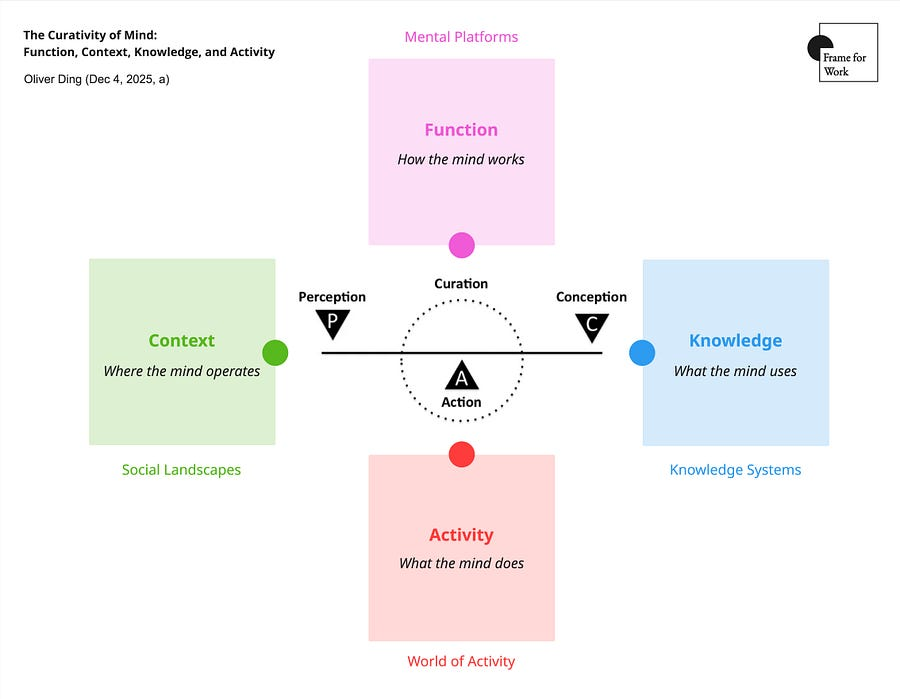
The Mental Platform emerges as the theme that bridges the Context and Knowledge dimensions. This theme investigates the structural products of curatorial activity—the dynamic, self-organizing concept systems that the mind continuously builds.
When these concept systems are connected to a concrete context—such as the Creative Enterprise emphasized in Creative Life Theory—they reveal their functional role in supporting purposeful activity. It is this contextualized and functionalized concept system that constitutes the Mental Platform.
At that time, my guiding preference in thinking about the mind was not to provide an essentialist answer to what the mind is. Instead, I was more concerned with how knowledge and the mind actually function in people’s lived activities—how they operate, support action, and participate in real contexts of life.
This is the same underlying orientation that I am now naming Developmental Functionalism: not a theory of what development is in essence, but a perspective that shapes what I attend to when I construct developmental concepts, and how I interpret their significance across different domains.
3
A related work, The Six Faces of the Concept System, introduced in my 2025 book Meta-Frameworks, follows the same underlying orientation.
In that work, I am not trying to define what a “concept system” is in an essentialist sense. Instead, I examine what concept systems do—how they function within social life, and how they participate in shaping lived activity, meaning-making, and coordination.
On December 17, 2025, I revisited a Creative Life Discovery project that I had originally conducted in 2024. One of the key models developed in that project was the History [Life (Self)] framework, also known as the HLS framework.
This re-engagement with prior work led me to further revisit and repurpose the HLS framework. On the following day, December 18, 2025, I used it as a creative heuristic within the Meta-Frameworks project to construct a model of concept systems. The diagram below presents the final version of this model.
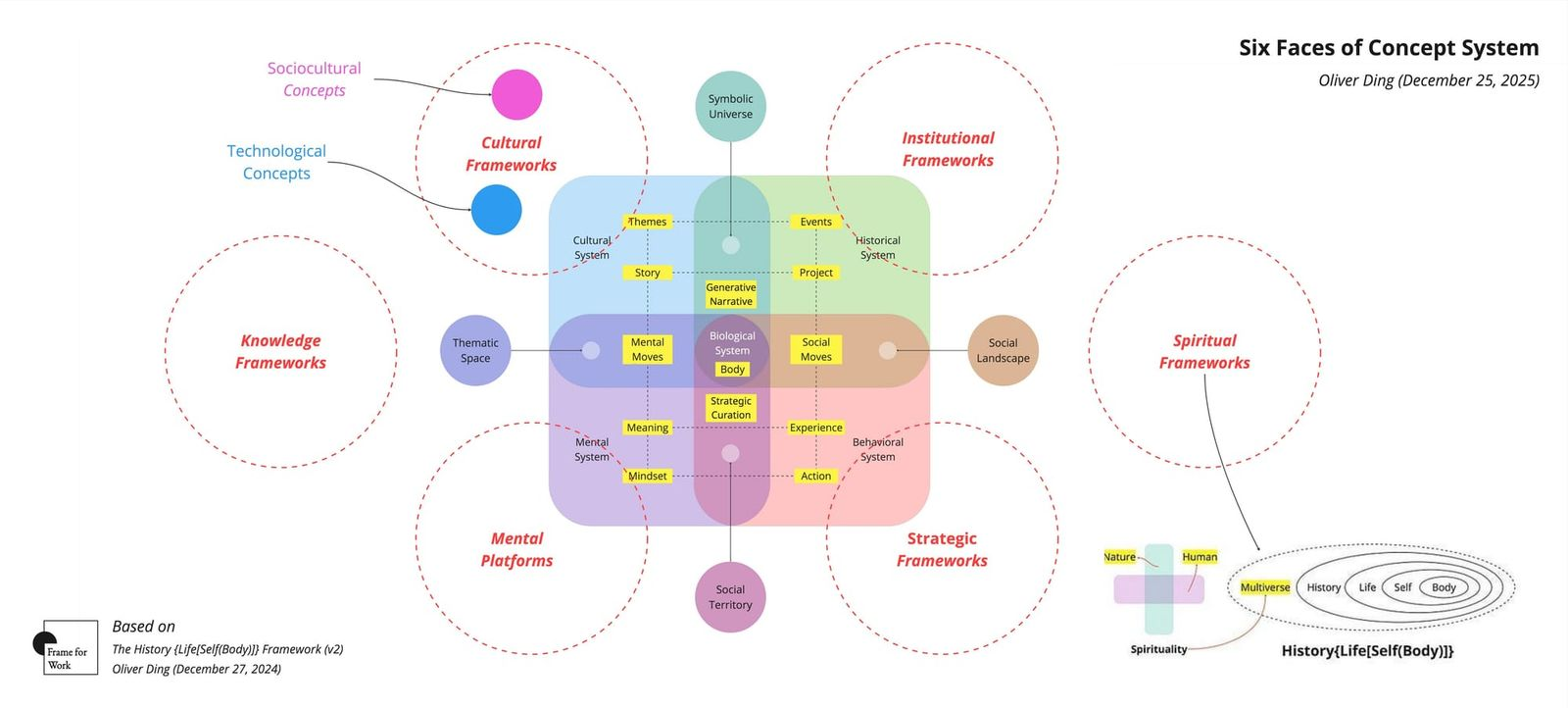
The diagram identifies six types of concept systems situated within the HLS framework:
- Knowledge Frameworks
- Cultural Frameworks
- Institutional Frameworks
- Mental Platforms
- Strategic Frameworks
- Spiritual Frameworks
This is not a static taxonomy. Rather, it is a dynamic map of evolving concept systems embedded within different layers of the HLS framework.
Across this work, the same underlying preference is present: I am not primarily asking what a concept system is, but rather how concept systems function within social and psychological life—how they operate as mediating structures in action, interpretation, and development.
4
If we further ask about the philosophical background of this perspective, I would say it is shaped by my engagement over the past several years with ecological psychology, Activity Theory, phenomenological sociology, and creativity studies.
As Harry Heft pointed out in his 2001 book Ecological Psychology in Context, the intellectual development of ecological psychologists such as James Gibson and Roger Barker is closely connected to the work of William James. In particular, James’s functionalist understanding of mind is widely acknowledged as a foundational influence. Gibson’s theory of affordances provides a powerful framework for understanding the action possibilities embedded in environments, and it has directly informed my long-term work on the Ecological Practice Approach as a theoretical project.
Within the tradition of Activity Theory, the work of Lev Vygotsky is central, especially his early ideas on tools and mediation. From my perspective, tools are inherently functional—they are defined by what they enable and what they transform in activity. Extending this further, projects or activities themselves can be understood as the basic units through which individuals and societies develop.
Phenomenological sociology adds another important insight: it emphasizes understanding the world from the standpoint of the subject’s lived experience. In particular, I have found it useful to consider the widest domain of reality that an individual can actively engage with and intervene in. I refer to this domain as the world of activity. While it is certainly important to understand the natural world and the social world in their own terms, my primary interest lies in how individuals develop their own world of activity, and how, through concrete projects and activities, they contribute to the broader development of both natural and social worlds.
Taken together, these intellectual influences help clarify the philosophical orientation behind my current work. What I am calling Developmental Functionalism is not an abstract doctrine about the essence of development, but rather a way of seeing: a functional lens shaped by ecological, activity-based, and phenomenological traditions, through which I select, construct, and relate developmental concepts.
v1.0 - June 26, 2026 - 1,622 words