
Leeway: The Ecological Total of Supportances
Reclaiming a Term, Refining a Concept
by Oliver Ding
June 30, 2026
This article is part of a new possible book: Supportance: Self, Other, and Possible Support.
Introduction
The term "leeway" has had an unusual journey through my theoretical work. First introduced in May 2026 as a bridge concept naming the convergence of Weave-points, Living Coordinates, and Thematic Spaces, it was almost immediately made redundant by the emergence of the Gejunction framework. For a brief moment, leeway was suspended—held in reserve, not abandoned.
Then something unexpected happened.
Ten days ago, I read a woman's blog (whom I will call Aria) and learned her journey of marriage and divorce. One event is that she was detained in a police cell for 42 hours. The cell is sparse—no belongings, no connection to the outside world. Yet inside this cell, she discovers something unexpected: her body is confined, but her consciousness moves freely. "My mind is very free," she later writes, "free to go wherever it wants."
Her story inspired me to explore Intimate Relationships and High-Conflict Divorce (HCD), resulting in a series of new articles on the concept of Supportance and the RelationField framework.
In analyzing Aria's response to a marital crisis—how she systematically restructured her entire supportance landscape across multiple dimensions rather than collapsing—a new insight emerged. What Aria was orchestrating was not individual supportances in isolation. She was strategically curating multiple supportances across different dimensions of her life.
Aria's story inspired me to reuse the term "leeway" to name the totality of supportances for Supportance Theory.
This article traces that reclamation. It reconstructs the conceptual lineage that made leeway necessary: from Gibson's ecological niche, through infoniche and the affordance-supportance frameworks, to the present moment. It shows how leeway clarifies what the "curation stage" of Actualization of Supportances actually means at the systemic level. And it situates leeway within the broader constellation of the Ecological Practice Approach, revealing connections that transform how we understand supportance, curativity, attachance, and genidentity.
Leeway is an ordinary word. In everyday use, it means freedom of movement, room to maneuver, a margin of safety—the space within which one can act without being constrained. When we adopt such an ordinary word for theoretical construction, we have many directions one might take.
My first choice was not wrong—but the framework it was attached to was later dismantled, and the term, freed from its old home, became an ordinary word again.
The second choice is different. This time, leeway has found its proper place: naming the totality of supportances in a person's social-material environment. It now stands alongside Gibson's niche—just as supportance stands alongside affordance. One pair for the natural environment; another for the social. The alignment is complete.
Contents
Part 1. The Conceptual Journey of Leeway
1.1 The First Leeway: A Bridge Concept (May 2026)
1.2 Gejunction Emerges: Leeway Becomes Suspended (June 2026)
1.3 A Case Study Reveals a New Use
Part 2. Leeway as the Ecological Total
2.1 Gibson's Niche (1979)
2.2 Infoniche (2020)
2.3 The Affordance-Supportance Loop (2021)
2.4 The Affordance-Supportance Cycle (2023)
2.5 Leeway (2026): The Totality of Supportances
2.6 Summary: The Conceptual Lineage
Part 3. Revisiting the Actualization of Supportances Model
3.1 The Three-Stage Model of Actualization (2021)
3.2 The Three Dimensions of Actualization
3.3 Leeway and Curation
Part 4. Leeway in the Context
4.1 Curativity and Supportance
4.2 Attachance and Leeway Choice
4.3 Genidentity and Adoption Style
4.4 Leeway as Integrating Concept
Conclusion
Part 1. The Conceptual Journey of Leeway
1.1 The First Leeway: A Bridge Concept (May 2026)
In May 2026, while working on the Weave 2.0 project, I needed a term to describe the convergence point where multiple theoretical dimensions met and produced a unified developmental space.
The phenomenon involved three dimensions:
- Weave-points: represent the symbolic aspect. They identify points where concepts, narratives, values, and meanings become woven together within a broader symbolic universe.
- Living Coordinates: represent the territorial aspect. They describe how a person becomes situated within a concrete life world.
- Thematic Spaces: represent the thematic aspect. They reveal what a particular social life configuration is about and how attention, interest, and commitment become organized around a theme.
At moments of significant development, these three dimensions did not operate independently. They intersected. When a person encountered a new Thematic Space, it could activate a Living Coordinate reorientation, which in turn produced new Weave-points of symbolic clarification.
On May 26, 2026, I conducted a Creative Confluence case study with the diagram below: Weave 2.0: Synchronic Line, Diachronic Line, and Living Coordinate.
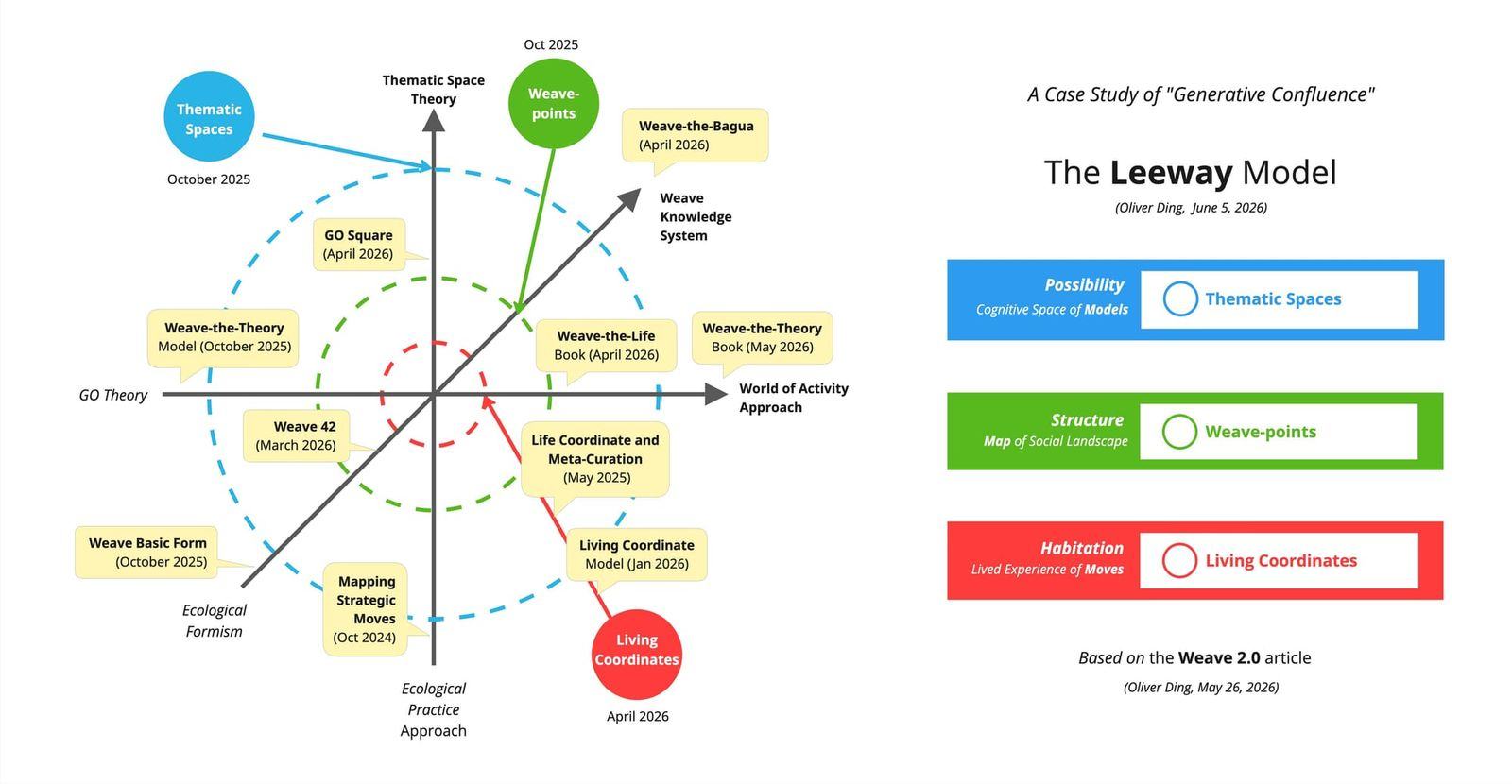
At that time, I used "Leeway" to name the outcome of the Creative Confluence:
The new creative center of Weave 2.0 is the Leeway Model — a conceptual object that names what the three creative elements, taken together, reveal. The name leeway captures the essential insight: the environment provides structure, the actor is situated within it, but the actor retains many possibilities for movement. Leeway is not freedom from structure — the Weave-point is given, the axes are fixed — but freedom within structure: the range of moves, trajectories, and cognitive explorations that remain available at any given position.
The naming process was driven by the Creative Confluence model because it requires a name for the new creative center.
However, the lifecycle of the Leeway Model is short.
1.2 Gejunction Emerges: Leeway Becomes Suspended (June 2026)
By June 2026, the theoretical landscape shifted.
I developed the RelationField (v3.0) framework on June 14, 2026. The framework uses a nested structure to model the social environment: Subject–Subject (Subject–Object). A relation that begins at the Subject–Object kernel does not remain there; it is taken up, carried, and told between subjects — and it is this carrying-and-telling that constitutes a field rather than a single point.
Moreover, I discovered that RelationField is related to the three ideas mentioned above. These four ideas just describe the same thing, but, each one focuses on one particular aspect.
On June 16, 2026, I put these four concepts on the landscape of the HLS framework (see below). The landscape made it clearer that they represent four units of analysis for the social life world.
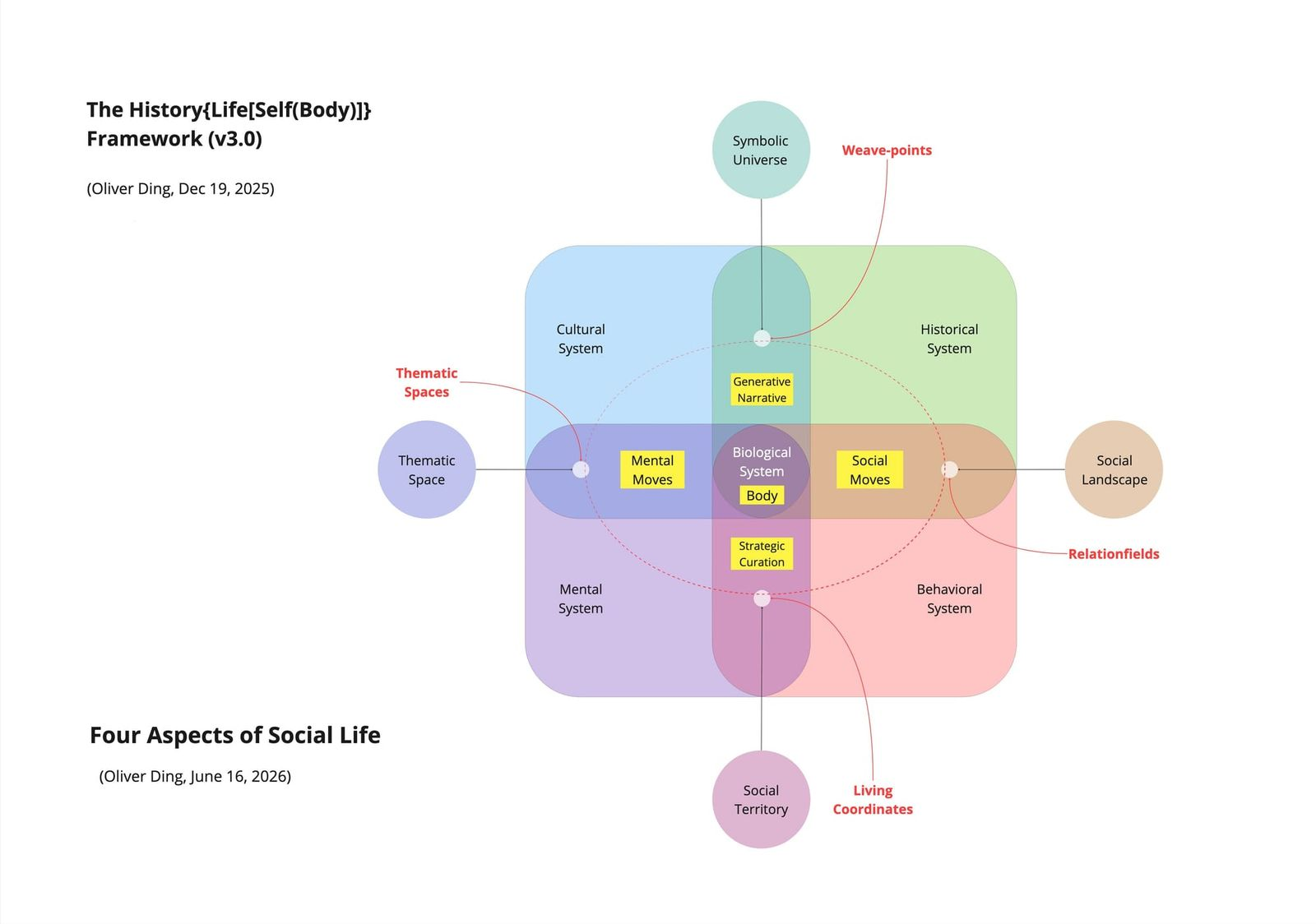
At that time, I decided to use the term "Gejunction" to name the same thing behind these four concepts.
The term "Gejunction" was coined early in January 2026 while I was working on the Anticipatory Cultural Sociology (ACS) project with a working definition of cultural development:
Cultural development is a continuous, dynamic anticipatory activity of creating and curating concept systems and transforming them into thematic enterprises by weaving active agency and evolving structure within the social world.
For the ACS project, I used the term "Bureaus of Agency" to name a dimension, exploring the "weaving active agency and evolving structure" part. I temporarily adopted the term bureau as a placeholder to describe structural domains within which agency operates. At that time, I was searching for a precise English equivalent for the Chinese concept of 格局 (geju) which is closer to what I wand to express.
However, it was difficult to find an appropriate word. Rather than adopting an existing term, I coined a new one: Gejunction. But I didn't publicly use it. Instead, I used "Bureaus of Agency" as a placeholder.
Now, the Gejunction was publicly released, naming a basic unit of social life: a situated configuration where multiple structural dimensions (relational, thematic, temporal, spatial) converge into a unified whole.
With this development, the previous "Leeway Model" became theoretically redundant. The function it had served—naming a convergence point—was absorbed into the larger and more comprehensive Gejunction framework. The term leeway was set aside, suspended—not abandoned, but held in reserve.
1.3 A Case Study Reveals a New Use
Aria is a woman from East Asia who relocated to Bali in her mid-thirties to start a new life. Over the following years, she experienced a marital breakdown, a protracted legal battle, and personal crisis. During this period, she was detained for 42 hours in a police cell.
In a previous article, Supportances in Intimate Relationships: A Theoretical Framework, I introduced self psychology and Kohut's concept of the selfobject and family sociology to develop a typology of Supportances in intimate relationships, organized in two groups: psychological Supportances (derived from self psychology) and functional Supportances (derived from family sociology).
When Aria's marriage—which had been her dominant source of selfobject supportances (relational mirroring that confirms her sense of self, idealization of her partner as embodying her values, and twinship through shared experience)—entered into crisis and those supportances became actively hostile, she did not collapse. Instead, she systematically restructured her entire supportance landscape across multiple dimensions:
- Ecological dimension: Bali as natural environment shifted from backdrop to thematic supportance; Dubai emerged as a new space of extreme experience.
- Platform dimension: The local meditation center became a developmental platform providing systematic supportances through community practice.
- Non-human dimension: Painting, horseback riding, and her cat offer thematic supportances by providing ongoing affective resonance.
- Relational dimension: "Soul sisters," a close friend, renewed connection with her father—new intimate circles emerged.
- Symbolic dimension: Reframing hostile experience as wisdom (imprisonment as deep rest; court loss as accelerated learning); designing her lived experience into shareable structures.
This reconfiguration was not random or reactive. what Aria was doing was strategically curating multiple supportances within her social environments—activating some dimensions while compensating for others. This observation revealed something: I had been analyzing individual supportances in isolation. It was time to develop a new concept for analyzing supportances at the collective level—as a meaningful whole of multiple supportances.
Aria's story inspired me to reuse the term "leeway" to name the totality of supportances for Supportance Theory.
Part 2. Leeway as the Ecological Total
2.1 Gibson's Niche: The Foundation
James J. Gibson, the ecological psychologist, developed the concept of niche to describe the totality of affordances available to an organism. A niche is not a spatial location—it is the full structured environment within which a particular form of life becomes possible. Gibson wrote: "The niche of an animal refers to how an animal lives... it encompasses the objects that the animal eats, the objects against which it orbits, the places where it takes refuge from enemies or weather, the social environment it participates in, and everything else that is relevant to how it survives and flourishes."
For human development in social environments, we need an analogous conceptual structure. This requirement motivated years of theoretical work to extend and parallel Gibson's ecological approach.
2.2 Infoniche (2020)
In my earlier work, between 2018 and 2020, I developed a framework to bridge Gibson's body-scale environment and Roger Barker's behavior settings, using the Infoniche framework to name these early efforts. The framework included units of analysis such as spot, zone, camp, and ba. The 2020 book draft After Affordance dedicated a full chapter to introducing this model. Later, in 2021, I added the project as a new unit of analysis to the framework.
In order to further develop the Infoniche framework, I developed the concept of Supportance in October 2020.
I have been searching for such a concept for about two years after I finished the draft of Curativity: The Ecological Approach to Curatorial Practice in March 2019.
The Ecological Practice approach is inspired by James J. Gibson’s Ecological Psychology. There are two goals behind the Ecological Practice approach:
- 1) Expanding Ecological Psychology from native natural environments to modern digital environments.
- 2) Expanding Ecological Psychology from perception-centered psychological analysis to social practice analysis.
In May 2020, I wrote the draft of After Affordance: The Ecological Approach to Human Action in which I proposed several new theoretical ideas for the above task #1. However, I think it still doesn’t provide an ideal solution for task #2. That is the reason I use ‘human action’ for the subtitle of the draft.
Eventually, I realized that it is better to escape from Ecological Psychology and find a brand new concept as a theoretical foundation if I want to develop a new social theory.
How can I detach from Gibson’s ideas? The answer is a Gibsonian trick.
In Oct 2020, I got an idea for the new concept when I was reading Gibson’s book The Ecological Approach to Visual Perception. I have been reading the book many times. The book includes a chapter on the theory of Affordance.
One day, while rereading Gibson's classic example of affordance, I noticed something I had overlooked in all my previous readings. In the passage about a horizontal, flat, rigid surface, Gibson writes:
If a terrestrial surface is nearly horizontal (instead of slanted), nearly flat (instead of convex or concave), and sufficiently extended (relative to the size of the animal) and if its substance is rigid (relative to the weight of the animal), then the surface affords support. It is a surface of support, and we call it a substratum, ground, or floor. It is stand-on-able, permitting an upright posture for quadrupeds and bipeds. It is therefore walk-on-able and run-over-able. It is not sink-into-able like a surface of water or a swamp, that is, not for heavy terrestrial animals. Support for water bugs is different. (1979/2015, p.119)
Usually, people use this example for understanding the concept of Affordance. Since I had read the book many times, I didn’t have to do it in such a way. I paid attention to one sentence “…the surface affords support…” and the word “support.”
And in that moment, I realized: if Gibson could take the word "afford" and turn it into a technical term, I could do the same with "support."
2.3 The Affordance-Supportance Loop (2021)
After introducing the concept of supportance in October 2020, I began looking for opportunities to develop and test it. By late 2021, I chose the domain of Platform Ecology as a testing ground. What I did not anticipate was that supportance and affordance would reveal themselves as a natural pair—two concepts that could be combined in multiple ways to analyze the interplay between material and social environments. This unexpected discovery opened a new line of inquiry.
The development of the Ecological Practice approach and Platform Ecology required a more precise model. In 2021, I developed the Affordance-Supportance Loop to show how these two concepts operate at different but related levels of ecological analysis.
First Layer: Platform and Affordance
At the foundational level, a Platform is understood as a super-large container offering ecological affordances to its users and stakeholders. Think of the platform as nearly horizontal, nearly flat, sufficiently extended, and rigid—Gibson's very criteria for a surface that affords support. The platform's affordances are material and technical: the features of the interface, the computational structures, the possibilities embedded in the system's design.
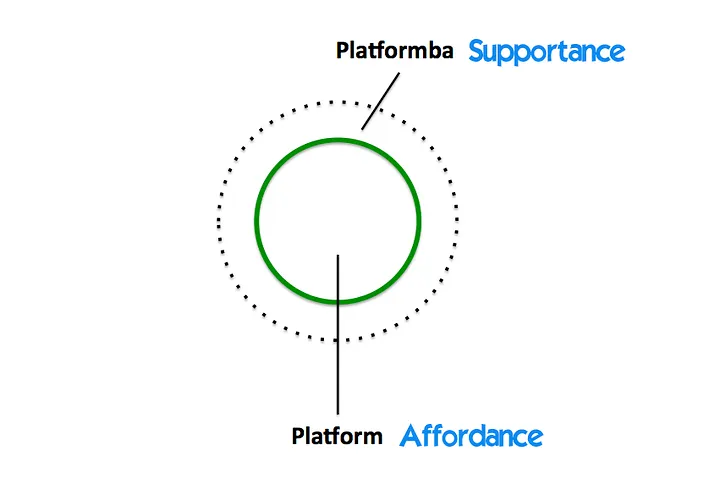
Second Layer: Platform-ba and Supportance
But human activity extends beyond the material affordances of the platform itself. Platform-ba (platform-based social field) emerges from the activities of people who participate in the platform. By actualizing the platform's affordances, people take actions that form activities. These people and their activities constitute the platform-ba—the sum of the containee (participants) and the spilling space (the living space occupied by participants).
Within the platform-ba, supportances operate: potential supportive action possibilities offered by the social environment. Supportances are distinct from affordances in a crucial way: they involve two-side agency. While a natural or material environment offers affordances passively (a rock doesn't "choose" to afford support), social environments actively offer supportances. This requires rational agency, language engagement, ownership claims, and the capacity for remote presence—capacities unique to human participation.
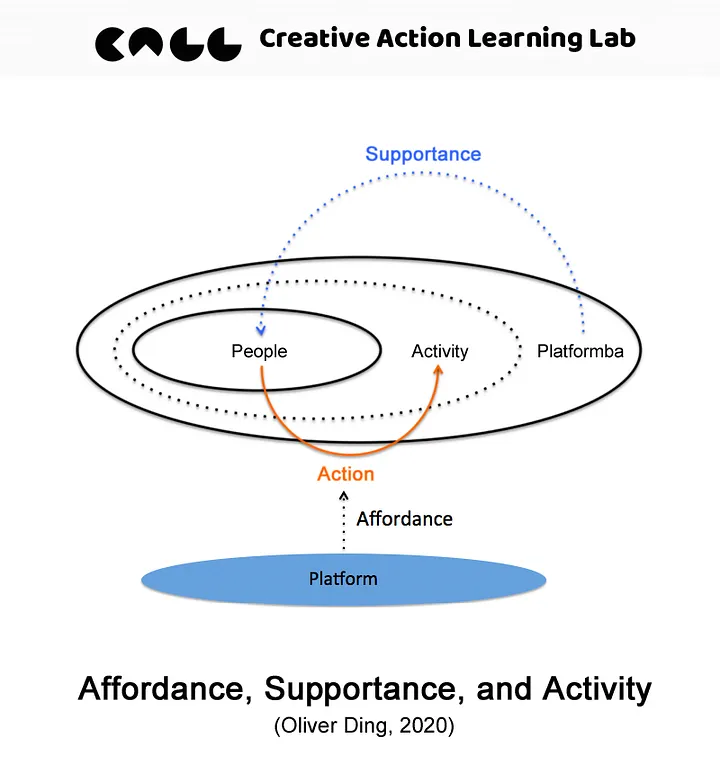
The Stratified Loop
The Affordance-Supportance Loop shows this relationship as a two-layer hierarchical structure:
- At the potential level: Affordance is assigned to Platform; Supportance is assigned to Platform-ba
- At the actual level: Action actualizes Affordance; Activity actualizes Supportance
The relationship is coordinated: Affordances generate Actions; Actions accumulate into Activities; Activities (of people and projects) generate Supportances within the Platform-ba. Then these Supportances feed back, enabling people to perceive and actualize new Affordances.
A Concrete Example
The Twitter Retweet (RT) illustrates this loop perfectly. Users perceived an affordance: the 140-character input box afforded a way to manually retweet. Individual users took this action repeatedly. These individual actions accumulated into an Activity—a whole community practice of manual retweeting. As this activity spread, other users recognized and supported it through various supportances: explaining how to do it, celebrating good retweets, coordinating norms around the practice. These social supportances (from the platform-ba) eventually prompted Twitter to formalize a Retweet button in 2015. But importantly, the affordance of the input box still remained—users could still perform manual retweets alongside the official feature.
Affordance versus Supportance: A Fundamental Distinction
The Affordance-Supportance Loop makes clear why a new concept is necessary. Some scholars have proposed "Social Affordance" to handle social action possibilities, but this approach conflates two distinct ecological levels. From the perspective of the Ecological Practice approach:
- Affordances operate in natural and material environments (one-side agency: the environment is passive)
- Supportances operate in social environments (two-side agency: both the supporter and the supported party are active agents)
This distinction is essential because social environments have properties that natural/material environments lack: rational decision-making about whether to offer support, language-based negotiation of meaning, ownership claims and rights, and remote presence through technology. Collapsing these into "social affordance" obscures these differences and weakens our ability to analyze human development in social-ecological contexts.
2.4 The Affordance-Supportance Cycle (2023)
Building on the Loop framework, I observed how a subscriber engaged with Lenny's Newsletter in 2023. This real-world case led me to develop the Affordance-Supportance Cycle, which adds a crucial dynamic dimension: the Problem-Solution relationship between the two concepts.
The Story
Lenny's Newsletter is a popular Substack publication with hundreds of posts across multiple years. Its readership is large. The content is valuable. But the platform has a problem.
Substack's native search and browsing functionality is limited. A reader who wants to find, say, all posts about product management—or all interviews with a particular type of guest—has no easy way to do it. The newsletter's archive is rich, but it is also scattered. The affordances are lacking.
George Nurijanian, a subscriber, perceived this problem. He also perceived something else: the possibility of a solution. He manually indexed the entire archive—hundreds of posts—and organized them into a themed Notion database. Topics, roles, guest types, key themes—all categorized and cross-referenced. He then shared this database with the community.
The response was immediate. Readers who had struggled to navigate the archive now had a way in. They could filter by topic, design their own learning sequences, find what they needed without friction. The database did not change Substack. It created a new layer of organization on top of the platform.
Theoretical Observation
In theory, any subscriber could have done what Nurijanian did. The posts were public. The need was clear. Yet he was the only one who acted. The difference is not capability. It is the act of actualizing supportances: perceiving a gap in the environment, recognizing that one's own action could create a structure for others, and following through.
Nurijanian's actual action—the act of selecting and actualizing his own supportances—produced a material artifact: a database. That artifact, in turn, changed the environment for others. What was once a personal supportance (his act of organizing and sharing) became, through the material structure he created, a new set of affordances for the community.
Nurijanian's database is not itself a supportance. It is a material structure that offers new affordances to its users: the ability to navigate, filter, and curate their own learning paths.
This is the Affordance-Supportance Cycle in motion. A lack of affordances prompted a supportance response. That response, through materialization, generated new affordances. Those new affordances, in turn, may prompt new supportances—community discussions, shared learning strategies, collaborative curation. The cycle continues.
2.5 Leeway (2026)
The case analysis of Aria revealed what leeway should actually name. While the Loop and Cycle frameworks addressed the relationship between affordance and supportance, leeway focuses specifically on the totality of supportances alone—the ecological total of all supportive action possibilities in a person's social environment.
This is precisely the symmetrical counterpart to Gibson's concept: Gibson's Niche names the totality of affordances; Leeway names the totality of supportances.
The term "leeway" carries the right conceptual density. In ordinary usage, it means "freedom to act according to one's judgment; latitude." In this theoretical context, it gains new precision: leeway describes the all latent supportive action possibilities in a person's social environment.
A person's leeway is:
- Multidimensional: It encompasses relational supportances (people), platform supportances (institutions/communities), thematic supportances (thematic objects and experiences), non-human supportances, and more.
- Dynamic: It shifts as life conditions change, as new relationships form or dissolve, as new platforms emerge or close, as new thematic objects become meaningful.
- Structured: It is not random. The availability of specific supportances is governed by ecological position, social location, cultural context, and the person's own capacity to recognize and actualize supportances.
Aria's case demonstrates this precisely. The supportances constituted for her shifted dramatically when her marriage supportances became hostile—a primary relational dimension collapsed. But the totality of her leeway remained; what restructured was which supportances she could actively engage with. New dimensions became active: platform supportances from local communities, thematic supportances from her evolving intellectual frameworks, relational supportances from mentors and colleagues. Her capacity to maintain her developmental trajectory depended on accessing multiple supportance dimensions and the strategic ability to reconfigure them through Curation.
2.6 Summary: The Conceptual Lineage
Gibson's Niche (1979) → Infoniche (2020) → Affordance-Supportance Loop (2021) → Affordance-Supportance Cycle (2023) → Leeway (2026)
Each step refined and extended the framework:
Gibson's Niche (1979) provided the ecological foundation: the totality of affordances available to an organism in its environment—the full structured field within which a particular form of life becomes possible.
Infoniche (2020) extended Gibson's logic to human social and informational environments. It introduced analytical units (spot, zone, camp, ba, and later project) to bridge Gibson's body-scale environment and Roger Barker's behavior settings, establishing a vocabulary for analyzing how people engage with designed and social environments.
Affordance-Supportance Loop (2021) formalized the distinction between the material and social dimensions of the social environment. The Loop established a two-layer structure—Platform (material/technical) and Platform-ba (social/relational)—with Affordance assigned to the former and Supportance to the latter. It also introduced the crucial distinction between one-side agency (affordance) and two-side agency (supportance), and between potential and actual levels of analysis.
Affordance-Supportance Cycle (2023) added the dynamic dimension that the Loop's structural model did not capture. Through a real-world case (George Nurijanian's manual indexing of Lenny's Newsletter), the Cycle showed how a lack of affordances prompts supportance responses, how those responses generate new affordances through materialization (a database that became a material structure offering new affordances), and how this feedback loop continues—creating a continuous interaction between platform constraints and community action.
Leeway (2026) completed the lineage by naming what Gibson had named for affordances—the totality, the full ecological field—but for supportances. Leeway is the ecological total of all supportive action possibilities in a person's social environment. It is the symmetrical counterpart to Gibson's Niche: one for the natural environment, one for the social.
Together, these five steps trace a conceptual lineage that began with ecological psychology's insight about organism-environment co-constitution and arrived at a framework for understanding support in human social environments. Each step added a new layer of precision, scope, or dynamics without discarding what came before. The lineage is cumulative.
Part 3. Revisiting the Actualization of Supportances Model
With leeway established as the ecological total of supportances, we can now return to an earlier framework and see it with new clarity. The 2021 Actualization of Supportances model described how individuals perceive, act upon, and curate supportances—but at the time, the object of curation remained underspecified. Leeway provides that missing concept.
3.1 The Three-Stage Model of Actualization (2021)
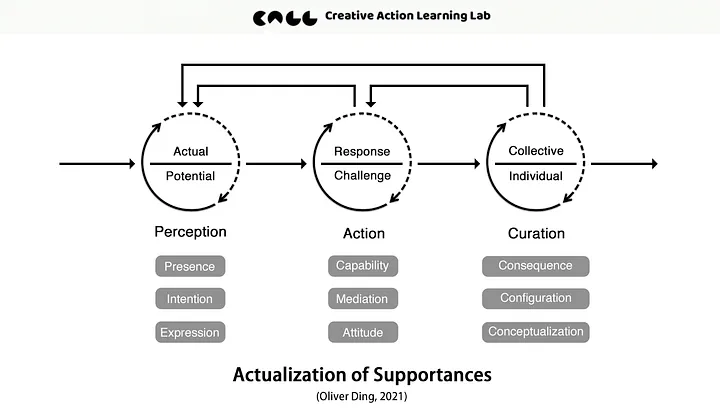
In my 2021 work The Concept of Supportance, I developed a three-stage model for how individuals actualize supportances:
- Perception: Recognizing that a potential supportance is available
- Action: Actualizing the supportance through sustained engagement
- Curation: Organizing multiple supportances into a coherent whole that sustains ongoing development
This model describes supportance not as a static resource but as a dynamic process. The three stages are not strictly sequential—feedback loops constantly connect later stages back to earlier ones.
3.2 The Three Dimensions of Actualization
The 2021 model identified specific topics within each stage:
Perception addresses the transformation between Potential and Actual:
- Presence (Near vs. Remote): The person and others must enter the same place—physical or virtual—where they can perceive supportances from each other.
- Intention (Unintended vs. Intended): Supportances can flow from Others' deliberate attempts to help, or from the person's capacity to actualize support that Others do not consciously intend to offer.
- Expression (Tacit vs. Explicit): The person must attend to both explicit expressions and tacit expressions to perceive supportances.
Action addresses the transformation between Challenge and Response:
- Capability (Capable vs. Incapable): The person's skill, knowledge, and embodied capacities determine whether they can actualize supportances.
- Mediation (Direct vs. Indirect): The person may directly actualize a supportance, or may use tools and mediating signs to actualize it indirectly.
- Attitude (Attractive vs. Defensive): Both the person's self-perception and Others' perception of the person's actions shape the quality of response. Others may respond amicably (Attractive) or cautiously (Defensive).
Curation addresses the transformation between Individual and Collective:
- Consequence (Positive vs. Negative): The outcomes of actualizing supportances feed back into the social ecology, generating new challenges and opportunities.
- Configuration (Piece vs. Whole): The person can coordinate multiple supportances from different sources into functioning configurations; can transform individual experiences into meaningful wholes; can manage the total landscape of their infoniche.
- Conceptualization (Abstract vs. Concrete): The person can generate abstract life themes from concrete experiences of actualizing supportances, creating knowledge that bridges individual and collective culture.
3.3 Leeway and Curation
At the time of the 2021 work, the curation stage operated at the level of "multiple supportances"—plural, but without a clear concept for thinking about them together as a whole. What exactly was the object of curation?
Leeway provides that concept. It gives the level of "multiple supportances" an ecological name: the total of all supportances in a person's social environment.
With leeway as the analytical object, curation becomes strategically intelligible. Among one's supportances, certain ones can be curated together—coordinated into functioning configurations. This is the "Configuration" topic from the Curation stage in action. Simultaneously, some supportances may be missing. Some may be alienated, as happened when Aria's relational supportances became hostile. When supportances are lost or become unusable, strategic curation means activating and organizing supportances from other dimensions to compensate.
This is exactly what Aria did during her marital crisis. Her relational dimension—which had been the dominant source of her supportances—was collapsing. Strategic curation meant: intensifying the thematic dimension (painting, horseback riding, extreme experience), activating the platform dimension (meditation community), cultivating new relational circles, engaging the ecological dimension (Bali transformed as space).
Leeway and curation are paired concepts. Leeway names the ecological totality of all supportances. Curation names the strategic work of activating, coordinating, and reconfiguring those supportances in response to changing life conditions.
Part 4. Leeway in the Context
The concept of leeway clarifies curation, but it also reveals something larger: it provides a new perspective for understanding supportance and its relationship to other core concepts in the Ecological Practice Approach.
4.1 Curativity and Supportance
Curativity is the general theory of curation — the operation of organizing pieces into a meaningful whole. Supportance, through the concept of leeway, introduces a specific domain of curation: the strategic activation and reconfiguration of supportances in response to changing life conditions.
In this sense, the curation of leeway is a particular application of the broader logic of curativity. Curativity works at the level of meaning and coherence — how fragments of experience become a unified whole. Leeway curation works at the level of ecological structuring — how individual supportances are organized into a functioning totality. One is about the coherence of experience; the other is about the viability of support.
4.2 Attachance and Leeway Choice
Attachance describes the capacity to enter and exit social containers—to move from outside to inside a project or community. But every social container provides access to a different constellation of supportances. When a person practices attachance—detaching from one container and attaching to another—they are reconfiguring which supportances are actualizable to them. The person is not simply changing locations; they are engaging with a fundamentally different structure of supportive action possibilities.
4.3 Genidentity and Actualization Style
Genidentity names the essential difference that persists through development. For understanding adult development, Genidentity focuses on the dynamics of Identity and Theme.
In Aria's case, her genidentity—Second-order Activity-driven Life Discovery—expresses itself through a characteristic actualization style: she seeks intense, high-density supportances regardless of which dimension they come from. This style is the signature of how an individual strategically curates and engages with supportances within their social environments.
Moreover, Genidentity connects directly to Thematic Supportance: the intense experiences that Aria seeks are precisely those that can be symbolized into themes that sustain both personal and collective culture.
4.4 Leeway as a Universal Concept
Curativity, attachance, and genidentity each address supportance from a different angle—curativity through the logic of curation, attachance through the movement between containers, genidentity through the style of actualization. But none of them names the thing they are operating on as a whole.
Leeway does that.
It gives supportance its own totality—a universal concept in the Hegelian sense: the general category under which all specific instances of supportance are understood. It is not one more concept alongside curativity, attachance, or genidentity. It is the concept that makes supportance thinkable as an ecological whole.
This is why leeway is necessary. Without it, supportance remains a collection of individual instances—this relational supportance, that platform supportance, this thematic supportance—without a framework for seeing them together. Leeway provides that framework. It is the universal that gives coherence to the particular and the individual.
Conclusion
The term leeway has been reclaimed from theoretical dormancy and restored to active theoretical work. Once used to name the convergence of Weave-points, Living Coordinates, and Thematic Spaces, it now names something more fundamental: the ecological total of all supportances in a person's social-material environment.
This reclaimed usage clarifies how the curation stage of Actualization of Supportance actually works at the systemic level. It is not about managing individual supportances in isolation. It is about strategically curating and activating multiple supportances within the totality of what is present in a person's social environment.
As a universal concept, leeway gives supportance its own totality—a framework for seeing individual supportances not as isolated instances but as a structured whole. It completes the conceptual lineage that began with Gibson's niche and extends it to the social dimension. With leeway, supportance theory now has its own counterpart to affordance's niche.
The term deserves its restoration. It names a phenomenon that is both theoretically important and empirically observable.
v1.0 - June 30, 2026 - 5,356 words