
Epilogue: The Future of Supportance Analysis
This article is part of a new possible book: Supportance: Self, Other, and Possible Support.
by Oliver Ding
June 30, 2026
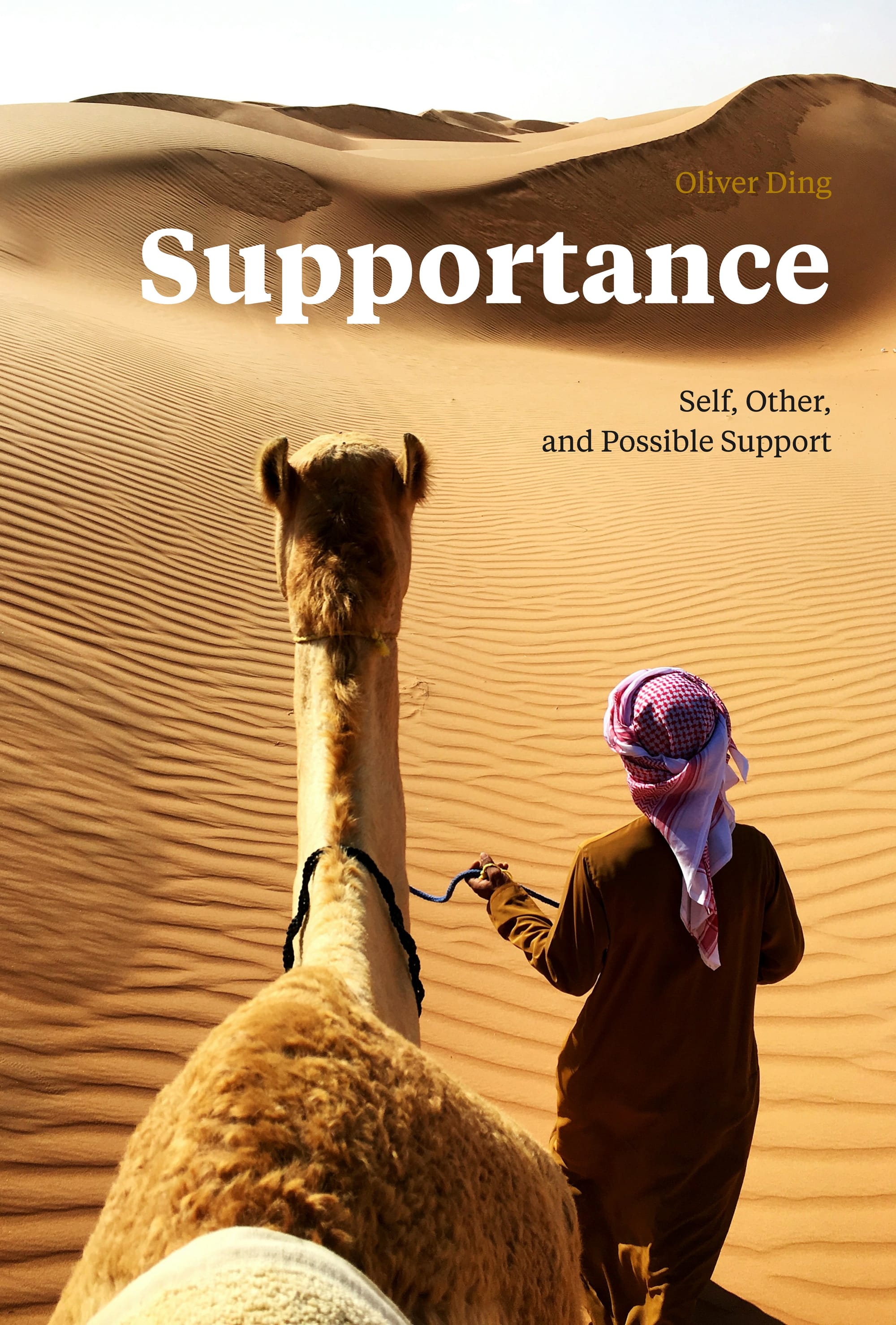
This book marks a watershed:
- Before: the "Supportance Theory" journey, focusing on theoretical development
- After: the "Supportance Analysis" journey, focusing on applications
The seven parts of this book have laid the conceptual and methodological foundations for the journey ahead. But a foundation is not a building. It is a base upon which others can build.
The central methodological insight that emerged from this work is this: supportance analysis is not a single method but an open analytical layer. Different social environments require different models. One cannot analyze a theoretical platform the same way one analyzes an intimate relationship, a supportive life discovery practice, or the ecological total of leeway. Each environment has its own structure, its own logic, its own forms of supportance.
Consider the case of theoretical platforms — examined in Part 4. To understand how a theoretical tradition supports the work of contributors, I found that no single model sufficed. A diachronic model traced the platform's developmental waves, revealing how different stages of a tradition's evolution open different types of supportance. A synchronic model mapped its current landscape across Conceptual, Social, and Material dimensions simultaneously. A relational model traced how individual contributors perceive and actualize specific supportances through their engagement with the platform. These three models do not compete with each other. They are complementary cuts through the same complex reality, each making visible what the others cannot see.
A fourth dimension emerged when I examined the perspective of a single contributor actualizing supportances across three structurally different platforms. Activity Theory, as a large established tradition, offered supportances at different depths of engagement — but all required the initiative of the contributor to perceive them. Lui's theoretical sociology, as a Possible Platform, demonstrated that the boundary between possible and established is always relative to the contributor's position: what remains structurally unrecognized by the broader community may already function as a developmental environment for a specific contributor. GO Theory, as a self-built platform, revealed a third mode: generative environmental support, in which the platform does not offer specific conceptual resources but creates the enabling conditions within which new developments become possible. Each mode requires different capacities; each produces different outcomes; each has a different relationship to the inside/outside distinction that governs the logic of supportance itself.
The three models of Part 2 and the three cases of Part 4 are not alternatives. They illustrate the openness of supportance analysis — its character as an open analytical layer rather than a unified method.
This openness is not a limitation. It is a reflection of the irreducible diversity of social environments — and of the fact that no single theorist can model all of them.
The environments examined in this book are a beginning, not an inventory. Over the past several years, I have developed models for specific environments: Infoniche, Developmental Platform, Knowledge Center, World of Activity, Evolving Knowledge Enterprise, Theory as Enterprise, RelationField. Each was developed in response to a specific set of questions encountered while applying supportance in different fields. Each has its own structure, its own assumptions, its own domain of applicability.
But these are only a few environments among many. Educational settings have their own structures of supportance — classrooms, curricula, mentoring relationships, peer learning communities. Organizational contexts have their own — teams, hierarchies, career paths, institutional cultures. Community development initiatives have their own — local networks, shared resources, collective action, intergenerational relationships. Digital spaces have their own — online communities, algorithmic environments, platform-mediated interactions. Cross-cultural encounters have their own — translation, adaptation, mutual learning, the negotiation of difference. Intergenerational relationships have their own — the transmission of knowledge, the sharing of experience, the tension between continuity and change.
I have not modeled these environments. I have not developed the typologies, the analytical frameworks, the diagnostic tools that would make supportance analysis operational in these domains. The work belongs to those who inhabit them.
This is an invitation.
It invites practitioners to see their own environments through the lens of supportance — to ask what their settings offer, to whom, and under what conditions. It invites researchers to develop domain-specific typologies, to test the framework against empirical cases, to refine and extend the models. It invites designers to build environments that enable others to perceive and actualize the supportances latent in their worlds. The models developed in this book are not templates to be applied mechanically. They are examples — demonstrations of what supportance analysis looks like when it is tailored to a specific domain.
The theoretical gaps are not gaps to be filled by a single author. They are invitations to others. The openness of the framework — its refusal to be a closed system — is not a weakness. It is a recognition that the work of understanding support is, by its nature, a collective endeavor. No one person can map all the ways in which human beings find and actualize support. But each domain that is mapped enriches the whole — and each new model adds a layer to the cumulative understanding of how we sustain each other.
The watershed is crossed. The foundation is laid. The next journey begins — not as a solo endeavor, but as a collective one.
v1.0 - June 30, 2026 - 888 words