
SDP: Gejunction — A Unit of Synthesis within GO Theory

by Oliver Ding
July 7, 2026
This article is part of a new possible book: Strategic Developmental Psychology: Situation, Gejunction, and Supportive Self-Actualization.
SDP stands for the Strategic Developmental Psychology project.
This chapter introduces Gejunction, GO Theory's most recent unit of synthesis. It begins by situating Gejunction within GO Theory's relationship to SDP, and within the cross-disciplinary method — bridging sociology and psychology through the Self-Life-Mind schema — that makes a sociological ontology like HLS a legitimate foundation for a psychological theory in the first place.
It then traces Gejunction's grounding in the HLS framework, the two-line history through which it was named and structured, and the four aspects — Weave-point, Living Coordinate, RelationField, Thematic Space — through which it can be approached.
It closes by showing why the Strategic Developmental Psychology (SDP) project, in particular, needs exactly this kind of unit: to supply the theoretical concept of strategy that psychology has never developed.
Contents
1. Introduction
1.1 GO Theory and SDP: Developmental Platform and Theoretical Enterprise
1.2 Gejunction: A New Construction on an Established Platform
1.3 Gejunction as the ACS–SDP Interface: From Self(Body) to Actor
1.4 SDP's Need: A Concept for Strategy
2. A Cross-Disciplinary Method: SLM, HLS, and the Sociology–Psychology Connection
2.1 SLM as the Psychological Instantiation of Ontology–Realism–Hermeneutics
2.2 Merleau-Ponty on Philosophy and Sociology
2.3 New Solutions to Psychology's Diagnosed Shortcomings
2.4 HLS as SLM's Natural Extension: A Real Foundation for Individual Development
3. Gejunction and HLS: From Body(Self) to Four Regions
3.1 The History{Life[Self(Body)]} Framework
3.2 Two Theoretical Resources: Rosen and Lui
3.3 Four Regions from a 2×2 Intersection
3.4 Four Mechanisms Radiating from the Center
4. The Development of Gejunction: A Brief History
4.1 The Concept Line: Searching for a Word
4.2 The Structure Line: Four Aspects Maturing Independently
4.3 Confluence
5. The Four Aspects and Their Knowledge Systems
5.1 Weave-point
5.2 Living Coordinate
5.3 RelationField
5.4 Thematic Space
5.5 Gejunction: From Self(Body) to Actor
6. Gejunction's Value for SDP
6.1 Why "Strategy" Has No Home in Psychology
6.2 From Situation to Gejunction: SDP's Commitment
6.3 Gejunction and the Four Action Opportunities
6.4 Summary
References
1. Introduction
1.1 GO Theory and SDP: Developmental Platform and Theoretical Enterprise
GO Theory and Strategic Developmental Psychology (SDP) stand in a specific relationship, one already given precise vocabulary elsewhere in this body of work: the relationship between a Theoretical Platform and a Theoretical Enterprise. A Theoretical Enterprise names the sustained trajectory of a creator's engagement with a body of theoretical work — the series of projects organized by a continuous commitment to a guiding theme. A Theoretical Platform is what a Theoretical Enterprise becomes once it has accumulated sufficient Meta-framework, Social network, and Material resources to function as a structured environment within which other enterprises can themselves develop — a Developmental Platform, in the terms of the Enterprise Development Framework, capable of supporting the work of others rather than only its own.
The name "GO Theory" is itself worth a brief note, because the platform did not always go by this name. In December 2025, HLS became the core of an integrated framework presented in the Meta-frameworks manuscript: the World of Life (World of Activity) Approach — a name that is itself a container-nesting construction, with the individual scale as its inner core and the macro, societal scale as its outer periphery. In early 2026, this framework was used directly as the theoretical platform supporting the development of both the ACS project and the SDP project. Only after the ACS manuscript was completed did it become clear that ACS could itself be understood as the second phase of an earlier, separately named project from early 2025: GO Theory. At that point, the shorter name — GO Theory — was adopted for the platform as a whole, chiefly because it was more concise than "the World of Life (World of Activity) Approach." What follows in this chapter uses GO Theory throughout, but it is worth keeping in view that the name arrived after the platform's substance was already largely in place.
GO Theory has reached this stage. It supplies the ontological grounding (the History{Life[Self(Body)]} Framework, or HLS, discussed in Part 3), the epistemological orientation (Ecological Formism), and the methodological toolkit (the LARGE Method) that several distinct theoretical enterprises now draw on without needing to rebuild any of it from scratch. Anticipatory Cultural Sociology (ACS) is one such enterprise, addressing cultural development. Strategic Developmental Psychology is another, addressing the theoretical concept of strategy within developmental psychology. Both are Theoretical Enterprises operating on GO Theory's platform; neither owns it, and neither exhausts what it makes available. This is why Gejunction, as the sections below will show, is platform-level rather than SDP-specific — a consequence of GO Theory's own status as a Developmental Platform, not of any special property belonging to Gejunction alone.
1.2 Gejunction: A New Construction on an Established Platform
Gejunction is best understood as the latest link in a chain of theoretical enterprises, not as an invention manufactured for a single occasion. Its ontological foundation, the History{Life[Self(Body)]} Framework (HLS), was itself the product of an earlier theoretical enterprise — the Advanced Life Strategy project, begun in 2022. HLS did not start out as a theory of the social world at all. It began as the Anticipatory Activity System (AAS), a framework operating at the scale of a single individual, inspired jointly by Robert Rosen's Anticipatory System Theory and by Activity Theory.
HLS is what resulted when this individual-scale AAS was extended to a macro scale — a societal or cultural AAS nested around the original individual one, rather than replacing it. Making that individual–macro relationship theoretically workable was itself a specific problem, and its solution was inspired by Ping-keung Lui's Subjectivist Structuralism, discussed in full in Part 2. The result, HLS, is not an adaptation of an existing sociological model but a genuinely new ontology of the social world — one built by nesting an individual anticipatory system inside a macro one, using Lui's resources to hold the two scales together.
HLS's four regions — Symbolic Universe, Social Territory, Thematic Space, Social Landscape — were themselves the accumulated result of still earlier, independent lines of development, some reaching back to 2022. What Gejunction adds, arriving only in mid-2026, is not a new region or a new theoretical resource, but a synthesis — a single unit capable of holding all four regions together as one configuration, where previously they had been four separate analytical territories requiring four separate acts of attention.
This is why Gejunction should be understood as a genuinely new construction within GO Theory, rather than a concept imported into SDP from outside it. It is the platform's own next development, arrived at by GO Theory's own internal logic — the confluence of a concept line and a structure line traced in Part 4 — before any particular project's needs entered the picture.
That SDP now has a specific and pressing use for exactly this kind of synthesis unit is what the remainder of this introduction, and Part 6 below, explain. But the availability of Gejunction to SDP is a consequence of GO Theory's platform status, not the reason Gejunction was built.
1.3 Gejunction as the ACS–SDP Interface: From Self(Body) to Actor
Gejunction's most direct contribution can be stated more precisely still.
SDP's own existing landscape — the three-dimensional model of Curativity of Mind, Supportive Life Discovery, and Dramatic Life Pattern, together with its five-ring Living Coordinate — is, at bottom, an actor model: an account of how a person acts, develops, and orients across time. Much of this model was itself inherited directly from ACS's own prior work — the five rings, for instance, arrived in SDP as a by-product of orientations first developed for ACS. But neither ACS nor SDP's own landscape, as inherited, ever explained how Self(Body) becomes an actor in the first place.
ACS never addressed the Biological System at all; and even HLS, in its earlier versions, left the Biological System sitting unelaborated at the center of its four-region diagram, present as a label but never theorized in its own right. Gejunction is what closes this gap. It supplies exactly the interface at which Self(Body) becomes an actor — the diachronic and synchronic movement through Flow, Focus, Center, and Circle described in Part 5 — and in doing so, it functions as the meeting point between ACS and SDP: not merely a shared platform resource the two enterprises happen to draw on independently, but the specific theoretical connector that lets an actor model inherited from ACS finally explain its own starting condition.
This interface can be stated precisely. Self(Body), moving through the social world along two axes — the diachronic (time) and the synchronic (space) — is thereby constituted as what sociology calls an actor. Each axis brings a pair of critical elements into view.
Along the time axis, Flow becomes Focus, and this transition requires thematic focus — the capacity to hold a theme steady enough for a flow of experience to condense into something pursuable. This corresponds to meta-curation on the temporal dimension: how the diachronic development of an individual's life theme comes to fit with the development of broader social-cultural themes.
Along the space axis, Center and Circle emerge. Every center has a boundary, and a boundary is what brings identity into being. This corresponds to meta-curation on the spatial dimension: how the synchronic development of an individual's creative identity comes to fit with the development of the other centers — that is, the circle of centers — that make up the surrounding social world.
Flow, Focus, Center, Circle together constitute the FFCC model — the four basic ecological forms of World of Activity. These ecological forms are closely bound to Self(Body): they are what Self(Body)'s movement through time and space actually produces, and it is this production that Gejunction's four aspects — introduced in Part 3 and taken up in full in Part 5 — are built to capture.
1.4 SDP's Need: A Concept for Strategy
SDP's own motivating question is not "what is a situation" or "what is an environment." It is narrower and more consequential: why has psychology never developed a proper theoretical concept of strategy — a construct with the same standing as emotion, cognition, or personality, rather than a mere operational label attached to specific coping or decision techniques? Answering this question, it turns out, requires passing through both situation and environment, because both are the closest existing concepts psychology has to what a theory of strategy would need as its object, and both fall short in specific, related ways.
A companion paper, Revisiting the "Situation" Issue from the Self-Life-Mind Perspective, traces this shortfall in detail: across three of psychology's most consequential internal debates, "situation" functions only as a unit of analysis, never as a unit of synthesis, and even the discipline's most successful resolutions leave this asymmetry in place. That paper's later parts extend the diagnosis to environment — showing that ecological psychology's transactionalism offers real historical precedent for a unit that resists decomposition, but that this alternative tradition has remained institutionally confined to research framed explicitly around physical and social environments, never generalizing into a resource the rest of psychology could draw on. Neither situation nor environment, as psychology has actually developed them, supplies what a theory of strategy requires: a unit of synthesis for a person's overall standing, internally structured by a potential/actual dimension.
This is the gap Gejunction is positioned to close — not because it was designed with psychology's shortfall specifically in mind, but because, as 1.2 described, it is GO Theory's own synthesis unit, already built to resist exactly the kind of decomposition that has kept situation and environment alike from supplying what strategy needs. Part 6 of this chapter develops this argument in full, after Parts 2 through 5 have established the method Gejunction draws on, what Gejunction is, where it comes from, and how its four aspects fit together.
2. A Cross-Disciplinary Method: SLM, HLS, and the Sociology–Psychology Connection
2.1 SLM as the Psychological Instantiation of Ontology–Realism–Hermeneutics
HLS is not the product of psychology reasoning alone about its own ontological foundations. It is the product of a deliberately cross-disciplinary method that has characterized GO Theory throughout — one that treats the boundary between sociology and psychology as a working distinction to be crossed when the work requires it, rather than a wall to be defended.
Sociologists often maintain a firm boundary between sociology and psychology, in part to protect the Genidentity of sociology as an academic discipline — its distinctive claim to a subject matter and method that psychology does not share. GO Theory takes a different position. Because its primary object is Life — social life, in its full concreteness — rather than either discipline's institutionally defined territory, it adopts a creative, dialogical approach that treats sociology and psychology as complementary partners within the same theoretical family rather than as separated domains. The philosophical warrant for this move comes from Merleau-Ponty's reflections on the relationship between philosophy and sociology, discussed in full in 2.2 below. Ping-keung Lui's own theoretical sociology already performs a comparable crossing, nesting Ontology, Realism, and Hermeneutics as three levels of a single grand theory — Ontology and Hermeneutics both respectable terms in philosophy, with Realism, sandwiched between them, supplying the properly sociological matter.
This is the schema the Self-Life-Mind (SLM) framework, used throughout this body of work, directly inherits and re-purposes: Self as Ontology (Philosophy), Life as Realism (Sociology), Mind as Hermeneutics (Psychology). Where psychology's own treatment of the self has long struggled with its status as an empirical construct, SLM sidesteps the struggle by treating Self, from the outset, as the Ontology of a genuinely interdisciplinary Theoretical Psychology — grounded in philosophy, not derived from psychology's own contested methods. Life inherits Realism's sociological grounding, and Mind inherits Hermeneutics' psychological one. SLM, in other words, is not a psychological schema that happens to resemble a sociological one; it is sociology's own Ontology–Realism–Hermeneutics structure, given a second name for use inside psychology. This is not without precedent: Andy Blunden has used a structurally identical move — Hegel (Philosophy), Marx (Sociology), Vygotsky (Psychology) — to frame his own creative and theoretical trajectory, a parallel that confirms the underlying schema is a genuine resource for interdisciplinary theory-building, not an idiosyncrasy of this project alone.
2.2 Merleau-Ponty on Philosophy and Sociology
The cross-disciplinary method described in 2.1 is not asserted without warrant. Its clearest statement comes from Merleau-Ponty's essay on the relationship between philosophy and sociology, in a passage worth quoting at length:
Knowledge will then be based upon the unimpeachable fact that we are not in a situation like an object in objective space. Our situation is for us the source of our curiosity, our investigations, and our interest in first other situations as variants of our own and then in our own life, illuminated by (and this time considered as a variant of) the lives of others. Ultimately, our situation is what links us to the whole of human experience, no less than what separates us from it. “Science” and “sociology” will designate the effort to construct ideal variables which objectify and schematize the functioning of this effective communication. We shall call “philosophy” the consciousness we must maintain — as our consciousness of the ultimate reality whose functioning our theoretical constructions retrace but could not possibly replace — of the open and successive community of alter egos living, speaking, and thinking in one another’s presence and in relation to nature as we sense its presence behind, around, and before us at the limits of our historical field.
Thus[,] philosophy is not defined by a peculiar domain of its own. Like sociology, it only speaks about the world, men, and mind. It is distinguished by a certain mode of consciousness we have of others, of nature, or of ourselves. It is nature and man in the present, not “flattened out” (Hegel) in a derivative objectivity but such as they are presented in our present cognitive and active commence with them. Philosophy is nature in us, the others in us, and we in them. Accordingly, we must not simply say that philosophy is compatible with sociology, but that it is necessarily to it as a constant reminder of its tasks; and that each time the sociologist returns to the living sources of his knowledge, to what operates within him as a means of understanding the forms of cultures most remote from him, he practices philosophy spontaneously. Philosophy is not a particular body of knowledge; it is the vigilance which does not let us forget the source of all knowledge.
Two claims in this passage do the specific work GO Theory relies on. The first is Merleau-Ponty's observation that a person's situation "is what links us to the whole of human experience, no less than what separates us from it" — science and sociology construct the ideal variables that schematize this effective communication, while philosophy remains the vigilance that keeps the source of that communication in view. The second is his summary formula: every science secretes an ontology, and every ontology anticipates a body of knowledge.
Read from a psychological perspective rather than Merleau-Ponty's own phenomenological one, what he calls philosophy's task of maintaining consciousness of the community of selves living, speaking, and thinking in one another's presence is, in substance, a description of Mind.
This is the license SLM takes: if a discipline's ontology already anticipates the body of knowledge that discipline will produce, then choosing Self-Life-Mind's ontology deliberately from philosophy and sociology, rather than assembling it piecemeal from psychology's own contested empirical constructs, is not a departure from proper method. It is what Merleau-Ponty's formula recommends.
2.3 New Solutions to Psychology's Diagnosed Shortcomings
The cross-disciplinary method is not merely a stylistic preference. Read against it, the shortcomings this project's own prior work has diagnosed within psychology turn out to have solutions that a psychology-only method could never have supplied.
Revisiting the "Self" Issue diagnosed a tripartite confusion: psychology asks the self to serve simultaneously as ontological presupposition, empirical variable, and explanatory construct, without ever settling which. Seen through the cross-disciplinary method, this confusion has a precise cause. Psychology has been asking Mind (Hermeneutics) to carry Ontology's proper burden as well — asking a single discipline to do philosophy's work without philosophy's resources. Assigning Self explicitly to Ontology, as SLM does, removes this burden from Mind and gives Self a stable philosophical home that psychology's own empirical methods were never built to secure on their own.
Revisiting the "Belief" Issue found that no existing account of belief adequately addresses belief-system transformation as a whole-person developmental phenomenon. HLS's own structure, described in Part 3, suggests why the gap exists and where its resources lie. Belief, in HLS's vocabulary, belongs to the Formal System side — Themes, Story, Meaning, Mindset — precisely the domain Symbolic Universe and Thematic Space were built to describe as constructions of mind. A theory of belief-system transformation needs the same cross-disciplinary resources Gejunction assembles: not a psychology-only account of what a person believes, but an account of how a person's beliefs are woven into the Symbolic Universe they inherit (outside subjective experience) and the Thematic Spaces they actively construct (inside subjective experience).
Revisiting the "Situation" Issue diagnosed situation, across three of psychology's major internal debates, as perpetually a unit of analysis and never a unit of synthesis. This is precisely the shortfall Life=Realism=Sociology exists to correct. Sociology — specifically Lui's Subjectivist Structuralism and its HLS elaboration — had already developed genuine units of synthesis for the social world (Symbolic Universe, Social Territory) well before psychology's situation debates reached their present impasse. Gejunction imports exactly this resource across the disciplinary boundary, which is why Part 6 of this chapter can offer it as a solution psychology's own internal resources were never going to produce on their own.
2.4 HLS as SLM's Natural Extension: A Real Foundation for Individual Development
HLS's extension of SLM, described formally in Part 3, is in this light not a stretch but a natural consequence of what SLM already commits to. If Life is Realism — sociology's proper object — then a full theoretical psychology cannot treat Life as an empirical residue to be measured by psychology's own instruments alone; it needs sociology's own ontology of the social world. HLS supplies exactly this: an account of the social world, via Symbolic Universe, Social Territory, Social Landscape, and Thematic Space, that gives Life a genuine ontological ground rather than a set of variables borrowed for psychological convenience.
Because HLS anchors this ontology concretely — in the Biological System, Self(Body), at the exact center of its four regions — it gives individual development a real, embodied foundation. Development, on this account, is not the development of an abstract mind afloat above the social world; it is the development of an actual body, situated at the center of a fully elaborated social ontology, radiating outward into that ontology through the four mechanisms described in Part 3.4. This is what makes the HLS–SLM extension feel inevitable rather than imposed: SLM already implied that Life needed sociology's resources; HLS is simply those resources, supplied — and Gejunction, as the rest of this chapter shows, is the synthesis unit that finally lets those resources be grasped as one configuration rather than four separate territories.
3. Gejunction and HLS: From Body(Self) to Four Regions
3.1 The History{Life[Self(Body)]} Framework
Gejunction's ontological foundation is HLS — formally, the History{Life[Self(Body)]} Framework, now at v3.0 (established December 19, 2025). The name is itself a container(contained) construction, the same notational convention used throughout GO Theory's other frameworks: History contains Life, Life contains Self, Self contains Body. Read this way, HLS is not a departure from the Self-Life-Mind (SLM) schema described in Part 2 — it is SLM's extension, adding History as a further containing term around Life, and grounding Self concretely in Body rather than leaving it as an unanchored abstraction.
HLS organizes social life into four regions, generated by crossing two pairs of systems: Cultural System and Historical System on one axis, Mental System and Behavioral System on the other. At the exact center of this 2×2 grid sits the Biological System — Self(Body) itself, the living organism from which everything else in the framework radiates outward.
3.2 Two Theoretical Resources: Rosen and Lui
Two independent theoretical resources converge in HLS's structure.
The first is Robert Rosen's Anticipatory System Theory, specifically his distinction between Natural Systems and Formal Systems. A natural system, for Rosen, is an aspect of the external world we seek to study — it generates percepts, and we come to know it only partially, through ongoing interaction. A formal system, by contrast, is entirely a creation of the mind, populated by symbols and the relations a mind establishes between them. In HLS, the Historical System and Behavioral System — Events, Projects, Social Moves, Experience, Action — belong to the Natural System side: objective things, grounded in real action. The Cultural System and Mental System — Themes, Story, Mental Moves, Meaning, Mindset — belong to the Formal System side: constructions of mind. This Natural/Formal distinction is what gives HLS its diagonal structure, rather than a simple four-quadrant grid with no deeper logic connecting opposite corners.
The second resource is Ping-keung Lui's Subjectivist Structuralism, part of his broader theoretical sociology. Lui's framework nests three levels — Ontology, Realism, Hermeneutics — with Realism further divided into two kinds of reality: Symbolic Universe, which exists outside subjective experience (a knowledge creator's published works remain part of the Symbolic Universe even after the creator's death), and Social Territory, the social structure within subjective experience. This inside/outside distinction is Lui's genuine innovation within theoretical sociology — a distinction that, as this project has argued elsewhere, has no real counterpart in how mainstream Western sociology has traditionally treated social structure and social environment. It is precisely this distinction, transplanted into psychology, that gives Gejunction access to a resource conventional psychological treatments of "situation" or "environment" have never had.
3.3 Four Regions from a 2×2 Intersection
Putting Rosen's Natural/Formal axis and Lui's inside/outside distinction together with HLS's own Cultural–Historical / Mental–Behavioral grid produces four regions, each defined as a specific intersection:
- Symbolic Universe = Cultural System ∩ Historical System (outside subjective experience). Adopted directly from Lui, who in turn drew the term from Berger and Luckmann's The Social Construction of Reality.
- Social Territory = Mental System ∩ Behavioral System (inside subjective experience). Also adopted from Lui.
- Thematic Space = Cultural System ∩ Mental System. Developed independently within this project beginning in January 2022, and it can be understood simply: a place for a concept in your mind, where all concepts originate from the Cultural System.
- Social Landscape = Historical System ∩ Behavioral System. Also developed independently, emerging from the House of Project Engagement project in 2024, and refined into a full framework the same year.
Two of these four regions, in other words, come from Lui's sociology; two are this project's own contribution, filling in the two intersections Lui's original framework left unnamed. The four together give HLS a complete account of the social world's structure — but a structure of four regions, not yet a single unit.
3.4 Four Mechanisms Radiating from the Center
HLS's four regions are not static territories. They are continually generated and transformed by four mechanisms radiating outward from the center — Self(Body) — toward each region: Mental Moves toward Thematic Space, Generative Narrative toward Symbolic Universe, Social Moves toward Social Landscape, and Strategic Curation toward Social Territory.
These four mechanisms were already the organizing structure of a December 2025 manuscript, Meta-frameworks, built around what that project called "Weave the Culture" — meaning HLS's four-region structure, and the four mechanisms that animate it, were substantially in place half a year before Gejunction itself was named. The mechanisms explain how agency (Self acting) and structure (the four regions) become woven together, rather than standing as two independent, externally related terms — the same anti-dualist commitment found throughout this body of work.
4. The Development of Gejunction: A Brief History
HLS itself, then, is not a recent invention. Its ontological core was in place well before Gejunction existed as a named concept — the four regions were defined, the two theoretical resources (Rosen, Lui) were integrated, and by December 2025 the four generative mechanisms were already organizing an entire manuscript. Gejunction is a comparatively recent development on top of this stable foundation: what HLS lacked, until mid-2026, was a single term for grasping all four regions together, as one configuration, rather than as four separate analytical territories. Gejunction is the concept that fills that gap. Its own history runs along two lines that developed independently before converging.
4.1 The Concept Line: Searching for a Word
The theoretical resource behind Gejunction — Lui's inside/outside treatment of social reality — had already been part of this project's toolkit for years, incorporated at least since 2023. But the explicit pursuit of a concept to name it began in January 2026, during the Anticipatory Cultural Sociology (ACS) project. Working with a definition of cultural development as "weaving active agency and evolving structure," the term "Bureaus of Agency" was adopted as a temporary placeholder, while a search began for a precise English equivalent of the Chinese concept 格局 (geju) — a word no existing English term captured adequately. Rather than settling for an approximation, a new term was coined: Gejunction.
At this stage the concept remained intuitive rather than formal. A thematic card — combining a name, an image (a wooden stool casting a large shadow), and a guiding phrase ("With genius, every tiny junction fine-tunes your life configuration") — captured the intuition without yet supplying a definition.

4.2 The Structure Line: Four Aspects Maturing Independently
Running in parallel, and independently of the search for a name, four specific concepts matured on their own separate timelines: Thematic Space (2022), Social Landscape (2023–2024), and, more recently, Weave-points and Living Coordinates. On May 26, 2026, a case study — Weave 2.0: Synchronic Line, Diachronic Line, and Living Coordinate — recognized that Weave-points, Living Coordinates, and Thematic Spaces, despite originating in three different knowledge systems, were describing three aspects of the same underlying thing.
This recognition was named the Leeway Model: the insight that an environment provides structure, an actor is situated within it, but retains a range of moves, trajectories, and explorations that remain available at any given position — freedom within structure, not freedom from it.
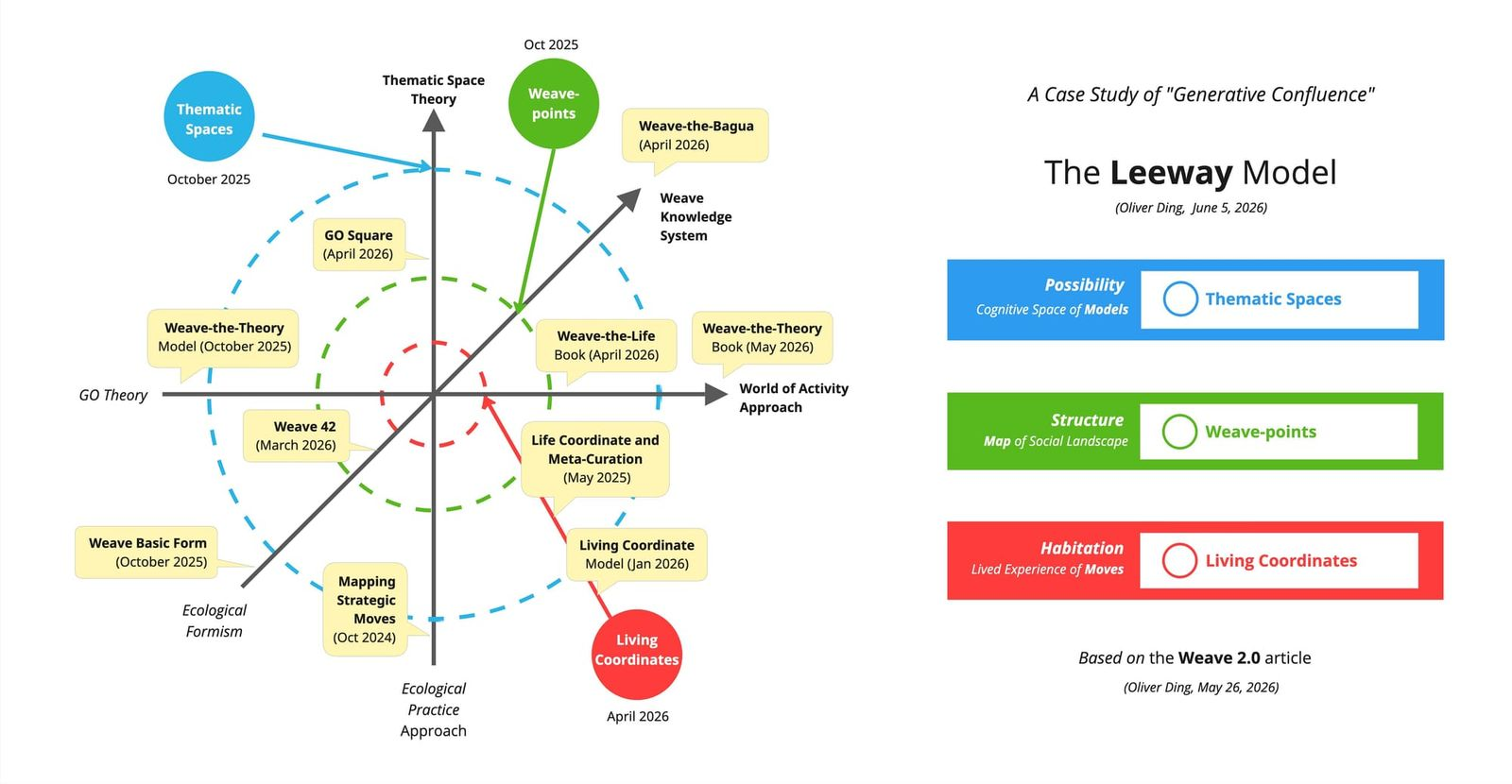
At this point, only three elements had converged, and no formal home had yet been found for what they, together, pointed toward.
4.3 Confluence
The fourth element arrived on June 14, 2026, with the development of the RelationField (v3.0) framework — a nested Subject–Subject (Subject–Object) model of the social environment, in which a relation beginning at a Subject–Object kernel is carried and told between subjects, constituting a field rather than a single point. With RelationField in place, the structure line's four elements were complete.
Two days later, on June 16, 2026, these four concepts were placed onto HLS's landscape — and the correspondence was immediate and exact:
- Symbolic Universe -> Weave-points
- Thematic Space -> Thematic Spaces
- Social Landscape -> RelationFields
- Social Territory -> Living Coordinates
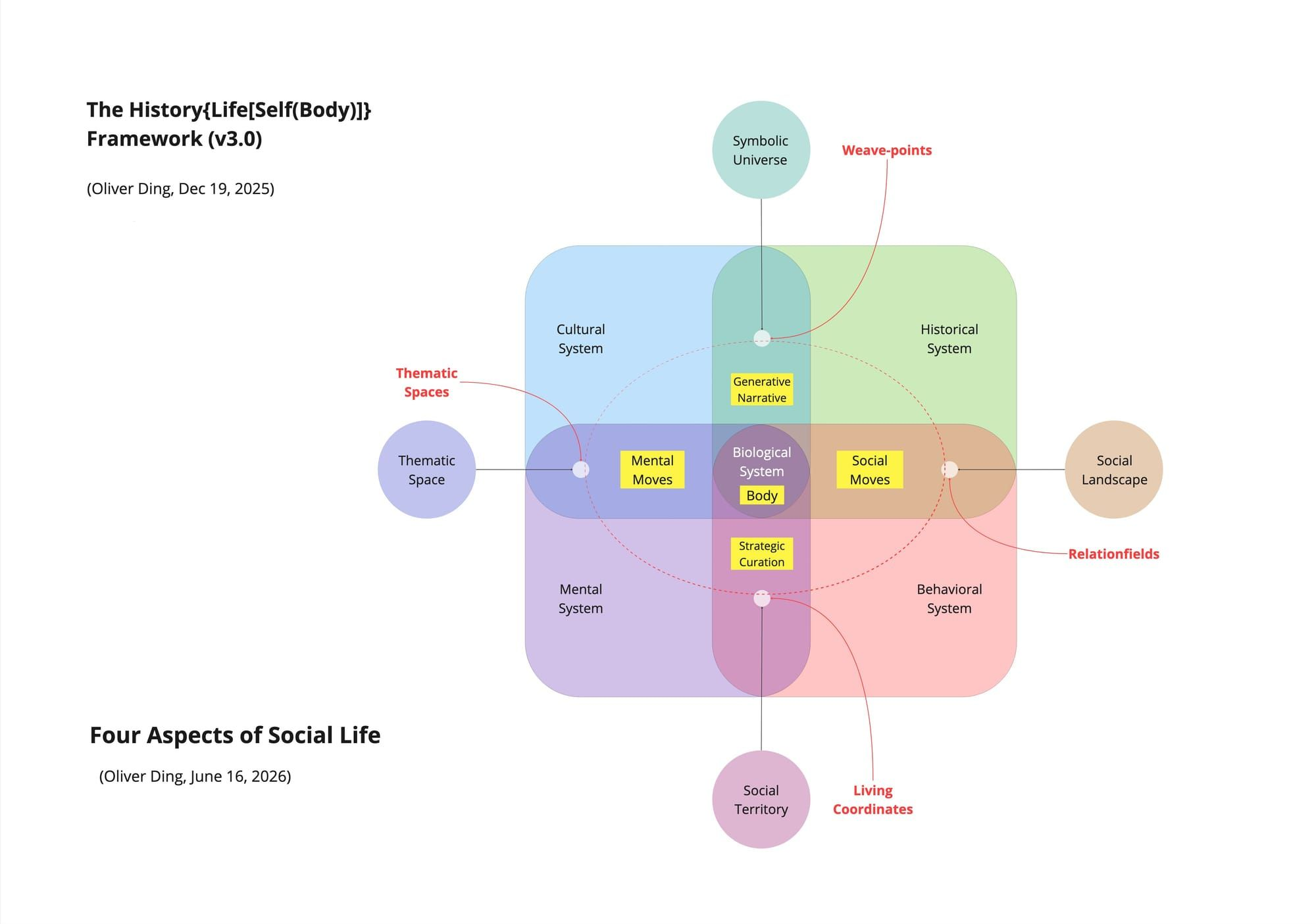
It was at this moment — not before — that the concept line and the structure line met. The Leeway Model, having served its purpose as a placeholder for an intuition that had not yet found its theoretical home, was deconstructed. Gejunction, the term coined five months earlier to name an intuition still searching for its ground, took its place — no longer a placeholder, but a Unit of Synthesis with a precise ontological address within HLS.
It is worth being exact about what this history does and does not show. HLS was not discovered at this moment; it had been the stable ontological ground since at least December 2025. What happened on June 16 was that a concept five months in search of a name, and a structure whose four pieces had each matured on its own schedule, finally converged — each supplying what the other lacked.
5. The Four Aspects and Their Knowledge Systems
A Gejunction is not a decomposed unit, obtained by breaking a situation into independent variables. It is a unit of synthesis, constituted by bringing multiple dimensions of social life together at once — and it presents a different face depending on which of HLS's four regions one approaches it from:
5.1 Weave-points
As a Weave-point, it represents the symbolic aspect. Specifically, a Weave-point is an intersection point in the Weave diagram family — diagrams built by crossing a diachronic line against a synchronic line — used to develop the series of Weave diagrams and the GO Square model. Each weave-point marks a theme or concept, functioning as a concrete tool for expressing the Symbolic Universe; each theme or concept, in turn, links onward to a Thematic Space (corresponding mechanism: Generative Narrative).
5.2 Living Coordinates
As a Living Coordinate, it represents the territorial aspect, within Social Territory (corresponding mechanism: Strategic Curation). A person's visible centers — a Knowledge Center, for instance — are only the surface of this aspect; what an outsider sees is typically some further surface product of that center, such as an email list. The center itself needs to be anchored in a Living Coordinate before it can be strategically curated at all — without that anchor, Strategic Curation has no site to work on. The Living Coordinate is this anchoring position within Social Territory, the inside social reality that remains largely invisible to anyone outside the person who holds it.
5.3 RelationFields
As a RelationField, it represents the relational aspect, within Social Landscape (corresponding mechanism: Social Moves). RelationField is a distinct model for environmental analysis in its own right, with a basic unit of Subject–Subject (Subject–Object) — the Object here can be a concrete thing or an abstract one. The model further provides a 3×5 combination of temporal and spatial dimensions, yielding fifteen relationship patterns, which are used to analyze how this basic unit behaves dynamically.
5.4 Thematic Spaces
As a Thematic Space, it represents the thematic aspect (corresponding mechanism: Mental Moves). A Thematic Space is a cognitive container named by a single theme, but what it actually holds is a shifting collection of related thematic clues, concepts, and information — cognitive elements that change over time, combined into structures that vary from space to space rather than following one fixed pattern. Mental Moves itself carries two senses: the movement of mental elements between different thematic spaces, and the movement of a person's attention or focus between thematic spaces, and between mind and its elements. Once visualized, a Thematic Space becomes a map, which can in turn be used to represent an individual's activity progress — and it is through this visualized, activity-tracking use that Thematic Space also connects to Social Moves.
5.5 Gejunction: From Self(Body) to Actor
These four aspects are not four separate entities requiring their own decomposition. They are four analytical perspectives on one and the same social unit — the same underlying configuration, viewed from four different angles, none reducible to the others. Each aspect, in turn, draws on a distinct knowledge system with its own developmental history; the four chapters that follow this one take up each in turn.
At a deeper level, these four aspects are the interface at which Self(Body) is situated within the social world — the surface where the psychological Self(Body) meets HLS's four regions. Self(Body), moving through the social world along two axes — the diachronic (time) and the synchronic (space) — is thereby constituted as what sociology calls an actor. Each axis brings a pair of critical elements into view.
Along the time axis, Flow becomes Focus, and this transition requires thematic focus — the capacity to hold a theme steady enough for a flow of experience to condense into something pursuable. Along the space axis, Center and Circle emerge. Every center has a boundary, and a boundary is what brings identity into being.
Flow, Focus, Center, Circle together constitute the FFCC model — the four basic ecological forms of World of Activity. These ecological forms are closely bound to Self(Body): they are what Self(Body)'s movement through time and space actually produces, and it is this production that the four aspects of Gejunction are built to capture.
6. Gejunction's Value for SDP
6.1 Why "Strategy" Has No Home in Psychology
The value Gejunction offers SDP begins with a gap in psychology itself. "Strategy" is an extremely common word in the psychological literature — coping strategies, learning strategies, emotion-regulation strategies, negotiation strategies, intervention strategies appear constantly across clinical, cognitive, developmental, and social psychology. But in every one of these uses, "strategy" functions only as an operational label for a specific technique or behavior pattern — a named item in an inventory, measured and correlated with outcomes, exactly the way a decomposed situational variable is measured and correlated with outcomes. What psychology has never developed is strategy as a core theoretical concept: a construct with the same standing as emotion, cognition, or personality, capable of organizing a research program the way "emotion" organizes affective science or "personality" organizes trait research.
Psychology's fluency with "strategy" as an operational word, and its absence as a theoretical concept, are two sides of the same fact — and the consequence extends beyond psychology's own disputes. Strategy is the central, defining object of study in several other fields — strategic management, military theory, organizational development, personal development — each with a substantial body of theory or practice built around it. When these fields look to psychology for a systematic account of strategy as a psychological phenomenon, there is nothing of comparable depth to draw on. This is the gap SDP is built to fill.
A companion paper, Revisiting the "Situation" Issue from the Self-Life-Mind Perspective, traces exactly why this gap has persisted. Read through the Self-Life-Mind (SLM) framework's own vocabulary — units of analysis versus a unit of synthesis — "situation" across three of psychology's most consequential internal debates (person–situation, nomothetic–narrative, brain–environment) is, without exception, a unit-of-analysis concept, pinned at different moments to a single isolated term or to one direction of a two-term relation, never allowed to range across the full whole. Even the debates' most sophisticated resolutions only partially close this gap.
Strategic action, by contrast, requires a reading of one's position that holds multiple dimensions together in a single act — where I am, where I should be, how I am construing it, what it calls for me to do — rather than answered by separate research literatures. What strategy requires is not a better unit of analysis on the situation side of the ledger; it requires that side to be given a unit of synthesis of its own. Nor, as that companion paper also shows, has ecological psychology's transactionalism supplied this: it offers real historical precedent for a unit of analysis that resists decomposition, but has generalized only as far as the person-environment system, remaining institutionally confined to research framed explicitly around physical or social environments.
A second requirement compounds the first. Even a synthesized reading of one's present standing is not, by itself, sufficient for strategic action, because strategy is inherently oriented toward the future — a way of acting now in light of possibilities not yet actual. Vygotsky's Zone of Proximal Development, distinguishing a person's actual developmental level from their potential developmental level, and Aristotle's classical distinction between dynamis (potentiality) and energeia (actuality), both supply precedent for this move — but where this potential–actual distinction has appeared in psychology, it has almost always been applied within the Self layer alone, never to the synthesized standing itself. That standing is not simply a fixed state of affairs to be read off; it, too, has a potential dimension — relationships not yet activated, positions not yet occupied, meanings not yet drawn out. A theory of strategy needs a unit of synthesis for standing that is itself internally structured by a potential/actual distinction, not merely a person whose potential is measured against an externally fixed situation.
Put together: psychology has never developed a proper theoretical concept of strategy because it has never developed (a) a unit of synthesis for a person's overall standing, and (b) a way of treating that unit itself — not just the person facing it — as containing a potential dimension awaiting actualization.
SLM, as a content-neutral meta-framework, can supply the diagnosis and the heuristic requirement, but not the answer — it does not specify what the missing unit of synthesis should be built from, any more than it specifies the content of a healthy belief system. Naming that unit is the work of a substantive theory. That theory is SDP, and the unit it names is Gejunction.
6.2 From Situation to Gejunction: SDP's Commitment
Section 4.1 above already described why "situation" itself never became the working term — Gejunction was coined in the course of a five-month search for an English equivalent of 格局 that no existing word, including "situation," supplied. It is worth adding the more precise theoretical reason why "situation" specifically was unfit, because the same reasoning is what makes Gejunction the right answer to the gap traced in 6.1, and not merely a convenient new label.
The English word "situation" is asked to do the work of two different Chinese concepts at once. 情境 (qingjing) names the local, piecemeal surround — the register the North American psychology of situations operates in exclusively. 处境 (chujing) names one's overall, holistic standing — a sense qingjing-based situational psychology has never captured, because its methodological commitments make chujing structurally invisible to it. A theory of strategy needs both registers, but it is chujing that does the heavier theoretical work, for the reasons given in 6.1: strategy requires the global, potential-bearing unit that only chujing can supply.
Even granting this distinction, though, chujing cannot simply be glossed in English as "situation, but the holistic kind" — translating it back into English collapses it into the very word whose disciplinary lineage created the confusion in the first place. A distinction that exists in Chinese but disappears the moment it crosses into English is not a stable foundation for a theoretical concept meant to travel. This is the precise sense in which Gejunction is not a synonym for chujing, but chujing given theoretical precision: not a fourth item added to the existing methodological toolkit alongside DIAMONDS or the if-then signature, but a genuinely different, synthesized kind of unit under a genuinely new name.
6.3 Gejunction and the Four Action Opportunities
Section 6.1 identified a second requirement beyond the global unit itself: a theory of strategy needs the standing, not only the person, to carry a potential dimension. Gejunction meets this requirement by connecting directly to the four positive frontiers already developed within the Ecological Practice Approach: Affordance, Supportance, Attachance, and Curativity. Each names a type of ecological opportunity — a latent, not-yet-actual possibility for action — that a given Gejunction makes available to a person positioned to perceive it. Strategic action, on this account, is precisely the actualization of one or more of these opportunities within a specific, comprehended Gejunction: not a reaction to a situational cue, but a move made in full view of one's overall standing, toward a possibility that standing has made available but has not yet realized.
This is where the Aristotelian and Vygotskian potential–actual distinction, discussed in 6.1, finds its proper home. It is not merely a fact about a person's developmental level, measured against an externally fixed situation. It is a fact about the Gejunction itself: every standing a person occupies contains both actualized and merely potential relations, positions, meanings, and themes — across all four of the aspects described in Part 5 — and strategic capacity is the capacity to read a Gejunction well enough to see which of its latent possibilities are worth actualizing, and how.
6.4 Summary
Psychology has no proper theoretical concept of strategy because strategic action requires a holistic, non-decomposable reading of one's overall standing, and requires that standing itself — not only the person facing it — to carry a potential dimension awaiting actualization. No debate examined in the companion paper, and no existing tradition within psychology, including ecological psychology's own transactionalism, has supplied a unit of synthesis meeting both requirements at once. Gejunction, grounded in the HLS foundation this chapter has described, is offered as that unit: synthesized rather than decomposed from the outset, and internally structured by its connection to the four action opportunities of Affordance, Supportance, Attachance, and Curativity. What earlier sections of this chapter established — the cross-disciplinary method behind Gejunction, its platform-level status within GO Theory, its ontological grounding in HLS, its own developmental history, and the structure of its four aspects — is what makes this more than an ad hoc answer to a single question. Gejunction is not invented to solve SDP's problem; it is GO Theory's own unit of synthesis, and SDP is one of the projects positioned to draw on it.
References
Berger, P. L., & Luckmann, T. (1966). The social construction of reality: A treatise in the sociology of knowledge. Doubleday.
Ding, O. (2026a). SDP: Revisiting the "Situation" Issue from the Self-Life-Mind Perspective. Activity Analysis Center. https://www.activityanalysis.net/the-situation-issue/
Ding, O. (2026b). [Creation Note] Gejunction: Toward a Unit of Synthesis for Social Life. Activity Analysis Center. https://www.activityanalysis.net/creation-note-gejunction-toward-a-unit-of-synthesis-for-social-life/
Ding, O. (2026c). World of Life: Four Positive Frontiers of Project Engagement. Activity Analysis Center. https://www.activityanalysis.net/world-of-life-four-positive-frontiers-of-project-engagement/
Ding, O. (2024). Strategy as Curation: The Meaning of the Social World and Its Consequences. Medium.
Lui, P. (2016). Aspects of sociological explanation: Lectures on sociology-philosophy.
Rosen, R. (1985). Anticipatory systems: Philosophical, mathematical, and methodological foundations. Pergamon Press.
Vygotsky, L. S. (1978). Mind in society: The development of higher psychological processes. Harvard University Press.
v1.0 — July 7, 2026 - 7,573 words