
Introduction: Strategic Developmental Psychology (v2.0)
From the ACS project to the SDP project
by Oliver Ding
July 8, 2026
This article is part of a new possible book: Strategic Developmental Psychology: Situation, Gejunction, and Supportive Self-Actualization.
SDP stands for the Strategic Developmental Psychology project.
1. Where v1.2 Left Off
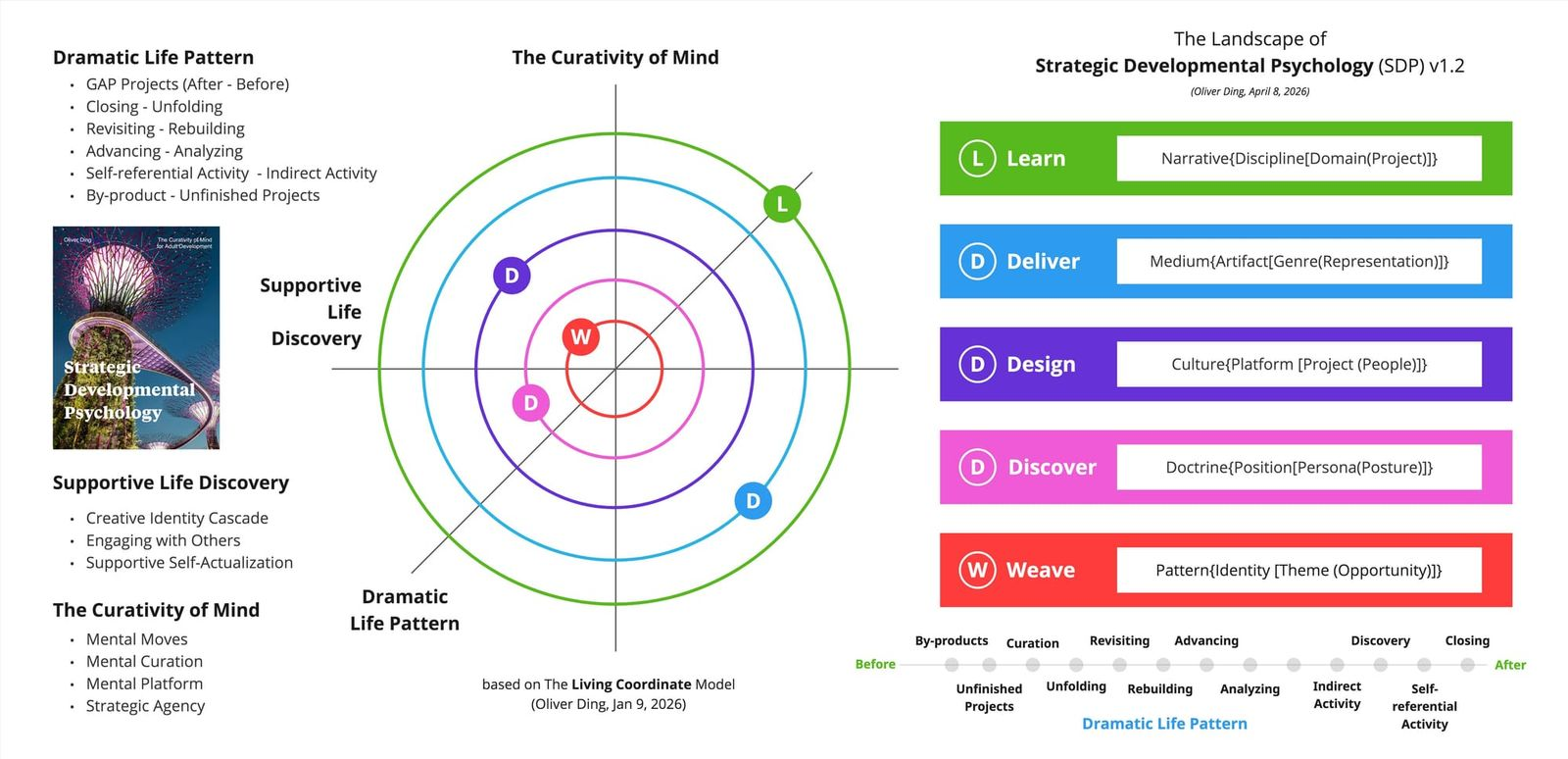
In April 2026, the landscape of SDP (v1.2) set out a three-dimensional model — Curativity of Mind, Supportive Life Discovery, Dramatic Life Pattern — organized around a five-ring Living Coordinate (Weave, Discover, Design, Deliver, Learn), and gave the enterprise its ontological sign: three concentric forms, World of Life holding World of Activity holding the core of AAS, under the tagline One World, Many Dreams.
That landscape closed by naming three unfinished tasks.
First, Dramatic Life Pattern needed systematic development beyond the Revisiting–Rebuilding collection that had opened it.
Second, the five-ring structure needed theoretical refinement — the distinction between Weave–Learn (universal orientations) and the Discover–Design–Deliver cycle (specific to cultural creators) had not yet been fully articulated, and its relationship to the Nine Aspects of Strategic Agency from Strategic Life Theory (v1, 2025) remained unresolved.
Third, the new sign had opened a connection — between the Self–Other dimension and the FFCC framework — that had not yet been followed through.
2. By-products, Digested
It is worth being plain about where v1.2's own material came from. The five rings arrived in SDP as a by-product of developmental orientations first built for the Anticipatory Cultural Sociology (ACS) project. The Supportive Life Discovery dimension grew out of the same Self–Other exploration that ACS had undertaken on the cultural side. At the time, this cross-pollination was framed as mutual enrichment through indirect activity — work done for ACS simultaneously advancing SDP, almost as a side effect.
By the time v1.2 was assembled, this was no longer quite accurate. What had arrived as by-product had, by then, been formally digested into SDP's own theoretical apparatus — no longer borrowed placeholders awaiting proper SDP treatment, but substantive components of SDP's own three-dimensional landscape, argued and grounded on SDP's own terms. The distinction matters for what follows: the developments below are not further imports from ACS. They are SDP's own next movement.
3. Recent Developments
3.1 Case Studies Bring the Return to SDP
A series of case analyses using real individuals' World of Activity — conducted in the months following v1.2 — brought the project's attention back to SDP directly. These cases revealed something about method as much as about their subjects: for each case, World of Activity did not call on a single framework but on a series of knowledge frameworks, assembled into a toolkit fitted to that specific case.
This is a strong hint about how SDP's own practice should work going forward — not as the application of one fixed model, but as case-by-case toolkit assembly, drawing on the growing set of frameworks GO Theory now makes available.
The cases also generated theoretical insights of their own, feeding directly into the developments described below.
3.2 Theoretical Psychology: SLM as a Meta-Framework Turned Outward
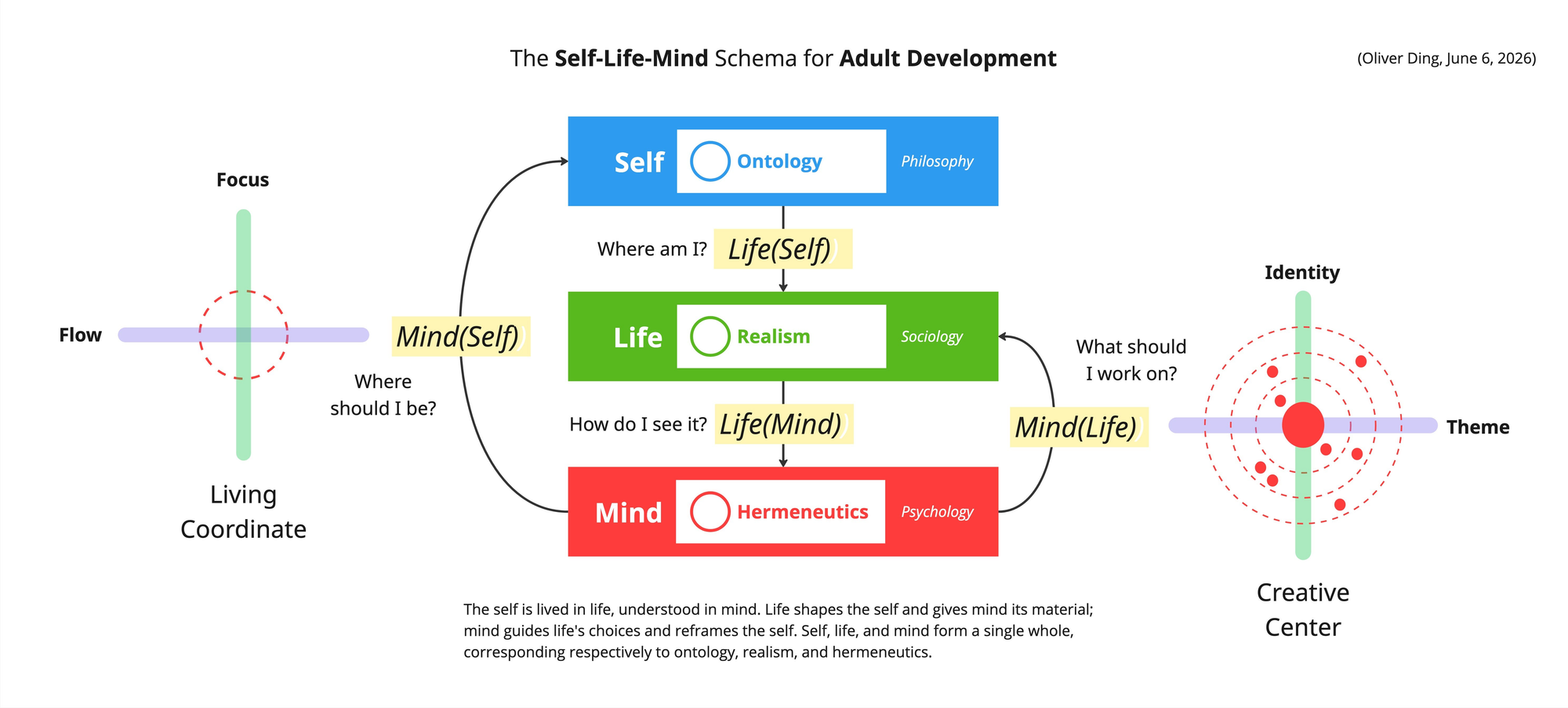
A sequence of papers — revisiting, in turn, the "self" issue, the "belief" issue, and the "situation" issue — used the Self-Life-Mind (SLM) schema to examine specific shortcomings in psychology's own conceptual apparatus.
What is new here is not SLM itself, but its direction of use. Until this point, SLM had functioned as a personal creative heuristic, orienting the development of my own knowledge frameworks from the inside.
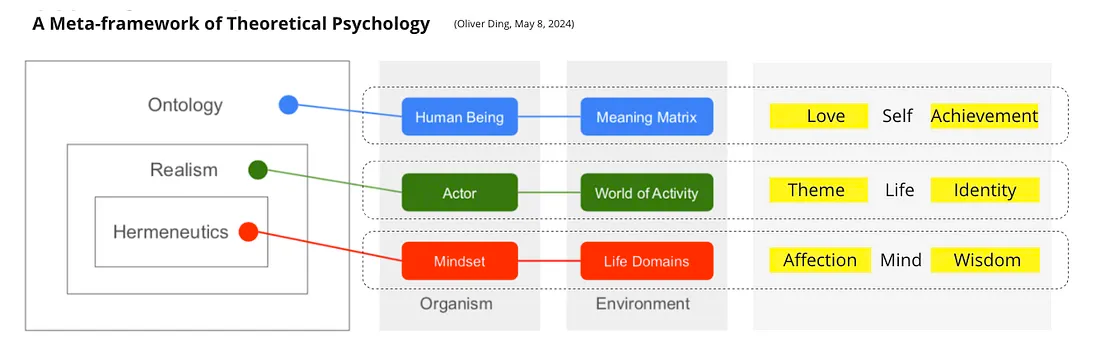
In this recent work, SLM is used for the first time as a meta-framework turned outward — applied to diagnose the state of the discipline itself, rather than to organize one person's own creative production.
3.3 Gejunction
The maturation of the RelationField framework, alongside the completion of the Supportance manuscript, together made it possible to complete Gejunction — both the concept and its full framework. Gejunction does two things at once.

Within GO Theory, it supplies the interface at which Self(Body) becomes an actor, the missing piece neither ACS nor earlier versions of HLS had ever elaborated. And in supplying that interface, it becomes the specific connector between ACS and SDP: a unit of synthesis available to both, addressing what each had been missing on its own.
3.4 Supportive Self-Actualization
The reflection on Self, and on the complexity of Self–Other, is now carried by the concept of Supportive Self-Actualization. This concept originated during the ACS phase of the project's work.
What is new is its status: no longer a cultural-side achievement lent to SDP by association, but a foundational theoretical concept of SDP in its own right, argued and grounded on SDP's own terms.
3.5 Dream, Revisited
SDP has also returned to Daniel Levinson's concept of "the Dream" — the loosely articulated vision of what one's life could become, first proposed in The Seasons of a Man's Life (1978). SDP takes Levinson's core insight seriously: that a person's long-term anticipatory orientation toward their own future is a central driver of adult development, not a peripheral curiosity.
But it departs from the single dramatic arc Levinson built around the Dream — early emergence, midlife suppression, midlife recovery — a script that imposes one uniform timeline on lives that do not, in fact, share one.
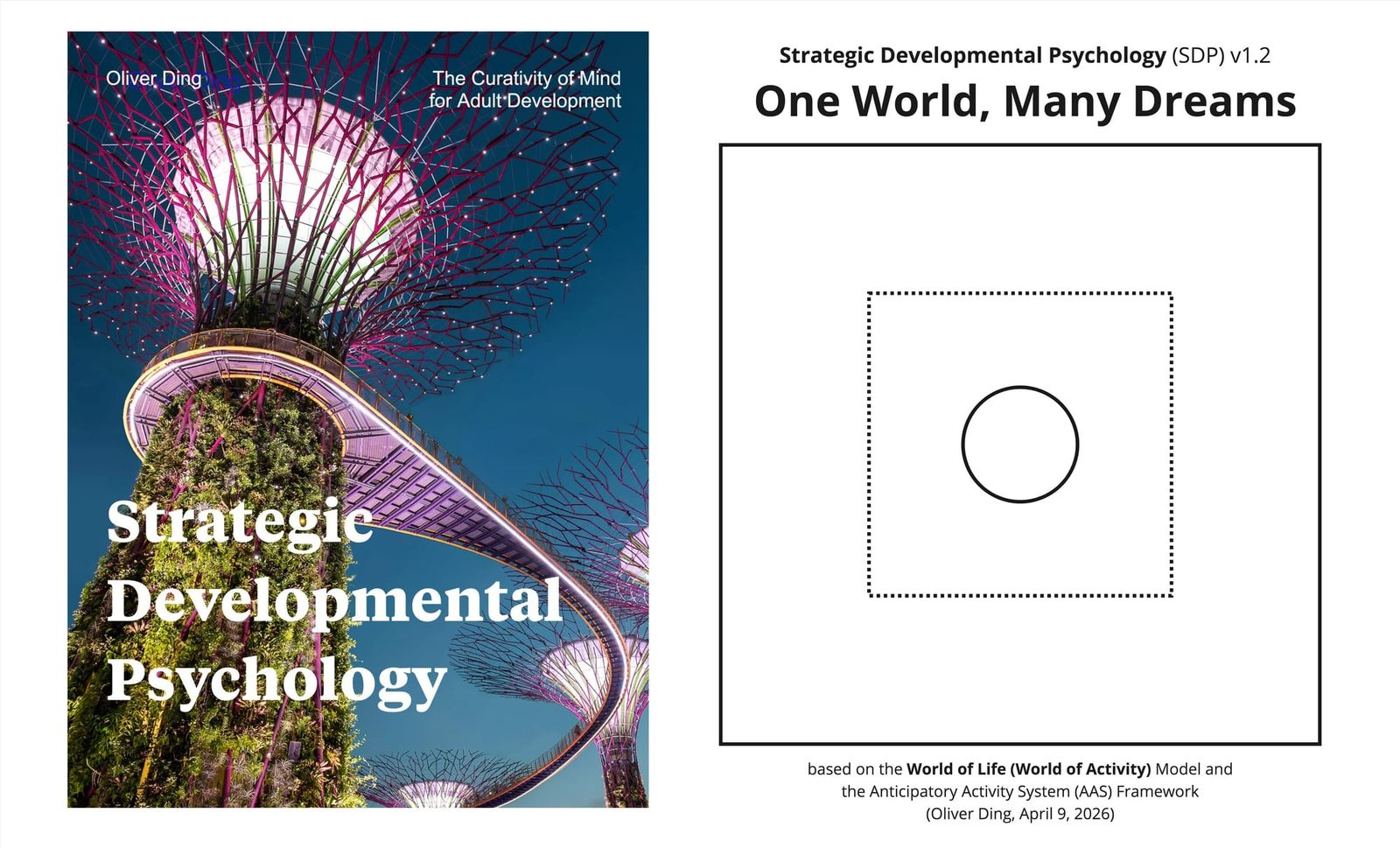
SDP's own definition and solution, developed in the One World, Many Dreams preface, treats the Dream as a matter of creative achievement without a normative timeline, and treats strategy — not patience, and not a fixed season of life — as what makes navigating toward it possible.
v1.0 — July 9, 2026 - 951 words