
World of Activity (Book, v1, 2026)
An Ecological Approach to Activity Analysis and Intervention (AAI)
by Oliver Ding
September 14, 2026
This is the introduction of a new possible book: World of Activity: An Ecological Approach to Activity Analysis and Intervention (AAI).
World of Activity refers to the individual’s world within social life. The World of Activity approach takes this individual perspective as its starting point.
The book aims to provide a systematic view of the World of Activity Approach for AAI Analysts, helping them understand its foundational modules — such as the Ecological Formism meta-framework, the Coordinate-Center-Gejunction Framework, and the AAI method.
For other readers, the book is also a guide to exploring the approach — especially by applying the FFCC model (Flow-Focus-Center-Circle) to understand individual life development, or for whatever purpose they bring.
How to Read This Book
Chapter 1 defines the Coordinate–Center–Gejunction framework and establishes the conceptual map for the entire book.
From there, the recommended path for all readers is:
- Part 2 and Part 3 — the FFCC model (Flow, Focus, Center, Circle) and the thematic maps that operationalize it.
- Part 4 and Part 5 — the Living Coordinate and the Gejunction, which extend the framework to the other two layers of the nested structure.
These four parts form the core of the book. Together they give a complete picture of the three-layer framework.
For AAI analysts, the recommended path continues:
- Part 1 — the theoretical resources that ground the framework: the Self–Life–Mind schema; the World of Activity and World of Life approaches, and the Ecological Formism.
- Part 6 — the case studies that produced the toolkit, and the World of Activity Toolkit v2.0 itself.
- Part 7 — the AAI method, including its five principles, the Theorist–Analyst–Client knowledge ecology, and examples of signature programs.
These three parts provide the theoretical depth, the empirical grounding, and the practical method that analysts need.
The other parts serve as context. The Preface introduces the individual perspective and the ecological approach. The Epilogue traces the motif of Creative Self and Social World across the book and connects the framework to earlier work.
A New Possible Book
This new possible book curates articles written from 2025 to 2026, focusing on the World of Activity approach, the FFCC model, the Coordinate–Center–Gejunction framework, and the Activity Analysis and Intervention (AAI) method.
A "possible book" is not a published book. It is not a complete PDF document either. It is a curated collection — articles that have been assembled, organized, and introduced, but not yet formally published. It exists as a possible book: a book that could become a published work, but for now remains an edited manuscript, open to further revision, reorganization, or expansion.
Some numbers about v1.0 of the possible book:
- 7 parts
- 23 chapters
- 56 articles
- 884 minutes of reading time
- 234,212 words (about 469 single-spaced pages)
Preface
- One Life,One World - 2,195 words
This preface is more than a conventional opening. It sets out the individual perspective that defines the World of Activity approach, explains its nested relationship with GO Theory and the World of Life, and clarifies how it differs from Creative Life Theory. It also introduces Ecological Formism as the meta-framework behind the approach and describes the current state of AAI — with the analysis phase now complete and intervention still to come.
Readers are encouraged to begin here. The preface establishes the conceptual map that the rest of the book builds on, and it shows how the World of Activity approach serves adult development without isolating the individual from the social world.
Part 1: Theoretical Foundations
This part establishes the theoretical foundations of the World of Activity approach.
The self is not a substance behind action. The self is subjectivity as it unfolds within activity and the social world. This unfolding is nested: Body(Self), Life(Self), History[Life(Self)]. It is a single whole — Self–Life–Mind — that we can distinguish analytically but not separate ontologically.
To discuss this whole, we adopt three analytical perspectives: ontology, realism, and hermeneutics. These are not three separate dimensions. They are three lenses on the same unfolding. Ontology asks where the self is. Realism asks how the self moves in the social world. Hermeneutics asks how knowledge is organized. Each perspective illuminates one aspect of the same whole.
| Analytical Perspective | Aspect of the Whole | Guiding Question | Chapter |
|---|---|---|---|
| Ontology | Self | Where is the self? | Ch.1–2 |
| Realism | Life | How does the self move in the social world? | Ch.3 |
| Hermeneutics | Mind | How is knowledge organized? | Ch.4 |
Chapter 1 begins with the Self–Life–Mind schema, which frames these three analytical perspectives, and then introduces the Coordinate–Center–Gejunction Framework as the core framework of the book. It traces how subjectivity becomes located (Living Coordinate), organized (Creative Center), and synthesized (Gejunction). This chapter serves as both the opening and the overview of the entire book.
Chapter 2 defines the World of Activity as the individual's world within social life. It establishes the boundaries, ecological forms, and basic structure of this world. The self is not an abstract point; it is situated in a concrete World of Activity.
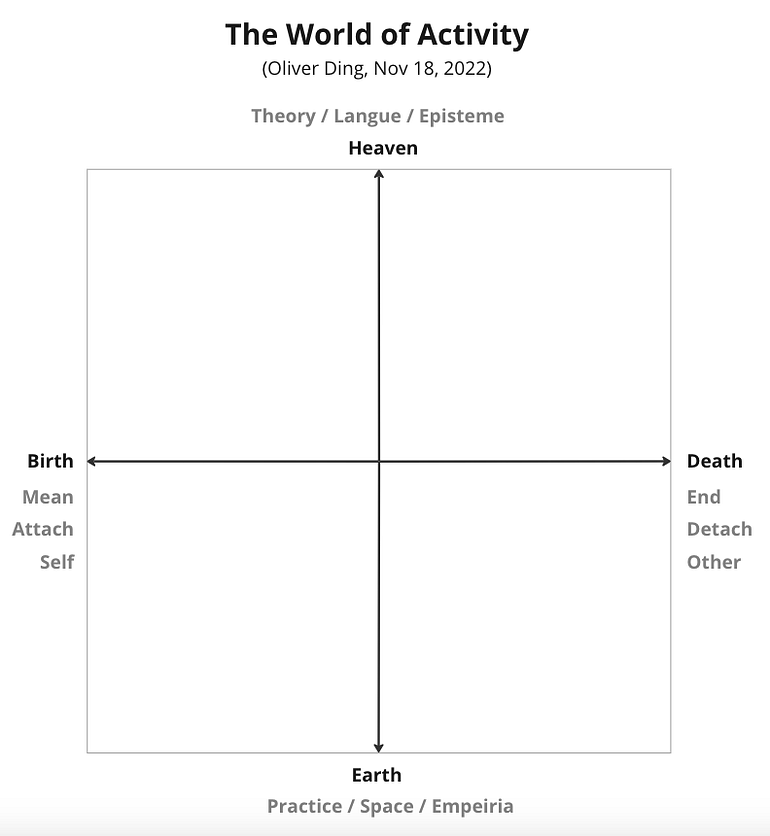
Chapter 3 moves from World of Activity to GO Theory. It integrates World of Activity and World of Life as two perspectives on the same nested structure. The History{Life[Self(Body)]} framework provides the ontological map of the social world. The individual moves within this map — from Body(Self), through Life(Self), toward History[Life(Self)].
Chapter 4 introduces Ecological Formism and the FFCC model (Flow–Focus–Center–Circle) as its primary application. Ecological Formism distinguishes Variant, Quasi-invariant, Invariant, and Invariant Set. This schema combines diachronic (time) and synchronic (space) dimensions, offering a meta-hierarchical view suitable for complex social and cognitive phenomena. This chapter prepares the way for Part II, which will examine each ecological form in depth.
The three analytical perspectives — ontology, realism, hermeneutics — are not a sequence. They are a set of three lenses. Every chapter can be read through any of the three. Together, these four chapters establish the theoretical foundations for the rest of the book.
Chapter 1: The Unfolding of Subjectivity
- Revisiting the “Self” Issue from the Self-Life-Mind Perspective - 8,613 words
- The Unfolding of Subjectivity: The Coordinate–Center–Gejunction Framework - 2,517 words
Chapter 2: The World of Activity
- The Concept of "World of Activity" - 3,980 words
- The World of Activity (v1.0, 2022) Framework: Theoretical Foundation and Generative Confluence - 4,242 words
Chapter 3: From World of Activity to GO Theory
- GO Theory: The World of Life (World of Activity) Approach - 3,833 words
- The Concept of "World of Life" - 2,270 words
- The History{Life[Self(Body)]} Framework (v3.0) — Part 3: Reflection - 17 min
Chapter 4: Ecological Formism and the FFCC Model
- Ecological Formism: Theoretical Foundations - 36 min
- The “Flow-Focus-Center-Circle” Schema and the Ecological Formism Framework (v1.2) - 21 min
Part 2: The FFCC Model
The FFCC model — Flow, Focus, Center, Circle — is the central model of the World of Activity approach. It is also deceptively simple.
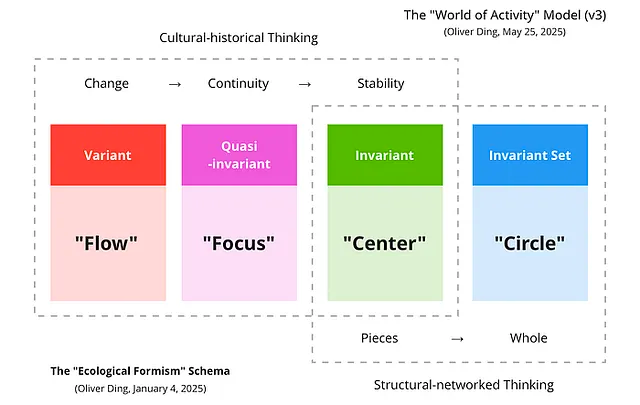
On paper, it looks like a four-part schema. But it condensed years of lived experience. It was not derived from reading alone. It emerged from practice — from years of running knowledge projects, curating creative centers, building a network of theoretical enterprises, and reflecting on my own autobiography. The model is simple because the experience behind it has been compressed into four words. Understanding the words is not the same as understanding the model.
This is why this Part does not only explain the FFCC model. It shows how the model has been used.
Chapter 5 presents the model itself. Adapted from Chapter 2 of Homecoming: A Thematic Trip and the World of Activity Approach, it introduces the World of Activity Toolkit, the FFCC schema (Flow, Focus, Center, and Circle), Creative Self as Center, the Seven Forms of the World of Activity drawn from the manuscript's case studies, and the map of my father's World of Activity as an illustrative example. The model is presented as the primary application of the Ecological Formism schema introduced in Part 1.
Chapter 6 presents three direct applications. The first is a short daily journal entry, showing how the model can be used to reflect on a single day. The second is a retrospective review written one year ago, in which I looked back at the World of Activity approach from four different angles. The third uses the model to plan the overall structure of a book manuscript, showing how FFCC can serve as an editorial framework.
Chapter 7 presents a different kind of case: the growth of the Weave knowledge system. These articles do not use the FFCC model explicitly. But read together, they show how a body of work moved from Flow to Focus to Center to Circle — the same developmental pattern the model describes. The Weave case is a demonstration by example.
Chapter 8 presents a third kind of case: the Activity Analysis Network. From September 2025, I began running a biweekly newsletter organized around the FFCC schema. Each issue gathered new articles under a single thematic focus. The five issues selected here are not illustrations of the model. They are records of the model being used, in real time, as an organizing structure for an ongoing body of work.
Together, these four chapters show the FFCC model from different angles: as a theoretical schema, as a reflective tool, as a developmental pattern, and as an organizational structure. The model is not a taxonomy to be memorized. It is a practical language for understanding how creative life develops — and how to work with it.
Chapter 5: The FFCC Model
- The World of Activity Model: Flow, Focus, Center, and Circle (v1.0, 2025) - September 7, 2025 - 3,332 words
Chapter 6: Three Direct Applications
- A Short Note: The Culture as Thematic Enterprise Framework - Sept 11, 2025 - 4 min
- See the Move: Four Looks at the World of Activity Approach - Aug 5, 2025 - 16 min
- Anticipatory Cultural Sociology: Creation, Projection, and Agency (Possible Book, 2026) - March 30, 2026 - 2,404 words
Chapter 7: A Case in Development
- The “Create-Curate-Weave” Schema - Sept 17, 2025 - 17 min
- The “Weave” Basic Form - Oct 10, 2025 - 11 min
- Weave: A Model of the Actor - April 29, 2025 - 4,927 words
- Weave 2.0: Synchronic Line, Diachronic Line, and Living Coordinate - May 26, 2026 - 5,552 words
Chapter 8: An Organizing Structure
- Activity Analysis Network #1: A Decade of Reflection, A Decade of Vision - Sept 15, 2025 - 1679 words
- Activity Analysis Network #5: Zone, Camp, and Project - Nov 15, 2025 - 1620 words
- Activity Analysis Network #11: Boundary, Givenness, and Agency Threshold - Feb 15, 2026 - 2243 words
- Activity Analysis Network #15: Dream, Watershed, and Dramatic Life Pattern - April 15, 2026 - 2362 words
- Activity Analysis Network #23: 安身立命 (Ānshēn Lìmìng), Gejunction in the Wild, and GO Theory (III) - August 31, 2026 - 2321 words
Part 3: Thematic Maps as Toolkits
The House series is not a set of illustrations. It is a theoretical system in visual form.
Each map is a square containing a circle, divided into four thematic areas, each with an outer layer and an inner layer. Together they hold sixteen thematic positions. But the maps are not taxonomies. They are toolkits. An analyst can enter a map, find the room that matches their case, and discover frameworks that fit.
The World of Activity approach identifies a family of ecological forms: Boundary, Coordinate, Flow, Focus, Center, Circle, and Gejunction. The first six are ecological forms. Four of them — Flow, Focus, Center, and Circle — form the FFCC model. Boundary and Coordinate are more foundational forms that underlie the FFCC model. Gejunction is the seventh member of this family, but it is a different kind of concept: a Unit of Synthesis within GO Theory.
The first map, The House of World of Activity, presents the whole approach as a house. The next four maps expand each member of the FFCC model into an independent thematic map: Flow, Focus, Center, Circle. The final map, The House of Gejunction, is different. Its map is a closed theoretical setting, and its value lies in the tools it brings together.
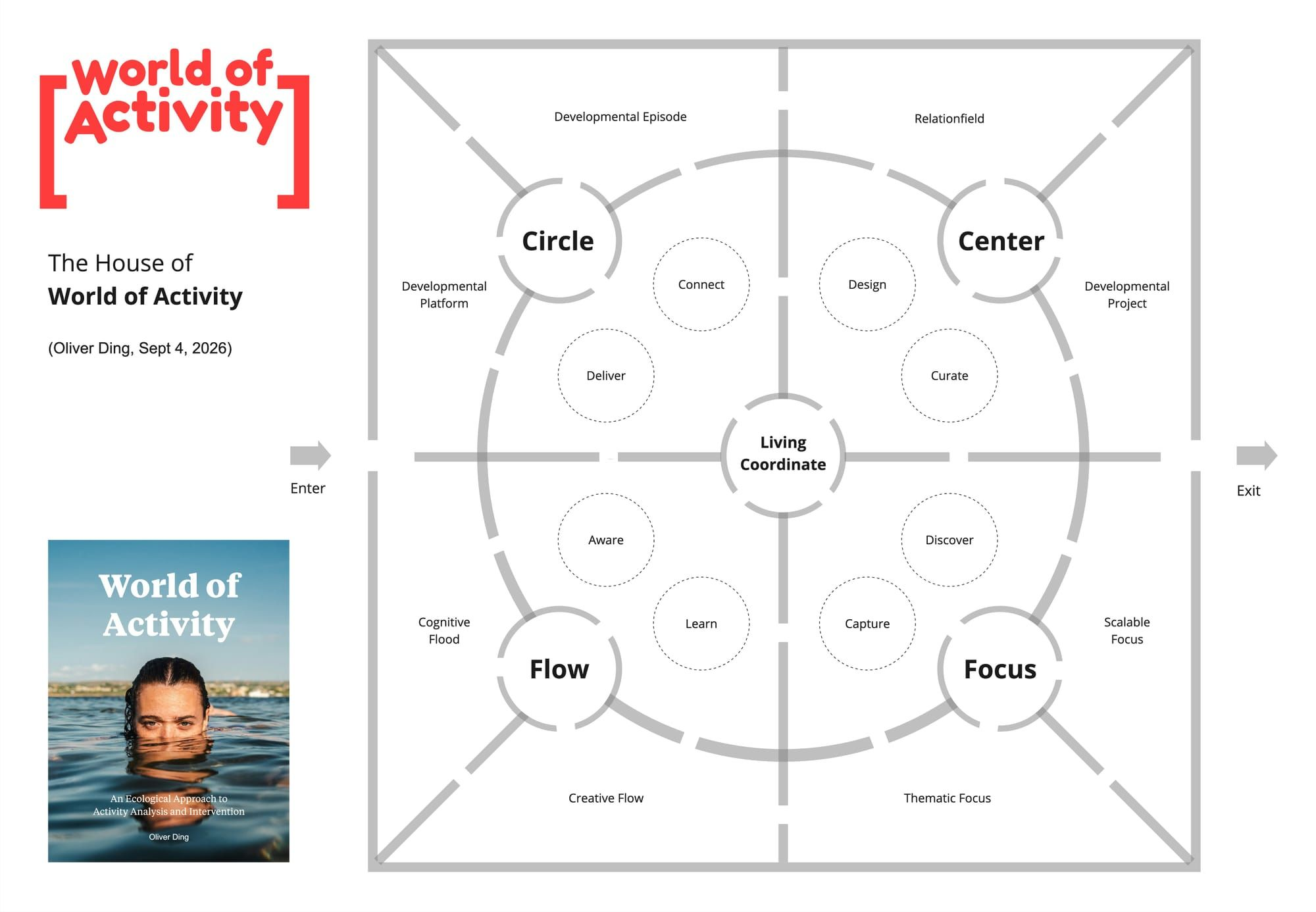
The four FFCC maps are not four copies of the same template. Each one unfolds along a different dimension. Flow unfolds by time mode: Aion, Chronos, Kairos, Awe. Focus unfolds by process stage: Perceive, Capture, Clarify, Action. Center unfolds by life season: Spring, Summer, Autumn, Winter. Circle unfolds by structural unit: Project, Program, Episode, Platform. Each map's four thematic areas reflect the nature of the ecological form it describes. Flow is temporal, so it unfolds by time. Focus is procedural, so it unfolds by stage. Center is life-like, so it unfolds by season. Circle is structural, so it unfolds by unit.
Each map also has its own theoretical highlight. The Flow map forced the emergence of Awe — a fourth time mode that the earlier Aion–Chronos–Kairos triad did not contain. The Focus map introduced the three-stage development model: Attention Focus, Thematic Focus, Scalable Focus. The Circle map incorporated the newest developments in platform ecology: Episode and Program. These are not decorative variations. They are theoretical advances that emerged from the design process itself.
The House series is also a demonstration of the ecological formism that underlies the World of Activity approach. The FFCC model is invariant — four ecological forms that remain constant. The four thematic areas of each map are quasi-invariant — structures determined at the time of design. The sixteen themes are variant — selections that can be replaced by each reader. This threefold structure of invariant, quasi-invariant, and variant is the same structure that the FFCC model itself embodies. The maps are not only tools for analysis. They are examples of the theory in practice.
Read together, these six maps form a curated landscape of the World of Activity approach — not a single model, but a set of lenses for analysts to use, adapt, and combine.
Each map ends with a question: where would you place your case?
Chapter 9: A House for the Whole Approach
- The House of World of Activity - 1,428 words
Chapter 10: Time Modes and the Emergence of Awe
- The House of Flow Dynamics - 4, 759 words
Chapter 11: From Attention to Scalable Focus
- The House of Focus Dynamics - 2,746 words
Chapter 12: Seasons of a Center's Life
- The House of Center Dynamics - 5,119 words
Chapter 13: The Perspective of Platform Ecology
- The House of Circle Dynamics - 3,914 words
Chapter 14: The Unit of Synthesis within GO Theory
- The House of Gejunction Dynamics - 3,535 words
Part 4: Living Coordinate
This part turns to the first layer of the three-layer structure: Body(Self), and its corresponding ecological form, the Living Coordinate.
The concept of Living Coordinate can be understood more fundamentally through a three-level structure: ontology, realism, and hermeneutics.
Ontology is the crossing of Flow and Focus that generates a Living Coordinate in the first place — the common foundation any coordinate shares, whatever it later becomes. This is a theoretical claim, set at the level of Body(Self), and it belongs to philosophy.
Realism is what happens when this ontological fact unfolds concretely within social life: Body(Self) is lived out, becomes Life(Self), and this living-out is exactly the process by which a Living Coordinate becomes a Center. This belongs to sociology.
Hermeneutics is everything that follows once the question becomes how, specifically, to understand a given Living Coordinate at the level of Life(Self), and how it becomes a Center in this or that particular case. Here there is no single correct explanatory model, and no single correct practical method. At the level of theory, different theorists and analysts can build different models; at the level of practice, different individuals can find their own ways of doing it. This belongs to psychology.
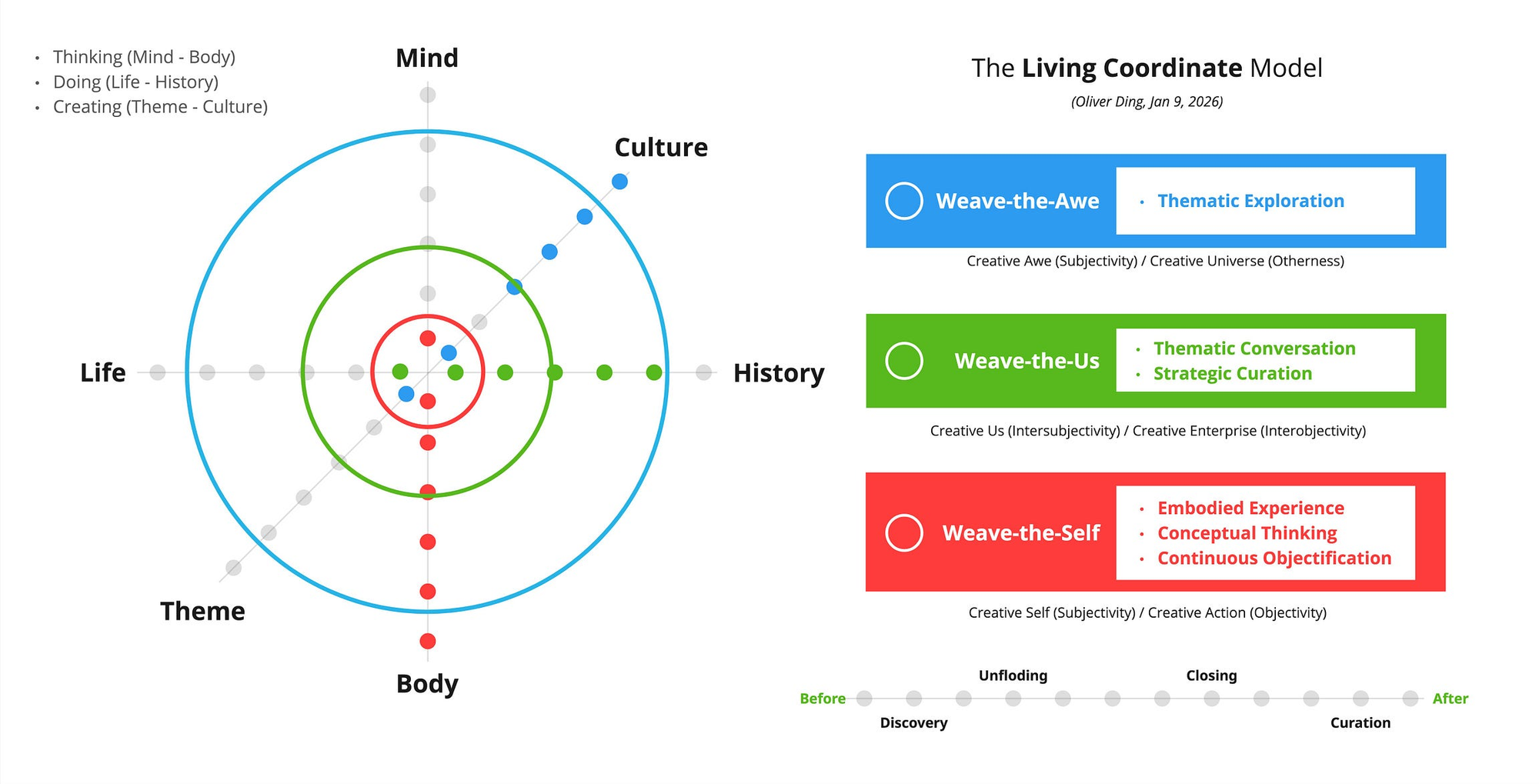
The whole line of Living Coordinate models introduced in this part sits at the hermeneutic level. Each is offered as a demonstration of one way of understanding the transformation, not as the standard answer to it.
The part has two chapters.
Chapter 15: Living Coordinate: Concept and Model presents two creative heuristic tools for understanding the development of the Living Coordinate. Both were developed from my own experience and applied to several cases.
15-1: The Living Coordinate Model (2026). It introduces the origin of the concept of Living Coordinate. It also provides a model for finding and analyzing a coordinate through three axes — Mind–Body (Thinking), Life–History (Doing), and Theme–Culture (Creating). These three axes were designed as a heuristic for locating one's own coordinate.
15-2 introduces the Evolving Thematic Coordinate Model, born from a case study. The model develops a four-part account of coordinate–center transformation — origin, dimension, element, and genidentity — tracing how a Thematic Coordinate evolves into a Creative Center.
Chapter 16: Living Coordinate: Case Studies presents four cases, each demonstrating a different facet of the Living Coordinate in practice.
- 16-1: the case of Alice. It documents the difficulty of finding a coordinate when the work remains incomplete, and raises questions about the limits of the model in an author–reader relationship rather than a formal intervention.
- 16-2: my own case. It traces how the Living Coordinate of Creative Life Theory was found, starting from an unexpected origin.
- 16-3: the case of Quinn. It shows a belief coordinate collapsing and being rebuilt. This is the belief side of the Living Coordinate, complementing the thematic side developed in the other cases.
- 16-4: the case of Johan Ivari, a Swedish military researcher. It traces a thematic coordinate from its earliest formation through several years of work.
Four cases. One for each facet: the difficulty of finding, the author's own journey, the belief coordinate, and the thematic coordinate in formation.
Chapter 15: Living Coordinate: Concept and Model
- 15-1: The Living Coordinate Model (2026) - 3,221 words
- 15-2: Evolving Thematic Coordinate: Origin, Dimension, Element, and Genidentity - 4,332 words
Chapter 16: Case Studies
- 16-1: A Thematic Conversation on Finding the Coordinate - 3,917 words
- 16-2: A Journey of Finding the Coordinate - 5,582 words
- 16-3: Rebuilding the Living Coordinate: A Case Study Summary - 6,447 words
- 16-4: Marinate the Mind: The Living Coordinate of Knowledge Engagement - 8,230 words
Part 5: Gejunction
This part turns to the third layer of the three-layer structure — History[Life(Self)] — and its corresponding ecological form, Gejunction.
Chapter 14 introduced the House of Gejunction Dynamics and presented Gejunction as a Unit of Synthesis within GO Theory, with its four aspects: Thematic Spaces, Living Coordinates, RelationFields, and Weave-points. That conceptual account is not repeated here.
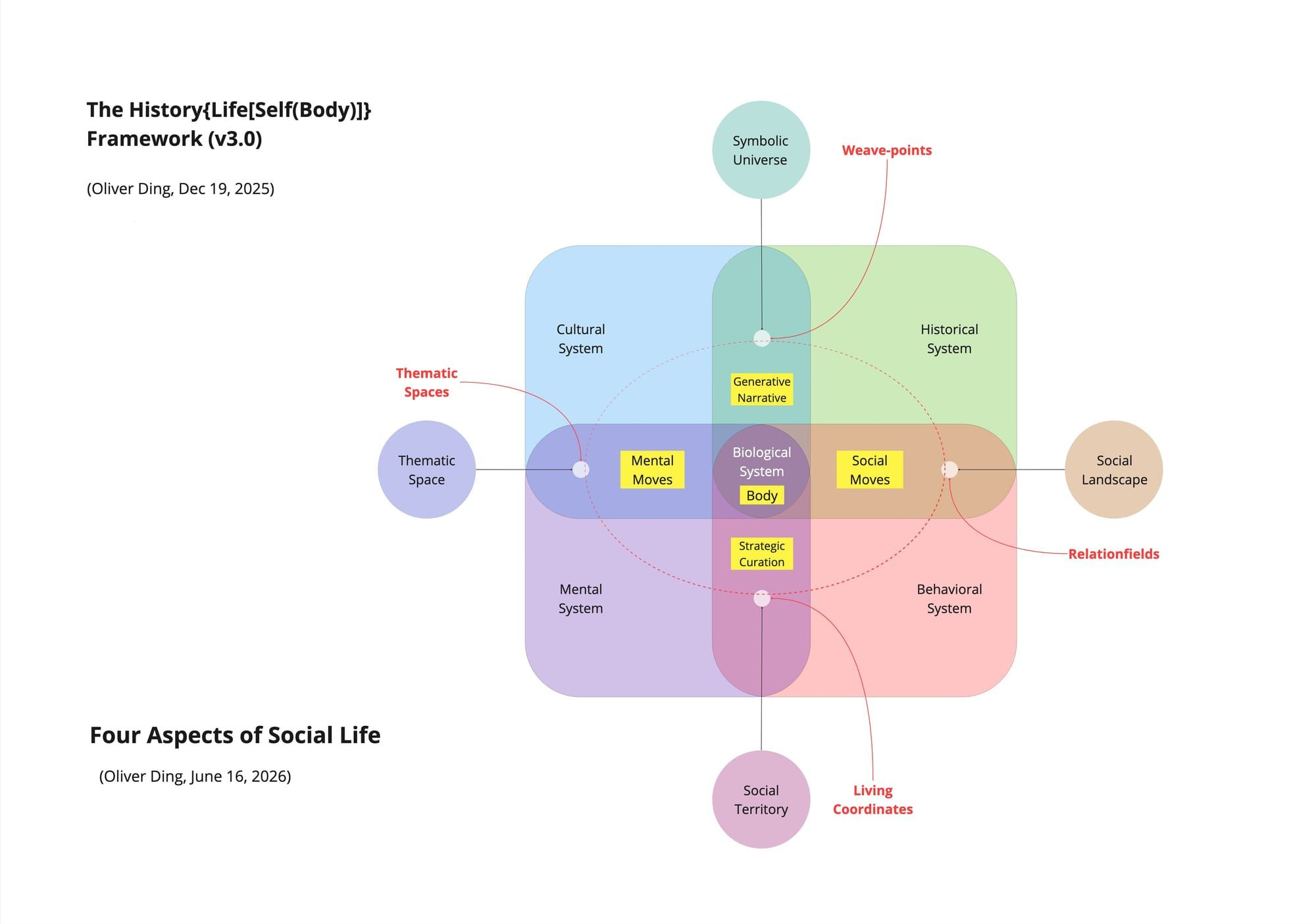
This part adds two things: the concept, and the cases.
Chapter 17: Gejunction: Concept presents Gejunction as a Unit of Synthesis within GO Theory. It covers the theoretical grounding of the concept, the four aspects through which a Gejunction can be grasped, and the methodological character of Gejunction analysis.
Chapter 18: Case Studies presents four cases, each demonstrating a different facet of Gejunction in practice.
- 18-1: Living Coordinates — a case that shows how a Living Coordinate is constructed as a tool for creative life discovery.
- 18-2: Thematic Spaces — a case that shows how thematic spaces moved from "theory maturity assessment" to "knowledge transfer pathway".
- 18-3: RelationFields — a case that examines the relational configuration between knowledge creators.
- 18-4: Weave-points — a case that introduces a GO Square's sub-map for mapping creative life
Together, the four cases demonstrate how Gejunction works as an analytical tool — not as a fixed model, but as an adaptive practice for grasping one's overall standing in the social world.
Chapter 17: Gejunction: Concept
- Gejunction — A Unit of Synthesis within GO Theory - 7,573 words
Chapter 18: Case Studies
- 18-1: Making a Living Coordinate for Creative Life Discovery - 2,896 words
- 18-2: A Situational Map After Three Weeks in China - 4,292 words
- 18-3: The Relationfield of Knowledge Engagement - 10,55o words
- 18-4: Introducing the Creative Life Square - 4,241 words
Part 6: Case Studies and Emergent Insights
In June 2025, the World of Activity Toolkit (v1, 2025) curated a series of knowledge frameworks for understanding the patterns within an individual's World of Activity.
Since then, I conduced a series of case studies which brought many new insights.
The Homecoming manuscript was the empirical research project built around the FFCC Schema — analyzing my own autobiography and my 2025 journey to Fuzhou, identifying seven specific forms of the World of Activity, and using the FFCC model to explain the dynamics and differences between them. Lake 42 developed this further, articulating eight movements using FFCC terminology and integrating the Living Coordinate concept with the FFCC model into a unified framework.
The 2026 RR practice — particularly the Significant Themes case study — made a further contribution: several new FFCC model cases emerged.
Furthermore, a series of case studies were conducted from April to September 2026.
To curate the emerged insights into the World of Activity Approach and the FFCC framework, in April 2026, I adopted Ecological Formism to expand the v1.0 of toolkit into v2.0: a four-layer architecture. The FFCC model now maintains its core simplicity — four basic ecological forms — while being able to accommodate rich empirical research and support diverse situational reflection.
- Invariant: FFCC Schema, four basic Ecological Forms
- Quasi-invariant: A series of movements, described with the FFCC vocabulary
- Variant: Situational life events and themes (open category)
- Invariant Set: Other Ecological Forms
This four-layer structure does more than classify the themes — it provides the framework with a principled openness. The Variant layer can always receive new themes as new situations are analyzed. The Quasi-invariant layer can grow as new cross-human developmental patterns are identified. The Invariant layer (FFCC) remains stable as the ontological foundation. The Invariant Set connects to other ecological forms.
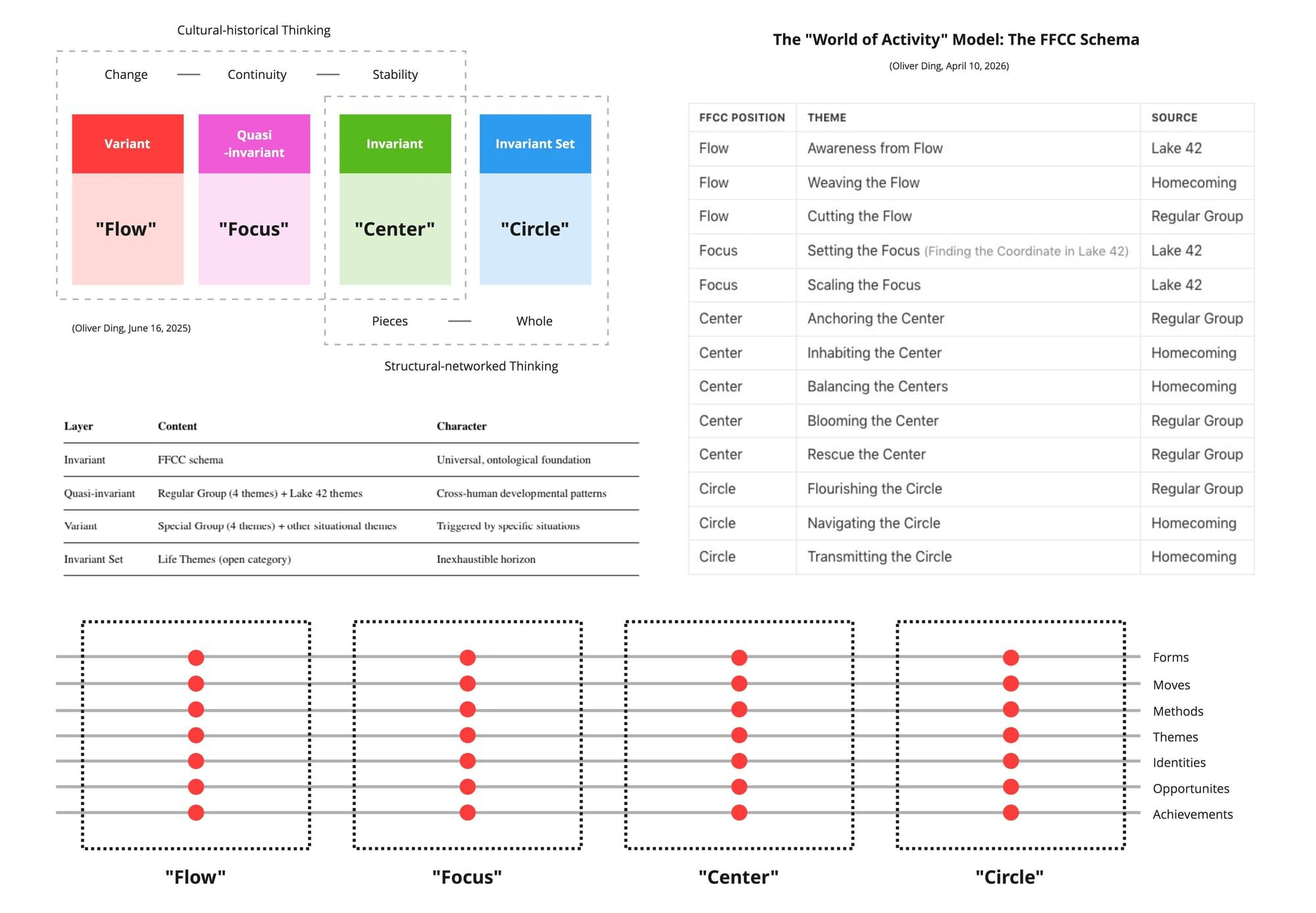
This part presents the case studies that produced these insights, and the toolkit that organizes them.
Chapter 19: Case Studies
- Homecoming: A Thematic Trip and the World of Activity Approach - 21 min
- Alien Land: Geographical Expansion - 2,600 words
- When the Circle Changes the Center - 3,045 words
- The World of Activity of Mid-life - 2,773 words
- Center as RelationField and the Dual-Center Pattern - 4,495 words
- Joint Center: Revisiting the van Gogh brothers' Creative Life - 12,286 words
Chapter 20: The Toolkit
- The World of Activity Approach (v2.0) - 2,268 words
Part 7: Activity Analysis and Intervention (AAI)
The previous parts built the theoretical framework. This part turns from theory to practice.
Activity Analysis & Intervention (AAI) is not a method for applying a fixed toolkit to other people's problems. It is an approach to developing a different kind of practitioner: the analyst who can navigate a knowledge ecology, understand concrete situations, curate appropriate conceptual resources, and gradually develop their own signature developmental programs.
AAI is a meta-framework within GO Theory. It takes the theoretical achievements of the platform and pushes them into the practical domain through five principles. The World of Activity approach provides the ecological orientation that serves as AAI's implementation foundation. The analyst uses the FFCC model and the Coordinate–Center–Gejunction framework to analyze a client's World of Activity, working across two temporal scales: life course and life situation.
But the World of Activity approach only maps. It does not interpret or explain what is found in a specific case. That work is left to the analyst, who selects knowledge frameworks appropriate to the situation and completes the analysis or intervention. Creative Life Theory is one such framework — my own theoretical system focused on creative activity. The thematic maps presented in Part 3 also curate a series of knowledge frameworks developed over the past years. For AAI analysts, these frameworks are not mandatory. They are resources. The analyst decides what to use, based on what the case calls for.
The three-way relation of Theorist–Analyst–Client constitutes the basic unit of the AAI and World of Activity knowledge ecology. Chapter 22 provides detailed discussion of the analyst and theorist roles.
The analyst's developmental path is itself organized along the FFCC arc. The analyst's creative center is expected to develop into signature programs with distinctive personal character. Chapter 23 presents two examples of such programs.
This part also marks a transition in the Activity Analysis Center itself — from theoretical development to practical application. AAI 2026 is the first product of this transition, and Chapter 21 documents not only its principles but also the exploratory thinking, travel notes, and anticipations that accompanied its beginning.
Three chapters. One for the program, one for the ecology, one for the signature programs that emerge from it. Together they show how the theoretical framework developed in the previous parts becomes a practice.
Chapter 21: AAI(2026): From Program to Meta-framework
- Five Principles of Activity Analysis and Intervention (AAI) - 5,311 words
- AAI in Context: When Psychotherapy meets Qualitative Sociology - 3,745 words
- Knowledge for Development: A Situational Map After Three Weeks in China - 4,292 words
- Closure and Unfolding: A Thematic Trip and the AAI (2026) Journey - 1,505 words
Chapter 22: Theorist, Analyst, Client: A Knowledge Ecology
- Becoming an AAI Analyst - 1,251 words
- Theorist: The Theory-Practice Connection - 1,808 words
Chapter 23: Developing Signature Programs
- Supportive Life Discovery (v2.0) — The Mid-life Curation Edition - 4,198 words
- Cognitive Hydrology Pedagogy (v1.0) - 7,349 words
Epilogue
v1.0 - September 14, 2026 - 4,313 words