
Creative Diagramming: The House of Gejunction Dynamics

A new thematic map
by Oliver Ding
September 12, 2026
This article is part of a series of posts introducing a new series thematic maps for the World of Activity Approach, especially the FFCC model — Flow · Focus · Center · Circle.
- The House of World of Activity
- The House of Center Dynamics
- The House of Focus Dynamics
- The House of Flow Dynamics
- The House of Circle Dynamics
World of Activity is part of a larger thematic enterprise: The World of Life (World of Activity) Approach, also called GO Theory. While World of Activity takes the individual development perspective, World of Life takes the cultural innovation perspective. The two parts are two sides of the same coin.
Circle is the form through which the World of Activity opens onto the World of Life. There are other concepts at this same threshold. One of them is Gejunction — a concept that serves as the unit of synthesis within GO Theory.
Like Circle, it belongs to the boundary between individual creative life and collective social life. But it asks a different question: how to understand the multiple aspects of unfolded activity and social life.
This article focuses on the "Gejunction" map: The House of Gejunction Dynamics.
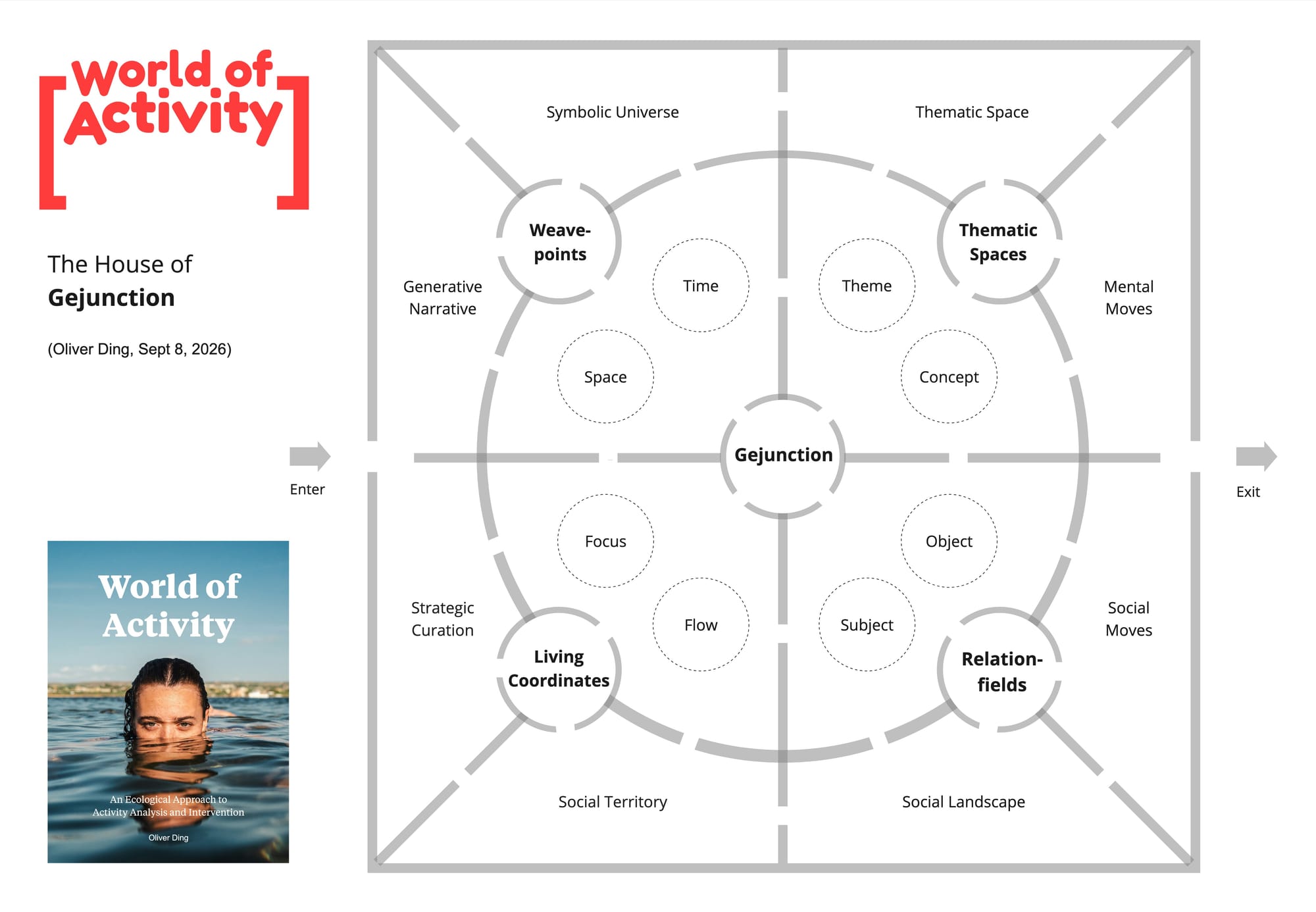
World of Activity, World of Life, and Gejunction
GO Theory is a short name for the World of Life (World of Activity) Approach which was initially introduced in December 2025, within Meta-frameworks.
This platform has its own knowledge ecosystem, built on a series of meta-frameworks completed between November 2025 and August 2026:
- Ontology: The History{Life[Self(Body)]} Framework (HLS Framework, v3.0, 2025) — the map of the social world, introduced in Meta-frameworks: Creative Heuristics for Individual and Social Development (book, v1.0, 2025), December 2025.
- Epistemology: The Ecological Formism Framework (v2.0, 2025) — the structure of knowledge systems, introduced in Ecological Formism (book, v1, 2025), November 2025.
- Methodology: The LARGE Method (v3.0, 2026) — the meta-method governing all methods within the platform, February 2026; the Activity Analysis & Intervention (AAI) method (2026) - a method for developing supportive programs, introduced in August 2026.
- Pedagogy: Cognitive Hydrology Pedagogy (v.1.0) — a pedagogical framework for thematic development and concept creation.
- Unit of Synthesis: The concept of Gejunction — a way of grasping a person's overall standing in the social world as a single, coherent configuration. Its four aspects—Thematic Spaces, Living Coordinates, Relationfields, and Weave-points—refer to four knowledge systems. It was introduced in Strategic Developmental Psychology (book, July 2026).
These meta-frameworks are not external scaffolding. They are the internal architecture of GO Theory itself — the ontological, epistemological, and methodological foundations on which several theoretical enterprises build.
I run the GO Theory platform from different directions. The World of Activity approach takes the individual developmental perspective, while the World of Life approach takes the cultural innovation perspective.
From January to July 2026, I used the World of Life model as a creative heuristic to run several knowledge projects. Eventually, some new ideas were born from the journey and returned to the theoretical platform itself — for example, the concept of Gejunction.
Gejunction: One Unit and Four Aspects
The explicit pursuit of a concept behind Gejunction began in January 2026, during the Anticipatory Cultural Sociology (ACS) project. Working with a definition of cultural development as "weaving active agency and evolving structure," the term "Bureaus of Agency" was adopted as a temporary placeholder, while a search began for a precise English equivalent of the Chinese concept 格局 (geju) — a word no existing English term captured adequately. Rather than settling for an approximation, a new term was coined: Gejunction.
In June 2026, I set the concept of Gejunction as the Unit of Synthesis within GO Theory and referred it to four aspects of social life:
- Thematic Spaces represent the thematic aspect. They reveal what a particular social life configuration is about and how attention, interest, and commitment become organized around a theme.
- Weave-points represent the symbolic aspect. They identify points where concepts, narratives, values, and meanings become woven together within a broader symbolic universe.
- RelationFields represent the relational aspect. They capture the intersubjective configurations through which people, resources, opportunities, and social environments are constituted.
- Living Coordinates represent the territorial aspect. They describe how a person becomes situated within a concrete life world.
These four aspects are not separate entities. They are four analytical perspectives on the same social unit. They also associate with four concepts of the HLS model:
| HLS Model | Gejunction Aspect |
|---|---|
| Symbolic Universe | Weave-points |
| Thematic Space | Thematic Spaces |
| Social Landscape | RelationFields |
| Social Territory | Living Coordinates |
In this way, the concept of Gejunction becomes a bridge concept between World of Activity and World of Life. See the diagram below:
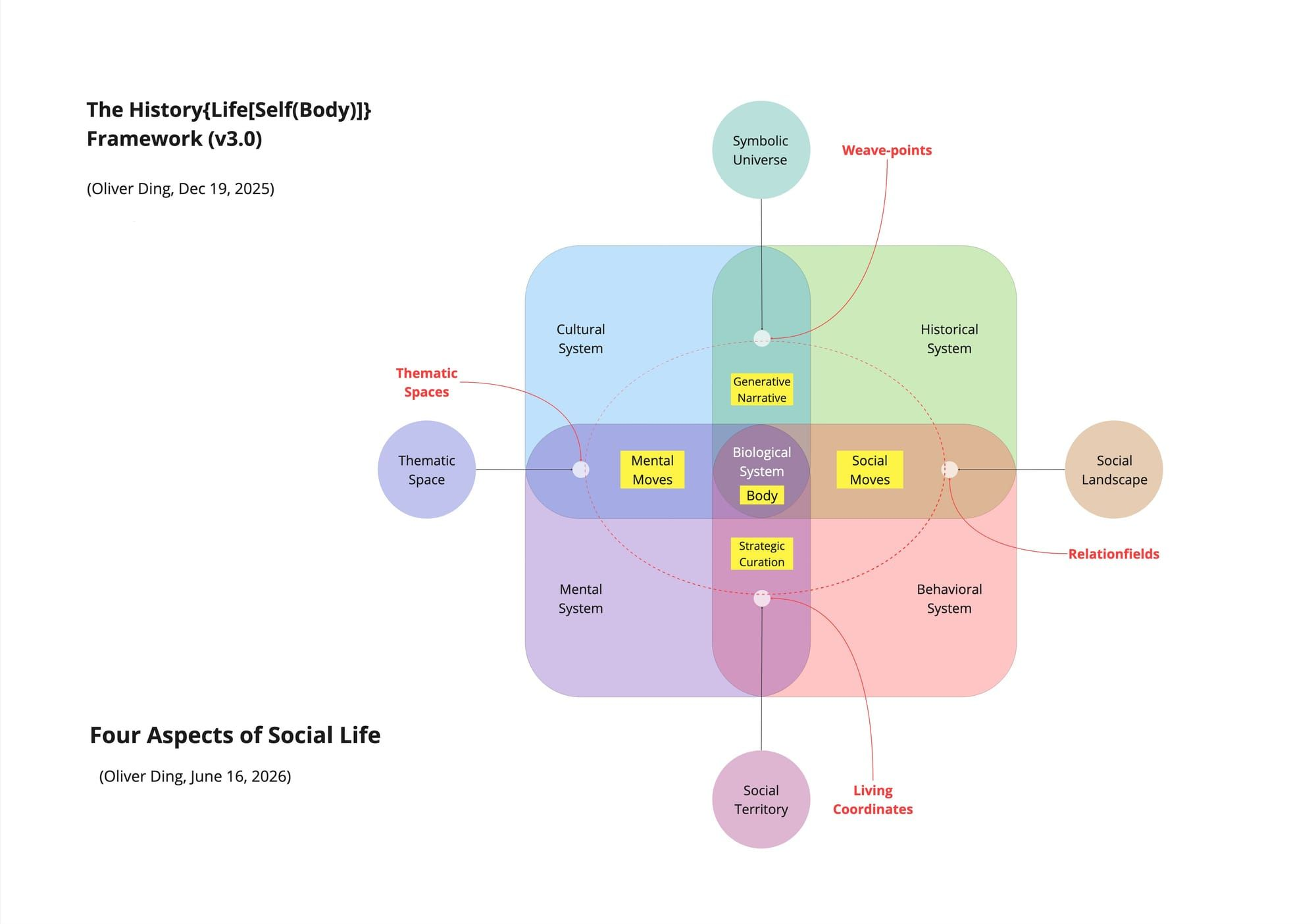
Following this setting, four aspects of social life are used to define four thematic areas of the new map.
More details can be found in Gejunction — A Unit of Synthesis within GO Theory.
Four Outside Themes (1): The Defining Concepts
The first group of outside themes consists of four defining concepts drawn from the HLS model, which was used to understand the social world within GO Theory. These four key concepts are Symbolic Universe, Social Territory, Social Landscape, and Thematic Space.
Symbolic Universe and Social Territory come from Lui’s Subjectivist Structuralism. I have followed Lui’s work for many years, and his Subjectivist Structuralism has greatly influenced my Creative Life Theory and guided my research on Knowledge Centers.
Lui adopted the term “Symbolic Universe” from The Social Construction of Reality by Peter L. Berger and Thomas Luckmann (1966). Lui claims that the “Symbolic Universe” exists outside of subjective experience. For example, the works of a knowledge creator — such as books or theories — belong to the Symbolic Universe. Even after the creator’s death, their works remain a part of this domain. I use the term “Symbolic Universe” to refer to the intersection of the Cultural System and the Historical System.
Lui coined the term “Social Territory” to describe the “social structure within subjective experience.” For example, in the Knowledge Center project, I used “Knowledge Center” as an example of a Social Territory. In the HLS model, I use the term “Social Territory” to refer to the intersection of the Mental System and the Behavioral System.
The other two terms — Social Landscape and Thematic Space — were developed during various projects I worked on between 2023 and 2024.
A Thematic Space refers to a cognitive space where an individual’s ideas, activities, and practices revolve around a particular theme. A theme can take many forms, such as an established theory like “Activity Theory,” a general concept such as “Platform” or “Life,” or an intermediate idea such as “Design Thinking” or “UX.” In the HLS model, I use the term “Thematic Space” to refer to the intersection of the Cultural System and the Mental System.
The term “Social Landscape” refers to “the ecological structure of social environments.” In the HLS model, I use the term “Social Landscape” to refer to the intersection of the Historical System and the Behaviroal System.
The result is a meta-framework for understanding the Social World that integrates actors’ subjective experiences, mindsets, and meanings. It also offers a perspective that connects sociology and psychology as complementary disciplines within the same theoretical family.
More details can be found in The Meaning of the Social World and Its Consequences.
These four concepts are placed on the outside layer of the House of Gejunction Dynamics — one in each thematic area, following their correspondence with the four aspects of Gejunction.
Four Outside Themes (2): The Operational Concepts
The second group of outside themes consists of four operational concepts drawn from the HLS model, which was used to understand mechanisms of cultural development within within GO Theory. These four concepts are Mental Moves, Social Moves, Strategic Curation, and Generative Narrative. Together, they form the Weave-the-Cultural Model.
They correspond to the four defining concepts from the first group as follows:
| Defining Concept (HLS) | Operational Concept |
|---|---|
| Symbolic Universe | Generative Narrative |
| Thematic Space | Mental Moves |
| Social Landscape | Social Moves |
| Social Territory | Strategic Curation |
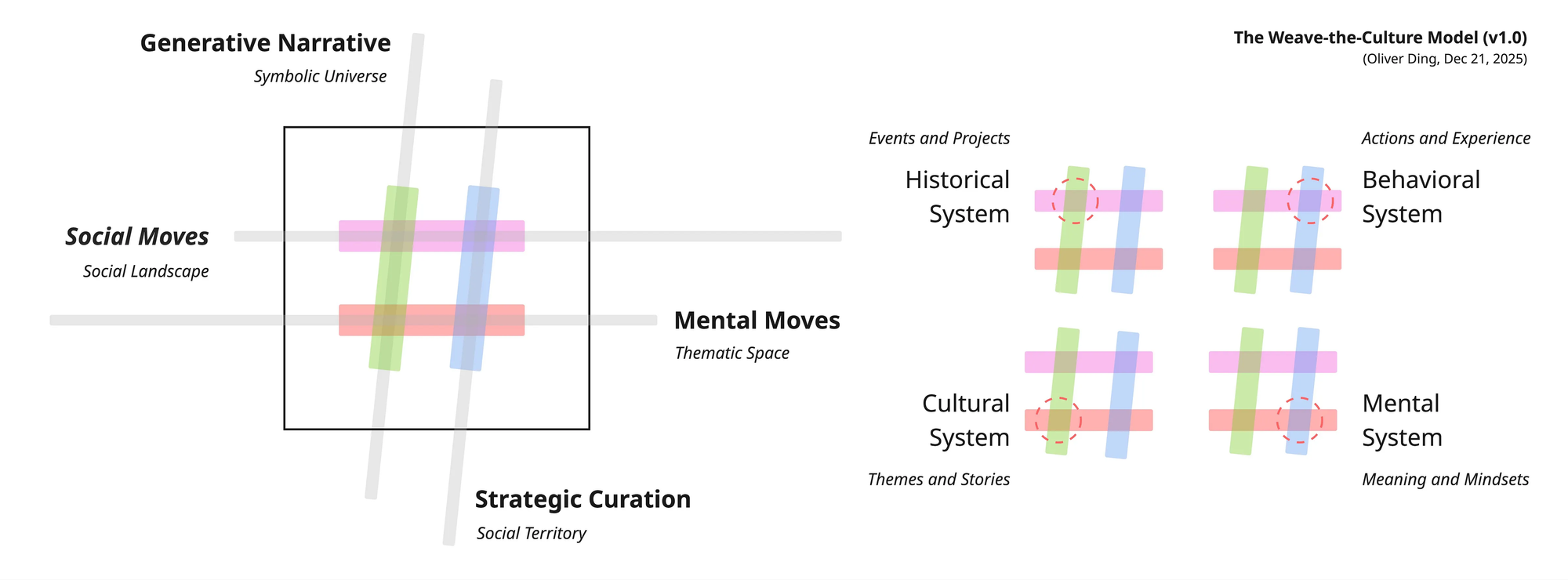
In the Weave-the-Culture Model (see the diagram above), Mental Moves and Social Moves are two diachronic dimensions, while Strategic Curation and Generative Narrative are two synchronic dimensions.
Mental Moves refer to the internal shifts in an individual’s cognitive perspective. Whether it is switching between different Predictive Models or reframing a problem through a new Mental Platform, these moves are the starting point of all cultural creation.
As the counterpart to Mental Moves, Social Moves describe the changes in an actor’s position within a Social Landscape. They involve navigating social norms, institutional boundaries, and collective expectations. By understanding Social Moves, we can track how an individual’s subjective intent begins to acquire objective weight within the “Outside” world.
Strategic Curation is the art of “weaving” disparate elements — ideas, objects, and people — into a meaningful whole. Operating primarily on the individual side, this mechanism focuses on the Achievement Chain. It explains how a creator curates various frameworks to achieve an “Objective-Object Fit,” transforming fragmented life experiences into coherent Thematic Enterprises (or Tiny Culture).
Generative Narrative represents a pivotal mechanism for cultural innovation, shifting the focus from individual subjectivity — often associated with strategic curation — to the realm of social interaction and inter-subjectivity. Within the developmental architecture of cultural systems, Generative Narrative functions as a vital bridge between “Creative Dialogue” and “Generative Confluence.” Drawing from “The ECHO Way” and the “Container Z” model, this approach addresses the inherent conflicts between opposing themes within a cultural meta-framework.
Together, these concepts show that weaving is not a static method but a living logic, capable of adapting to the complexity of the World of Life and the World of Activity.
More details can be found in Weave the Culture: One Meta-Framework and Four Mechanisms of Cultural Development.
These four concepts are placed on the outside layer of the House of Gejunction Dynamics — one in each thematic area, following their correspondence with the four aspects of Gejunction.
Living Coordinates: Flow and Focus
The thematic area of Living Coordinates corresponds to the aspect of Social Territory — the social structure within subjective experience. Its inside themes are Flow and Focus.
A Living Coordinate is not designed in advance, and it is not handed down from outside. It is generated inside activity itself.
Before an individual acts, there is no Flow and no Focus — and so no coordinate. Once activity begins, experience opens along two dimensions. Along the diachronic dimension, experience simply flows: a continuous, water-like stream moving from past to future. This is Flow. Along the synchronic dimension, certain fragments of that flow begin to draw attention; if they keep condensing and gathering meaning, they become a thematic point of attention. This is Focus.
A coordinate is born at the moment Flow is cut by Focus. Their intersection is the Living Coordinate — not an abstract point in space and time, but the actual position of a person’s lived experience: where the stream has reached, where attention has landed.
Flow and Focus are therefore the two inner dynamics of Living Coordinates. Flow provides the temporal continuity of experience; Focus provides the thematic concentration that gives it direction. Together, they locate the person within the social world — not as a fixed point, but as a living coordinate that moves as activity unfolds.
At the concrete level, the Living Coordinate appears in two forms. A Thematic Living Coordinate is the coordinate at a Center’s forming stage — dynamic, growing, the Center’s forming state. A Belief Living Coordinate operates beneath a Center once the Center already exists — its values, worldview, and basic assumptions about self and world. The first is the coordinate as content; the second is the coordinate as foundation.
Both types require Strategic Curation — the outside theme we introduced earlier. Strategic Curation is the mechanism by which disparate elements are woven into a meaningful whole. For the Thematic Living Coordinate, it is the work of gathering creative elements around a forming focus. For the Belief Living Coordinate, it is the work of aligning underlying values and assumptions with the Center’s ongoing development.
In this way, the inside themes of Living Coordinates and the outside theme of Strategic Curation are coordinated. The coordinate provides the position; curation provides the work that sustains and transforms it.
Relationfields: Object and Subject
The thematic area of Relationfield corresponds to the aspect of Social Landscape — the ecological structure of social environments. Its inside themes are Object and Subject.
A Relationfield is not a single person’s position within a social structure. It is the relational texture that forms between two subjects. Its core unit of analysis is:
Subject–Subject (Subject–Object) = RelationField
This formula contains two analytical layers, and the two inside themes of this area correspond to them.
Object represents the Subject–Object layer — the thematic content the relation is about. It is what the two subjects are working on, the shared project, the joint output, or the piece of work one produces for the other. This layer can exist with only one subject: a person working alone on a theme still has a Subject–Object relation.
Subject represents the Subject–Subject layer — the relation between the two people themselves. It is how they are oriented toward each other, how they hold or fail to hold a shared container, how they move between Outside and Inside. This layer requires two subjects.
The two layers are nested, not parallel. The Subject–Subject relation carries the Subject–Object content. A relation can be oriented toward the same object while the two subjects remain oriented toward each other differently — or a relation can hold a strong Subject–Subject bond while the shared object shifts or dissolves.
This is where Social Moves become the operational key. Social Moves describe changes in an actor’s position within a Social Landscape — navigating norms, boundaries, and collective expectations. In the Relationfield, a Social Move is not a single step but a shift in orientation between subjects, and it is what makes the Subject–Subject layer observable.
My case studies use the Ap–Re–Pro–Co model to conduct Episode analysis, precisely examining Social Moves within a Relationfield and the changes they bring. The model distinguishes two broad conditions:
Outside — no shared container yet exists. Within this condition, a person can move toward subject (treating themselves as the endpoint) or toward object (treating the other’s output as the endpoint).
Inside — a shared container has formed. Within this condition, a person can move toward part (attending to their own piece of the shared whole), toward whole (attending to the shared whole’s direction), or together (attending to the shared whole jointly with the other).
Each Episode in a Relationfield can be read as a specific position on Ap–Re–Pro–Co. A sequence of Episodes traces a Social Move Path — the trajectory of a relation across time. Read this way, the case studies do not merely describe what a relation is; they show how it moves, where it holds, and what makes it shift.
For the full discussion, see The Relationfield of Knowledge Engagement (2026).
Thematic Spaces: Theme and Concept
The thematic area of Thematic Spaces corresponds to the aspect of Thematic Space — the intersection of the Cultural System and the Mental System. Its inside themes are Theme and Concept.
In Thematic Space Theory, these two themes are the ontological foundation. The theory was formed with three levels:
- The “Theme (Concept)” Ontology — the ontological level
- The “Map (Move)” Realism — the realist level
- The “Model (Map)” Hermeneutics — the hermeneutic level
At the ontological level, Theme and Concept define the basic structure of a Thematic Space. “Theme” emphasizes subjective experience and understanding. “Concept” pertains more to objective meaning and definition. Their relationship is not only semantic but genetic: the semantic relationship belongs to the “themes” part, while the genetic relationship belongs to the “practice” part — the real historical development of projects.
At the realist level, the “Map (Move)” form holds: any Move, any activity, admits a Map representing its own structure. When this realism is applied specifically to Concept Development as a social practice, it takes the shape of the Knowledge Discovery Canvas.
At the hermeneutic level, the “Model (Map)” form holds: each thematic area provides a map for Concept Development, and each actor can adopt various perspectives and knowledge frameworks for their Concept Development activities.
This three-level architecture is what makes the operational chain possible. Any Social Move can be understood through knowledge frameworks and models. Any knowledge framework or model can be understood as a combination of concepts. These concepts can be further understood as a combination of Thematic Spaces. And these Thematic Spaces can be represented visually as diagrams.
Once this chain is established — Social Move → Knowledge Framework → Concepts → Thematic Spaces → Visual Representation — the analysis becomes operational. Through the Map–Models–Moves structure, Mental Moves and Social Moves can be read on the same terrain.
For the full discussion, see The Relationfield of Knowledge Engagement (2026) and Thematic Space Theory: An Ecological Approach to Social Cognition.
Weave-points: Time and Space
The thematic area of Weave-points corresponds to the aspect of Symbolic Universe — the intersection of the Cultural System and the Historical System. Its inside themes are Time and Space.
A Weave-point is not a fixed location. It is a structural nexus where a process and a structure meet — where the temporal unfolding of meaning intersects with the spatial organization of meaning. In the Weave knowledge system, this is the basic form of any weave-point: the crossing of one diachronic line with one synchronic line.
Time represents the diachronic dimension — the Historical System. It is the domain of sedimented meaning: institutionalized norms, canonized texts, and established narratives that have crystallized into stable structures. Time is what unfolds, what accumulates, what persists across generations.
Space represents the synchronic dimension — the Cultural System. It is the domain of living meaning: contemporary debates, competing narratives, and emerging frameworks that are still in formation. Space is what coexists, what is distributed, what is organized in the present.
A Weave-point is born at the intersection of Time and Space. It is not a point in chronological time or physical space, but a structural position defined by the meeting of a diachronic process and a synchronic structure. The coordinate itself is stable; what occupies it changes.
The concept of Weave-points comes from the Weave knowledge system. It is also embodied in a series of maps, such as GO Square.
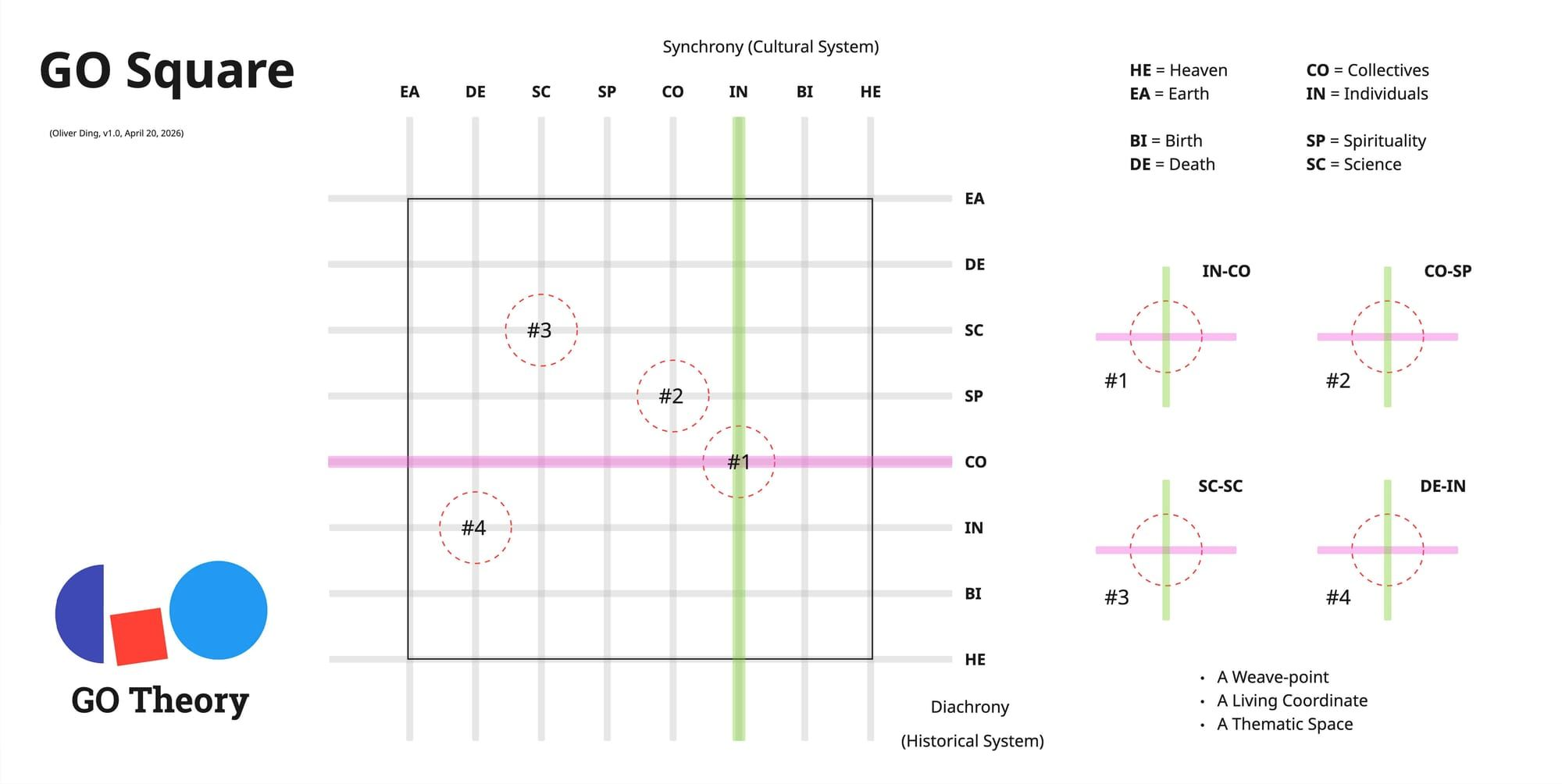
In GO Square, the Eight Units are crossed with themselves to produce 64 Weave-points — 64 structural positions within the Symbolic Universe. Each is a distinct thematic space, defined by the intersection of two boundaries. The content of each space changes with historical time, but the structural position remains invariant.
This is what Generative Narrative — the outside theme of this area — operates on. Generative Narrative is the mechanism by which meaning is generated at the intersection of Time and Space. It is the work of narrating the process: giving form to what emerges when a historical trajectory meets a contemporary configuration.
For the full discussion, see GO Square: Mapping the Symbolic Universe and How to Navigate the Symbolic Universe: Three Principles of Spatial Heuristics.
The Bridge Between Two Worlds
Gejunction is not a member of the FFCC model. It is not Flow, Focus, Center, or Circle. It is a different kind of concept — a Unit of Synthesis within GO Theory, a way of grasping a person’s overall standing in the social world as a single, coherent configuration.
This map is a closed theoretical setting. The four aspects and sixteen themes presented here are not an open template waiting to be filled with arbitrary content. They are a specific theoretical construction — a proposal about how the multiple aspects of unfolded activity hold together. The map is what it is.
What is open is not the map, but the tools that accompany it. Each of the four aspects carries its own set of instruments:
- Thematic Spaces — Thematic Space Theory, the Knowledge Discovery Canvas, and the Map–Models–Moves structure for reading Mental Moves.
- Living Coordinates — the Living Coordinate model, the FFCC schema, and the Strategic Curation mechanism for reading how a person locates themselves within their World of Activity.
- Relationfields — the RelationField framework, the Ap–Re–Pro–Co model, and the Episode Analysis method for reading Social Moves between subjects.
- Weave-points — the Weave knowledge system, GO Square, and the Weave-the-Culture Model for reading how meaning is generated at the intersection of Time and Space.
These tools are not closed. Each can be used independently, applied to different cases, adapted to different contexts. The map is a theoretical setting; the tools are an open toolkit.
This is what distinguishes Gejunction from the other maps in this series. Flow, Focus, Center, and Circle are ecological forms — their maps are templates that invite replacement. Gejunction is a synthesis — its map is a setting, and its value lies in the tools it brings together.
For the full discussion, see Gejunction — A Unit of Synthesis within GO Theory (2026).
v1.0 - September 12, 2026 - 3,535 words