
Creative Diagramming: The House of Focus Dynamics

A new thematic map
by Oliver Ding
September 9, 2026
This article is part of a series of posts that introduce a new series thematic maps for the World of Activity Approach, especially the FFCC model (Flow-Focus-Center-Circle).
This article focuses on the "Focus" map: The House of Focus Dynamics.
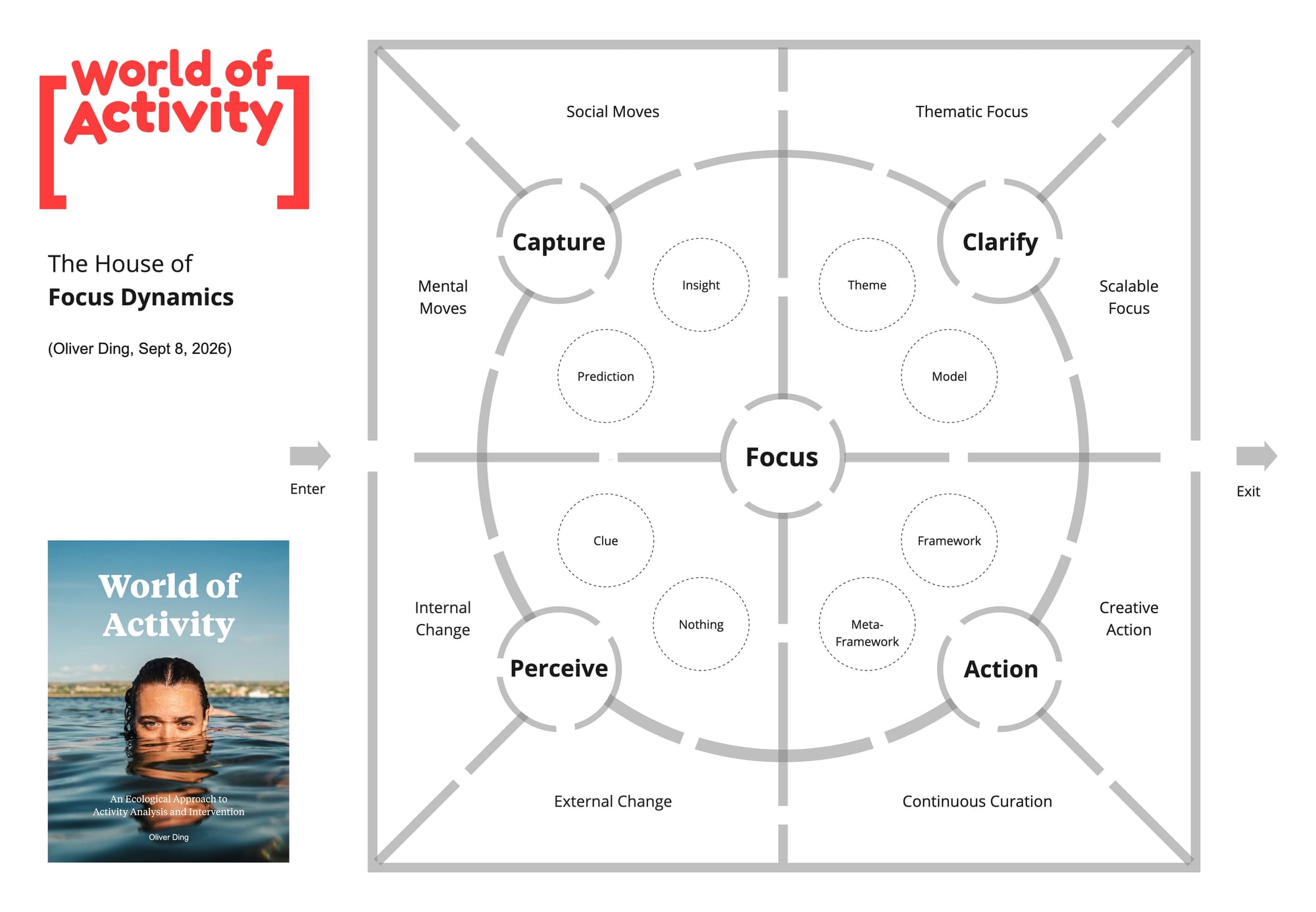
Yesterday I has a short chat with a friend who is an OODA researcher. Inspired by the conversation, I revisited a paper he published several months ago. While reading his theoretical discussion around the OODA model, I wondered if the map could be used to represent the OODA loop.
Then, I opened the file on Miro.com and modified an old map, replacing four words on four circles with Observe, Orient, Decide, and Act.
However, I realized that I don't know the OODA knowledge system well enough—I couldn't immediately find sixteen themes to fit the map. So, I returned to the World of Activity approach and changed the map to represent the dynamics of Focus, a key member of the FFCC model.
The FFCC Model and Focus
The World of Activity approach represents a comprehensive toolkit containing multiple analytical modules for examining human experience and development. Its central model, the "World of Activity" Model (v1, 2025), represents the "Flow — Focus — Center — Circle" schema.
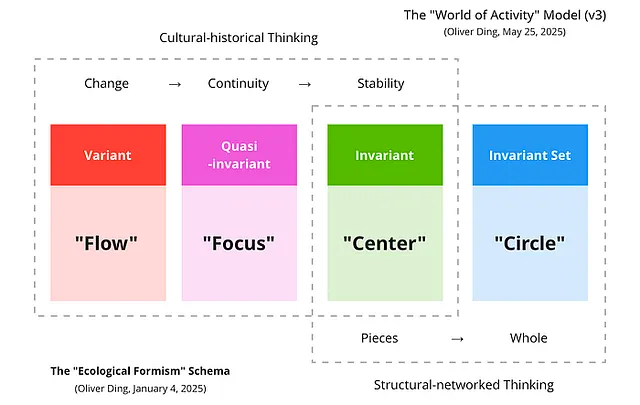
Flow represents the movement of everyday life experience—the continuous stream of activities, encounters, and engagements that constitute our lived reality. Focus marks the emergence of mental concentration that creates thematic coherence. The key difference from Flow is that Focus involves the emergence of a thematic space that channels attention toward specific domains of meaning. Center represents the creative center we work with continuously—the stable organizing principles that give structure to experience over time. Circle encompasses the network of connected creative centers—the broader social and cultural contexts that link individual Worlds of Activity to collective enterprises.
Focus occupies a pivotal position in this schema. It is the bridge between the raw stream of experience (Flow) and the sustained commitment of a Center. Without Focus, Flow remains scattered and Center cannot form. Focus is where meaning begins to coalesce.
The Meaning Discovery Model
To define the four circles of the map—which represent four thematic areas—I revisited the Meaning Discovery Model, introduced in my 2024 book Meaning Discovery: Capture Significant Insight in Everyday Life.
The original model frames "Meaning Discovery" as a specific type of activity—a dynamic process through which we turn raw experience into meaningful insight, and insight into action. It identifies six foci that together trace the arc of this process.
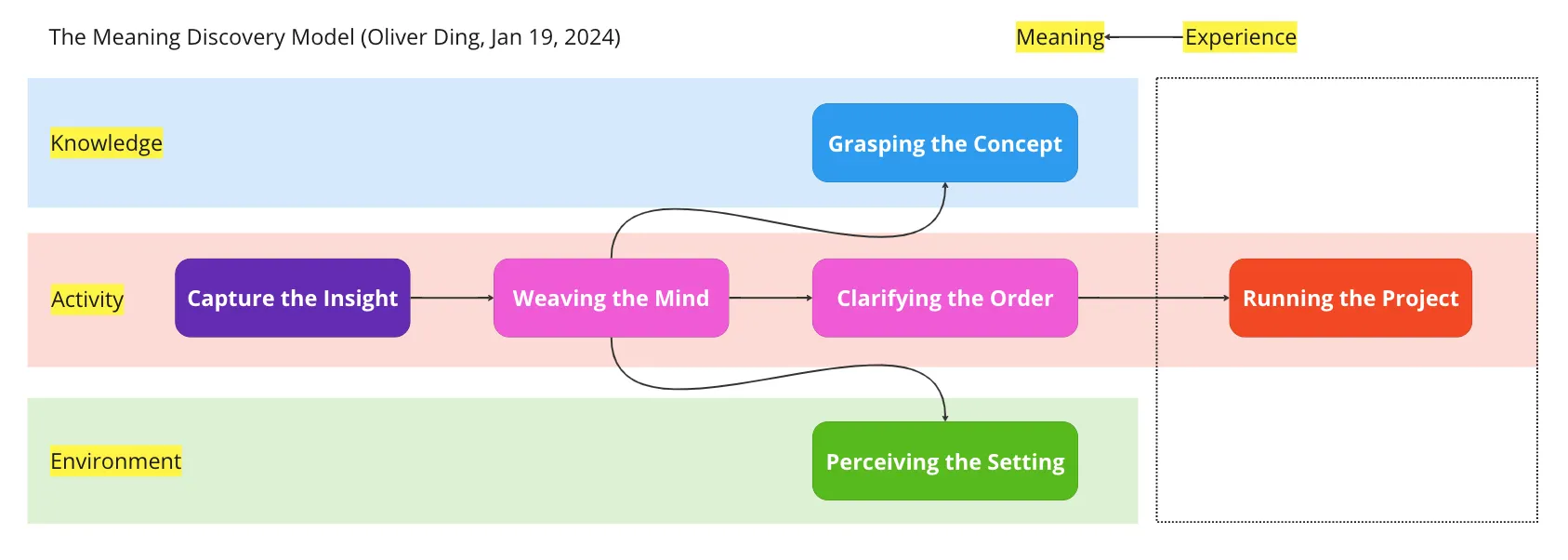
- Perceiving the Setting — attending to the surrounding environment and its ecological structure
- Capture the Insight — recognizing and preserving significant moments of understanding
- Weaving the Mind — connecting disparate insights into a coherent whole
- Clarifying the Order — defining objectives and objects for future activity
- Grasping the Concept — developing tacit knowledge into explicit conceptual frameworks
- Running the Project — enacting insights through sustained action
These six foci are organized within a broader 3×2 conceptual structure—the "Knowledge — Activity — Environment" Hierarchy and the "Meaning - Experience" transformation —which situates meaning-making across three levels: Environment (Perceiving the Setting), Knowledge (Grasping the Concept), and Activity (Capture, Weaving, Clarifying, and Running). The model also incorporates a core recursive dynamic: experience generates meaning, and meaning, in turn, shapes future experience and action.
For the House of Focus Dynamics, I distilled these six foci into four states: Perceive · Capture · Clarify · Action. This is not a strict one‑to‑one mapping—rather, I drew inspiration from the model’s underlying structure and adapted it to the specific dynamics of Focus. The four states capture the essential arc of how a Focus emerges, develops, and eventually prepares the ground for a Center. Their detailed meanings, and how they relate to the three‑stage development model (Attention Focus → Thematic Focus → Scalable Focus), will be unpacked in the following sections.
A Three-Stage Development Model
The three-stage model—Attention Focus → Thematic Focus → Scalable Focus—emerged from a year of case studies conducted under the World of Activity framework. It is important to emphasize, however, that this model is not intended as a general-purpose "cognition-action" framework. It does not describe how people in general perceive, think, decide, and act. Rather, it is situated within the specific concerns of Creative Life Theory—the theoretical approach I have been developing since 2022, which examines how individuals discover, develop, and sustain creative themes across their life course.
The Creative Life Curation framework—first introduced in my 2022 book manuscript of the same name—centers on a critical operation: naming a creative theme. This is the pivotal move that transforms diffuse experience into a workable theme. We all have recurring sensations, vague impulses, and half-formed interests. But until we give them a name—a precise word or phrase that captures their essential character—they remain elusive. Naming brings a theme into existence as an object of sustained attention. This is precisely the transition from Attention Focus (noticing something) to Thematic Focus (holding it as a named theme).
Selection, then, marks the transition from Thematic Focus to Scalable Focus. The practical reality is this: we can have many Thematic Foci. A life generates countless themes, and naming costs little. But a Center is different. A Center demands sustained investment—time, energy, resources, and action over time. While we may have many Foci, we can only sustain a small number of Centers.
This creates a critical question: among all the themes we have named, which ones are worth developing into Centers? I introduced the concept of Scalable Focus in a 2025 book draft as a criterion for making this strategic choice. A Scalable Focus is a Thematic Focus with the capacity to extend beyond its initial context—to connect with other domains, to grow in scope, and to support the sustained activity a Center requires.
The following sections will show how the four states of the map—Perceive, Capture, Clarify, Action—map onto this three-stage developmental arc, and how the operations of naming and selection operate within each stage.
The "Perceive" Thematic Area
Attention meets the world
Focus begins with perception. Before we can focus on anything, we must first perceive it—not in the passive sense of sensory reception, but in the active sense of attending to something that stands out from the background and begins to hold our attention. This is the domain of Attention Focus, the first stage of the three-stage development model.
| OUTSIDE | External Change · Internal Change |
| INSIDE | Nothing → Clue |
The Outside layer of the "Perceive" thematic area tracks two types of change: External Change—shifts in the surrounding environment, new conditions, emerging opportunities or disruptions—and Internal Change—shifts in one's own mental state, attention, interest, curiosity, or emotional resonance. These two dimensions together define the situational texture of perception.
Instead of describe mental operations, the Inside layer describes the objects of cognitive operation—what the mind encounters when it turns its attention inward. These objects form a sequence: Nothing and Clue.
Nothing is the experience of attending without yet finding—the blank page, the open question, the search without a result. Clue is the first sign of pattern—a detail that stands out, a connection that flickers, a thread that might lead somewhere. The movement from Nothing to Clue is the opening move of Focus itself: the shift from empty attention to the first glimmer of meaning.
The "Capture" Thematic Area
Holding what matters
Perception alone is not enough. What is perceived must be captured—held, preserved, kept from dissipating back into the flow of experience. Capture is the act of taking what has been noticed and giving it a form that can be revisited. This is where Focus begins to take on a life of its own—still within the domain of Attention Focus, but moving toward something more durable.
| OUTSIDE | Mental Moves · Social Moves |
| INSIDE | Prediction · Insight |
The Outside layer of the Capture area describes two types of moves. Mental Moves are shifts in thinking—moving from one conceptual position to another. For example, moving from the abstract framework of a model to its concrete applications, or from the overall architecture of the World of Activity framework to a specific ecological form like Focus. The map you are looking at right now is itself a product of such a move: from the general House of World of Activity to this more focused House of Focus Dynamics. Social Moves are shifts in relational space—choosing to engage with a particular person, group, or community. Both types of moves expand the territory in which a Focus operates.
The Inside layer of the Capture area deals with Prediction and Insight. Prediction is the act of anticipating outcomes before making a move—forming expectations about what will happen. Insight is what emerges after the move, when the actual results reveal something new—unexpected connections, fresh inspiration, or a clearer sense of direction. Together, Prediction and Insight form a learning loop: we anticipate, we move, we try, we learn. The insights gained prepare us for the next round of moves.
The "Clarify" Thematic Area
Giving form to Focus
Once something has been captured, it must be clarified. Clarification is the process of giving shape, structure, and meaning to what has been gathered. This is where Focus moves from raw attention to something more durable—from the fleeting to the formulated.
| OUTSIDE | Thematic Focus · Scalable Focus |
| INSIDE | Theme · Model |
The Outside layer of the Clarify area refers to the two advanced stages of Focus development introduced earlier: Thematic Focus and Scalable Focus. Thematic Focus is the stage where a named theme becomes a stable object of attention. Scalable Focus is the stage where a theme demonstrates the capacity to extend beyond its initial context and support sustained activity. These two stages mark the progression from naming to selection—from having a theme to choosing which themes are worth investing in.
The Inside layer of the Clarify area deals with Theme and Model.
A Theme is the outcome of naming. It is what we get when we take a diffuse, recurring experience and give it a precise name—transforming raw sensation into a stable cognitive object. But a Theme is not an insight. An insight is a moment of understanding, often fleeting. A Theme is the name of a Thematic Space—a cognitive container into which we can place various insights, observations, examples, and questions. The Theme is the label on the container; the Thematic Space is the container itself. Once items are placed inside this space, they begin to relate to one another, and their connections often generate new insights that were not visible before. The named Theme thus becomes a living structure—not a dead label, but an active site of ongoing discovery.
A Model, on the other hand, is tied to the question of Scalable Focus. Not every Thematic Focus deserves to become a Center. Centers require sustained investment—time, energy, resources—and we can only sustain a few. So how do we choose? This is where Model comes in. To determine whether a Thematic Focus has the potential to grow into a future Center, we need a predictive model—a way of anticipating what that Center might look like, what role it could play in the larger landscape of our creative life, and whether it is worth the commitment. A Model is not a fixed blueprint; it is a working hypothesis about a theme's future trajectory, a lens for assessing its scalability before we commit to it.
The "Action" Thematic Area
Enacting Focus, preparing for Center
The final area is Action. A Focus that remains only in the mind is incomplete. Focus must be enacted—brought into the world through sustained practice, application, and engagement. This is where Scalable Focus is tested and realized, and where a Focus prepares to become a Center.
| OUTSIDE | Creative Action · Continuous Curation |
| INSIDE | Framework · Meta-framework |
The Outside layer of the Action area describes two complementary types of sustained action. Creative Action is the work of producing—generating new insights, new artifacts, new outcomes. It is the forward-moving, generative dimension of Focus. Continuous Curation is the work of tending to what has been produced—sorting, organizing, refining, selecting, and connecting. It is the reflective, structuring dimension of Focus. Creative Action produces the raw material; Continuous Curation gives it form and direction. Both are necessary for a Focus to grow and sustain itself over time.
The Inside layer of the Action area deals with Framework and Meta-framework. Creative Action requires frameworks—practical knowledge structures that guide what to do, how to do it, and why it matters. A framework provides the scaffolding for action. Continuous Curation, however, requires a different kind of knowledge: a meta-framework. A meta-framework is a framework about frameworks—a lens for selecting, comparing, and organizing multiple frameworks. It enables the curatorial work of deciding which frameworks to apply, when to switch between them, and how to integrate their insights. Together, Framework and Meta-framework support the dual work of creating and curating that sustains a Focus over time.
The Inside: A Sequence of Cognitive Objects
Before concluding, it is worth stepping back to look at the Inside layer across all four areas—not as separate themes, but as a single sequence.
Read in order, the Inside themes trace the full arc of a Focus from its earliest stirrings to its most mature expression:
Nothing → Clue → Prediction → Insight → Theme → Model → Framework → Meta-framework
These eight terms are cognitive objects —the material our minds work with. They are not the operations themselves (observing, selecting, naming, modeling), but rather the objects that those operations act upon. I could have named the Inside themes after cognitive operations, but that would tell a story about what the mind does. Instead, I chose to tell a story about what the mind works with: the objects that appear, take shape, and transform as a Focus develops.
The sequence begins in the Perceive area with Nothing and Clue—the blank of not-yet-knowing and the first sign of pattern. These are the raw materials attention first encounters: either empty space or the first hint of something worth pursuing.
In the Capture area, we encounter Prediction and Insight—together forming a try and learn loop. Prediction is what we hold before a move; Insight is what we gain after. The loop cycles through Mental and Social Moves, testing and refining as it goes.
In the Clarify area, we encounter Theme and Model. Theme is the name of a Thematic Space—a cognitive container that gives a Focus its identity. Model—short for predictive model—is what we build to assess whether a Theme has the potential to become a Center, giving a Focus its future trajectory.
Finally, in the Action area, we work with Framework and Meta-framework. Framework guides Creative Action—the structured knowledge of what to do and how. Meta-framework guides Continuous Curation—the structured knowledge of how to select, organize, and refine multiple frameworks.
A Map of Creative Focus
Like the other maps in this series, the House of Focus Dynamics is a template rather than a fixed model. The sixteen themes presented here are my current choices; they can be replaced. Readers can use the same structure to curate their own themes and create their own map of Focus.
The particular version presented here reflects my case studies, especially my work on Creative Life Theory. For this reason, I see it not as a general model of Focus, but specifically as a map of Creative Focus—how a creative theme emerges from experience, develops through attention and action, and may eventually grow into a Creative Center.
This reflects a deliberate separation between map and model. The World of Activity approach, through the FFCC model, focuses on ecological forms and provides the map. Creative Life Theory focuses on a particular type of creative activity and provides the model. Keeping these two roles separate allows the World of Activity approach to remain open, while different readers can bring their own activities, themes, and models into the same ecological structure.
The map is therefore both a framework and an invitation: keep the structure, change the themes, and see what your own Focus reveals.
v.1.0 - September 9, 2026 - 2,746 words