
The Relationfield of Knowledge Engagement

Mental Moves, Social Moves, and Relational Development
by Oliver Ding
September 10, 2026
This article asks what actually happens when two knowledge creators meet. Thematic Space Theory has had a partial answer since 2023 — the Thematic Zone — but no way to say whether a meeting had crystallized into anything held in common, or why it might come apart once it had.
Using RelationField, a framework completed in 2026, this article supplies that missing layer: reading a series of cases, from a single brief exchange to eighteen years of correspondence, Episode by Episode. Along the way, it locates RelationField within a larger architecture, Gejunction, and opens what is meant to be the first in a series reading Knowledge Engagement from that wider perspective.
Contents
Introduction
Part 1: Map, Moves, and Models
1.1 What Thematic Space Theory Is
1.2 Map, Moves, and Models in the Knowledge Discovery Canvas
1.3 Understanding Through the Chess Metaphor
1.4 Limitations of Traditional Epistemology
1.5 The Addition of Map
Part 2: Map
2.1 The RelationField v3.0 Framework
2.2 The RelationField of Knowledge Engagement
2.3 One Subject, One Map
2.4 What a Second Subject Brings
2.5 Outside and Inside: What 2023 Could Not See
Part 3: Paths
3.1 What a Path Is
3.2 Or Starting From the Other End
3.3 Three Kinds of Paths
3.4 Paths vs. Purposes
3.5 Social Move Paths: An Open Question
3.6 The Limits of One Map
3.7 Episode Analysis
Part 4: Mental Move Cases
4.1 Kegan: The Top-down Case
4.2 The Mental Moves Project: A Predictive Case
4.3 The Theme-Concept-Framework Transformation: A Bottom-up Case
4.4 The House of Knowledge Discovery: An Adaptive Case
4.5 Paths Are Not Fixed
Part 5: Social Move Cases
5.1 Tony: The Shortest Path
5.2 The Counseling Platform: A Chain Without Resolution
5.3 The van Gogh Brothers: A Path That Crosses Inside
5.4 Martin: A Path That Crosses Back Out
Part 6: Models
6.1 What TST Leaves Open
6.2 Three Models
6.3 What Parts 4 and 5 Already Did
6.4 Why Martin's Circle Stopped Completing
6.5 What This Closes
Part 7: Relationfield in Context
7.1 Social Landscape
7.2 Gejunction
Postscript
Introduction
In February 2025, I published Castle and Forest: The Landscape of Concept-related Knowledge Engagement, organizing twelve types of concept-related activities around four Thematic Areas. Part 5 of that book, "The People," was meant to address a question the rest of the book left largely untouched: what happens when two knowledge creators meet?
The answer I gave at the time was thin. Chapter 29, "Meet with Others," simply reproduced an article I had written back in December 2023, introducing ten Thematic Zones — Z1 through Z6, plus four in-area zones — as the interpersonal spaces where two creators' Home areas intersect. Chapter 30, "See the Moves," offered a single example: Robert Kegan's decades-long journey across the four Thematic Areas. The chapter named the phenomenon but never opened it up.
A Thematic Zone, as I defined it then, was already a correct intuition. Z1 (THEORY—END) meant something specific: a theoretical psychologist and an empirical psychologist meeting, each visiting the other's Home. But the concept, as it stood, described a result — two people, in a zone — without a tool to explain how that result was constructed, or why it might change over time. It was a black box that happened to be labeled correctly.
Recent research into a specific RelationField gave me the material to open that box. What became visible was a formula: RelationField = Subject-Subject(Subject-Object). Every Thematic Zone is a Subject-Subject container carrying Subject-Object content. This article uses that distinction to finish what Chapter 29 and 30 of Castle and Forest left undone.
Opening that box, however, turns out to depend on a distinction I first need to make explicit on its own terms — one that this article's own structure follows from here on. Part 1 sets out that distinction, between Map, Moves, and Models, as a general theoretical principle. Part 2 then puts it to work: it is the Map, in this specific sense, that the rest of the article builds on.
There is a second methodological move this article makes, less visible than the first but doing just as much work. The 2023 and 2025 analyses — the Thematic Zones, the Four Paths — worked at the grain of the Area: one Area, one Move, one arrow on the diagram. What follows works at a finer grain: the Episode. A single Area, it turns out, can hold more than one Episode, distributed unevenly — several in quick succession, one that runs continuously underneath everything else, or none at all. Both sides of this article's formula are read this way: Mental Move Cases broken into the Episodes that make them up (Part 4), Social Move Cases broken into the Episodes that make them up (Part 5).
Part 1: Map, Moves, and Models
The Thematic Zone discussion this article builds on — the one first introduced in 2023 and carried into Castle and Forest in 2025 — was not developed on its own. It grew out of the framework of Thematic Space Theory (TST).
1.1 What Thematic Space Theory Is
Thematic Space Theory is based on the Theme (Concept) ontology and the concept of Thematic Space. It was formed with three levels:
- The "Theme (Concept)" Ontology
- The "Map(Move)" Realism / The "THEORY(PRACTICE)" Realism
- The "Model (Map)" Hermeneutics
The "Map(Move)" Realism is a general form: any Move, any activity, admits a Map representing its own structure. "THEORY(PRACTICE)" — the "Theory, Practice, End, Means" model — is the specific shape this Realism took when I first built it to view Concept Development as a social practice. This specific shape is, precisely, the Knowledge Discovery Canvas (KDC), which I designed in early 2022. The "THEORY(PRACTICE)" Realism also emphasizes the dual trajectories behind Concept Development:
- The Developmental Trajectory of "PRACTICE"
- The Developmental Trajectory of "THEORY"
At the Developmental Trajectory of "PRACTICE," I see all acquired knowledge as heuristic tools for real-life activity in managing all kinds of projects. At the Developmental Trajectory of "THEORY," I see all real actions of running projects as data to test different theoretical approaches and knowledge frameworks.
The "Theme (Concept)" Ontology and the "THEORY(PRACTICE)" Realism lay the foundation for Hermeneutics. The "Theme (Concept)" Ontology defines four types of actors and four types of terms, forming a matrix of meaning. The "THEORY(PRACTICE)" Realism defines four thematic areas. If we combine these two, we see "Model (Map)" Hermeneutics — the interpretation of Realism itself:
- Map: Each thematic area provides a map for Concept Development.
- Model: Each actor can adopt various perspectives and knowledge frameworks for their Concept Development activities.
The "Theme — Map — Model" schema highlights the uniqueness of Thematic Space Theory.
This is why the architecture reaches further than the purpose it was first built for. "THEORY(PRACTICE)" was shaped specifically for Concept Development, but the underlying Realism it instances — any Move admits a Map of its own structure — is not. Any knowledge framework can be understood as a set of Thematic Spaces: a Map. Once a social reality is read against such a map, Social Moves become something that can be modeled directly on it, with the Mental Moves they correspond to observed in turn — and the relationship runs the other way as well, from Mental Moves back to the Social Moves they imply. This is the bridge TST actually provides, between Mental Moves and Social Moves, through whatever Map a given knowledge framework happens to supply. KDC is one such map, built specifically for Concept Development; Part 2 uses it that way. But the bridge itself, not any one map, is what this article puts to work.
Read this way, TST's own three levels already anticipate Part 1's Map, Moves, and Models: the Map (Move) Realism supplies the Map, representing whatever Moves it is built to describe; the Model (Map) Hermeneutics supplies the Model, interpreting the Moves. Map, Moves, and Models are not a framework borrowed from outside TST to organize this article — they are TST's own architecture, read at a different grain. What follows, accordingly, is not a second, separate illustration of these terms: it is that same architecture worked through concretely, first in KDC, then in chess.
The next two sections do exactly that.
1.2 Map, Moves, and Models in the Knowledge Discovery Canvas
KDC is a canvas I designed in early 2022 to map an individual's knowledge development activity. The canvas itself — the fixed arrangement of THEORY, END, MEANS, PRACTICE, and the sixteen blocks nested within them — is the Map: a shared terrain, the same for anyone who uses it.
How a particular person, at a particular time, actually carries out their own knowledge development activity on that terrain is Moves. I have used KDC to map several different creative projects of my own over the years, and the paths these projects trace across the canvas are never the same — some circle through all four Areas, some cut straight through the center, some loop back on themselves. The canvas stays fixed; what a given project does on it does not.
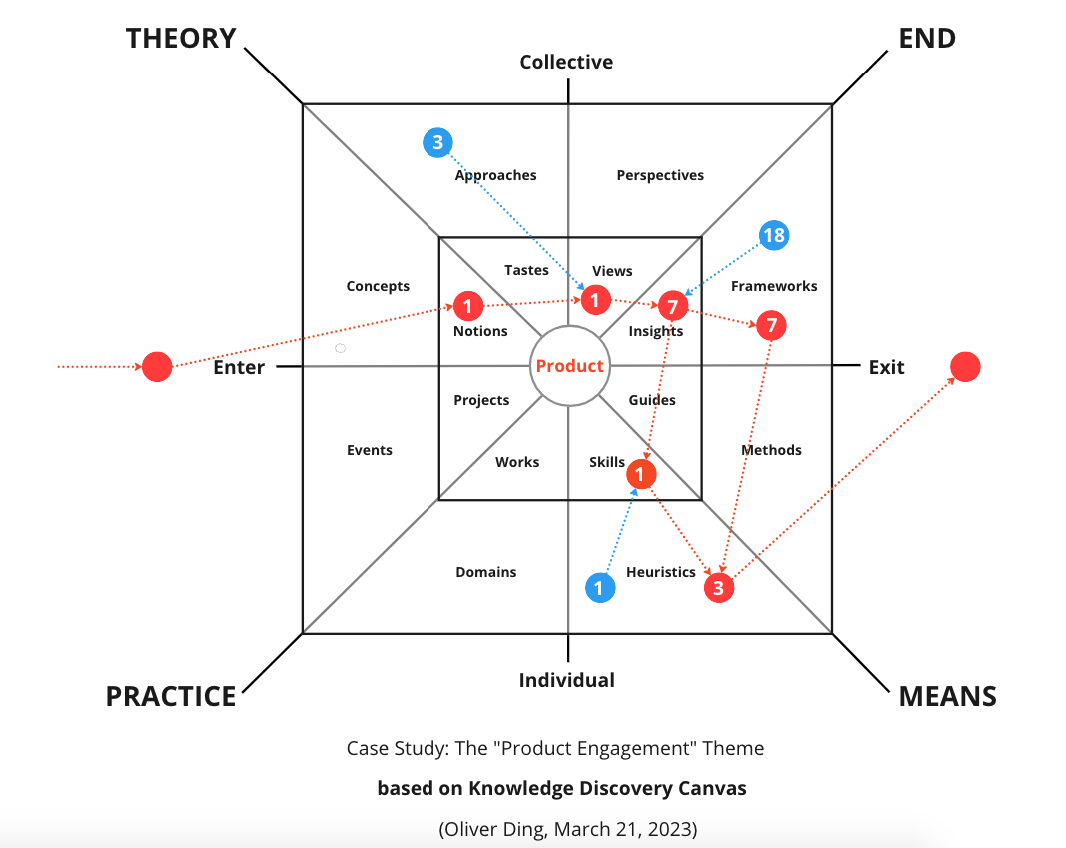
The sixteen blocks each name a kind of thing — Concept is one block, Framework is another. The knowledge frameworks that address the issues raised by a given block are Models. I have written several books touching on the block called Concept, and each addresses a different issue within that territory — concept formation, concept dynamics, concept curation, and more. A block names a territory of issues, not a single question; Models are what different frameworks propose about the issues raised within that territory, and this is exactly the situation traditional epistemology leaves us in, with no further resource to fall back on, as the next section explains.
1.3 Understanding Through the Chess Metaphor
KDC shows this distinction operating within one specific system — a system built for exactly one purpose, mapping individual knowledge development. The same three-part structure, however, is not particular to KDC, or even to knowledge work. It shows up in domains that have nothing to do with either.
Let us take chess as an example. My younger son practices chess on chess.com every morning while eating breakfast. Using chess as an ecological metaphor helps clarify this distinction:
- Map: The chessboard is the map of the game. Everyone uses the same map, plays the same game.
- Moves: Each player's moves in each game — what chess terminology literally calls "moves."
- Models: Patterns that chess practitioners and researchers have identified to explain various game situations. These are models that interpret moves.
1.4 Limitations of Traditional Epistemology
Chess makes the three terms easy to see side by side, but this is not how theorizing usually proceeds outside of it. Traditional epistemology and mainstream philosophy of science only distinguish Moves and Models:
- Moves = actual phenomena occurring in nature and society
- Models = theoretical frameworks developed by theorists and scientists to explain phenomena
Because different models come from different scientists and theorists, their differences lead to model competition and knowledge competition, often with no one able to convince the others. In social life involving ideology, especially in political domains, conflicts between different ideological and interpretive systems often lead to intense social conflict, even war.
1.5 The Addition of Map
Thematic Space Theory, to resolve and mitigate competition and conflict between models and ideologies, adds Map as a description of objective structural features characterizing phenomena's development.
Importantly, Thematic Space Theory emphasizes formal cause rather than efficient cause. Formal cause refers to the context providing background for the content. Map provides that context, while Models provide the content.
This Map-Moves-Models solution represents a fundamental advance over earlier approaches. Previous epistemologies either privileged one perspective over others or tried to force them into a single unified framework. Thematic Space Theory reveals a different path: maintain distinctions between perspectives but ground all in a shared map and connect them through structured moves.
This is not a compromise but a topological solution that preserves the integrity of multiple perspectives while showing their systematic relationship.
Part 2: Map
Thematic Zones name where two knowledge creators meet — Z1, Z4, and the rest. This article returns to that concept, this time using the RelationField framework to understand it. Doing so draws on a series of knowledge frameworks, developed across different years and for different purposes, that together make up the Map this article builds on.
2.1 The Relationfield v3.0 Framework
The Relationfield framework (v3.0) provides a model for analyzing the relational texture of social environments. Its core unit of analysis is:
Subject–Subject (Subject–Object) = RelationField
A relationfield consists of a kernel—the relation between a subject and an object (person or thing)—and an outer ring—how that relation is carried, narrated, and transmitted among subjects. The framework dissects a relationfield through four dimensions:
- R (Relation) – What type of connection exists between the subject and the other? Cooperative, adversarial, supportive, neutral? This dimension establishes the foundational structure of the relationfield.
- S (Support/Supportance) – What Supportances are available in the relation? Supportance is not social support (which depends on the giver's intention) but potential supportive action possibilities that the receiver can perceive and actualize.
- N (Narrative) – How does the subject interpret the ongoing activities within the relationfield? What is happening, what does it mean, and what role does the subject play in it? N is the subjective meaning-making dimension through which the subject makes sense of the activities they are engaged in.
- C (Curation) – How does the subject select, organize, and present the experience? In ordinary contexts, Curation preserves memories and transmits meaning across time; in adversarial contexts, Curation can mutate into evidence-construction and strategic storytelling.
A crucial feature of the RelationField framework is the ontological status of its four dimensions. R (Relation) and S (Supportance) are environmental properties—they describe the structural features of the relationfield that exist prior to and independent of any particular subject's engagement. N (Narrative) and C (Curation) are actor properties—they depend on the subject's active participation, interpretation, and selection.
This is not a mere analytical convenience. It reflects the fundamental duality of the relationfield: the social environment and the actor who operates within it are not two separate things but two sides of the same phenomenon. The actor's ongoing activities within the relationfield continuously constitute the social environment (relationfield) they are deeply embedded in. The environment, in turn, shapes what the actor can perceive and actualize.
This is what I mean by the principle: relation is environment, environment is relation.
2.2 The RelationField of Knowledge Engagement
This article's title names its scope directly: Knowledge Engagement. KDC has been mapping that scope since 2022, and it is where the Object of this article's relationfields comes from.
KDC looks at knowledge engagement activity through a single lens: Theme. It does not address other forms of knowledge. A Theme, in this view, points to a Knowledge System, and a Knowledge System has three levels: the system itself; several Knowledge Frameworks beneath it; and, beneath each framework, many Knowledge Elements.
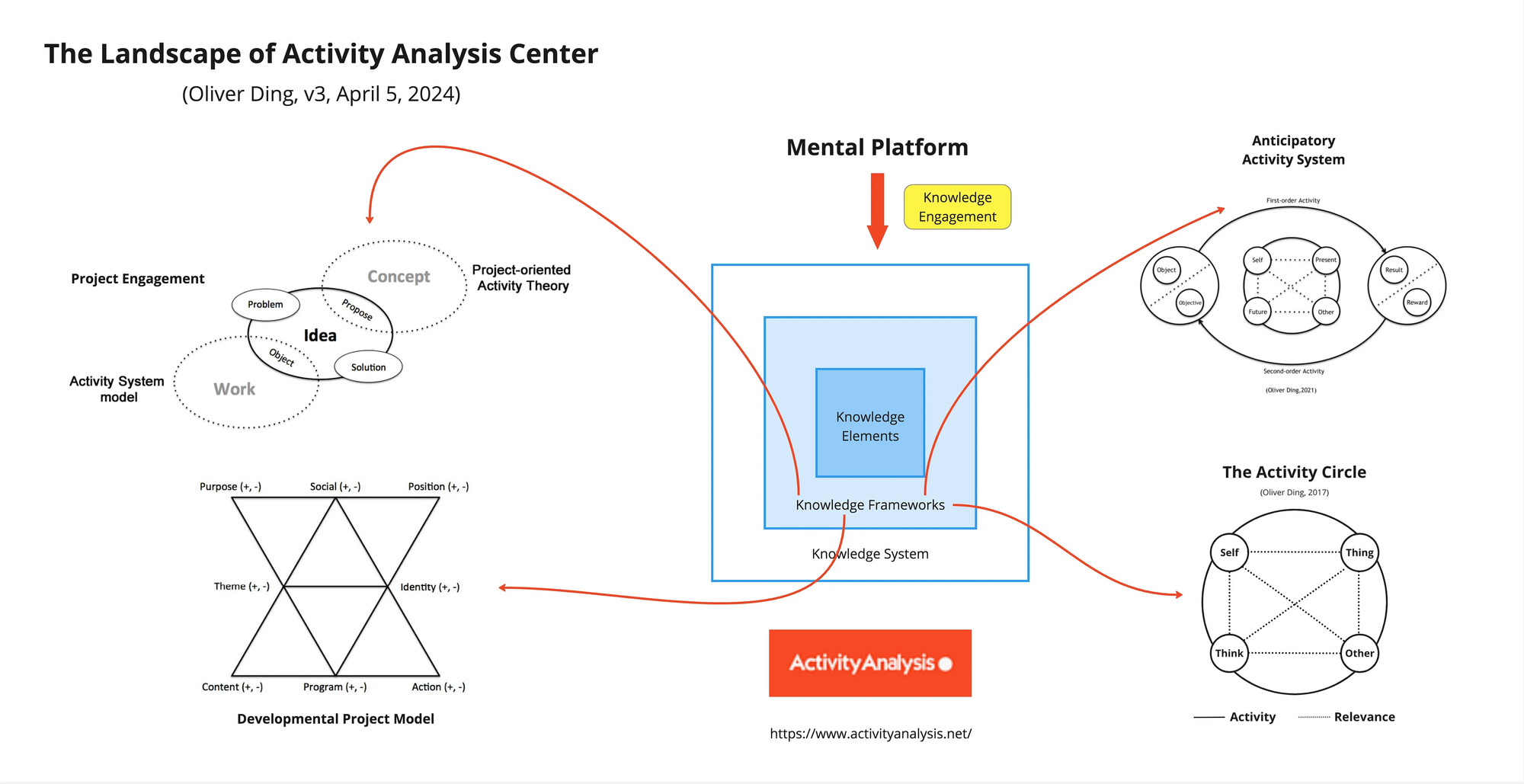
Not everyone engaged in knowledge work is building a system on this scale themselves. But whatever knowledge engagement activity a person carries out in a given period can still be located within some larger knowledge system — one whose creator need not be that person at all. This is the Object against which RelationField's kernel is read here: not necessarily a system of one's own authorship, but always a position somewhere within a Knowledge System's three levels.
This article narrows the general picture to one specific case. Here, both subjects are creators, and each subject's Object is, broadly, a knowledge system they are each developing on their own.
KDC itself offers many specific Objects to work with — Concept, Framework, and the rest of its sixteen blocks. Those are the concrete particulars of any given case: which block a person's Object happens to occupy, which level of a knowledge system it sits at, which project it belongs to.
2.3 One Subject, One Map
That map is one this project has used since 2022: the Knowledge Discovery Canvas, with its four Thematic Areas — THEORY, END, MEANS, PRACTICE. It describes a single person's position relative to their own knowledge system as Object.
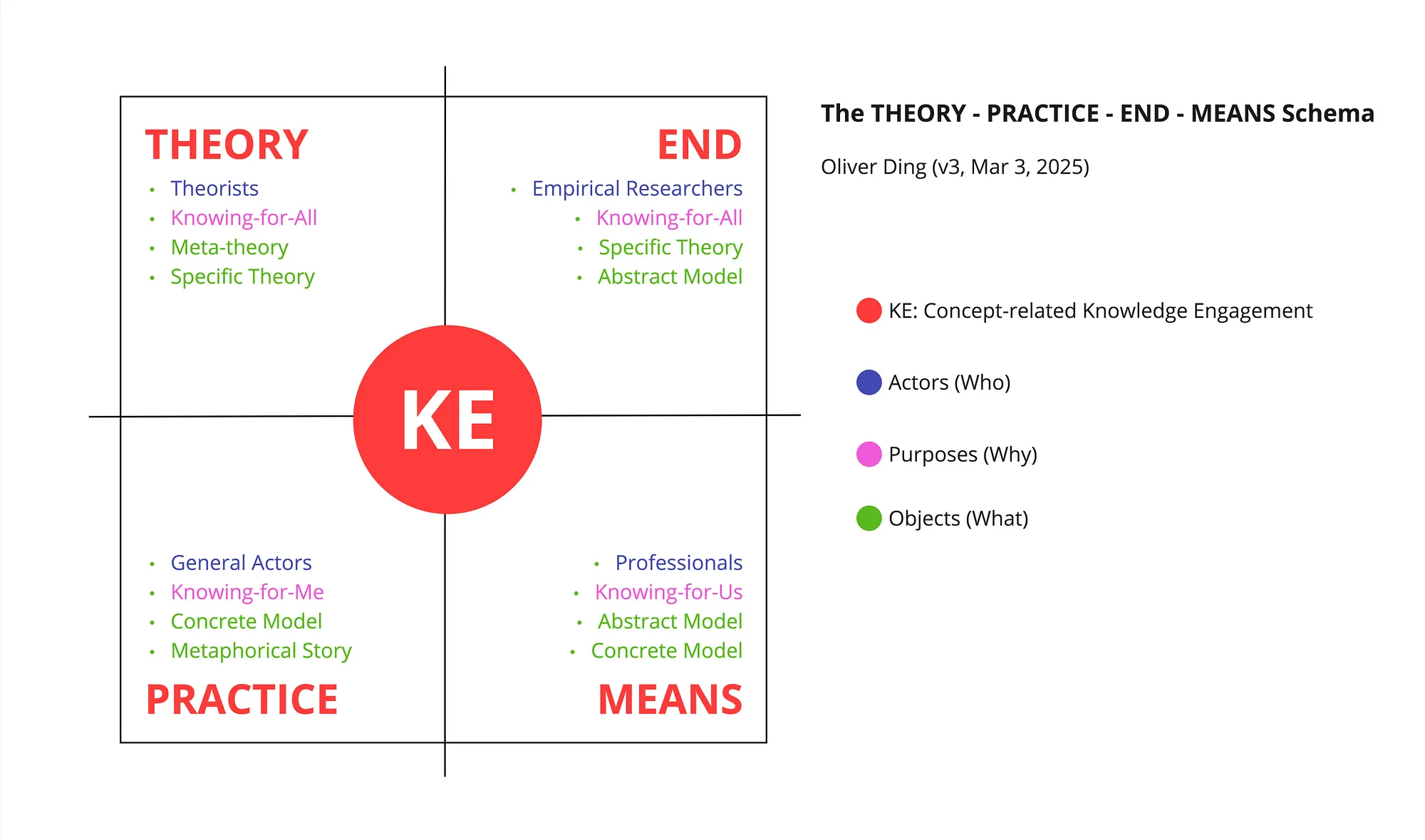
The four Areas sit at the intersection of two axes. One runs from Individual to Collective: work concerned with one person's own tacit knowledge sits toward Individual; work concerned with knowledge the wider field holds in common sits toward Collective. The other runs from Enter to Exit: work that develops and holds a theme sits toward Enter (THEORY and PRACTICE); work that pushes it out into finished, usable form sits toward Exit (END and MEANS).
- THEORY (Collective, Enter) is the Area of theorists. Their construal level sits closest to meta-theory; their practical interest is the progress of the discipline as a meaningful whole; they move by what could be called the "Concept—Theory" move, working through concept analysis and formal representation, and their expressive conventions run to mathematical formulas and conceptual frameworks.
- END (Collective, Exit) is the Area of empirical researchers. Their construal level sits at specific theories and abstract models; their interest is developing a particular innovation or framework for the discipline; they move by the "Perspective—Framework" move, working through empirical methods such as laboratory experiments, and express their findings in conceptual frameworks and data charts.
- MEANS (Individual, Exit) is the Area of professionals — intervenors, designers, coaches. Their construal level sits at concrete models and test tools; their interest is a particular intervention program, for behavior change or education; they move by the "Methods—Heuristics" move, working through design, communication, and testing, and express themselves face-to-face, often through questionnaires and structured tools.
- PRACTICE (Individual, Enter) is the Area of general actors — anyone using the knowledge in their own life. Their construal level is concrete, often metaphorical; their interest is learning for their own work or reflecting on their own experience; they move by the "Work—Project" move, working through reflection, discussion, and reading, and express themselves face-to-face, in stories and metaphor rather than formal language.
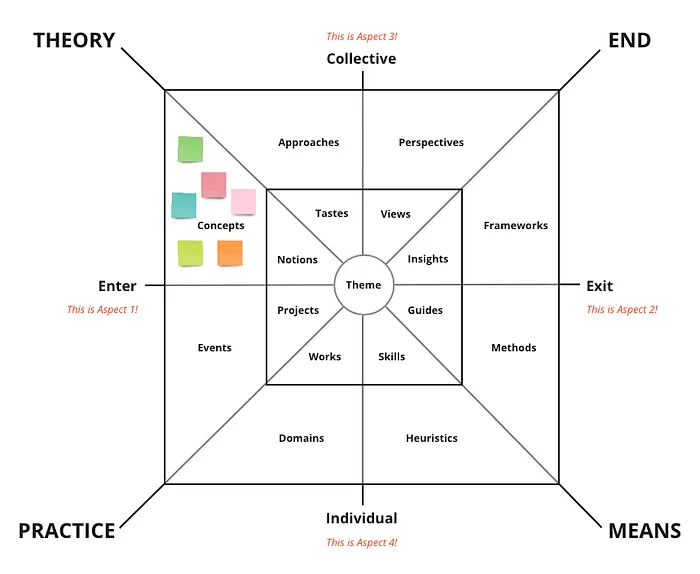
A theorist's Object sits closer to THEORY; a practitioner working in the field sits closer to PRACTICE. This is Subject-Object space, and it requires only one subject to exist. Robert Kegan, working alone across four decades, moved through this space by himself — no second subject was needed for his Object to travel from THEORY toward PRACTICE.
2.4 What a Second Subject Brings
KDC already provides a model of pairwise interaction, built from its four Areas: the Thematic Zone. Combining two people's Areas gives a typology — Z1 (THEORY—END) names a meeting between someone whose Object sits in THEORY and someone whose Object sits in END, and the same combinatorics produce the rest of the ten Zones. But earlier work never went further than this typology; it never analyzed the concrete dynamics of what happens once two people are, in fact, meeting in a given Zone.
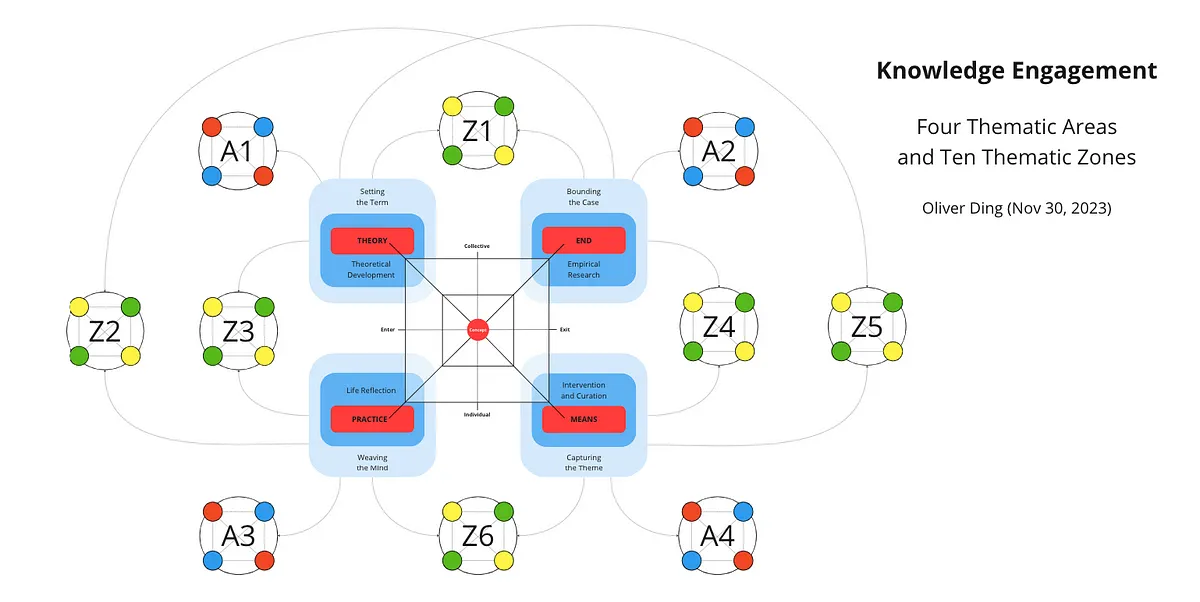
This article introduces the RelationField framework's Ap-Re-Pro-Co model as a new map, for understanding the dynamics of Subject-Subject interaction. Ap-Re-Pro-Co does not ask what the two people are meeting about — a Zone already answers that — but how they are oriented toward each other and toward whatever they may be building together.
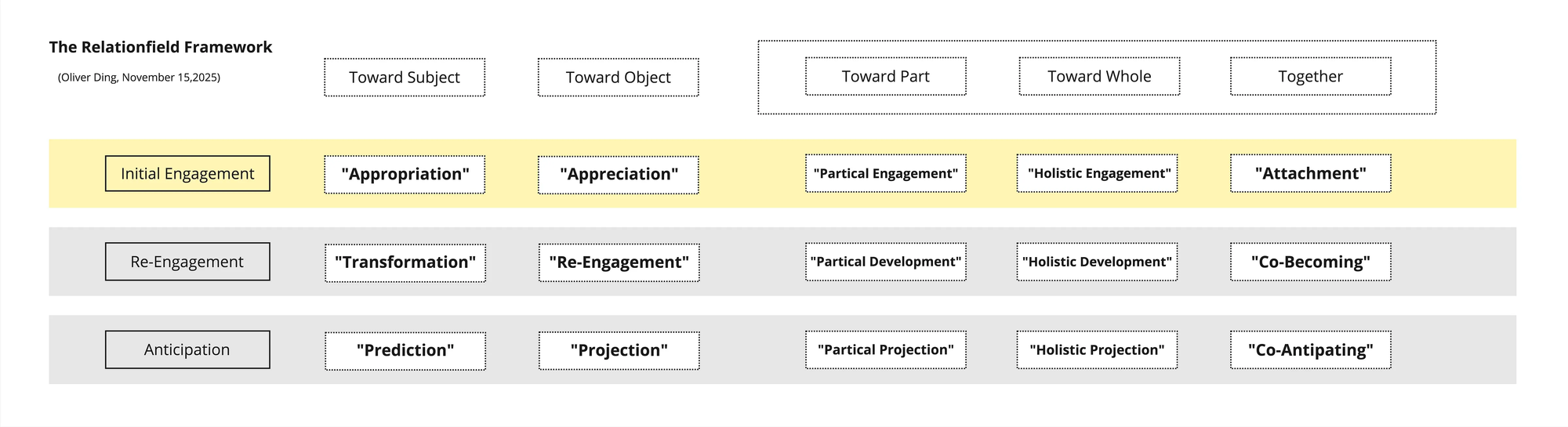
It distinguishes two broad conditions. Outside: no shared container yet exists. Within this condition, a person can move toward subject (treating themselves as the endpoint, the other's output as a means) or toward object (treating the other's output as the endpoint, themselves as appreciator or support).
Inside: a shared container has formed. Within this condition, a person can move toward part (attending to their own piece of the shared whole), toward whole (attending to the shared whole's overall direction), or together (attending to the shared whole jointly and simultaneously with the other).
2.5 Outside and Inside: What 2023 Could Not See
The 2023 Thematic Zone concept had no way to ask whether a meeting had actually moved Inside. A Zone names where two Areas meet — Z1 names a THEORY-END encounter — but it says nothing about whether that encounter has crystallized into a shared container, a Joint Center both subjects hold in common, or whether each side remains oriented toward their own subject or the other's output without anything genuinely shared yet existing between them. Structurally, the 2023 vocabulary only ever describes the Outside condition.
This is precisely why Castle and Forest's Part 5 — despite naming ten Thematic Zones in detail — never managed to say anything about what happens once two creators' work together crystallizes into something shared, or what happens when that shared thing later comes under strain. The chapter had the container's address, but no way to tell whether anyone had actually moved in.
Part 3: Paths
3.1 What a Path Is
A single map can hold more than one path. This is what separates a map from a list: a list of themes is already one path, laid out in the order it was written; a map is richer, because it can hold several different paths across the same terrain, including that one. I have called this the difference between two visual styles — Train and Square. A Train is a single path, drawn as a line of stops. A Square is a map containing many possible paths, the Train among them.
Within Thematic Space Theory, this gives a working vocabulary: Maps represent natural and social environments; Moves refer to actions; Paths are sequences of moves — not a single move, and not the map itself, but the record of several moves taken in order across a map.
3.2 Or Starting From the Other End
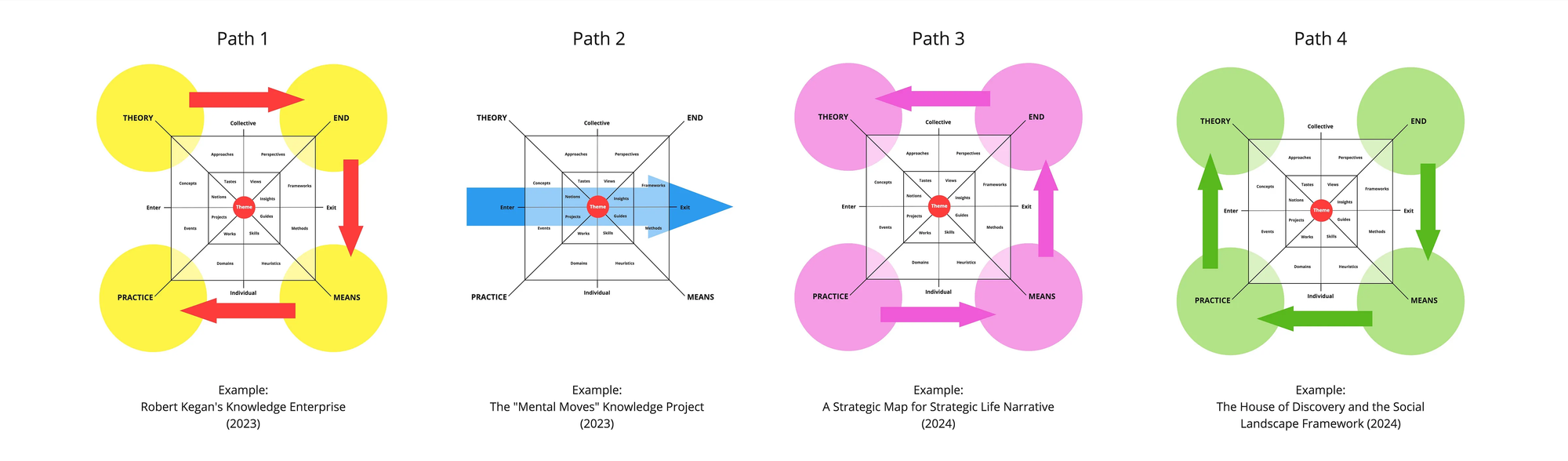
3.1 read the relationship in one direction: a map exists, and paths are traced across it. But the relationship runs the other way too. KDC, as a map, was designed in 2022. The Four Mental Move Paths taken up in the next Part were not designed alongside it — they were noticed only years later, after several individual projects had already been carried out and mapped onto that same canvas. The map came first; the paths, and the recognition of which of them recurred often enough to name, came only afterward, by laying several already-completed trajectories down side by side and comparing them.
Read this way, a Path is not simply a trace left on an already-known map. A sufficient accumulation of Paths is also what lets a Map's finer structure become visible in the first place — which regions of it tend to get visited together, which sequences of moves recur, which shapes are common enough to deserve a name. The map itself does not change; but what can be said about it depends on how many paths have already been laid across it and compared.
This distinction matters for the rest of this article. Part 4 works in the first direction: a settled map, several paths already compared, four shapes already named. Part 5 works in the second: a much newer map — Ap-Re-Pro-Co — and paths that have, for the most part, never been laid down and compared before. Whether any shapes recur across them, the way Path 1 through Path 4 did for KDC, depends on doing for that map what 2022–2024 quietly did for this one.
3.3 Three Kinds of Paths
Not every path is the same kind. Working through several years of projects, I found three:
- Mental Paths use a thematic map to trace cognitive moves — how one person explores, connects, and transitions between ideas within a map of a structured knowledge framework.
- Social Paths, as I first used the term, trace how cognitive structure and social landscape intersect — how a person's ideas develop not only through internal refinement but through engagement with communities, institutions, and professional networks. Robert Kegan's knowledge enterprise was the example: an individual who spent decades moving between roles, but a single subject throughout — the network around him shaped how he moved, without a second subject ever entering the relation itself.
- Strategic Paths use a thematic map for long-range planning and adaptive navigation — the journey of constructing Thematic Space Theory itself is an example of one.
This earlier use of "Social Path" is worth flagging, because this article's own vocabulary collides with it. Part 2 introduced "Social Move" for something else entirely — the orientation between two specific subjects, tracked through Ap-Re-Pro-Co. Kegan's Social Path, by that definition, is still a Mental Path: one subject's trajectory, embedded in a social environment but never paired with a second subject inside a shared container. To keep the two senses apart, this article uses Mental Move Cases for the single-subject case taken up next, in Part 4, and turns to the two-subject case — where, as 3.5 will explain, no comparable typology yet exists — later in this Part.
3.4 Paths vs. Purposes
A Path, on its own, does not mean anything. It is a neutral record of movement — this block, then that one, then a third — and by itself it says nothing about why the movement happened or what it was for. Meaning comes from Purpose, and Purpose operates at different scales:
- Situation — the immediate conditions framing a choice, without dictating it.
- Project — a structured effort toward a goal within a defined timeframe.
- Journey — a longer trajectory spanning multiple projects and changing contexts.
- Landscape — the broader, interconnected space in which several journeys relate to one another.
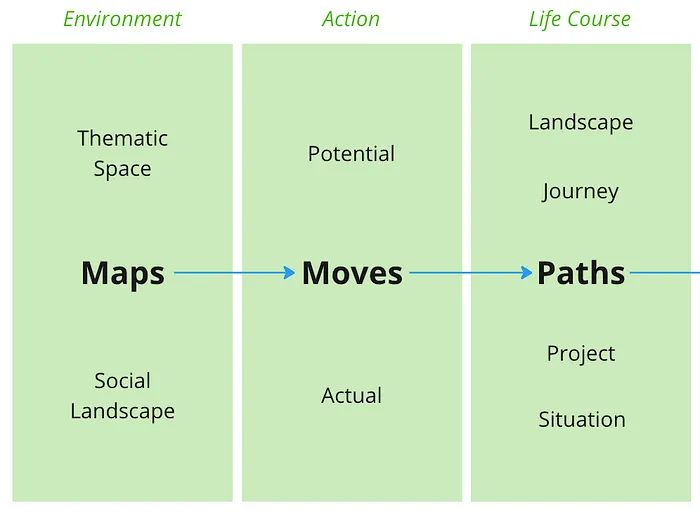
The same Path can carry different meanings depending on which of these scales it is read against. Kegan's Path 1 read at the Journey scale is a life spent moving from theory toward application; the same Path, read at the scale of a single Project — one book, one collaboration — means something narrower and more specific. Part 5's cases will need this distinction: a trajectory that looks like a completed Path at the Project scale may turn out, at the Journey scale, to be only partway through a longer one — or to have changed direction entirely.
3.5 Social Move Paths: An Open Question
No typology exists yet for the two-subject map — no equivalent of Path 1 through Path 4, naming shapes that recur across several cases. But the absence of a typology is not the absence of paths. Every two-subject relation that persists across more than one episode already traces some sequence of moves across Ap-Re-Pro-Co — together, then together again, then oscillating, then settling toward one orientation or another — whether or not anyone has yet compared enough of these sequences to notice which shapes repeat.
This is exactly how the four Mental Move Cases themselves were found: not derived in advance, but noticed only after several individual projects had already been mapped onto KDC and laid down side by side. Part 5 does the same work for the two-subject map — laying out several individual Social Move Cases, case by case, without presupposing that they belong to any established family. Whether shapes recur across them, the way Path 1 through Path 4 did, is left open for now.
3.6 The Limits of One Map
Everything in this Part, so far, has stayed inside Part 1's own vocabulary: a Path is already a kind of Model — it takes the regularities in a body of Moves and gives them a name and an explanation, the way Path 1 through Path 4 do for KDC. But a Path built this way inherits a limitation from the Map it was found on: it stays confined to whatever that one Map can describe.
Take Kegan's Creative Life as a whole, rather than just the part of it KDC maps. His life was not only a sequence of positions on THEORY, END, MEANS, and PRACTICE. It also included, among a great deal else, his relationships with other people — collaborators, students, his co-author Lisa Laskow Lahey — and those relationships inevitably shaped how his Creative Life actually developed. Examined at the scope of a Creative Life, rather than at the scope of one canvas, a single Map is not enough.
I have not tried to solve this by naming a further kind of Path — something like a cross-map Path, splicing several Maps into one larger one. That move would still be Map-oriented thinking: it assumes the fix has to be a bigger or cleverer Map, when the actual problem is that no single Map, however large, was ever going to hold everything a Creative Life contains.
The way I have handled this instead is to return to Moves themselves. A Path's complexity should track however much complexity the underlying Moves actually have — not the complexity of whichever Map happens to be in front of us. 3.4 already introduced the vocabulary for this: Situation, Project, Journey, and Landscape are not only what supplies a Path with meaning; they are also scopes, each wider than the last, within which a Path can be described without needing to fix on one Map in advance. A Path read at the scale of a Situation or a Project can often stay within a single Map, the way Path 1 through Path 4 do. A Path read at the scale of a Journey or a Landscape usually cannot — and does not need to. It simply follows the Moves, across whatever Maps those Moves actually crossed.
3.7 Episode Analysis
Everything said about Paths so far treats an Area, implicitly, as something a Path either occupies or doesn't — one stop among four, one leg of a journey. This picture is too coarse. The unit a Path is actually built from is smaller: not the Area, but the Episode — a bounded stretch of activity with its own Object, occupying one position on whichever Map is in use.
An Area can hold more than one Episode, and it can hold them unevenly. Some Areas collect several Episodes in quick succession, each revising or deepening the last. Some hold a single Episode that never really ends, running underneath everything else a Path later does. Some hold none at all. None of this shows up in a Path described only as a sequence of Areas — THEORY into END into MEANS into PRACTICE looks the same whether THEORY held one Episode or five, whether PRACTICE was a stop along the way or the continuous ground the whole Path stood on.
Breaking a Path into its Episodes is what makes this texture visible — and the move is not specific to one side of this article's formula. It works the same way on both maps: Mental Move Paths break into the Episodes that build them, one Object at a time, on KDC's four Areas; Social Move Paths break into the Episodes that build them, one orientation at a time, on Ap-Re-Pro-Co's five. Part 4 does the first. Part 5 does the second.
A further distinction matters here: Episodes can be organized two ways. Read temporally, they form a sequence — this Episode, then that one, then a third — the order in which a Path was actually walked. Read spatially, they are grouped instead by which Area or orientation they occupy, regardless of when they happened — showing how much of a Path's weight actually accumulated in one place, independent of sequence. The two readings can diverge sharply, and Part 4's first case shows exactly how: read temporally, Kegan's case is Path 1's familiar circuit, THEORY then END then MEANS. Read spatially, with every PRACTICE-related Episode gathered into one category rather than left scattered across the timeline, PRACTICE turns out not to be a stop on the circuit at all, but the largest category by far — running the entire length of the other three.
Part 4: Mental Move Cases
Chapter 30 of Castle and Forest, "See the Moves," promised an account of this and gave only one example, Kegan's. This Part gives four — and, like Part 5, it works case by case. Where Part 5 analyzes the Subject-Subject side of this article's formula, this Part analyzes the Subject-Object side: one person, one Object, read against the four Areas.
4.1 Kegan: The Top-down Case
Robert Kegan is an American developmental psychologist, formerly the William and Miriam Meehan Professor in Adult Learning and Professional Development at Harvard Graduate School of Education, where he taught for forty years until his retirement in 2016. His decades-long body of work is the clearest case of a single Object moving through all four Areas — read not as one continuous sweep, but as a series of Episodes, each with its own Object.
- 1970s–1982 (THEORY). Object: building the Constructive-Developmental framework itself. Published The Evolving Self (1982, Harvard University Press).
- 1982–1994 (THEORY). Object: deepening the framework — the Orders of Consciousness, and the distinction between Socialized, Self-authoring, and Self-transforming Mind. Published In Over Our Heads (1994, Harvard University Press).
- 1994 onward (moving toward END). Object: testing the framework empirically. His partnership with Lisa Laskow Lahey begins here; she develops the Subject-Object Interview, a research method for assessing a person's developmental stage.
- 2001 (END). Object: the framework applied to organizational language patterns. Co-authored, with Lahey, How the Way We Talk Can Change the Way We Work.
- 2009 (MEANS). Object: a concrete intervention. Co-authored Immunity to Change, formalizing the Immunity-to-Change coaching process — later taught commercially through Lahey's firm, Minds at Work.
- 2016 (MEANS, Collective). Object: organizational design. Co-authored An Everyone Culture, introducing the Deliberately Developmental Organization (DDO) model.
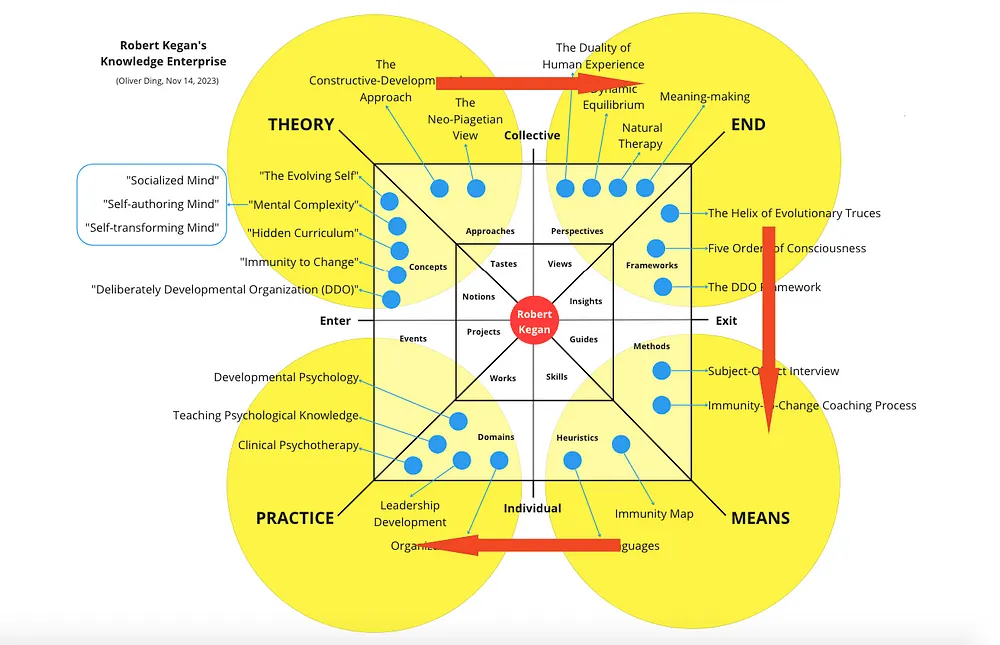
One Episode does not fit this sequence at all, because it never stops: decades of teaching, clinical psychotherapy, and leadership-development consulting, running continuously alongside every Episode above rather than arriving as a final destination. This complicates Path 1's own description of itself as a circuit that ends in PRACTICE — in Kegan's case, PRACTICE was never the last stop. It was where he started from, and never left.
Traced through its most legible Episodes — 1982, 1994, 2001, 2009, 2016 — the case still reads as Path 1: The Top-down Approach: THEORY into END, END into MEANS, roughly in that order. But the Episode-level view shows what a single-arrow summary hides: the fourth Area wasn't a destination Kegan eventually reached. It was the undercurrent both THEORY and END kept drawing on and feeding back into.
4.2 The Mental Moves Project: A Predictive Case
Not every case is read after the fact. In March 2023, before starting what became the Mental Moves project, I used KDC to predict the shape it would take. I framed the project as a simple First-order Activity: a clear Object (a new possible book) and a simple Program (collect more examples of moving between thematic spaces). Using KDC, I identified related elements, connected them, and had a working view of the whole project before writing a word of it.
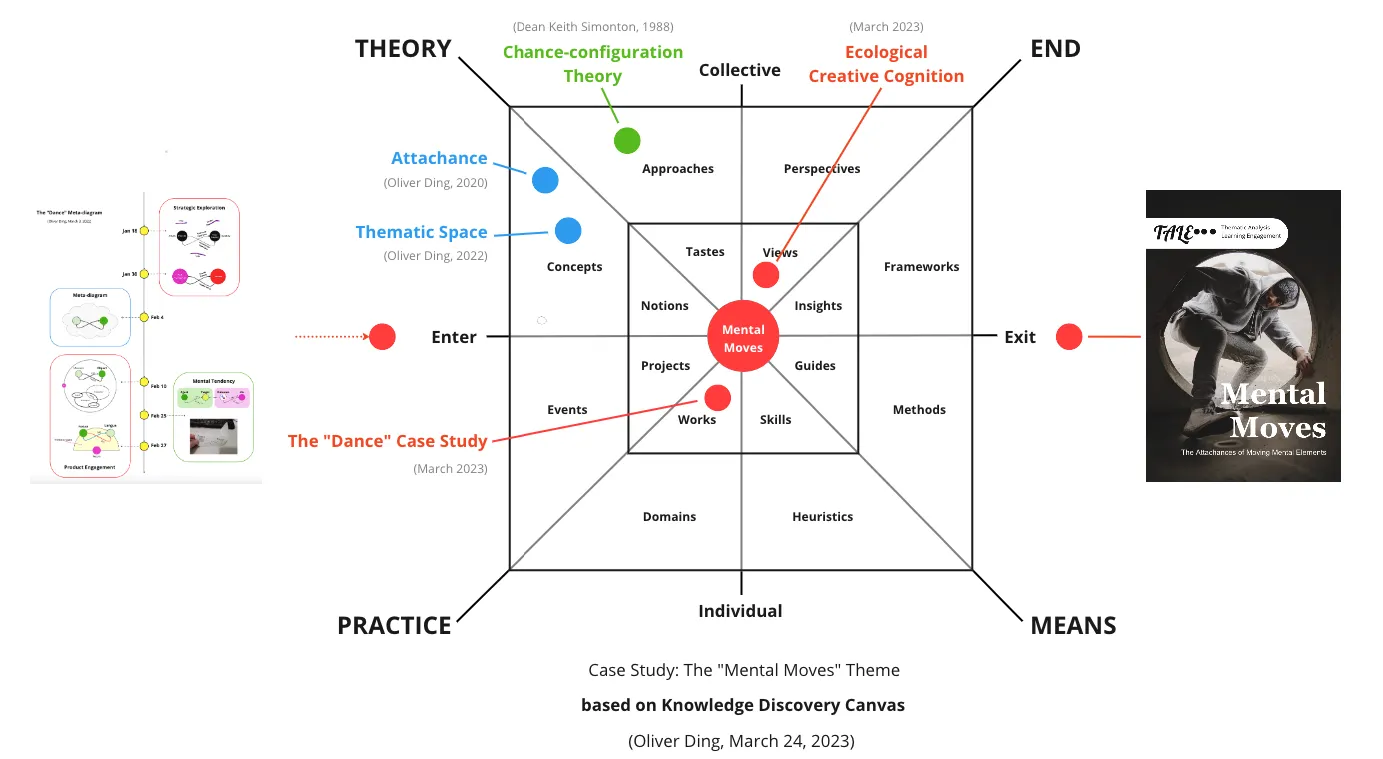
The path this produced does not circle the canvas. It moves along a single axis — Enter to Exit — from Resource to Result. The axis comes from an older idea: the thematic space as a container, drawn from the Ecological Practice approach. Enter corresponds to Resources — the THEORY and PRACTICE Areas supply what a project starts with. Exit corresponds to Results — the END and MEANS Areas supply what it produces: End as "knowing for me," the personal, internalized kind of result; Means as "knowing for all," the shared, communicable kind. This is Path 2: The Predictive Model — the one shape here that can be used before a case exists, not only after.
4.3 The Theme-Concept-Framework Transformation: A Bottom-up Case
In 2024, working on the Strategic Life Narrative project, I traced a case that runs in the opposite direction from Kegan's — starting in PRACTICE, ending in THEORY — and is less a single move than a transformation: Theme into Concept into Framework.
The method requires answering, first, which kind of actor you are — Theoretical Researcher, Empirical Researcher, Professional, or General Actor — because the answer sends the transformation down a different route.
General Actors, starting in PRACTICE, work with Situational Themes and Spontaneous Concept Systems: raw, subjective, tied to their own life circumstances.
From there, the path moves through two further stages — Strategic Thematic Exploration, which produces a Spontaneous Concept System, and Conceptual Elaboration, which develops that system into something more defined, formal enough to serve a specific enterprise.
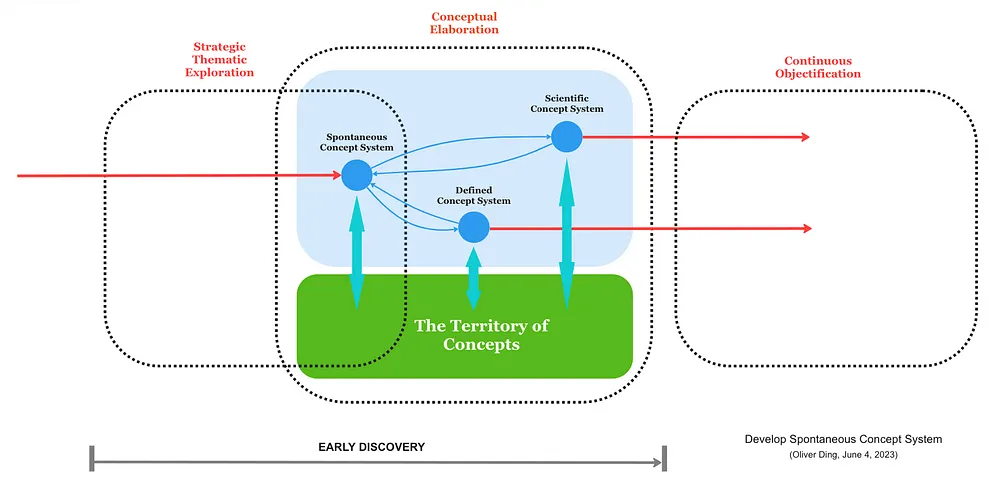
I described this elaboration using three dimensions: a Mental Platform, the cognitive side; a Behavioral Network, the social, interactive side; and a Material Container, the material side — developing a concept system, on this path, is never purely a matter of thinking; it is also doing, saying, and making.
Empirical Researchers, further along the path, work on turning a Primary Knowledge Framework — the END of the enterprise — into something more developed, supported by Secondary Knowledge Frameworks that function as MEANS.
Theoretical Researchers, at the path's far end, arrive at abstract, high-level theory: Theory, in the fullest sense.
Where Kegan's Path 1 starts with abstraction and moves toward application, this case — Path 3: The Bottom-up Approach — starts with lived experience and moves toward abstraction.
4.4 The House of Knowledge Discovery: An Adaptive Case
In August 2024, I mapped a fourth case with a tool called The House of Knowledge Discovery, built around a Castle and Forest metaphor: four small circles, each a castle, inside one large circle, a kingdom, with the space outside the large circle standing for the forest. The circles represent subjective, personal knowledge; the forest represents objective, public knowledge shared by a wider field.
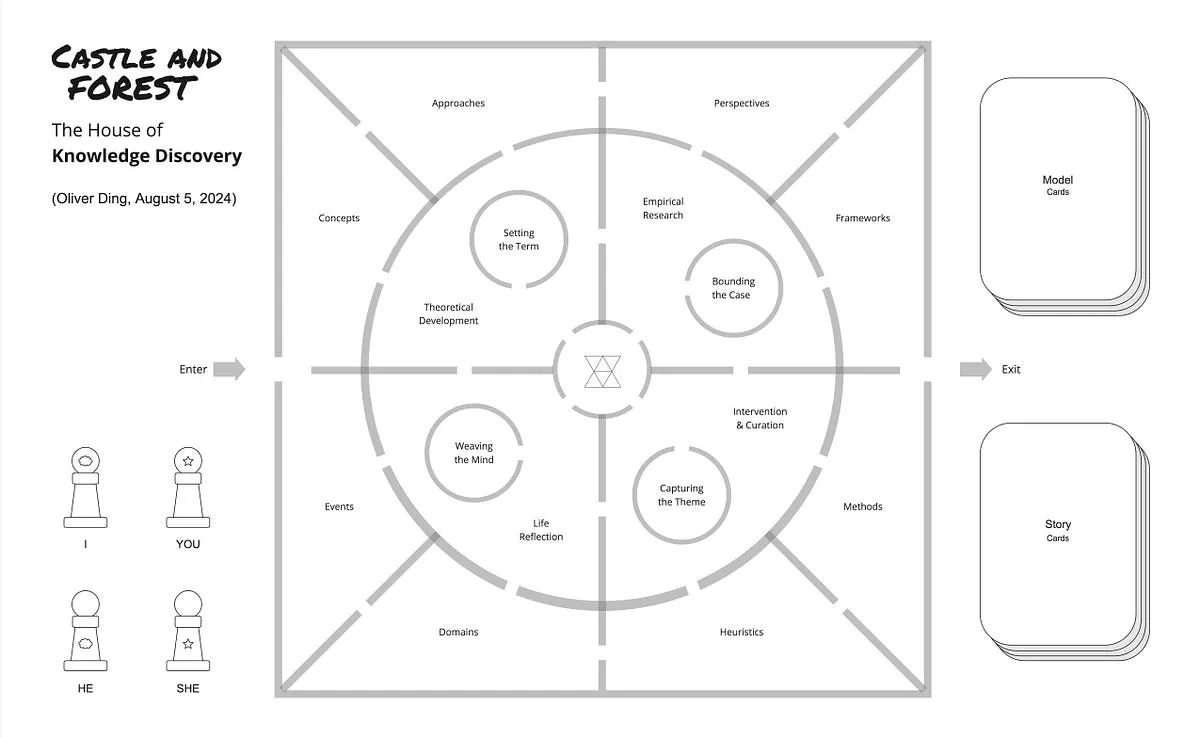
Between May and August of that year, I used this tool to track how I developed the idea of a "Social Landscape" — watching it move from a loose creative theme into a full theoretical concept over the course of the Project Engagement (v3.1) work. The resulting diagram recorded fourteen separate movements, moving from END to MEANS, then to PRACTICE, and finally to THEORY — not a straight line in any one direction, but a sequence in which each stage built on what the one before had turned up, continually revising the shape of the whole as it went.
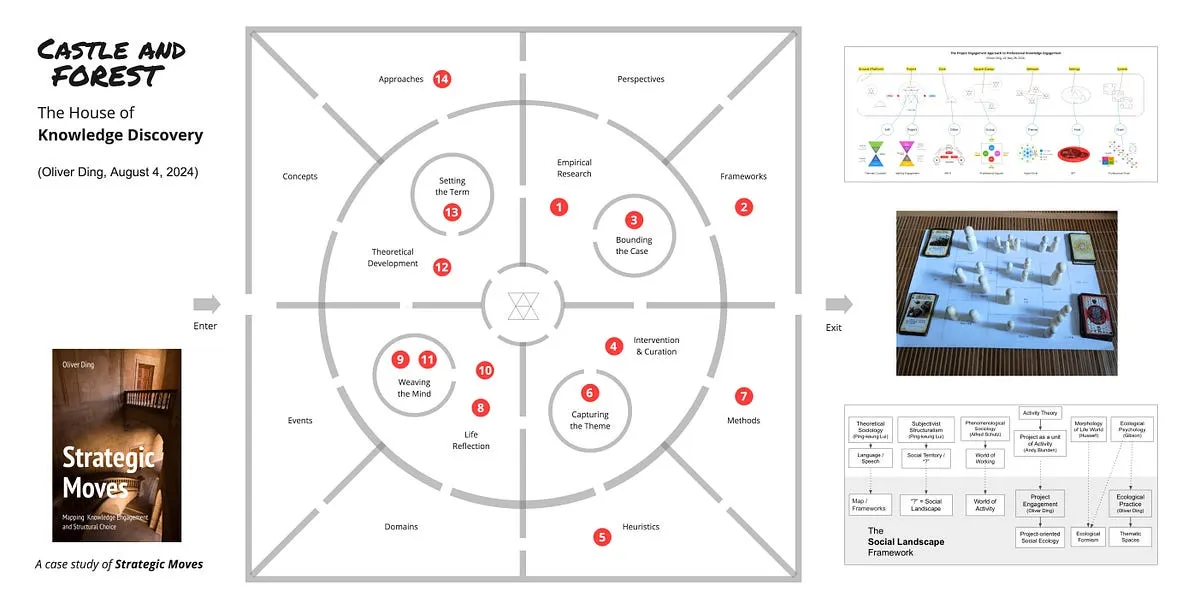
This is Path 4: The Adaptive Approach — a case that sits between the other two, not committed to moving strictly top-down or bottom-up, but blending both as the work demands.
4.5 Paths Are Not Fixed
These four are not exhaustive, and they are not all the same size. A new path can turn up in work not yet examined this way — mapping a later version of my Ecological Strategic Cognition framework, I traced an eleven-node trajectory that did not simply repeat any of the four above.
And a path need not span years to count as one: reflecting on three days in January 2022, I found my own attention moving from the Heuristics block to the Approaches block, and from there into a new Projects entry.
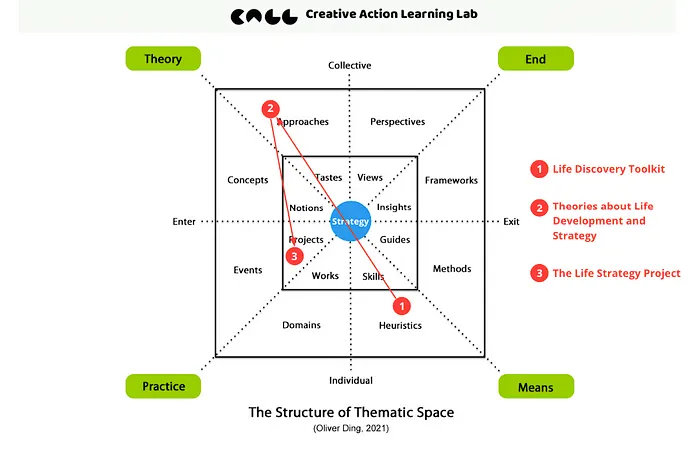
Three nodes, not a lifetime, but still a Path in the same sense Kegan's was.
More details can be found in Thematic Space Theory: One Map and Four Paths.
Part 5: Social Move Cases
3.5 left an open question: whether any shapes recur across the two-subject map the way Path 1 through Path 4 recur across the one-subject map. Answering that question starts here, the same way it started for KDC in 2022–2024 — not by deriving shapes in advance, but by laying down several individual trajectories and letting whatever recurs make itself visible. As in Part 4, each trajectory is read Episode by Episode: an orientation on Ap-Re-Pro-Co, like an Object on KDC, can hold one Episode or several, distributed however the relation actually unfolded.
Four trajectories follow. They are not equally long, equally documented, or equally resolved — and that unevenness is left visible rather than smoothed over. A Social Move Path, like a Mental Move Path, can be a single point or a multi-decade arc; what matters is that each is read from the material it actually has, not filled in to match the others.
5.1 Tony: The Shortest Path
In December 2023, I had a short exchange with a friend I called Tony, a C-suite executive developing a ranking tool he called the Likert 7 project. We met in Z5 — THEORY, my Area, and MEANS, his. Tony was direct about the shape of the exchange: he wanted to focus on developing his tool, and my theoretical resources, in his words, did not currently provide much assistance to his project.
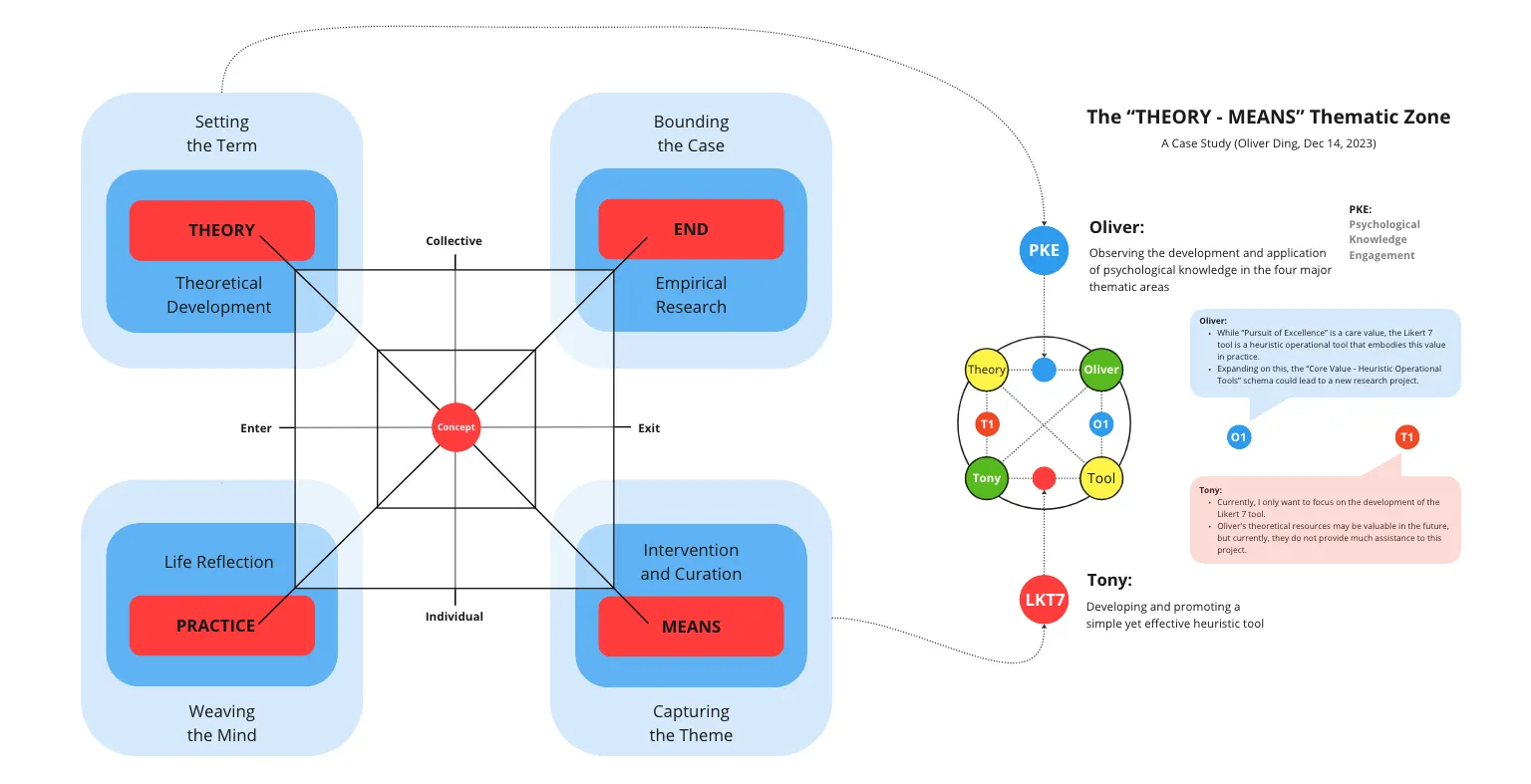
Read on the Ap-Re-Pro-Co map, this barely traces a path at all. Tony stayed oriented toward his own object — the tool itself — throughout; I stayed oriented toward mine, curious about what his project might illustrate about a "Core Value—Heuristic Operational Tools" pattern, but not drawn toward his object as an endpoint, nor him toward mine. No shared container ever formed.
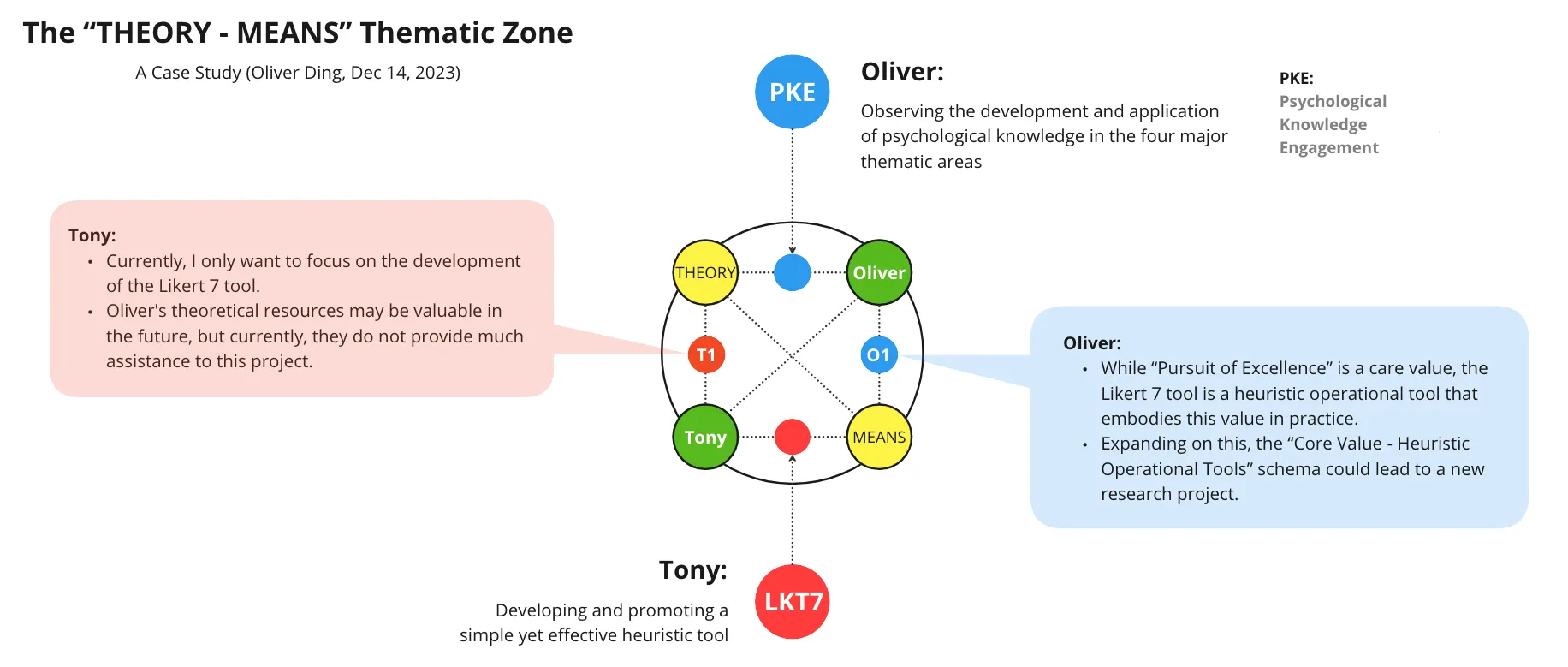
Both of us remained Outside, each toward our own object, for the entire length of the exchange. If a Path needs at least two points to show movement, this one barely qualifies — a single position, held, and then the exchange ended.
5.2 The Counseling Platform: A Chain Without Resolution
In 2023, I mapped a Psychological Counseling Platform as a chain of seven roles — Influencee, Supporter, Founder, Supervisor, Counselor, Client, Follower — using the Activity Circle model rather than KDC, with Clan, Hierarchy, Market, and Network standing in for the four Thematic Areas. Each adjacent pair in the chain forms its own two-person relation, and the chain as a whole suggested that a Social Move Path need not stay confined to one dyad — it can run through several, end to end.
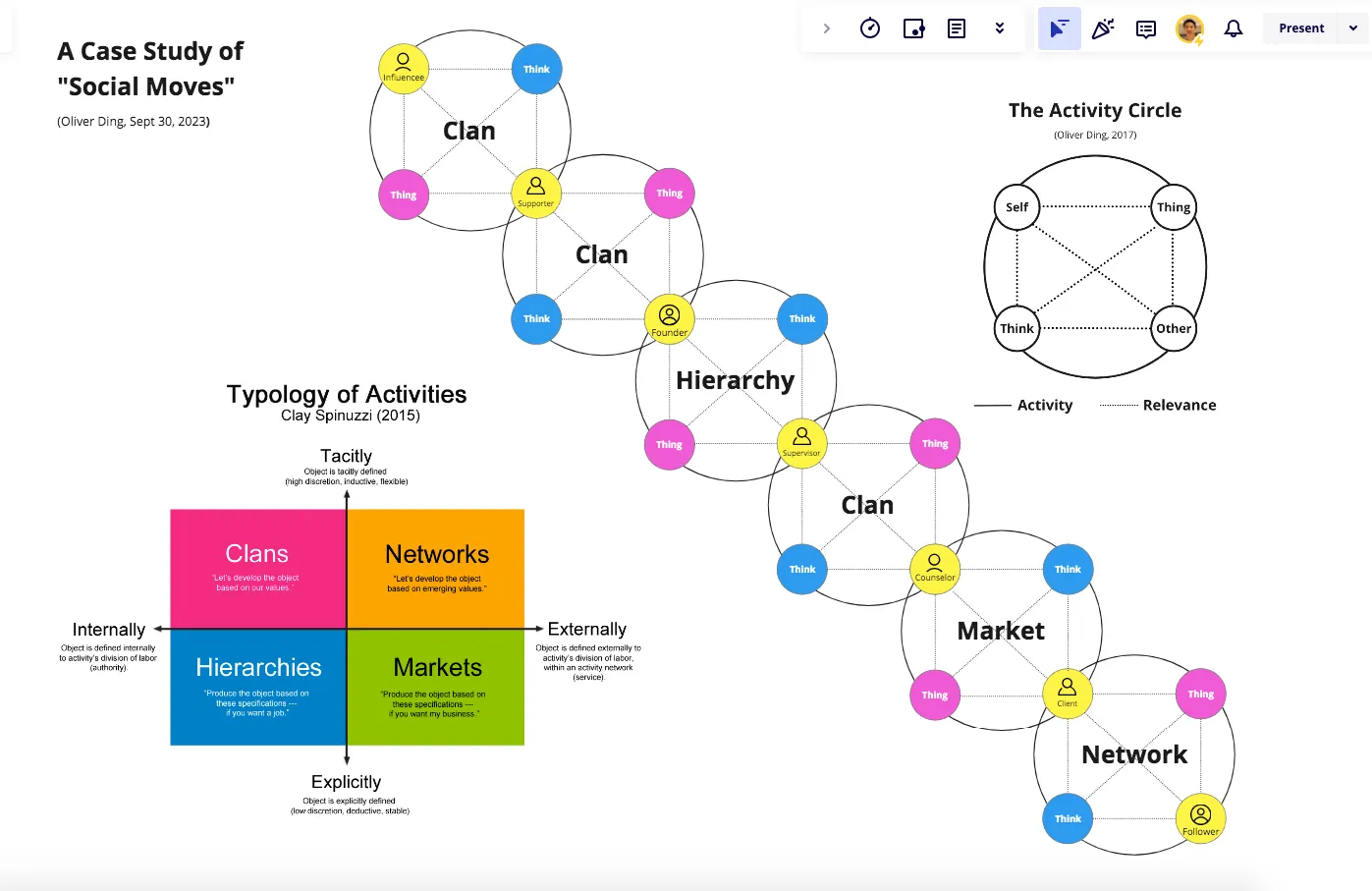
That analysis, however, predates Ap-Re-Pro-Co by three years. It records who occupies which position in the chain, and what kind of Area each position belongs to, but it does not record how any adjacent pair was actually oriented toward each other — whether any of the seven links ever moved Inside, or stayed Outside throughout. The case establishes that a chain-shaped Social Move Path is structurally possible. It cannot, on its own, say what shape any one link in that chain actually took.
5.3 The van Gogh Brothers: A Path That Crosses Inside
The longest and best-documented trajectory available is not one of my own projects. In August 2026, I published a case study of Vincent and Theo van Gogh, using their eighteen-year correspondence — 659 surviving letters from Vincent, 46 from Theo — to trace a Subject-Subject(Subject-Object) relation across its full lifecycle. Unlike the two cases above, this one crosses from Outside into Inside, stays there for most of a decade, and eventually shows what happens to an Inside relation under strain.
Five phases emerged from the letters themselves, not from a plan laid down in advance. Each phase named below is itself a temporal aggregate — a stretch of years, not a single Episode. Within any one of them, the correspondence holds many smaller Episodes: individual letters, individual acts of support, individual exchanges of work and criticism. What follows works at the grain the published case resolves them to; a finer reading could subdivide any phase further, the same way Kegan's THEORY years could be split beyond the two Episodes 4.1 gave them.
From 1872 to 1880, both brothers were finding their footing in the art trade — Vincent at Goupil's branches in The Hague, London, and Paris; Theo following the same path a few years behind. Their objects pointed the same direction without yet converging on anything held in common: two parallel trajectories, still Outside, each toward his own unsettled object. This phase ended only when Vincent, after a failed turn to religious work, committed to becoming an artist in 1880 — the first time either brother's Object stabilized.
From 1880 to 1885, a shared container formed. Theo's Object became, specifically, Vincent — not Art directly, but Vincent's development as an artist. He sent a monthly allowance, materials, and encouragement; Vincent worked. The relation had crossed Inside, but asymmetrically: this is what the case calls a Nested structure — one person's Object being the other person, rather than the same external thing (a distinction that case draws for its own purposes; this article has not needed it elsewhere). Theo, from inside the shared container, held Vincent's flourishing as the whole he was oriented toward; Vincent worked on Art largely on his own terms, sustained by, but not answering to, Theo's involvement.
From 1886 to 1888, Vincent moved into Theo's Paris apartment, and the nested structure deepened rather than changed shape. Theo's support stopped being only financial: his own network — dealers, painters, the Paris avant-garde — became the platform through which Vincent's work developed. The Object was still Vincent; what changed was how much of Theo's own Circle got pulled into sustaining it.
From 1888 to 1889, Theo attempted something the first two phases hadn't required: he brought a third party into the container. He arranged for Gauguin to join Vincent in Arles, hoping to grow the two-person structure into something larger. For a few months, this created a second, different kind of Joint Center alongside the first — Vincent and Gauguin, both painters, both oriented toward the same external object, Art, in what the case calls a Co-Oriented structure, distinct from the nested one that still held between the brothers. The expansion did not hold. Tension between the two painters escalated, and the phase ended with Vincent's breakdown and Gauguin's departure. The nested structure between the brothers survived; the co-oriented one collapsed.
From 1889 to Vincent's death in 1890, the nested structure remained in place, but its content changed. Vincent's capacity to sustain his own side of the relation — his ability to work, to be the artist Theo's Object depended on him being — was eroding. Theo kept supporting him, but the container was no longer holding a creative collaboration; it was holding a person in crisis.
Read as a single Social Move Path, this trajectory starts Outside (Phase 1), crosses into Inside and stays there for the rest of its length (Phases 2 through 5), survives one failed attempt to expand what it was carrying (Phase 4), and ends not by leaving Inside again, but by the Object inside it — Vincent's own capacity — giving way. None of the four scales from 3.4 fully capture it alone: read as a Project, it is the failed Gauguin experiment; read as a Journey, it is eighteen years of one brother sustaining another's Center; read against a wider Landscape — the pattern of Curator-Creator pairs across many creative lives besides this one — it is a single instance of something considerably more common.
5.4 Martin: A Path That Crosses Back Out
The fourth trajectory cannot be shown in the same detail; the material is not public, and I refer to the other party only as Martin. What can be said, briefly, is its shape. It began, like the van Gogh case, by crossing Inside — a specific joint output, produced together and explicitly treated by both sides as shared, not belonging to either alone. For a period of roughly a year, this arrangement held, oscillating between working together and each attending to a separate part of the same whole, but never leaving Inside.
What makes this trajectory worth including, despite its brevity here, is what happened afterward, which none of the other three cases show: the path did not simply end or stay put. It moved back out. Over roughly two years, exchanges that had been together started arriving instead as one-sided documents — the other party's own material, processed through an AI tool, resynthesized, and returned. Each occurrence, on its own, could be read as an ordinary act of engagement. Read as a sequence, they trace a specific direction: away from together, through toward whole, and settling, by the end, on toward subject — the other party's output increasingly treated as material for a project whose endpoint was no longer shared.
This last trajectory is the reason Part 6 exists. Nothing in the van Gogh case, the Counseling Platform, or Tony's brief exchange shows a relation moving back out of Inside once it has genuinely arrived there. Martin's case does — and it does so by a specific mechanism, tied to a specific tool, that the next Part takes up directly.
Part 6: Models
6.1 What TST Leaves Open
Thematic Space Theory, read at the level Part 1 set out, handles the relation between Map, Moves, and Models as a general architecture — but it does not choose, in advance, which Model to bring to a given Zone. A Thematic Zone, in the 2023 book's own words, is an "interpersonal social interactive space," a term Part 2 has already used to name where two Areas meet. What a Zone actually looks like in detail depends on which Model gets brought in to read it — and different Models are built for different depths of detail, not ranked against one another.
6.2 Three Models
Three Models have been brought to a Thematic Zone at three different points, each suited to a different task.
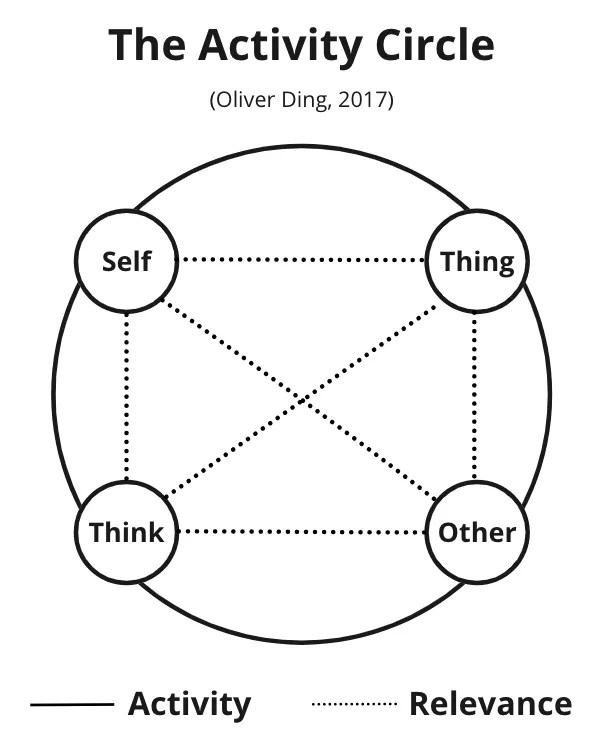
The first is the Activity Circle — the Self-Other-Thing-Think structure already used to read the Psychological Counseling Platform in 5.2. Read through this lens, a Thematic Zone becomes a Thematic Circle: a recognizable shape, the same shape any activity has. This is exactly what Activity Circle is for — recognizing that a Zone is a structured activity at all, not describing what makes one Zone different from another.
The second is the ARCH framework, the source of "Thematic Zone" itself — five stages for the development of an interpersonal relationship, the third of which, Think Together, is organized around Relevance. Reading a Zone through ARCH places it somewhere along this developmental arc — useful for knowing roughly how far a relationship has come, in terms neither Activity Circle nor a bare Zone label supplies. This, too, is what ARCH is for: staging, not the interaction detail within a given stage.
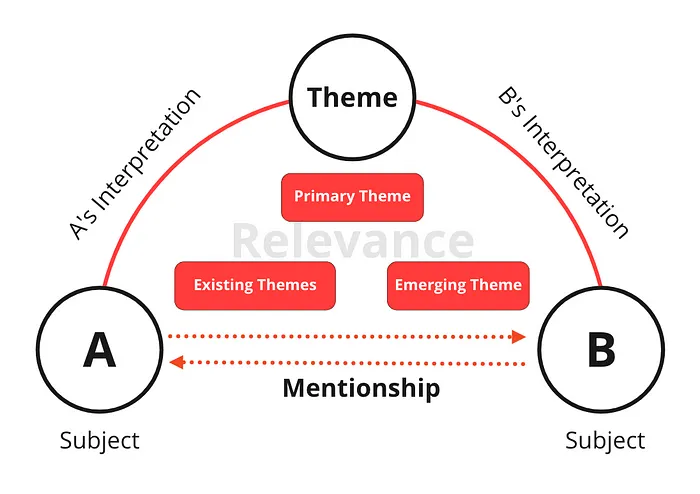
The third is RelationField, the framework this article has been building since Part 2. It is suited to a different task again: not recognizing the shape of a Zone, and not placing it on a developmental arc, but examining the specific interaction detail inside it — a dimension-by-dimension state (R-S-N-C), a specific direction on Ap-Re-Pro-Co, a specific Episode among however many, read temporally or spatially. Where the earlier two Models answer "what kind of thing is this" and "how far along is it," RelationField answers "what, exactly, are these two people doing with each other, right now."
6.3 What Parts 4 and 5 Already Did
This is the task Parts 4 and 5 were already doing. Kegan's Episodes, broken out in 4.1 and re-read spatially in 3.7; the van Gogh brothers' five phases, each read for its own specific orientation rather than assigned one label for all eighteen years — both needed the third kind of Model, because the question being asked was the third kind of question: not what shape, not how far along, but what exactly, Episode by Episode. Activity Circle and ARCH were never going to answer that question — not because they fall short, but because it was never the question either was built to answer.
6.4 Why Martin's Circle Stopped Completing
Martin's case needs this third kind of Model most directly, because it asks not just where a relation sits, but why a relation that had reached Inside stopped staying there — a question about specific mechanism, which is exactly RelationField's territory.
Thematic Space Theory already has a name for the basic movement a Subject makes toward and away from a Thematic Space: Attach, and Detach. A Subject attaches to a space — takes it up, works within it, lets it shape what they do — and detaches from it, returning to whatever independent position they started from. Read this way, an Inside orientation is not a single fixed posture held constant for as long as it lasts. Together, toward part, toward whole — all three are made of the same underlying pair of moves, cycled continuously: each subject attaches to the shared whole, or to the piece of it the other holds, and detaches back to their own independent Object, over and over, for as long as the relation stays Inside. A Thematic Circle, in this operational sense, is what this cycle looks like when it completes, from both sides, each time — neither party permanently absorbed into the other's Object, neither party permanently withheld from it.
A circle can fail at either half. It fails at Attach if a party stops engaging with the shared whole at all — a simple return to Outside, already covered by 2.5. It fails at Detach differently, and more quietly: a party keeps attaching to the other's material, but stops returning it as still theirs. What enters gets kept. This is what happened, gradually, in Martin's case. Material that had been produced together started being taken up by one side, processed, and returned — not handed back as the other party's own contribution, restated or engaged with, but folded into a document the returning party now treated as their own synthesis. Each single instance of this was easy to read as ordinary collaborative behavior. It was only visible as a broken circle in aggregate, once the direction stopped reversing.
6.5 What This Closes
Castle and Forest's Part 5 named two gaps, and left a third implicit. Chapter 29 could say where two creators met, but not whether the meeting had crystallized into anything held in common — closed by the Subject-Subject(Subject-Object) formula in Part 2.
Chapter 30 could show a Path, but only Kegan's, and only as an outline — closed by eight Episode-by-Episode cases across Parts 4 and 5.
The implicit third gap was never named as a gap at the time, because it was never a gap in the ordinary sense: Activity Circle and ARCH each said something true and useful about a Zone, just not the operational thing this article needed said. RelationField supplies that — not by replacing either earlier Model, but by being the Model built for this specific task.
Part 7: RelationField in Context
Everything so far has stayed close to one map, KDC, and the two kinds of Moves it supports. This Part steps back far enough to show where that map, and RelationField itself, actually sit.
7.1 Social Landscape
Relationfield did not arrive without a history of its own. In 2024, working on Project Engagement (v3.1), I developed a tool called The House of Project Engagement — a Map built around a Museum metaphor, with twelve Thematic Rooms (Before, Role Models, Ideas, Possible Project, Meet with Others, Actual Project, Settings, Supportive Platform, Public Square, Network of Project, Conflict, After) representing different types of social structure. I named this group of rooms Social Landscape, and organized the whole approach under a "Map — Move — Model — Method — Meaning" schema, with Method the practice of using the twelve rooms to map a life course or creative journey, and Meaning the reflective discovery that practice supports.
In March 2025, reading a friend's case study of a twenty-year school-community partnership, I recognized this kind of long-running partnership as an instance of Social Landscape, and built a three-level map to discuss what I called Supportance-based Development. That map echoed an earlier model, Project Network, first sketched in early 2022: a network of Themes (theoretical approaches and frameworks), a network of Projects (real activities — a toolkit, a canvas, a program), and a network of People (biography and social ties). By early 2025, Social Landscape and Project Network were two related but separately built accounts of the same territory — one organized around twelve rooms, the other around three networks.
At the time, I analyzed that partnership using three levels — Thematic Space, Social Landscape, and Project Engagement — and read it through both Mental Moves and Social Moves.
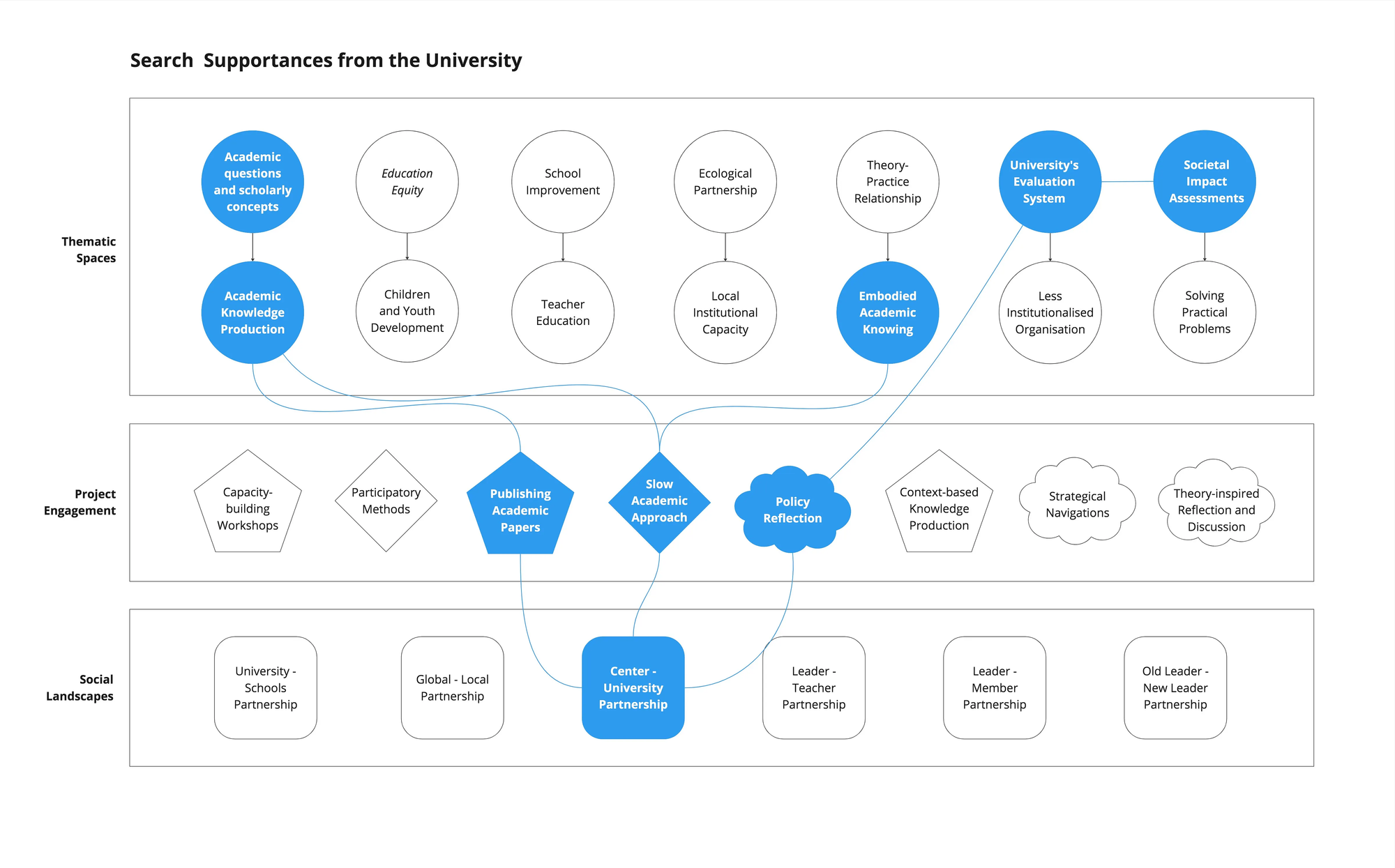
But the Social Landscape half of that reading rested on a narrower concept: Platform-ship, first named in a 2021 book draft, Platform for Development, which described exactly this kind of arrangement — a platform sustaining many people's development over an extended stretch of time — without yet supplying the operational detail RelationField now provides. What I could say then was that the partnership was a Platform-ship, a form of Social Landscape. What I could not yet say was which specific Subject-Subject(Subject-Object) kernel sat at its center, which Ap-Re-Pro-Co orientation it held at any given point across its twenty years, or how its Episodes distributed across that span. That fuller reading is available now.
RelationField, arriving in June 2026, is what let this territory be read as a single model rather than two. Two days after it was formalized, this project's structural line was placed against HLS, and an alignment emerged — not a replacement, but a correspondence on one specific dimension: Social Landscape, a macro-scale region of HLS, found its Gejunction-scale counterpart in RelationField.
That alignment made something else visible almost immediately.
The March 2025 map, Supportance-based Development, was named and organized around Supportance from the start — and Supportance is also one of RelationField's own four dimensions, S in R-S-N-C. The correspondence registered as cleanly as it did partly because this specific piece of Social Landscape had already been built around the concept RelationField would later formalize as one of its own coordinates.
7.2 Gejunction
Both Thematic Spaces and Relationfields belong to Gejunction — the basic unit of synthesis at the center of this project's wider theoretical home, GO Theory.
GO Theory is a short name for the World of Life (World of Activity) Approach — a name that is itself a container-nesting construction, with the individual scale as its inner core and the macro, societal scale as its outer periphery.
Four key concepts define the structure of World of Life:
- Symbolic Universe = Cultural System ∩ Historical System (outside subjective experience).
- Social Territory = Mental System ∩ Behavioral System (inside subjective experience).
- Thematic Space = Cultural System ∩ Mental System (a place for a concept in your mind, where all concepts originate from the Cultural System).
- Social Landscape = Historical System ∩ Behavioral System.
Gejunction is not that structure; it is the bridge connecting that macro scale (also called World of Life) to the micro scale of a single person's activities (also called World of Activity).
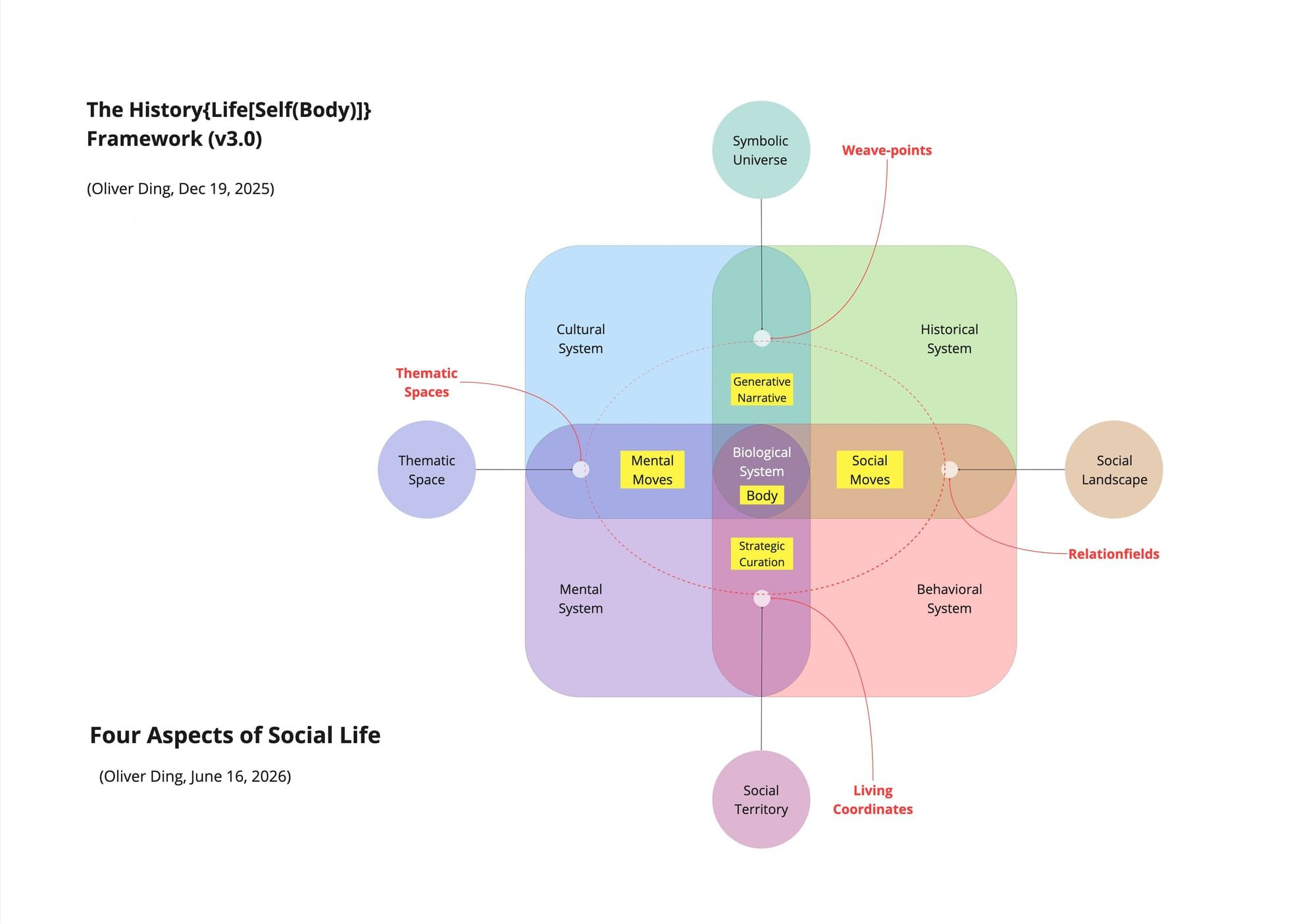
Each of Gejunction's four aspects corresponds to one World of Life region and its mechanism, but the aspect and the region it corresponds to are not the same thing:
- Weave-point, it represents the symbolic aspect. Each weave-point marks a theme or concept, functioning as a concrete tool for expressing the Symbolic Universe; each theme or concept, in turn, links onward to a Thematic Space (corresponding mechanism: Generative Narrative).
- Living Coordinate, it represents the territorial aspect, within Social Territory (corresponding mechanism: Strategic Curation).
- RelationField, it represents the relational aspect, within Social Landscape (corresponding mechanism: Social Moves).
- Thematic Space, it represents the thematic aspect (corresponding mechanism: Mental Moves).
Two of the four aspects are what this article has been about: Thematic Space, tied to Mental Moves, is where KDC and Part 4's Mental Move Paths belong; RelationField, tied to Social Moves and now aligned with Social Landscape on this one dimension, is where Part 5's Social Move Paths belong, and where Part 6 explains what happens when one of them breaks. The alignment this article has traced throughout — Mental Moves read on one map, Social Moves read on another, the two together — is not a device built for this article alone. It is how Gejunction is actually structured.
The other two aspects, Weave-points and Living Coordinates, do not appear in this article's cases and are not needed here — each is its own knowledge system, with its own developmental history, covered elsewhere.
Seen this way, this article is also an answer. In February 2025, when Castle and Forest was published, it was the second installment of a planned trilogy — alongside Knowledge Strategy: The Ecological Strategic Cognition Framework, published a month earlier, and Wonder and Wander, completed that June, exploring an Evolving Knowledge Enterprise model. Neither Gejunction nor RelationField existed yet when any of the three were written. RelationField, arriving in 2026, is what lets this one part of that trilogy finally be read at the resolution this article has used throughout.
Postscript
KDC is one example of a Thematic Area set — the one this article has used throughout, because Knowledge Engagement, and specifically Castle and Forest's unfinished Part 5, is what needed patching. It is not the only Area set available, and Knowledge Engagement itself is not a single topic KDC's four Areas can exhaust. I have mapped other domains with their own Thematic Areas before — enterprise innovation, for one, resolves into well over a dozen — and nothing in this article depends on KDC being the only map of its kind.
What generalizes beyond KDC is not the four Areas themselves, but the method Parts 2 through 6 put together: a combined Social-Move/Mental-Move analysis, grounded in RelationField, read Episode by Episode. Any domain that can define its own Thematic Areas — its own map — can be read this way. KDC supplied the map for this article. The method does not depend on it being the only one.
Nor is RelationField the only model this project has developed for interpersonal interaction. Social Landscape and Project Network, described in 7.1, are two others, and there are further ones besides. RelationField is not privileged among them by design. It happens to support the most detailed analysis of the four cases in Part 5, and that is a function of the material available for each — Vincent and Theo left eighteen years of letters; Martin's case, though private, spans several years of documented exchange. A case with less material to work from would not automatically call for RelationField over an older model; it would call for whichever model the material actually supports.
v1.0 - September 10, 2026 - 10,550 words