
Creative Diagramming: The House of OODA Dynamics
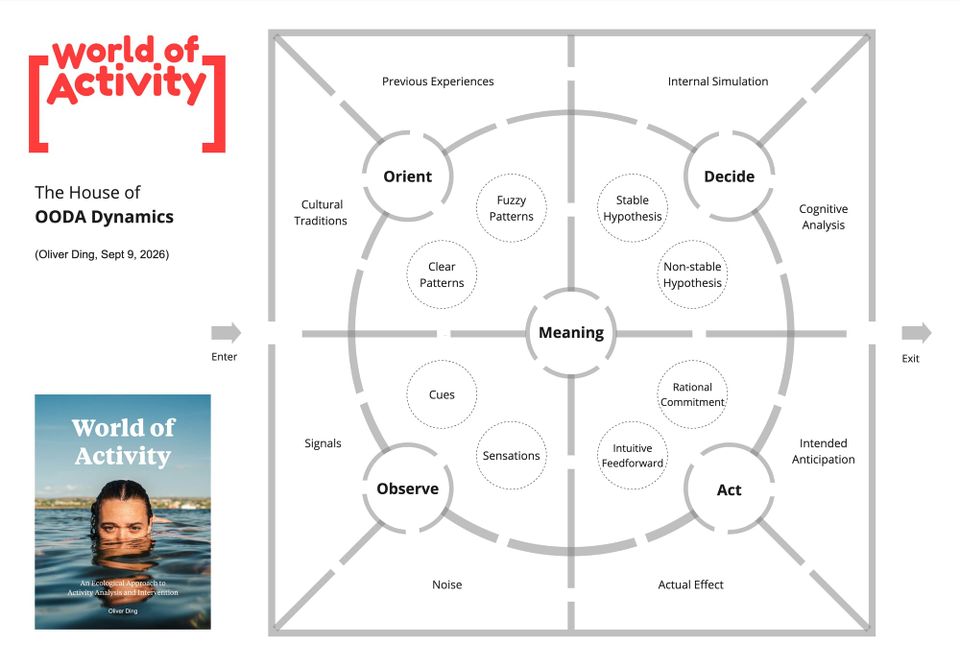
A new thematic map
by Oliver Ding
September 9, 2026
This article is part of a series of posts that introduce a new series of thematic maps for the World of Activity Approach, especially the FFCC model (Flow-Focus-Center-Circle).
- The House of World of Activity
- The House of Center Dynamics
- The House of Focus Dynamics
- The House of Flow Dynamics
This article focuses on the OODA map: The House of OODA Dynamics.
Introduction
Yesterday I had a short chat with a friend who is an OODA researcher. Inspired by the conversation, I revisited a paper he published several months ago. While reading his theoretical discussion around the OODA model, I wondered if the map could be used to represent the OODA loop.
Then, I opened the file on Miro.com and modified an old map, replacing four words on four circles with Observe, Orient, Decide, and Act.
However, I realized that I don't know the OODA knowledge system well enough—I couldn't immediately find sixteen themes to fit the map. So, I returned to the World of Activity approach and changed the map to represent the dynamics of Focus, a key member of the FFCC model. That became The House of Focus Dynamics.
But the OODA question stayed with me.
Later, I read the paper more carefully—Beyond Doctrine: Harmonizing Meaning in Military Planning by Johan Ivari and Annette Nolan. It offered a rich interpretation of Boyd's work, grounded in the Harmonization Emergence Model (HEM) and the Set-based Approach (SbA). The paper treats Boyd's OODA not as a simple decision cycle, but as a theory of enactive cognition—a recursive process of meaning-making through action and interaction.
That reading gave me enough material to return to the OODA map. This time, I built it from the ground up, using the paper's concepts and Boyd's own framework.
This is not to propose a new diagram for the OODA community, but a learning process with creative diagramming. If you are not familiar with OODA, please refer to its Wikipedia entry as a general introduction, or see its original source: “The Essence of Winning and Losing” (Boyd, 1996).
The OODA Process
The OODA "loop" is frequently misunderstood. As Richards (2020) notes, "Boyd never drew it like this in any of his works"—the common circular and linear versions neglect its depth, detail, and recursive nature. Boyd's original sketch is significantly more complex.
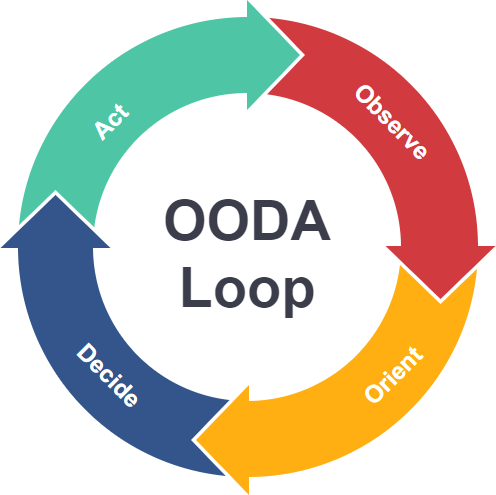
In the interpretation offered by Ivari and Nolan, OODA is fundamentally about how humans and organizing entities learn and unlearn—how we make and break mental patterns to see anew and produce novelty.
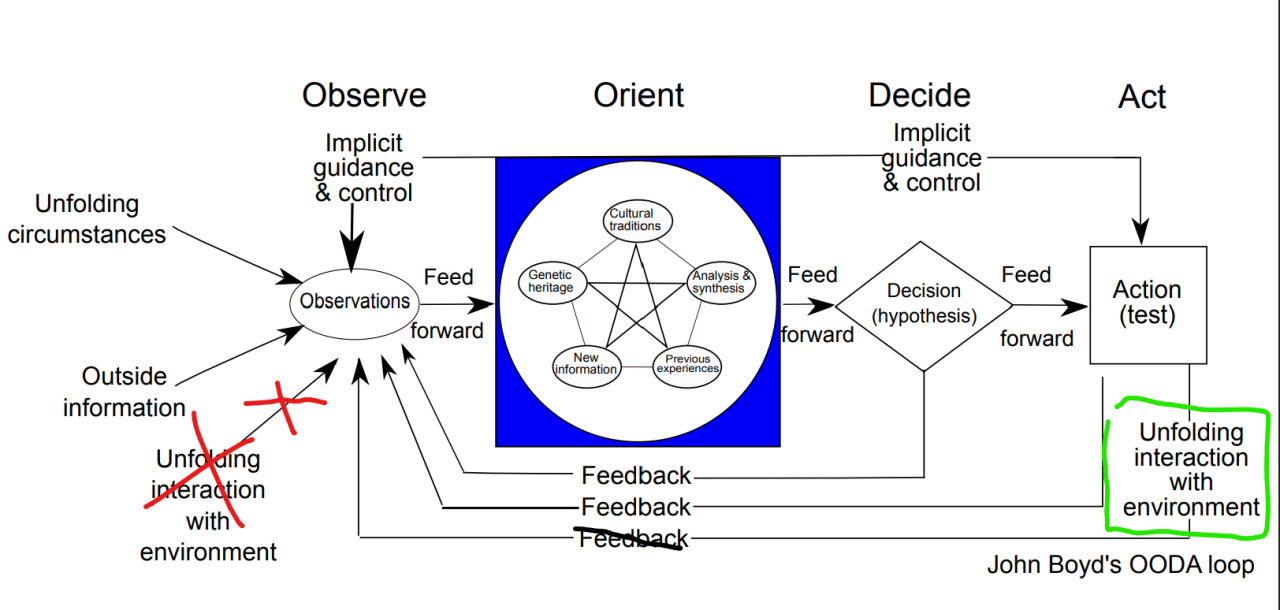
Observe encompasses all sensations—whether external or internal, known or unknown—that produce continuous afferent signals. These signals feed into Orient, where perceptual synthesis occurs. This is the core of the OODA process. Meaning emerges as the output-synthesis from Orient, manifesting either as an intuitively recognized mental pattern that results in action through implicit guidance and control (feedforward to Act), or as a less clear mental pattern that requires further internal-mental or cognitive simulation or analysis in Decide. Once a hypothesis is stable enough, it is tested through interaction with the external shared environment in Act. After acting, two types of feedback are received: whether the action unfolded as anticipated, and whether it had the intended effect.
In his interpretation, Ivari connects the OODA loop to the concept of cognitive dissonance—an extension that is not part of Boyd's original framework. He writes:
When applying the OODA loop to understand personal meaning-making, we refer to the discrepancy between these feedback signals as 'cognitive dissonance' (Festinger, Riecken, & Schachter, 1956), that is, the difference between the intended effect and the actual outcome.
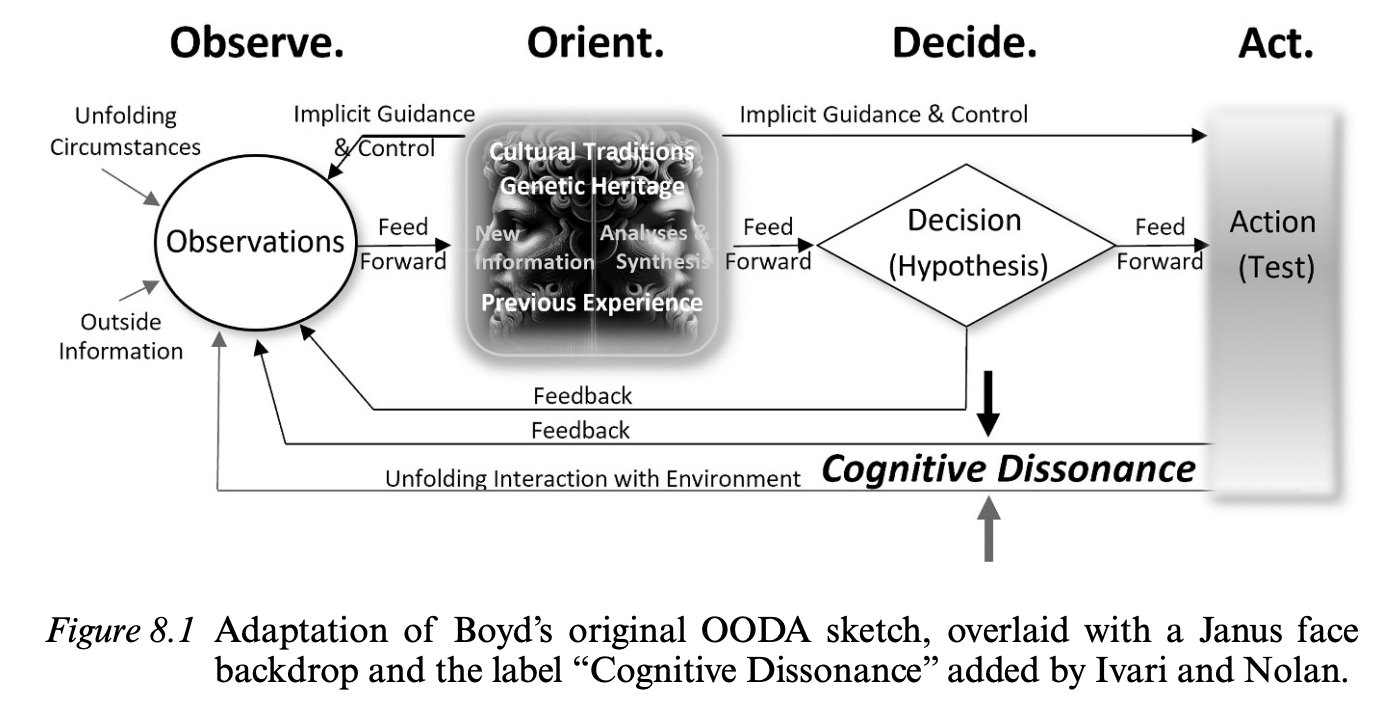
Readers interested in Boyd's original sketch should refer to "The Essence of Winning and Losing" (Boyd, 1996). The OODA Dynamics Map presented in this article was designed based on Ivari's paper.
The Map
The House of OODA Dynamics follows the same visual architecture as the previous maps in this series—a square containing a circle, divided into four thematic areas. Each area contains both an Outside layer and an Inside layer.
The four areas are Observe · Orient · Decide · Act—the four stages of Boyd's OODA process.
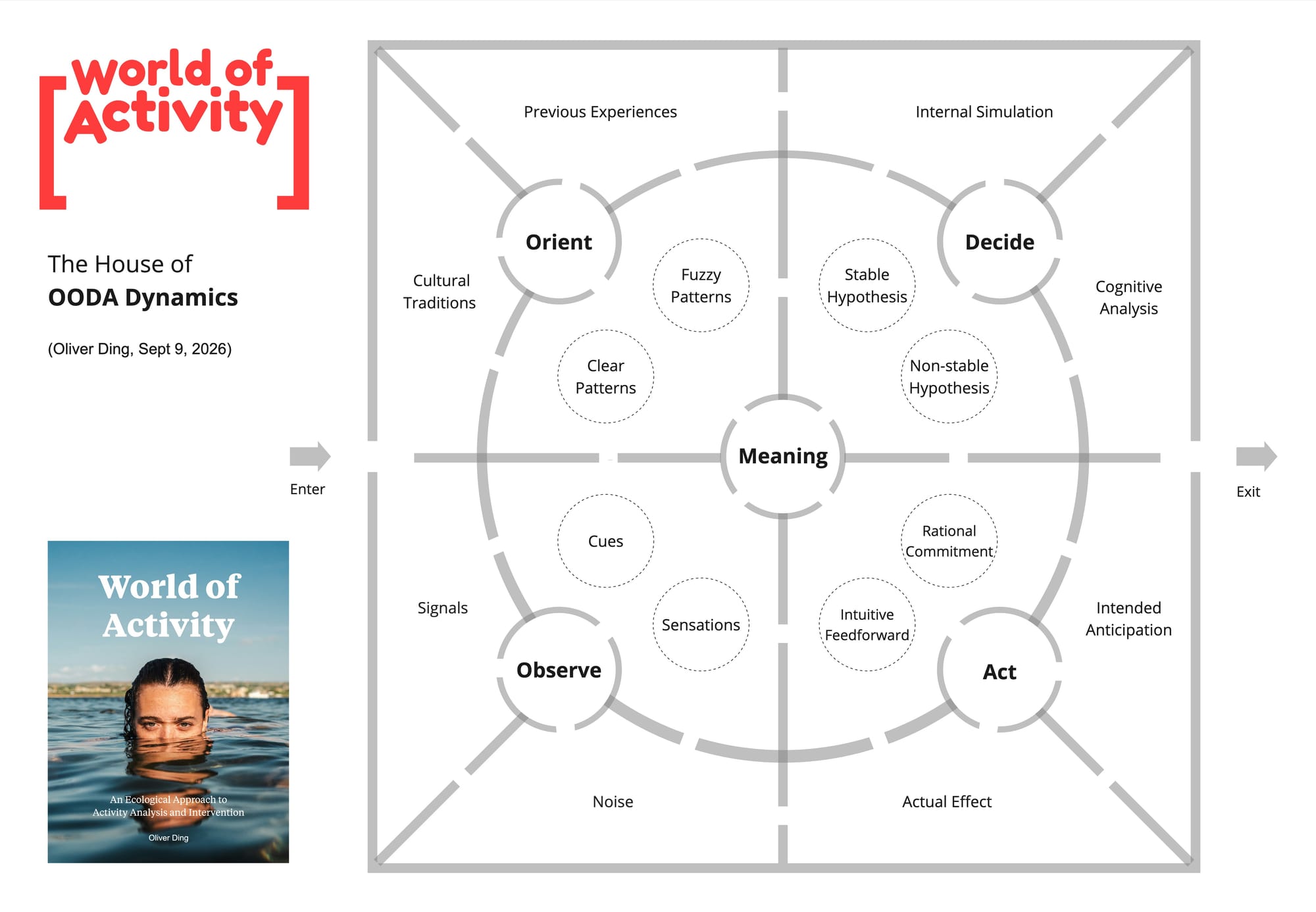
Compared with Boyd's original sketch, it is obvious that this map does not clearly show the connections between the various processes. This is a limitation of my thematic map series: they only present the core concepts of a framework, placing these concepts in thematic rooms, without carefully drawing the connecting lines between them. Readers need to move between the different thematic rooms themselves and fill in these connections on their own.
This is why I sometimes call these thematic maps "walk-through museums for XX"—you need to imagine yourself moving between the different rooms.
A note on terminology: while the four areas—Observe, Orient, Decide, and Act—come directly from Boyd, not all of the sixteen themes placed within them are his original terms. Some are my own constructions, developed through the process of building this map. They are intended as interpretive tools to help articulate the cognitive objects that move through the OODA process, not as claims about Boyd's exact vocabulary.
The Center: Meaning
At the very center of the map—inside the circle, at the heart of the four areas—is a small circle containing the word Meaning.
This is not an arbitrary placement. It reflects Boyd's own understanding of the OODA process.
In Boyd's framework, Orient is the core. The other three stages—Observe, Decide, Act—are oriented around it. And the output of Orient is meaning:
"As meaning emerges as the output-synthesis from Orient..."
Boyd did not treat meaning as a separate stage or a final product. He treated it as what emerges from the process of orientation—the synthesis of cultural traditions, previous experiences, and genetic heritage into a coherent understanding of the situation. Meaning is not something we find; it is something we generate through the act of orienting.
But meaning is also what the entire OODA process serves. We observe to gather signals that feed into meaning. We decide to test hypotheses that are grounded in meaning. We act to see if our meaning holds up against the world. And we receive feedback that either confirms or disrupts our meaning.
The placement of Meaning at the center of the map makes this visible: OODA is not a decision cycle. It is a meaning-making cycle. Its purpose is not merely to act faster, but to generate better, more adaptive meaning in the face of complexity, uncertainty, and change.
This is why Boyd placed Orient—the site of meaning-making—at the heart of his sketch. And this is why Meaning belongs at the center of the map.
The "Observe" Thematic Area
Sensing the world
Observe encompasses all sensations—whether external or internal, known or unknown—that produce continuous afferent signals. This is the foundational layer of the OODA process: before we can orient, decide, or act, we must first sense.
| OUTSIDE | Signals · Noise |
| INSIDE | Sensations → Cues |
The Outside layer of the Observe area describes what flows into the system from the environment. Signals are the continuous stream of incoming information—external sensory data, internal bodily states, emotional cues. They are always present, always flowing. Noise is the undifferentiated mass of signals that have not yet been parsed as meaningful. Noise is not "noise" in the sense of useless static; it is the surplus of signals that exceed our current capacity to interpret.
The Inside layer of the Observe area describes what the system does with what it receives. Sensations are the raw, pre-reflective contact with signals—the immediate feel of input before it is categorized. Cues are the meaningful fragments that emerge from sensation—details that stand out, anomalies that catch attention, signals that seem to matter. A signal becomes a cue when it is noticed. The movement from Sensations to Cues is the first act of attention: from everything to something.
The "Orient" Thematic Area
Making sense of signals.
Orient is the core of the OODA process. It receives continuous signals from Observe and performs perceptual synthesis—integrating sensory input into a coherent whole. This is where meaning emerges.
| OUTSIDE | Cultural Traditions · Previous Experiences |
| INSIDE | Clear Pattern → Fuzzy Pattern |
The Outside layer of the Orient area describes the two constraints that shape perception, drawn directly from Boyd's original formulation. Cultural Traditions and Previous Experiences—together with genetic heritage (which Boyd himself acknowledged as problematic)—form the lens through which all signals are interpreted and synthesized into mental patterns.
The Inside layer of the Orient area describes the two cognitive objects that emerge from perceptual synthesis. Clear Pattern is an intuitively recognized mental pattern that can directly guide action through implicit guidance and control, feeding forward to Act. Fuzzy Pattern is a less clear mental pattern that remains ambiguous or incomplete, requiring further internal simulation or analysis in the Decide stage.
The "Decide" Thematic Area
Testing possible futures
When Orient produces a Fuzzy Pattern—a mental pattern that remains ambiguous or incomplete—it enters the Decide stage. Here, the system engages in internal mental simulation or cognitive analysis: testing possibilities, running scenarios, and refining hypotheses. This is the space where we think before we act.
| OUTSIDE | Internal Simulation · Cognitive Analysis |
| INSIDE | Stable Hypothesis → Non-Stable Hypothesis |
The Outside layer of the Decide area describes the two cognitive operations performed in this stage. Internal Simulation is the mental rehearsal of possible actions and their outcomes—running scenarios, playing out sequences, imagining how the world might respond. Cognitive Analysis is the more analytical processing: weighing evidence, comparing options, assessing probabilities. Together, these operations test the stability of emerging patterns.
The Inside layer of the Decide area describes the cognitive objects that are tested through these operations. Stable Hypothesis is a proposed course of action that has been sufficiently tested through internal simulation and analysis—it is ready to be committed to action. Non-Stable Hypothesis is a proposed course of action that remains uncertain, requiring further simulation or a return to Orient for re-synthesis. The recursive loop—from Decide back to Observe, then forward to Orient—continues until a hypothesis becomes stable enough to test through action in the shared environment.
The "Act" Thematic Area
Testing in the world
The final stage of the OODA process is Act. Here, a stabilized cognitive object—whether from Orient or Decide—is brought into the shared environment, tested through interaction with the world, with others, and with the adversary. Act is where meaning meets reality.
| INSIDE | Intuitive Feedforward · Rational Commitment |
| OUTSIDE | Intended Anticipation · Actual Effect |
The Inside layer of the Act area describes the two ways a stabilized cognitive object enters action. Intuitive Feedforward is the path taken by Clear Pattern from Orient—action triggered through implicit guidance and control, without explicit deliberation or articulated expectation. Rational Commitment is the path taken by Stable Hypothesis from Decide—action taken with explicit commitment, carrying a clear anticipation of expected outcomes.
The Outside layer of the Act area describes the two cognitive objects that serve as feedback references. Intended Anticipation is the expected outcome held before acting—present only for Rational Commitment. Actual Effect is what actually happened in the shared environment. For Rational Commitment, the contrast between Intended Anticipation and Actual Effect generates cognitive dissonance. For Intuitive Feedforward, there is no prior expectation to compare against—only Actual Effect itself serves as the raw material for learning, feeding directly back into re-Orientation.
The Inside: A Sequence of Cognitive Objects
Read in order, the Inside themes across the four areas trace the full arc of cognitive objects in the OODA process:
Sensations → Cues → Clear Pattern → Fuzzy Pattern → Stable Hypothesis → Non-Stable Hypothesis → Intuitive Feedforward → Rational Commitment
These eight terms are cognitive objects—the material our minds work with. They are not the operations themselves (sensing, orienting, deciding, acting), but rather the objects that those operations act upon.
The sequence begins in the Observe area with Sensations and Cues—the raw feel of input and the first meaningful fragments that emerge from it.
In the Orient area, we encounter Clear Pattern and Fuzzy Pattern—the two possible outcomes of perceptual synthesis. Clear Pattern is ready for action; Fuzzy Pattern requires further work.
In the Decide area, we work with Stable Hypothesis and Non-Stable Hypothesis—the cognitive objects being tested through internal simulation and analysis. The recursive loop continues until a hypothesis becomes stable enough to act on.
Finally, in the Act area, we encounter the two paths into action: Intuitive Feedforward (from Clear Pattern) and Rational Commitment (from Stable Hypothesis). Act is where these cognitive objects meet the world—and where feedback reshapes them.
Two Kinds of Learning
In working with this map, one thing I have come to appreciate more clearly is the asymmetry between the two paths into Act.
For Rational Commitment, learning is relatively straightforward. The hypothesis is tested against the world. The gap between Intended Anticipation and Actual Effect reveals where the hypothesis was wrong. The model can be adjusted, refined, or discarded. The feedback loop is clear: improve the reasoning, improve the hypothesis, improve the decision.
For Intuitive Feedforward, learning is something else entirely. There is no explicit hypothesis to correct. There is only the pattern that was recognized—or misrecognized—and the action that followed. The feedback is not a comparison between expectation and outcome. It is simply Actual Effect: what happened. The learning is a matter of tuning pattern recognition itself, not modifying a model. And pattern recognition is not adjustable by reasoned reflection. It is shaped by repetition, by exposure, by immersion—by the slow accretion of experience.
This is why Orienting is harder than Deciding, and why Boyd placed it at the center of his framework. Improving intuition is difficult because we are not directly aware of the pattern as a distinct cognitive object to be analyzed and changed. Yet it is precisely intuitive pattern recognition that enables speed, agility, and the capacity to act ahead of the adversary.
Thus, while the map shows a neat symmetry—two inputs, two feedbacks—the underlying dynamics are not symmetrical. Improving reason is a matter of refining a model; improving intuition is a matter of re-forging the lens through which the world is seen.
Reflecting from the "Activity" Perspective
Readers may wonder why I chose these sixteen themes and arranged them this way. Reflecting on this, I realize that my thinking has been shaped by my long engagement with Activity Theory.
When I looked at the OODA concepts, I instinctively classified them into four categories:
- Cognitive operations
- Tool mediation involved in cognitive operations
- Outcomes derived from cognitive operations
- The organizational form of cognitive operations
Given the map's structure, I selected only three of these. The Outside layer shows cognitive operations or tool mediation. The Inside layer shows the outcomes of cognitive operations. The fourth category—the organizational form of operations, which in Boyd's original sketch appears as the connecting lines—is not drawn on this map.
One interesting thing about this categorization: for Activity Theorists, it is entirely normal for the output of one activity or operation to become the tool of the next. This principle of means-end transformation is one of the ways activities are linked to one another.
This "Activity" perspective lens explains why the map is organized as it is. It shows the objects; the process must be reconstructed by the reader moving between the rooms.
Reflecting from the "Thematic Space" Perspective
This map—and the entire series of thematic maps—is designed according to the basic principles of Thematic Space Theory.
According to this theory, every knowledge framework or model can be understood as a combination of concepts. Each concept corresponds to a thematic space, and together they can be represented visually as a set of thematic spaces.
Not all knowledge diagrams are designed this way. Many authors are unaware of this principle or hold no such view. They simply visualize their ideas in their own way.
For Boyd's original OODA diagram, we can clearly identify four core concepts: O, O, D, A—and four corresponding thematic spaces. The internal elements within these concepts, the connections between internal elements, and the connections between the four concepts can all be understood as the internal and external relations of thematic spaces.
This reading helps explain why OODA has become an evergreen model. The Orient thematic space is so vast that different people in different historical periods can interpret it in different ways, placing their own understanding into that space.
From another angle, this is also its weakness. It compresses too much into the interior of a single thematic space, making it impossible to optimize the model through external relations. If Orient were divided into two or three thematic spaces, the model would lose its Genidentity—its name, its diagram, and the original author's initial ideas. It would no longer be OODA.
This is a dilemma.
The Full Map
The map is a tool for reflection, not a prescription. It offers a way of seeing where we are in the OODA process—and what cognitive objects we are working with.
| Thematic Area | Outside | Inside |
|---|---|---|
| Observe | Signals · Noise | Sensations → Cues |
| Orient | Cultural Traditions · Previous Experiences | Clear Pattern → Fuzzy Pattern |
| Decide | Internal Simulation · Cognitive Analysis | Stable Hypothesis → Non-Stable Hypothesis |
| Act | Intended Anticipation · Actual Effect | Intuitive Feedforward · Rational Commitment |
Whether applied to individuals, teams, or organizations, the map invites us to ask: What cognitive objects are present in our Observe? What patterns are we recognizing or struggling with in our Orient? What hypotheses are we testing in our Decide? And how are we acting—through Intuitive Feedforward or Rational Commitment—in our Act?
The rooms are all connected. The doors are all open. There is no prescribed path.
v1.0 - September 9, 2026 - 3,003 words