
Creative Diagramming: The House of Flow Dynamics
A new thematic map
by Oliver Ding
September 10, 2026
This article is part of a series of posts introducing a new series thematic maps for the World of Activity Approach, especially the FFCC model — Flow · Focus · Center · Circle.
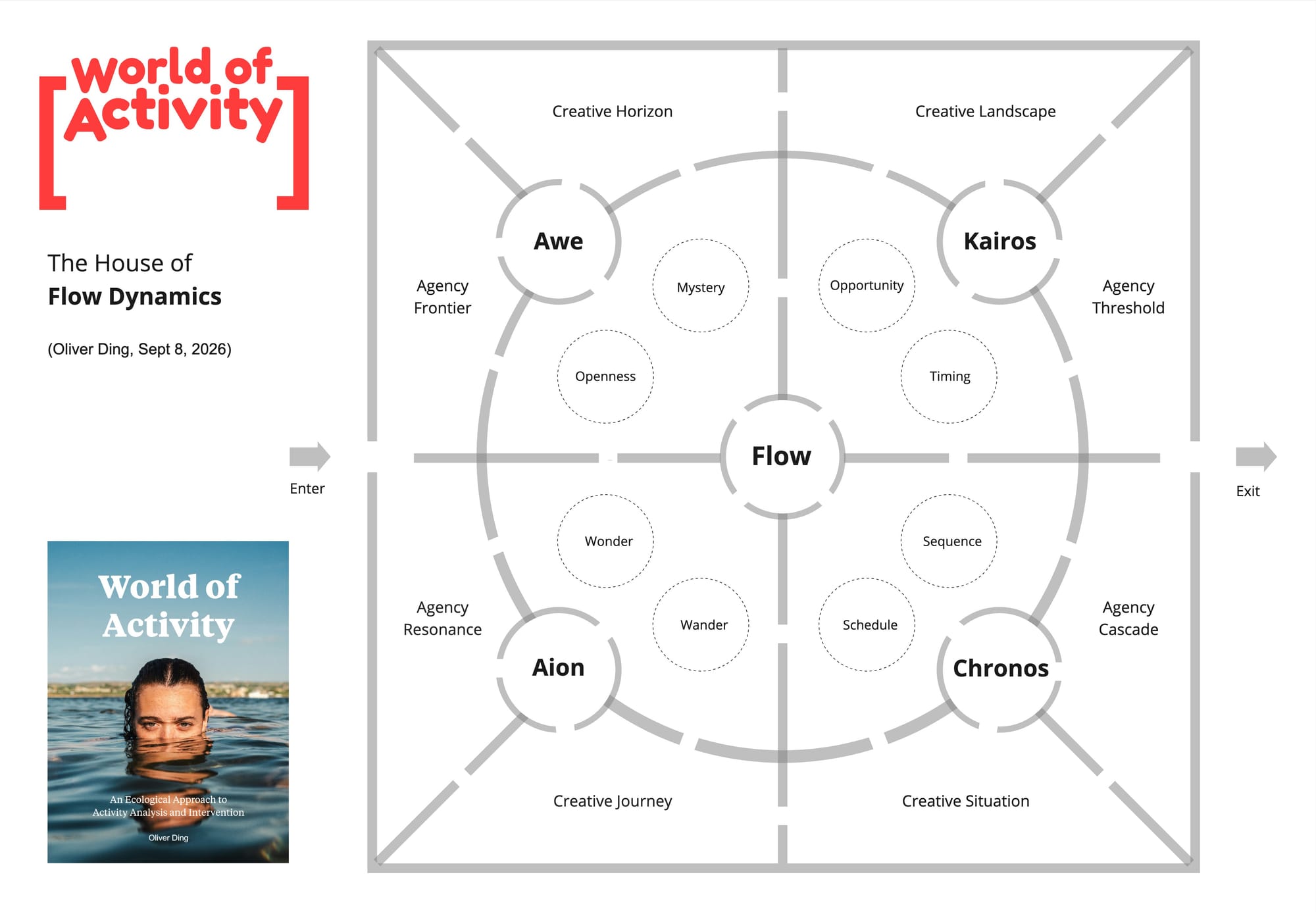
This article focuses on the "Flow" map: The House of Flow Dynamics.
The FFCC Model and Flow
The World of Activity approach represents a comprehensive toolkit containing multiple analytical modules for examining human experience and development. Its central model, the World of Activity Model, represents the Flow — Focus — Center — Circle schema.
Flow represents the movement of everyday life experience — the continuous stream of activities, encounters, and engagements that constitute our lived reality. It is the most basic ecological form in the FFCC model. Before there is Center, before there is Focus, there is Flow.
This is why Flow is both the easiest and the hardest form to map. It is easy because we live inside it all the time. It is hard because it is so close to us that it often disappears from view. We do not usually notice the stream while we are in it. We notice it only when something interrupts it, intensifies it, or gives it a name.
It is important to distinguish this ecological concept of Flow from the psychological concept of “flow” associated with Mihaly Csikszentmihalyi. Csikszentmihalyi’s flow describes an optimal state of absorbed concentration — a condition in which challenge and skill are balanced, attention is fully engaged, and action feels effortless. That is a specific psychological state, valuable in its own right, but not what we mean here.
In the World of Activity approach, Flow is broader. It is the ecological stream of experience itself — the ongoing movement of situations, sensations, emotions, impulses, routines, disruptions, and meanings that make up everyday life. It is not necessarily optimal. It is not necessarily focused. It is simply the continuous flow of lived experience.
This ecological notion of Flow draws inspiration from William James’s metaphor of the “stream of thought.” James wrote:
“Consciousness, then, does not appear to itself chopped up in bits. Such words as ‘chain’ or ‘train’ do not describe it fitly as it presents itself in the first instance. It is nothing jointed; it flows. A ‘river’ or a ‘stream’ are the metaphors by which it is most naturally described. In talking of it hereafter let us call it the stream of thought, of consciousness or of subjective life.” (vol. 1, p.239)
James emphasized the continuity, constant change, direction, connectedness, pace, rhythm, and flow of subjective life. He rejected the idea that consciousness is a chain or train of discrete bits. Instead, it flows.
I follow this metaphor and extend it from consciousness to life experience itself. Flow, here, is the continuous stream of everyday life experience. You cannot cut a stream with a knife. You can only contain it, shape it, or let it move.
In the World of Activity approach, I treat Flow as a diachronic development — a process that unfolds over time. This is the key difference from Focus, Center, and Circle. Focus is about the emergence of thematic coherence. Center is about sustained organization. Circle is about networks of centers. Flow is about the temporal movement of experience itself.
Therefore, the basic idea of Flow Dynamics is to consider four thematic areas from the temporal dimension.
Four Views of Time
To understand Flow Dynamics, we need a richer vocabulary of time than the modern clock provides. In earlier work, I developed the Aion–Chronos–Kairos framework as a way to distinguish different experiences and uses of time. To this trio, I now add a fourth: Awe.
In modern life, time is usually understood as clock time — external, countable, and tied to scheduling, planning, and measurable progress. It is the structure by which we organize our lives and make our actions accountable.
However, traditional philosophy offers other ways of understanding time. In ancient Greek thought, the modern notion of clock time was captured by the term Chronos (Χρόνος), which refers to measurable, sequential time — the kind of time that unfolds minute by minute, day by day. In mythology and metaphysics alike, Chronos represents linear temporality, a forward-moving stream that divides experience into past, present, and future. Plato described it as time modeled on the “moving image of eternity,” grounded in the movement of celestial bodies.
In contrast, the Greek term Aion (Αἰών) refers to a fundamentally different experience of time, not linear, but enfolded, eternal, or timeless. Aion is not about progression but about presence, resonance, and becoming. It contains the past and future within an expanded now. Philosophers such as Deleuze adopted Aion to describe the virtual — the zone of the event, emergence, and transformation — where meaning is continuously generated rather than fixed. Aion is thus the temporality of creativity, conceptual growth, and self-reflective depth, making it particularly relevant for theoretical construction and artistic practice.
From the perspective of Curativity Theory, I define Time Curation as a meta-curation process — the act of curating pieces of time into a meaningful whole. By adopting the ancient Greek terms Chronos and Aion, I distinguish two thematic spaces for Time Curation: the Chronos space and the Aion space.
In the Chronos space, Time Curation focuses on the linear flow of a journey — events unfold in sequence, forming a narrative of progression. In contrast, the Aion space represents a transformational domain, where the curation shifts from linear unfolding to the dynamic interplay between Journey and Landscape. Here, time becomes reflective and generative, supporting conceptual and experiential reconfiguration.
The model also highlights the transitions between the Chronos space and the Aion space — movements that mark critical shifts in the way time is experienced, interpreted, and curated.
The term Kairos (καιρός), from ancient Greek, refers to the “right” or “opportune” moment, distinct from Chronos, which signifies linear, quantitative time. Kairos emphasizes timing and significance: a moment of decision, transformation, or intervention. Following Aion Space and Chronos Space, I defined Kairos Space as part of the Time Curation model. See the modified diagram below.
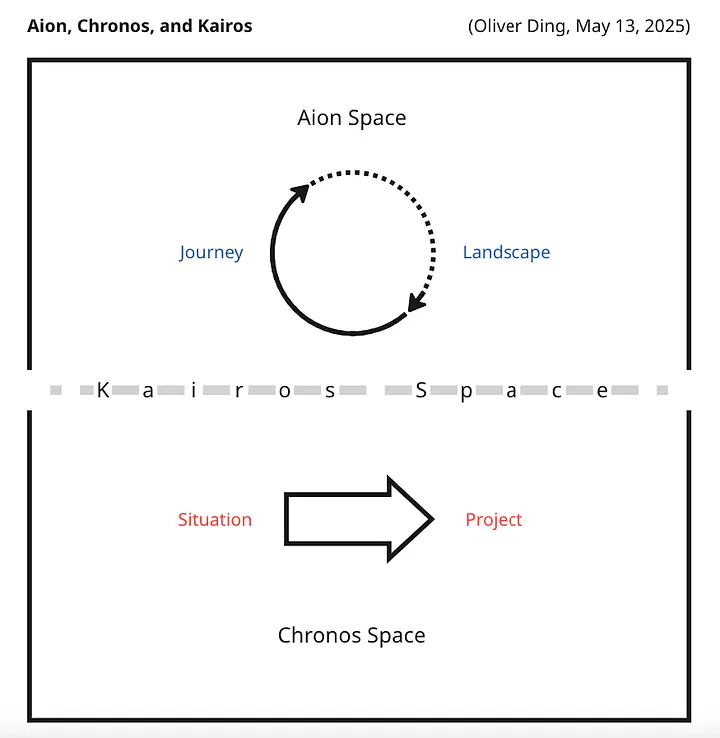
Kairos Space represents the threshold between Aion Space (the realm of meaning and cycles) and Chronos Space (the realm of situations and projects). It marks a critical zone where meaning is translated into timely action.
Within Kairos Space, Time Curation identifies the key shift points between Chronos Space and Aion Space, and captures the Attachaces involved in moving between four types of Decision Containers. The term Attachance — a coinage combining attach and chance — is a sister concept to Curativity. More details can be found in Curativity Theory in Context and The “Aion-Chronos-Kairos” Schema.
The fourth view of time is Awe. This concept emerged from my earlier work on Creative Life Theory, where I proposed a threefold distinction: Creative Self — Creative Us — Creative Awe.
- Creative Self refers to the individual creative agent.
- Creative Us refers to collaborative, social creativity.
- Creative Awe refers to a state of interaction with nature that transcends social action.
Awe points to an experience that is not primarily social. It is the experience of standing before something vast, mysterious, and open — a horizon, a frontier, a mystery that cannot be fully captured by social categories. Awe is not a rejection of social action; it is a reminder that human experience also includes a relationship with the natural world, with the unknown, and with that which exceeds our control.
Together, Aion, Chronos, Kairos, and Awe provide four views of time for understanding the Flow of everyday life.
Four Configurations of Agency
The outer layer of the map contains eight themes. Four of them are structural configurations of agency. Together, they offer an initial mapping of how agency operates across different configurations of social structure.
The source of these four themes come from the "Bureaus of Agency" project, part of the Anticipatory Cultural Sociology (ACS) project I did in the first half of this year.
Agency Resonance
Agency Resonance corresponds to the Aion space. It describes the configuration in which multiple activity circles activate simultaneously and begin to trigger one another — producing emergent developments that no single circle would have generated alone.
Resonance is lateral and networked. A concept begins to vibrate, and nearby projects begin to vibrate with it. Resonance is not planned; it is recognized and cultivated. It is the structural pattern of deep time, where actions echo across a field of interconnected activities, creating meaning that extends beyond any single moment.
In the Aion space, agency resonance pairs with creative journey and the inner objects of wander and wonder.
Agency Cascade
Agency Cascade corresponds to the Chronos space. It describes the configuration in which agency flows through nested levels of social structure, each level’s Other becoming the next level’s Self.
It is the structural pattern of hierarchical anticipatory systems — educational institutions, cultural industries, developmental sequences. To act well in a Cascade configuration is to understand which level you occupy and how your anticipations shape the conditions for those below.
Cascade is linear, cumulative, and sequential. It is the structural pattern of measurable time, where actions unfold in order, each triggering the next.
In the Chronos space, agency cascade pairs with creative situation and the inner objects of schedule and sequence.
Agency Threshold
Agency Threshold corresponds to the Kairos space. It describes the configuration in which agency operates at structural boundaries — the gaps between projects, the transitions between phases of a creative life.
The threshold is the moment when a project ends and a new GAP opens. To act well at a Threshold is to recognize the creative potential of the gap and choose deliberately how to cross it. It is the structural pattern of the opportune moment, where meaning is translated into timely action.
In the Kairos space, agency threshold pairs with creative landscape and the inner objects of timing and opportunity.
Agency Frontier
Agency Frontier corresponds to the Awe space. It describes the configuration in which agency operates at the outermost edges of established territory — where familiar frameworks reach their limits and something not yet named begins.
Frontier is the condition of working at the boundaries of the World of Life itself: engaging with the structural limits of Spirituality, Science, Individuals, and Collectives, and finding what becomes possible there. It is the structural pattern of the horizon, where the known meets the unknown.
In the Awe space, agency frontier pairs with creative horizon and the inner objects of mystery and openness.
These four configurations are not a closed framework. They are the configurations I have identified so far in my research. They represent an ongoing exploration into the structural terrains in which agency operates. There may be other configurations not yet named or discovered.
Four Units of Analysis of Creative Life
The other four outer themes are units of analysis for Creative Life. Over the past several years, I have been conducting case studies of creative lives. In that work, I have used three primary units of analysis: situation, journey, and landscape. For this map, to pair with Awe, I have added a fourth: creative horizon.
Creative Situation
A situation is a particular configuration of circumstances that calls for action. It is the immediate context in which creative work happens: what we respond to, what we navigate, what we transform. Situations are the building blocks of everyday experience, the concrete moments in which agency is exercised.
Situations are not isolated. They arise within a stream of events and give rise to a cascade of actions. A situation presents conditions; our response to those conditions shapes what follows. This is why situation pairs naturally with Chronos, the time of measurable sequence.
In the map, creative situation occupies the outer layer of the Chronos space. It corresponds to Agency Cascade and the inner objects of Schedule and Sequence.
Creative Journey
A journey is a sustained movement through a landscape of creative work. A journey is not a project; it is a larger container that holds multiple projects. It has a direction, a sense of progression, and a narrative arc. A journey is how we experience the diachronic dimension of creative life.
Life is a meaningful journey. Behind this metaphor lies a profound idea: Life is about Spatial Difference.
This idea draws inspiration from George Lakoff and Mark Johnson’s exploration of the Cognitive Science of the Embodied Mind in their 1999 book Philosophy in The Flesh and other books. According to Lakoff and Johnson, “Very little of our understanding of time is purely temporal. Most of our understanding of time is a metaphorical version of our understanding of motion in space.”
In the map, creative journey occupies the outer layer of the Aion space. It corresponds to Agency Resonance and the inner objects of Wander and Wonder.
Creative Landscape
A landscape is the synchronic field of possibilities. It is the context in which decisions are made, the terrain through which a journey moves. A landscape is not just physical; it is also social, cultural, and intellectual.
A Landscape provides a comprehensive view of all related projects, significant actions, themes, and materials. While there are various approaches to exploring such a complex landscape, they share a common purpose: understanding the present situation and transforming complexity into opportunity.
In the Kairos space, creative landscape pairs with Agency Threshold and the inner objects of Timing and Opportunity.
Creative Horizon
A horizon is the distant edge of possibility, the line where the known meets the unknown. It is what calls us forward, what invites us to explore. A horizon is not a goal to be reached; it is a direction to be oriented toward.
I added Creative Horizon as a fourth unit of analysis specifically to pair with Awe. While situation, journey, and landscape describe the terrain of creative life as it is and has been, horizon points toward what lies beyond — the frontier of the unknown, the mystery that exceeds our current frameworks.
In the Awe space, creative horizon pairs with Agency Frontier and the inner objects of Mystery and Openness.
The inner layer of the map contains eight themes. These are the experiential objects that correspond to the four time views and the outer themes. They are what appears, takes shape, and transforms as Flow moves through different temporal modes.
Aion: Wander and Wonder
In the Aion space, the inner themes are wander and wonder. Wander is the act of moving without a fixed destination, open to what appears. Wonder is the experience of being arrested by something mysterious, beautiful, or profound. Together, they represent the open, receptive mode of deep time.
This pair emerged from a specific case study. In [Wonder and Wander] The Aion Journey (2021–2025), I traced the four-year creative journey from Strategic Developmental Psychology to Strategic Life Theory. That case study introduced the Aion–Chronos–Time Curation model, and it originally proposed a creative echo:
Wonder in the Aion Space. Wander in the Chronos Space.
In that earlier framing, the two terms were separated by their temporal quality. Wander belonged to Chronos because it was tied to sequential movement — steps, stages, the physical constraints of time and task. Wonder belonged to Aion because it opened up a generative space beyond linear progression.
However, in the House of Flow Dynamics, I have repositioned both wander and wonder into the Aion space. This is a deliberate shift.
The reason is that in this map, Aion is not merely the opposite of Chronos. Aion is the space of deep time — the temporal mode in which the past, present, and future are curated together into a meaningful whole. In that space, wandering is not just physical movement; it is the free movement of attention across a landscape of possibilities. And wonder is not just a moment of arrest; it is the receptive openness that sustains that movement.
Wander and wonder belong together because they are two aspects of the same disposition: openness to what is not yet known. Wander is the movement; wonder is the receptivity. Wander is the path; wonder is the light that falls on it. In the Aion space, to wander is already to wonder.
This repositioning does not invalidate the earlier case study. It reframes it. The earlier distinction highlighted a contrast between two temporal modes. The new map highlights a unity within one mode. Both are true at different levels of analysis.
For the full case study, see [Wonder and Wander] The Aion Journey (2021–2025).
Chronos: Schedule and Sequence
In the Chronos space, the inner themes are schedule and sequence. Schedule is the arrangement of activities in time, the allocation of attention and resources. Sequence is the order in which actions occur, the step-by-step progression. Together, they represent the structured, linear mode of everyday time.
This pair connects directly to the Aion–Chronos–Kairos framework, and through it, to a specific analysis of identity development. In that framework, I distinguished four types of identity and placed them across the Chronos and Aion spaces:
- Projected Identity — identity shaped by external roles and responsibilities in collaborative projects. It is how others see us, and how we see ourselves in relation to a shared task.
- Narrative Identity — the self that is constructed and communicated through personal storytelling. It develops over time and reflects one’s sense of self.
- Creative Identity — the identity that emerges through concrete actions guided by the actor’s autonomous will and subjective exploration. It is agency in its most generative form.
- Anticipated Identity — a forward-looking identity that represents an individual’s vision of their future self, aligning with the concept of Possible Selves.
In this framework, Projected Identity and Narrative Identity are placed in the Chronos Space, while Creative Identity and Anticipated Identity are placed in the Aion Space.
The reason is that Projected and Narrative identities are tied to sequential time. Projected Identity is shaped by roles that unfold in a schedule — you join a project, you take on a position, you carry out responsibilities in sequence. Narrative Identity is constructed through storytelling, which is itself a linear form: a story has a beginning, a middle, and an end. Both operate within the structured, linear mode of everyday time.
Creative and Anticipated identities, by contrast, belong to deep time. Creative Identity emerges through autonomous exploration, which is not bound to a schedule. Anticipated Identity projects forward into a possible future, which is not yet sequenced. Both operate within the generative, open mode of Aion.
This is why schedule and sequence are the inner themes of Chronos. They are not just practical tools for time management. They are the cognitive objects through which Projected and Narrative identities take shape. When we schedule our activities and sequence our actions, we are also arranging the roles we play and the stories we tell about ourselves. Chronos is the time in which identity becomes accountable, visible, and narratable.
For the full discussion, see The Life Coordinate Framework (v2, 2023) and The “Aion–Chronos–Kairos” Schema.
Kairos: Timing and Opportunity
In the Kairos space, the inner themes are timing and opportunity. Timing is the sense of when to act, when to wait, when to speak, when to be silent. Opportunity is the recognition of a favorable moment, a chance that may not return. Together, they represent the discerning, threshold mode of time.
This pair connects directly to my long-standing research on ecological opportunity. Over the years, I have developed four types of ecological opportunity, each corresponding to a different domain of action:
- Affordance — the potential action opportunities offered by material environments. It is the opportunity of Material Adaptability.
- Supportance — the potential supportive action opportunities offered by social environments. It is the opportunity of Social Adaptability.
- Attachance — the potential action opportunities provided by attaching to and detaching from contexts. It is the opportunity of a Sense of Boundarylessness.
- Curativity — the potential action opportunities of turning pieces into a meaningful whole. It is the opportunity of a Sense of Wholeness.
What does this have to do with Kairos?
Kairos is the threshold between Aion and Chronos. It is the moment when meaning is translated into timely action. At that threshold, the actor faces a choice: which opportunity to recognize, which moment to seize, which path to take. This is precisely where the Difference–Conversion–Opportunity Schema operates.
The schema works like this: every situation contains Ecological Differences — structural distinctions that, once recognized as convertible, become opportunities for action. Between the two elements of a difference, there are Conversion Mechanisms — processes by which one element can become another. When a Conversion Mechanism is available, an Ecological Opportunity is born.
Kairos is the temporal dimension of this schema. Timing is the perception of when a Conversion Mechanism is available. Opportunity is the recognition that an Ecological Difference has become convertible. The two are inseparable: timing without opportunity is restlessness; opportunity without timing is missed.
This is why Kairos pairs with creative landscape and agency threshold in the outer layer. A landscape is the synchronic field of possibilities. A threshold is the critical zone where choice becomes necessary. Kairos is the time in which the landscape reveals its convertible differences, and the threshold demands a decision.
For further reading, see the Difference–Conversion–Opportunity Schema and World of Life: Four Positive Frontiers of Project Engagement.
Awe: Mystery and Openness
In the Awe space, the inner themes are mystery and openness. Mystery is the experience of encountering something that cannot be fully explained or mastered. Openness is the willingness to remain open to what is not yet known, to let go of the need for closure. Together, they represent the transcendent, horizon mode of time.
This pair emerged from a specific development in my theoretical work: the Self–Us–Awe Schema. In that project, I applied a meta-framework from Ping-keung Lui's theoretical sociology — the schema of Subjectivity—Intersubjectivity—Otherness — to the domain of creative life. Subjectivity corresponded to Creative Self. Intersubjectivity corresponded to Creative Us. And Otherness opened a question: what corresponds to Otherness in Creative Life Theory?
The answer was Creative Awe. Where Creative Self is the individual creative agent and Creative Us is the collaborative, social dimension, Creative Awe describes our experience of engaging with phenomena beyond human articulation — nature itself, the universe, the unknown. It points to a relationship that is not primarily social, but ecological in the deepest sense.
This is why Awe pairs with creative horizon and agency frontier in the outer layer. A horizon is the distant edge where the known meets the unknown. A frontier is the outermost edge of established territory, where familiar frameworks reach their limits and something not yet named begins. Mystery is the experience of encountering that edge. Openness is the willingness to remain there, without forcing closure.
For the full case study, see The Birth of the "Self-Us-Awe" Schema.
The Inside: A Sequence of Experiential Objects
The four time views — Aion, Chronos, Kairos, Awe — are abstract. We cannot see Aion, touch Chronos, grasp Kairos, or measure Awe. They are temporal modes, not things. But we can experience them. We experience them through the objects that appear within them.
These are the experiential objects of Flow. They are the eight inside themes of the map: wonder, wander, schedule, sequence, timing, opportunity, mystery, openness.
An experiential object is not an operation. It is not something the mind does. It is something the mind encounters. Wonder is not the act of wondering; it is what appears when we are arrested by something mysterious. Schedule is not the act of scheduling; it is the arrangement that takes shape when we allocate attention and resources. Timing is not the act of timing; it is the felt sense of when to act.
This distinction matters because it shifts the map from a framework of cognition to a framework of experience. The inside themes are not cognitive faculties. They are the material that experience works with — the shapes that time takes when it becomes perceptible.
William James described consciousness as a stream. The stream is continuous, but within it, objects appear. A thought, a sensation, a memory — these are not separate bits chopped from the stream. They are eddies, patterns, momentary forms that arise within the flow. The experiential objects of Flow are like these eddies. They are not the stream itself. They are what the stream becomes when we notice it.
Read in order, the eight objects trace an arc:
wonder → wander → schedule → sequence → timing → opportunity → mystery → openness
This sequence follows the four time views themselves. Aion gives us wonder and wander — the open, receptive mode of deep time. Chronos gives us schedule and sequence — the structured, linear mode of everyday time. Kairos gives us timing and opportunity — the discerning, threshold mode of time. Awe gives us mystery and openness — the transcendent, horizon mode of time.
No additional narrative structure is needed. The framework is already a rhythm. It is the rhythm of Flow as it moves through time, from open perception to structured action to decisive moments to transcendent openness.
The inside layer of the map is therefore not a taxonomy of mental states. It is a sequence of experiential objects — the perceptible forms that time takes when we attend to it. They make the abstract concrete. They make time something we can talk about, reflect on, and place on a map.
An Open Template
The sixteen themes presented in this map are my current choices. They are not an absolute account of Flow. They reflect my own case studies, my own reading, and my own preferences. Like the other maps in this series, the House of Flow Dynamics is a template rather than a fixed model.
Flow is too rich, too plural, and too ordinary to be exhausted by sixteen themes. Flow is everyday life itself. It cannot be fully captured by any taxonomy. The map offers one way to notice its textures, not the only way.
Readers are invited to replace these sixteen themes with their own. Keep the structure, change the themes, and create your own version of the House of Flow Dynamics. The map is for placement, not prescription. It is for dialogue, not diagnosis. It is open to revision.
One thematic area on this map deserves a note about its newness. The Awe space — both its outside themes and its inside themes — was not drawn from a pre-existing body of case studies. It was forced into existence by the structure of the map itself.
The Aion–Chronos–Kairos trio was itself recent. I developed it in 2025, through the Time Curation model and the case study of the Aion Journey. It was not a long-settled framework. When I built this four-part map, the structure opened a fourth position. What belonged there? The answer was not obvious. The three existing spaces had at least some theoretical grounding behind them. The fourth space had nothing.
The pressure came from two directions at once. On the inside, I needed two experiential objects to pair with the fourth time view. On the outside, I needed a configuration of agency and a unit of analysis to match. Neither existed yet.
Agency Frontier was not originally connected to Creative Awe. It came from a different project — the Anticipatory Cultural Sociology work on configurations of agency — where it described agency operating at the outermost edges of established territory. Only when I placed it beside the emerging Awe space did the pairing become visible: frontier and awe both concern the encounter with what lies beyond current frameworks. The structural requirement revealed a resonance that had not been apparent before.
Creative Horizon was added for the same reason. Situation, journey, and landscape had accumulated case material. The fourth unit did not. The structure demanded a fourth position, and pairing it with Awe clarified what kind of unit it had to be — not another terrain to be mapped, but a direction to be oriented toward. The gap forced the discovery.
This is the heuristic value of a meta-canvas. It does not merely organize what you already know. It puts pressure on the edges of what you know, and sometimes that pressure produces something new. The entire Awe space is an example. It is an open position, waiting to be tested and refined. Readers who use this map may find that it fits their own cases — or may replace it with something better.
v1.0 — October 10, 2026 — 4,759 words