
Creative Diagramming: The House of Center Dynamics

A new thematic map
by Oliver Ding
September 6, 2026
The day before yesterday, I updated the World of Activity page on the Activity Analysis Center website.
After finishing the update, I decided to make a small visual experiment to celebrate the work.
I created a thematic map as a visual template for presenting the six ecological forms of World of Activity:
Boundary · Coordinate · Flow · Focus · Center · Circle
I also selected sixteen themes from the research insights accumulated through the past year and placed them on the canvas.
The v2.0 framework had accumulated so many concepts, models, cases, and insights that I began to worry that a comprehensive presentation might actually make it harder for someone new to enter the approach.
That experiment became The House of World of Activity.
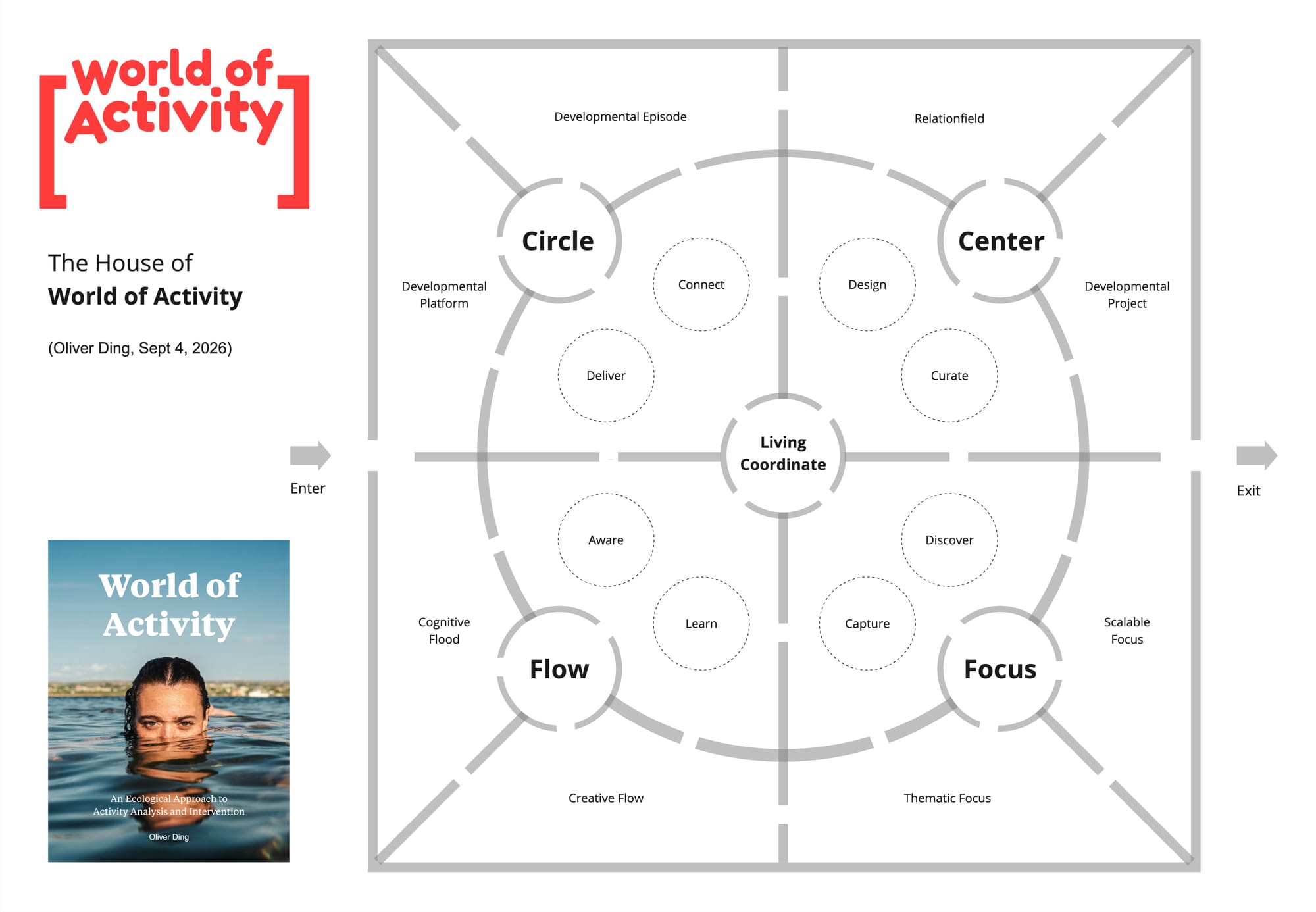
Yesterday, I made a new one that expanded "Center" into an independent thematic map. If one map is not enough, we can make a series of maps. By using the new "Center" map, I could curate themes about the "Center" into the map.
Inspired by Daniel Levinson's The Seasons of a Man's Life (1978), I began to ask: if a Center could be seen as having a life of its own, what would its seasons look like?
Seasons of a Man's Life
In 1978, Daniel Levinson published The Seasons of a Man's Life, a landmark study based on in-depth biographical interviews with forty American men between the ages of thirty-five and forty-five. The study identified an "age-linked sequence of developmental eras and periods", revealing that adult development unfolds through an alternating rhythm of structure-building (stable) periods lasting about six to eight years, and structure-changing (transitional) periods lasting about four to five years.
At the heart of Levinson's framework is the concept of the Life Structure—"the underlying pattern or design of a person's life at any given time". This structure is not merely a collection of roles but "an organized integration of the self into the world," defined by relationships with significant others, groups, institutions, and major life components such as occupation and family.
Levinson proposed that adult development unfolds in a sequence of seasons, each lasting about twenty-five years. Within each season, life alternates between structure-building periods (stable, when we consolidate our lives) and structure-changing transitions (when we question and rebuild). The seasons are:
- Spring (0–25): Childhood and adolescence—forming a preliminary life structure, entering the adult world, and exploring possibilities.
- Summer (25–50): The years of greatest energy and productivity—settling down, advancing in career, forming commitments.
- Autumn (50–75): Midlife—a period of reflection, often marked by questions about what has been accomplished and what remains.
- Winter (75–100): Late adulthood—integration, acceptance, and preparing for closure.
Levinson's metaphor is powerful because it is intuitive. We all understand that spring brings growth, summer brings flourishing, autumn brings harvest and decay, and winter brings dormancy and rest. But his framework also received valid criticism: it tied development too rigidly to chronological age, assumed a single universal life course, and was based on a narrow sample of men.
Despite the limitations, the seasonal metaphor itself remains powerful. What if we detached it from the assumption of a single, unified life course—and applied it instead to Centers?
Seasons of a Center's Life
In the World of Activity approach, a Center is a creative center we work with continuously—a stable organizing principle that gives structure to experience over time. A Center can be a professional specialization, a creative practice, an intimate relationship, a community involvement, or any sustained thematic engagement.
Here is the crucial insight:
A person only has one life, but within that life, there are multiple Centers—and each Center has its own developmental rhythm.
A person can have one Center in Spring (just beginning and exploring), another in Summer (anchoring and expanding), a third in Autumn (undergoing reflective curation or collapse), and a fourth in Winter (closing down and releasing its contents). The person is not defined by any single Center's season; the person is the whole landscape in which multiple Centers co-exist and co-evolve.
This reframing—understanding a life course as a multi-center landscape rather than a single linear trajectory—is what makes the seasonal metaphor useful rather than deterministic. Levinson locked a person into one developmental timeline because he assumed there was only one life structure to track. But if we recognize that a life contains multiple Centers, each with its own rhythm, then the seasonal metaphor can do something Levinson never intended: it becomes a tool for mapping the co-existence of multiple developmental trajectories within a single life.
This is where the World of Activity approach fundamentally differs from Levinson's framework—and where it overcomes its weakness.
| Levinson's Framework | World of Activity Framework |
|---|---|
| One person, one life structure | One person, multiple Centers |
| A single developmental timeline | Multiple, parallel developmental trajectories |
| Age-linked, sequential stages | State-based, non-sequential spaces |
| You are in a season | Your Center inhabits a season |
| The person is the life structure | The person manages multiple Centers |
A New Thematic Map: The House of Center Dynamics
The seasonal metaphor thus becomes an organizing framework for curating multiple empirical insights about Centers that have emerged from my research over the past year.
The map is designed as a square containing a circle. The entire space—both inside and outside the circle—is divided into four quadrants, corresponding to the four seasons: Spring, Summer, Autumn, and Winter.
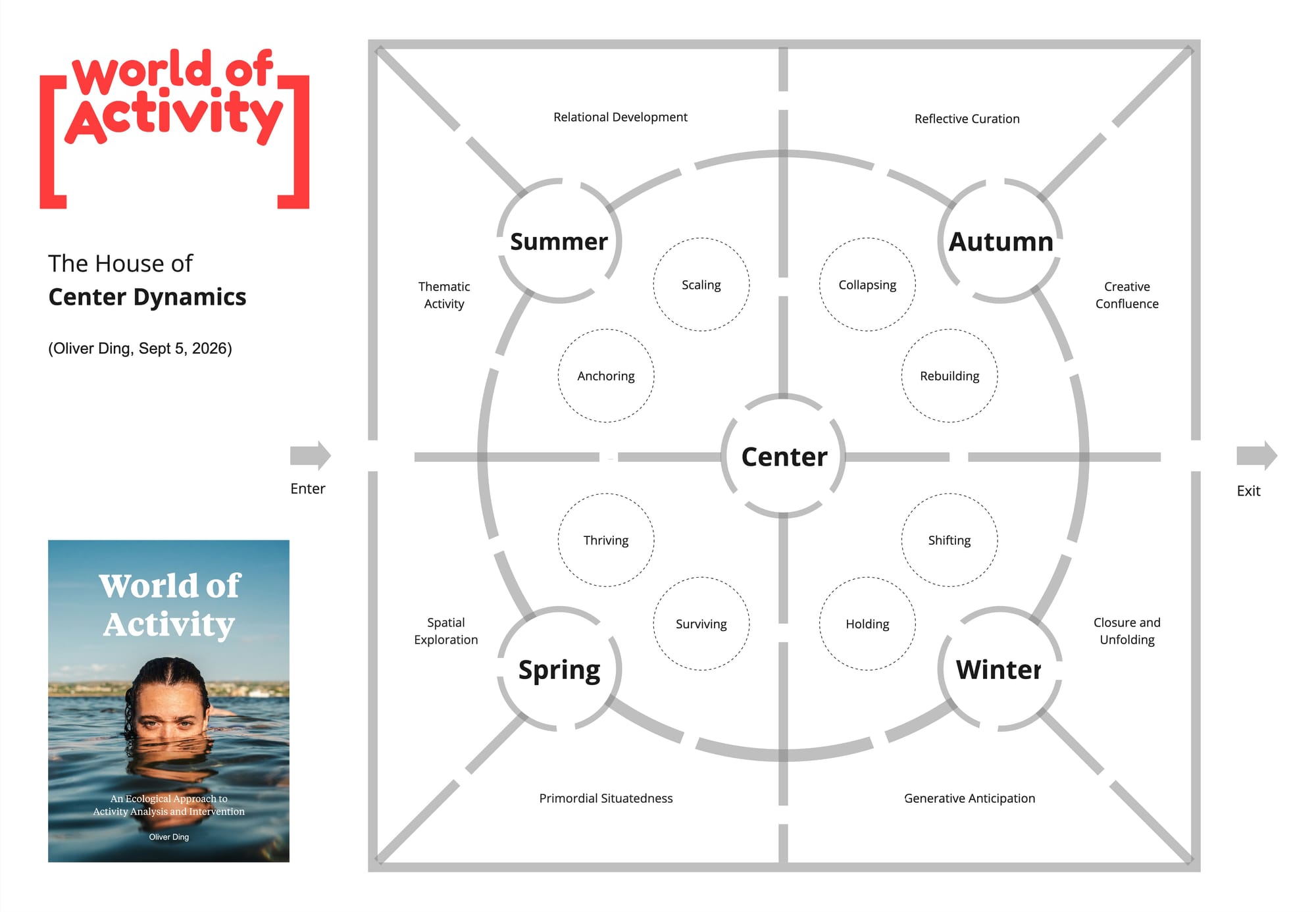
The circle represents the inner layer—the mental dynamics of a Center. It is divided into four parts, one for each season. Within each of these four parts, there are two dotted circles, indicating the two themes that belong to that season's inner layer.
The space outside the circle, within the square, represents the outer layer—the situational texture of a Center. This area is divided into eight parts by the diagonal lines that extend from the center of the circle to the corners of the square. Each season corresponds to two of these eight outer sections, with one theme placed in each section. Together, the eight outer sections hold the eight outer themes—two per season.
Together, the map presents four thematic spaces, each containing four themes—two in the inner layer and two in the outer layer. This structure yields a total of sixteen thematic positions on the map.
| Season | Outer Layer (Situational Texture) | Inner Layer (Mental Dynamics) |
|---|---|---|
| Spring | Primordial Situatedness + Spatial Exploration | Surviving + Thriving |
| Summer | Thematic Activity + Relational Development | Anchoring + Scaling |
| Autumn | Reflective Curation + Creative Confluence | Collapsing + Rebuilding |
| Winter | Closure and Unfolding + Generative Anticipation | Shifting + Holding |
The map is not a sequence. There is no prescribed entry point or path. A viewer can start at any season, move to any other, and return. The rooms are all connected; the doors are all open. The structure simply provides a visual framework for placing and relating the sixteen themes.
Center's Spring
A Center at its origin, or when its boundaries are being pushed outward.
| Outer Layer (Situational Texture) | Inner Layer (Mental Dynamics) |
|---|---|
| Primordial Situatedness | Surviving |
| Spatial Exploration | Thriving |
The four themes in Center's Spring came from different streams of my research, and each went through a process of naming, renaming, and repositioning before settling into its current place on the map.
Primordial Situatedness came directly from the Homecoming project. In my autobiographical analysis, this was the earliest form of World of Activity—childhood in rural Pengdun, where the Center was simply "Hometown." It was a single, encompassing Center that contained all early life experiences. The term "Primordial Situatedness" was chosen to capture both the originality of this experience (it is the first) and its situatedness (it is always in a specific place, with specific people, in a specific culture). On the map, this theme refers to a Center's point of origin—the ground from which it emerges, the place it calls its beginning.
Spatial Exploration was originally named "Geographical Expansion," reflecting my own experience of moving from Pengdun to Fuzhou. But the more I worked with the map, the more I realized that the core phenomenon was not geographical movement per se, but a felt experience—the sense of moving outward, looking around, testing new grounds without yet anchoring in any of them. A Center does not need to involve physical relocation to experience Exploration. It can happen through reading, meeting new people, entering a new field, or simply stepping outside one's familiar boundaries. The renaming from "Geographical Expansion" to "Spatial Exploration" clarified that this theme captures the initial phase of movement—before anchoring, before settling, before committing to a new ground. It is the season of looking around.
Surviving and Thriving emerged together from the dual-center pattern first observed in the Alien Land form of the Homecoming analysis. In that early configuration, Surviving Centers were those dedicated to academic requirements and basic adaptation—the minimum conditions for maintaining oneself in a new environment. Thriving Centers, by contrast, were those oriented toward growth and exploration—creative activities like the Cape of Good Hope Poetry Society. These two centers operated in parallel, each serving a distinct function. On the map, they have been repositioned from a "dual-center structure" (two separate Centers) to the inner dynamics of a single Center—the push and pull between the impulse to persist and the impulse to grow, both present within any Center at the Spring stage.
Center's Summer
A Center in its most active state—engaged in its core thematic work and developing relationships.
| Outer Layer (Situational Texture) | Inner Layer (Mental Dynamics) |
|---|---|
| Thematic Activity | Anchoring |
| Relational Development | Scaling |
The four themes in Center's Summer came from multiple research streams, each addressing a different dimension of what it means for a Center to be in its most active state.
Thematic Activity came from the Homecoming project's "Domain" form. In that analysis, the Center evolved through professional identity formation—first in advertising, then in investment consulting. The original theme was named "Professional Development," but this term proved too narrow. It carried an implicit assumption of employment, of being a "professional" in an institutional sense. What I actually wanted to describe was something broader: a Center's sustained engagement with its core theme—whether that theme is a profession, a craft, a creative practice, a scholarly pursuit, or any domain of sustained activity. The shift from "Professional" to "Thematic" opened the theme to anyone engaged in any sustained practice, regardless of whether it is paid, institutionalized, or recognized by formal credentials.
Relational Development came from a different research stream—a divorce case study I conducted earlier this year as part of my work on cultural transformation. In that study, I observed Centers organized around intimate relationships, and the patterns of development, rupture, and reconstruction they underwent. The original theme was named "Intimacy Development," but as I worked with the map, I realized that "Intimacy" was too narrow. It pointed primarily to romantic relationships and close family bonds. What I wanted to capture was the full spectrum of subject-subject relationships—not only intimate partnerships, but also friendships, collaborations, mentorships, and community ties. "Relational Development" thus refers to a Center's engagement with people—the building, maintaining, and deepening of human connections, at any level of closeness.
Together, Thematic Activity and Relational Development describe the two fundamental dimensions of any Center's active life. Thematic Activity is subject-object engagement—the Center's relationship with its domain, its craft, its work. Relational Development is subject-subject engagement—the Center's relationship with people. These two dimensions are not parallel in the sense of being equally fundamental. Thematic Activity is the base. A Center can exist with only thematic activity—a person working alone on a craft, a practice, a project. Relational Development is an extension that may or may not develop. Some Centers are solitary; others are relational. The map accommodates both.
Anchoring and Scaling describe the inner dynamics of a Center in its Summer state. They came from the ongoing analysis of Center development patterns—the internal experience of what it feels like to be in an active, growing Center.
Anchoring is the drive to establish a stable identity. It is the work of securing the Center's position, of being able to say "this is what I do" or "this is who I am in this domain." It is not merely survival (which belongs to Spring) but a deeper consolidation—a sense of belonging, of being recognized, of having a place.
Scaling is the drive to extend influence. Once a Center is anchored, there is a natural impulse to reach further—to expand its reach, to take on more, to grow in scope or impact. Scaling is not the same as Spatial Expansion (which is about boundaries being pushed from the outside). Scaling is an internal ambition—the desire to extend what has been built.
Together, Anchoring and Scaling describe the inner rhythm of a Center's active life: first securing a foothold, then extending its reach. These are not sequential stages but a continuous oscillation—anchoring creates the stability needed for scaling, and scaling reveals new grounds that require new anchoring.
Center's Autumn
A Center in a state of reorientation—reviewing what has accumulated, connecting with other Centers, and undergoing transformation.
| Outer Layer (Situational Texture) | Inner Layer (Mental Dynamics) |
|---|---|
| Reflective Curation | Collapsing |
| Creative Confluence | Rebuilding |
The four themes in Center's Autumn came from different sources, and they reflect two distinct but related dimensions of what it means for a Center to be in a state of reorientation.
Reflective Curation came from the Homecoming analysis, specifically from the Foreign Land form—the period of cultural reconstruction after moving to the United States. In that phase, I experienced a multi-center configuration: Surviving, Thriving, Continuous, Reflective, and Constructive Centers operating simultaneously. One of the key dynamics was the constant processing of multiple inputs—different cultural frameworks, professional influences, and intellectual traditions—that required ongoing sorting, connecting, and making sense of what was flowing in. However, in Homecoming, this was not named as a separate concept. Here, in this map, I have extracted and renamed this specific dynamic as Reflective Curation. It now stands as its own theme, capturing the activity of a Center that is no longer simply building itself, but is actively engaged in reviewing, connecting, and curating its relationships with other Centers and sources of influence.
Creative Confluence came from the Lake 42 project, a study of how creative work emerges at the intersection of multiple thematic enterprises. In that analysis, I observed patterns where independent creative streams—different projects, practices, or collaborations—converged at the boundary of a Center, generating new possibilities that none could produce alone. The term "confluence" captures both the coming together of separate streams and the generative quality of their intersection. On the map, Creative Confluence is not a universal feature of all Centers in Autumn. It is a special condition that emerges when multiple streams of creative activity intersect at the Center's boundary, creating new configurations and opening unexpected directions.
Together, Reflective Curation and Creative Confluence describe the outer texture of a Center in Autumn: it is engaged in reviewing and sorting its accumulated material (Reflective Curation), and under specific conditions, it may also be experiencing a convergence of creative streams that generates new possibilities (Creative Confluence).
Collapsing and Rebuilding came from the internal sequence I have been developing for Center dynamics. The sequence—Surviving → Thriving → Anchoring → Scaling → Collapsing → Rebuilding → Shifting → Holding—describes the possible inner states of a Center as it moves through its life. In Autumn, the sequence reaches its most intense phase.
Collapsing is the experience of a Center losing its coherence. A Center that has been deeply anchored and actively scaling will, at some point, encounter conditions that its existing structure cannot accommodate. The Center's internal organization—its patterns of activity, its relationships, its sense of direction—begins to dissolve. The Center no longer holds together in the way it once did.
This is a crisis. In my empirical studies, I observed this pattern in several cases, and it forced me to reconsider a basic assumption: that a Center's development is always positive, always progressive, always moving forward. The cases showed otherwise. Whether we accept it or not, this kind of breakdown is real. It appears. Centers do not always develop smoothly. They break. They fall apart. They lose their coherence before they can reorganize.
Rebuilding is the process of constructing a new organization from what remains. It is not a return to what was before, nor is it a simple replacement. It involves working with the fragments of the collapsed Center—salvaging what remains useful, letting go of what no longer serves, and assembling new patterns of activity, new relationships, and new directions that can accommodate the complexity that the old organization could not hold. Rebuilding is both difficult and generative—difficult because it requires letting go of what was once stable, generative because it opens possibilities that the old organization precluded.
Together, Collapsing and Rebuilding describe the inner dynamics of a Center in Autumn: the crisis of losing coherence and the work of constructing a new one. These are not sequential stages in a linear progression. They often overlap—collapse continues even as rebuilding begins, and rebuilding may trigger further collapse. They are two aspects of a single transformative process.
Center's Winter
A Center at the end of its active cycle, or in a state of dormancy—closing down, releasing content, and possibly flowing to new hosts or new generations.
| Outer Layer (Situational Texture) | Inner Layer (Mental Dynamics) |
|---|---|
| Closure and Unfolding | Shifting |
| Generative Anticipation | Holding |
The four themes in Center's Winter came from different research streams, and they reflect what it means for a Center to complete, pause, or transform its active life.
Closure and Unfolding emerged from the 2026 thematic trip to China—a journey that turned out to be a sequel to the Homecoming trip the year before. This trip gave birth to a new book project: Closure and Unfolding: The World of Activity Across Generations and Continents.
The title itself signals a shift in perspective: from my personal World of Activity (the focus of Homecoming) to a family across four generations—a form of World of Activity in which a tiny circle develops its diverse Centers, generation by generation. The book also expands to a broader nationwide activity: studying abroad, a form of World of Activity across continents that echoes the "Studying Abroad and Returning Home" theme within the Significant Themes Framework (2026).
Using Hegel's concept theory, we can see three movements of the same theme:
- Individual: my own creative journey in 2025—closing my multi-year work on Knowledge Engagement while unfolding a new direction in Cultural Development.
- Particular: a family across four generations—my aunt and uncle in the old house, my cousins in Jianyang, their children in Fuzhou, Japan, and Vienna.
- Universal: a nationwide activity of studying abroad and returning home—a pattern that has shaped Chinese life for decades.
Though the book is not yet finished, the theme has already been integrated into the World of Activity knowledge system. When I designed this map, I naturally placed it in Winter. The pattern it captures—closure and unfolding happening simultaneously in the same temporal window—is a special form of World of Activity that I had already seen in my research and now found a natural home in the seasonal structure.
Generative Anticipation came from the Homecoming analysis, specifically from the Inheritance form—where Centers from one generation are transmitted to the next through "thematic objects" such as poetry cassettes, photographs, and calendars. In Homecoming, I observed how elements from my own Centers migrated to my son's Centers, creating intergenerational continuity. However, Generative Anticipation is not a universal feature of all Centers in Winter. It is a special condition that emerges when the released content finds a new host—a new person, a new Center, a new generation. Without this reception, the content may simply dissipate. When it finds a host, it becomes generative, carrying forward what was built.
Together, Closure and Unfolding and Generative Anticipation describe the outer texture of a Center in Winter: it is closing and releasing (Closure and Unfolding), and under specific conditions, its released content may flow to new hosts (Generative Anticipation).
Shifting and Holding came from the internal sequence I have been developing for Center dynamics. In Winter, the sequence reaches its final phase.
Shifting is the experience of letting go. A Center that is closing down requires a shift in the person's relationship to it—from active engagement to detachment, from ownership to release. This is not the same as Collapsing (which is the breakdown of Center) or Rebuilding (which is the construction of new ones). Shifting is a quieter process—the gradual realignment of attention and energy away from the Center, allowing it to recede from active life.
Holding is the experience of keeping faith with what a Center has created, even after its active life has ended. Unlike a human life, a Center does not die—it simply becomes dormant, its activities fading, its boundaries contracting. But it remains. It can be reactivated at any time. Its creations—the works, the artifacts, the traces it has left behind—stay in the world. They do not disappear. They continue to exist, often doing their own work, independent of whether the Center is active or not. A book remains on the shelf. A poem continues to be read. A photo still speaks to someone years later. Holding is not about actively maintaining the Center's presence. It is about allowing its creations to remain present—to be there, in the world, available for whatever comes next. This is what makes Holding distinctive: it is not a project, not a maintenance task, but a recognition that what the Center produced continues to matter, even when the Center itself has gone quiet.
Together, Shifting and Holding describe the inner dynamics of a Center in Winter: the simultaneous processes of letting go and keeping faith. These are not contradictory but complementary. Shifting creates space for new Centers to emerge; Holding ensures that what was valuable is not entirely lost. In the winter of a Center's life, both are necessary.
Thematic Map and Empirical Insights
Throughout the design of this map, I maintained a constant tension between formal structure and empirical insight. On one hand, the map's structure—four seasonal spaces, each with an outer layer and an inner layer—presents a multi-center configuration and a seasonal developmental pattern. This is the framework I wanted to offer. On the other hand, the selection and placement of the sixteen themes were not determined entirely by structural considerations. I prioritized the key findings that emerged from my empirical research, allowing them to guide where each theme would be placed.
As a result, when the themes are viewed in pairs—two outer, two inner, per season—they do not conform to a single unified structural pattern. Some pairs show a "general-special" relationship (Reflective Curation and Creative Confluence in Autumn; Closure and Unfolding and Generative Anticipation in Winter). Others show a "base-extension" relationship (Thematic Activity and Relational Development in Summer). Still others show a "temporal sequence" in experience (Primordial Situatedness and Spatial Expansion in Spring). This asymmetry is not a flaw. It reflects the fact that these themes came from different case studies, different contexts, and different patterns of experience. The structure accommodates them; it does not prescribe them.
The Eight Inner Themes as a Sequence
Though the eight inner themes are distributed across four seasonal spaces, I view them as a complete sequence. Let me lay them out:
Surviving → Thriving → Anchoring → Scaling → Collapsing → Rebuilding → Shifting → Holding
This sequence captures the full arc of a Center's inner experience. Spring—Surviving and Thriving—comes first because without addressing the basic conditions of persistence and growth, no further Center development is possible.
Summer—Anchoring and Scaling—follows naturally once the Center is established: it stabilizes its identity and extends its reach.
Autumn—Collapsing and Rebuilding—reveals the complexity of Center development. It is not always smooth or progressive. Collapse is real, and rebuilding is necessary.
Finally, Winter—Shifting and Holding—brings the sequence to its unique conclusion. Shifting allows the person to let go, to realign attention elsewhere. Holding allows what the Center created to remain present, even after the Center itself has gone quiet. This last pair, especially Holding, is distinctive to the World of Activity approach. A Center's creations do not vanish when it becomes inactive. They remain. They continue to matter.
The Termination of a Center
One final clarification on termination. In the World of Activity approach, a person's World of Activity closes only when the person dies. When that happens, all Centers within that World close as well—because the mental activity that sustains them ceases. This is the one condition in which a Center's closure is truly final.
However, there is another condition: Joint Centers. A Joint Center is shared by multiple people—a family, a team, a community, a collaboration. When one person in a Joint Center dies, the Center does not necessarily close. It continues to exist in the Worlds of Activity of the others who share it. The narrative of that Center shifts: it is no longer told from the deceased person's perspective, but from the perspective of the living who continue to carry it.
This is why, in the map, Winter describes a Center's dormancy or inactivity—not its death. A Center can become quiet, fade, and still be reactivated. Its creations can continue to hold meaning. Its presence can be felt. Only when the person who sustained it is no longer alive does the Center truly end. And even then, it may persist in the World of Activity of others—not as an active Center, but as a presence, a legacy, a trace.
How to Read This Map
The House of Center Dynamics, like The House of World of Activity created earlier, is a thematic map template. Both maps share the same structural form—a square containing a circle, divided into four seasonal spaces, each with an inner and outer layer. The sixteen themes placed on the canvas are interchangeable. A reader working with their own cases can adapt this template, replace the themes with their own, and create a customized version for their specific purpose—whether for personal reflection, team discussion, or teaching.
The map is not a sequence. You do not enter at Spring and exit at Winter. You can enter at any point and move to any other. The rooms are all connected; the doors are all open. The map is for placement, not prescription. Take a Center you care about—your professional work, your intimate relationships, your creative practice—and ask: Where is this Center right now? Is its outer situation best described by Spring, Summer, Autumn, or Winter? Is its inner dynamic best described by Surviving and Thriving, Anchoring and Scaling, Collapsing and Rebuilding, or Shifting and Holding?
The map is for dialogue, not diagnosis. It provides a shared vocabulary that allows you to talk about the state of your Centers with greater precision and less judgment. And the map is open to revision. Just as I revised the placement of themes based on new case studies, you are invited to rearrange the themes, rename the spaces, or add new positions that better fit your experience.
The seasonal metaphor, borrowed from Levinson, finds a new home in the World of Activity approach—not as a rigid developmental timetable, but as a flexible thematic map for understanding the multiple rhythms of our Centers. Within one life, multiple Centers live their own seasons. The map helps us see them, talk about them, and move between them without being defined by any single one. And when you create your own version, you join the design itself—building a map that fits your cases, your questions, and your context.
How to Use This Map
This map is designed as a tool for reflection, dialogue, and analysis. Here are some ways you might use it.
Start with a Center. Think of a Center you care about—your professional practice, a creative journey, an intimate relationship, a community involvement, a long-term hobby. Place it at the center of your attention.
Locate its season. Ask: Where is this Center right now? Does its outer situation feel more like Spring (rooted in its origin and exploring outward), Summer (active and engaged), Autumn (reviewing and transforming), or Winter (closing and releasing)? You may find that the Center fits one season clearly, or that it sits between two. Place it accordingly.
Examine its inner dynamics. Once you have located the outer situation, look inward. Is the Center's inner experience closer to Surviving and Thriving, Anchoring and Scaling, Collapsing and Rebuilding, or Shifting and Holding? The outer and inner layers do not have to align perfectly. A Center can be externally active (Summer) while internally experiencing collapse (Autumn). These misalignments are often the most revealing.
Use the map for dialogue. Share your placement with others. Explain why you put the Center where you did. Ask them where they would place it, and why. The map provides a shared vocabulary that makes these conversations more precise and less judgmental.
Compare multiple Centers. If you have several Centers—a job, a relationship, a creative practice—place each one on a separate copy of the map. Compare their positions. Are they all in the same season, or spread across different ones? The pattern of distribution often tells a more complete story than any single placement.
Revise over time. A Center's season is not fixed. Come back to the map weeks or months later and see if the placement has shifted. Track the movement. What changed? What triggered the transition?
Create your own version. The House of Center Dynamics is a template. You are invited to replace the sixteen themes with your own—using categories that better fit your cases, your questions, or your context. The structure remains; the content adapts.
That is the House of Center Dynamics. The rooms are all connected. The doors are all open. There is no prescribed path. You can walk through it at your own pace, stay in a room as long as you need, and leave whenever you want.
v1.0 - September 6, 2026 - 5,119 words