
Creative Diagramming: The House of Circle Dynamics
A new thematic map
by Oliver Ding
September 11, 2026
This article is part of a series of posts introducing a new series thematic maps for the World of Activity Approach, especially the FFCC model — Flow · Focus · Center · Circle.
- The House of World of Activity
- The House of Center Dynamics
- The House of Focus Dynamics
- The House of Flow Dynamics
This article focuses on the "Circle" map: The House of Circle Dynamics.
The FFCC Model and Circle
The World of Activity approach represents a comprehensive toolkit containing multiple analytical modules for examining human experience and development. Its central model, the World of Activity Model, represents the Flow — Focus — Center — Circle schema.
Flow is the continuous stream of everyday life experience. Focus is the emergence of mental concentration that creates thematic coherence. Center is the creative center we work with continuously — the stable organizing principle that gives structure to experience over time. Circle is the network of connected creative centers — the broader social and cultural contexts that link individual Worlds of Activity to collective enterprises.
In the previous Houses, I explored Flow, Focus, and Center. Each of these three forms describes a different aspect of individual creative life. Circle is different. It marks the transition from the individual to the collective.
To understand where Circle sits within the FFCC model, it helps to revisit the meta-framework that first gave the model its hierarchical structure. On May 25, 2025, I adopted the Ecological Formism schema to develop a layered account of the World of Activity. The schema distinguishes four levels of form:
- Variant: Creative Flow — the “flow” of everyday life experience.
- Quasi-invariant: Creative Focus — the mental “focus” of our mind.
- Invariant: Creative Center — the creative “center” we work with continuously.
- Invariant Set: Creative Circle — the creative “circle” of connected creative centers.
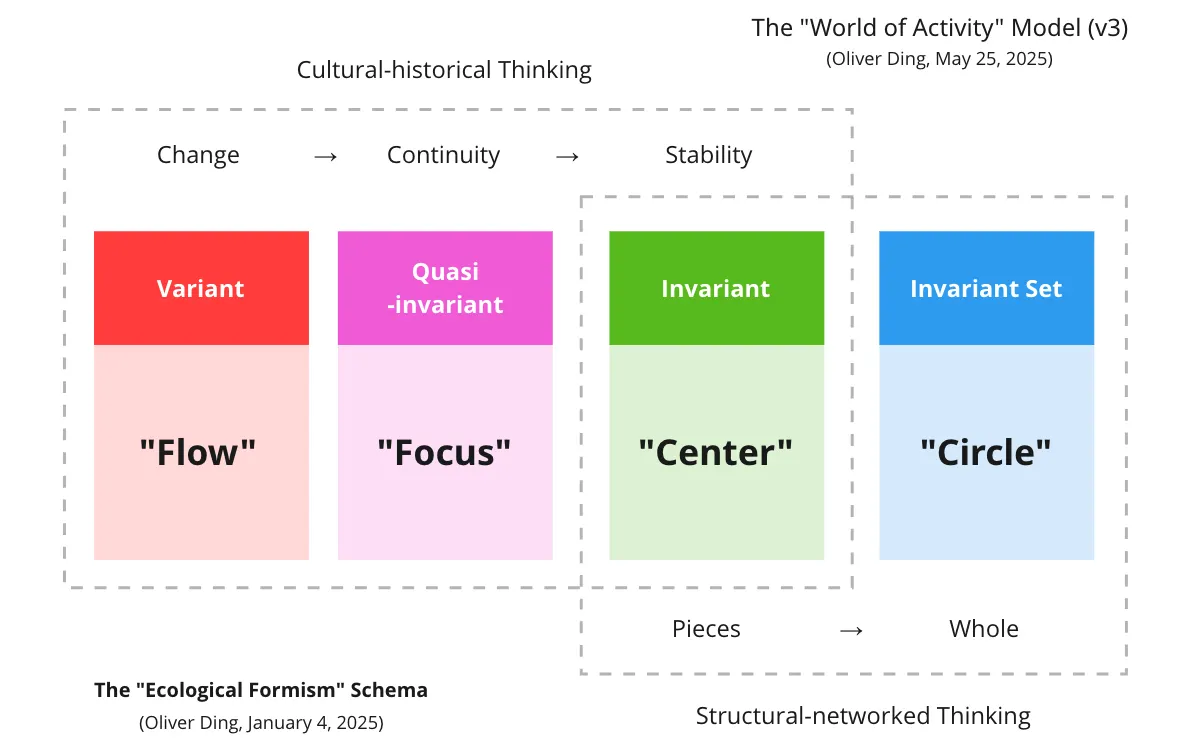
This schema combines two modes of thinking. The first is cultural-historical thinking, inspired by Activity Theory. The second is structural-networked thinking, inspired by Curativity Theory. Together, they offer a way to understand change, continuity, and stability by exploring the relationship between parts and the whole.
The four forms of the FFCC model are not a single sequence. They divide into two sequences with different orientations.
- Flow → Focus → Center is the first sequence. It belongs to cultural-historical thinking. It concerns development over time — how the stream of experience becomes focused, and how focus becomes sustained commitment. This sequence is diachronic. Its primary dimension is time.
- Center → Circle is the second sequence. It belongs to structural-networked thinking. It concerns the relationship between parts and wholes — how a single center connects with other centers to form a larger configuration. This sequence is synchronic. Its primary dimension is space.
This is why Circle has a different character from the other three forms. Flow, Focus, and Center are all, in their own ways, about individual creative life. Circle is about the collective. It is where individual centers connect, interact, and form a larger ecology.
The FFCC model is the primary model of the World of Activity approach. But the World of Activity approach is itself part of a larger theoretical framework: GO Theory and its World of Life ontology. The World of Life frames the broader social and cultural terrain in which individual lives unfold.
World of Activity looks at this terrain from the perspective of the individual. It traces how a single creative life develops — from Flow to Focus to Center. Circle is where this individual perspective reaches its limit and opens onto the collective. In this sense, Circle can be understood as the point where World of Activity touches the World of Life.
I do not want to expand the FFCC model too far in this direction. The four forms of the FFCC model should remain distinct. But it is worth noting that Circle, more than the other three, carries the weight of the social and cultural. It is the form through which the individual enters the collective.
Understanding Circle Dynamics
Circle represents the social and collective layer of analysis. How to understand the dynamics of Circle is an open question. Many social theories and cultural theories could be brought to bear. My own approach, in the map that follows, is to draw on concepts I have developed over years of theoretical work.
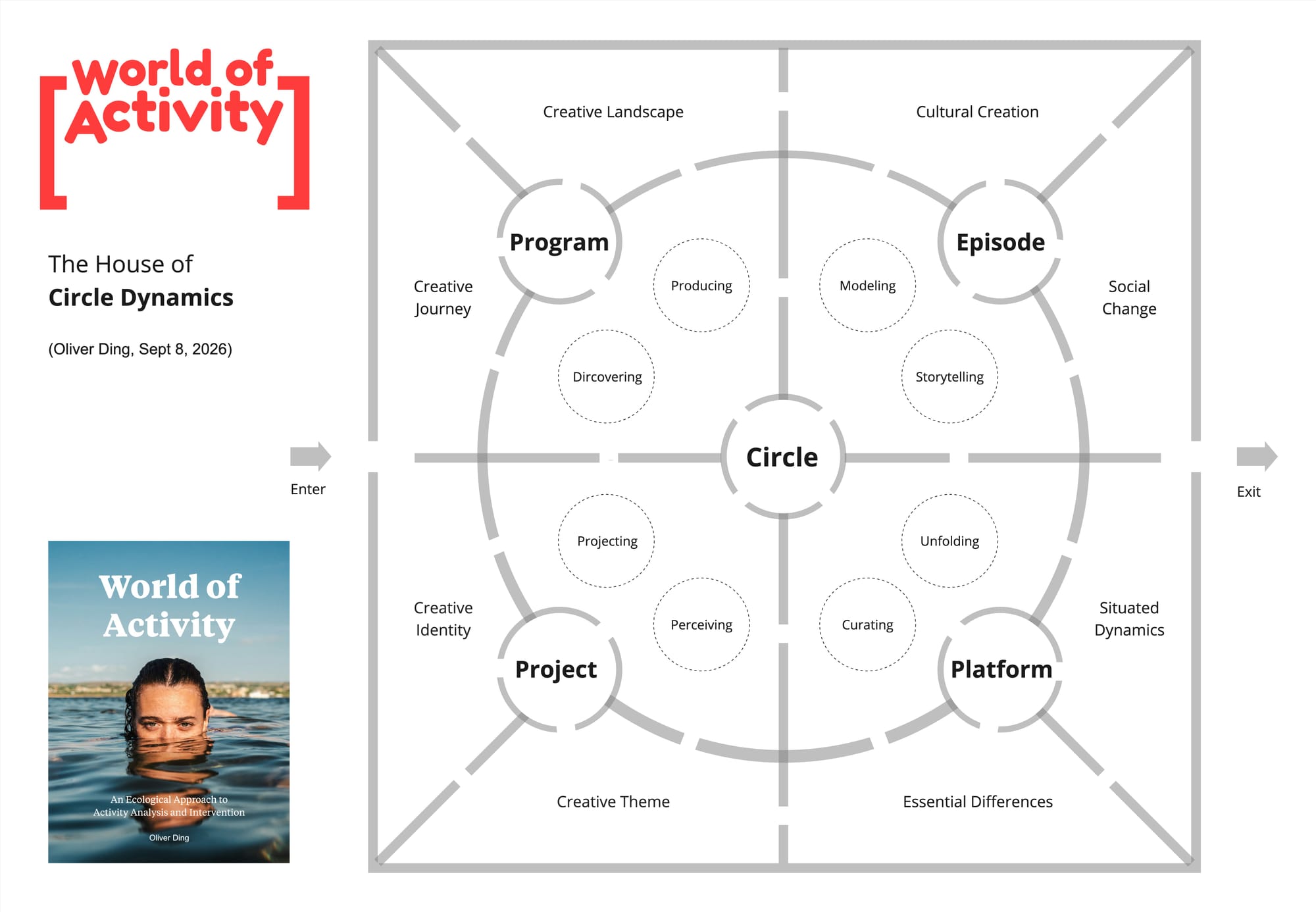
The House of Circle Dynamics is therefore not a general model of collective dynamics. It is a curated selection. The four thematic areas and sixteen themes presented here reflect my own theoretical framework — my own case studies, my own reading, my own conceptual vocabulary. They are one way to map the dynamics of Circle, not the only way.
Put simply, this new map can be understood from the perspective of platform ecology. It concerns the complex relationships among people, projects, and platforms. From this perspective, I have selected four concepts — Project, Program, Episode, Platform — to define the four thematic areas of the map.
These four areas describe the ecological relationship between developing a Project and developing a Platform. A Center does not become a Platform overnight. It grows through sustained Project work.
- Project is the basic unit — a purposeful organization of actions.
- Program is a series of Projects that gives a Center a distinctive orientation and a capacity to support others, though still in the phase of self-accumulation.
- Episode is a special type of Project that makes a distinctive contribution to the Center–Platform development process.
- Platform is the stage when a Center has grown strong enough to support others in running their own Projects.
These four areas are grounded in three knowledge systems that have shaped my thinking over the years:
- Platform Ecology — the study of the dynamic relationship between people and platforms.
- The Project Engagement Approach — a project-centered social theory inspired by Andy Blunden's notion of the project as a unit of analysis.
- The Enterprise Development Framework — a framework for understanding how creative enterprises grow from small centers to larger platforms.
The conceptual development of these theoretical enterprises at different periods is documented in several book manuscripts I have worked on over the years:
- Platform for Development (2021)
- Project-oriented Activity Theory (2021)
- Developmental Projects (December 2025)
- Anticipatory Cultural Sociology: Creation, Projection, and Agency (March 2026)
- Weave the Theory (May 2026)
Together, these works reflect a long-standing interest: how to understand individual creative development within social ecology and activity practice. The House of Circle Dynamics is one attempt to map that interest.
Developmental Project
The first thematic area of the Circle map is Project. A Project is the basic unit of creative work — a purposeful organization of actions. It is where the dynamics of Circle begin.
| PROJECT | |
|---|---|
| Outside | creative theme · creative identity |
| Inside | perceiving · projecting |
The outside themes describe the situational texture of a Project: the creative theme that gives it direction, and the creative identity that gives it a recognizable character. The inside themes describe the experiential objects: perceiving — the act of noticing what a project might become — and projecting — the act of moving from outside to inside, from observer to participant.
The thinking behind this thematic area is based on the Project Engagement Approach and its Developmental Project Model. The approach is a project-centered social theory inspired by Andy Blunden's notion of the "project as a unit of analysis of activity." The Developmental Project Model was introduced as its foundational framework in a 2021 book manuscript Project-oriented Activity Theory.
The model identifies eight elements that characterize a developmental project: Purpose, Position, Program, Social, Content, Action, Theme, and Identity. Among these, Theme and Identity are the two that matter most for Circle dynamics.
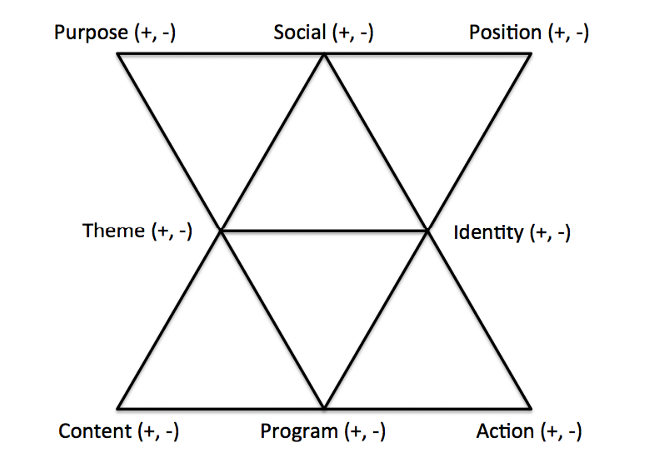
Theme is what gives a Project its direction. It is the creative thread that runs through a series of actions and gives them coherence. Theme is not just a topic or a subject. It is a living concern — something that matters to the person, something they return to, something that grows as they work on it. When a person engages with a Project, they may discover new themes for their life development.
Identity is what gives a Project its recognizable character. It is how the person perceives themselves in relation to the Project — and how others perceive them. Identity evolves through Project engagement. With each Project joined or left, with each role taken or released, the person's identity shifts. This ongoing evolution is what I call the Microdynamics of Identity.
For the full discussion, see Developmental Projects: The Project Engagement Approach to Adult Development (book, v1, 2025).
Developmental Platform
The "Platform" thematic area is inspired by the Platform Ecology theoretical enterprise.
| PLATFORM | |
|---|---|
| Outside | essential differences · situated dynamics |
| Inside | unfolding · curating |
The outside themes describe the key concepts of Platform Ecology: essential differences — the qualities that make a platform irreducibly itself, distinguishable from others — and situated dynamics — the ongoing changes through which it maintains its identity over time. Together, they define what a platform is and how it persists.
The inside themes describe the individual subjective experience: unfolding — the process by which a platform's potential becomes actual, the transformation from Center to Platform — and curating — the ongoing work of gathering, organizing, and shaping what the platform holds.
The Platform Ecology project aims to explore platform-based social practices, especially the Platform—People relationship. The configurational model is structured as:
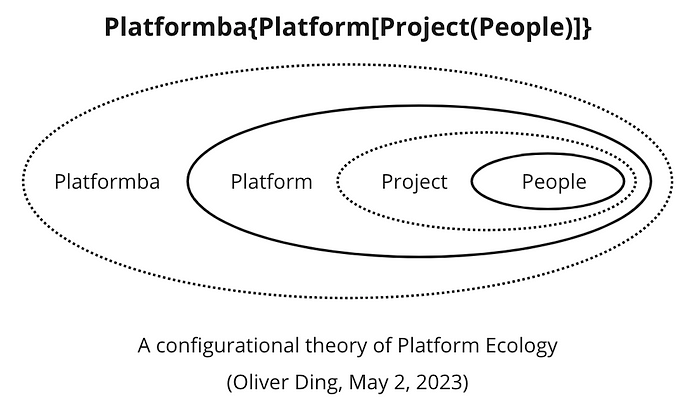
In order to describe the platform-based various activities and social practices, I coin the term Platform-ba, which means platform-based social field. While a Platform has a solid boundary, its Platform-ba has a soft boundary. Platform-based activities can happen both inside and outside the platform.
In the FFCC model, the Platform-ba is understood as Circle. The Developmental Platform represents the moment when a Center's supportive function becomes visible and accessible to others. It is the stage when a Center is recognized as a platform — not by itself, but by those it supports.
The key to understand the development of a Platform was the Double Platform framework, which connects Platform Genidentity and Mental Platform together.
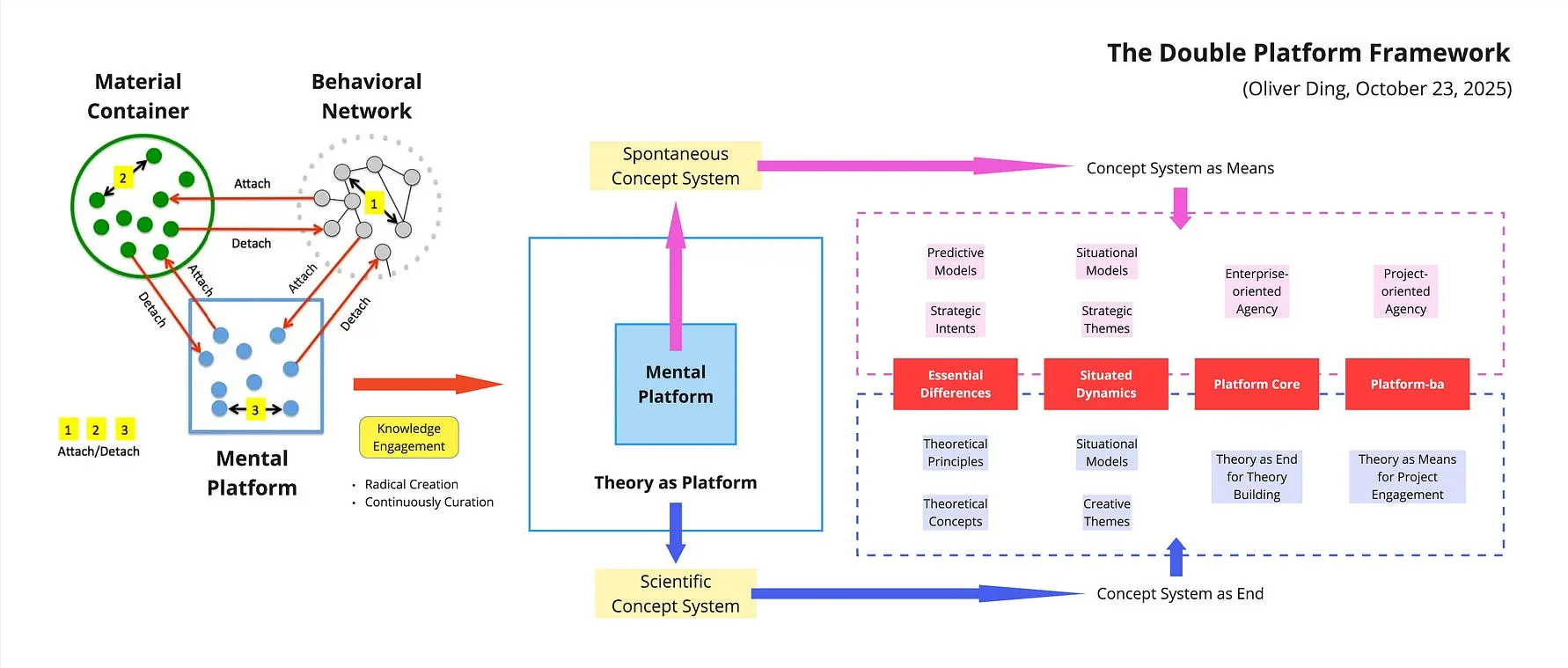
The Genidentity of a platform is defined by four ideas:
- Essential Differences — the basic unit of a platform.
- Situated Dynamics — the updates and versions through which the platform evolves.
- Platform Core — the core contributors who support the platform's development at the enterprise level.
- Platform-ba — the broader field of participants who engage with the platform at the individual level.
Theory, or any other form of knowledge system, is understood as a special type of Developmental Platform. It appears in two forms: Mental Platform, the internal knowledge foundation for a platform team; Theory as Platform, the product delivered by a knowledge innovation team, for others to use.
For a Theory as Platform, these four ideas correspond to the Genidentity of a knowledge system:
- Essential Differences — theoretical principles and theoretical concepts.
- Situated Dynamics — situational models and creative themes.
- Platform Core — theory builders, for whom the theory is an end in itself.
- Platform-ba — theory users, for whom the theory is a means for their own project engagement.
An example can be found in Revisiting the Genidentity of Activity Theory.
For the full discussion, see Platform Ecology (v3.1), The Double Platform Framework (v1, 2025), and Design-oriented Project Engagement (2026).
In the daily developmental process, people participate in a Platform by running Projects. These connections lead back to the other thematic areas: Episode and Program. Platform is not the end of the arc — it is the condition that makes new Projects possible.
Developmental Episode
The "Episode" thematic area represents the newest development of Platform Ecology: the concept of Developmental Episode.
| EPISODE | |
|---|---|
| Outside | cultural creation · social change |
| Inside | modeling · storytelling |
The development of a Platform responds to the the transformation of social structures, relationships, or institutions. In this manner, projects that engage with cultural creation and social change are typically identified as Developmental Episodes.
Modeling is the act of constructing a predictive model of social change and cultural creation. Storytelling is the act of narrating the process — giving it a form that can be communicated, remembered, and built upon.
The concept of the Developmental Episode emerged from my recent work on the Genidentity of Activity Theory (May 2026). It refers to a special type of Project — one that makes a distinctive contribution to the development of a theoretical enterprise.
In that case study, I analyzed the history of Activity Theory through the lens of developmental episodes. A developmental episode is a project in which a contributor engages directly with the foundational concept systems of a tradition — identifying a limitation, introducing a new concept, or restructuring the coordination mechanism — in a way that leaves a lasting mark on what the tradition is.
In the Activity Theory case, several contributors produced developmental episodes:
- Lev Vygotsky introduced the concept of mediation — the role of cultural signs as mediating tools. This resolved the Stimulus–Response dualism of behaviorism and produced the triadic structure S–X–R. It was a foundational episode for the tradition.
- Aleksei Leontiev introduced the concept of object-orientedness — the principle that activity is always directed toward a socially constituted object. This resolved the dualism of Individual Actions and Collective Activity, producing the triadic structure Individual Actions–Object-orientedness–Collective Activity.
- Yrjö Engeström introduced the concept of System — the collective Activity System as the fundamental unit of analysis. This resolved the dualism of Object and Outcome, producing the triadic structure Object–System–Outcome, and made visible the complex mediation in collective activity.
- Andy Blunden produced two episodes. In the first, he introduced Project as the unit of analysis, resolving the dualism of Individual and Collective. In the second, he introduced Concept as the active process of concept formation, resolving the dualism of Practice and Sign.
These episodes did not follow a single pattern. Each addressed a different problem, introduced a different third element, and produced a different triadic structure. What they share is that each made a distinctive contribution to the Platform of Activity Theory — and each is an example of what an Episode can be.
For the full case study, see Revisiting the Genidentity of Activity Theory (2026).
Developmental Program
The concept of the Developmental Program is a recent addition to Platform Ecology, developed in August 2026 during the design of the AAI (Activity Analysis & Intervention) 2026 version. It is a companion concept to the Developmental Episode.
Where the Episode emphasizes a contribution to the Platform, the Program emphasizes the development of the individual. A Program does not need to contribute to the Platform. It only needs to develop the person who runs it.
| PROGRAM | |
|---|---|
| Outside | creative journey · creative landscape |
| Inside | discovering · producing |
Creative Journey and Creative Landscape are two units of analysis I have often used for Creative Life Theory. They are useful to understand the development of Programs.
Creative journey is a sustained movement through a landscape of creative work — a larger container that holds multiple projects over time. Creative landscape is the synchronic field of possibilities, the terrain through which a journey moves. These two units of analysis help creators find the right direction and identify potential opportunities for running their programs.
Discovering is the act of finding new directions, new themes, new possibilities through sustained engagement. Producing is the act of generating work — putting insights discovered into actual creations.
In the AAI 2026 project, I articulated three values for the analyst: Navigating the Knowledge Ecology, Curating Situational Toolkits, Developing Your Signature Program. The third value is where the concept of the Developmental Program becomes concrete.
A Signature Program is not a method applied to other people's problems. It is a sustained body of work — a podcast, a workshop series, a consulting practice, a research agenda — through which the analyst develops their own capacity while serving others. It carries the analyst's signature. It is recognizable as theirs.
AAI itself can be understood as a Theory as Platform. It is a knowledge system that supports analysts in developing their own Programs. It is a young platform, still in its early development. But it is a platform.
In this framing, AAI describes a three-way relationship: theorist — analyst — client. The theorist develops the conceptual resources. The analyst navigates the knowledge ecology, curates situational toolkits, and develops a signature program. The client brings the concrete situation. AAI is the platform that holds these three roles together.
For a mature platform, we will see many Programs. A podcast platform hosts hundreds of shows. Each show is a Program for its host. For the platform, most of these shows are not Episodes — they do not change what the platform is. But for the hosts, each show is a developmental program. It is where their own capacity grows, where their own signature takes shape.
This is what makes Program and Episode complementary. A platform needs Episodes to develop. But it also needs Programs — the countless small developmental projects that sustain the individuals who make up the platform's community. Without Programs, there would be no one to run the Episodes.
The Inside: Eight Strategic Skills
The four thematic areas of the Circle map — Project, Program, Episode, Platform — bring with them many kinds of activity within a platform ecology. Running a project, sustaining a program, contributing an episode, building a platform: each involves a distinct set of challenges, and each calls for a distinct set of capacities.
In my earlier work on Strategic Life Theory, I curated a set of strategic skills for navigating these activities. These skills do not separate internal cognitive operations from external action operations. They treat mind and action as one — capacities that unfold in concrete activity, not in the mind alone. Perceiving is not just thinking about a landscape; it is acting within it. Curating is not just organizing concepts; it is shaping a platform.
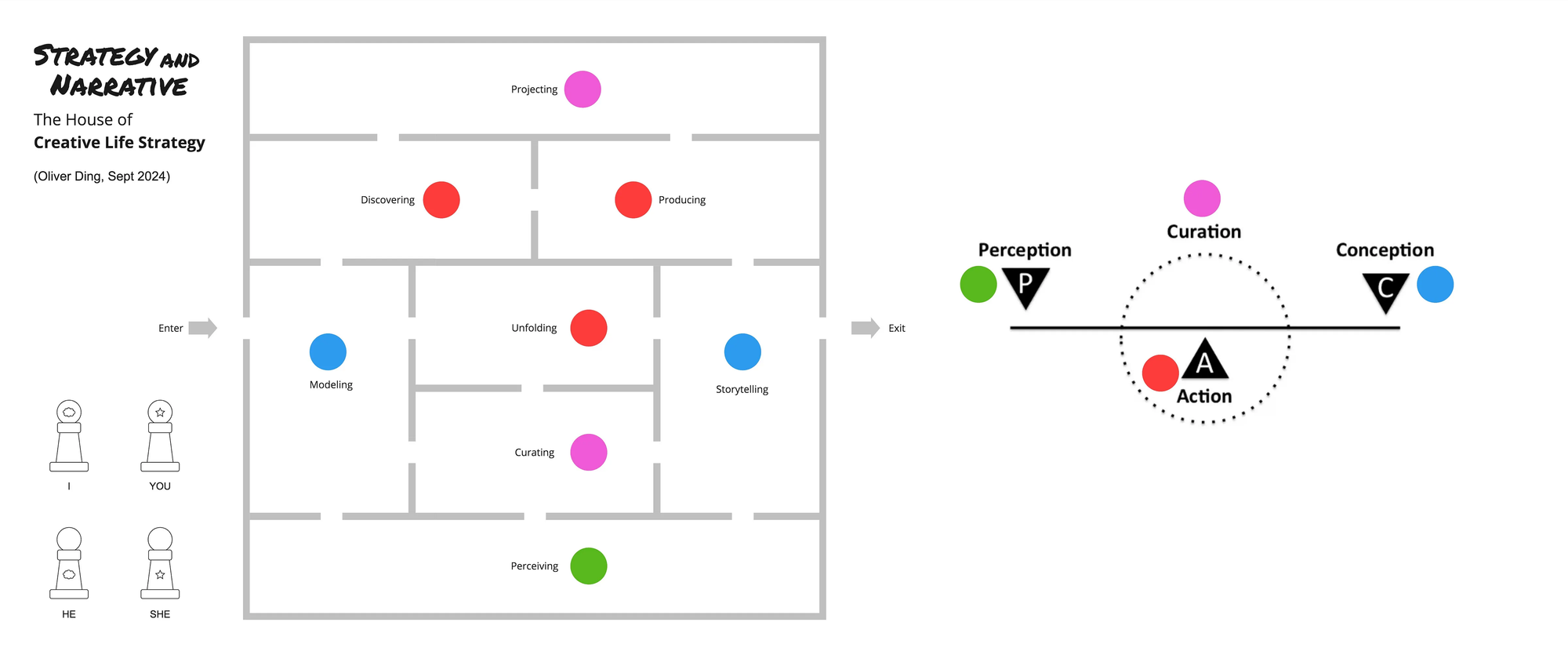
The eight inside themes of the Circle map are inspired by this set of strategic skills. Together, they form the capacities that an individual develops and operates to master activities within a platform ecology:
perceiving → projecting → discovering → producing → modeling → storytelling → unfolding → curating
In the Project area, the strategic skills are perceiving and projecting.
- Perceiving is the capacity to attend to physical environments and social landscapes — to see the terrain, the people, the projects, and the possibilities that surround us.
- Projecting is the capacity to curate self and others into a meaningful whole — to take up a position in relation to a project, not merely observing from outside but entering, committing, becoming part of something.
Perceiving and projecting belong together. Before we can project ourselves into a project, we must first perceive the landscape in which it sits.
In the Program area, the strategic skills are discovering and producing.
- Discovering is the capacity for second-order activities — activities like Life Discovery that seek significant insights and define objectives and objects. It is the skill of finding direction, of asking what matters.
- Producing is the capacity for first-order activities — activities like Life Performance where objects are transformed into outcomes in line with defined objectives. It is the skill of making, of bringing something into existence.
Discovering and producing are the two poles of creative work. Discovering without producing remains insight without form. Producing without discovering remains activity without direction.
In the Episode area, the strategic skills are modeling and storytelling.
- Modeling is the capacity to create and evolve models of projects. A model is a structured representation — a way of making the dynamics of a project visible, predictable, and shareable.
- Storytelling is the capacity to craft narratives that reflect ongoing project developments. A story is a form that can be communicated, remembered, and built upon.
Modeling and storytelling are both connected to language and conception. Modeling builds the structure. Storytelling gives it a life.
In the Platform area, the strategic skills are unfolding and curating.
- Unfolding is the capacity to manage the dynamic interplay between first-order and second-order activities, forming an Anticipatory Activity System. It is the skill of releasing what has been built into new contexts.
- Curating is the capacity to curate pieces of perception and conception into a meaningful whole at the mind level, supporting the unfolding movement at the life level. It is the ongoing skill of gathering, organizing, and shaping what the platform holds.
Unfolding and curating describe the inner dynamic of a Platform. Curating builds the platform. Unfolding releases it.
Read across the four areas, the eight strategic skills form a single sequence. This sequence traces the arc of an individual's development within a platform ecology. It begins with perception — becoming aware of the landscape. It moves through projection — entering a project. It continues through discovery and production — finding direction and making work. It deepens through modeling and storytelling — building structure and giving it form. It completes through unfolding and curating — releasing what has been built and gathering what comes next.
The sequence is not linear in practice. We loop back constantly. But as a whole, it describes the full arc of strategic capacity that an individual develops through participation in a platform ecology.
For the full discussion of these skills and their relationship to the Curativity of Action, see The House of Creative Life Strategy.
A Note on the Origins of the FFCC Model
The House of Circle Dynamics completes a series. Four maps, four ecological forms: Flow, Focus, Center, Circle. But it is worth pausing to note where these forms came from — not as abstract concepts, but as lived experience.
The FFCC model was formally introduced in 2025. But the experiences that gave rise to it were accumulated over many years. Long before there was a model called FFCC, there was the practice of running a network of knowledge centers.
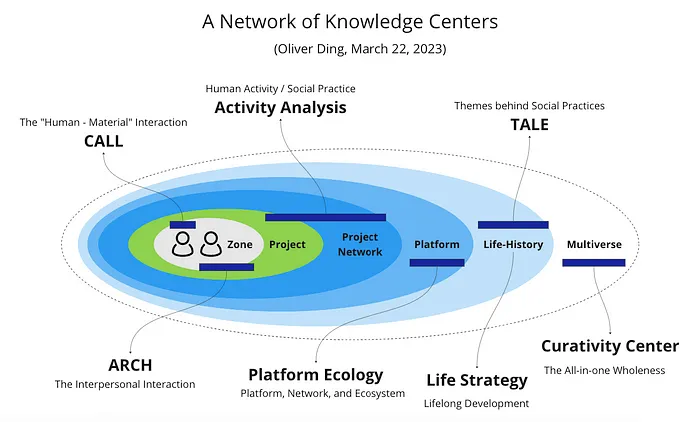
From 2022 to 2024, I built and maintained a Value Circle — a network of interconnected knowledge centers. CALL, Curativity Center, Activity Analysis Center, Platform Ecology Center, Life Strategy Center, TALE, ARCH. Each was a Center. Together, they formed a Circle. The relationships among them — supportive, overlapping, sometimes tense — were the lived reality that the concepts of Center and Circle were later developed to describe.
That experience is documented in Center, Circle, and Genidentity: The Dynamics of Networked Knowledge Centers (book, v1, 2024). The book is a case study of the Value Circle as it actually operated. It traces the developmental trajectories of both practice and theory: the day-to-day work of running knowledge centers, and the theoretical frameworks — Project Engagement, Platform Genidentity, Creative Course — that emerged from reflecting on that work.
This is why the FFCC model is not an abstract construction. It is a distillation. Flow, Focus, Center, Circle — these are not categories invented in a study. They are names given to forms of experience that were already there, already operating, already shaping the work. The model came later. The experience came first.
The same is true for the other maps in this series. The House of Center Dynamics drew on years of thinking about creative centers. The House of Flow Dynamics drew on the Aion Journey and the long practice of Time Curation. The House of Focus Dynamics drew on the Meaning Discovery Model and a decade of work on creative themes.
The FFCC model, in other words, is not a framework imposed on experience. It is a framework that emerged from experience — slowly, over years, through the accumulation of practice, reflection, and curation.
This is what makes the House of Circle Dynamics more than a map. It is a record of something that was lived before it was named.
v1.0 - September 11, 2026 - 3,914 words