
Activity Analysis & Intervention (AAI) 2026

A Meta-Framework for Supportive Development
by Oliver Ding
August 13, 2026
In the 19th issue of the Activity Analysis Center newsletter (June 15, 2026), I mentioned a significant shift: from theoretical development to practical analysis.
The Activity Analysis Center hosts two major theoretical enterprises:
- The Life-as-Activity Approach (including the Project Engagement Approach)
- The World of Activity Approach, now operating within a nested structure: World of Life (World of Activity).
The release of three recent possible books — Weave the Life, Weave the Theory, and Appropriating Activity Theory — marked a milestone of my journey of engaging with Activity Theory.
Since the Life-as-Activity Approach has reached v4.0, the future of the Activity Analysis Center will no longer focus on theoretical development, but more on testing the theoretical approach, empirical research, and intervention. The new direction has been named Activity Analysis & Intervention (AAI) in 2023.
After wrapping up the Activity U project, I established the Activity Analysis Center to continue my journey of engaging with activity theory. The term "activity analysis" has taken on different meanings at different times, but I generally understand it as: using activity‑theory concepts or knowledge frameworks to make sense of and reflect on concrete practices.
Here, the activity-theory concepts or knowledge frameworks, refers to both the traditional activity theory and my own activity-centered knowledge frameworks, such as the Life-as-Activity approach and the World of Activity approach.
This article introduces the AAI (2026) version, a meta-framework for supportive development.
Contents
- From Program to Meta-framework
- Principle 1: The Agency Cascade Principle
- Principle 2: The Knowledge for Development Principle
- Principle 3: The Supportive Self-Actualization Principle
- Principle 4: The Project Engagement Principle
- Principle 5: The Weave-the-Knowledge Principle
- Case Study: Supportive Life Discovery (v2.0) — The Mid-life Curation Edition
- Case Study: Cognitive Hydrology Pedagogy (v1.0)
- Calling a Toolkit
From Program to Meta-framework
In 2023, the Activity Analysis & Intervention (AAI) program was conceived as a concrete professional development program for consultants interested in leveraging activity-centered theoretical knowledge. The original design featured:
- Three types of roles: Clients, Consultants, and Coaches
- Two types of analysis: First-order Analysis (Client-Consultant Circle) and Second-order Analysis (Consultant-Coach Circle)
- A focus on applying Activity Theory to situational challenges and professional development
At this stage, AAI was a specific program—a bounded intervention with defined roles, methods, and outcomes.
In the first half of 2026, while I worked on closing the theoretical development journey, I also explored the practical application of theoretical knowledge through working on the Supportive Life Discovery project. After several months of testing and re-designing, I recently realized that the project itself was a rebuilding of AAI at the principle level.
Here are five principles I learned from the project, which could be expanded to all projects guided by AAI.
- The Agency Cascade Principle (#1)
- The Knowledge for Development Principle (#2)
- The Supportive Self-Actualization Principle (#3)
- The Project Engagement Principle (#4)
- The Weave-the-Knowledge Principle (#5)
Building on these principles, AAI transformed from a specific program into a meta-framework for designing various supportive developmental programs. The series of models have been curated as a toolkit for program design.
The Agency Cascade principle is the structural foundation of the entire AAI 2026 framework, providing the backbone for the other four principles. In the Knowledge for Development principle, the L3D model renames the four levels as Learn, Discover, Design, and Deliver, adapting them for the context of knowledge development. In the Supportive Self‑Actualization principle, the three‑tier subject structure is defined against the backdrop of the four‑level cascade. In the Project Engagement principle, projects are engaged and advanced in different ways across the different levels. In the Weave‑the‑Knowledge principle, subjects at different levels develop different types of knowledge.
The 2026 AAI framework now serves as the foundational architecture for programs like Supportive Life Discovery (v2.0): The Mid-life Curation Edition, providing both the theoretical grounding and the operational principles that guide program design and delivery.
Principle 1: The Agency Cascade Principle
In 2023, AAI adopted a two‑level analytical structure:
- First‑order Analysis: focusing on the client’s situational challenges and using activity‑centered knowledge to discover new opportunities.
- Second‑order Analysis: focusing on how the consultant enhances their own personal knowledge through activity‑theoretical knowledge.
These two levels corresponded to two Activity Circles:
- First‑order Analysis → Client‑Consultant Circle
- Second‑order Analysis → Consultant‑Coach Circle
At that time, the two levels were related, but they sat side by side as parallel structures rather than as a connected sequence—First‑order Analysis dealt with the client’s issues, while Second‑order Analysis dealt with the consultant’s development, and they operated independently.
In 2026, the Activity Circle was organically expanded through the Agency Cascade mechanism. This expansion is not a simple layering of more levels, but introduces a deeper driving logic: the “Other” at each level of analysis becomes the “Self” of the next level—agency does not remain within the individual, but continually cascades outward and upward through the layers of social structure.
This mechanism fundamentally transforms AAI. Building on it, I have extended the original two levels into a four‑level structure. Taking a specific AAI project as an example:
- Pre‑Activity: the client’s activities prior to the AAI project, or activities outside the current situation.
- Activity: the activity in which the client is currently situated within the AAI project.
- First‑order Analysis: the analysis of the client’s current Activity, conducted by the analyst.
- Second‑order Analysis: the analysis of the analyst’s work, conducted by the theorist.
To illustrate with a traditional psychotherapy example: Pre‑Activity could be understood as the client’s early life experiences, or their current activities outside the therapy room; Activity as the client’s present situation, or the immediate interaction with the therapist inside the room; First‑order Analysis as the therapist’s assessment of the client’s condition; and Second‑order Analysis as the supervisor’s review of the therapist’s work.
The above examples are tied to a particular AAI project for illustrative purposes. At the abstract principle level, however, we need not be confined to these examples. We need only understand the deep cascade relationship that exists among the levels—one level leads to the next—while the concrete specification of each level is determined by the particular program in question. In particular, the introduction of the Pre‑Activity level establishes a connection between the primary activity addressed by AAI and other activities beyond it. The precise nature of this connection can be defined on a case‑by‑case basis.
Principle 2: The Knowledge for Development Principle
On November 22, 2024, I shared the basic model of Project-oriented Activity Theory with a friend. Later, I realized a spatial mapping exists between this model and the Activity Analysis & Intervention (AAI) Program.
- Lower layer: Activity
- Higher layer: Knowledge
The insight inspired me to wrote a short note on knowledge, activity, and development.
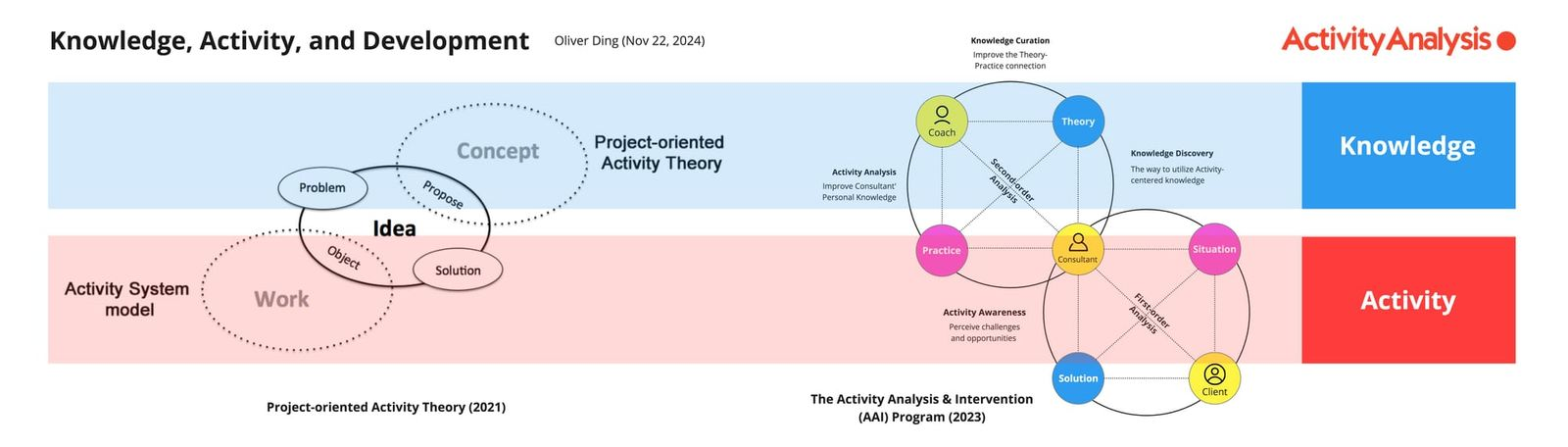
The relationship between Knowledge and Activity has been my focus for many years. Over the years, I wrote a series of possible books that related to this topic. Some are about how theoretical activity develops and how knowledge center develop, some are examples of how to discovery creative themes from live experience and turn them into knowledge frameworks, and some specially focus on strategic knowledge for individual development.
On August 9, 2026, inspired by the Knowledge Discovery Canvas, I selected 20 possible books to map my "Knowledge for Development" creative journey. The mapping process frames my own theoretical activity about the "World of Activity" approach and the "Strategy" theme into the field of developmental science, across four domains:
- Philosophy/Sociology/Psychology (Source)
- Developmental Science (Focus & Valid)
- Applied Developmental Science (Apply & Engage)
- Life Experience (Live)
I also highlight three types of knowledge:
- Theoretical knowledge
- Practical knowledge
- Private knowledge
These three types of knowledge do not remain static. They move through a series of transformation nodes: Source, Focus, Valid, Apply, Engage, and Live. 20 possible books are assigned with these six nodes.
This mapping contributes the "Knowledge for Development" principle to the AAI (2026) framework. It also bring three tools and resources to the framework.
- The Knowledge Discovery Canvas, for mapping various knowledge activity
- 20 possible books, a tiny AAI library
- The L3D model, for supportive development program design
For the domain of Applied Development Science, the key is transforming abstract knowledge into concrete practice to service domain-specially needs. The L3D model offers a method to apply and engage with theoretical knowledge within an AAI program.
- Learn: Cognitive preparation (pre-activity)
- Discover: Conversation and Exploration (activity)
- Design: Developmental Projects for Structured Creation (first-order analysis)
- Deliver: Cultural Contribution and Self Development (second-order analysis)
This principle directly builds on the Agency Cascade. The four levels of the cascade are renamed in the L3D model as Learn, Discover, Design, and Deliver, adapting the structural logic of the cascade for the context of knowledge development. The cascade's insight—that agency moves from one level to the next through the "Other→Self" relation—is preserved, but now applied to the movement of knowledge from external resource to internalized orientation to enacted practice to cultural contribution. In this sense, the Knowledge for Development principle shows how the structural logic of the cascade is not limited to describing social dynamics, but can also describe the cognitive and developmental dynamics of a person moving through a learning journey.
The Knowledge for Development principle reframes the entire AAI process as not only an intervention into activity but also a promotion of knowledge development. Different subjects develop different types of knowledge through different modes of engagement: the theorist develops theoretical knowledge through framework creation; the analyst develops practical knowledge through program design and casework; the actor develops private knowledge through weaving tools into lived experience. And through this process, each develops—not only in their capacity to act, but in their capacity to understand, to reflect, and to grow.
Principle 3: The Supportive Self-Actualization Principle
In 2023, the AAI program employed the Activity Circle model as its core structural device, with the Self-Other relationship defined primarily as a positional arrangement for mapping roles within each circle of analysis. In 2026, through the integration of insights from the Revisiting-Rebuilding series and the development of the Anticipatory Cultural Sociology (ACS) framework, the Self-Other relationship has been elevated into a standalone principle.
Drawing on the Aristotelian concept of entelechy—the state of having one's end within oneself—and the Ecological Practice Approach's distinction between potentiality and actuality, I reframed Self-Actualization as an anticipatory activity: the continuous process by which a Self recognizes ecological opportunities and moves from their latent form to their enacted form. This is not a final state to be achieved but a sustained mode of engagement.
For the ACS project, I further defined the Supportive Self-Actualization principle for understanding the Creator - Supporter relationship. The Supporter does not actualize the Creator's potential—only the Creator can do that. The Supporter holds the space, recognizes the signals, provides the frameworks, and offers the perspective, creating the conditions within which the Creator's own Self-Actualization becomes more possible. Through this sustained practice, the Supporter develops as well.
This principe now is expanded into the applied developmental science. For the AAI (2026) framework, I further implement it through the Relationfield framework—a structured design of the Self-Other relationship across the four levels of analysis. The Outcome is a tripartite subject structure:
- Subject 1: Actor (Client, Participant, etc.)
- Subject 2: Analyst (Consultant, Supporter, etc.)
- Subject 3: Theorist (Theoretical thinker, Framework developer, etc.)
The relation follows a clear directional logic: Subject 3 supports Subject 2, and Subject 2 supports Subject 1. For Subject 1, the Subject 1-Object relationship constitutes the Activity—or, in some cases, Pre-Activity. The Analyst helps the Actor navigate anticipated activity and achieve self-anticipation. The Theorist helps the Analyst navigate anticipated activity and achieve self-anticipation. Each subject is both a supporter of the one before them and a supported participant of the one after them.
This tripartite structure maps directly onto the four-level cascade:
| Agency Cascade Level | Subject Configuration | Activity |
|---|---|---|
| Pre-Activity / Activity | Subject 1 ↔ Object | The Actor engages with their activity |
| First-order Analysis | Subject 2 ↔ Subject 1 | The Analyst supports the Actioner |
| Second-order Analysis | Subject 3 ↔ Subject 2 | The Theorist supports the Analyst |
The Relationfield design translates the abstract definition of Supportive Self-Actualization into a concrete operational structure. Each level of the cascade becomes a site where Supportive Self-Actualization occurs.
This principle directly builds on the Agency Cascade: the tripartite subject structure is defined against the backdrop of the four-level cascade, with each subject positioned at a different level of the "Other→Self" progression. It also connects to the Knowledge for Development principle: the Theorist develops theoretical knowledge through supporting the Analyst; the Analyst develops practical knowledge through supporting the Actioner; the Actioner develops private knowledge through engaging with their own activity.
In this sense, the Supportive Self-Actualization principle shows how the structural logic of the cascade and the knowledge dynamics of development are both grounded in the same fundamental relation—one Self supporting another, and through that support, both developing.
Principle 4: The Project Engagement Principle
Within the tradition of Activity Theory, especially the branch developed by Andy Blunden, the concept of project was defined as the basic unit of activity, framing a series of actions. From 2020 to 2025, following this direction, I developed the Project Engagement Approach. The Project Engagement Principle simply means applying this approach to develop an AAI program.
The core insight is that between each pair of subjects, there are concrete activities—a series of projects. Projects are not merely tasks to be completed; they are the primary sites where development happens. Knowledge is internalized through projects, relationships are constituted through projects, and self-actualization is achieved through projects.
The L3D framework and the Relation Field framework combine to provide Project Engagement with its developmental orientation. Each stage of the L3D model corresponds to a different mode of project engagement, and each subject configuration in the Relation Field engages with projects in a qualitatively different way:
| L3D Stage | Mode of Project Engagement | Subject Role |
|---|---|---|
| Learn | Cognitive preparation | Developing orientations that make project engagement possible |
| Discover | Thematic exploration | Finding themes and coordinates that guide project selection |
| Design | Structured creation | Designing and executing developmental projects |
| Deliver | Cultural contribution | Sharing project outcomes and sustaining independent engagement |
Within the AAI framework, Project Engagement is further specified through the Achievement Chain—a developmental trajectory that traces the outcomes produced by project engagement:
| Node | Description |
|---|---|
| Flow | The undifferentiated stream of lived experience—before intentional thematic attention has formed |
| Focus | The emergence of intentional thematic attention—recognizing what is significant |
| Coordinate | The identification of a personal creative coordinate—the point from which knowledge enterprise can develop |
| Center | The establishment of a sustained creative center—stable, developed thematic identity |
| Circle | The formation of a network of collective engagement—the Actor's work entering a community |
Principle 4: The Project Engagement Principle
Within the tradition of Activity Theory, especially the branch developed by Andy Blunden, the concept of project was defined as the basic unit of activity, framing a series of actions. From 2020 to 2025, following this direction, I developed the Project Engagement Approach. The Project Engagement Principle simply means applying this approach to develop an AAI program.
The core insight is that between every two subjects, there are concrete activities—a series of projects. Projects are not merely tasks to be completed; they are the primary sites where development happens. Knowledge is internalized through projects, relationships are constituted through projects, and self-actualization is achieved through projects.
The L3D framework and the Relation Field framework combine to provide Project Engagement with its developmental orientation. Each stage of the L3D model corresponds to a different mode of project engagement, and each subject configuration in the Relation Field engages with projects in a qualitatively different way:
| L3D Stage | Mode of Project Engagement | Subject Role |
|---|---|---|
| Learn | Cognitive preparation | Developing orientations that make project engagement possible |
| Discover | Thematic exploration | Finding themes and coordinates that guide project selection |
| Design | Structured creation | Designing and executing developmental projects |
| Deliver | Cultural contribution | Sharing project outcomes and sustaining independent engagement |
Within the AAI framework, Project Engagement is further specified through the Achievement Chain—a developmental trajectory that traces the outcomes produced by project engagement:
- Flow
- Focus
- Coordinate
- Center
- Circle
The Achievement Chain describes what actually changes in the Actor as project engagement unfolds. Flow is the starting point—experience is rich but unstructured. Focus marks the moment when something in the flow becomes recognizably significant. Coordinate is the pivotal transition: the identification of a personal creative coordinate that makes Design and Deliver possible. Center is the establishment of a sustained creative center around which ongoing work can organize itself. Circle is the formation of a network of collective engagement, where the Actor's work enters into relationship with a community.
This Achievement Chain maps directly onto the four levels of the Agency Cascade, with Coordinate serving as the watershed—the critical transition point that separates reflective exploration from actual action.
This principle also includes a design flexibility: the L3D framework and the Achievement Chain can be scaled to fit different program contexts. For training a participant's capacity across the full cycle, a program might deliberately narrow the object and objective of each stage—keeping the scope small and the threshold low—so that the participant can complete an entire Learn-Discover-Design-Deliver loop within a bounded context. The structure remains intact; what changes is the scale.
The Project Engagement principle directly builds on the Agency Cascade: projects are engaged and advanced in different ways across the different levels of the cascade. It also connects to the Knowledge for Development principle: the L3D model provides the method through which knowledge is applied and developed. And it connects to the Supportive Self-Actualization principle: the Actor's project engagement is precisely where Supportive Self-Actualization occurs—the Analyst supports the Actor's engagement with their projects, and the Theorist supports the Analyst's engagement with theirs.
Principle 5: The Weave-the-Knowledge Principle
Where the Project Engagement principle addresses what people do across the four levels, the Weave-the-Knowledge Principle addresses what they know and how they develop knowledge through doing.
In my recent work, Weave the Life: The Life-as-Activity Approach, I proposed the Create-Curate-Weave triad to resolve the dualism between Creativity and Curativity. Creativity generates new conceptual objects; Curativity organizes existing ones into coherent structures. The tension between them does not resolve itself automatically. Weave is the third element—not a compromise or a sequence, but the integrative action that holds both in motion simultaneously. To weave is to create in a way that is already organized, and to curate in a way that is still generative.
The Weave-the-Knowledge Principle applies this triad to the AAI framework. The core insight is that the entire AAI process is not only about improving activity but also about promoting knowledge development within a collaborative relationfield. Different subjects develop different types of knowledge through distinct modes of engagement:
| Subject | Mode | Output | Activity |
|---|---|---|---|
| Theorist | Create | Framework | Weave-the-Theory—producing unique theoretical frameworks |
| Analyst | Curate | Program | Weave-the-Method—selecting and combining frameworks for specific cases |
| Actor | Weave | Toolkit | Weave-the-Life—integrating knowledge into lived experience |
The Theorist creates unique theoretical frameworks. The Analyst curates by selecting and combining different knowledge frameworks according to the client's unique situation, building a customized toolkit. The Actor weaves by taking the customized toolkit and using it to gain a systematic understanding of their own life journey and current situation.
These three modes form a reciprocal developmental cycle. The Theorist creates frameworks through sustained theoretical work. The Analyst curates these frameworks into programs tailored to specific client segments, developing their own professional identity through this practice. The Actor weaves these programs into their life, gaining understanding that transforms their experience. The Analyst learns from this application and refines their programs accordingly. The Theorist learns from the entire process, gaining new theoretical insights that stimulate further framework development.
This principle builds directly on the Agency Cascade: at each level of the cascade, a different mode of knowledge engagement is at work. It connects to the Knowledge for Development principle: the three types of knowledge correspond to what each subject develops through their respective mode of engagement—the Theorist develops theoretical knowledge, the Analyst develops practical knowledge, the Actor develops private knowledge. And it connects to the Supportive Self-Actualization principle: the development of each subject through their knowledge engagement is precisely what Supportive Self-Actualization enables.
Case Study: Supportive Life Discovery (v2.0) — The Mid-life Curation Edition
Together, the five principles form a coherent framework. The Agency Cascade provides the structural foundation. The Knowledge for Development principle explains what happens at each level. The Supportive Self-Actualization principle defines the relationship between subjects across levels. The Project Engagement principle specifies the concrete activities through which development occurs. And the Weave-the-Knowledge principle describes the knowledge dynamics that emerge from the entire process.
Let's return to the Supportive Life Discovery project, where these principles were born from practice.
Supportive Life Discovery (v2.0): The Mid-life Curation Edition is a concrete program designed for mid-life professionals. It addresses a specific developmental challenge: unlike early-career phases where direction is often externally provided, mid-life individuals have accumulated experience, capabilities, and fragmented trajectories that often require rebuilding rather than simple integration. This introduces a dual challenge—career development and professional direction, alongside life meaning, identity, and orientation itself.
The program is organized around the concept of the Watershed—a structural reconfiguration point in which a person's World of Activity reorganizes around a newly emerging coordinate system. The Achievement Chain traces this movement: Flow → Focus → Coordinate → Center → Circle. The Living Coordinate is the critical watershed. Before this moment, engagement focuses on reflective thinking; after this moment, engagement shifts to actual actions.
The L3D structure follows the four-level cascade:
| Phase | L3D Element | Activity | Output |
|---|---|---|---|
| 1 | Learn | Learning Autobiography | Revisiting and rebuilding life history |
| 2 | Discover | Thematic Conversation | Living Coordinate |
| 3 | Design | Developmental Project | Center |
| 4 | Deliver | Possible Book | Circle |
The program operates through two interconnected achievement chains. The product line describes the transformation of lived experience into thematic outputs: Experience → Story → Creative Theme → Thematic Creation → Thematic Network. The meta-product line describes the evolution of the participant's World of Activity: Flow → Focus → Coordinate → Center → Circle. Both chains operate in parallel, with the Coordinate serving as the essential transition point between thematic development and activity-structural transformation.
The three subjects defined by the Supportive Self-Actualization principle are present in the program's design. The mid-life professional is Subject 1 (Actor), the SLD practitioner is Subject 2 (Analyst), and the theoretical frameworks underlying the program—drawn from AAI, AAS, L3D, and FFCC—serve as Subject 3 (Theorist). The Analyst helps the Actor navigate anticipated activity and achieve self-anticipation. The Theorist—embodied in the program's design and its knowledge sources—helps the Analyst navigate anticipated activity and achieve self-anticipation. The Relation Field is operationalized through the program's structure, with each subject both supported and supporting.
The Weave-the-Knowledge principle is visible here as well. The SLD practitioner curates existing frameworks into a program tailored to mid-life professionals. The participant weaves this customized toolkit into their life, gaining a systematic understanding of their career trajectory and current situation. The process generates new insights that feed back into the theoretical frameworks, creating a reciprocal cycle of knowledge development—the Theorist learns from the entire process, the Analyst refines their programs, and the Actor gains understanding that transforms their experience.
The Supportive Life Discovery project demonstrates how the five principles, abstracted from practice, return to practice as a coherent framework for program design. What began as an exploration of life discovery became the testing ground for a set of principles that now guide the design of supportive developmental programs across different contexts and populations.
Case Study: Cognitive Hydrology Pedagogy (v1.0)
The Cognitive Hydrology Pedagogy (v1.0) was developed several months before the AAI 2026 meta‑framework was formally articulated. Together with the Supportive Life Discovery project, its practice and iterative design served as the primary testing ground from which the five principles of AAI 2026 were later distilled. Now, with the meta‑framework in place, we can return to CHP and examine it retrospectively as a concrete instantiation of AAI—not as a post‑hoc application, but as an organic expression of principles that were already operating in practice before they were named.
The Cognitive Hydrology Pedagogy (CHP) is a concrete program designed for learners who are already engaged in creative intellectual work and wish to develop their capacity for thematic development and concept creation over long time scales. It addresses a specific developmental challenge: in an age of information abundance, most learners are overwhelmed by the cognitive flood, yet lack the orientation, tools, and sustained support to transform scattered experiences into coherent thematic enterprises. The program offers a structured path—from entering the flow of lived experience to entering the circle of shared knowledge—while preserving each learner’s unique creative coordinate.
The program is organised around the Flow‑Focus‑Center‑Circle schema, which traces the movement from variability to stability, and is operationalised through the L3D model (Learn, Discover, Design, Deliver). The Achievement Chain maps this movement: Flow → Focus → Center → Circle. The Coordinate—the point where a learner identifies their own creative centre—is the critical watershed. Before this moment, engagement focuses on tool acquisition and reflective exploration; after it, engagement shifts to deliberate project design, thematic integration, and eventual theoretical contribution.
The four‑stage architecture follows the Agency Cascade principle directly. Stage 1 (Entering the Flow) corresponds to Pre‑Activity—the learner’s prior experiences and cognitive flood outside the program. Stage 2 (Developing Focus) is the Activity itself, where themes are tested through real projects. Stage 3 (Establishing Center) is First‑order Analysis, where the learner uses meta‑frameworks to design a coherent thematic enterprise. Stage 4 (Entering the Circle) is Second‑order Analysis, where the learner reflects on their own practice and contributes new concepts to the knowledge community. Each level cascades into the next: the “Other” (the frameworks and cases studied) becomes the “Self” (the learner’s own mental model and project), and eventually that Self becomes a source for further theoretical development.
The Knowledge for Development principle is embedded in the L3D model. Learn corresponds to acquiring theoretical knowledge (the program’s maps and models); Discover generates practical knowledge through project engagement; Design transforms mental models into structured thematic creation; Deliver moves private knowledge into the social world as a cultural contribution. The four L3D methods are not sequential but co‑present, with each stage emphasising one dominant method while the others remain active.
The Supportive Self‑Actualisation principle defines the three‑subject structure. The learner is Subject 1 (Actor), the facilitator is Subject 2 (Analyst), and the entire theoretical apparatus of Cognitive Hydrology—including its first principles, maps, models, and the trilogy of books—serves as Subject 3 (Theorist). The Analyst does not teach content but holds space, asks generative questions, provides resistance when the learner closes too early, and offers genuine response after each delivery. The Theorist supports the Analyst through the program’s design resources, and the Analyst supports the Actor by helping them navigate their cognitive flow toward self‑actualisation—a process that is never finished but continuously renewed.
Project Engagement is the operational vehicle. Every stage involves concrete projects: case studies of completed works, personal projects executed by the learner, and eventually the integration of multiple projects into a thematic enterprise. Projects are not mere tasks; they are the primary sites where themes unfold, knowledge is internalised, and the creative self develops. The Achievement Chain—Flow, Focus, Coordinate, Center, Circle—describes what actually changes in the learner as project engagement deepens, with Coordinate serving as the pivotal transition from exploration to action.
Finally, the Weave‑the‑Knowledge principle is visible in the three modes of knowledge work. The Theorist creates the original frameworks (e.g., L3D, Generative Confluence, Slow Cognition). The Analyst curates these frameworks into a coherent pedagogical program, selecting and combining them to fit the specific developmental needs of learners. The Actor weaves the curated toolkit into their own life and work, integrating abstract tools into lived experience. This creates a reciprocal cycle: the Actor’s weaving generates new insights that feed back to the Analyst and Theorist, refining the program and stimulating further framework development.
The Cognitive Hydrology Pedagogy thus demonstrates how the five principles, abstracted from practice, return to practice as a coherent architecture for program design. It is not a generic curriculum but a meta‑framework‑guided intervention, tailored for a specific population (creative intellectual workers) at a specific developmental moment (the need to move from scattered projects to a unified thematic identity). The program illustrates that AAI is not a fixed method but a set of orienting principles that program designers can draw upon to build supportive developmental experiences—each unique, yet all grounded in the same cascade of agency, knowledge transformation, supportive relations, project engagement, and knowledge weaving.
Calling the Toolkit
Over the past few months, as I applied the World of Activity approach to case analyses, I repeatedly observed a pattern in my own practice. While the FFCC model (Flow-Focus-Center-Circle) served as the primary framework for understanding each participant's career trajectory and current situation, I found myself naturally calling additional knowledge frameworks—some from the World of Activity knowledge system, some from external sources—based on the unique characteristics of each case. The process of calling frameworks felt intuitive and organic. The resulting toolkit was always customized, never pre-arranged and then applied.
This experience illuminated something essential about the analyst's ecological position and unique value. The analyst does not simply deliver a pre-packaged method. The analyst calls frameworks into a living configuration, curating a toolkit that fits the particular person, situation, and moment. This is the art of the analyst—and it is also the key to AAI's future development.
AAI is not designed to serve clients directly. It is designed to serve analysts—to contribute to the development of their professional practice and the unfolding of their creative lives. The meta-framework provides the principles and the resources; the analyst performs the curation.
The AAI (2026) framework is not intended to replace existing programs or prescribe a single method of intervention. It is a meta-framework—a set of guiding principles that program designers can draw upon to build their own supportive developmental programs, tailored to their specific contexts, populations, and objectives.
The five principles offer a coherent foundation: a structural logic (Agency Cascade), a knowledge model (Knowledge for Development), a relational design (Supportive Self-Actualization), an operational vehicle (Project Engagement), and an achievement dynamic (Weave-the-Knowledge). Together, they provide both the theoretical grounding and the practical orientation for designing interventions that support development—not by directing it from outside, but by holding the space within which it can unfold. The Supportive Life Discovery project is one instance of this framework in action. More programs will follow, each applying the same principles in different ways, for different people, at different moments in their developmental journeys.
v1.0 - August 13, 2026 - 4,415 words
v1.1 - August 16, 2026 - 5,311 words - Adding "CHP" as a new case study