
Evolving Thematic Coordinate:Origin, Dimension, Element, and Genidentity
A Four-Part Model of Coordinate–Center Transformation
by Oliver Ding
September 17, 2026
This article introduces the Evolving Thematic Coordinate Model, which was born from a case study. The model has been curated into a new possible book: World of Activity: An Ecological Approach to Activity Analysis and Intervention (AAI).

Introduction
This article is Part 4 of the case study Marinate the Mind: The Living Coordinate of Knowledge Engagement. The full study continues the series opened by The RelationField of Knowledge Engagement and examines a second facet of Gejunction: the Living Coordinate. Drawing on Johan Ivari and Annette Nolan’s multi-year creative journey around John Boyd’s OODA loop, the original report asks a narrower and more personal question: inside a single creator’s activity, how does a thematic focus first appear, how can it grow into a lasting Creative Center—or fail to?
Parts 1–3 lay out the theory, present the case, and offer a close reading of the coordinate. Part 4, published here on its own, turns to the theoretical payoff: what does the case reveal about the mechanism by which a Living Coordinate evolves into a Creative Center? It develops a four-part analytical model—origin, dimension, element, and genidentity—and tests it through an imagined future project. It also clarifies the model’s limits by locating it at the hermeneutic level, not as the single correct explanation of the transformation.
Because this part assumes the case and vocabulary established earlier, readers who have not yet read the full report may want to begin with the original 8,224-word article:
Marinate the Mind: The Living Coordinate of Knowledge Engagement
Below are the two background sections, original Part 4, and selected excerpts from the Postscript. The numbering of Part 4 remains unchanged.
Contents
- Background 1: The Living Coordinate and the Thematic Coordinate
- Background 2: The OODA Case and Its Key Findings
- Part 4: Evolving Thematic Coordinate
- 4.1 Prior Work
- 4.2 The Present Case's Contribution
- 4.3 An Imagined Journey
- 4.4 The "Coordinate–Center" Transformation
- Postscript: Early Validation from a Forthcoming Paper
Background 1: The Living Coordinate and the Thematic Coordinate
To follow the model developed in Part 4, we need to return first to the basic definition of the Living Coordinate.
A Living Coordinate is not designed in advance, and it is not handed down from outside. It is generated inside activity itself. Before an individual acts, there is no Flow and no Focus — and so no coordinate. Once activity begins, experience opens along two dimensions. Along the diachronic dimension, experience simply flows: a continuous, water-like stream moving from past to future. This is Flow. Along the synchronic dimension, certain fragments of that flow begin to draw attention; if they keep condensing and gathering meaning, they become a thematic point of attention. This is Focus. A coordinate is born at the moment Flow is cut by Focus. Their intersection is the Living Coordinate — not an abstract point in space and time, but the actual position of a person's lived experience: where the stream has reached, where attention has landed.
A Living Coordinate can appear in two forms, depending on what it is doing for a person's activity. A Thematic Living Coordinate is the coordinate at a Center's forming stage. When someone keeps attending to a thematic focus and keeps acting around it, that focus becomes a Living Coordinate — dynamic, growing, the Center's forming state. A Center evolves from exactly this kind of coordinate: when attention and action keep gathering around a thematic focus, a Center grows out of it naturally. A Belief Living Coordinate is a different kind of coordinate — one that operates beneath a Center once the Center already exists, working as the Center's foundation rather than its content. This piece stays on the thematic side; the belief side is a different inquiry, for a different piece.
Once a Living Coordinate evolves into a Creative Center, the two dimensions we track change. Flow becomes Theme: does the Center hold a core theme steady over time, and does it expand a network of related sub-themes? Focus becomes Identity: does the Center keep a boundary that distinguishes it from other living centers, and does it build a recognizable identity of its own? A Center forms through repeated rounds of Strategic Curation — each round a Developmental Project in its own right — with each round leaving behind an accumulation of creative elements clustered around the core theme. What Part 4 asks is the specific mechanism behind that evolution.
Background 2: The OODA Case and Its Key Findings
Part 4's analysis rests on a real case. Between 2023 and 2026, Johan Ivari, together with his collaborator Annette Nolan, published three papers and one synthesizing book chapter, and posted one solo reflection on LinkedIn — five projects in all, built around a single military decision-making model: John Boyd's OODA loop. On the surface, the journey looks like a straightforward expansion. A first paper, on the Harmonization Emergence Model, reworks Boyd's Orient stage around a pair of new terms, Stimmigkeit and Einheit, and imports resources from Luhmann's systems theory, Follett's theory of organizational conflict, and Derrida and DeLanda. A second paper, on the Set-based Approach, borrows Toyota's set-based design methodology to argue for parallel, hypothesis-driven military planning. A third paper turns to psycholinguistics and the CEFR framework to study how using a second language affects multinational planning teams. A synthesizing book chapter, Beyond Doctrine, draws the first three together. And a solo LinkedIn reflection, the White Rubber Canvas, reframes the mind itself as a resonating membrane, with OODA reread as one process running on it. A further LinkedIn post overlays concepts from Jacques Lacan — the Real, the Symbolic, the Imaginary, jouissance, the object a, the divided subject — onto the OODA loop's Orient stage.
Read closely, however, Part 3 of the original report draws the case's central distinction. The theme Ivari keeps exploring is: how does congruent, shared meaning emerge between people, or between organizations, in the face of difference and complexity? Episode 1 opens on exactly this question, and Episode 4 closes on it. But something structurally prior to the theme — an origin — is also at work. Episode 5 names it directly: consciousness, memory, and the self as patterns that emerge when a flexible membrane, shaped by genetics, culture, and experience, resonates and dissonates with its environment. This is the coordinate's actual origin. The shared-meaning question is not the origin; it is the theme this origin has been generating, episode after episode, since before it had a name. OODA is neither of these. It is not the origin, and it is not quite the theme either. It is one dimension of the coordinate that opens onto both.
The Living Coordinate Model's three axes make the point precisely. OODA's original form, Boyd's own military-cognitive sketch, sits on the Mind-Body axis (Thinking) — it is where the theme of shared meaning first got a concrete, individual-cognition shape. Bringing in Luhmann, in Episode 1, and then Toyota's Set-Based Design, in Episode 2, moves the same theme onto the Life-History axis (Doing): now the difference to be reconciled is between organizations. Bringing in language — first through the psycholinguistics of Episode 3, then, more radically, through the Lacan episode — moves the theme onto the Theme-Culture axis (Creating): now the difference to be reconciled runs through language and the symbolic order itself, down to a subject who, in Lacan's terms, is internally divided rather than unified to begin with. Episode 5 sits apart from this three-axis picture, because it is not another dimension — it is the origin the three dimensions have all, in different ways, been circling.
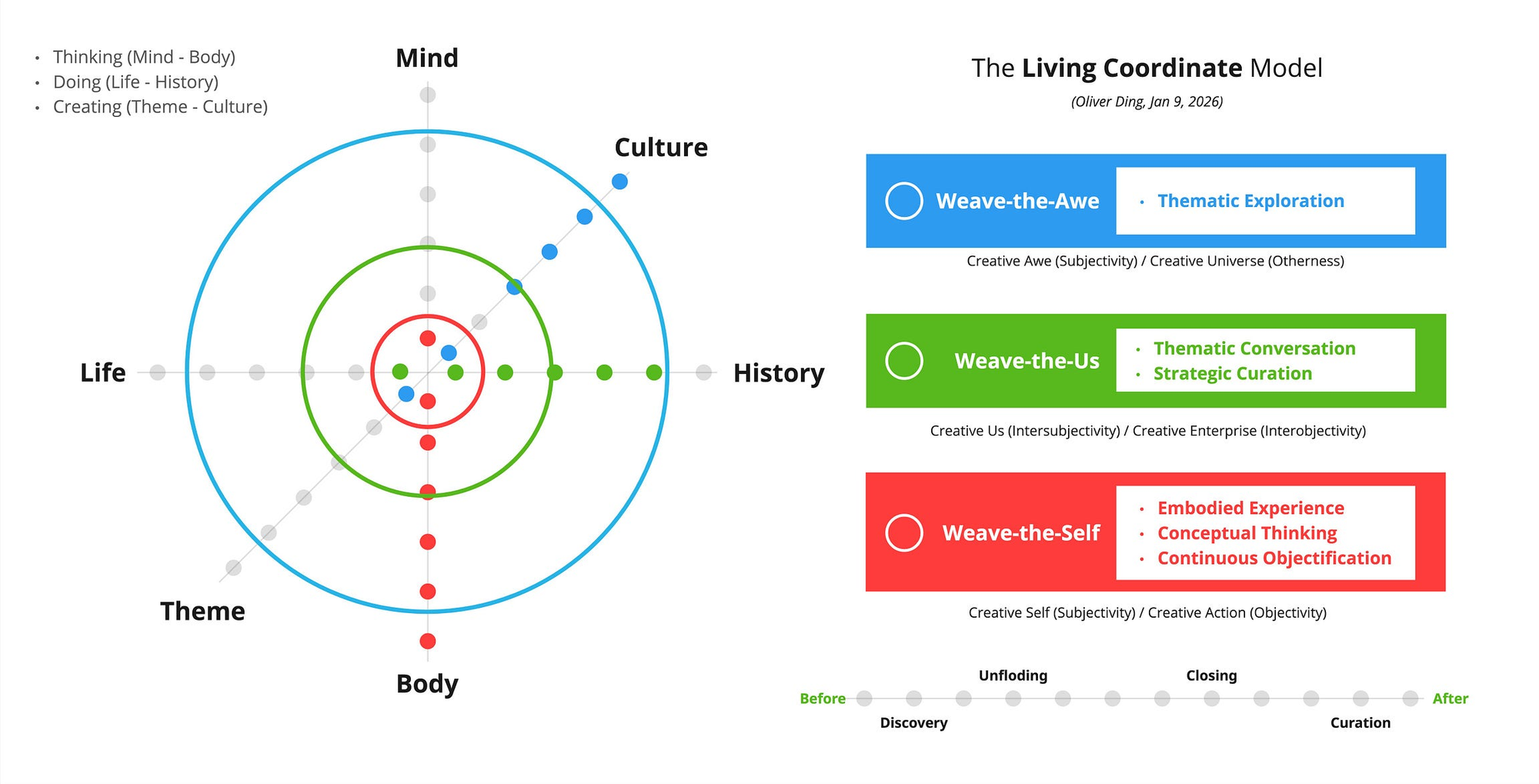
This exposes a gap. The journey he is actually on is a Creative Center forming around a genuine origin and a theme that origin keeps generating. But the journey he takes himself to be on, across the formal, publishable episodes, is always oriented toward OODA: each new dialogue is read as enriching OODA, rather than as an independent line of inquiry in its own right. OODA is one dimension of the coordinate; in practice, it is treated as though it were the coordinate's origin. White Rubber Canvas is direct evidence that he can, and did, articulate the coordinate's actual origin in his own words, in a solo, unreferenced, personal piece. What the pattern shows instead is that this clarity does not travel: it appears in the register where he is answerable to no one but himself, and it recedes everywhere he is answerable to a field. Ivari works in military and command-and-control studies, a field in which OODA is the canonical framework. To be legible and citable in that field, new work has to remain recognizably in dialogue with OODA — this is exactly what Boyd's own theory of Orient would predict, since Orient is shaped in part by cultural tradition, the sedimented expectations of a field or a community.
It is this case that exposes a gap in the existing theory: how, exactly, does a Living Coordinate evolve into a Creative Center? Part 4 takes up that question through a four-part model — origin, dimension, element, genidentity — and works through each in turn.
Part 4 follows, beginning with 4.1, "Prior Work."
Part 4: Evolving Thematic Coordinate
This case study is focused on the Thematic Living Coordinate. Working through the material it makes available, we find that a Thematic Coordinate's own development can support a proper analytical model — and this may be the case's real contribution to the theory of World of Activity, beyond what it says about Ivari himself.
4.1 Prior Work
Earlier work had already settled the Living Coordinate concept, developed a concrete, operational heuristic — the Living Coordinate Model — and used it across several intervention cases. It had also worked out the relationship between Living Coordinate and Center, and set the theoretical correspondence between Body(Self) and Living Coordinate, and between Life(Self) and FFCC, Center in particular.
The ontological account was likewise in place: a Living Coordinate is generated where Flow crosses Focus, together with a rough account of how a Living Coordinate evolves into a Center. What was missing was a more specific account of the mechanism behind that evolution — how, exactly, a coordinate becomes a center.
4.2 The Present Case's Contribution
The rich material this case supplies is what exposed that gap, and it lets each of the moving parts split further, into a more specific model.
Origin comes in two kinds. A heuristic origin is provisional, and can be chosen somewhat arbitrarily, early on, just to give a coordinate somewhere to start from. A functional origin is discovered later — the point that, once found, turns out to have already been functioning as the origin all along, whether or not it yet had a name. In Ivari's case, the shared-meaning question, with OODA as its vehicle, served for years as a heuristic origin — good enough to organize Episodes 1 and 2 around. Only with Episode 5 does a functional origin appear: the membrane-like account of consciousness and self that White Rubber Canvas names directly. Once it appears, it becomes clear that this functional origin had been operating underneath the heuristic one all along.
Dimension has a quantity side and a quality side. Quantity asks how many dimensions a coordinate actually runs on — one, two, three, or more. Quality asks how developed each dimension has become — how much has actually been invested in it, and how mature its output is. The "Body-Mind" dimension, opened by OODA's original form, stays thin — little beyond the inherited sketch itself. The "Life-History" dimension, carried by Luhmann and by Toyota's Set-Based Design, is comparatively rich, with two full projects behind it. The "Theme-Culture" dimension, carried first by the FLE paper and then by the Lacan post, is the newest and least settled of the three. (This same quantity-and-quality reading is how my own ACS work was actually carried out: three dimensions, each developed through months of concept development and case studies, invested in from January through March of 2026, before the resulting landscape was edited into the ACS v2.0 manuscript at the end of March — most of its articles written during those same three months.)
Element splits into important elements, which carry decisive weight, and ordinary elements, which simply accumulate. Episode 5 is an important element, since it is what exposes the functional origin; the CEFR data collection in Episode 3, by contrast, is an ordinary element — it adds to the record of the "Theme-Culture" dimension dimension without itself changing what the coordinate turns out to be about.
Genidentity splits into theme and identity. Theme is what the inquiry is actually about — here, how shared meaning emerges across difference. Identity is what marks a coordinate as recognizably itself rather than something else: its name, its diagram, its characteristic terms, its stylistic signature. For this coordinate, identity is carried almost entirely by OODA — Boyd's name, his four-box loop, his own vocabulary — which is exactly why Section 3.3 could show that identity being borrowed and redrawn onto material the theme had already outgrown.
None of these four — origin, dimension, element, genidentity — develops independently, and each can convert into another: a heuristic origin gives way to a functional one; an ordinary element can turn out, in hindsight, to have been the important one; a dimension's growing quality can eventually harden into part of the identity. Coupling and recoupling between them is not an exception to how a coordinate develops. It is the normal condition of it.
A caveat belongs here before the case is read through this model. What follows is our analytical model applied to the case, not a claim about how things actually unfolded inside Ivari's own mind. The reading below is a post-hoc one — a way of making the case's material legible through this model, not a report of a process anyone lived through, in real time, as origin, dimension, element, and identity.
Read chronologically, this is exactly what happened in Ivari's case. In 2023, before White Rubber Canvas had been written or named, the shared-meaning question was, for all practical purposes, functioning as the origin — it was the thing Episode 1 and Episode 2 were organized around, with OODA as its vehicle. Only in 2025 does Episode 5 name something structurally prior to that question. Once it is named, the shared-meaning question is repositioned: what had been playing the role of origin is now seen to have been a theme all along, and OODA, which had seemed to be at the center, is confirmed as one dimension among several. The coordinate did not change. What changed is which of its own parts was standing in for the origin at any given moment — and that substitution is only visible because Part 2 broke the journey into episodes instead of reading it as one settled whole.
This is also why the substitution is easy to miss. Once a coordinate has stabilized into a Center — and Ivari's OODA-centered work is stable enough now to be recognizable as one — these earlier couplings and recouplings fold into the background. A Center, once formed, presents itself as though it had always had exactly this shape: this origin, these dimensions, this theme. Methodologically, any account of a long-running Center that does not stop to divide its development into stages will fold away precisely this kind of movement — a fine-grained change in which part is doing which job — and see only the finished arrangement, mistaking a settled outcome for something that was always settled.
4.3 An Imagined Journey
One kind of test does not require waiting for a new intervention case. It can be run as a thought experiment, using a technique from an earlier piece, Life Strategy: The "Possible Journey". That piece distinguishes four related terms. Real Events are things that actually happen in a life. Actual Journeys are planned sequences of real events, given a meaning from the start. Possible Journeys are real events that happened without being planned as a meaningful whole, whose shared meaning has to be discovered afterward — this is what the method of Mapping Thematic Journey is for. Imagined Journeys are formed by adding an imagined future project onto a Possible Journey, which lets the same mapping work look forward as well as back.
The five real episodes read across Part 2 are a Possible Journey in exactly this sense: real events, not planned as a meaningful whole from the outset, whose shared theme this piece has had to discover after the fact. To test the model built in 4.2, we can turn this Possible Journey into an Imagined Journey by adding a sixth, imagined project, and asking what the model would say about it.
Imagine that, at some future date, Ivari publishes a book: Meaning Orientation: The Legacy of John Boyd and Beyond. Starting from Orient, the book works through dialogue with a range of contemporary sociological and psychological theories, gradually building a more systematic and mature theory of meaning orientation — one that answers Boyd's own original concerns while offering a more modern body of theory than OODA itself. Run through the four-part model, this imagined project changes each part differently.
Origin. The functional origin stops being something only an outside analyst can find underneath the work, and becomes the origin Ivari declares outright. What White Rubber Canvas named informally, the book would name as its own explicit foundation. The gap between heuristic and functional origin, which structured Episodes 1 through 4, closes.
Dimension. The three dimensions would not simply stay where Episode 5 left them. The "Body-Mind" dimension, thin since HEM, would finally have to catch up, since a systematic theory of meaning orientation has real work to do on this axis. Quality would likely rise across all three together, rather than one dimension developing while the others wait. Whether quantity also changes — whether a theory this systematic needs a fourth dimension the current three do not cover — the imagined project does not yet say.
Element. The book itself is not the element — it is the state a coordinate reaches once enough elements have accumulated underneath it. The real question this imagined journey raises is how many elements, and of what kind, that takes. My own ACS work offers a working answer: three dimensions, each carried through months of concept development and case studies — invested from January through March of 2026 — before enough had accumulated to edit into the five-ring ACS v2.0 landscape at the end of March. If Ivari's imagined book runs on a comparable three dimensions, reaching a comparably mature theory would mean each dimension accumulating a similar depth of work across several rounds of Strategic Curation, not simply arriving after one further project.
Genidentity. This is where the imagined project changes the most, and obviously so. Theme survives largely intact — the book is still, in the end, about how meaning is achieved amid difference and complexity — but identity does not. A book that sets out to supersede OODA cannot keep OODA's diagram, or be satisfied with OODA's name. Its own title already signals this: not another paper folded into Boyd's four boxes, but Meaning Orientation — a name of its own, needing a diagram, and a vocabulary, of its own. This is the one part of the coordinate the imagined journey does not simply develop further. It replaces it.
None of this is a prediction. It is what the model in 4.2 says should happen if the gap diagnosed in Part 3 were ever closed — origin made explicit, dimensions rising together rather than staggered, elements accumulating across several more rounds of curation, and identity, finally, let go of. Whether Ivari's actual future work goes anywhere near this imagined shape is not something this piece can know. What the exercise tests is only the model itself — whether it can say something coherent and specific about a coordinate's possible future, not only about its past.
4.4 The "Coordinate–Center" Transformation
This mechanism is still an early hypothesis. It needs testing against more cases, and it needs to be checked, in the course of actual intervention work, for how stable it is and for what practical, actionable guidance can be drawn from it. Reading a completed case through this model, as this piece has just done, only shows that the model can make a case legible after the fact. Whether it can also do real work — guiding someone while their coordinate is still forming, rather than only explaining it once it has settled — is something only intervention cases themselves can show.
The ACS case in 4.3 is worth returning to here, because it makes the limits of this model worth stating outright. The Living Coordinate Model, and the four-part structural model this piece has just built and tested, are both operational, heuristic tools. They help make sense of how a coordinate turns into a center, and they have real, concrete use in intervention work. But they are not the only possible explanation of that transformation, and they should not be mistaken for one.
The concept of Living Coordinate can be understood more fundamentally through a three-level structure: ontology, realism, and hermeneutics.
Ontology is the crossing of Flow and Focus that generates a Living Coordinate in the first place — the common foundation any coordinate shares, whatever it later becomes. This is a theoretical claim, set at the level of Body(Self), and it belongs to philosophy.
Realism is what happens when this ontological fact unfolds concretely within social life: Body(Self) is lived out, becomes Life(Self), and this living-out is exactly the process by which a Living Coordinate becomes a Center. This belongs to sociology.
Hermeneutics is everything that follows once the question becomes how, specifically, to understand a given Living Coordinate at the level of Life(Self), and how it becomes a Center in this or that particular case. Here there is no single correct explanatory model, and no single correct practical method. At the level of theory, different theorists and analysts can build different models; at the level of practice, different individuals can find their own ways of doing it. This belongs to psychology.
The whole line of Living Coordinate models developed in this work — including the four-part model tested on Ivari's case in this piece — sits at the hermeneutic level. Each is offered as a demonstration of one way of understanding the transformation, not as the standard answer to it.
After completing the first draft, I shared it with Johan Ivari. He replied with a forthcoming co-authored paper: Peter Houghton & Johan Ivari, Leadership as an Integrative Function in Multi-Domain Operations: A C2 Perspective, to be presented at ICCRTS at Johns Hopkins University in November 2026. I do not add it as a sixth project in Part 2, because it arrived after the draft and is not yet published. But it offers an unexpected opportunity to test some of the more speculative claims made in Part 4. What follows are excerpts that bear directly on the four-part model.
Postscript: Early Validation from a Forthcoming Paper
The new paper is especially instructive for the element and dimension parts of that model.
On element: in the earlier episodes, OODA functioned as an important element—it carried the coordinate’s identity, supplied its diagram, and served as the vehicle for the shared-meaning question. In the new paper, many new elements accumulate around the same coordinate: Weick’s sensemaking, Follett’s integration, narrative, constructive conflict, non-cooperative centres of gravity, and others. OODA remains present, but only as one principle among seven. Its relative importance declines not because it is rejected, but because more elements now share the weight. This is exactly what the model predicts: as elements accumulate, no single inherited element can continue to carry the whole coordinate. OODA becomes a historical grammar rather than the organising centre.
On dimension: the distribution also becomes clearer. Weick’s sensemaking belongs to the Mind–Body axis—it is still a cognitive, meaning-formation process, now paired with Boyd’s orientation. Follett’s integration belongs to the Life–History axis, taking a place alongside or in place of Luhmann’s systems theory. OODA itself is compressed into orientation and remains on the Mind–Body axis, but it is no longer the sole occupant of that dimension. The Theme–Culture axis is less explicitly developed in this paper, though narrative touches it. The three dimensions are not abandoned; they are re-sorted.
On genidentity: theme and identity begin to separate more visibly. The theme remains the question of how shared meaning or coherence emerges across difference. Identity is still partly carried by OODA—Boyd’s name, his diagram, his vocabulary—but the new name Coherence Centred Model begins to take over that function. Whether it becomes a lasting name is an open question, but it is the first clear candidate for an identity that does not need to be borrowed from OODA.
Fifth, on the imagined journey.
The draft imagined a future book, Meaning Orientation: The Legacy of John Boyd and Beyond. The ICCRTS paper is not that book, but it can be read as an early version of that journey. It has a new name—Coherence Centred Model—and has moved OODA to the periphery, yet it still remains within the C2/MDO field and still uses Boyd’s diagram. Identity is being transferred gradually: theme has moved ahead, identity still borrows Boyd’s figure, but the direction is clear.
v1.0 - September 14, 2026 - 4,332 words