
Preface: One Life,One World
The World of Activity Approach (v3.0) and AAI
by Oliver Ding
September 16, 2026
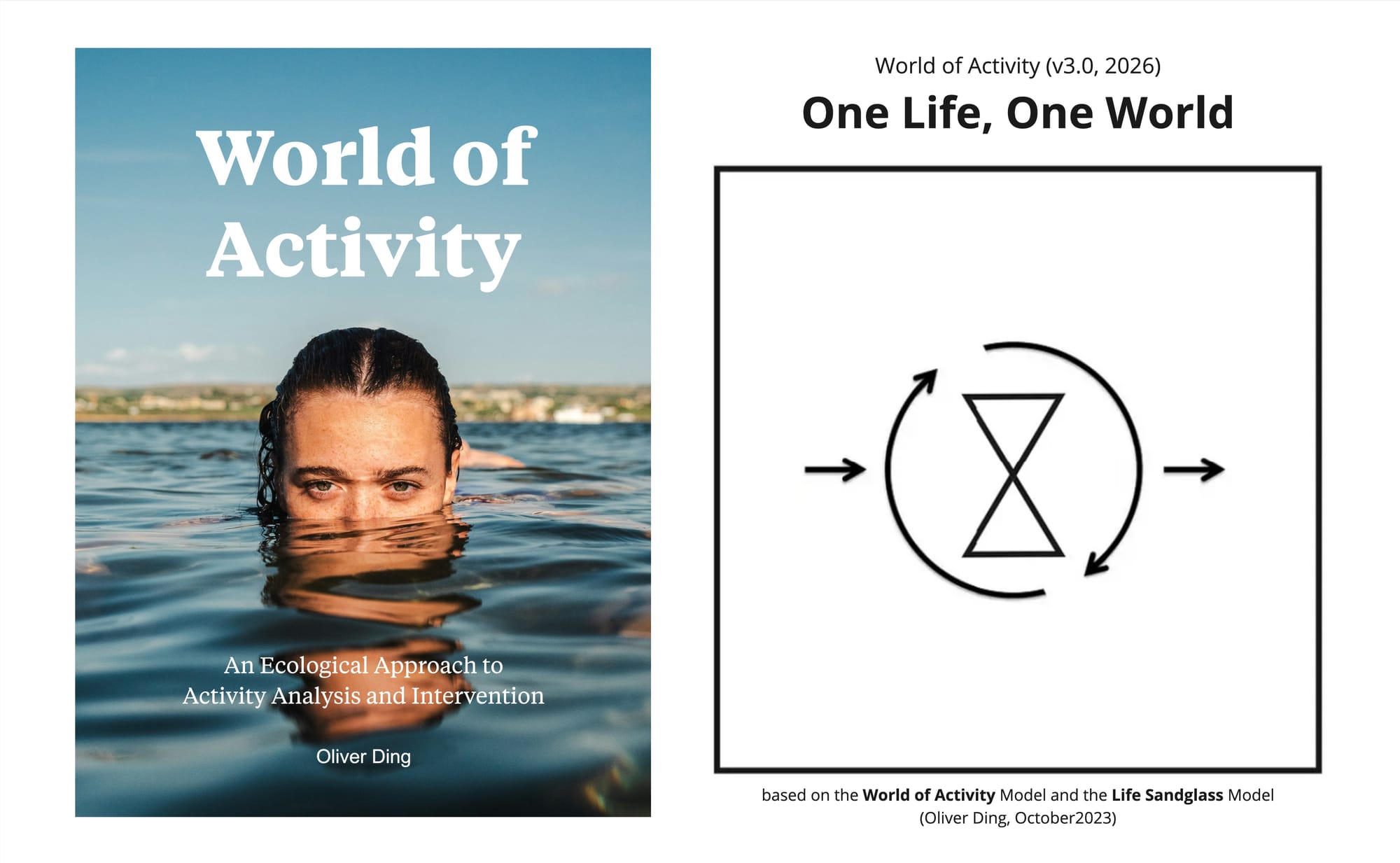
This is the Preface of a new possible book: World of Activity: An Ecological Approach to Activity Analysis and Intervention (AAI).
1
The World of Activity Approach is an individual perspective. Not an organizational perspective, not a macro-social perspective. It begins with a single person — their activities, their engagements, their unfolding within the social world.
This book exists to serve that individual development. More precisely, it serves adult development — a topic I have been concerned with for many years.
The concept of World of Activity was born in 2021 during my Career Curation project. At that time, I sought a framework to define “career” in a way that considered both paid work and unpaid work — an approach inspired by my own life course, especially my non-profit activities and intellectual explorations.
In the social phenomenologist Alfred Schutz’s work, I found a starting point: his World of Working.
To distinguish covert acts of mere thinking from overt acts requiring bodily movements, Schutz referred to the latter as Working. According to Schutz, Working refers to action in the outer world. However, Schutz’s framework primarily focused on the practical world of daily life, treating other realms like fantasy and dreams as separate sub-worlds within the broader Life-world.
In 2022, when developing my approach to researching creative life, I recognized that Schutz’s distinction between different sub-worlds needed to be reconsidered. For creative individuals, the worlds of fantasy and dreams are not merely separate realms — they are significant sources of creative inspiration that actively inform and shape their outer-world projects. A novelist’s dream becomes the seed of a story; an artist’s fantasy transforms into a painting; a theorist’s imaginative leap leads to new frameworks.
This insight led me to coin the term “World of Activity” to capture a more integrated understanding of creative engagement. While Schutz’s “Working” emphasizes the projection of intention into the outer world through bodily movements, my “Activity” encompasses the fuller spectrum of creative engagement — including how inner experiences of imagination and reflection actively contribute to outer-world projects.
2
The World of Activity Approach is not a theory that isolates the individual from society. The individual's World of Activity is nested within World of Life, a term I used to describe the social world. Together, they form GO Theory — The World of Life (World of Activity) Approach — which provides a series of ecological forms for understanding subjectivity as it unfolds within a person's World of Activity. Instead of asking what the self is, we ask where the self is and where it ought to be.
The framework is built on a nested structure:
- Body (Self) — the embodied individual, the starting point of subjectivity
- Life (Self) — the Self as lived through activities and engagements in the world
- History [Life (Self)] — the Self as situated within historical and cultural contexts
These three layers are not stages of development. Every individual exists in all three layers at every moment — the differences lie in whether and how they are perceived, and to what extent. I present them as three states for the purpose of explanation, not as a developmental sequence.
This book introduces the Coordinate–Center–Gejunction Framework as a toolkit to understand this nested structure.
Many theories of individual development begin and end with the individual. They treat the social world as a background, a context, an environment. The World of Activity approach does not. It sees the individual and the social world as two inseparable aspects of the same whole. The World of Activity approach looks outward from the individual's perspective — at their own activity, and at the social world they inhabit. The World of Life approach looks at the same terrain from the cultural perspective. They are not two separate worlds. They are two views of the same whole.
This matters because it changes what development means. It means the unfolding of subjectivity with in activity and the social world.
3
Readers familiar with my work will know that World of Activity began as a concept within Creative Life Theory. In 2025, it separated from that theory and developed into an independent theoretical framework.
The original World of Activity was an empty container. It defined only four boundaries — Heaven, Earth, Birth, Death — for the individual's activity. However, I did not attempt to build a general theory of adult development. Creative Life Theory only focuses on knowledge creators and, more recently, on creative activity across cultural innovation. Even after this expansion, it remains a specific theory, not a general one.
Creative activity is one type of individual life — a narrow and specific one. Individual life is far more diverse. A person may organize their life around raising a family, caring for aging parents, building a local community, practicing a craft, serving a faith tradition. They are equally real, equally developmental, equally worthy of theoretical attention.
This is why World of Activity needed to separate from Creative Life Theory. Not because Creative Life Theory was wrong, but because it was specific. It could not serve as the general framework for all adult development. It could only serve as one powerful lens for one important type of life.
4
In the current Activity Analysis & Intervention (AAI) framework, I treat the relationship between World of Activity and Creative Life Theory this way.
The World of Activity (v3.0) Approach focuses on seven ecological forms — the original FFCC model (Flow, Focus, Center, Circle), plus three more: Boundary, Coordinate, and Gejunction. These seven forms constitute the foundational framework for AAI. Every AAI project uses them. They provide a map — a way of surveying and discussing an individual's life situation through a shared set of ecological forms.
The map is not prescriptive. It does not tell you what a good life looks like. It does not rank one form above another. It simply names the structural features that every World of Activity has — the boundaries that contain it, the coordinates that locate it, the flows and focuses that move through it, the centers that organize it, the circles that connect it, and the gejunctions that synthesize it. An analyst can use this map to survey any individual life, whatever its content.
But the map does not interpret what it surveys. That work is left to the analyst.
The analyst chooses the knowledge frameworks appropriate to the individual case. If I, as an analyst, am working with a knowledge creator, I will naturally draw on Creative Life Theory to explain what the World of Activity framework has mapped. Another analyst, encountering a different kind of individual case, will choose different frameworks. This is the relationship between a foundational framework and optional modules. The foundation is shared. The modules are selected flexibly. The relationship between World of Activity and Creative Life Theory in this book is one demonstration of how that works.
A note for readers as they move through this book. The articles collected here span theoretical frameworks, thematic maps, and case studies. Many of the themes in the thematic maps come from the knowledge frameworks I have accumulated over years of work — and many of those frameworks come from Creative Life Theory. Similarly, the case studies often develop a situational toolkit for a particular case, and some of the frameworks used in those toolkits also come from Creative Life Theory.
With the principle stated above in mind, readers should understand these frameworks as demonstrative examples — not as prescribed knowledge frameworks. They show one way of connecting the World of Activity map with interpretive resources. Other analysts, with other cases, will connect it with other resources. That is not a deviation from the approach. It is how the approach is meant to work.
5
The subtitle of this book is An Ecological Approach to Activity Analysis and Intervention. The word "ecological" deserves explanation.
It does not refer to environmental sustainability, nor to the ecology of natural systems. It refers to Ecological Formism — the meta-framework that underlies the World of Activity approach.
Ecological Formism distinguishes four layers of form: Variant, Quasi-invariant, Invariant, and Invariant Set. These four layers combine two modes of thinking. The first is cultural-historical thinking, which concerns change over time. The second is structural-networked thinking, which concerns the relationship between parts and wholes. Together, they offer a way to understand both continuity and stability — how forms persist, how they change, and how they relate to one another.
The FFCC model itself was generated through Ecological Formism. On May 25, 2025, I adopted the schema to develop a layered account of the World of Activity:
- Variant: Creative Flow — the flow of everyday life experience.
- Quasi-invariant: Creative Focus — the mental focus of our mind.
- Invariant: Creative Center — the creative center we work with continuously.
- Invariant Set: Creative Circle — the circle of connected creative centers.
These four forms are not a taxonomy imposed on experience. They are names given to forms of experience that were already there, already operating. The model came later. The experience came first.
In April 2026, after a year of case studies, I used Ecological Formism again to organize the insights that had emerged. The FFCC model and its derivative insights were arranged into a three-layer architecture:
- Invariant: FFCC Schema, four basic ecological forms.
- Quasi-invariant: A series of movements, described with the FFCC vocabulary.
- Variant: Situational life events and themes (an open category).
- Invariant Set: Other ecological forms.
This architecture gave the framework a principled openness. The Variant layer can always receive new themes. The Quasi-invariant layer can grow as new cross-human developmental patterns are identified. The Invariant layer remains stable as the ontological foundation.
More recently, the thematic map series — the House of World of Activity, House of Flow, House of Focus, House of Center, House of Circle, and House of Gejunction — can be understood as another application of Ecological Formism. Each map has a core theme given by FFCC: that is the invariant. Each map has four thematic areas set by me at the time of design: those are quasi-invariants. And each map has sixteen themes that can be replaced by the reader: those are variants. The structure remains; the content adapts.
This is what "ecological" means in the subtitle. It means that the approach is built on a meta-framework that distinguishes what is invariant from what is variable — and that gives both the stability of a foundation and the flexibility of an open toolkit.
6
This book marks the completion of the analysis phase of AAI.
What does that mean? It means that AAI analysts can now use the theoretical framework and knowledge frameworks presented here to conduct case analyses. If readers want to explore certain frameworks mentioned in this book further, they can consult my previously edited manuscripts or articles not included here.
AAI treats analysis and intervention as a unity. Analysis is not merely a preparation for intervention. Analysis has its own value. This claim places the analyst's own development at the center. When an analyst uses the World of Activity approach to conduct case analysis — one case after another — they are engaged in a form of self-training in understanding. Over time, they internalize the ecological forms of World of Activity. They learn to connect those forms with the knowledge frameworks they already possess, and with the specific situations their clients bring.
The analyst who only reads about a framework does not yet know it. The analyst who has used it on a single case begins to know it. The analyst who has used it on several cases — across different people, different problems, different contexts — has made it part of their own cognitive infrastructure. This is what AAI offers: not just a method, but a path of development for the analyst themselves.
7
I should also be candid: this book does not say much about intervention. AAI has not yet reached that phase. Intervention is the next task.
But it would be misleading to suggest that the book contains no intervention at all. Many of the case studies collected here are drawn from my own lived experience. Some of them show how I have used the World of Activity toolkit in my own life. If these count as self-intervention, then readers can see that World of Activity is not a product that sits idle in the study. It is a set of tools that have been tested in the rough terrain of a real life. Readers interested in these cases may look especially at Part 2, where the FFCC model is used in direct applications, and at Parts 4 and 5, which contain several case studies of the Living Coordinate and Gejunction.
If we adopt a stricter definition of intervention — one that requires a trained analyst, a client, a formal agreement, and a sustained process of change — then these self-cases do not qualify.
This book is the foundation. It provides the map. Intervention, in the full professional sense, is the next task.
v1.0 - September 16, 2026 - 2,195 words