
Activity Analysis Network #22: — Closure and Unfolding: A Thematic Trip and the AAI (2026) Journey
Hi, and welcome back to Activity Analysis Network.
I returned from China on July 30. Three weeks away — time with family, visits to relatives, and a chance to step back from the daily rhythm of the Activity Analysis Center.
Last year, that same trip led to a Kindle book: Homecoming: A Thematic Trip and the World of Activity Approach. This year's journey turned out to be unexpectedly interesting — it echoed last year's theme in a way I hadn't anticipated, and it gave birth to a sequel. But this was only part of the story.
Three things came out of this trip: a thematic journey, a new book project, and a shift in the Center's direction.
A Thematic Trip
I traveled back with my children—from the U.S. to Fuzhou, then to Jianyang, and finally to Pengdun, a small village about 12 km from Jianyang where I grew up.
In Jianyang, I gathered with my cousins. Most of them left Pengdun years ago; their children are now scattered – some in Fuzhou, some in Japan, one heading to Vienna later this year. From Pengdun to Jianyang, from Jianyang to Fuzhou, from Fuzhou to overseas – a four‑generation migration pattern unfolded right there at the dinner table.
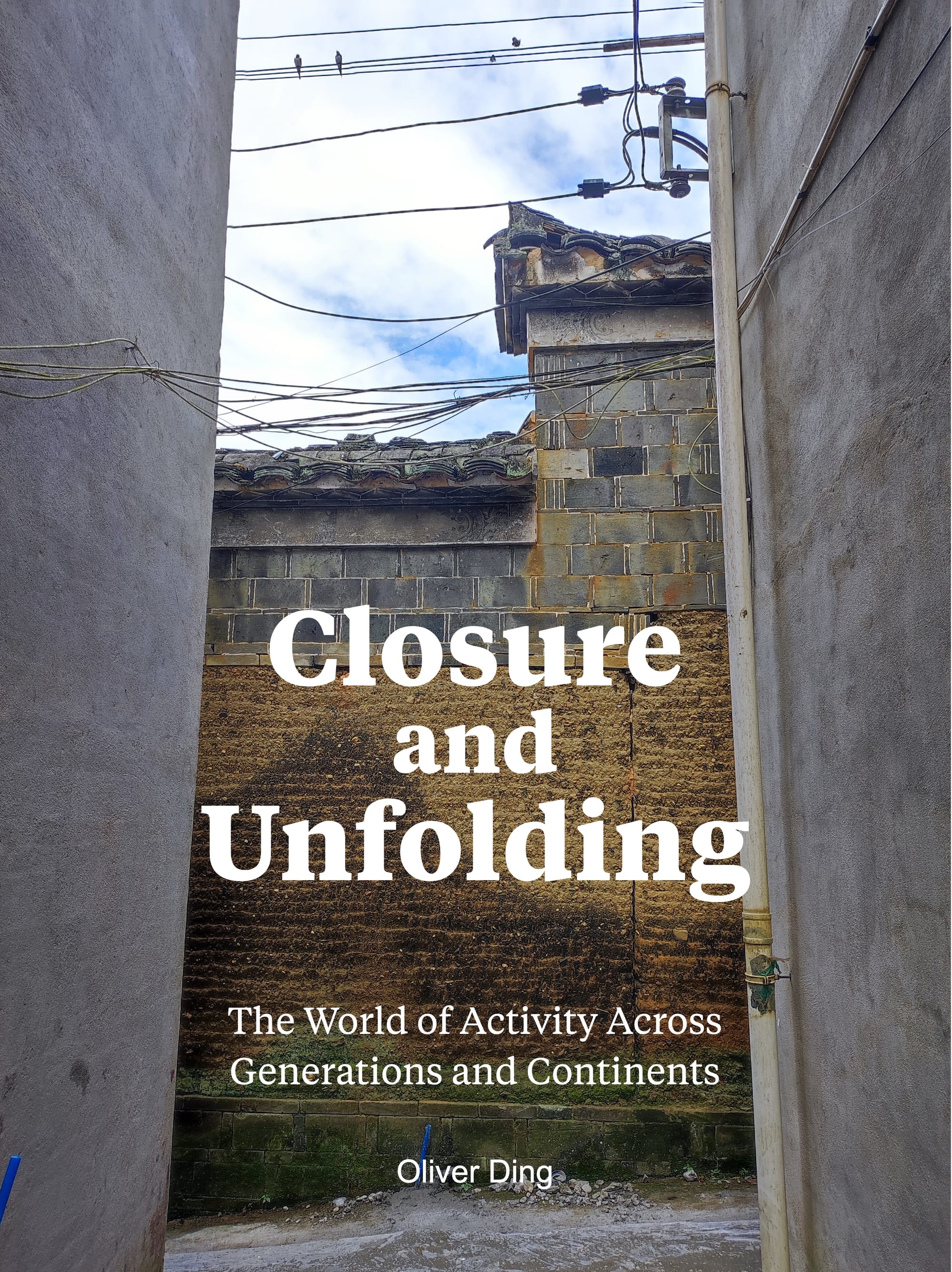
The next day, I visited my aunt and uncle, who still live in the old ancestral house – a Ming‑Qing building now marked as “historic architecture.” The house is nearly empty; only they remain. After saying goodbye, I walked down the lane I used to take to elementary school. The road was being paved with concrete; on both sides, new cement walls were rising, with an old earth wall still standing between them. I took a photo and stood there for a long time.
That image – two new walls like curtains, one old wall like a stage – became the core metaphor of the trip. Back in the U.S., I kept returning to it. A theme slowly emerged: Closure and Unfolding. My aunt and uncle’s world is closing; their descendants’ worlds are unfolding across continents. Two movements, happening at the same time.
The theme resonated with my own creative journey in 2025 — the year I closed my multi-year work on Knowledge Engagement while simultaneously opening a new direction in Cultural Development. What I had experienced at the individual level in 2025, I now saw at the family level in Pengdun.
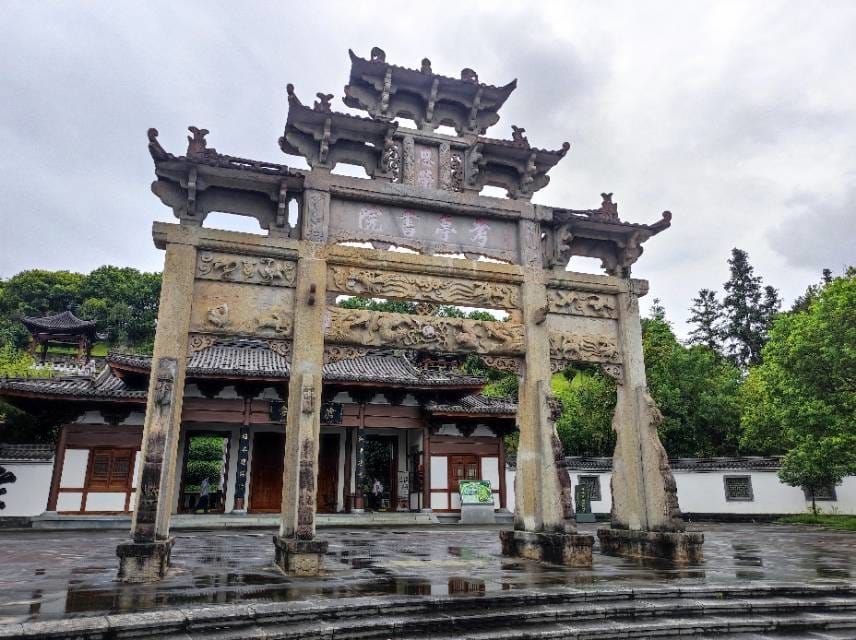
We also went to Kaoting Academy to pay my respects to Zhu Xi.
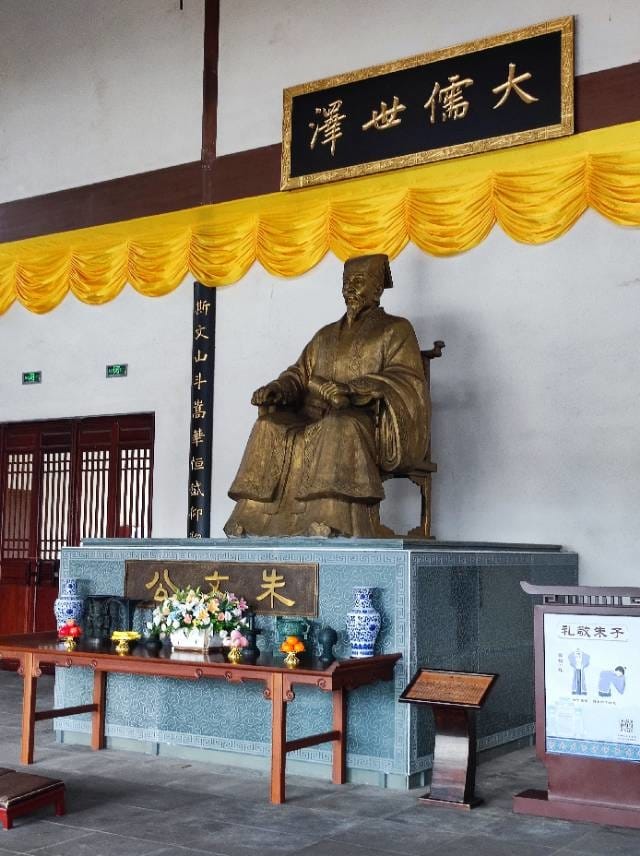
In my heart, this was more than sightseeing. Over the past few years, Zhu Xi's name had appeared more and more frequently in my creative notes—from Kwang-Kuo Hwang's scientific interpretation of his thought as a case study for Creative Life Theory, to the inspiration Zhouyi Benyi (Original Meaning of the Book of Changes) gave to my thinking on formal structures on GO Square, to the "Ren-based Activity Theory" (仁体活动论) I was beginning to conceive. Yet most of these engagements remained at the textual and conceptual level. I had not yet faced him again in real space, standing on the ground where he once stood.
I had waited a long time for this trip.
After coming back to Houston, I revisited this experience repeatedly, slowly recognizing its place in my entire creative trajectory. I realized that my connection with Zhu Xi was itself in the process of closing and unfolding. For many years, he had been part of my hometown sentiment—an emotional guide, a figure I turned to for comfort by browsing his Wikipedia entries. But I had never truly entered his intellectual world, never seriously engaged with his philosophical system, never treated him as a thinker with whom I could have a dialogue. That old state was now being closed. A new state was opening.
Closure and Unfolding: A New Possible Book
The thematic trip led to a plan to write a new possible book:
Closure and Unfolding: The World of Activity Across Generations and Continents
More details and related articles:
- Spatial Heuristics: A Thematic Trip and a Possible Book
- GO Square: A Thematic Mapping of a Trip to China
- GO Square: Mapping the "Thematic Trip" Constellation
- Closure and Unfolding: Part 1 - A Dramatic Life Pattern
- Closure and Unfolding: Part 2 - Across Generations
- Closure and Unfolding: Part 3 - Across Continents
- Closure and Unfolding: Part 4 - Zheng Xin Cheng Yi
- Closure and Unfolding: Chapter 4.1 - A Jianyang Boy
A New Creative Journey
But this journey was not only personal. It also marked a significant institutional shift.
In the 19th issue of this newsletter (June 15, 2026), I mentioned a major transition: the Activity Analysis Center is moving from theoretical development to practical analysis.
To recap, the Center hosts two major theoretical enterprises:
- The Life-as-Activity Approach (including the Project Engagement Approach), now at v4.0.
- The World of Activity Approach, now operating within a nested structure: World of Life (World of Activity).
The release of three recent possible books — Weave the Life, Weave the Theory, and Appropriating Activity Theory — marked a milestone in my engagement with Activity Theory.
Since the Life-as-Activity Approach has reached v4.0, the future of the Activity Analysis Center will no longer focus primarily on theoretical development. Instead, it will shift toward testing the theoretical approach, empirical research, and intervention. This new direction was first named Activity Analysis & Intervention (AAI) in 2023. Now it becomes the operational core.
I've come to see this trip — this moment of return, of seeing my family's world close and unfold — as the Center's own "closing and unfolding": the chapter of theory is closing, while the chapter of practice is opening.
AAI 2026: From Program to Meta-Framework
What I didn't expect was how much of this trip would directly feed into AAI itself.
A friend traveled from Hangzhou to Fuzhou specifically to meet with me and discuss the future development of AAI. We talked through the direction, the challenges, and the opportunities. Alongside this, I had conversations with multiple other friends in China — academics, practitioners, and thinkers from different fields — who offered their perspectives on what an "activity analysis and intervention" practice could look like in different cultural and institutional contexts.
During my time in China, I also began writing on the World of Activity approach and AAI in Chinese — a new creative experience for me. I started drafting the outline for 《活动分析与干预二十讲》 (Twenty Lectures on Activity Analysis and Intervention). What made this writing process distinctive was my choice of entry point: instead of beginning with theoretical frameworks, I used儒家典故 (Confucian classical references) — familiar touchstones for Chinese readers — to raise foundational questions about human activity, difficulty, and transformation. Only then did I gradually introduce concepts from my own theoretical system. This mode of writing — starting from cultural common sense and moving toward theoretical articulation — gave me a fresh sense of how AAI can be communicated across different intellectual traditions.
After returning to the U.S., I continued refining the AAI framework. The result is AAI 2026 — not a specific program, but a meta-framework for designing supportive developmental programs.
In 2023, AAI was conceived as a concrete professional development program with defined roles (Clients, Consultants, Coaches), two levels of analysis (first-order and second-order), and a focus on applying Activity Theory to situational challenges. By 2026, after months of testing through the Supportive Life Discovery project and other experiments, AAI has transformed. It now operates at the principle level — a set of guiding principles that program designers can draw upon to build their own supportive developmental programs, tailored to their specific contexts, populations, and objectives.
Here are five principles of the AAI (2026):
- The Agency Cascade Principle (#1)
- The Knowledge for Development Principle (#2)
- The Supportive Self-Actualization Principle (#3)
- The Project Engagement Principle (#4)
- The Weave-the-Knowledge Principle (#5)
Together, they provide both the theoretical grounding and the practical orientation for designing interventions. A series of models have been curated as a toolkit for program design.
Full document:
A New Homepage
To better support both ongoing theoretical work and the new practice‑oriented direction, I’ve reorganised the homepage with four new categories:
- Activity Analysis & Intervention (AAI) – latest updates on the AAI program
- Cultural Themes – continuation of the ACS project, now focusing on case studies of themes and concept systems
- Dramatic Life Pattern – ongoing study within the SDP (Strategic Developmental Psychology) project
- Gejunction – further development of this core concept of GO Theory and SDP
The former “Z lab” is now “Z lab / GO Theory”, highlighting its function as the publishing channel for GO Theory updates.
The site’s slogan has been updated to:
Becoming an Activity Analyst
This is not just a tagline. It signals the shift – from a museum of finished theories to a workfield for developing analytical practice.
That’s all for this issue.
See you next time.
Oliver Ding
Founder of the Activity Analysis Center
August 15, 2026
v1.0 - 1,505 words