
GO Square: Mapping the "Thematic Trip" Constellation
The GO Theory Series
by Oliver Ding
August 8, 2026
Three days ago, I published an article titled Spatial Heuristics: A Thematic Trip and a Possible Book. That article documented a creative journey: a trip to China, a photograph taken in my hometown village, and the emergence of a theme called "Closure and Unfolding" — which grew into a plan to write a new possible book. The article completed the first cycle of that theme's development.
But as I worked on that theme, I began to see the trip itself as something more than a single experience. It was an instance of a recurring pattern in my creative life: traveling with openness to themes, and returning to extract and generate creative work from the experience. I had used the term "Thematic Trip" to describe it in my last year book Homecoming: A Thematic Trip and the World of Activity Approach.
This insight led to a thematic network, a series of themes that related to the "Thematic Trip" theme:
- Thematic Trip
- Thematic Travel
- Thematic Place
- Thematic Object
- Thematic Event
- Tiny Culture
This article presents my analysis of this thematic network using GO Square, a 64-fold coordinate system I developed for mapping the Symbolic Universe — the intersection of the Cultural System and the Historical System.
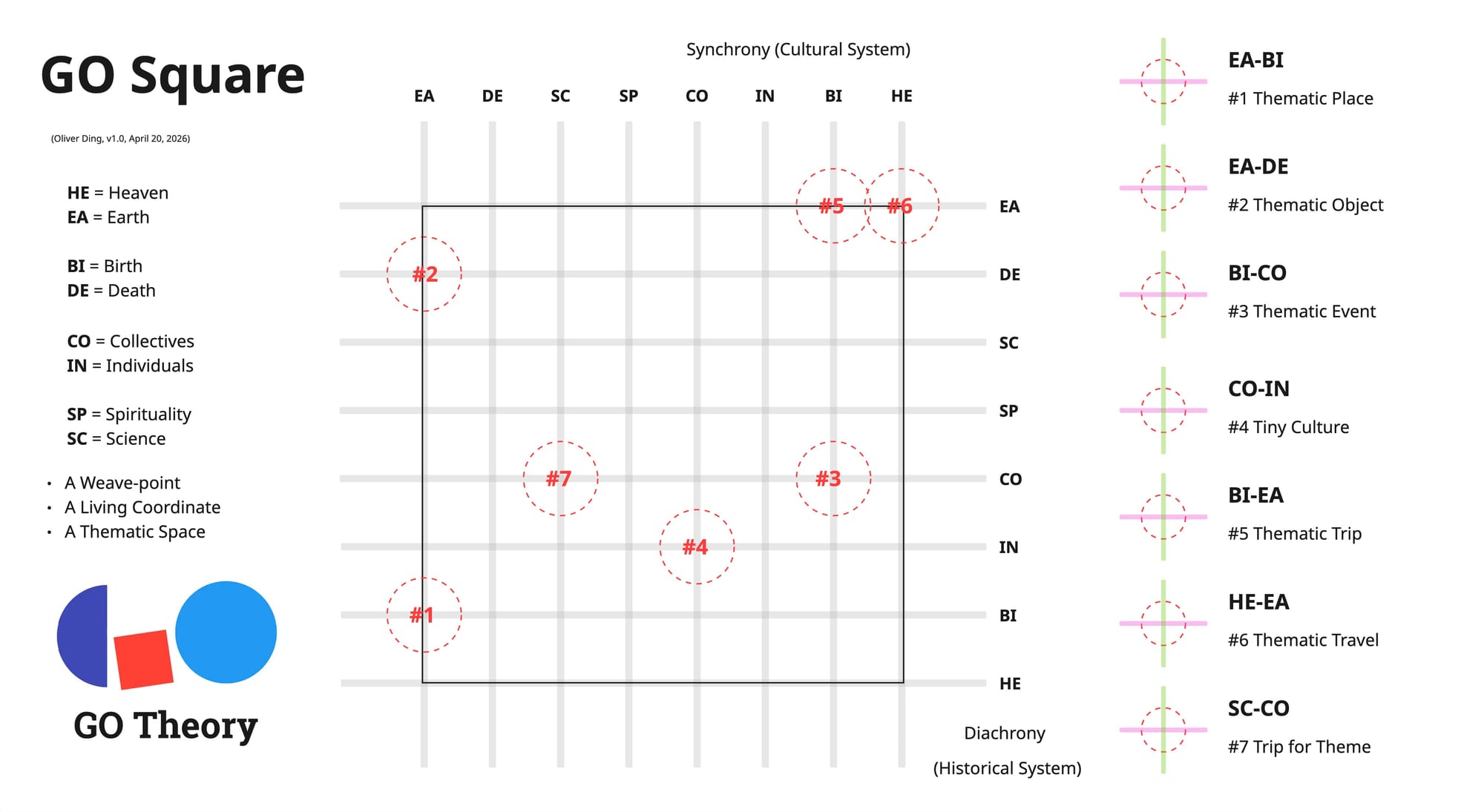
To navigate this space, I apply three operational principles: Genidentity, which locates a concept system by distinguishing its Essential Difference from its Situated Dynamics; Attachance, which traces how concept systems move across coordinates over time; and Curativity, which weaves multiple concept systems into a meaningful larger whole.
Under the guidance of Curativity, I treat the seven concepts as an interconnected constellation — a conceptual family that describes the lifecycle of how themes emerge, move, settle, and spread in creative practice. The analysis reveals that these themes, while intuitively related, occupy distinct structural positions on the GO Square map, and together they form a coherent framework for understanding thematic development.
1
From July 10 to July 30, I was traveling in China, visiting family. Last year, that same trip led to a kindle book: Homecoming: A Thematic Trip and the World of Activity Approach. This year's journey turned out to be unexpectedly interesting—it echoed last year's theme in a way I hadn't anticipated, and it gave birth to a sequel. But this wasn't planned.
I traveled back with my children—from the U.S. to Fuzhou, then to Jianyang, and finally to Pengdun, a small village about 12 km from Jianyang where I grew up.
The day before returning to Pengdun, I gathered with my cousins (表哥 and 表妹们)—a big family reunion. They all left Pengdun years ago and settled in Jianyang, which is almost a miniature of China's urbanization over the past few decades. As we talked, I heard about their children: some working in Fuzhou, some in Japan, and one who was just selected for a Model UN program and will be heading to Vienna later this year.
I sat there listening, and a pattern began to emerge: from Pengdun to Jianyang, from Jianyang to Fuzhou, from Fuzhou to Japan and Vienna. This wasn't just one person's unfolding—it was an entire family's.
The next day, I visited my aunt and uncle, who still live in the old ancestral house—a Ming-Qing dynasty building now marked as a "historic architecture." When I was a child, I lived on the periphery of this same house. Back then, I could walk from my home to my aunt's without stepping into the rain, passing through two other families' sections. Now, the whole house stands nearly empty—only my aunt and uncle remain.
After saying goodbye, I walked down the lane I used to take to elementary school. The road was being paved with concrete; on both sides, new cement walls were rising, with an old earth wall still standing in between. I took several photos. But after capturing this particular one (see below) —the frame that held the two cement walls and the earth wall together—I stopped and stood there for a long time.
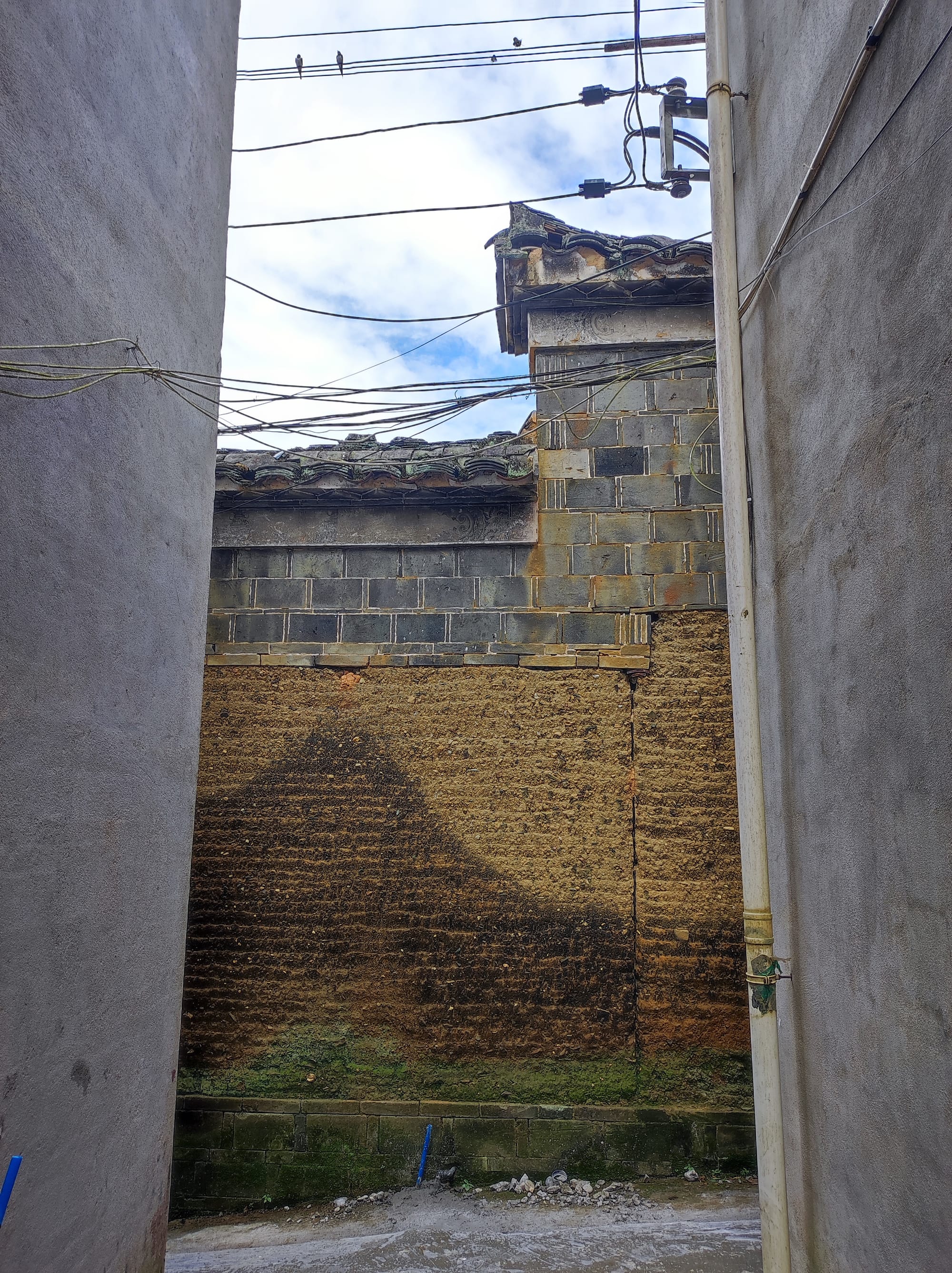
The family gathering the night before and the quiet of the old house—suddenly, they converged in this single image. The cement walls on both sides felt like curtains, and the earth wall in between like a stage.
What I saw was not just a building, but a World of Activity spanning four generations: my aunt and uncle, their world slowly closing; their descendants, their worlds unfolding across continents.
Back in the U.S., I kept returning to the photo, and began taking notes. Slowly, a theme emerged: "Closure and Unfolding." The details of development of the theme can be found in Spatial Heuristics: A Thematic Trip and a Possible Book.
2
As I worked on the “Closure and Unfolding” theme, I began to see the trip itself as something more than a single experience. It was an instance of a recurring pattern in my creative life: traveling with openness to themes, and returning to extract and generate creative work from the experience.
In fact, I had already written a book draft in 2022 called Creative Life Curation, which proposed a systematic methodology for transforming life experience into creative themes. The Thematic Trip experience, I now realize, was an example of that methodology internalized as my own knowledge.
On August 5, 2026, I wrote a note titled "Thematic Trip!!!" on my private notebook on Coda (now named Superhuman). The note is very simple:
Thematic Trip should be upgraded as a Theme (just like Creative Diagramming)
It's time to run a Creative Life Curation project: Selected four projects, forming a Creative Journey, using "Thematic Trip" as the primary theme of the Creative Journey:
2023: The ECHO Trip
2024: The Fuzhou Trip - thematic object: the House of Project Engagement; possible book: Strategic Moves
2025: The Fuzhou/Wuyi Trip - thematic object: A Freefoul; possible book: Homecoming
2026: The Fuzhou/Jianyang Trip - thematic object: a photo taken at Pengdun; possible book: Closure and Unfolding
Looking back, I could see the pattern clearly.
2023: The ECHO Trip
In the summer of 2023, I took a 10-day road trip with my family. During the busy journey, I couldn't write detailed notes, so I captured insights with short keywords — what I called "Situational Themes." After returning home, I listed 21 such themes and conducted a thematic analysis, treating them as data to uncover deeper patterns. This moved the experience from the Story level to the Model level. I used the ECHO Way model to reflect on the trip, turning fragments of lived experience into a structured creative project. Though I never wrote the book, the project generated a series of thematic cards, diagrams, and a board on Milanote — the first full iteration of the Thematic Trip method.
2024: The Fuzhou Trip
In the summer of 2024, I traveled to China for four weeks while caring for a family member undergoing surgery. During this time, I actively worked on designing and testing the House of Project Engagement, a thematic map for the Project Engagement approach. I used this map as a lens to reflect on the healthcare system and developed a physical prototype — a tabletop game centered on life narrative practices. Upon returning to the U.S., I detached the concept of Social Landscape from the thesis and developed it into a standalone framework, which later became the basis for a possible book titled Strategic Moves: Mapping Knowledge Engagement and Structural Choice.
2025: The Fuzhou/Wuyi Trip
From late June to July 2025, I traveled to Fuzhou, where I had lived for nearly 20 years before moving to the U.S. At the beginning of the trip, I revisited Wuyi Mountain, searching for a symbolic object that had inspired my son's name. This led me to re-read my 2015 autobiography, A Freesoul. I reunited with old friends and immersed myself in the familiar yet transformed city.
Using the World of Activity model, I reflected on my autobiography and discovered distinct forms of the "World of Activity" corresponding to different life stages: Hometown, Alien Land, Domain, Internet, Foreign Land, Inheritance, and Homecoming. By the end of the trip, I had written 138,000 words of notes in Chinese. After returning to the U.S., I rewrote the material in English, resulting in the book Homecoming: A Thematic Trip and the World of Activity Approach.
A Method Emerges
Across these three trips — 2023, 2024, 2025 — a pattern repeated: travel with openness, engage deeply with experience, and return to extract and generate creative work. Each trip produced a thematic output: diagrams and cards in 2023, a framework and a book draft in 2024, and a full book in 2025. The 2026 trip continued this pattern.
I realized this pattern could be named and developed as a creative method — parallel to Creative Diagramming, my other creative cognition method. Both are ways of generating ideas and insights through structured engagement with materials:
| Method | Core Operation |
|---|---|
| Creative Diagramming | Engaging with diagrams to develop thinking |
| Thematic Trip | Engaging with lived experience through travel to generate themes |
The note marked a turning point. What had been an unconscious pattern across multiple years — ECHO in 2023, Fuzhou in 2024, Fuzhou/Wuyi in 2025, Fuzhou/Jianyang in 2026 — was now recognized as a coherent method.
3
On August 6, 2026, I started running an AI-supported Creative Life Discovery section, asking DeepSeek to use GO Square to analysis the "Thematic Trip" theme.
DeepSeek's understanding was not what I expected. It offered this interpretation:
The essence of "thematic trip" does not lie in the physical movement of travel, but in its organizing principle. It differs from traditional sightseeing or leisure travel.
Its core is the use of a clearly defined intellectual or cultural theme — such as architecture, history, philosophy, cuisine, or artistic movements — as a thread to structure and connect the entire journey's experience and learning process. Travel itself becomes a means of "immersive research" or "embodied learning."
Therefore, its core is: "how an individual achieves cognitive and experiential construction of a specific theme through structured spatial movement."
This is essentially a consumption-oriented or learning-oriented model of travel: "thematic trip" understood as "setting an external theme in advance — such as architecture or history — and then planning the itinerary around it." The theme is pre-set, predetermined. The traveler is passive.
This is precisely the opposite of what I experienced. What I wanted to emphasize was that travel itself is the source of creativity. The individual gains significant experiences through immersion in the journey, then extracts creative themes from those experiences, and subsequently produces various forms of creative output. The theme is post-set, generative — something the traveler, as creator, excavates from experience.
Using the Creative Workfield framework, the journey — along with the activities before and after it — is a living creative workfield.
DeepSeek's description was not wrong. It represents the common understanding of "thematic trip" — the general interpretation of the term. To balance DeepSeek's interpretation with my own, I proposed a distinction: use "thematic travel" to refer to what DeepSeek described, and keep "thematic trip" for my original meaning.
After lunch, I thought of another term: perhaps "trip for theme" could express my meaning more directly.
DeepSeek then offered this interpretation of "trip for theme":
"Trip for Theme" elevates the theme from the content of the trip to the reason for the trip.
It answers a fundamental question: why are you embarking on this journey?
The answer: for the theme itself. Not for leisure, not for sightseeing, not for escape. For the theme that is waiting to be explored, understood, and generated.
The naming "Trip for Theme" puts your real motivation front and center:
"I am traveling for the theme."
That interpretation also did not fit my vision. Traveling for the theme? This turns Thematic Trip into something driven by a strong instrumental purpose — similar to Thematic Travel. That was not what I meant. Travel is travel. The theme is hidden behind the experiences the journey brings. The individual senses this theme and then naturally uncovers and develops it.
"Traveling for the theme" is planned, task-oriented. "Traveling, and the theme naturally emerges" is generative — it allows travel to return to a state of exploration, where the theme is seen and named through the process.
I didn't get a clean resolution on the naming. But the tension itself was instructive. It showed that the experience I was trying to name did not match the existing understanding of the term. Creating something new means deviating from what is already there.
Finally, I worked with DeepSeek to map a network of themes around the "Thematic Trip" concept using the GO Square framework, analyzing each theme individually. Details will be unpacked in the following sections.
4
The conversation with DeepSeek resulted in three distinct concepts being placed side by side:
| Concept | Meaning |
|---|---|
| Thematic Travel | Traveling with a known theme, interacting with and validating it. The theme is pre-existing. |
| Trip for Theme | A strategic, planned exploration to capture a specific theme. The purpose is pre-existing. |
| Thematic Trip | Creating a new theme through unknown travel experience. The theme is post-emergent, the output of travel. |
But as I continued to reflect on "Thematic Trip" as a creative practice, I realized it involved more than just "travel" itself. It included a series of related conceptual elements: the places where themes are anchored, the objects encountered along the way, the events that occur, and — when the creative output is shared — the tiny cultures that emerge.
I decided to expand these three concepts into a full thematic network. Each concept is defined as follows:
- Thematic Trip — In travel, or after travel, one extracts creative themes from the experience of the journey. The theme is unknown before the trip. The journey itself constitutes the container within which a new theme is created. This is a creative cognition practice described in the Creative Life Curation book draft and methodology.
- Thematic Travel — Traveling around a specific, pre-existing theme. The theme is prior. The traveler interacts with these established themes through the journey.
- Trip for Theme — A strategic exploration undertaken to discover or capture a specific theme. The emphasis is on methodology, planning, and systematic inquiry.
- Thematic Place — A space — physical or cognitive — where a theme is anchored, occurs, or resides. It represents "dwelling" and "boundary."
- Thematic Object — An entity — concrete or abstract — that carries thematic meaning. It is the material bearer of a theme, capable of being transmitted across time.
- Thematic Event — A specific occurrence at a particular point in time that is thematically significant. It has a clear beginning and end, and can produce transformative effects.
- Tiny Culture — A new theme created by an individual (or a new interpretation of an existing theme), which, once it begins to spread to people around them, constitutes a micro-culture. It is the smallest identifiable unit of culture.
These themes were first explored in my 2025 book Homecoming, which documents a journey to Fuzhou in the summer of 2025 — a narrative filled with concrete examples of each concept.
The book documents a journey to Fuzhou in the summer of 2025, where I revisited familiar places, reunited with old friends, and re-read my 2015 autobiography A Freesoul. Through this process, I discovered seven distinct forms of the "World of Activity," each corresponding to a different developmental stage of life. Within this narrative, each of the seven thematic concepts finds its expression.
Thematic Place appears throughout the book in concrete locations: Fuzhou's West Lake, where I wandered as a young adult and where memories of my early years in the city are anchored; the Fujian Provincial Museum, where local history and culture are displayed and encountered; and the former residence of Yan Fu, the influential translator and thinker who bridged Chinese and Western thought — a place that carries layered historical and intellectual significance. Each of these places served as a container where themes were encountered, felt, and later developed.
Thematic Object is exemplified by the "symbolic object" I searched for at Wuyi Mountain at the beginning of the trip — an object that had inspired my son Peiphen's name. This search led me back to my 2015 autobiography. In the Inheritance form of the World of Activity, "thematic objects" play a crucial role: a cassette tape of a poetry collection, a photograph, and my 19-year-old chess poetry series titled "Chapter of Chess" all function as tangible carriers of meaning that migrate from one World of Activity to another, enabling intergenerational transmission. These objects become bridges between generations, carrying not just art but a worldview and "tools for future understanding."
Thematic Event is exemplified by specific moments during the journey: the visit to Wuyi Mountain to search for the Peifeng Academy archway — a symbolic act that reconnected me with childhood cultural inheritance; the exploration of Yan Fu's former residence with a friend who had written the first Wikipedia entry on Yan Fu in Chinese — an event that merged personal friendship with intellectual history; and the gathering with old classmates, where shared memories and life trajectories converged. Each of these events served as a trigger for thematic reflection and development.
Tiny Culture is the most developed concept in Homecoming. The book explicitly includes a section titled "Tiny Culture: The 'Culture as Thematic Enterprise' Framework". The book argues that the journey from an individual "freesoul" to a comprehensive theoretical framework illustrates a broader pattern: how individual development intrinsically contributes to collective cultural understanding. The progression from personal curation practice to theoretical contribution — from individual skill development to public application to cultural framework — shows how Centers can transcend individual boundaries to become cultural resources. The "Thematic Enterprise" framework captures this evolution: thematic objects, ideas, social networks, places, and journeys that begin as personal Centers can develop into "Tiny Cultures" with broader social relevance. The Chapter of Chess story — where my teenage poems were translated by AI into English and turned into a calendar as a Christmas gift for my son — exemplifies how a deeply personal creative endeavor becomes a meaningful cultural artifact, capable of being inherited and developed within the family.
These seven concepts are not isolated terms. They form a coherent conceptual family — a constellation that describes the full lifecycle of how themes emerge, move, settle, and spread in creative practice.
5
These seven concepts form a coherent family — but where exactly do they live in the broader symbolic landscape? To answer this, I turn to GO Square.
GO Square provides a 64-fold coordinate system for mapping the Symbolic Universe — the intersection of the Cultural System and the Historical System. To navigate this space, I have developed three operational principles:
Genidentity — Locating a concept system by distinguishing its Essential Difference (theoretical core, defining problem, or fundamental stance) from its Situated Dynamics (application fields, historical trajectories, or target domains). The Essential Difference maps to the synchronic dimension; the Situated Dynamics maps to the diachronic dimension.
Attachance — Tracing how concept systems move across coordinates over time. A concept system can attach to a thematic space, dwell within it, detach from it, and re-attach to another. This describes the biography of a concept system in the Symbolic Universe.
Curativity — Weaving multiple concept systems — possibly distributed across different GO Coordinates — into a meaningful larger whole, such as a tradition, a school of thought, or a research program.
The seven concepts in this thematic network should not be analyzed in isolation. They share a dense semantic and logical relationship, forming a complete chain from "action" to "sedimentation." Therefore, under the guidance of the Curativity principle, I adopt "Play A: Starting from an Abstract Container (Concept System Set)" — first determining each concept's GO Coordinate, and then analyzing how they collectively constitute a larger meaning-whole.
The abstract container here is the constellation itself: "Thematic Dynamics" — a framework for understanding how themes are anchored, encountered, moved through, and crystallized in creative practice.
6
This is the first step of the analysis. Applying the Genidentity principle, I analyze each concept in turn, distinguishing its Essential Difference from its Situated Dynamics to determine its GO Coordinate.
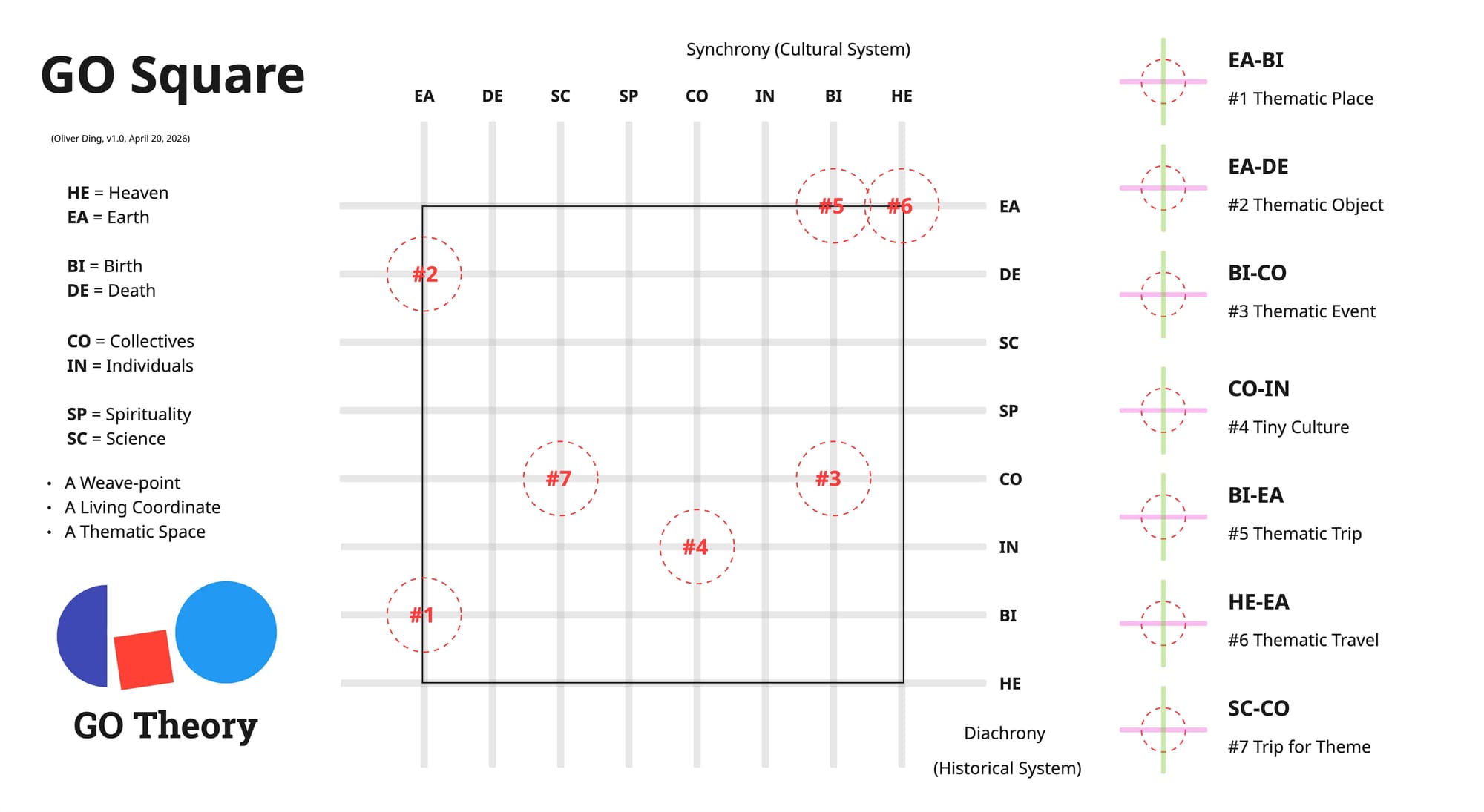
#1 Thematic Place
- Essential Difference: A space — physical or cognitive — where a theme is anchored or housed. It can be concrete (a café, a city) or abstract (a research field, an online community). It represents "dwelling" and "boundary."
- Situated Dynamics: As a "place," its dynamic is how it attracts, contains, and shapes the themes that enter it. It concerns "environment" and "container."
- GO Coordinate: Earth (EA) - Birth (BI)
Analysis: EA (Earth) as the lower material boundary perfectly corresponds to the materiality and container properties of "place." BI (Birth/Initiation) corresponds to the dynamic process through which a theme is "opened" and "anchored" within this place. A place is where themes begin their life.
#2 Thematic Object
- Essential Difference: An entity infused with or marked by a theme. It can be concrete (a book, a tool) or abstract (a work, a framework). It is the material bearer of a theme.
- Situated Dynamics: Objects are produced in specific activities and then circulate through history, being interpreted and used across time.
- GO Coordinate: Earth (EA) - Death (DE)
Analysis: EA (the material realm) remains its foundation, but the object is the "result" or "legacy" of activity. It is born from activity and persists beyond its "death" — the conclusion of the activity that produced it — becoming part of history. DE (Death/Endpoint) captures this quality of "solidification" and "remains."
#3 Thematic Event
- Essential Difference: A specific "occurrence" at a point in time that is thematically significant. It has a clear beginning and end, and can produce transformative effects (e.g., a workshop, a social movement).
- Situated Dynamics: The meaning of an event lies in how it serves as a "starting point" or "trigger" for subsequent thematic development.
- GO Coordinate: Birth (BI) - Collectives (CO)
Analysis: BI (Birth) is the core of an event, as it represents "occurrence" and "origin." However, for an event to carry thematic significance, it must be defined and shared within a collective (CO) context. Without sociality, an event is merely an isolated point in time.
#4 Tiny Culture
- Essential Difference: A small-scale, stable system of shared beliefs, practices, and norms organized around a specific theme. It is the smallest identifiable unit of "culture."
- Situated Dynamics: Once formed, it becomes a relatively stable "system" and begins to be internalized, influencing the behavior and cognition of individuals within it.
- GO Coordinate: Collectives (CO) - Individuals (IN)
Analysis: This is one of the clearest coordinates. CO (Collectives) is its essence, because a micro-culture is collectively shared. Yet its dynamic (IN) is how this culture is (re)internalized, experienced, and expressed by individuals. It sits at the intersection of the collective and the personal.
#5 Thematic Trip
- Essential Difference: A journey with clear boundaries — a departure and a return — undertaken not with a pre-set theme, but with openness to experience. The theme is unknown before the trip, and the journey itself functions as the container within which a new theme is created. This is a creative cognition practice.
- Situated Dynamics: Its dynamic is movement itself — traversing different "places," encountering different "objects" and "events," and ultimately generating new thematic output.
- GO Coordinate: Birth (BI) - Earth (EA)
Analysis: BI (Birth) captures the essence of this concept — it is the action of "birthing" a new theme. Yet this creative process depends on and is grounded in concrete, embodied travel experience. The theme does not emerge from abstraction; it is excavated from the material and experiential world (EA). The journey is the container; the theme is its creative offspring.
#6 Thematic Travel
- Essential Difference: Traveling around a specific, pre-existing theme. The theme is prior. The traveler embarks on the journey to interact with, experience, and deepen their engagement with this established theme.
- Situated Dynamics: Its dynamic is a continuous, adaptive wandering. Its meaning lies in the possibilities encountered along the way — the dialogues with the theme that unfold through movement.
- GO Coordinate: Heaven (HE) - Earth (EA)
Analysis: HE (Heaven/the symbolic world) represents the infinite possibilities and direction provided by the pre-existing theme. EA (Earth/the material world) represents the field and experience through which movement occurs. Thematic Travel is the free flow of meaning (Heaven) through lived experience (Earth) — a state of continuous oscillation between symbol and reality.
#7 Trip for Theme
- Essential Difference: A strategic, purposeful "expedition." The theme itself is the goal of the trip. It emphasizes "traveling for" something, with a strong instrumental purpose.
- Situated Dynamics: Its dynamic is instrumental: planning routes, overcoming obstacles, and ultimately "capturing" or "discovering" the theme.
- GO Coordinate: Science (SC) - Collectives (CO)
Analysis: SC (Science/Knowledge Frameworks) here represents "methodology," "strategy," and "planning." It is a systematic approach. Its dynamic (CO) is that this exploration is rarely isolated — it draws on collective resources, knowledge bases, and is validated within a collective context. An academic research project, for example, is a classic instance of a "trip for theme."
7
With each concept now anchored at its GO Coordinate through Genidentity analysis, we move to the second step: examining their dynamic relationships through the lens of Attachance. Once these concepts are placed on their coordinates, their dynamic relationships become visible, forming a network of "attach-detach" operations.
As I examined the coordinate distribution, I noticed a pattern emerging — a progression from static to dynamic across the constellation.
- The Starting Points (Static): Thematic Place (EA-BI) and Thematic Object (EA-DE) are static "containers" and "remains." They represent the "anchors" and "legacy" of a theme — the fixed points around which thematic activity revolves.
- Occurrence and Connection: Between these anchors, Thematic Event (BI-CO) emerges as a "trigger point" — a punctual occurrence that activates and connects the static elements.
- Structured Movement: These anchors and events constitute the nodes of Thematic Travel (HE-EA). The Trip connects these static and punctual elements into a meaningful, bounded narrative — a story with a beginning and an end, a complete experiential arc.
- Open Movement: Thematic Trip (BI-EA), by contrast, represents a more open state of wandering. It encompasses all anchors and events simultaneously, moving freely between "meaning" and "experience" without the constraint of a fixed itinerary or predetermined outcome.
I also noticed a second pattern running in parallel — a progression from individual to collective.
- Tiny Culture (CO-IN) is the "convergence point" and "outcome" of this chain. When the experiences and discoveries of a "travel" or a "trip" are shared and institutionalized by a group, they form a "micro-culture." This represents the sedimentation of a theme — from a personal, fluid experience into a collective, stable social fact. What begins as an individual's creative insight becomes, through sharing, a shared reality.
- Trip for Theme (SC-CO) can be seen as the "prelude" or "methodology" for forming a Tiny Culture. It is the systematic, collective process of "discovering" and "constructing" a theme. Unlike the open wandering of Thematic Travel or the generative immersion of Thematic Trip, Trip for Theme is purposeful and methodical — it applies structured inquiry to bring a theme into view, often as a precursor to its wider circulation and eventual crystallization as culture.
Together, these two patterns — from static to dynamic, and from individual to collective — reveal the full life trajectory of a theme as it moves across the GO Square landscape.
8
Now, applying the Curativity principle, we weave these "scattered pieces" into a meaningful whole, using a "Container" to hold them together.
- Pieces: The seven concepts.
- Container: "Thematic Dynamics" — a provisional name I adopt for this specific case analysis.
This is an abstract, higher-order container. It describes how a "theme," as a living entity, moves across the interplay between individual cognition (IN) and collective construction (CO), between material anchors (EA) and symbolic meaning (HE), between specific triggers (BI) and historical sedimentation (DE). It does so through both structured exploration (Trip for Theme) and open wandering (Thematic Travel), thereby being born, developing, solidifying, and evolving.
- Whole: "The Lifecycle of a Theme"
Through Curativity, we no longer see these as seven independent concepts, but as seven key facets or stages of an organic process:
| Role | Concept | Coordinate |
|---|---|---|
| Incubator | Thematic Place | EA - BI |
| Trigger | Thematic Event | BI - CO |
| Artifact / Evidence | Thematic Object | EA - DE |
| Systematic Inquiry | Trip for Theme | SC - CO |
| Free Wandering | Thematic Travel | HE - EA |
| Immersive Structuring | Thematic Trip | BI - EA |
| Social Crystallization | Tiny Culture | CO - IN |
Furthermore, we can even assign a GO Coordinate to this "whole" itself. This meta-concept system — "The Lifecycle of a Theme" — has as its essence the description of a process (Science, SC), and its dynamic is its application to the cognitive development and life experience of the self (Individuals, IN). Therefore, we can anchor this entire conceptual constellation at GO Coordinate: SC-IN.
In fact, this whole already has a formal name: Thematic Space Theory.
What does this theory offer? It defines a thematic space as a "living cognitive container" with three operations: Map (the spatial structure that organizes materials), Models (the multiple theoretical frameworks that coexist within a space), and Moves (the cognitive and social operations through which individuals and groups navigate, connect, and transform thematic spaces). The analysis we have just completed — mapping this constellation of seven concepts — can be seen as a concrete application of Thematic Space Theory to my own thematic enterprise.
Complementing this theoretical framework is Thematic Development Study, a practice I defined and developed through my own creative work. It refers to the systematic investigation of how a theme develops across time in a person's creative life — tracing its emergence, transformation, and eventual crystallization into concepts and frameworks. The analysis we have just completed is itself an instance of Thematic Development Study: tracing the "Thematic Trip" theme from its emergence in a private note, through its expansion into a conceptual network, to its final anchoring on the GO Square map. The constellation we have woven — seven concepts distributed across seven coordinates, held together by the container of "Thematic Dynamics" — is both an analytical outcome and a tool for future thematic exploration.
These two frameworks reinforce the Curativity analysis from different angles. Thematic Space Theory provides the ontology of containers and operations. Thematic Development Study provides the temporal lens for tracing a theme's journey across time. Together, they show that the seven concepts are not just a static classification — they are a dynamic language for understanding how themes live, move, and grow in creative practice.
9
Now we have a complete mapping case of the "Thematic Trip" constellation — seven concepts, each anchored at its own GO Coordinate, woven together through Attachance into a dynamic network, and finally curated into a coherent whole: "The Lifecycle of a Theme."
It is worth noting, however, that I also produced another version of this analysis — one that I ultimately found less satisfying, but which I share here as a useful counterpoint. The contrast between the two approaches reveals two distinct ways of using GO Square as a thinking tool.
In this alternative version, I treated the word "Thematic" in each concept as a separate semantic unit — and assigned it to HE (Heaven) , the boundary of language, symbols, and meaning. My reasoning was straightforward: if every concept in this family is "thematic," then the "thematic-ness" of each must come from the symbolic dimension. The theme itself is a symbolic construct; therefore, HE should be its natural home.
Applying this logic yielded the following results:
| Concept | GO Coordinate | Role |
|---|---|---|
| Trip for Theme | HE - IN | Motivation: setting out for a theme |
| Thematic Travel | EA - HE | Action: moving through space with a theme |
| Thematic Place | EA - HE | Encounter: meeting a theme in a material place |
| Thematic Object | EA - HE | Connection: dialoguing with a theme through objects |
| Thematic Event | CO - HE | Participation: experiencing a theme in collective events |
| Thematic Trip | IN - HE | Extraction: generating thematic creations from experience |
What this analysis captures beautifully is the mechanism of thematization — the way the prefix "Thematic" lifts concrete experiences, objects, and movements into the symbolic realm. It reveals a shared source: HE (Heaven) is what makes these concepts "thematic" in the first place. Without HE, they would be ordinary trips, objects, and places; with HE, they become vessels of meaning.
This approach, which I came to call atomistic analysis, is not wrong. It is simply asking a different question. It asks: "What semantic operation does the word 'Thematic' perform?" And it answers: it injects symbolic meaning (HE) into the physical and social world.
The holistic analysis presented in this article, by contrast, asks a different question: "What functional role does each concept play in the lifecycle of thematic creation?" And it answers: they occupy distinct structural positions — some anchor (Place), some trigger (Event), some carry (Object), some wander (Travel), some structure (Trip), some strategize (Trip for Theme), and some crystallize into shared reality (Tiny Culture).
The contrast can be summarized as follows:
| Dimension | Atomistic Analysis | Holistic Analysis |
|---|---|---|
| Object of analysis | Lexical components (words, prefixes) | Concept systems (cognitive frameworks) |
| Core question | What semantic shift does "Thematic" introduce? | What function does this concept serve in the creative process? |
| What it reveals | The universal mechanism of "thematization" | The differentiation of roles in meaning-making |
| Result | A set of variations sharing a common source (HE) | A set of complementary positions across the map |
| Use case | Lexicography, terminology ontology | Workshop design, research paradigms, personal knowledge management |
Neither approach is superior to the other. They serve different analytical purposes. If one's goal is to understand how language transforms the ordinary into the meaningful, the atomistic approach is precise and revealing. But if one's goal — as it is mine in this article — is to articulate a set of cognitive tools for creative practice, then the holistic approach is more useful. It does not erase the shared "thematic" quality of these concepts; it builds on it, showing how that shared quality differentiates into distinct functional roles across the landscape of the Symbolic Universe.
In the end, the two approaches are not in competition. They are two lenses. The atomistic lens zooms in on the semantic thread that binds the family together; the holistic lens zooms out to reveal how each member of the family contributes to the whole. Both are valuable. The choice depends on what you are trying to see.
10
What began as a private note and a conversation with AI became something larger. The naming friction with DeepSeek revealed that "Thematic Trip" carried a common meaning opposite to what I experienced. The expansion from three concepts to seven revealed an ecology of related concepts. And GO Square revealed that these concepts occupy distinct structural positions — each with its own role, each contributing to a larger whole.
The value of this exercise was not the map itself, but what the mapping process taught me. I had been practicing Thematic Trip for years — the ECHO Trip in 2023, the Fuzhou Trip in 2024, the Fuzhou/Wuyi Trip in 2025, the Fuzhou/Jianyang Trip in 2026. Each was an instance of the same pattern: traveling with openness, returning to extract, and generating creative work from experience. It took a moment of reflection and a conversation with AI to recognize this pattern as a method.
And it took GO Square to see that this method was not a single thing but a constellation — a set of distinct cognitive moves that work together: Place anchors, Event triggers, Object carries, Travel wanders, Trip structures, Trip for Theme strategizes, and Tiny Culture crystallizes. Together, they form a complete language for describing how themes enter our lives, move through our experiences, and become part of the world we share with others.
The alternative atomistic analysis — which assigned "Thematic" to HE — was not wrong. It served a different purpose: revealing the mechanism of thematization itself. But the holistic analysis presented here served my purpose better: articulating a set of cognitive tools for creative practice.
In the end, GO Square did not create these relationships. It made them visible. And in making them visible, it made them usable. I can now name what I am doing — and that naming opens up the possibility of doing it with more intention, more clarity, and more awareness of the whole.
v1.0 - August 8, 2026 - 6,067 words