
GO Square: A Thematic Mapping of a Trip to China
The GO Theory Series
by Oliver Ding
August 7, 2026
1
In early June 2026, I wrote to a friend, Alice, introducing GO Square. Our conversation had a history — she appears in Chapter One of Lake 42: The Great Confluence as someone searching for her own "coordinate." Her questions had always pushed me to think more clearly about how theoretical tools land in real life.
I was excited about the framework and wanted to share it with her. She responded with interest — but her questions were practical:
The GO Square you mentioned — 64 themes, 8 boundaries, 3 principles — I find it quite compelling. It's not just a tool framework; it feels more like a method for helping individuals and organizations reframe their understanding of goals, knowledge, action, and management."
"I would really like to see you lay out some concrete use cases in the future. For example: how does it help individuals with knowledge management? How does it help teams with goal-setting and collaboration? How does it help entrepreneurs, consultants, content creators, or organizational managers improve their effectiveness? And how does it offer others clearer organizational insights and methodological references?"
I didn't have a direct answer.
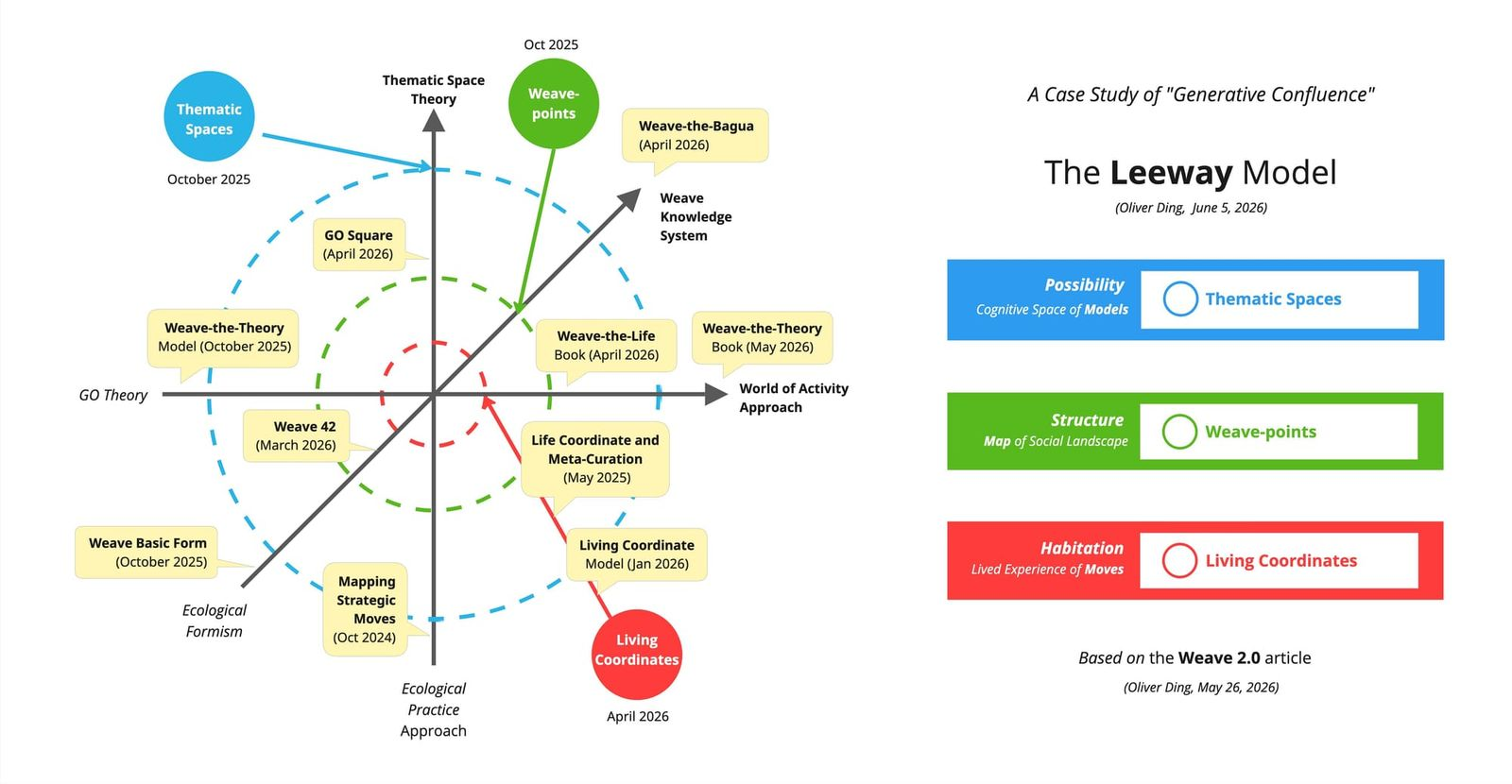
I wrote back. I explained the Leeway Model — Structure, Habitation, Possibility. I told her that I don't treat AI as my primary focus. I prefer working on things that don't change too fast, so I can develop them slowly and systematically. As an activity theorist, I focus on concrete, specific things that actually happen, not on grand narratives. I care about how activity itself develops, and how an individual's mind blossoms within her world of activity.
I introduced the Leeway Model:
Structure (Weave-point): the given positional architecture of the environment — where the actor is located within the diachronic and synchronic grid
Habitation (Living Coordinate): the actor's lived experience of dwelling in and moving through that position over time — the developmental trajectory from the inside
Possibility (Thematic Space): the dynamic cognitive space of what can be explored, reflected upon, and created from within that position — the open territory that gives each position its generative character
I didn't have a concrete case to show her.
That was June 6.
2
A few weeks later, I traveled to China with my children — to Fuzhou, then to Jianyang, then to Pengdun, the small village where I grew up.
I visited my aunt and uncle in the old ancestral house — a Ming-Qing dynasty building now marked as "historic architecture." The house was nearly empty; only my aunt and uncle remained.
I gathered with my cousins in Jianyang. Over dinner, I listened to stories of our family across four generations: my aunt and uncle still in the old house, my cousins settled in Jianyang, their children now in Fuzhou, Japan, and one preparing for Vienna.
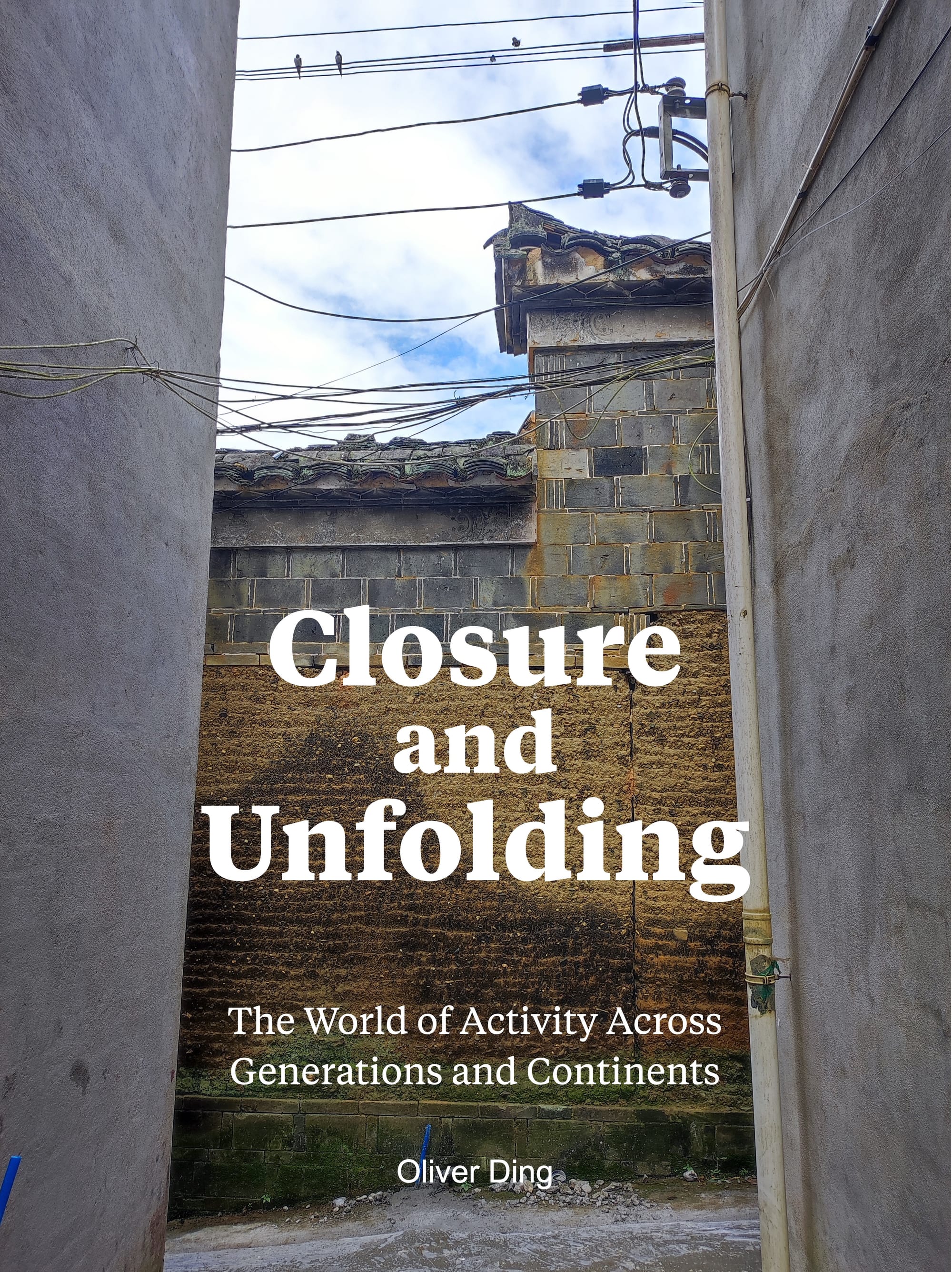
I walked down the lane I used to take to elementary school. The road was being paved with concrete; on both sides, new cement walls were rising, with an old earth wall still standing in between. I took several photos. But after capturing this particular one — the frame that held the two cement walls and the earth wall together — I stopped and stood there for a long time. The cement walls on both sides felt like curtains, and the earth wall in between like a stage.
That moment became the seed of a creative theme. Back in the U.S., I kept returning to the photo and began taking notes. Slowly, a theme emerged: Closure and Unfolding — two processes happening simultaneously in the same temporal window. The family gathering the night before and the quiet of the old house had converged in this single image.
The theme resonated with my own creative journey in 2025 — the year I closed my multi-year work on Knowledge Engagement while simultaneously opening a new direction in Cultural Development. What I had experienced at the individual level in 2025, I now saw at the family level in Pengdun.
Over the following days, the theme developed through a series of Slow Cognition operations: embodied experience (the walk, the photo), thematic conversation (discussing it with family and with AI), conceptual thinking (the metaphor of "closure" and "unfolding"), thematic exploration (tracing its resonance with my 2025 journey), strategic curation (sketching a possible book structure), and continuous objectification (writing a long article about the process).
On August 5, 2026, I published that article — Spatial Heuristics: A Thematic Trip and a Possible Book — completing the first cycle of this theme's development. The theme now has a name, a cover image, a manuscript outline, and a book in progress.
3
As I worked on the “Closure and Unfolding” theme, I began to see the trip itself as something more than a single experience. It was an instance of a recurring pattern in my creative life: traveling with openness to themes, and returning to extract and generate creative work from the experience.
In fact, I had already written a book draft in 2022 called Creative Life Curation, which proposed a systematic methodology for transforming life experience into creative themes. The Thematic Trip experience, I now realize, was an example of that methodology internalized as my own knowledge.
On the same day, I wrote a note titled "Thematic Trip!!!" on my private notebook on Coda (now named Superhuman). The note is very simple:
Thematic Trip should be upgraded as a Theme (just like Creative Diagramming)
It's time to run a Creative Life Curation project: Selected four projects, forming a Creative Journey, using "Thematic Trip" as the primary theme of the Creative Journey:
2023: The ECHO Trip
2024: The Fuzhou Trip - thematic object: the House of Project Engagement; possible book: Strategic Moves
2025: The Fuzhou/Wuyi Trip - thematic object: A Freefoul; possible book: Homecoming
2026: The Fuzhou/Jianyang Trip - thematic object: a photo taken at Pengdun; possible book: Closure and Unfolding
I realized this pattern could be named and developed as a creative method — parallel to Creative Diagramming, my other creative cognition method. Both are ways of generating ideas and insights through structured engagement with materials:
| Method | Core Operation |
|---|---|
| Creative Diagramming | Engaging with diagrams to develop thinking |
| Thematic Trip | Engaging with lived experience through travel to generate themes |
On August 6, 2026, I started run an AI-supported Creative Life Discovery section, asking DeepSeek to use GO Square to analysis the "Thematic Trip" theme.
DeepSeek's understanding of "thematic trip" was not what I expected. It offered this interpretation:
The essence of "thematic trip" does not lie in the physical movement of travel, but in its organizing principle. It differs from traditional sightseeing or leisure travel.
Its core is the use of a clearly defined intellectual or cultural theme — such as architecture, history, philosophy, cuisine, or artistic movements — as a thread to structure and connect the entire journey's experience and learning process. Travel itself becomes a means of "immersive research" or "embodied learning."
Therefore, its core is: "how an individual achieves cognitive and experiential construction of a specific theme through structured spatial movement."
This is essentially a consumption-oriented or learning-oriented model of travel: "thematic trip" understood as "setting an external theme in advance — such as architecture or history — and then planning the itinerary around it." The theme is pre-set, predetermined. The traveler is passive.
This is precisely the opposite of what I experienced. What I wanted to emphasize was that travel itself is the source of creativity. The individual gains significant experiences through immersion in the journey, then extracts creative themes from those experiences, and subsequently produces various forms of creative output. The theme is post-set, generative — something the traveler, as creator, excavates from experience.
Using the Creative Workfield framework, the journey — along with the activities before and after it — is a living creative workfield.
DeepSeek's description was not wrong. It represents the common understanding of "thematic trip" — the general interpretation of the term. To balance DeepSeek's interpretation with my own, I proposed a distinction: use "thematic travel" to refer to what DeepSeek described, and keep "thematic trip" for my original meaning.
After lunch, I thought of another term: perhaps "trip for theme" could express my meaning more directly.
DeepSeek then offered this interpretation of "trip for theme":
"Trip for Theme" elevates the theme from the content of the trip to the reason for the trip.
It answers a fundamental question: why are you embarking on this journey?
The answer: for the theme itself. Not for leisure, not for sightseeing, not for escape. For the theme that is waiting to be explored, understood, and generated.
The naming "Trip for Theme" puts your real motivation front and center:
"I am traveling for the theme."
That interpretation also did not fit my vision. Traveling for the theme? This turns Thematic Trip into something driven by a strong instrumental purpose — similar to Thematic Travel. That was not what I meant. Travel is travel. The theme is hidden behind the experiences the journey brings. The individual senses this theme and then naturally uncovers and develops it.
"Traveling for the theme" is planned, task-oriented. "Traveling, and the theme naturally emerges" is generative — it allows travel to return to a state of exploration, where the theme is seen and named through the process.
I didn't get a clean resolution on the naming. But the tension itself was instructive. It showed that the experience I was trying to name did not match the existing understanding of the term. Creating something new means deviating from what is already there.
Finally, I worked with DeepSeek to map a network of themes around the "Thematic Trip" concept using the GO Square framework, analyzing each theme individually. For details, see the other article.
This exercise turned out to be a warm-up. Afterward, I began mapping the thematic network of this China trip itself.
4
While working on the Closure and Unfolding book manuscript, I began to see that this theme was not alone. The trip had generated a whole network of themes — cultural themes I had encountered, personal themes I had generated, and the meta-theme that held them together.
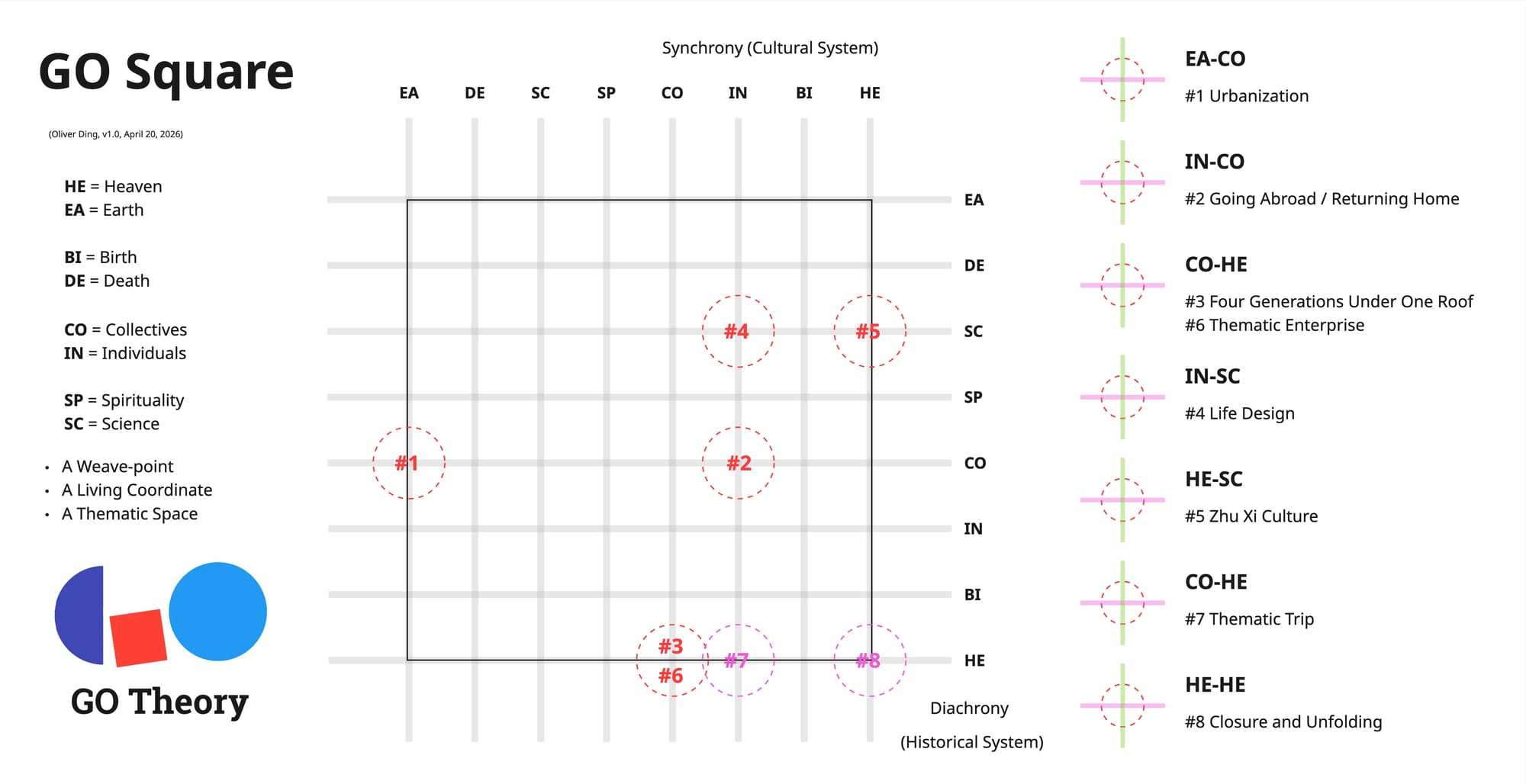
I decided to use GO Square to map them.
Here is the full thematic network:
Each theme occupies a distinct structural position. Together, they form a coherent landscape — a snapshot of contemporary China as experienced through one family's story, and the creative work that emerged from that encounter.
Cultural Themes (Encountered in the Trip)
#1 Urbanization
What it is: The movement of population from villages to cities — a massive social transformation that has reshaped China over the past four decades. In my family, it meant my cousins leaving Pengdun for Jianyang. In the village, it meant empty houses and aging parents left behind.
GO Coordinate: EA - CO
| Dimension | Assignment |
|---|---|
| Synchronic (what it is about) | EA (Earth) — material environment, spatial structure, physical infrastructure |
| Diachronic (its historical dynamic) | CO (Collectives) — collective social transformation, population migration |
Why: Urbanization is fundamentally about the transformation of material space — villages becoming towns, farmland becoming concrete, old houses being abandoned for new apartments. Its historical dynamic is a collective movement of people across the landscape.
#2 Going Abroad / Returning Home
What it is: The dream of studying overseas — a phenomenon that has shaped Chinese middle-class aspirations for decades. In my family, it meant cousins moving from Jianyang to Fuzhou to Japan to Vienna. The "return" wave is equally significant: those who went abroad and came back, bringing new skills and perspectives.
GO Coordinate: IN - CO
| Dimension | Assignment |
|---|---|
| Synchronic (what it is about) | IN (Individuals) — individual decisions, personal aspirations, life choices |
| Diachronic (its historical dynamic) | CO (Collectives) — collective trends shaped by policy, economy, and global mobility |
Why: Going abroad is an individual choice — a person decides to leave. But it is driven by collective historical conditions: education policy, economic opportunity, global migration patterns. The phenomenon sits at the intersection of personal decision and social trend.
#3 Four Generations Under One Roof
What it is: The traditional Chinese ideal of multiple generations living together — a family structure that is now fragmenting across cities and countries. In my family, it meant my aunt and uncle in the old house, their children in Jianyang, and their grandchildren scattered across Fuzhou, Japan, Vienna — the same family but no longer one roof.
GO Coordinate: CO - HE
| Dimension | Assignment |
|---|---|
| Synchronic (what it is about) | CO (Collectives) — family as a collective social structure, intergenerational organization |
| Diachronic (its historical dynamic) | HE (Heaven) — cultural ideals, narratives, symbolic meanings of family, the "four generations" as a cultural concept |
Why: Four generations under one roof is not just a demographic fact — it is a cultural ideal. It represents a particular vision of family, obligation, and continuity. Its historical dynamic is about how this ideal has changed, fragmented, and persisted in the face of modernization.
#4 Life Design
What it is: The growing cultural conversation around intentionally planning one's life path — career, meaning, relationships. A concept that has gained traction through books, courses, and social media, especially among young professionals.
GO Coordinate: IN - SC
| Dimension | Assignment |
|---|---|
| Synchronic (what it is about) | IN (Individuals) — individual agency, personal planning, self-development |
| Diachronic (its historical dynamic) | SC (Science) — knowledge frameworks, psychological theories, methodological tools |
Why: Life Design is an individual practice — each person designs their own path. But it draws on systematic knowledge frameworks: psychology, career theory, design thinking. It sits at the intersection of personal agency and applied knowledge.
#5 Zhu Xi Culture
What it is: The deep historical and philosophical heritage embedded in the Jianyang region. Zhu Xi (1130–1200), one of the most influential Confucian philosophers, lived and taught in this area. The region carries his legacy in its landscape, its temples, and its cultural memory.
GO Coordinate: HE - SC
| Dimension | Assignment |
|---|---|
| Synchronic (what it is about) | HE (Heaven) — philosophical thought, textual tradition, symbolic heritage |
| Diachronic (its historical dynamic) | SC (Science) — scholarly study, academic research, historical knowledge production |
Why: Zhu Xi Culture is a symbolic tradition — it exists in texts, ideas, and cultural memory. Its historical dynamic is its transmission through scholarly study, from the Song dynasty to the present. It is a symbolic system that has been continuously examined and reinterpreted through academic inquiry.
#6 Thematic Enterprise
What it is: A long-term, theme-centered project of creation and development — what I am building through GO Theory, the Cultural Themes series, and my ongoing work. It is the idea that a person can build a life and career around a sustained thematic commitment.
GO Coordinate: CO - HE
| Dimension | Assignment |
|---|---|
| Synchronic (what it is about) | CO (Collectives) — a public, social enterprise that engages with communities, readers, and collaborators |
| Diachronic (its historical dynamic) | HE (Heaven) — the theme itself as a symbolic concept, evolving over time through writing, dialogue, and creation |
Why: A thematic enterprise is a social endeavor — it exists in public, through relationships, audiences, and communities. But its core is a theme — a symbolic concept that develops and deepens over time. It is both collective and symbolic.
Personal Themes (Generated from the Trip)
#7 Thematic Trip
What it is: This is not a theme encountered in the trip. It is the activity itself — my practice of traveling with openness to themes, and returning to extract and generate creative work from the experience. The trip to China was itself a Thematic Trip.
GO Coordinate: IN - HE
| Dimension | Assignment |
|---|---|
| Synchronic (what it is about) | IN (Individuals) — individual creative practice, personal methodology |
| Diachronic (its historical dynamic) | HE (Heaven) — themes as symbolic concepts, generated from experience over time |
Why: A Thematic Trip is a personal practice — I do it. Its output is thematic concepts that enter the symbolic universe. It sits at the intersection of individual creative work and the generation of symbolic meaning.
#8 Closure and Unfolding
What it is: The creative theme that emerged from this trip — the pattern of simultaneous closure and unfolding that I observed in my family (aunt and uncle in the old house closing a chapter, their descendants unfolding across continents) and recognized from my own 2025 creative journey. It became the central concept for a possible new book, and was developed through a complete cycle of Slow Cognition operations, culminating in the published article Spatial Heuristics: A Thematic Trip and a Possible Book.
GO Coordinate: HE - HE
| Dimension | Assignment |
|---|---|
| Synchronic (what it is about) | HE (Heaven) — a symbolic pattern, a conceptual structure |
| Diachronic (its historical dynamic) | HE (Heaven) — the theme itself, unfolding through writing and conceptual development |
Why: Closure and Unfolding is a pure symbolic construct — it was generated from experience but exists as a concept. Its historical dynamic is its own development: from a moment of perception (the photo, the family stories), to a named theme, to a book manuscript in progress, to a published article. It is a self-referential theme — a concept about temporal patterns, developing over time through creative work.
5
When I listed these themes for mapping on the GO Square diagram, I noticed something.
AI was not there.
That evening, gathered with my cousins in Jianyang, we talked about many things — urbanization, American politics, the futures of their children. But not once did anyone mention AI.
I don't know why. I didn't ask. It's not that they don't know about it — everyone has smartphones, everyone has internet. It simply didn't come up.
And I found that curious. Because in my WeChat feed, AI articles and discussions are everywhere. It's a constant presence in my information environment. But in that room that evening, it was entirely absent.
This contrast — between two worlds, two information environments, two conversational realities — is what I began to call AI Divide. Not a technological gap. Not a judgment. Just an observation: AI is central in one world, invisible in another.
6
When I looked at the list of themes I had written down, I noticed "Four Generations Under One Roof." I became curious about the thematic space it opened — what else lives there?
I started looking.
The first to arrive was Lao She's novel Four Generations Under One Roof — a story set in a Beijing alley, following the Qi family through four generations during the eight years of the War of Resistance. It shares the same name as my family observation, but it exists in a different layer: one is a lived family structure, the other is a literary monument to a nation's suffering. Placed side by side, they began to define the tension within this thematic space.
Then I realized that Gabriel García Márquez's One Hundred Years of Solitude belongs here too. It tells the story of the Buendía family across seven generations, spanning a century in the fictional town of Macondo, carrying the weight of Latin America's colonial past and its cycles of solitude and repetition. Lao She and Márquez — two writers, two nations, two novels — but both responding to the same structural question: how does a family's multigenerational fate become a vessel for a people's historical memory?
A friend's doctoral thesis also entered this space — a study of three generations of Chinese mothers, told through their life narratives. Three stories, three women's voices, spanning from the grandmother's generation to our own. Together, they carry the imprint of China's transformation through the twentieth century and beyond. They, too, live in this space.
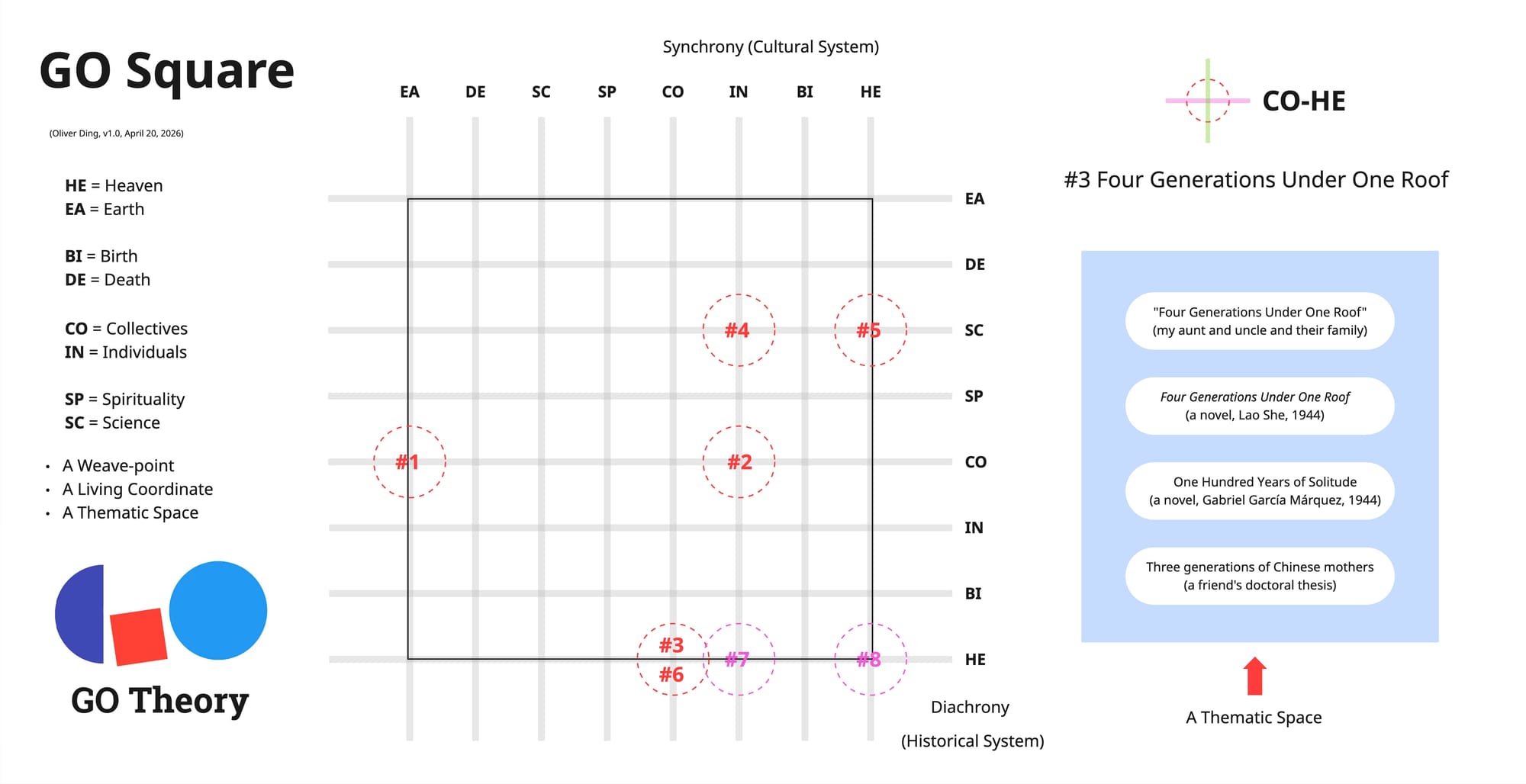
Slowly, the thematic space began to reveal its contours. It was not defined by a category or a theory. It was being filled, piece by piece, by real themes — a family observation, two novels, an academic work. They had not planned to be together. But they were all responding to the same underlying concern.
I realized that I was also inside this space. The first generation I saw in the old house, the second generation at the dinner table in Jianyang, the third generation absent, her child visible only through a phone screen — I had lived through a family's four generations and three mothers, not by reading about them, but by walking through them. I entered this thematic space not through literature, but through living.
Two kinds of element became visible. One is experiential — entering as a participant in life, through direct encounter. The other is symbolic — entering through writing, reading, research, and cultural production. One generates lived facts; the other generates cultural works. They are not in competition. They coexist, overlapping and enriching each other, like two currents converging in the same landscape.
GO Square did not create this space. It only made it visible. And the filling of it — with novels, theses, family stories, and my own observations — is what I realized I was doing all along.
This exploration, I now see, is part of the groundwork for my Closure and Unfolding manuscript. The themes I encountered, the questions that emerged, the space that opened up — they are not separate from the book I am writing. They are the materials I am gathering, the landscape I am mapping, the stories I am learning to tell.
7
On August 7, 2026, I finished mapping these themes on the GO Square. Then I realized that the whole process was not just about putting themes on a diagram. The mapping was an activity — a series of actions:
- Listing what I had encountered
- Noticing what was missing
- Placing themes on coordinates
- Exploring thematic spaces
- Watching as one theme opened into others
The diagram on the screen was the final frame. But the real work had happened through these actions — the listing, the noticing, the opening, the connecting.
This was when I remembered Alice's question from June. She had asked: how can GO Square be used for personal knowledge management? She wanted use cases — how it helps individuals organize their thinking, teams align their work, creators develop their projects.
I didn't have an answer then. I could only explain the theoretical structure. But reading back through my own email, I realized I had already described it — I just didn't have the case to show her.
I had written:
When we float in the noisy flood of information, when we resonate deeply with certain themes and concept systems… we are in fact moving among 64 weave-points. This movement is our habitation. These weave-points are the living coordinates we pass through and dwell at.
That trip to China was exactly that — moving through the noisy flood of information, resonating with themes as they emerged. The list of themes I mapped on GO Square — Urbanization, Going Abroad, Four Generations, Life Design, Zhu Xi Culture — those were the living coordinates I had passed through and stopped at.
And I had written:
Each weave-point also opens onto a thematic space… If we not only receive external concept systems but also integrate our own life experience and reflection — along with new insights from our own thinking — then the creative potential within that thematic space grows. We are no longer one-sided recipients. We become creators within that symbolic universe as well.
That was exactly what happened when I opened the thematic space of "Four Generations Under One Roof." I started with my own family observation — a lived experience. Then I found Lao She's novel there, then Márquez's One Hundred Years of Solitude, then a friend's study of three generations of mothers. Each addition enriched the space. I was no longer just receiving what was already in the symbolic universe — I was adding to it, connecting things that had not been connected before, becoming a creator within that space.
And finally, I had written:
Creating something new means deviating from what already exists. The word Leeway refers to deviation from a given structure."
The discussion with DeepSeek about "Thematic Trip" was precisely that — a deviation. DeepSeek understood "thematic trip" the way most people would: a trip organized around a pre-set theme, a planned itinerary driven by a topic. That was not my experience. For me, the trip itself came first — the immersion, the encounters, the lived moments. The theme emerged afterward, from the experience itself. I created a new meaning for the term, one that deviated from the common understanding. That deviation was not a mistake. It was the act of creating something new.
Alice asked me for a method. I gave her a journey instead — and the mapping of that journey turned out to be the answer I couldn't give her in June.
v1.0 — August 6, 2026 — 4,121 words
Previous in the GO Square series: