
GO Square: Mapping ACS, SDP, and Other Theoretical Enterprises
The GO Theory Series
by Oliver Ding
August 6, 2026
1. Introduction
This article is part of the ongoing GO Square series. The previous two articles introduced the framework itself and its navigational principles:
- GO Square: Mapping the Symbolic Universe (April 2026) — established the 64-fold coordinate system generated by crossing eight boundary-dimensions, defining the Symbolic Universe as the intersection of the Cultural System and the Historical System.
- How to Navigate the Symbolic Universe: Three Principles of Spatial Heuristics (May 2026) — developed Genidentity, Attachance, and Curativity as operational principles for locating concept systems, tracing their movements, and weaving them into larger constellations.
This article shifts focus from the map to the territory. Specifically, it applies the GO Square framework to map the five theoretical enterprises that currently operate on the GO Theory platform:
- Life as Activity
- Anticipatory Cultural Sociology (ACS)
- Strategic Developmental Psychology (SDP)
- Cognitive Hydrology
- Platform Ecology
These five enterprises are not separate projects. They share the same ontological foundation — the World of Life (World of Activity) approach — and the same theoretical platform. But each occupies a distinct position, attends to a different dimension of reality, and offers a unique lens on social life development.
The question this article answers is: where does each enterprise sit within the 64-fold coordinate system of GO Square?
2. The GO Theory Platform: A Brief Overview
GO Theory — full title GO Theory: The World of Life (World of Activity) Approach — is a theoretical platform for analyzing social life development. Its initials stand for Generation and Orientation, the two directions that define its theoretical character:
- Generation names the productive, emergent, forward-moving dimension: things are created, enterprises unfold, meaning accrues.
- Orientation names the positional, directional, sense-making dimension: actors are always somewhere, always facing some directions rather than others, always anticipating futures that shape present action.
The platform rests on three meta-frameworks completed between November 2025 and February 2026:
| Meta-framework | Function | Completed |
|---|---|---|
| History[Life[Self(Body)]] Framework (HLS, v3.0) | Ontology — map of the social world | December 2025 |
| Ecological Formism Framework (v2.0) | Epistemology — structure of knowledge systems | November 2025 |
| LARGE Method (v3.0) | Methodology — meta-method for all platform methods | February 2026 |
These are not external scaffolding. They are the internal architecture of GO Theory itself — the foundations on which all five enterprises build.
3. The Five Theoretical Enterprises
The five enterprises operate within the World of Life, each occupying a distinct position:
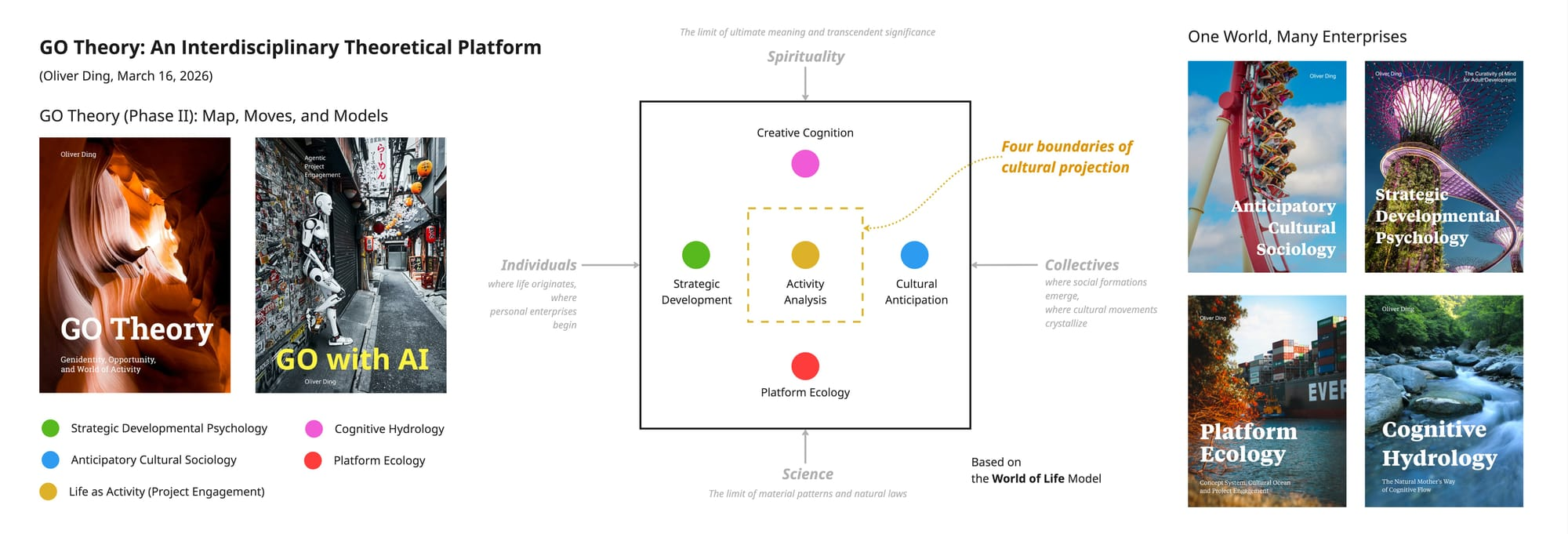
Life as Activity (including the Project Engagement Approach) — at the center — attends to the structure of activity itself. It provides the operational language shared by all other enterprises. It is not about any specific domain; it is about activity as such — action, practice, engagement, the basic unit of human doing.
Anticipatory Cultural Sociology (ACS) — at the Collectives boundary — attends to cultural development at the collective scale. It studies how cultural frameworks emerge, compete, sediment, and transform. Its questions are about movements, institutions, public narratives, and social imaginaries.
Strategic Developmental Psychology (SDP) — at the Individuals boundary — attends to individual life development at the personal scale. It studies how a person's life unfolds across time: the development of direction, meaning, and structure in a single life course.
Cognitive Hydrology — at the Spirituality boundary — attends to the flow of ideas and meaning in creative life. It studies how themes develop, concepts are created, and meaning moves through the creative process. The metaphor of "hydrology" captures the flowing, generative, circulatory nature of meaning in creative work.
Platform Ecology — at the Science boundary — attends to the ecological and structural conditions of platform development. It studies the environment in which theoretical platforms grow: the knowledge ecosystem, institutional conditions, resource flows, and structural constraints that enable or limit development.
4. Mapping the Five Enterprises with GO Square
The GO Square framework provides a 64-fold coordinate system generated by crossing eight boundary-dimensions. Each coordinate captures the intersection of:
- Synchronic dimension — the structural position of a concept system in the Cultural System: what it is about in the present.
- Diachronic dimension — the temporal unfolding of a concept system in the Historical System: what it is as a historical entity.
For the five theoretical enterprises, the key insight is this:
All five enterprises are academic theories. They share the same diachronic dimension: Science (SC).
Each enterprise is a knowledge system — a theoretical framework developed, articulated, and disseminated within the academic and intellectual world. Regardless of what each enterprise studies, each is itself a product of scholarly inquiry.
The differences lie in their synchronic dimensions — what each enterprise is about:
| Enterprise | Synchronic (What it is about) | Diachronic (What it is) | GO Coordinate |
|---|---|---|---|
| Life as Activity | CO — social practice and its structure | SC — academic theory | CO - SC |
| Anticipatory Cultural Sociology | CO — collective culture | SC — academic theory | CO - SC |
| Strategic Developmental Psychology | IN — individual development | SC — academic theory | IN - SC |
| Cognitive Hydrology | HE — theme/concept creation | SC — academic theory | HE - SC |
| Platform Ecology | EA — environment/ecology | SC — academic theory | EA - SC |
5. Life as Activity — CO - SC
Synchronic (CO): Life as Activity is about social practice. Its core concern is activity itself — the structure of action, the engagement of actors with their worlds, the unfolding of practice across time. It does not study a specific domain (culture, individual, meaning, platform). It studies the basic unit of all human doing.
Diachronic (SC): Life as Activity is an academic theory. It is a formal knowledge system, articulated through concepts, models, and frameworks. It lives in the scholarly world, available for critique, application, and refinement.
Coordinate: CO - SC
This places Life as Activity at the intersection of social practice and academic knowledge. It is a theory about practice, developed within the academic world. This is the foundation of the platform: the operational language that all other enterprises share is itself a theoretical construct about the structure of human activity.
6. Anticipatory Cultural Sociology — CO - SC
Synchronic (CO): ACS is about collective culture. Its core concern is how cultural frameworks develop at scale — how movements form, narratives compete, institutions crystallize, and social imaginaries shift. Its unit of analysis is the collective, not the individual.
Diachronic (SC): ACS is an academic theory. It is a sociological framework, built on concepts, models, and empirical orientations. It lives alongside other sociological theories in the scholarly world.
Coordinate: CO - SC
Like Life as Activity, ACS occupies CO - SC. But while Life as Activity studies the structure of practice (activity as such), ACS studies the content and development of culture (collective meaning-making). They share the same structural position but differ in their internal focus. In GO Square terms, they are neighbors within the same thematic space — two distinct concept systems occupying the same coordinate, addressing different dimensions of the collective-social world.
7. Strategic Developmental Psychology — IN - SC
Synchronic (IN): SDP is about individual development. Its core concern is how a single human life unfolds across time — the formation of direction, the emergence of meaning, the navigation of transitions, the integration of life themes. Its unit of analysis is the person, not the group.
Diachronic (SC): SDP is an academic theory. It is a psychological framework, drawing on developmental psychology, life course studies, and narrative identity research. It lives in the scholarly world as a formal knowledge system.
Coordinate: IN - SC
This places SDP at the intersection of individual life and academic knowledge. It is a theory about personal development, developed within the scholarly world. Its neighbor in the GO Square matrix is CO - SC (collective theories) — the two coordinates together cover the individual-collective spectrum of social life.
8. Cognitive Hydrology — HE - SC
Synchronic (HE): Cognitive Hydrology is about theme and concept creation. Its core concern is how ideas flow, how themes develop, how concepts are born and evolve through creative work. It studies the symbolic dimension of creative life — the movement of meaning across time, the generation of new conceptual structures.
Diachronic (SC): Cognitive Hydrology is an academic theory. It is a theoretical framework about creative cognition and meaning dynamics, developed through scholarly inquiry.
Coordinate: HE - SC
This places Cognitive Hydrology at the intersection of the symbolic world and academic knowledge. It is a theory about how symbolic meaning (themes, concepts) develops, developed within the scholarly world. Its position on the HE (Heaven) boundary reflects its focus on language, symbols, concepts — the very stuff of meaning-making in creative life.
9. Platform Ecology — EA - SC
Synchronic (EA): Platform Ecology is about environment and ecology. Its core concern is the structural and material conditions that enable or constrain platform development — the knowledge ecosystem, institutional infrastructure, resource flows, and environmental factors that shape how a theoretical platform grows and sustains itself.
Diachronic (SC): Platform Ecology is an academic theory. It is a knowledge system about the ecological conditions of platform development, built through scholarly inquiry.
Coordinate: EA - SC
This places Platform Ecology at the intersection of the material environment and academic knowledge. It is a theory about the ecological conditions of knowledge platforms, developed within the scholarly world. Its position on the EA (Earth) boundary reflects its attention to the material, institutional, and environmental ground on which platforms stand.
10. What This Map Reveals
All five enterprises share SC as their diachronic dimension. This is not arbitrary. It reflects the nature of the GO Theory platform itself: a theoretical platform. All five enterprises are knowledge systems, not practices or institutions. They are ways of understanding the world, produced through scholarly inquiry.
The synchronic dimensions span four boundaries: EA, IN, CO, HE. This distribution covers the full spectrum of social reality:
- EA (Earth) : the material-ecological ground
- IN (Individuals) : the personal-developmental scale
- CO (Collectives) : the social-cultural scale
- HE (Heaven) : the symbolic-conceptual dimension
In the 2026 diagram using the World of Life four-boundary model (CO-IN-SP-SC), Cognitive Hydrology was placed at the Spirituality (SP) boundary by necessity — the diagram had no other available position for it.
With GO Square's eight-boundary framework — merging the four boundaries of the World of Activity (HE-EA-BI-DE) with the four boundaries of the World of Life (CO-IN-SP-SC) — a more precise placement becomes possible. Cognitive Hydrology attends to theme and concept creation, which belongs to the symbolic dimension of language and culture. Therefore, its synchronic dimension is properly located at Heaven (HE), not Spirituality (SP).
The Spirituality boundary remains unrepresented among the five enterprises. No enterprise on the platform attends to spirituality as such. This is not a gap to be filled — it is a structural characteristic of the platform. GO Theory is a secular, practice-oriented, knowledge-centered platform. It does not venture into transcendent or spiritual domains.
Life as Activity and ACS share the same coordinate (CO - SC). This reflects their shared location at the collective-social boundary. Their difference is internal to the thematic space: one studies the structure of practice, the other studies the development of culture. They are neighbors within the same coordinate — distinct concept systems operating from the same structural position.
The platform is unified in its academic character, diversified in its objects of study. This is the core insight of the GO Square mapping: the five enterprises are all theories (SC), but they each point to a different dimension of the World of Life (EA, IN, CO, HE). Together, they form a complete, non-hierarchical network of theoretical perspectives on social life development.
Here is the final section to add to the article:
11. An Open Invitation: The Vacant Coordinate
The GO Square map reveals an empty column. Among the five theoretical enterprises currently operating on the GO Theory platform, the Spirituality (SP) boundary is the only one not represented in the synchronic dimension.
This vacancy is not a gap to be filled out of obligation. It is not a problem to be solved. It is, rather, an open possibility — an invitation written into the structure of the map itself.
The coordinate SP-SC asks: what would a scientific knowledge framework about spirituality look like on this platform? What would it study? Transcendent experience, ultimate meaning, existential care, the sacred, the numinous — matters that have been systematically explored in religious studies, theology, and philosophy of religion, but rarely integrated with a practice-oriented, life-development framework like GO Theory.
GO Square does not prescribe who should fill this coordinate. It does not demand that I fill it myself. My current interests and expertise lie elsewhere — in the structure of activity (CO-SC), collective culture (CO-SC), individual development (IN-SC), theme and concept creation (HE-SC), and platform ecology (EA-SC). Spirituality is not my path.
But the map makes visible what would otherwise remain invisible: there is a structural position here, waiting for someone who cares about these questions.
This, perhaps, is the deepest heuristic value of GO Square. It does not merely classify what exists. It reveals what does not yet exist — and, in revealing it, invites its creation.
I do not know whether a SP-SC enterprise will ever be developed. Perhaps a friend, a colleague, or someone I have not yet met will find this coordinate meaningful. Perhaps they will see the empty position, recognize its structural logic, and decide to occupy it with their own work.
That is the nature of a platform: it is not a closed system, but an open one. The five enterprises on GO Theory today are not the final set. They are the current set. The platform is open — to new questions, new voices, and new enterprises that may one day fill the coordinates that are now empty.
The map is drawn. The invitations are written. The rest is up to those who respond.
12. The Heuristic Power of GO Square
This kind of discovery — identifying a vacant position through structural logic — is not a matter of intuition or casual imagination. It is a scientific mode of reasoning, comparable to the logic of the periodic table.
| Psychometric Instruments | GO Square | |
|---|---|---|
| Logic | Inductive — pattern recognition from data | Deductive — structural derivation from boundaries |
| Discovery of vacancy | Statistical rarity — "few people score high here" | Structural necessity — "this coordinate exists but is unoccupied" |
| Nature of conclusion | Descriptive — what is | Generative — what could be |
When Mendeleev constructed the periodic table in 1869, he left four positions empty. He did not say, "I feel like there should be four elements." He said: "According to my structure, these positions must exist logically. Go find them."
Later, others did:
- Gallium (1875) — filled the "eka-aluminum" position
- Scandium (1879) — filled the "eka-boron" position
- Germanium (1886) — filled the "eka-silicon" position
The empty positions were not guesses. They were structural predictions. Their properties — atomic weight, density, chemical behavior — were deduced before they were ever discovered in a laboratory.
GO Square operates by the same logic. The eight boundaries form a complete structure. When the five existing enterprises are placed on the map, the SP-SC coordinate stands empty.
This is not to say, "I think there should be a theory about spirituality." It is to say: "According to this structure, SP-SC is a logically valid position. It belongs to no existing enterprise. If someone wishes to occupy it, its structural character is already clear: it concerns the spiritual dimension, developed as a systematic knowledge framework."
The empty positions on the periodic table pointed to elements waiting to be discovered. The empty positions on GO Square point to theoretical enterprises waiting to be developed. This is the heuristic power unique to structural frameworks — not casual thinking, but reasoning derived from the logic of the structure itself.
v1.0 — August 6, 2026 — 2,307 words
Previous in the GO Square series:
- GO Square: Mapping the Symbolic Universe (April 2026)
- How to Navigate the Symbolic Universe: Three Principles of Spatial Heuristics (May 2026)