
Closure and Unfolding: Chapter 4.1 - A Jianyang Boy
by Oliver Ding
August 14, 2026
In July 2026, I traveled to China to visit family. I returned to my hometown, Jianyang, and went to Kaoting Academy to pay my respects to Zhu Xi. After coming back to Houston, I developed the theme of Closure and Unfolding from this trip and began planning a new possible book. This essay is part of the fourth section of that book, "Zheng Xin Cheng Yi" (正心诚意 — Rectifying the Mind and Cultivating Sincerity), which recounts my visit to Kaoting Academy and my connection with Zhu Xi (朱熹).
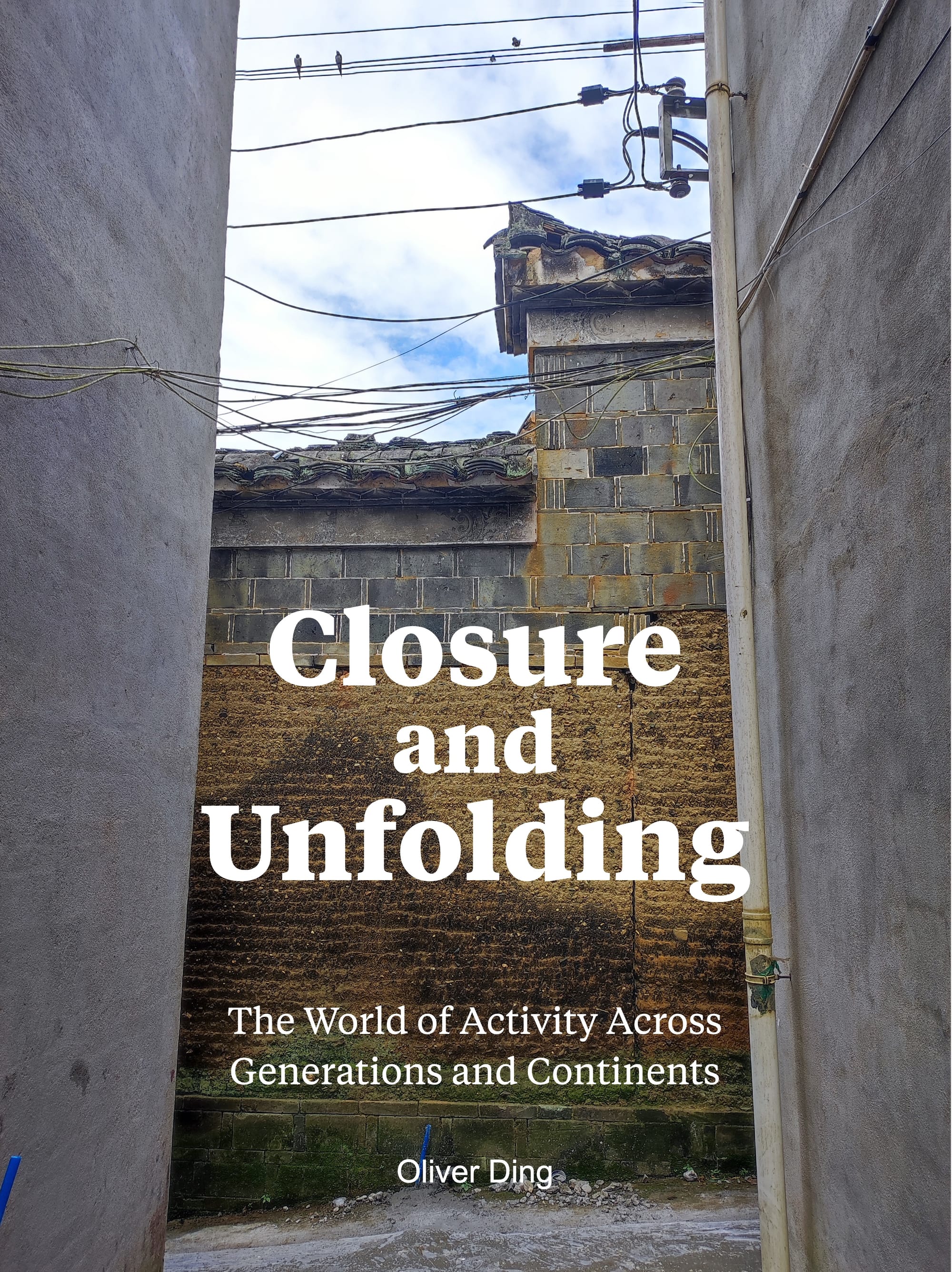
A Jianyang Boy
I was born in Jianyang, a small town in northern Fujian Province, nestled along the Chongyang Creek as it flows down from the Wuyi Mountains. Growing up, I knew the water system intimately—my father worked at the municipal water plant, managing water drawn from that very creek. Each semester, I traveled downstream to Fuzhou for school; each vacation, I traveled upstream, returning home. This back-and-forth movement, following the river's natural course, became a foundational pattern in my understanding of flow, confluence, and scale.
But there was another current running through my childhood, one less visible but no less powerful. According to Wikipedia, Jianyang was a significant cultural hub: "From the 11th to the 17th century, commercial publishers in the area used local bamboo for paper manufacturing, making it one of the three largest book-producing areas in China during the Song and Yuan dynasties."
And at the heart of this scholarly tradition stood Zhu Xi.
1
Zhu Xi was a a philosopher and educator of the Southern Song dynasty, later venerated as one of the most influential figures in Chinese thought, whose ideas had a profound and lasting influence on the civilization of China and East Asia.
He was born in Youxi County, not far from Jianyang, in 1130. He passed the imperial examination at nineteen, but his official career was short—he held office for only nine years total, and in 1194 he was forced out of court after just forty days. Political failure, however, did not end his life's work. It redirected it.
He is best known as the great synthesizer of Neo-Confucianism. Drawing on earlier thinkers, he built a philosophical system around the concept of Li—the underlying principle and moral order of the universe. His commentaries on the Four Books became the standard curriculum for the imperial examinations for more than six centuries, shaping how generations of Chinese scholars understood the world and their place in it.
In 1192, at the age of sixty-three, he settled in Kaoting, a village just outside Jianyang. There he built a simple academy and spent his final eight years teaching, writing, and mentoring students who came from across the empire. It was here that he closed his political ambitions and unfolded his most enduring work—not as a statesman, but as a teacher and thinker.
When I later wrote about my hometown, I poetically described the Chongyang Creek as carrying "the lingering fragrance of rock tea and the scholarly tradition of Zhu Xi." The phrase came naturally—it was how I had always experienced my home. The tea from the Wuyi Mountains and the legacy of the great Neo-Confucian philosopher were simply part of the landscape, part of the water that flowed past my door.
For years, I treated Zhu Xi as an emotional mentor, a presence that accompanied my intellectual journey without my ever digging deeply into his philosophy. When I felt lost or confused, I would open Wikipedia and read the page on Zhu Xi, slowly opening each footnote link one by one. This was my form of "philosophical therapy"—a way of reconnecting with a figure who had always been there, in the background of my consciousness, since childhood.
That might have been where the story ended—a quiet, private ritual of return. But a chance discovery was about to change how I saw him, and how I saw myself.
2
My career path took me far from that small town. I moved to Fuzhou for higher education, then worked in advertising and media as a creative copywriter and designer. Later, I supported pre-IPO enterprises as a business strategist and fundraising consultant. In 2007, I moved to the United States, crossing the international date line—a physical division that would later become a powerful symbol in my thinking.
In the 2000s and 2010s, I threw myself into digital cultural innovation. I co-founded TEDtoChina, a volunteer project promoting TED Talks across China. I built online communities supporting open education, free culture, and social innovation. These were years of collective creation, of building things with others.
But beneath the outward activity, a quieter thread was weaving itself. In 2014, I made a significant shift in how I spent my spare time—detaching from digital nonprofit communities and attaching to theoretical learning. Over the following years, I devoted myself to exploring ecological psychology, activity theory, and related fields. I wrote my first learning autobiography in 2015 and became deeply interested in biographical studies.
Yet, when I developed a series of tools—the Learning Autobiography Guide, the Learning & Reflective Cards, the Learning & Reflective Canvas—they were not adopted by others. So I shifted my focus inward and concentrated on my own journey of intellectual discovery.
In June 2018, I found myself facing a classic midlife question:
What should I do with the rest of my life?
It became clear that intellectual development and life reflection was one of my life enterprises—I had pursued it for years without any financial return. If someone can keep doing something for many years without getting paid, it must be their passion. The question was no longer about the meaning of life, but about the methods.
3
I had been living what I call a portfolio life—paid work, volunteer projects, family life, and independent intellectual inquiry running in parallel. I had been practicing this way of life since the early 2000s. By 2018, the first three strands had each reached certain milestones and completed their cycles. The paid work phase had run its course. The volunteer initiatives had reached natural closures. Family life had settled into a stable rhythm. It felt like the right time to give the fourth strand—independent intellectual inquiry—a more serious push.
This was not a crisis. It was a portfolio rebalancing. In my own theoretical language—specifically, the concept of "multi-center emergence" I developed in Homecoming—I was not abandoning one life to pursue another. I was shifting the center of gravity within a life that already contained multiple centers, each with its own arc and timing.
From today's vantage point, that shift—from volunteer initiatives to theoretical activity—was itself an early chapter in my own story of closure and unfolding.
One day, I opened Wikipedia and read the page on Zhu Xi. While following the footnotes, I came across Yu Yingshi's The Historical World of Zhu Xi. The book opened a door I hadn't known existed. Yu's analysis of Zhu Xi's career showed me something I had never fully appreciated: Zhu Xi's life was itself a story of closing and unfolding.
4
Yu Yingshi described Zhu Xi's trajectory through two distinct phases. In his early and middle career, Zhu Xi pursued the ideal of "De Jun Xing Dao" (得君行道)—gaining the ruler's trust and using that authority to implement Confucian governance. This was the classical ambition of the scholar-official: to advise the emperor, shape policy, and bring moral order to the realm. In 1194, Zhu Xi briefly held a court position. But it lasted only forty days. Political opposition forced him out, and he never held office again.
After this failure, Zhu Xi turned away from the center of political power. He retreated to Jianyang, to Kaoting Academy, where he spent his remaining years teaching, writing, and mentoring students. This was not merely a retreat from politics—it was a reorientation of his life's work. His ambition shifted from reforming the state through the ruler to shaping the next generation through education. He stopped seeking to change the world through power and began cultivating it through learning.
Yu described this as a transition from "De Jun Xing Dao" (gaining the ruler to implement the Way) to what later thinkers would call "Jue Min Xing Dao" (awakening the people to implement the Way)—from top-down reform to grassroots transformation through education and cultural influence. Zhu Xi's later years at Kaoting were not a defeat. They were the closing of one chapter and the unfolding of another.
I recognized this pattern because I was living through something similar. The volunteer initiatives had accomplished what they could. I was at a point where I could choose which part of my portfolio to foreground. Looking at Zhu Xi's trajectory, I saw an alternative: when the path of "gaining the ruler" failed, he did not abandon his life's project. He redirected it. He moved from the political center to the educational periphery, from working with power to working with people, from immediate results to long-term cultivation.
The question I had been reflecting on—What should I do with the rest of my life?—began to shift.
5
After that mid-year reflection in 2018, I decided to do something specific with the second half of the year. I would take on what I thought of as a "final project"—a culminating effort that would bring together the theoretical threads I had been exploring over the years.
I was still working at the startup during the day. But I started arriving at the office an hour early each morning to write. On weekends, I spent half a day at the office, continuing the work. I gave myself a timeline: October 2018 to March 2019. If my life were end soon, this was what I wanted to leave behind.
The project drew from three areas I had been studying: ecological psychology, cognitive linguistics, and action science. I assembled concepts from these fields into a toolkit, then used it to reflect on a key theme that had run through my career—curation. I had been curating content, knowledge, experiences for years, first in advertising, then in digital communities, then in my own learning. I had never stopped to ask: what is this activity, fundamentally?
That question gave rise to Curativity Theory—an ecological approach to general curation practice. The book draft was over six hundred pages long. It was my first full theoretical work.
When I finished the draft in March 2019, I felt a sense of completion. But I also knew the theory needed to be tested. So in 2020, I started a new project: applying curation to a domain I knew well—Activity Theory. I set out to map the development of this theoretical tradition, tracing how it had evolved and how different figures had contributed to it over time. It was a knowledge curation project, using my own framework to understand how a tradition grows.
It was during this mapping that something unexpected surfaced.
I thought of Zhu Xi.
He had done theoretical curation in a remarkably way—not as a philosopher constructing a system from scratch, but as an editor and commentator. He selected the classical texts, compiled the Four Books, wrote commentaries on them, and gave them a coherent interpretive framework. Through this editorial work, he shaped how the Confucian tradition was understood for centuries. He became a great thinker through his work as a theoretical curator.
The resonance struck me as both obvious and profound. I had developed a theory of curation that could explain how traditions are built and transmitted. And all along, I had a figure from my own hometown who had done exactly that work—eight centuries before I started writing about it.
I realized that both of us had followed a similar pattern. He had closed one way of working—seeking to change the world through political power—and opened another: teaching, writing, and curating a tradition for future generations. I had closed my earlier phases of paid work and volunteer initiatives, and opened a new phase of independent intellectual inquiry. The "final project" I was writing was itself a closing of one chapter and the unfolding of another. I had not planned it this way. But looking back, I was living out a pattern I had first recognized in Zhu Xi's own life.
I began to see Zhu Xi differently. Not just as an emotional guide, not just as a role model for redirecting a life, but as a fellow worker in the same kind of intellectual labor.
6
But the recognition of his way of working also prompted a question about my own. I had built my theoretical frameworks entirely from Western resources—Ecological Psychology, Activity Theory, Phenomenology. Zhu Xi's work, and the entire Chinese intellectual tradition he represented, had been absent from my toolbox.
On May 31, 2025, while running in a park, I reflected on a knowledge curation project. I realized that for years, although I had focused on connecting theory with practice, I relied almost exclusively on theoretical resources drawn from Western traditions.
At that time, a question surfaced: Why had all my theoretical resources been drawn exclusively from Western traditions?
The strangeness of it struck me deeply. I was born and raised in China, in the very town where Zhu Xi had spent his later years teaching. I had felt his presence as a kind of emotional companionship for my entire life.
And yet, my understanding of James Gibson’s ecological psychology runs far deeper than my understanding of Zhu Xi’s philosophy of Lixue. To say I ignored Zhu Xi would not be accurate. After years of reading scholars on his approach to self-cultivation, reading and learning, his ideas had worked their way into my thinking. But I had never engaged with his Lixue as a theoretical resource in the way I had engaged with Gibson’s ecological psychology — studying it systematically, extending it, building on it to develop what I now call the Ecological Practice Approach. Zhu Xi had come to me as a presence and an orientation. Gibson had come to me as a tradition to work with.
This reflection later inspired me to launch the West-East Creative Dialogue project. My connection to Zhuxi also slowly changed within the project. For example, one sub-project considers the work of Kwang-Kuo Hwang (1945–2023) as a case study for Creative Life Theory. In his final major work, The Scientific Interpretation of Song-Ming Neo-Confucianism (2023), Hwang offers a rigorous reinterpretation of Zhu Xi’s Neo-Confucian thought using the conceptual tools of scientific realism. In this book, he treats Zhu Xi’s philosophy of li (principle) as a metaphysical and epistemological foundation that can be translated into the language of modern scientific theory, enabling a cross-cultural dialogue between Chinese metaphysics and Western social science.
In this way, I had found a new reason to go back to Zhu Xi, indirectly or directly.
7
In March 2026, I wrote Cognitive Hydrology Pedagogy (v1.0). It was my first formal exploration of pedagogy, and it contained something that had been waiting to emerge.
Cognitive Hydrology was built on first principles that had arrived from different moments across a lifetime:
Natural Mother as Teacher. West and East as Resources. Sea embraces all rivers. Greatness comes from openness.
The first principle—Natural Mother as Teacher—came from my childhood along the Min River watershed. My father taught me that working with a water system requires holding together two things: respect for the natural flow of water, and the intelligent human intervention that makes that flow serve life. Not fighting the current, but learning it deeply enough to guide it.
The third and fourth principles belonged to Lin Zexu, the nineteenth-century statesman from Fujian whose words—Sea embraces all rivers; greatness comes from openness (海纳百川,有容乃大)—had been my personal motto since my student days in Fuzhou.
And between them, something else emerged.
In the pedagogy document, I wrote about the Neo-Confucian tradition of self-cultivation, particularly as developed by Zhu Xi—"who spent his later years teaching at Kaoting Academy in Jianyang, the same landscape where Cognitive Hydrology was born." I noted that this tradition understood learning as a lifelong practice integrating knowledge and character: "Learners are not improved by education; they are transformed by it across a lifetime."
This was not just an observation. It was a homecoming.
For the first time, I had brought Zhu Xi explicitly into my theoretical work—not just as an emotional presence, but as a pedagogical voice in dialogue with my own framework. I wrote: "‘West and East as Resources’ is not a relativist stance but a higher epistemic freedom: not attached to any single tradition, and therefore able to draw genuinely from all of them."
That insight, the morning run that revealed my epistemic blindspot, and the recognition that I had been drawing exclusively from Western theoretical traditions—these threads were beginning to weave together. I began to see that my relationship with Zhu Xi was not just personal history; it was a creative resource waiting to be activated.
8
Now, looking back on this journey from the vantage point of mid-2026, I can name what I could not name then.
In The Systems Model of Creativity, Mihaly Csikszentmihalyi wrote about "symbolic mentors"—figures we have never met, often from the past, who nevertheless shape our development. He noted, "Some people have purely symbolic mentors whom they have never met, such as an inspiring figure from the past, but who nonetheless may have taught them a great deal about the nature and standards of a domain of interest" (2014, p.209). This was exactly what Zhu Xi had been for me: a presence I had never encountered in person, yet who had accompanied me through my entire intellectual life.
I can now also understand this relationship through a concept I developed in my own theoretical work—supportance, which I define as the potential supportive action opportunities offered by the social environment. Like Gibson's affordance in the physical world, supportance operates in the social world: it exists neither in the environment alone nor in the person alone, but in the encounter between them. Looking back, Zhu Xi provided me with three distinct forms of supportance across different periods:
Emotional supportance. In my childhood and early adulthood, Zhu Xi was part of my hometown landscape—a figure of pride and comfort. His presence gave me a sense of belonging to a place with a meaningful intellectual tradition. When I felt lost or rootless, he reminded me that I came from somewhere that mattered. This was the support of identity and connection.
Role model supportance. When I was rebalancing my portfolio life and deciding to give intellectual inquiry more weight, Zhu Xi's life trajectory became a source of guidance. Through Yu Yingshi's work, I saw his turn from political failure to educational commitment. This was not abstract inspiration—it was a concrete example of how to redirect one's life within a larger arc. He showed me that closing one chapter could lead to a more meaningful unfolding.
Academic supportance. Most recently, Zhu Xi has become an intellectual resource—a thinker whose philosophical system I can engage, whose concepts I can test against my own frameworks. The West-East Creative Dialogue project, starting with Kwang-Kuo Hwang's work on Zhu Xi, has opened a path for this engagement.
These three forms are not mutually exclusive; they coexist and layer upon one another. But recognizing them helped me see something I had not noticed before: the nature of my relationship with Zhu Xi had been shifting over time, and I had been a participant in that shift without fully realizing it. The symbolic mentor I had known as a child, who offered only comfort, was gradually becoming a conversation partner whose ideas I could take seriously.
That insight, and the recognition that I had been drawing exclusively from Western theoretical traditions, were starting to converge. The next chapter picks up the story in July 2026, when I returned to Jianyang with my two sons and went to Kaoting Academy with my middle school classmate.
v1.0 - August 14, 2026 - 3,435 words