
Spatial Heuristics: Introducing the Creative Life Square
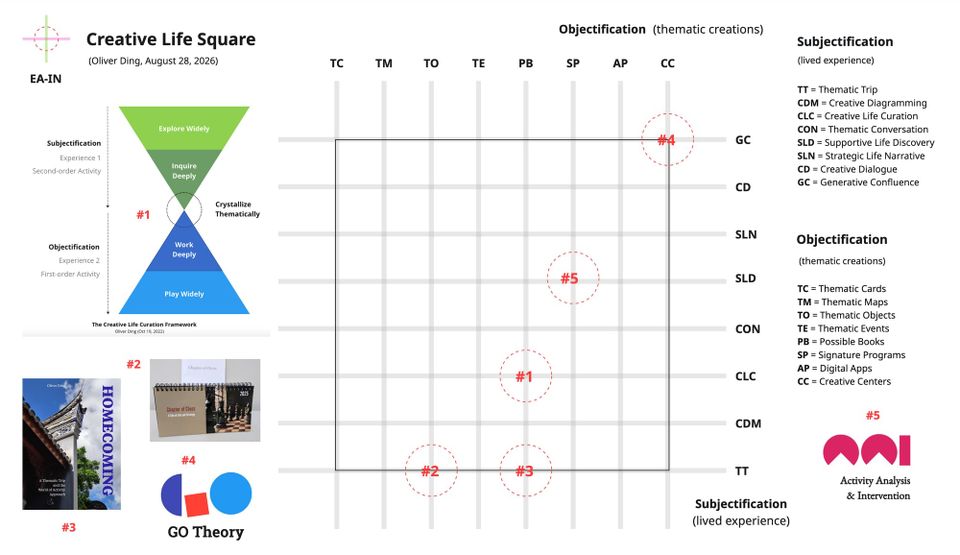
A Sub-square of the GO Square, representing 64 Weave-points for Creative Life Mapping
by Oliver Ding
August 29, 2026
In August, after returning from my trip to China, I entered a sustained period of exploration.
Over the past few weeks, I had drawn a series of diagrams. Each served a different purpose—one traced how my theoretical system might extend into practice, another mapped the direction of the AAI project, a third charted my own "Living Coordinate." They were not part of a single plan. They were separate attempts to make sense of the same underlying transition: the movement from theory to practice that I had been anticipating since June, and that the July trip had set in motion.
I was in discovery mode—the kind of open-ended exploration where you don't yet know what you're looking for, only that you'll recognize it when it arrives. In my vocabulary, this is what I call a Creative Life Discovery project—a "Before" project that takes place in the gap between formal commitments, a space where exploration itself becomes the work.
One of these exploratory threads traced the development of a creative theme that emerged from the trip—a theme that set off a chain of reflections about its most suitable form of presentation. That thread then interwove with other recent developments, and together, they eventually led to something unexpected: a new Creative Life Square. See the diagram below.
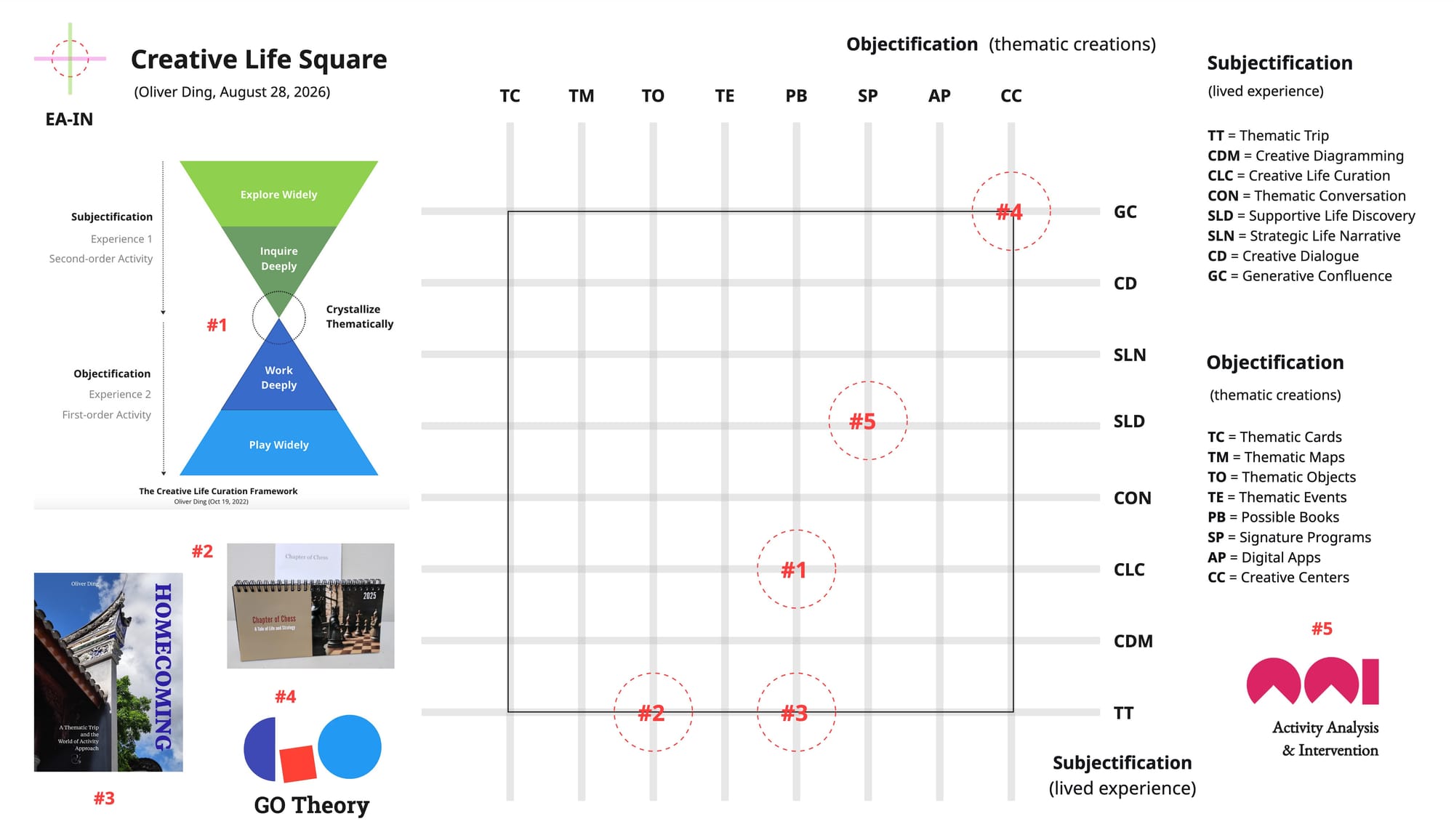
This article tells the story of how that square came to be. I should caution, however, that the story is not a single, coherent narrative. It reads more like several separate threads that developed independently, each moving at its own pace, before they converged. From my experience running Creative Life Discovery projects over the years, this is actually the norm. Discovery rarely arrives through a straight line. It arrives through the confluence of multiple lines of inquiry that were never designed to meet—until, one day, they do.
1. A Thread: Book or Exhibition?
The thread began with a creative theme called "Closure and Unfolding."
I had recently written about this theme in A Thematic Trip and a Possible Book—the first case study in this Spatial Heuristics series. That article traced the full arc: a journey, a photograph, a theme that crystallized from the experience, and finally a plan for a possible book. In the language of Creative Life Theory, this is the S-T-O principle in action: Subjectification (the lived experience of the trip) → Thematic Crystallization (the "Closure and Unfolding" theme) → Objectification (the book plan).
The theme had emerged from the trip itself: the family gathering in Jianyang, where I listened to stories of four generations scattered across continents; the visit to the old ancestral house, nearly empty now except for my aunt and uncle; the walk down the lane I used to take to school, and the photograph I took there—two new cement walls on either side, an old earth wall standing between them.
Back in the U.S., the theme slowly took shape. I wrote about it, traced its arc, and eventually planned it as a possible book—the sequel to Homecoming. I mapped out the entire structure: four parts, each with a clear arc. I wrote chapter summaries for every section, and even drafted the first chapter of Part Four—"A Jianyang Boy." The book felt real. It felt inevitable.
Last week, I completed the proposal and began sharing it with a few friends for feedback. On the surface, everything was proceeding smoothly. The structure was solid. The chapters were mapped. The writing was underway.
But something felt off.
Not wrong, exactly. Just ... off. A persistent unease that I couldn't quite name.
The theme was different from the knowledge-oriented ones I had written about before. It wasn't a framework to be taught or a model to be applied. It was cultural—a shared experience that many people might recognize in their own lives. Four generations moving across geography. One world closing while another unfolds. The old wall and the new walls, framed together in a single image.
Those things—the migration maps of multiple families, the tangible objects from different eras, the spatial configuration of old and new—didn't feel like they belonged between covers. They felt like they should occupy a physical space. A space you could walk into. A space you could feel before you understood.
I had never made an exhibition. I had only made books.
But that question—if an exhibition is possible, what else haven't I considered?—stayed with me.
2. Another Thread: The Book Diagram
As I mentioned at the beginning, the past few weeks had been a period of diagramming. I had been drawing maps—some to trace how my theoretical system might extend into practice, others to chart the direction of the AAI project, still others to locate my own position in the landscape I was mapping.
This kind of work is not new to me. Over the years, I have come to rely on diagramming as a way of thinking. Not just representing thought, but generating it. In 2024, I wrote a book manuscript on this very subject—Creative Diagramming: The Fifth Way of Knowing and Early Discovery—where I explored how diagrams can function as active territories for exploration, reflection, and discovery. That manuscript documented a method I had been developing for years. By now, the method has become a regular part of my practice, especially during Creative Life Discovery projects—those open-ended periods of exploration where I don't yet know what I'm looking for, only that I'll recognize it when it arrives.
Earlier in August, for example, I had made a diagram called Knowledge for Development, which mapped how my theoretical knowledge might move into practice through six transformation nodes. Later, I compared that August diagram with one I had made in February—a side-by-side look that revealed a clear trajectory: the February diagram was about theory maturity, the August diagram about knowledge transfer. The comparison itself was a product of diagramming.
On August 27, I updated an old diagram.
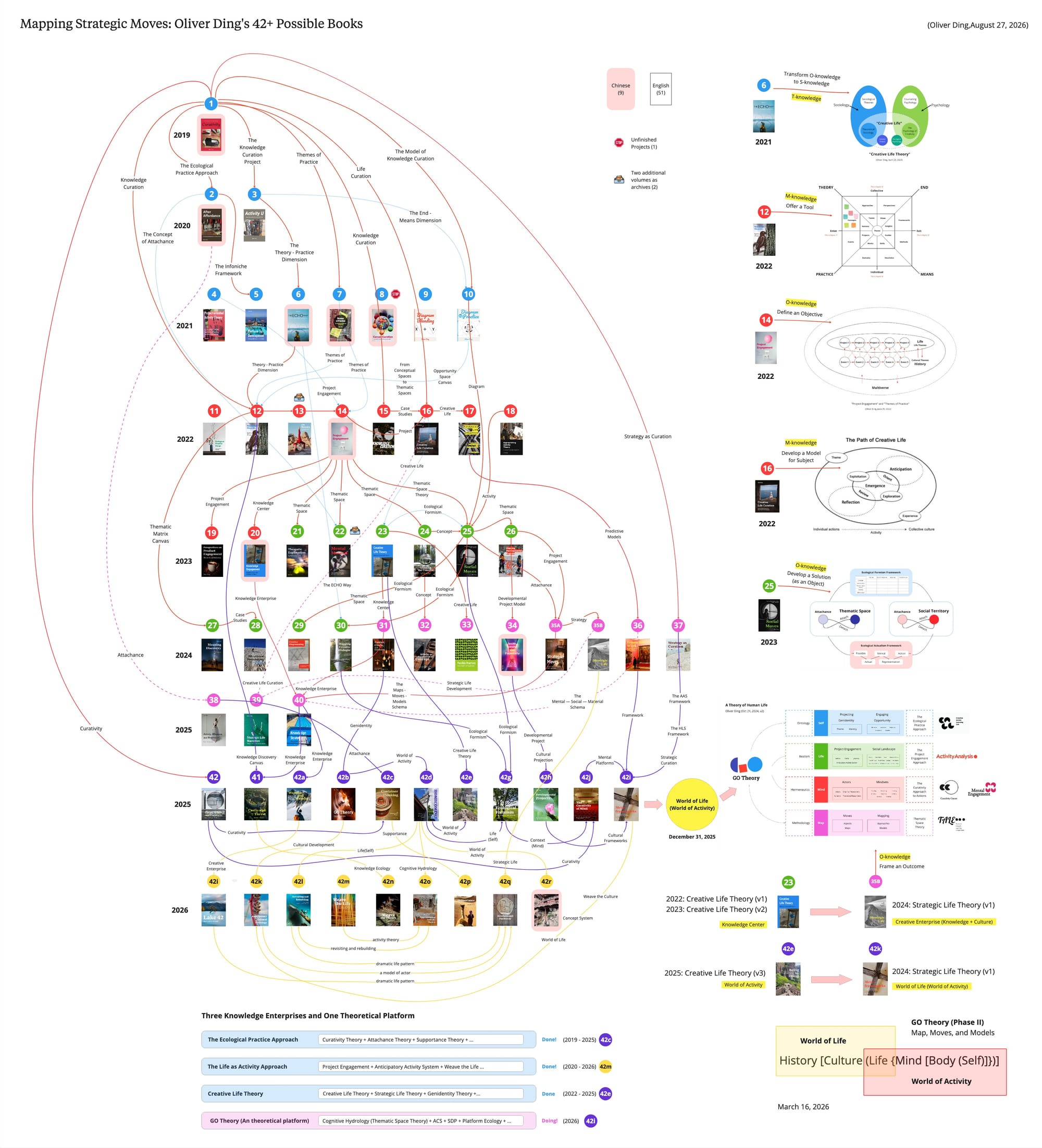
For years, I have used the "Possible Books" format to compile my manuscripts. Each book collects articles from a knowledge project, and each comes with a long introductory essay that crystallizes the theoretical thinking at that moment. Over time, these manuscripts have accumulated into a substantial archive.
The diagram was called "Mapping Strategic Moves." I had been maintaining it for years, tracking the growth of my manuscript collection. In 2024, I had reached 42. This time, the count reached 42r—sixty possible books in total.
I looked at the number. 2025: 42. 2026: 60.
Something about that progression registered differently this time. For years, I had been accumulating manuscripts, watching the count grow, treating each new book as a milestone. But now, looking at the diagram, the numbers seemed to be telling me something else. This practice—the "Possible Books" format—had become a well-worn path. I knew exactly how to do this.
And if I knew how to do this, perhaps it was time to ask what I didn't yet know how to do.
I looked at the diagram and saw something I hadn't fully registered before. Books were just one type of creative artifact I produced. If exhibitions were possible, what about cards? What about maps? What about objects, events, programs, applications?
The diagram showed me the full weight of what I had already made, but also the limits of what I had allowed myself to imagine.
3. Yet Another Thread: A Conversation on LinkedIn
The next morning, a friend messaged me on LinkedIn.
He had been working on his own theoretical framework for years, and over time he had produced a series of diagrams—each one a version of his evolving thinking. He shared several of them with me, from early sketches to more refined versions. I looked at the progression: the same core idea, rendered differently at each stage, with each iteration revealing something new about what he was trying to understand.
I wrote back: "Yes — I think you should write an article about this process. Rather than only presenting the latest version, it would be interesting to show how the diagrams changed over time, what you were thinking at each stage, and how the changes in the diagrams reflected changes in your thinking."
I added that I often do this in my own work—looking back at a series of diagrams to reconstruct the path of thinking that produced them. The diagrams become traces of the development of an idea, rather than merely illustrations of a final one. I suggested that he might do the same: show the sequence, tell the story of what he was trying to understand at each point, what he discovered, what didn't work, and why the next diagram became necessary. The evolution of the diagrams itself, I said, becomes part of the story of the theory.
After I sent the message, I sat with my own words for a moment.
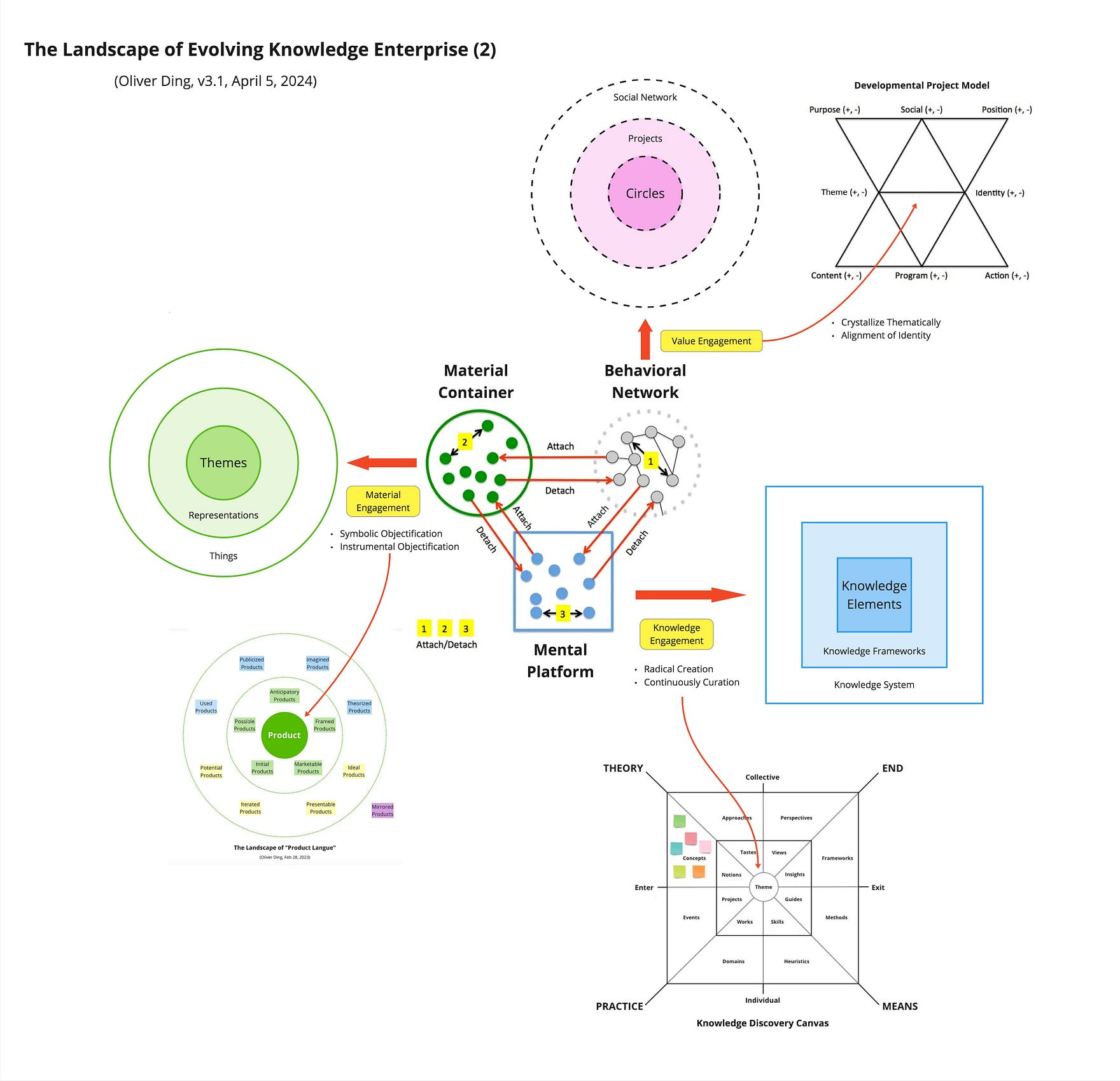
I had just told someone else to look at his creative artifacts as traces of a thinking process—each one capturing a particular moment in a longer journey. It was not a new idea to me. For years, I have used the "evolving knowledge enterprise" model to organize my own work, distributing thematic creations across three dimensions: mental, social, and material. The model has served me well.
But this time, something felt different.
The conversation, coming on the heels of the book diagram and the lingering unease about the exhibition, pushed me to think further. The three-dimensional model was good for mapping the landscape. But what if I needed something more operational—a classification that could guide not just where things sit, but what I might do next?
The trip itself had given me a clue. The "thematic trip" practice—the act of turning a journey into a creative theme—had emerged as something distinct.
I had been doing this for longer than I realized, but only now was I beginning to see it as a pattern. In 2025, the Fuzhou trip had yielded Homecoming: A Thematic Trip and the World of Activity Approach. This year, the Jianyang trip had yielded "Closure and Unfolding"—a theme that echoed and extended the previous one, moving from my personal World of Activity to a family across four generations. Two years, two trips, two creative themes, one following the other like a call and response.
And it went back even further. Over the years, many of my travels had seeded creative themes. Some of my book covers still carry photographs I took on those journeys—images that had captured something I couldn't yet name, but that later became the visual anchor for an entire manuscript.
What I had treated as isolated incidents—each trip a separate event, each theme its own story—I now saw as something else: a consistent practice. Thematic trips were not just travel. They were a method. They deserved to be recognized as a specific creative practice, alongside Creative Diagramming and other methods I use. They were not just different outputs. They were different types of activities, each with its own logic, its own rhythm, its own relationship to experience and to artifacts.
This was the real question that the morning's conversation had surfaced: if my creative artifacts could be classified, could my creative practices be classified too?
The diagrams, the cards, the objects—they were not merely illustrations of my ideas. They were a different kind of thing from my books. They had different affordances. They served different purposes. They lived in a different relationship to the people who encountered them.
This was not a new thought, but it landed differently that morning. The conversation had opened a door, and I was beginning to see what lay beyond it.
4. Convergence: A Square Emerges
That afternoon, I sat down.
I asked myself: if thematic creations are not just books, but everything that can be made—cards, maps, objects, events, programs, applications—what is the relationship between them?
And then: if lived experience also varies—from one person, to two people, to many people—what is the relationship between those different scales of experience?
The questions hung in the air. Then something clicked.
I thought of GO Square. The connection was immediate, almost obvious once I saw it. GO Square is built on two dimensions: the diachronic dimension (temporal unfolding) and the synchronic dimension (structural positioning). These two dimensions map directly onto the two core concepts of the S-T-O principle in Creative Life Theory: Subjectification (Lived Experience) —which unfolds over time, through a life—and Objectification (Thematic Creations) —which can be positioned and classified in structural terms.
This alignment invited a natural next step: what if I designed a sub-square of GO Square specifically for creative life?
Months ago, when I introduced GO Square, I had explicitly left room for sub-squares as a free expansion layer. The framework was designed to be generative—not a closed system, but an open one. Anyone could create their own sub-square and then link it back to the 64 weave-points of the larger GO Square coordinate system. This, it turned out, was exactly what I was doing now.
I named it the Creative Life Square.
The next question was immediate: where does it sit within the overall GO Square?
The answer came quickly: EA-IN.
In the GO Square framework, each coordinate is defined by two dimensions. EA—Earth—represents the material, the ecological, the tangible. It is where artifacts live, where things are made and shared. IN—Individuals—represents the personal, the developmental, the unfolding of a single life over time. Together, EA-IN captures the essential movement of creative life: from the temporal flow of lived experience to the material crystallization of that experience into thematic creations.
The sub-square would follow the same 8×8 format as GO Square. Two dimensions. Eight positions each. I began to map them.
For the vertical dimension — Subjectification, lived experience—I identified eight types organized by increasing complexity:
- Individual: TT (Thematic Trip), CDM (Creative Diagramming), CLC (Creative Life Curation)
- At Least 2 People: CON (Thematic Conversation), SLD (Supportive Life Discovery), SLN (Strategic Life Narrative)
- Multi-theme Enterprises: CD (Creative Dialogue), GC (Generative Confluence)
For the horizontal dimension — Objectification, thematic creations—I identified eight types organized by increasing complexity of production and artifact type:
| # | Abbreviation | Full Name |
|---|---|---|
| 1 | TC | Thematic Cards |
| 2 | TM | Thematic Maps |
| 3 | TO | Thematic Objects |
| 4 | TE | Thematic Events |
| 5 | PB | Possible Books |
| 6 | SP | Signature Programs |
| 7 | AP | Digital Apps |
| 8 | CC | Creative Centers |
Two dimensions. Eight types in each. Crossing them generates 8 × 8 = 64 weave-points.
WOW.
That was the exact thought. The square had arrived, and in that instant, I saw what it meant for Creative Life Theory.
Until now, the theory had offered a set of analytical levels—creative action, creative project, creative journey, creative landscape, creative lifescope—five scales for understanding creative life at different magnifications. The S-T-O principle had always been there, guiding my thinking. But in practice, my own work followed its own natural rhythms. I rarely sat down and consciously planned out the S-T-O arc before a project began.
This square was different. It offered something the theory had not yet given me: a heuristic tool that could be used deliberately. Not just for analysis, but for design. Not just for understanding where I had been, but for imagining where I might go next. For planning interventions. For seeing, in concrete terms, what kind of experience might lead to what kind of creation.
I didn't plan the square. It arrived. But once it arrived, I knew exactly what to do with it.
5. Mapping the Situation
I didn't wait. I immediately used the square to map where I currently stand.
The exercise was simple: take a few of my own thematic creations and place them on the grid. Where do they fall? Which weave-points do they occupy? The act of placing them would test the square—and, I suspected, reveal something about my own creative landscape that I hadn't fully seen before.
I started with five examples.
#1 — Creative Life Curation
Weave-point: CLC — PB (Creative Life Curation × Possible Books)
In October 2022, I closed the Knowledge Curation project after three years of intensive work. The moment I closed it, I turned my attention to a new direction: Life Curation. I realized immediately that I could use my experience from the Knowledge Curation project as raw material for the first Life Curation project itself—analyzing what I had just done, extracting patterns, and building new frameworks from it.
Over the following months, I conducted a series of case studies. From them, I developed a set of models. The most representative of these was the Creative Life Curation model—the very model that later became the source of the S-T-O principle. The case studies were eventually compiled into a possible book. Later, the model itself evolved into a method—a way of approaching creative life not as something that simply happens, but as something that can be actively curated.
So the practice is at CLC. The book is at PB. The weave-point where they meet is CLC-PB.
#2 — The Chess Calendar
Weave-point: TT — TO (Thematic Trip × Thematic Objects)
In late 2025, I made a calendar.
It was a gift for my second son, who loves chess. The calendar featured a set of poems I had written about chess when I was nineteen—one poem for each piece on the board, paired with a simple chess-related image.
The object itself—a physical calendar—belongs to TO (Thematic Objects). But why TT (Thematic Trip)?
The connection came through the trip. In the summer of 2025, I returned to Fuzhou and found some old belongings in my house there. Among them was a cassette tape—a recording I had made as a student, when I was part of a poetry club, of my own poems read aloud. Finding that tape unlocked something. It reminded me of the poems I had written decades ago, and that memory eventually made its way into the final chapter of Homecoming, which I was writing in Fuzhou that summer.
The chess calendar was not made on the trip. But the trip brought back the memory that made the calendar possible. The thematic trip activated the object.
#3 — Homecoming
Weave-point: TT — PB (Thematic Trip × Possible Books)
Homecoming sits at TT-PB. It was born from a thematic trip—the 2025 journey to Fuzhou—and it took the form of a possible book.
Its sequel, Closure and Unfolding, is currently in development. If completed, it will occupy the same weave-point. This is where the heuristic value of the square—and its connection to GO Square—becomes visible. In GO Square, each weave-point points to a thematic space, a conceptual territory where related things can be gathered. Homecoming and Closure and Unfolding belong to the same thematic space. Placing them together at TT-PB invites further exploration: what makes them the same? What makes them different? What else belongs in this space?
#4 — GO Theory
Weave-point: GC — CC (Generative Confluence × Creative Centers)
GO Theory is the theoretical platform I am currently using to host several theoretical enterprises. It was established in late 2025 and gradually matured in the first half of 2026.
Why GC-CC?
The platform was born from a generative confluence that unfolded between June and December 2025. For years, I had been following three theoretical traditions—Activity Theory, Ecological Psychology, and Theoretical Sociology—each pursued in parallel. I developed frameworks within each, and over time, I conducted creative dialogues between them.
At some point, I realized that the three theoretical enterprises had not converged into one—they continued to develop independently, each following its own trajectory. But what had converged was the outcome of my work across them: the frameworks, the methods, the case studies, the creative dialogues I had conducted within and between each tradition. These outputs had woven themselves into something new—a platform that could host my emerging theoretical enterprises without collapsing them into one. I named it the World of Life (World of Activity) Approach. Later, I shortened it to GO Theory.
The platform itself functions as a Creative Center (CC), and its origin story is a Generative Confluence (GC). GC-CC is where it sits.
#5 — Activity Analysis & Intervention (AAI)
Weave-point: SLD — SP (Supportive Life Discovery × Signature Programs)
This is the direction I am currently focusing on.
AAI is designed as a service program for theorists, analysts, and practitioners. It draws on the theoretical frameworks I have developed over the past several years and translates them into a structured offering. That makes it a Signature Program (SP).
But the essence of the program is Supportive Life Discovery (SLD)—a type of activity in which individuals are supported in discovering their own themes, their own directions, their own creative paths. The program is a container; the activity is what happens inside it. SLD-SP is where they meet.
What This Mapping Reveals
Five examples. Five weave-points.
| Example | Weave-point |
|---|---|
| Creative Life Curation | CLC — PB |
| Chess Calendar | TT — TO |
| Homecoming | TT — PB |
| GO Theory | GC — CC |
| AAI | SLD — SP |
Placing them on the grid made something visible. The five examples are not randomly distributed—they cluster in certain regions of the square. Some weave-points are already occupied. Others remain open. The square, in this sense, functions like a map of my own creative territory: here is where I have been, here is where I am, and here are the empty spaces where I have not yet ventured.
This is the heuristic value of the square. It does not tell me what to do next. It shows me where I stand—and that clarity is often enough to suggest the next move.
6. Looking Back: What Just Happened?
I sat with the square for a while before I understood it.
Then I realized: this was not an invention. It was a discovery of something that had been implicit in my own work for years.
The S-T-O principle had always been a temporal sequence. First S. Then T. Then O. But the square had turned it into a spatial matrix. I could now place any kind of experience alongside any kind of artifact. I could see where I had been, and where I had never gone. The T was no longer just a middle step—it became something discoverable at every weave-point where a particular experience met a particular form of creation.
The square did not invent a new principle. It made an existing principle operational.
This is what Spatial Heuristics does. GO Square had provided the structural container—a 64-fold coordinate system. It had invited me to reconsider the relationship between Subjectification and Objectification, to ask what a sub-square anchored at EA-IN would look like. And then it had let me find my own answer.
The two dimensions and their eight types each were organized based on my own creative landscape—my practices, my artifacts, my journey. Other readers may find different categories that better fit their own work. This is the principle of GO Square at the sub-square level: there is no requirement for uniformity. The framework provides the structure; what fills it depends on who is using it and what they are mapping.
7. What This Square Reveals
The square gave me something I hadn't anticipated.
My current focus is AAI—a meta-framework designed to help analysts use knowledge frameworks for analysis and intervention. It is not a fixed program, but a flexible structure that different analysts can adapt to develop their own signature programs, depending on the clients they serve and the approaches they bring.
The square, however, opened a door I hadn't fully considered.
If an analyst were to use Creative Life Theory as the primary resource within the AAI framework, they could develop a program specifically designed for creators—one that helps them navigate their creative journey from experience to theme to artifact, using the square as a map to locate where they are and where they might go next.
I did not plan this before the square arrived. The square arrived in the middle of the exploration, and only afterward did I see how it connected to S-T-O, to GO Square, to AAI—and now, to a broader vision of what AAI could become.
It also brought me back to where I started.
So—should "Closure and Unfolding" be a book or an exhibition? The square didn't give me an answer. But it gave me a new way to approach the question. I could try the theme in different cells. Book is one cell. Exhibition is another. Maybe there is a third.
I don't need to decide now. I just have a map that shows me where I stand—and that map itself is the unexpected fruit of this exploratory thread.
v1.0 — August 29, 2026 - 4,241 words