
Project Engagement: Activity, Curativity, and Creativity
One insight I gained from mapping 60 possible books
by Oliver Ding
August 30, 2026
Three days ago, I updated a diagram that mapped possible books I made over the past several years. Possible Books means completed book drafts, not formally publishing yet.The total number of possible books I have written or edited reached 60.
As I looked at the updated diagram, several new insights began to surface. One, in particular, stood out:
Activity provides materials; Curativity organizes them; Creativity opens up new possibilities.
This insight led to a new diagram that discusses the relationship between Activity, Curativity, and Creativity.
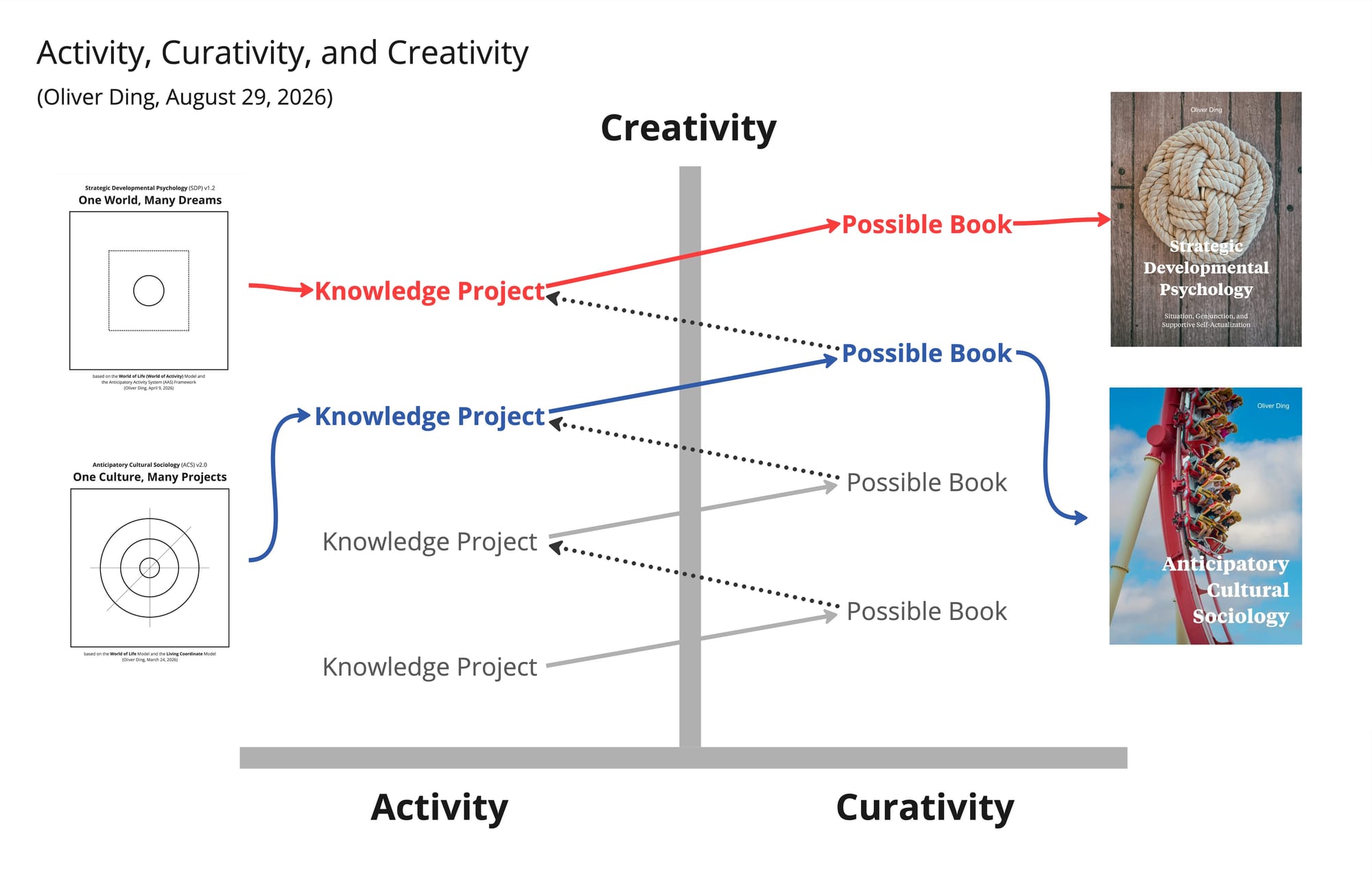
That's what this article is about.
Why Did I update the Old Diagram?
In August, after returning from my trip to China, I entered a sustained period of exploration.
Over the past few weeks, I had drawn a series of diagrams. Each served a different purpose—one traced how my theoretical system might extend into practice, another mapped the direction of the AAI project, a third charted my own "Living Coordinate." They were not part of a single plan. They were separate attempts to make sense of the same underlying transition: the movement from theory to practice that I had been anticipating since June, and that the July trip had set in motion.
I was in discovery mode—the kind of open-ended exploration where you don't yet know what you're looking for, only that you'll recognize it when it arrives. In my vocabulary, this is what I call a Creative Life Discovery project—a "Before" project that takes place in the gap between formal commitments, a space where exploration itself becomes the work.
Then something happened. A connection on LinkedIn reached out for a private conversation about our respective creative practices. During our exchange, I noticed that he kept going back to my older manuscripts and articles—reading, re-reading, asking questions about things I had written years ago. It struck me that for new readers, my body of work is not easy to navigate. It's not a single theory, book, or research program. It's scattered across years, projects, and formats. What I needed was a better entry point—something that could orient new visitors before they dive into the archive.
That wasn't the only reason to revisit the diagram. Over the first half of this year, I had written or edited eight new book manuscripts. They hadn't yet made it into the old diagram I had updated back in January. The diagram was already out of date.
So on August 27, I opened the diagram again.
For years, I have used the "Possible Books" format to compile my manuscripts. Each book collects articles from a knowledge project, and each comes with a long introductory essay that crystallizes the theoretical thinking at that moment. Over time, these manuscripts have accumulated into a substantial archive.
The diagram was called "Mapping Strategic Moves." I had been maintaining it for years, tracking the growth of my manuscript collection. In 2025, after the number reached 42, I started a new numbering system (42a, 42b, 42c...). At this update, the last number was 42r—which means sixty possible books in total.
That number—60—surprised me. And when I looked at the updated diagram, a pattern I hadn't seen before began to emerge.
Activity, Curativity, and Creativity
The pattern that emerged was this: Activity provides materials; Curativity organizes them; Creativity opens possibilities.
This is a small insight that came to me while organizing my 60 Possible Books. I drew a new diagram to capture it.
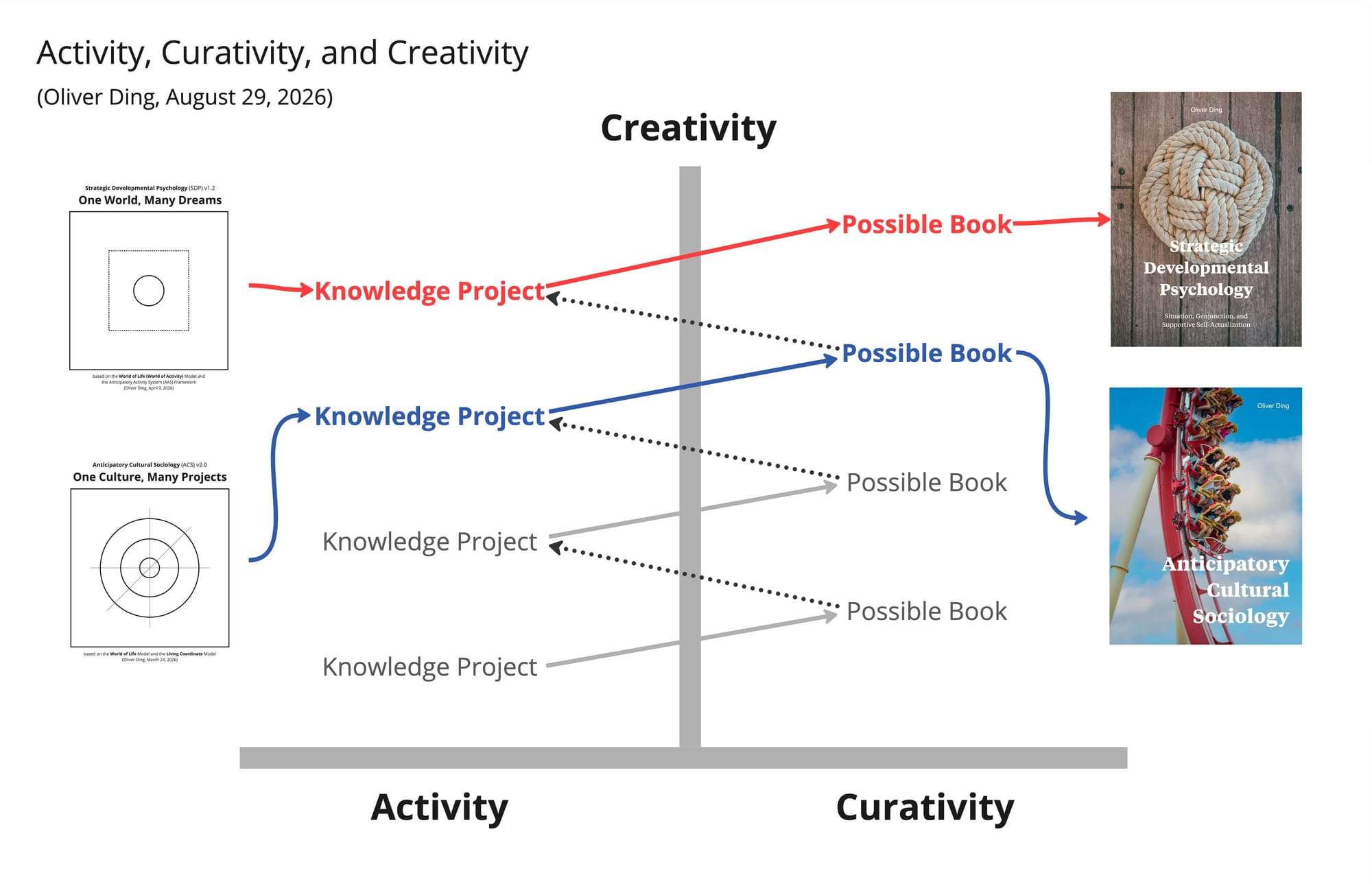
The diagram above uses two colors simply as an example:
🔵 The ACS (Anticipatory Cultural Sociology) Project
🔴 The SDP (Strategic Developmental Psychology) Project
Earlier this year, I developed ACS as a knowledge project and eventually produced an ACS manuscript. Because I had designed ACS and SDP in advance as two symmetrical projects within my World of Life, once the ACS manuscript was edited, some of its outcomes naturally continued into the SDP project.
This made me notice something about how my own knowledge ecology works.
Activity. At the activity level, my concrete units are individual knowledge projects. A project generates articles, concepts, diagrams, notes, experiments, and other forms of intellectual material.
Curativity. At the curativity level, my concrete units are Possible Books. I don't write these books primarily for publication. They are a way of bringing together and archiving the outcomes of a knowledge project. But curativity is not simply archiving. It creates something new. Whenever I edit a Possible Book, I don't just collect the articles I have recently produced. I also go back into my older materials, select things that become relevant to the theme of the manuscript, classify them differently, and reorganize them according to the framework that has emerged through the project. That new organization is itself a creative intellectual outcome. I also usually write a substantial introductory essay, using the manuscript as an opportunity to review, articulate, and rethink the core concepts that have emerged. So the project itself and the curation that follows are actually different kinds of activity. The latter doesn't merely preserve the former. It transforms it.
The dashed lines matter. The connections between Possible Books and knowledge projects are not always direct or mandatory. That's why I use dashed lines. For example, I often write an afterword for a manuscript. Sometimes that afterword points toward a new project. Sometimes I return to an old afterword months or years later and find an idea that becomes useful for something completely different. The knowledge ecology develops through these loose, sometimes unexpected connections.
And then there is creativity. If you keep operating this way for years, you eventually have 60 Possible Books, a continuously growing theoretical system, and a large but increasingly ordered personal knowledge ecology. That obviously requires creativity—not only in producing new ideas, but in continuing to find new ways to connect, reorganize, extend, and transform what has already been created.
Activity, curativity, and creativity are all needed at different scales.
Knowledge Projects vs. Possible Books
To understand this diagram fully, we need to look more closely at two concepts at its core: Knowledge Projects and Possible Books.
The first version of the “Mapping Strategic Moves” diagram was made in April 2024.
After publishing the 30th possible book on March 31, 2024, I realized there had been a 5-year Creative Journey from March 2019 to March 2024.
This insight inspired me to run a Creative Life Curation project in April 2024. I used 30 possible books as raw materials to analyze the patterns behind my journey. The diagram was born from this project.
I also wrote a 100-slide deck in Chinese to tell the whole story of the creative journey.
In May 2024, I shared the deck with some of my friends in China. One friend sent a list of questions to interview me. One of her questions was about Possible Books. She asked:
You refer to these manuscripts as “Possible Books” rather than official publications. What is the reason behind this? Do you have plans to convert these manuscripts into official publications, or do you prefer to maintain this exploratory form? Alternatively, will you share them for free as e-books?
I use [Knowledge Projects] as the basic unit of my creative journey, focusing on [Connecting Theory and Practice], with [Knowledge Frameworks] as the primary output. These manuscripts are not my main output; they are creative containers that hold the outcomes of these knowledge projects and house these knowledge frameworks.
These manuscripts are not created with the aim of formal publication. Because they are over 250 pages long and are more formal and rigorous in content than [Notes], I refer to them as [Possible Books].
From the perspective of [Creative Life Theory], this is a unique [Genre] that is particularly useful for studying the [Early Discovery] of [Creative Life].
In 2025, I launched the Possible Press website to publish some of my Possible Books, along with other formats such as Thematic Cards and Conceptual Decks, as digital products. This makes it easier for readers to find my work in one place.
A Case Study: My Creative Journey in 2024
The ACS→SDP example above is just one small piece of a much larger picture. To see how Activity, Curativity, and Creativity play out across time, let me zoom out and look at the full year of 2024.
In 2024, my creative journey produced three measurable outcomes: 17 creative themes, 17 creative diagrams, and 12 Possible Books. While these numbers tell a surface story, the deeper narrative lies in how they were made—and what they reveal about the relationship between Activity, Curativity, and Creativity.
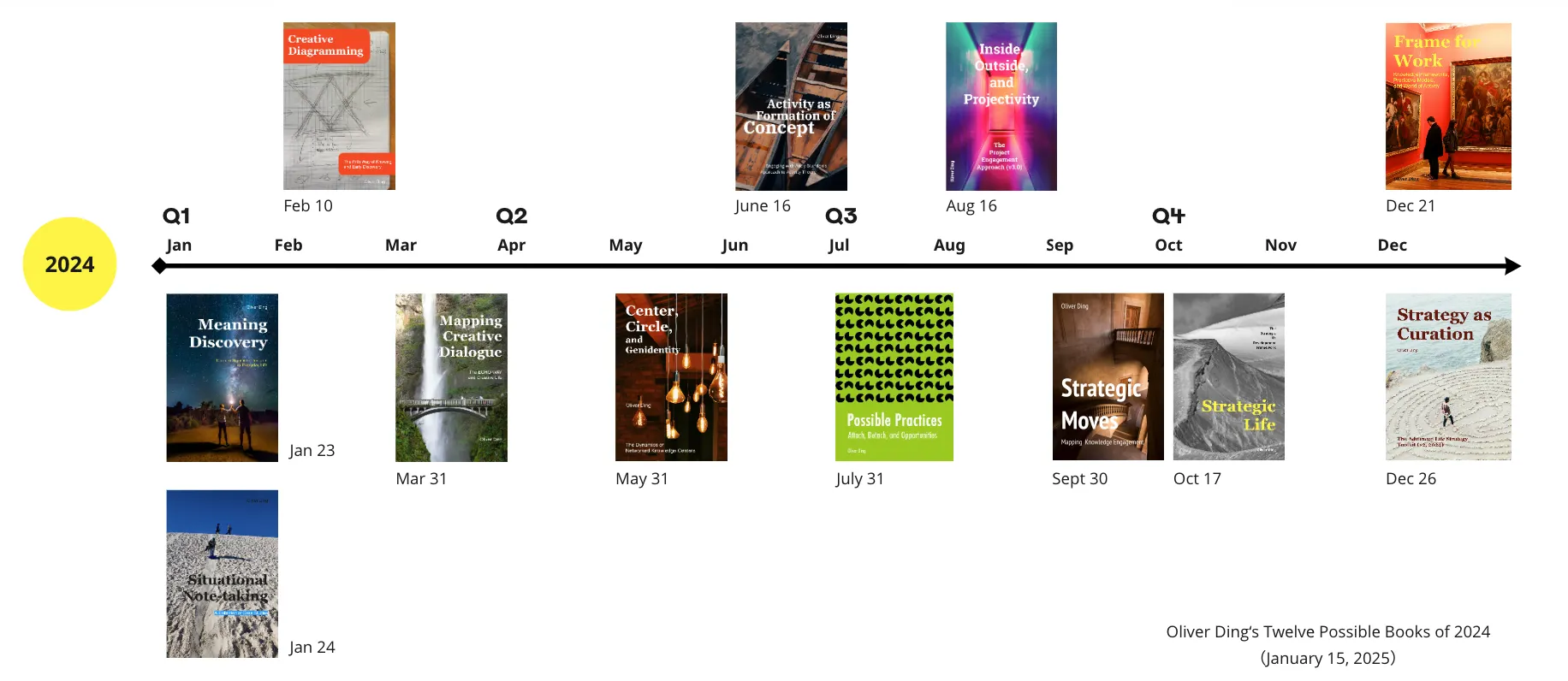
In Mapping Developmental Projects (book, v1, 2023), I listed a series of projects from 2019 to 2023. Here is a list for 2024:
- The Evolving Knowledge Enterprise project
- The Meaning Discovery project
- The Situational Note-taking project
- The Strategic Moves project
- The Creative Diagramming project
- The Mid-Career Curation project
- The Creative Dialogue project
- The "Self - Life - Mind" project
- The Theoretical Psychology project
- The Knowledge Center project
- The Value Circle project
- The General Genidentity Theory project
- The Project Engagement Approach (v3.1) project
- The Thematic Identity Curation project
- The Strategic Life Development project
- The Social Landscape project
- The Knowledge Strategy project
- The Dramatic Life Pattern project
- The GO Theory project
- The Strategic Life Narrative project
- The Frame for Work project
The projects above are connected to possible books, knowledge frameworks, and creative diagrams. At a more abstract level, they reflect several major "Project Networks" that shaped my creative journey in 2024.
The diagram below illustrates the four major Project Networks and two significant focuses.
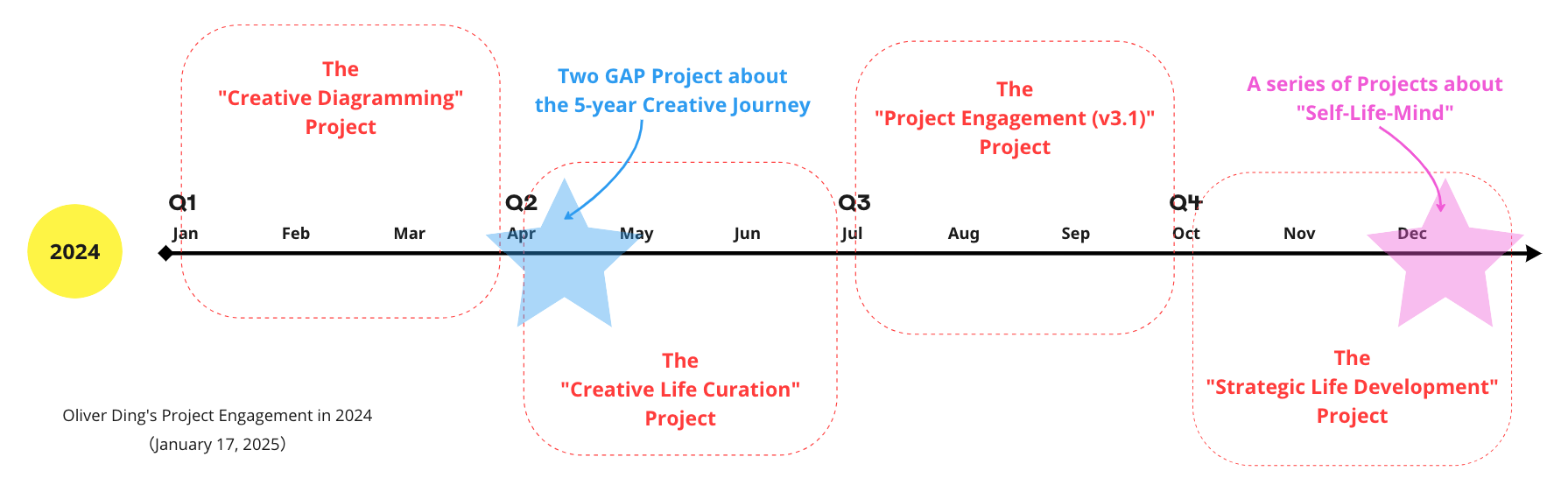
The Landscape of My Creative Enterprise
Over the past several years, my work has been organized around a central mission: connecting Theory and Practice. By 2024, this effort had evolved into a large creative enterprise supported by multiple knowledge centers—Curativity Center, CALL (Creative Action Learning Lab), Activity Analysis Center, TALE (Thematic Analysis Learning Engagement), and others. Each center hosts a distinct theoretical approach: Curativity Theory, Creative Life Theory, The Project Engagement Approach, Thematic Space Theory, and more.
This enterprise was not planned from the start. It grew organically through a series of projects, each building on the last. The diagram I updated in August 2026—the one that sparked the insight for this article—was part of a long-standing practice of mapping this growth.
Thematic Iterative Curation: A Core Method
The primary method I used to make Possible Books in 2024 is what I call Thematic Iterative Curation. It is a creative process that combines newly written articles with previously created content, thoughtfully curated around a central theme. This approach does two things simultaneously: it iterates on the outcomes of existing knowledge projects, and it reframes them within the broader context of a knowledge enterprise.
Take the example of Center, Circle, and Genidentity, completed on July 1, 2024. The Value Circle theme was born on January 17, 2023, as a project to explore the dynamics of networked knowledge centers and reflect on my journey of building these centers from 2022 to 2023. The plan was simple: Explore > Reflect > Write > Edit. However, it took nearly a year to produce a series of articles and case studies rooted in a real Value Circle in my creative life.
On May 30, 2024, I revisited the articles I had written for the Value Circle project. By reframing them in the broader context of building a knowledge enterprise, I realized the project wasn't solely about the concept of the Value Circle. It also encompassed three key insights: it was part of the larger "Building A Knowledge Enterprise" journey; the Value Circle and Knowledge Center projects represented two stages in the development of a knowledge enterprise; and the entire journey served as an example of Genidentity Theory. These insights inspired me to rename the possible book Center, Circle, and Genidentity.
Project-Centered vs. Book-Centered
A crucial distinction in my creative practice is the difference between being project-centered and being book-centered. Most of my Knowledge Projects are not centered around Writing a Book. Instead, they revolve around Developing Concept Systems. My Possible Books are not the main output; they serve as creative containers that encapsulate the outcomes of these projects and house the resulting knowledge frameworks.
The Creative Diagramming project, which ran from October 2023 to March 2024, illustrates this point well. During this time, I produced a series of related Possible Books—Social Moves: The Attachance Approach to Social Cognition, Mapping Developmental Projects: Life, Stories, and Thematic Spaces, Meaning Discovery: Capture Significant Insights in Everyday Life, and others. Yet these books were not the primary objective of the project. They emerged organically as by-products of the journey.
The project itself explored two interconnected levels: a practical methodology (Creative Diagramming) and theoretical innovation (the Integrated Ecological Approach). These two levels mutually reinforced one another. The Possible Books captured the outcomes, but the project was the engine.
Creative Themes and Situational Frameworks
Another key insight from 2024 is how Creative Themes and Situational Frameworks interact. Two Possible Books—Strategic Moves and Strategic Life—share a set of articles but have different titles, covers, and tables of contents. How is this possible?
The theme of Strategic Moves was defined on February 13, 2024, as part of a trilogy following Mental Moves and Social Moves. It aimed to develop case studies exploring psychological knowledge engagement. By September 30, 2024, I had edited a Possible Book titled Strategic Moves: Mapping Knowledge Engagement and Structural Choice.
However, an unexpected by-product of this project was an emerging theme: "Strategic Life." On October 4, 2024, I used three thematic maps to curate ideas from the Ecological Practice approach, the Project Engagement approach, and Curativity Theory. The outcome was the Strategic Life Development framework. On October 17, 2024, I edited a new Possible Book titled Strategic Life: The Strategic Life Development Framework.
These two Possible Books, labeled 35A and 35B in my list, share a series of articles featuring case studies that use the Mapping Strategic Moves Method. Yet they express distinct creative themes. This is an excellent example of Thematic Iterative Curation, demonstrating the dynamic interplay between Themes, Frameworks, and Projects.
Slow Cognition vs. Fast Ignite
Some Possible Books result from long-term projects spanning years. Others emerge through quick, focused curation efforts within hours or days. Both modes have their place.
The Advanced Life Strategy Toolkit (v2, 2024) captures the development of Advanced Life Strategy over two years. It represents a journey of Slow Cognition—the kind of deep, patient thinking that requires time to mature.
Yet on December 23, 2024, I did a tiny knowledge curation project on Twitter by making a thread. The result was a diagram presenting a knowledge map of Advanced Life Strategy (v2). Following this, I wrote a long article and published it on the morning of December 26, 2024. After publishing the article, I used it as a Situational Framework to curate a Possible Book titled Strategy as Curation within six hours.
This was possible because the Slow Cognition had already done the heavy lifting. The Fast Ignite was simply the final act of curation—bringing together what had already been developed, framed in a new way.
Custom Possible Books
One of the 12 Possible Books in 2024 stands out as unique: Activity as Formation of Concept: Engaging with Andy Blunden's Approach to Activity Theory. In June 2024, I developed a personal learning plan for the first fellow of the Activity Analysis Center. To support his exploration, I curated and edited several articles from my book drafts into specific sections. Reflecting on my knowledge projects related to "Activity as Formation of Concept," I identified a set of relevant articles dating back to 2021.
On June 16, 2024, I realized it was time to edit an independent book to represent the idea. However, I didn't see the uniqueness of this effort until one week ago, when a reader inquired about accessing several Possible Books. Inspired by his need, I created a new Possible Book specifically for him. That moment led me to define a new category: Custom Possible Books.
The Meta-Project Perspective
Beyond individual projects, 2024 also featured two meta-projects that framed my entire creative journey. The first involved two GAP projects centered on a 5-year creative journey from March 2019 to March 2024. When I recognized the existence of this journey—marked by my 30th Possible Book on March 31, 2024—I initiated two "GAP" projects within the following 45 days. These projects resulted in a series of new creative themes and frameworks that shaped my work from June to December 2024.
The second meta-project was the development of the Self-Life-Mind schema in May 2024. This meta-framework established a correspondence between Self (Ontology), Life (Realism), and Mind (Hermeneutics), derived from Ping-keung Lui's Theoretical Sociology. From October to December 2024, I applied this schema to several knowledge projects, including the Strategic Life Development Framework, a Theory of Human Life, and GO Theory (the Genidentity-Opportunity Approach).
These meta-projects reveal something important: Creativity does not happen in isolation. It is nested within larger structures of reflection and reframing. The meta-projects were not "more creative" than the projects they framed. They were curative—they organized and gave meaning to what had already been made.
What 2024 Teaches Us About Activity, Curativity, and Creativity
Looking back at 2024 through the lens of this article's core insight, the pattern becomes clear:
- Activity provided the materials: the projects, the articles, the diagrams, the case studies. The Creative Diagramming project, the Value Circle project, the Strategic Moves project—each generated raw content through engagement with real situations.
- Curativity organized them: Thematic Iterative Curation, Creative Life Curation projects, the Self-Life-Mind schema, and the act of curating Possible Books from project outcomes. Curativity turned scattered materials into meaningful wholes.
- Creativity opened possibilities: The emergence of "Strategic Life" as an unexpected theme, the discovery of the 5-year creative journey, the development of GO Theory, the shift from individual development to cultural development—each opened new directions that were not visible before.
The 12 Possible Books of 2024 were not the goal. They were the record of a creative process where Activity, Curativity, and Creativity worked in dynamic interplay. More details can be found in Oliver Ding's Project Engagement in 2024 and Oliver Ding’s Twelve Possible Books of 2024.
GAP Projects
Yesterday I added two new elements to the "Activity, Curativity, and Creativity" diagram: Creative Life Discovery (CLD) and Creative Life Curation (CLC) . They were placed on different lines.
On the line from Knowledge Project to Possible Book, I placed CLC.
On the line from Possible Book to Knowledge Project, I placed CLD.
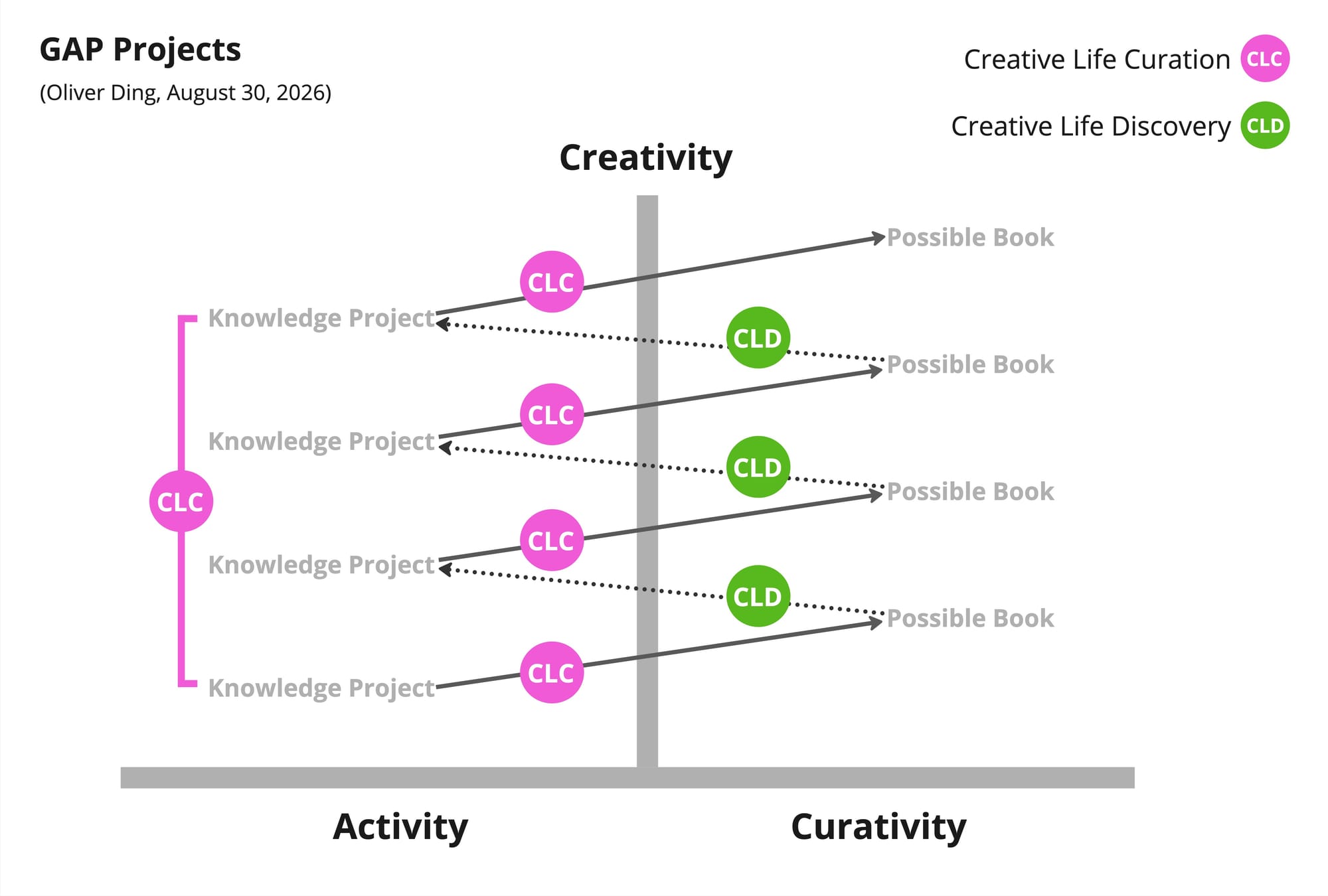
They both belong to GAP Projects—projects that take place in the gap between two formal projects. CLC is about editing book manuscripts; CLD is about free exploration until a new insight emerges that leads to a new Knowledge Project.
GAP Projects represent a temporal pattern: the structural opportunities that exist between formal projects. These "After" and "Before" projects—such as Creative Life Curation and Creative Life Discovery—occupy the gaps between major endeavors. They serve as reflection points, transition spaces, and moments of strategic choice. The timing of GAP projects is itself a pattern: recognizing when to pause, curate, or explore can dramatically affect developmental outcomes.
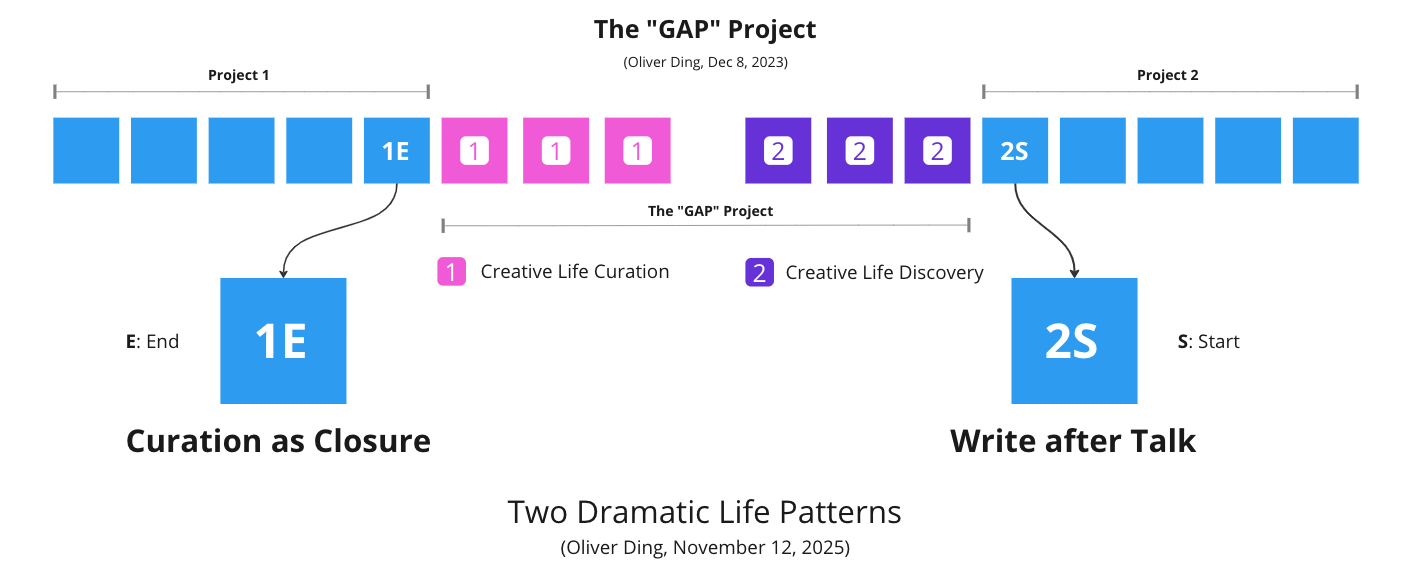
The 1E/2S Pattern describes positional patterns within project sequences:
- 1E (Curation as Closure) : Curating a collection of work before a project ends, using the curation itself as a formal closure mechanism.
- 2S (Write after Talk) : Engaging in conversations with others after writing initial ideas at the start of a new project, using dialogue as a development mechanism.
These patterns, together with others like the Weave-the-Pattern model, reveal a deeper structural dimension of development. They show that development is not random but exhibits recognizable configurations—and once these configurations are recognized, they become tools for strategic action.
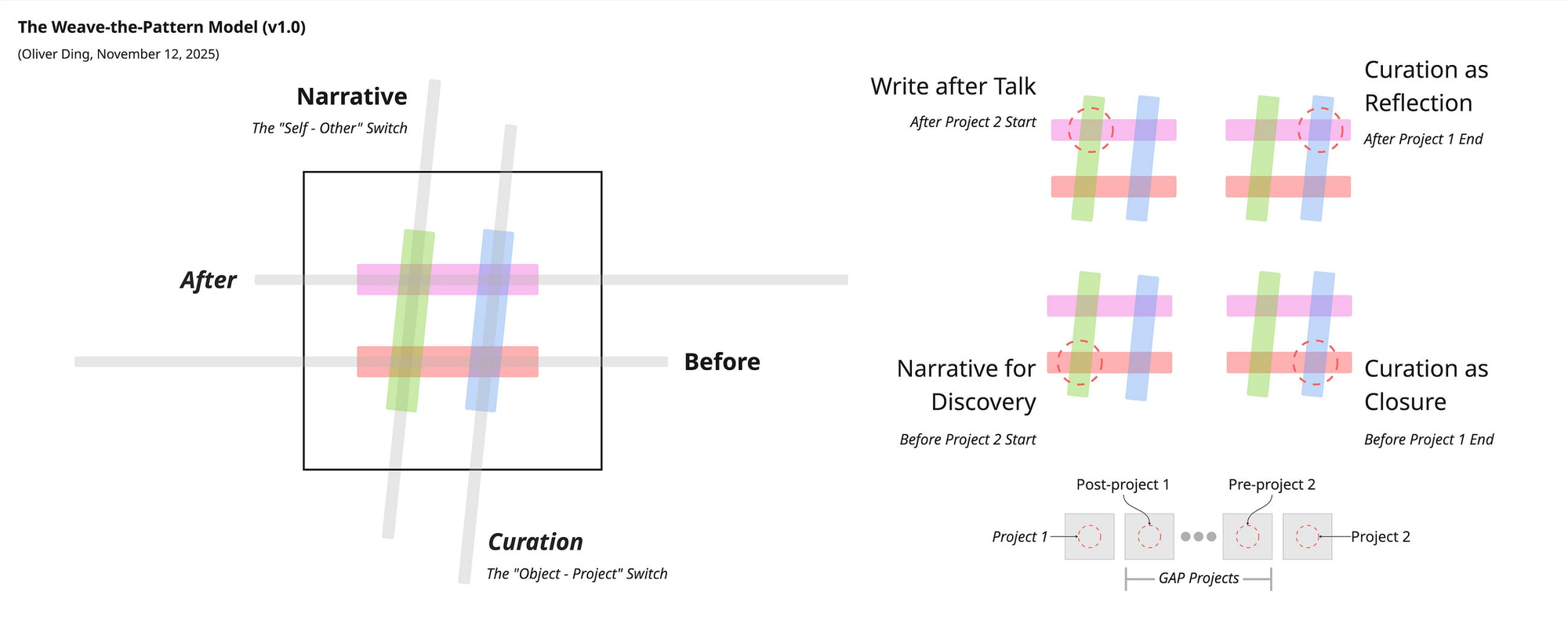
Perhaps most significantly, the practice of recognizing patterns has led to the discovery of Anticipatory Analogy—a meta-pattern in which past structural similarities enable prediction of future outcomes. In my own experience, recognizing the structural isomorphism between October 2022 and March 2024 led to a strategic decision to invest time in a GAP project, predicting (correctly) that it would yield outcomes similar to those in 2022. This predictive use of pattern recognition transforms development from reactive response into strategic engagement.
This is the hidden pattern behind the 60 Possible Books—a unique model of project engagement that emerged from practice, not from prior design.
Mapping Creative Journey
CLD and CLC reveal a pattern at the project level. But Creative Life Curation also operates at a higher scale—one that maps entire journeys across multiple projects.
At the project level, I curate the outcomes of individual knowledge projects into Possible Books. But the "Creative Life Curation" method allows ,multiple unit of analysis. For example, four or more related projects can form a Creative Journey.
And when I look across my 60 Possible Books, I can often identify which books—and therefore which projects—contributed to the formation of a particular Journey.
This makes it possible to trace a Theoretical Enterprise through its journeys, projects, and Possible Books.
In this sense, Creative Life Curation is not simply curating materials into wholes. It is curating trajectories and wholes of wholes.
And sometimes, the larger whole only becomes visible when you step back far enough.
Here are some examples from my archive:
- The Foolish Explorer: A Trilogy about "Discovery"
- The "Knowledge Ecology" Trilogy
- The "Attachance Theory" Trilogy: Mental Moves (2023), Social Moves (2023), and Strategic Moves (2024)
- The "Theme–Concept–Framework" Transformation (2023–2026): This map traces a journey from themes → concepts → frameworks → meta-frameworks, beginning with my TALE work in 2023 and eventually revealing a much larger architecture.
Sometimes, such mapping of a creative journey generates a new knowledge framework and naturally leads to the conception of editing a new book draft. For example, on January 31, 2025, I edited Knowledge Strategy: The Ecological Strategic Cognition Framework (v2.2) for Building Knowledge Enterprise.
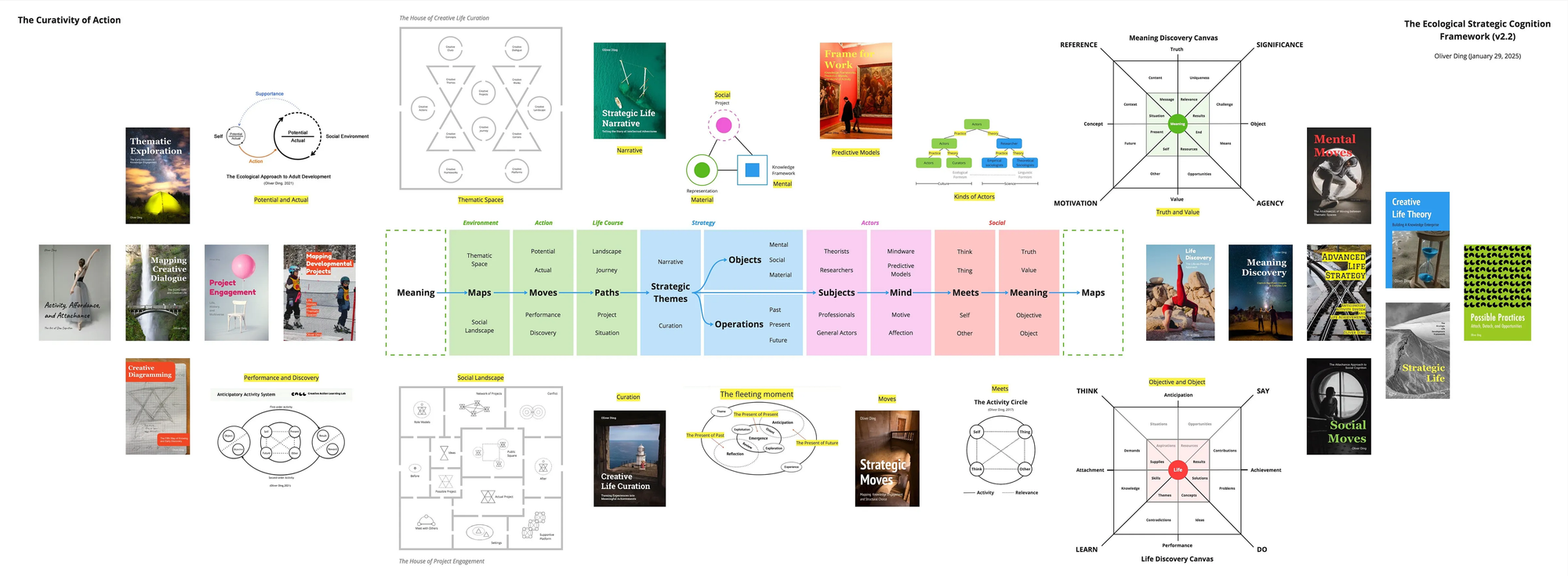
The book features 1 core model, 4 maps, 6 models, and 18 related book drafts. It stands as a concrete case of how themes, concepts, and frameworks converge into a coherent knowledge enterprise.
Conclusion: Activity, Curativity, Creativity
For years, I have been advancing theoretical explorations in multiple directions—Activity Theory, Curativity Theory, Creative Life Theory, and their various extensions. I treated them as distinct threads, each with its own questions, frameworks, and trajectories.
I never expected that my own creative journey would turn out to be their intersection.
The 60 Possible Books, the projects that produced them, the gaps between them, the journeys that emerged across them—all of it, viewed together, reveals a simple truth:
Activity provides materials.
Curativity organizes them.
Creativity opens possibilities.
These are not three separate theories. They are three movements within a single process—the process of building a creative enterprise over time.
Activity is the engagement with the world. It generates raw materials: articles, diagrams, notes, experiments, frameworks, failures, insights.
Curativity is the act of bringing those materials into coherent wholes. It transforms fragments into collections, collections into manuscripts, manuscripts into archives.
Creativity is what happens when you step back, look at what you have made, and see something new—a connection, a pattern, a direction that was not visible before.
I designed theories about these things. But the proof is in the practice.
The 60 Possible Books are not the goal. They are the trace of a process that moves continuously between activity, curativity, and creativity. Each cycle builds on the last. Each transformation opens new possibilities for the next.
That is the insight I saw when I looked at the updated diagram.
And that is what I have been doing all along.
v1.0 - August 31, 2026 - 4,021 words