Making a Living Coordinate for Creative Life Discovery
Using my own framework for my own thematic enterprise

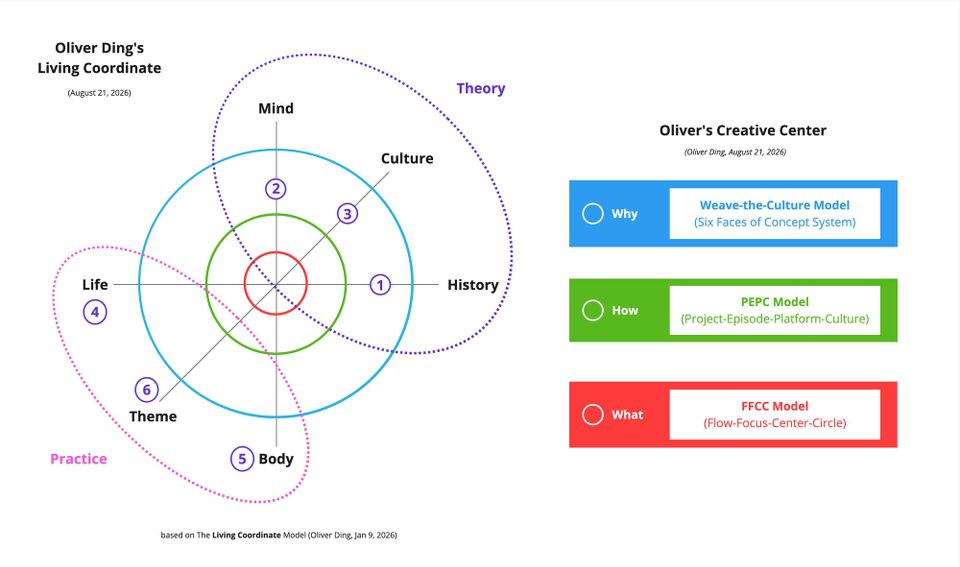
The diagram above was created on August 21, 2026, titled Oliver Ding's Living Coordinate. It was based on the Living Coordinate Model I developed in January 2026. So this new diagram is what people call eating your own dogfood.
This article shares the story behind the diagram.
The Situation
On July 30, 2026, I came back to Houston after completing a three-week trip in China. In the following days, I entered the GAP Projects mode:
- After: a "Creative Life Curation" project: Reflecting on the trip and developing a creative theme into a plan for a new book
- Before: a "Creative Life Discovery" project: Exploring the situation and the future direction
I often use a diagram with a pre-made knowledge framework to curate creative elements for a Creative Life Discovery project. This kind of diagram is called a Situational Map. It is not a direct application of a knowledge framework, but a landscape inspired by the framework.
In August, I made a series of diagrams for a "Creative Life Discovery" project, exploring the AAI 2026 project.
The Activity Analysis Center hosts two major theoretical enterprises: the Life-as-Activity approach (including the Project Engagement approach) and the World of Activity approach. In April 2026, the Life-as-Activity approach reached v4.0, and the Center's focus shifted from theoretical development toward empirical research and intervention. This new direction was named Activity Analysis & Intervention (AAI) in 2023.
On June 15, 2026, I mentioned a major transition in my newsletter: the Activity Analysis Center is moving from theoretical development to practical analysis.
Before the trip, I started using the World of Activity v2.0 toolkit for case analysis. Each case was based on publicly available materials. I would begin by using the FFCC model (the primary model of the World of Activity approach, structuring activity through Flow, Focus, Center, and Circle) to get a rough picture of an individual's World of Activity, then identify specific areas that warranted further exploration and bring in other knowledge models from the toolkit for deeper analysis. In some cases, the analysis ended up chaining together multiple models. The experience felt unique to me—I came to see that the analyst role would be a distinctive and important one in the future development of the World of Activity approach.
In the first few days of my stay in China, I had a WeChat conversation with two friends. One of them was conducting a career development analysis for the other. Having read my earlier work on the World of Activity, this friend applied the FFCC model to his client’s case. He shared his initial thoughts with me, and we exchanged views on how both he and his AI assistant had interpreted the model. Based on my feedback, he iterated on his analysis and kept me posted on his client’s latest replies. Eventually, he introduced me directly to the client, and the three of us continued the discussion in a group chat on WeChat. Throughout this process, I consistently offered insights from the World of Activity framework and walked them through the practical use of the FFCC model.
During my stay in Fuzhou, I also held video calls with several friends in other cities—catching up on their progress and introducing them to the World of Activity framework. One friend in Hangzhou, after our call, decided to return to Fuzhou, partly to visit his family, but mainly to meet me in person for a deeper conversation. Before we met, I designed a prototype toolkit of 12 cards to showcase the World of Activity approach. When we finally sat down together, we explored ways to translate the theoretical framework into practical field applications.
While in Fuzhou, I also took notes and began drafting a lecture series titled AAI: Twenty Lectures, completing the first installment. As I had done the previous year, I wrote in Chinese on Xiaomiquan, a knowledge‑sharing app. The difference, however, was that last year I finished all the Chinese draft materials for Homecoming while still in Fuzhou; this year, I completed only the first lecture, with the rest consisting of scattered notes. That first lecture, nonetheless, set the tone—I used a Confucian allusion as the entry point to introduce key concepts and frameworks from my theoretical system.
After returning to the U.S., I continued writing this twenty‑lecture series in Chinese, and this week I finished the first six lectures, which cover the theoretical foundations.
The July trip to China was the unfolding I had announced—a transition from theoretical closure to practical engagement, realized not in abstract plans but in real conversations, real case analyses, and real writing. The lectures, the toolkit, and the exchanges with friends all became the Center’s opening chapter in practice.
On August 13, 2026, I released the AAI (2026) Framework, introducing five principles for developing a supportive developmental program. In the following days, I continuously thought about the situation of the AAI project.
A week later, on August 21, the new Living Coordinate diagram was born within this ongoing "Creative Life Discovery" project.
The Framework
The Living Coordinate model did not emerge from a single moment of insight. It was born from a convergence of two parallel threads: a conversation with a friend and a personal journey of theoretical discovery.
In October 2025, shortly after I released Homecoming, I received an email from a friend I had known for over a decade. Let me call her Alice. She had read the book and was writing to say that the concept of "World of Activity" resonated deeply with her—especially as someone who had lived and worked across multiple cultures.
But what she really wanted to ask was this: How could she organize her scattered life experiences into a coherent system? How could she find her own "disciplinary coordinate" and "knowledge positioning"?
She wasn't looking for abstract advice. She was looking for a framework—a way to turn the fragments of her cross-cultural journey into a meaningful whole that could guide her next decade of work.
Over the following months, we had a series of conversations. I shared the Self-Life-Mind meta-framework with her. She shared her story, her themes, and her vision. At one point, she mentioned wanting to build a "life operating system." In my vocabulary, I called it a "mental platform." But beneath the different terms, we were reaching for the same thing: a way to anchor a life.
Then, in early November, Alice sent me an email that sharpened the question considerably. She wrote:
"How can I crystallize my personal experience into a clear 'Disciplinary Coordinate' and 'Knowledge Positioning'? If I were to systematize my direction, where would it fit on the map of academic or professional fields?"
This was the breakthrough. She wasn't just asking for a personal operating system. She was asking for a coordinate—a way to locate herself in the larger world of ideas and practice.
At the same time, I was deep in my own journey. In June 2025, I had created a diagram that revealed a pattern I hadn't seen before: over the years, I had drawn on three theoretical traditions—Ecological Psychology, Activity Theory, and Theoretical Sociology—and they had converged into something new. I named this pattern Generative Confluence.
From June to December 2025, I unfolded this pattern through a series of movements. Finding the Coordinate was about searching for a meta-framework to answer: "Where am I?" and "Where should I be?" Anchoring the Center was about using that coordinate to transform a potential focus into a creative center.

By the end of 2025, I had lived through this process. I had written several books—Homecoming, Being by Doing, Developmental Projects, The Curativity of Mind—that documented different aspects of the journey. But I hadn't yet built a general model that others could use.
Alice's question and my own journey came together in January 2026. I realized that what Alice was asking for—a "disciplinary coordinate"—was exactly what I had found through my own Generative Confluence. And what I had found could be modeled.
On January 9, 2026, I created a new diagram: the Living Coordinate Model. It was designed as an intermediate framework—a bridge between two levels of abstraction:
- Situational Model: The "Theorizing Creative Life Landscape" diagram I had made in June 2025, which captured my personal journey.
- Meta-framework: The Life Coordinate Framework I had developed in 2023, which offered a general structure for understanding human activity.
The Living Coordinate Model sat between them. The three dimensions of the coordinate were:
- Thinking (Mind-Body) — the cognitive and bodily dimension
- Doing (Life-History) — the action and life trajectory dimension
- Creating (Theme-Culture) — the thematic and cultural dimension

The three circles represented a new meta-framework: the Self-Us-Awe schema—Creative Self, Creative Us, and Creative Awe.
Together, they formed a map for mental moves—a way to locate oneself in the landscape of creative life.
The Delivery
The Living Coordinate model is not just a framework for self-reflection. It is a tool for helping others find their own coordinates.
Alice once gave me a list of themes and her ideas on defining a life coordinate. On February 2, 2026, I revisited the email and used her themes to test the Living Coordinate model. I took three themes that seemed most central to her situation:
- China-ASEAN-Global Bridge
- Cross-Cultural Leadership
- AI × Sustainability
I mapped them onto the three dimensions of the Living Coordinate. Each thematic pair formed an axis:
- Body-Mind (Nomading vs. Anchoring) — the transition from a nomadic international lifestyle to anchoring in a creative center
- Life-History (Tradition vs. Innovation) — the spectrum between ancestral heritage and future-forward transformation
- Theme-Culture (Emic vs. Etic) — navigating cultural nuances from both insider and outsider perspectives

The primary focus that emerged was Transcultural Sensemaking—a theme that could define a new creative center for hosting a series of projects.
On the right side, three circles presented a "Golden Circle" logic as a strategic framework:
- Why: Global Bridge for Sustainable Development
- How: Creative Dialogue & Co-becoming
- What: Cross-boundary Narrative
I then integrated a Principles-Projects structure into the model to capture the evolution of a creative center's genidentity:
- Principles define what makes the center unique—the core values and creative spirit
- Projects act as the creator's interface with the world—the situational dynamics that unfold
This structure shows how a creative center evolves: what begins as a singular origin point gradually absorbs creative elements through active engagement, evolving into a robust creative center.
After finishing this testing, I realized that this could be a methodological delivery—a way to show the method of the Living Coordinate framework in action, even when the data was based on an old email.
I named the diagram Alice's Method and told her in an email:
"At this stage, the specific content acts as a placeholder—a structural prototype that you can refine or redefine as your vision evolves. This reflects a 'methodological delivery': I am providing the vessel, and you provide the essence. Once these elements are tested over time and solidified, the method will naturally mature into 'Alice's Model' or 'Alice's Framework'—becoming a durable meta-framework to guide your creative journey for years to come."
The idea of "Transcultural Sensemaking" may not fit Alice's current situation, yet the methodological delivery is powerful because it gives the tool to find the living coordinate. The vessel is what matters—the content can be refined over time.
The Dogfood
Since January, I have used the Living Coordinate model in several consulting cases. It also laid the groundwork for the LARGE Method framework I developed later. More recently, I have also considered it as one of the four aspects of the Gejunction concept—alongside Thematic Space, RelationField, and Weave-point.
This time, however, the application was different. I used it to explore my own situation.

To create this diagram, I started with Alice's diagram as a template.
First, I adapted the structure. Where Alice's case used a Principles-Projects structure, I replaced it with a Theory-Practice structure. My situation is about moving from theory to practice—this structure reflects the specific character of my own situation, distinct from Alice's.
On the three axes, I placed Practice in the lower-left corner, close to Life, Theme, and Body. I placed Theory in the upper-right corner, close to Mind, Culture, and History. Interestingly, my current situation involves moving from the upper-left to the lower-right—from theory toward practice.
The 3D coordinate anchors a coordinate origin, and the three circles around it unfold that origin into a creative center. In the What-How-Why circles, I placed my current thinking about AAI:
- What: The FFCC Model (Flow-Focus-Center-Circle)
- How: The PEPC Model (Project-Episode-Platform-Culture)
- Why: The Weave-the-Culture Model (Six Faces of Concept System)
This three-module structure emerged during my time in Fuzhou while I was drafting the AAI: Twenty Lectures series. I found that when I explained these ideas to friends during our conversations, this sequence made them easy to understand.
The FFCC Model provides a foundational description of a person's World of Activity. The PEPC Model traces how an individual's center develops into a thematic enterprise and eventually into a platform that supports others. The Weave-the-Culture Model shows how the themes and concept systems generated by these enterprises become curated into the broader collective culture.
Together, the three models form a complete arc: from the body-centered self, unfolding through the various dimensions of life, to finally becoming a cultural creator.
This arc echoes the nested framework I introduced in Meta-frameworks (December 2025): History { Life [ Body (Self) ] } . The model uses a nested structure to show how subjectivity unfolds from the foundational unit of embodied cognition—Body (Self)—through the intermediate layer of Life (Self) where one actively lives out the self, and extends outward to History (Life) where one becomes an actor embedded in historical and cultural contexts.
I deliberately selected and arranged the three models—FFCC, PEPC, and Weave-the-Culture—to trace this trajectory. They are not a natural progression I discovered after the fact; they are a structure I designed to guide the unfolding from the embodied self to the lived life to the cultural creator.
The Theme
In Alice's case, her theme was Transcultural Sensemaking—a framing that brought together her cross-cultural experiences, her professional projects, and her long-term aspirations. Around this theme, she envisioned a series of projects: cross-cultural leadership development, a bridge between China and the global south, and the integration of AI with sustainability.
For me, the theme was different. My theme is World of Activity. This is also the name of my theoretical approach. I chose it as the primary theme for the current phase of AAI because I position the individual—rather than organizations or institutions—as the service object. The concept of World of Activity describes the social world of an individual's subjective experience, the world constituted by their own activities.

Along the three dimensions of the coordinate, I selected three theoretical systems on the theory side:
- The Life-as-Activity Approach
- Strategic Developmental Psychology (SDP)
- Anticipatory Cultural Sociology (ACS)
In fact, my larger theoretical landscape is organized by GO Theory: The World of Life (World of Activity) Approach as a theoretical platform, which hosts five theoretical enterprises. For this diagram, however, I selected only three of them.
On the practice side, symmetrically aligned with these three theoretical systems, I placed three corresponding practical methods:
- Activity Analysis & Intervention (AAI) — corresponding to (1), with an emphasis on social moves and mental moves
- Advanced Life Strategy — corresponding to (2), with an emphasis on patterns and models
- Creative Life Curation — corresponding to (3), with an emphasis on themes and stories
Each pair forms a theory-practice axis, bridging conceptual understanding with applied engagement.
For now, most of my attention is focused on the overall design of AAI. However, my considerations remain largely at the level of analysis—using the FFCC model to map the basic contours of a person's World of Activity. I have not yet ventured into intervention.
Yet (5) and (6) already point toward two broad directions for intervention: one centered on patterns and models, the other on themes and stories. They mark the path ahead—from describing a World of Activity to actively participating in its transformation.
The Unfolding
On August 21, the diagram was made. On August 27, I write this reflection. The map is not the journey—but it helps me see where I am, and where I might be going.
This is what a Living Coordinate does: it does not tell you what to do. It shows you where you stand.
In the past days, I have published several articles to share a series of diagrams (1, 2, 3) from the same Creative Life Discovery project. This is what Unfolding means.
v1.0 - August 27, 2026 - 2,896 words