
GO Theory (Phase III): Gejunction and AI
A Mapping of Creative Landscape
by Oliver Ding
August 17, 2026
The day before yesterday, I sent out the latest newsletter to share what I learned from the newest trip to China and the new direction for the Activity Analysis Center: shifting from theoretical development to practical application through the AAI meta-framework.
Yesterday, I spend one afternoon reflecting on the context of the Activity Analysis Center: GO Theory: the World of Life (World of Activity) Approach, which has been considered a developmental platform for my theoretical enterprises.
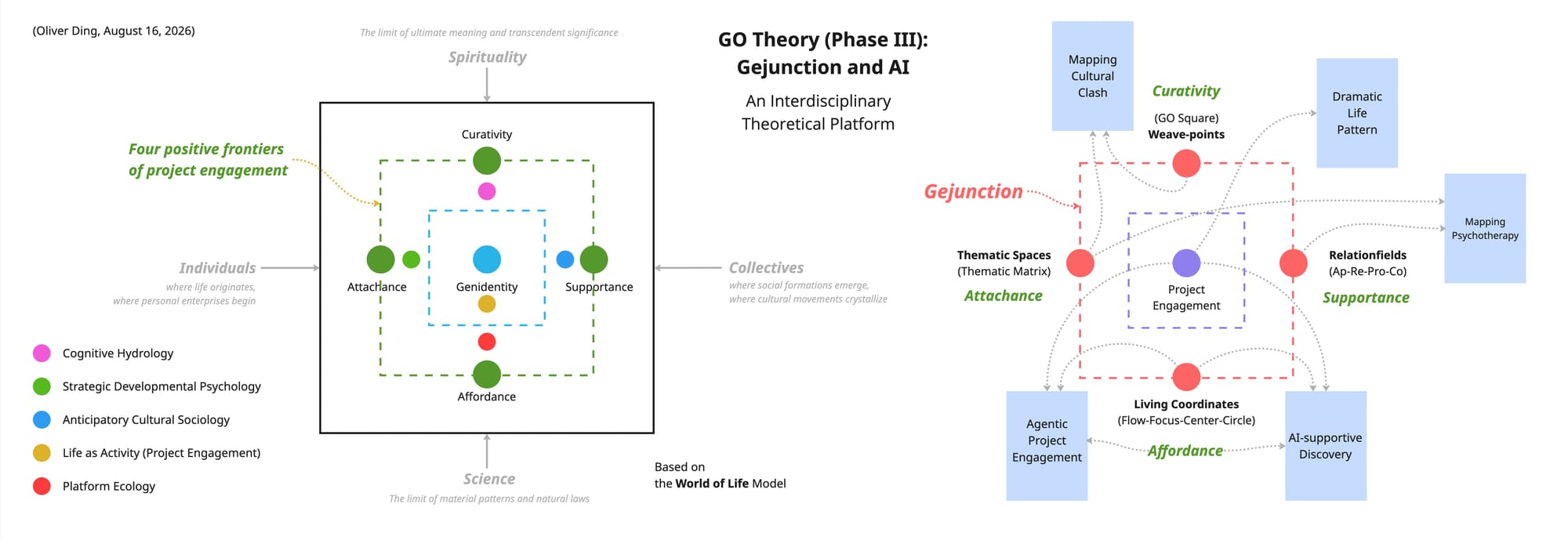
The diagram above was the result, highlighting the next phase of the theoretical platform: Gejunction and AI. This article shares more details of this mapping experience.
1. Mapping Creative Landscape
Three weeks in China in July left a backlog of creative fragments. And the Activity Analysis Center's recent decision to shift from theory toward practice—focusing on the AAI project in the second half of the year—had sharpened the question of what GO Theory should become next.
In late 2025, I set the Activity Analysis Center as the Meta-center to support a network of knowledge centers I worked on. These knowledge centers host a series of theoretical enterprise which are supported by GO Theory. Thus, I often used the website of Activity Analysis Center to share the newest development of these theoretical enterprises and GO Theory itself.
As mentioned in the last newsletter, I've come to see this trip — this moment of return, of seeing my family's world close and unfold — as the Center's own "closing and unfolding": the chapter of theory is closing, while the chapter of practice is opening.
At this movement, it was time to look at the large landscape to see something bigger.
In the Life-as-Activity Approach, I defined GAP Projects as a special type of Dramatic Life Pattern. In every creative journey, there are "gaps"—informal, liminal spaces between formal projects. A gap is not just a rest; it is an Agency Threshold. When a project ends, you face a choice: stay with the given routines, or initiate a new GAP project, such as an "After" project for creative life curation, or a "Before" project for creative life discovery.
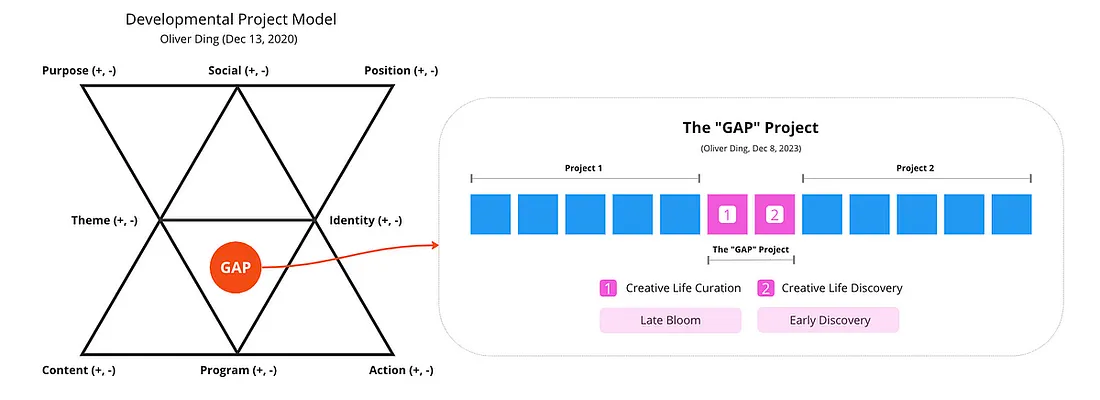
What I did yesterday afternoon was a "Before" project, a Creative Life Discovery project. And the method I used for the project was called Mapping Creative Landscape – simply putting visual elements on a diagram to see the whole picture of the landscape.
I returned to GO Theory's nested square diagram, which represents World of Life and World of Activity – two major parts of GO's ontological setting of the social world. I placed it at the center of the map and arranged around it the creative themes that had been accumulating in recent weeks.
What emerged by the end of the day was simple:
Gejunction and AI.
Most of the themes I had been carrying connected to one of Gejunction's four aspects. Two of them engaged AI directly. And all of them, read together, pointed toward the same underlying direction: case-based exploration.
This matched the strategic turn toward practice. These themes were not asking for more theoretical elaboration—they were asking to be encountered through concrete cases, prototypes, and interventions. The insights they generate can feed directly into the AAI project.
This convergence marks a formal transition. GO Theory Phase I established the World of Activity. Phase II expanded to the World of Life and cultural development through ACS. The work ahead—centered on Gejunction, AI, and the movement from theory into practice—I am naming Phase III.
2. GO Theory (Phase III)
GO Theory has entered a new stage.
When the project was first named in 2025, GO Theory was conceived around Genidentity, Opportunity, and World of Activity, with the ambition of extending creative life development toward a broader account of Social Life Development. Phase I established the World of Activity as the inner field of individual creative life. Phase II expanded this field into the World of Life and moved the project into cultural development through the Anticipatory Cultural Sociology (ACS) project.
By August 2026, the platform has developed into something broader than either of these original phases. GO Theory is now a Developmental Platform: an interdisciplinary theoretical environment within which multiple theoretical enterprises can develop, while sharing a common ontological, epistemological, methodological, and application-oriented architecture. A theoretical platform, in this sense, is not simply a collection of theories. It is a structured environment capable of supporting the development of other theoretical enterprises without requiring them to rebuild the platform's foundations from scratch.
The platform can therefore be summarized as:
GO Theory: The World of Life (World of Activity) Approach
The name GO originally emerged from Genidentity and Opportunity. It has since acquired a broader meaning through Generation and Orientation: generation names the productive and emergent dimension of life, while orientation names the positional, directional, and anticipatory dimension through which actors are situated and move toward possible futures.
2.1 The knowledge ecosystem of GO Theory
The platform now has four meta-frameworks, each answering a different question:
- Ontology — The History{Life[Self(Body)]} Framework (HLS, v3.0, 2025)
HLS provides the ontological map of the social world. It extends the Self-Life-Mind perspective by nesting Self within Life and History, while grounding Self in Body. The World of Life is the larger social and cultural container within which the World of Activity unfolds. - Epistemology — The Ecological Formism Framework (v2.0, 2025)
Ecological Formism provides the epistemological architecture for understanding how knowledge systems are formed, organized, and developed within the platform. - Methodology — The LARGE Method (v3.0, 2026)
LARGE provides the meta-methodological architecture governing the methods used by the platform. It establishes how theoretical work is conducted rather than specifying the substantive content of any individual enterprise. - Application Design — The Activity Analysis & Intervention Framework (AAI, 2026)
AAI provides the design principles for moving from theoretical knowledge toward practice. It addresses a question that ontology, epistemology, and methodology do not by themselves answer: How should a theoretical insight be designed into a practical activity, intervention, tool, or developmental experience? In this sense, AAI is the platform's application-design layer—the bridge from theoretical enterprise to practical engagement.
These four meta-frameworks form an architecture rather than an external scaffold. HLS establishes what kind of world the platform addresses; Ecological Formism concerns how knowledge is organized within that world; LARGE governs how theoretical work proceeds; and AAI concerns how the resulting theoretical resources can be deliberately designed into practice.
2.2 Five theoretical enterprises
The five theoretical enterprises established earlier remain unchanged:
- Life as Activity, including the Project Engagement Approach — at the center, attending to activity itself and providing a series of knowledge models.
- Anticipatory Cultural Sociology (ACS) — at the Collectives boundary, attending to cultural development.
- Strategic Developmental Psychology (SDP) — at the Individuals boundary, attending to individual life development.
- Cognitive Hydrology — at the Spirituality boundary, attending to the flow of ideas and meaning in creative life.
- Platform Ecology — at the Science boundary, attending to ecological and structural conditions of platform development.
These enterprises are not arranged hierarchically. Each occupies a different position within the World of Life and therefore contributes a different theoretical perspective. Their shared platform makes it possible for them to interact without collapsing into a single theory.
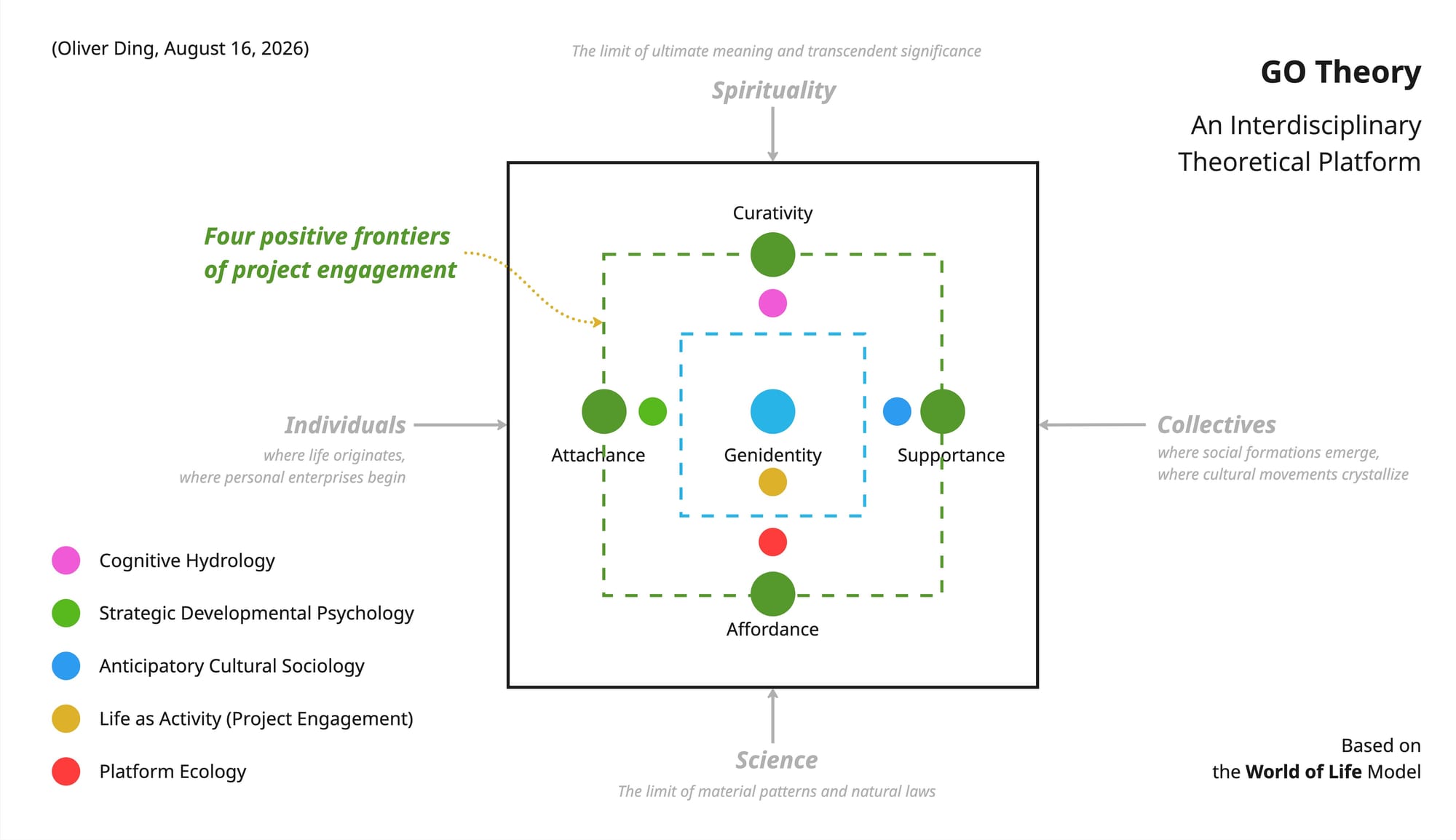
In the diagram above, four types of opportunities (curativity, attachance, supportance, and affordance) are assigned to four boundaries of the World of Life model. More details can be found in World of Life: Four Positive Frontiers of Project Engagement.
In the first half of 2026, the major achievement of GO Theory was ACS (v2.0) and SDP (v2.0), with two book drafts. The two projects were designed as a symmetric pair.
ACS and SDP share the same ontological foundation — the World of Life — but are oriented toward different dimensions of the same social reality. ACS attends to cultural development at the collective scale: how thematic enterprises emerge, develop, and settle into the cultural world as Worldentity. SDP attends to individual life development at the personal scale: how a person strategically develops their capacity to contribute to and be shaped by that cultural world.
The concept of Gejunction was born from these two projects. However, it became a significant concept of GO Theory because it supplies exactly the interface at which Self(Body) becomes an actor.
3. Gejunction: A Unit of Synthesis
Gejunction emerged from the need to identify a unit capable of holding together the different dimensions of a person's actual standing in the social world. The concept developed through two lines of work: one searching for a precise term for a holistic social standing, and another bringing together four analytical structures that had previously developed independently. On June 16, 2026, these two lines converged. Gejunction became a Unit of Synthesis within GO Theory.
The concept is grounded in HLS. HLS provides the four boundaries of the World of Life, while Gejunction provides a way to grasp the individual's concrete placement within that world as a single configuration rather than as four disconnected analytical territories.
This gives Gejunction a crucial role in the relationship between Genidentity and Opportunity.
The four positive frontiers of Project Engagement identify four kinds of ecological opportunity:
- Affordance
- Attachance
- Supportance
- Curativity
Each names a latent possibility for action that may be available within a person's standing but has not yet been actualized. Gejunction provides the concrete social environment in which these possibilities become available to the individual.
Genidentity, in turn, concerns the individual's process of selection: whether to take up an opportunity, which opportunity to pursue, and how to orient oneself toward it.
The relationship can therefore be expressed simply:
Gejunction provides the field of opportunities; Genidentity concerns how the individual selects among them.
Strategic action is consequently not merely a response to an external stimulus. It is the actualization of one or more possibilities perceived within a comprehended Gejunction.
3.1 Four Aspects of Gejunction
Because a Gejunction is a synthesized whole, it can be approached through four units of analysis. These four correspond simultaneously to the four boundaries of the World of Life and to the four positive frontiers of Project Engagement:
| World of Life boundary | Action opportunity | Gejunction aspect |
|---|---|---|
| Individuals | Attachance | Thematic Spaces |
| Collectives | Supportance | RelationFields |
| Science | Affordance | Living Coordinates |
| Spirituality | Curativity | Weave-points |
These are not four independent components of a Gejunction. They are four analytical perspectives on the same whole. The point of synthesis is precisely that the four dimensions remain together while allowing each to be examined through its own knowledge system.
This makes Gejunction particularly important for GO Theory because it connects the platform's social ontology with its theory of action.
The structure can now be stated as:
World of Life → Gejunction → Action Opportunities → Genidentity → Action
The World of Life provides the larger social world.
Gejunction is the individual's concrete social environment within that world.
The four frontiers identify the possibilities for action available there.
Genidentity concerns the individual's selective orientation toward those possibilities.
Action is the actualization of selected possibilities.
This gives GO Theory a more precise account of how Self(Body) becomes an actor within the social world. The four aspects of Gejunction capture the interface through which the embodied Self moves through time and space and becomes an actor.
New case studies will be published under the category Gejunction.
4. Creative Themes: The Next Developmental Frontier
In the past several weeks, I developed a number of creative themes.
These are not intended to become additional theoretical enterprises. They are exploratory fields in which the existing theoretical resources of GO Theory can be woven together, tested, and transformed into new forms of knowledge and practice.
When I placed these themes on the World of Life diagram, they mapped naturally onto Gejunction's four aspects. The correspondence was immediate:
| Creative Theme | Gejunction Aspect | Action Opportunity |
|---|---|---|
| Mapping Cultural Clash | Weave-points | Curativity |
| Dramatic Life Pattern | Thematic Spaces | Attachance |
| Mapping Psychotherapy | RelationFields | Supportance |
| Agentic Project Engagement | Living Coordinates | Affordance |
| AI-supportive Discovery | Living Coordinates | Affordance |
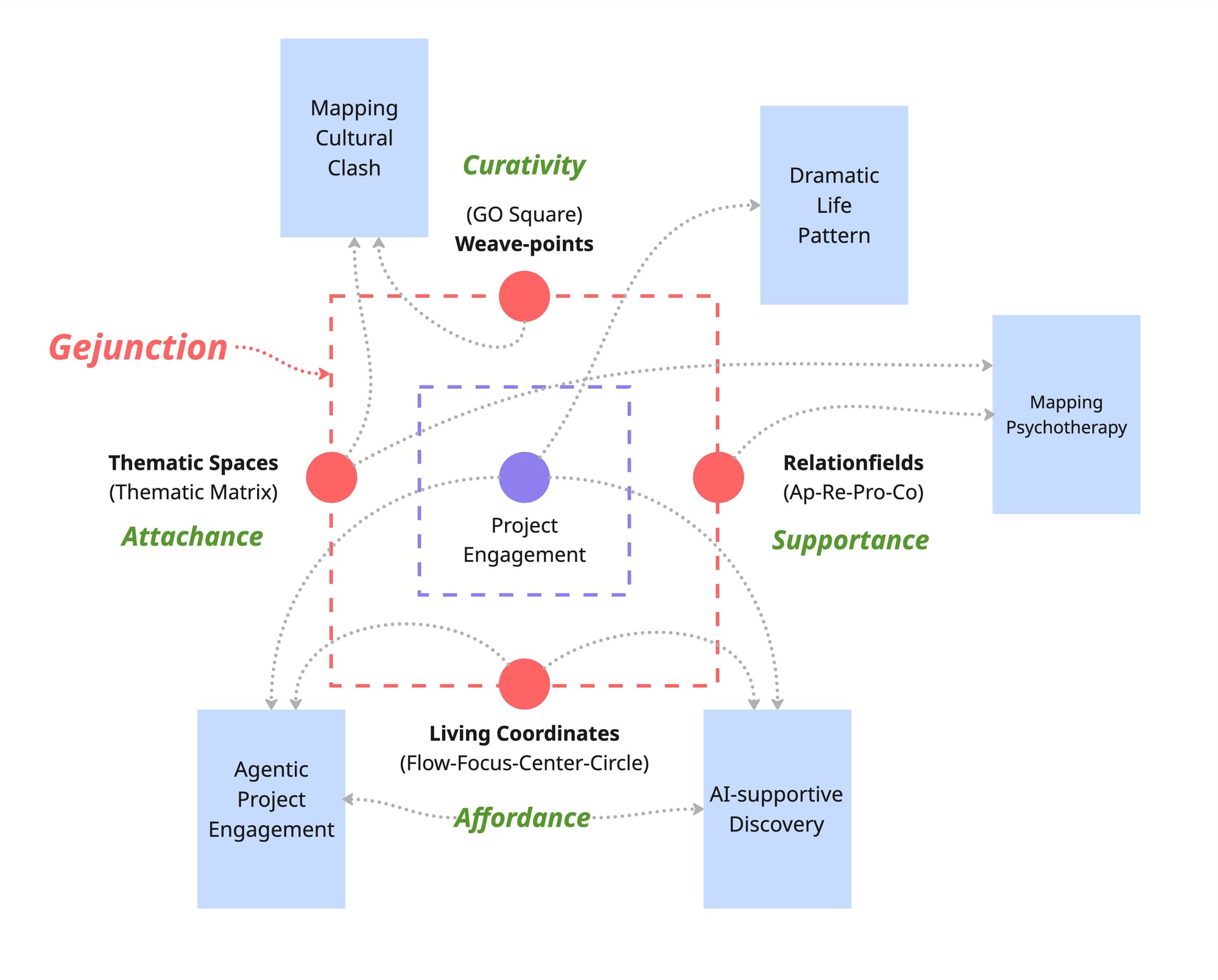
Each theme connects to a specific aspect of Gejunction and a corresponding action opportunity. The last two—Agentic Project Engagement and AI-supportive Discovery—share the same pair (Living Coordinates + Affordance), but operate at different levels: the former focuses on how an actor perceives and acts on possibilities in their environment; the latter focuses on how AI tools can assist in that process.
Current creative themes include:
4.1 Mapping Cultural Clash
A theme for exploring cultural difference and conflict using the GO Square as the mapping tool.
This can be explored through the "Weave-points" concept, a dimension of Gejunction. It is also related to the "Curativity" concept, the opportunity to turn pieces into a meaningful whole.
Case studies will be published under the category Cultural Themes.
4.2 Dramatic Life Pattern
A theme for examining recognizable configurations of Project Engagement in creative life. This theme has been considered as a dimension of the SDP project. A series of patterns has been identified.
Case studies will be published under the category Dramatic Life Pattern.
4.3 Mapping Psychotherapy
A theme for running a case study using the RelationField framework to understand the dynamics of psychotherapy.
Case studies will be published under the category Gejunction.
4.4 Agentic Project Engagement
A theme applying the Project Engagement approach to understand AI agents and human-in-the-loop.
Case studies will be published under the category Project Engagement.
4.5 AI-supportive Discovery
A theme exploring AI tools as part of a supportive environment for human discovery. It grew out of my own experience of using AI tools for creative life discovery projects.
New case studies will be published under the category Gejunction.
5. Between Margins and Center
This mapping exercise was itself an instance of the same method documented in Spatial Heuristics: From the Margins to the Center. The World of Life's four boundaries served as the generative container, calling forth concepts from the margins. But at the time of that writing, Gejunction did not yet exist. Now it does.
Gejunction now stands between the margins and the center. The four aspects—Weave-points, Thematic Spaces, RelationFields, Living Coordinates—are not the center itself. They are the interface through which concepts from the margins are organized before they move into action.
That is what Phase III is about.
V1.0 - August 17, 2026 - 2,417 words