
The Landscape of ACS 1.2 and a New Model of the Actor
Anticipatory Cultural Sociology
by Oliver Ding
March 14, 2026
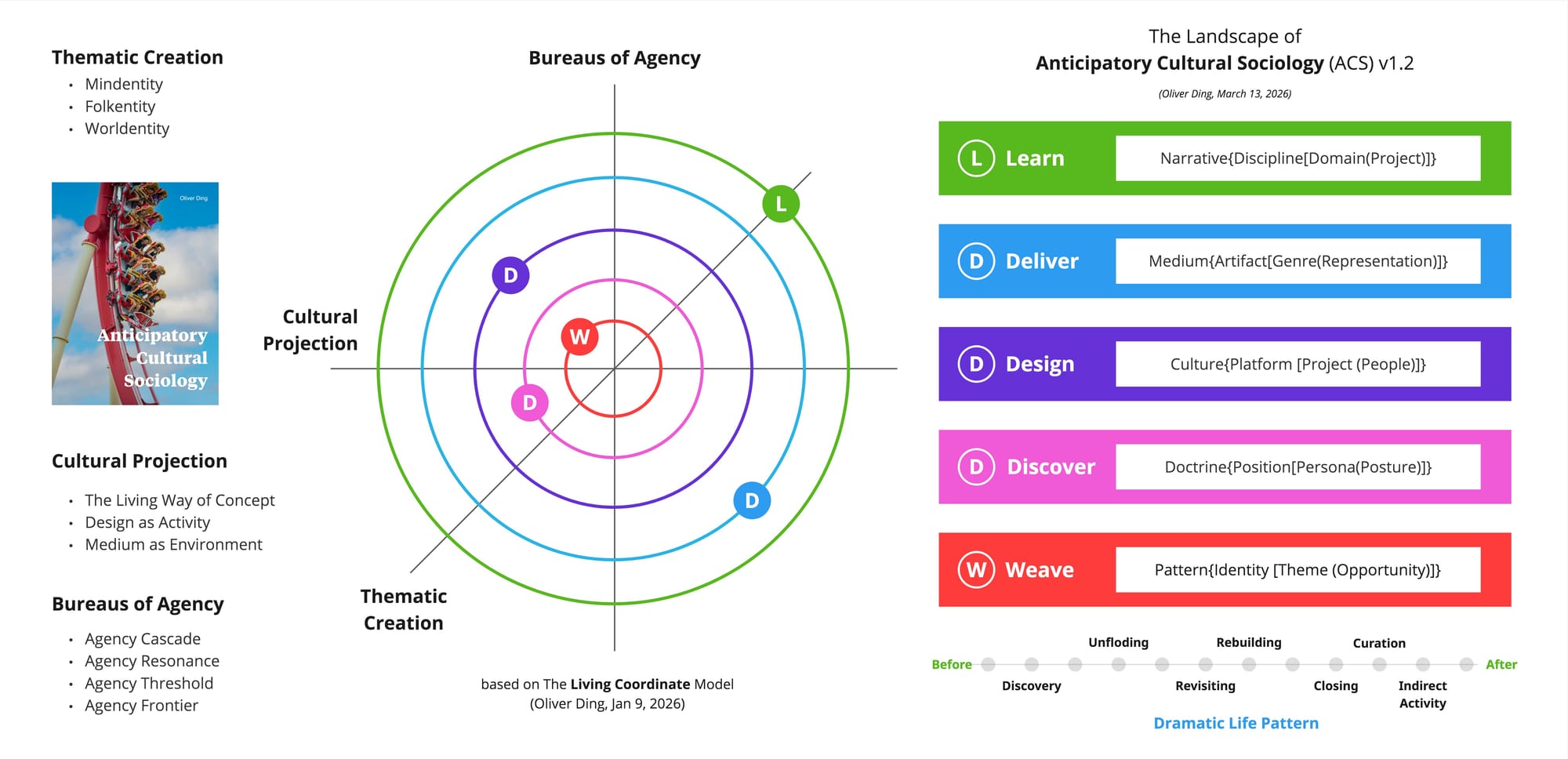
On March 13, 2026, I completed a new diagram: The Landscape of Anticipatory Cultural Sociology (ACS) v1.2.
The diagram was the natural endpoint of two weeks of intensive work. ACS development had been advancing simultaneously along three axes since January: the Ontology of Thematic Creation, the operational structure of Cultural Projection, and the structural patterns of the Bureaus of Agency. By mid-March, all three series of articles had reached a point where they could pause — not because the work was finished, but because a stage had completed itself. The three streams had each run their course for this phase, and the landscape had reached a new level of articulation.
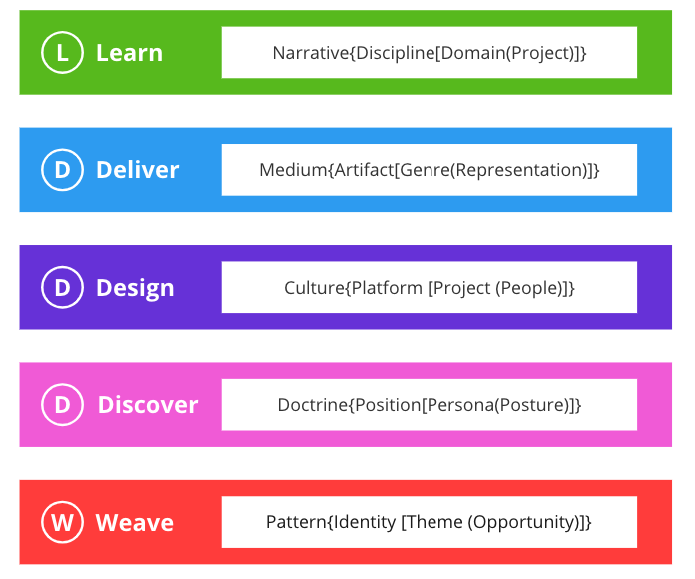
The v1.2 diagram records this completion. Compared to its predecessor — ACS v1.1, drawn on February 27, 2026 — the most visible change is the expansion from three concentric rings to five. The v1.1 diagram had three method-orientations at its center: Discover, Design, and Deliver. The v1.2 diagram adds two more: Learn, at the outermost ring, and Weave, at the innermost. Five rings now surround the three-dimensional coordinate of Thematic Creation, Cultural Projection, and Bureaus of Agency.
The Dramatic Life Pattern timeline along the bottom also reached its fuller form, adding Revisiting, Rebuilding, and Indirect Activity to the earlier sequence.
Looking at the completed diagram, something unexpected arrived.
The phrase "model of the actor" came to mind — a concept I had encountered in 2023, while reading a collection of discussion texts by theoretical sociologist Lui Ping-keung and his younger colleagues. I read these texts on weekend mornings, sitting at the sidelines of a football field while my son practiced with his team. In those recorded conversations about the development of theoretical sociology, the term "model of the actor" appeared repeatedly — used as a meta-analytical tool for comparing social theories across traditions, revealing what each theory assumes about human being without necessarily declaring it. Every social theory, in their view, carries an implicit model of the actor at its core.
At that time, I considered his over twenty years of development of theoretical sociology as a case of Creative Life Theory. I noted the concept. I moved on. Other work followed.
Now, more than two years later, looking at the ACS v1.2 diagram, the concept returned. And with it, a recognition: the three-dimensional, five-ring coordinate I had been building — not as a portrait of the person, but as a map of cultural development — had quietly become exactly that. A model of the actor.
This article tells that story.
I. The Question Behind Every Social Theory
Every social theory carries within it an implicit answer to a deceptively simple question: what kind of being is a human being? This answer — whether stated openly or buried deep in theoretical assumptions — is what we may call a model of the actor. It is the ontological core of a social theory, the figure of the human that makes the rest of the theoretical architecture possible.
Yet here is something worth noticing: social theorists rarely begin by constructing their model of the actor. The founding gestures of sociology — Durkheim's social facts, Weber's interpretive method, Bourdieu's field analysis — do not open with a declaration of what a person fundamentally is. They open with a map of the social world, a description of its structures, its mechanisms, its patterns. The model of the actor is implicit, embedded in the architecture, to be extracted by later analysts.
This is not accidental. Sociology has always maintained a careful distance from psychology. To announce a model of the actor too explicitly is to risk collapsing the social into the individual — to reduce collective phenomena to the sum of personal motivations.
Lui Ping-keung has made this operation explicit. In his comparative analysis of social theories, he treats the model of the actor as a meta-analytical tool — a lens for reading across theoretical traditions, revealing what each theory assumes about human being without necessarily saying so.
With this background in view, we can now trace the development of Anticipatory Cultural Sociology — and arrive at a surprise.
II. The Foundation: World of Life
ACS did not begin with a model of the actor. It began with a map of the social world.
On January 5, 2026, the landscape of Anticipatory Cultural Sociology was formally established, organized around six meta-frameworks curated into a coherent terrain. At the center of this terrain lies the World of Life — a four-boundary ontological structure that serves as the foundational map of the social world.
The four boundaries of the World of Life define the fundamental dimensions of the social world in which cultural activity unfolds:
- Spirituality — the upper boundary, the limit of ultimate meaning and transcendent significance
- Science — the lower boundary, the limit of material patterns and natural laws
- Individuals — the left boundary, where life originates, where personal enterprises begin
- Collectives — the right boundary, where social formations emerge, where cultural movements crystallize
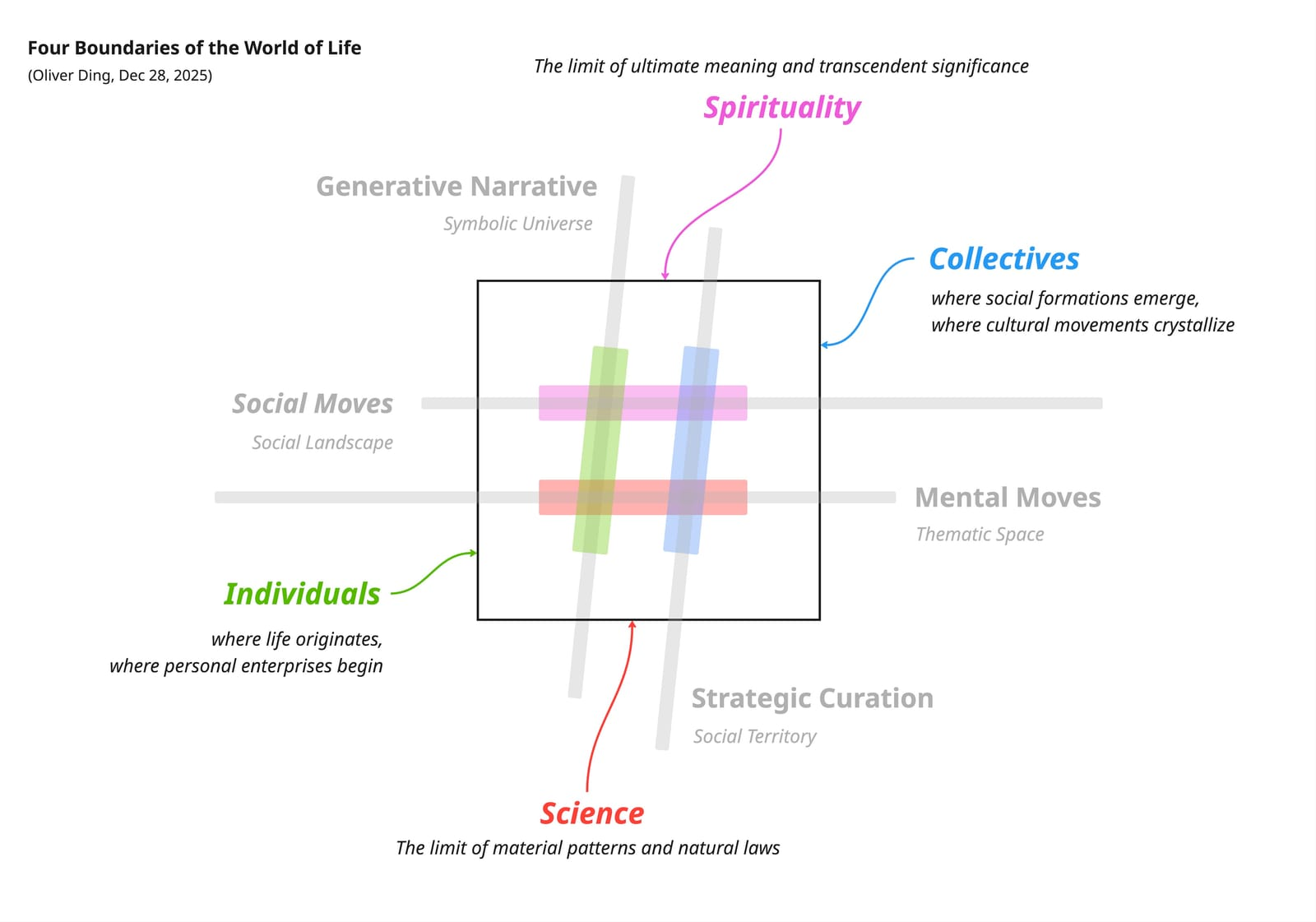
This is not a model of the actor. It is a map of the world the actor inhabits. The question ACS was asking at v1.0 was not what is a person? but where does cultural development happen, and what are its fundamental mechanisms? The actor was already present in the landscape — the Culture as Thematic Enterprise Framework (September 2025), one of the six meta-frameworks curated into ACS v1.0, explicitly named the Creator and the Supporter as the foundational figures of any cultural enterprise. But the actor appeared there in a relational and functional role, not yet as the subject of a systematic account of the actor as such.
At v1.0, ACS answered the questions of what and why: what cultural development is, and why it unfolds as it does. The six meta-frameworks — including the HLS Framework, the Cultural Projection Model, the AAS Framework, and the Culture as Thematic Enterprise Framework — together constituted the theoretical architecture of this landscape. It was an anchored center. The figure of the actor remained in the background.
The core focus of ACS at this stage was captured in a definition first formulated in "Weave the Culture: One MetaFramework and Four Mechanisms of Cultural Development" (December 21, 2025) and carried forward into the ACS v1.0 landscape:
Cultural development, in this view, is a continuous, dynamic anticipatory activity of creating and curating concept systems and transforming them into thematic enterprises by weaving active agency and evolving structure within the social world.
This definition describes a process — what cultural development is and does. It says nothing explicit about the actor who performs it. That would come later, and not by design.
III. Scaling the Focus: v1.0 to v1.1
Between January and late February 2026, ACS development continued along three simultaneous axes — what the ACS v1.1 diagram (February 27, 2026) rendered as a three-dimensional coordinate:
Thematic Creation — building the ontology of thematic creation itself. Three articles established the foundational concepts: Mindentity (the ontological status of a thematic creation at its origin, existing through psychological ownership), Folkentity (the status of thematic creations as they enter social circulation through projection), and Worldentity (the cultural givenness of thematic creations that have settled into the background of social life as shared presuppositions). The driving engine across all three states is the Agency Cascade — the mechanism through which creative work moves from private origin to cultural horizon.
Cultural Projection — elaborating the operational structure through which cultural actors project their concept systems into the social world. Three nested container structures were developed, each specifying a different level of engagement: Discover operates through Doctrine{Position[Persona(Posture)]}, tracing the actor's orientation from innermost posture to declared position; Design operates through Culture{Platform[Project(People)]}, tracing from cultural framework through platform to concrete collaborative engagement; Deliver operates through Medium{Artifact[Genre(Representation)]}, tracing from the medium environment through material artifact to cognitive representation.
Bureaus of Agency — mapping the structural patterns through which agency manifests differently depending on positional configuration. Four distinct bureaus were identified: Agency Cascade, Agency Resonance, Agency Threshold, and Agency Frontier — each describing a different structural situation in which an actor finds themselves, each calling for different forms of action.
These three axes were not independent. Concepts developed in one direction would reverberate into another. A question raised along the Thematic Creation axis would find its answer in the Bureaus of Agency; an insight from Cultural Projection would illuminate the structure of Mindentity. What the v1.1 diagram captured was not just the content of this work, but a living coordinate that defines a creative center for the ACS theoretical enterprise.
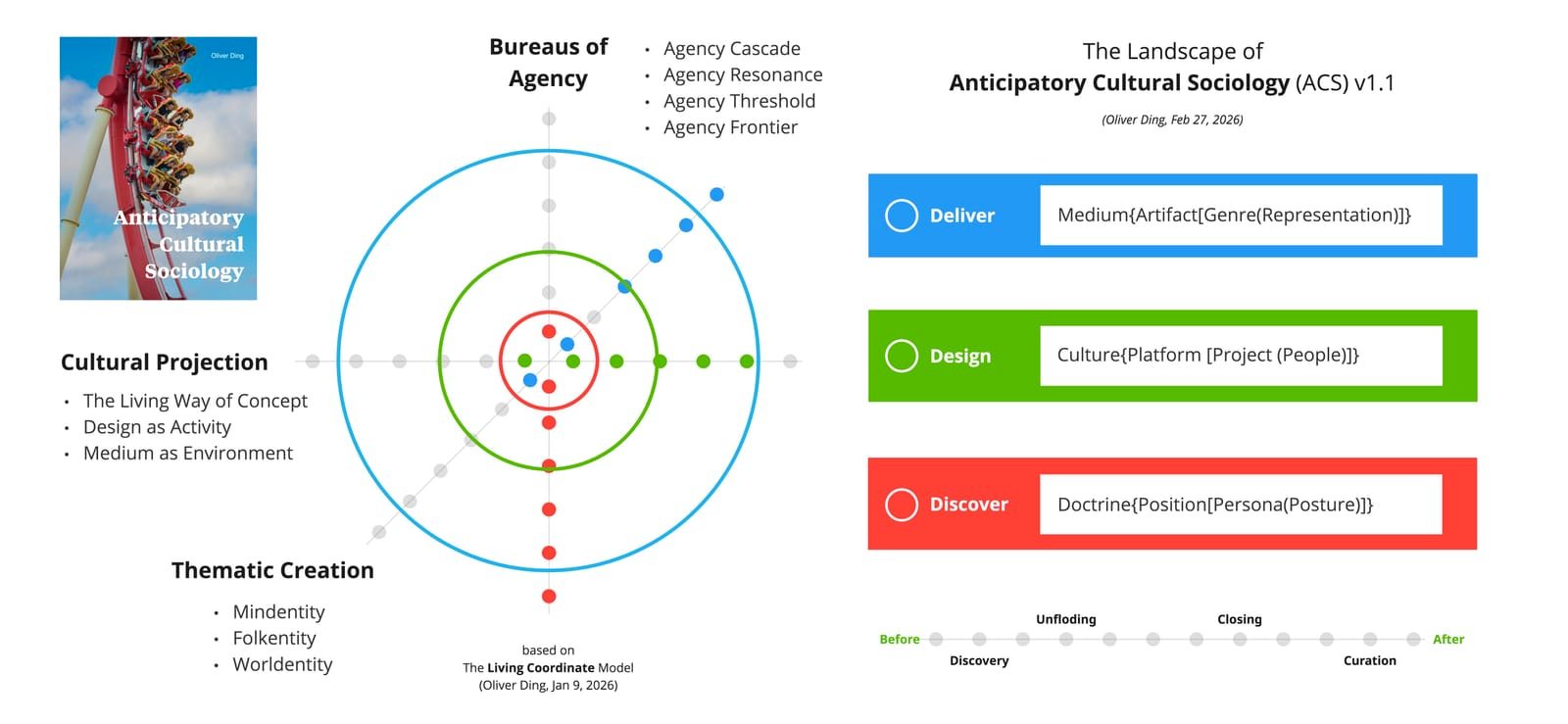
This movement — from v1.0 to v1.1 — was named Scaling the Focus: the anchored center growing outward, filling in depth and detail across three dimensions simultaneously, through the mutual activation of three independent yet entangled lines of creative work. In the language of Lake 42's eight-movement model of Generative Confluence, this was movement #3 — following Finding the Coordinate (#1) and Anchoring the Center (#2). The v1.2 diagram marks a milestone within this same movement: Scaling the Focus continues, and the landscape is still deepening.
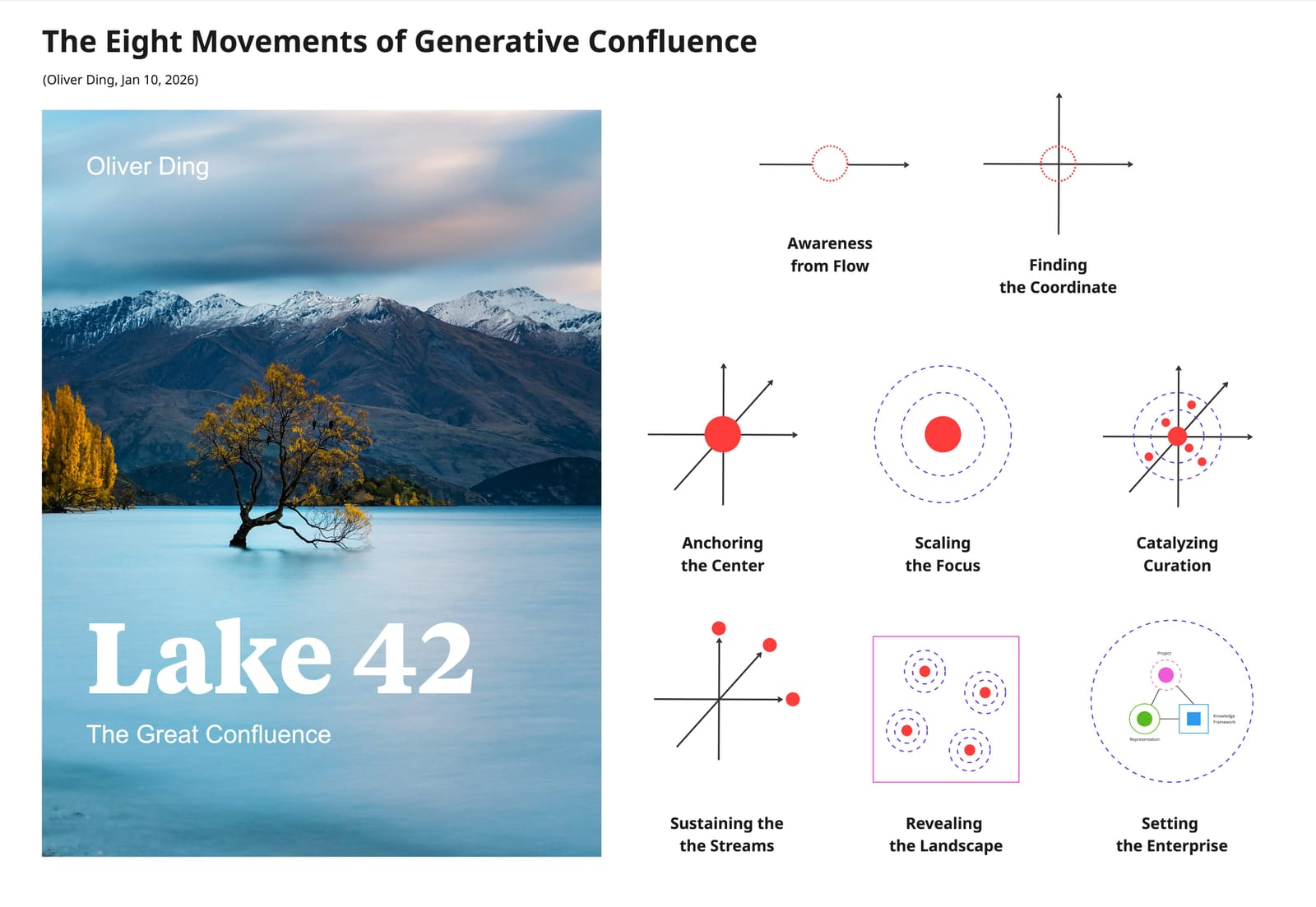
The model of the actor was still not the explicit concern. ACS was mapping how concept systems exist in the social world, how they move, and how they develop. The landscape was expanding. The figure in the landscape was growing more defined — but still unnamed as such.
IV. Completing the Landscape: v1.1 to v1.2
Between late February and March 13, 2026, three series of articles were completed simultaneously — one for each axis of the coordinate. All of them were published on the Activity Analysis Center website.
The Bureaus of Agency axis followed a particularly distinctive development pattern: the four structural patterns — Agency Cascade, Agency Resonance, Agency Threshold, and Agency Frontier — served as the organizing themes for the biweekly updates of the Activity Analysis Center website. Each pattern anchored a publication cycle, and the ACS articles developed in tandem, following the thematic rhythm set by the four bureaus.
The three axes were not advancing at the same pace or through the same mechanism — each had its own internal logic of development. The method-orientations expanded from three (Discover, Design, Deliver) to five, with the addition of Learn and Weave.
Learn is not merely an additional orientation. It marks the condition of possibility for all the others: an actor who cannot learn cannot act. Knowledge and skill are the necessary antecedents of every cultural engagement. Its position in the diagram — the outermost ring, green — reflects this: it is where the world enters the actor, the interface between an actor's interiority and the cultural resources that surround them.
Weave marks the other end. Positioned at the innermost ring, it names the integrative action that holds everything together: real practice is never single-mode. A cultural actor always simultaneously discovers, designs, delivers, and learns — and the action that holds these together, that weaves them into a coherent practice, is Weave. Its position at the center is its meaning.
The Dramatic Life Pattern timeline also reached its fuller form: Before → Discovery → Unfolding → Revisiting → Rebuilding → Closing → Curation → Indirect Activity → After. This was no longer just a map of structural positions. It was a map of temporal movement — the arc through which an actor's engagement with a project develops across time.
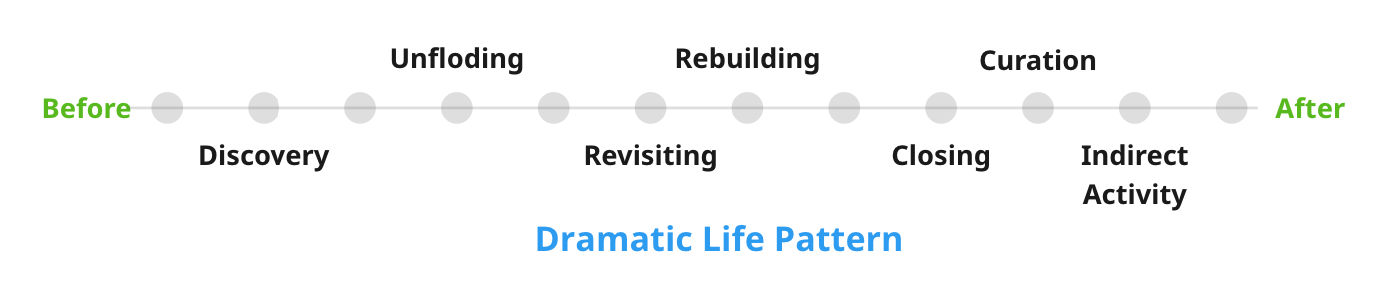
By March 13, 2026, ACS v1.2 was complete. The landscape had reached a new level of articulation: three dimensions, five method-orientations, the full structure of Cultural Projection, the full ontology of Thematic Creation, the four Bureaus of Agency, the Dramatic Life Pattern. The diagram — three-dimensional coordinate, five concentric rings, individual at center, world at periphery — was drawn.
V. The Unexpected Reversal
And then, on the same day, returning home after a morning of tennis, the ACS v1.2 diagram just completed — something shifted.
Looking at the completed ACS v1.2 diagram, and thinking about its relationship to Strategic Developmental Psychology (SDP) — the mirror enterprise that had been established alongside ACS in January 2026, focused on individual life development where ACS focuses on cultural life development — a recognition arrived quietly:
The three-dimensional, five-ring structure of ACS v1.2 applies equally to SDP.
The same coordinate. The same five orientations. The same container logic of individual-at-center, world-at-periphery. The same Dramatic Life Pattern.
If the diagram applies to both ACS (cultural life development at the collective scale) and SDP (individual life development at the personal scale), then the diagram is not specific to either. It is describing something more fundamental than either cultural sociology or developmental psychology. It is describing the actor — the generic cultural actor — as such.
This was not the intended outcome. ACS had been built as a map of the social world, not a portrait of the person who inhabits it. The strategy had been sociological throughout: map the terrain, describe the structures, trace the mechanisms. The model of the actor had never been the explicit goal.
But this is precisely how the sociological tradition has always worked. Durkheim was not trying to theorize the actor; he was trying to explain suicide rates and collective effervescence. Bourdieu was not trying to draw a portrait of the person; he was trying to analyze the reproduction of social class. The model of the actor that emerges from their work is a consequence of the theoretical architecture, not its starting point.
ACS followed the same path — not by imitation but by structural necessity. Working from the World of Life ontology, through the three axes of Thematic Creation, Cultural Projection, and Bureaus of Agency, across five method-orientations, the landscape of cultural development was mapped. And when the mapping was complete, the figure it had been tracing all along became visible:
A model of the actor.
The deeper logic of this path was set in place even before ACS was named. The ACS-SDP symmetry — one enterprise attending to cultural life at the collective scale, the other attending to individual life development at the personal scale — was not a post-hoc arrangement. It was built into the World of Life ontology from the beginning: Individuals and Collectives as two distinct boundaries of the same social world, each calling for its own theoretical enterprise. When ACS v1.2 was complete and the comparison with SDP became natural, the symmetry did what symmetry is designed to do — it revealed the shared structure beneath two different surfaces.
VI. The Structure of the Model
What does the ACS model of the actor look like?
It is organized around three dimensions — the axes along which a cultural actor exists:
The actor creates themes (Thematic Creation): bringing forth Mindentities from psychological ownership, projecting them through social engagement as Folkentities, watching them — if the conditions are right — settle into the cultural background as Worldentities. This is the actor as ontological origin of cultural life.
The actor projects into the world (Cultural Projection): discovering personal orientation (Doctrine, Position, Persona, Posture), designing cultural engagements (Culture, Platform, Project, People), delivering into cultural circulation (Medium, Artifact, Genre, Representation). This is the actor as operative presence in social space.
The actor navigates structural configurations (Bureaus of Agency): encountering situations of Cascade, Resonance, Threshold, and Frontier — structural patterns that shape what forms of agency are available at any given moment. This is the actor as positioned being, embedded in social terrain.
And it is organized around five orientations — the fundamental modes of cultural action:
Learn: the actor as recipient and developer of knowledge and skill — the necessary condition of all further action. Discover: the actor as explorer, seeking new connections, recognizing patterns not yet named. Design: the actor as builder, constructing cultural forms, platforms, and engagements. Deliver: the actor as contributor to cultural circulation, working through mediums, artifacts, and genres. Weave: the actor as integrator, holding the other four orientations together in the coherence of living practice.
The diagram itself enacts the model's logic: the actor is at the center (Weave, innermost), the world is at the periphery (Learn, outermost), and the movement between them — through Discover, Design, Deliver — is the substance of cultural life.
Now we can return to the definition that ACS carried from its earliest formulation:
Cultural development is a continuous, dynamic anticipatory activity of creating and curating concept systems and transforming them into thematic enterprises by weaving active agency and evolving structure within the social world.
This definition describes what cultural development does. The ACS model of the actor now provides its complement: a specification of the actor who is capable of this activity.
To create and curate concept systems → the actor must Learn and Discover.
To transform them into thematic enterprises → the actor must Design and Deliver.
To weave active agency and evolving structure → the actor must Weave — and here the connection runs deepest. "Weaving active agency and evolving structure" in the original definition corresponds directly to the symmetry between the Nine Aspects of Strategic Agency (active agency, the cognitive dimension) and the Four Bureaus of Agency (evolving structure, the structural dimension). Weave, as the innermost orientation, is the name for the action that holds these two dimensions together in living practice.
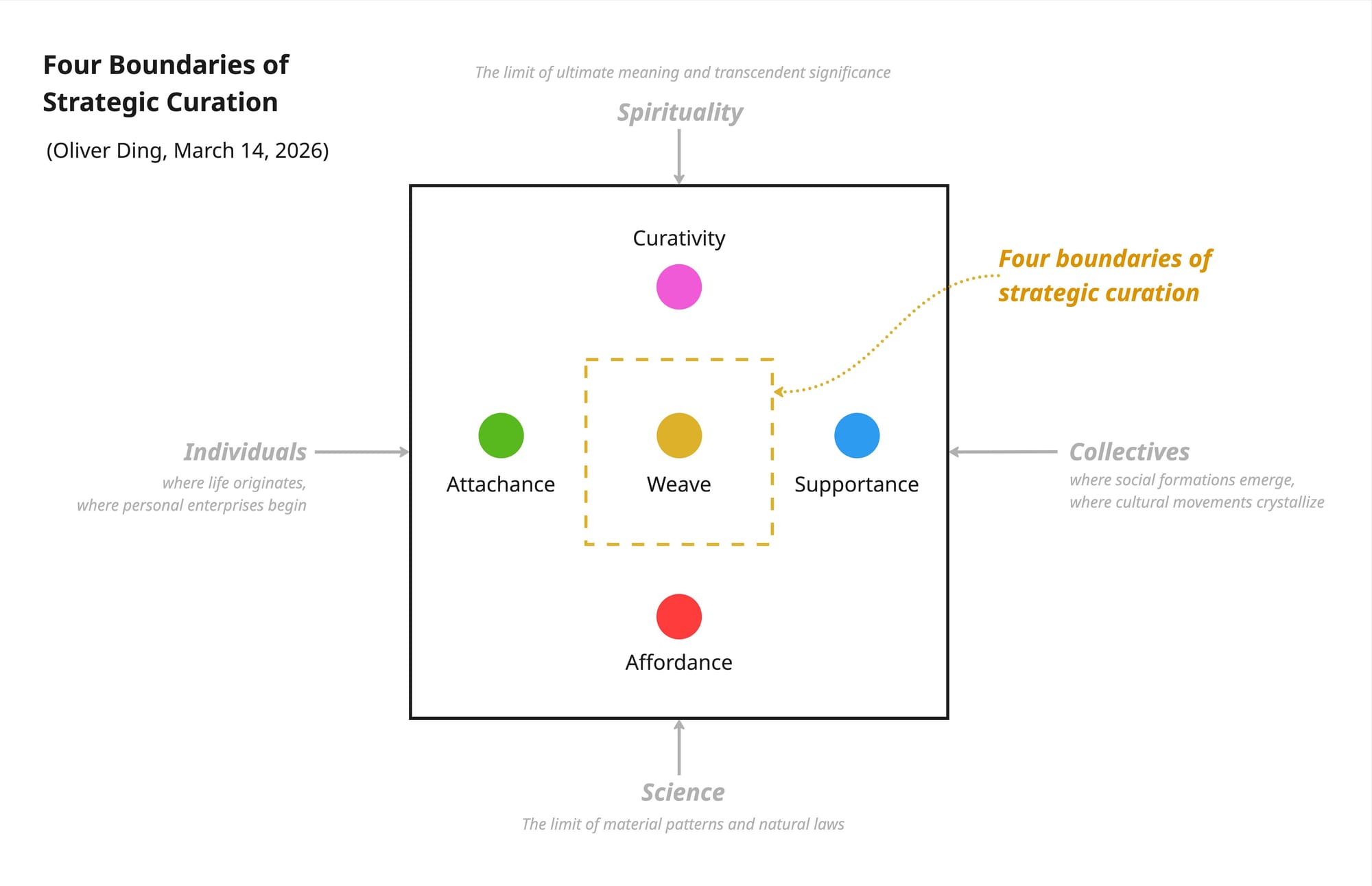
The word "weaving" was already in the definition from December 2025. The v1.2 diagram made it a named orientation. This was not a coincidence — it was the theory recognizing itself.
The v1.0 definition described the activity. The v1.2 model describes the actor adequately. They were always two faces of the same thing.
VII. A Different Kind of Model
How does this model of the actor differ from its predecessors?
The classical sociological models of the actor tend toward constraint: the actor is shaped by social facts (Durkheim), oriented by internalized values (Weber), structured by habitus (Bourdieu), and positioned within systems (Parsons). Agency is real but always bounded, always already formed by forces that precede it. Even Giddens's reflexive agent, monitoring action and drawing on tacit knowledge, operates within structures that simultaneously enable and constrain.
The classical economic model tends toward calculation: the actor as rational maximizer, computing costs and benefits, optimizing outcomes. Homo Economicus knows what he wants and pursues it efficiently. The actor is transparent to himself, strategic in the strict sense.
The ACS model is oriented differently. It is not primarily about constraint or calculation. It is about orientation — what directions are available, what positions are possible, what forms of action are open. The three dimensions do not constrain the actor; they constitute the space in which the actor moves. The five orientations do not prescribe what the actor must do; they name the fundamental modes through which any cultural actor engages with the world.
Moreover — and this is the formal distinctive — the ACS model of the actor is spatial and visual. It is not a description embedded in prose. It is a diagram: a Living Coordinate that can be held, examined, customized, and inhabited. Anyone who encounters this model can take it and locate themselves within it: which orientations are currently dominant? Which dimensions are most alive? Where is the Weave? Where is the Learn?
The diagram does not tell you who you are. It gives you a thematic space in which to find out.
The map was drawn to understand cultural development. The figure it traced, all along, was the actor — free to move.
v1.0 - March 14, 2026 - 3,242 words