
Activity Analysis Network #10: Re-visiting, Re-building, and Agency Cascade

This is the 10th issue of the Activity Analysis Center newsletter
by Oliver Ding
January 30, 2026
Hi, and welcome to Activity Analysis Network, a newsletter hosted by the Activity Analysis Center.
Each issue is organized around the "Flow - Focus - Center - Circle" schema, the primary model of the World of Activity Toolkit (v1, 2025).
As a biweekly newsletter, I share summaries of new articles from the Activity Analysis Center, along with updates on related activities, including some of my own published work elsewhere.
In this issue (#10), seven new articles have been added to the site:
- #1 - Concepts: Mindentity: The Ontology of Thematic Creation
- #2 - Methods: Revisiting and Rebuilding: The Mindentity Concept (2017, 2026)
- #3 - Case Studies: The Path of Creative Life in a Trip
- #4 - Appropriating Activity Theory #10: The GREAT Method (2018 - 2026)
- #5 - Case Studies: Revisiting and Rebuilding: The LARGE Method (2018-2026)
- #6 - Frameworks: The Living Coordinate Model (2026)
- #7 - Library: Wonder and Wander (book, v1.0, 2025)
These articles can be seen as a special issue centered on the theme of "Re-Engagement."
Both #1 and #4 were inspired by revisiting earlier works I created many years ago. These experiences led me to articulate the "Revisiting - Rebuilding" pattern, which is further explored through two case studies in #2 and #5.
In addition, #3, #4, and #5 are all related to the Path of Creative Life model.
Flow
The historical development of the Activity Analysis Center and my experience of daily life
In the last issue, I mentioned Donald Schön and his method of Reflection. From January 26 to 27, 2026, I reflected on several methods I had developed over the past years and wanted to develop a meta-framework that would serve as the principles underlying these methods.
Eventually, I found a model whose name perfectly inspired this discovery: the LARGE Method. Originally developed in 2018 as a meta-framework for the learning and reflection project (LAR), it consisted of six words—Learn, Action, Reflect, Generate, Explore, and Exploit—forming the acronym LARGE.
This project was highly influenced by Donald Schön and Chris Argyris. Although I later moved to Ecological Psychology, Activity Theory, and Theoretical Sociology, I now see that their early impact on my creative thoughts and creations was the seed of the Life-as-Activity approach and Creative Life Theory.
In Appropriating Activity Theory #10, I share the story of the LARGE Method and trace its development over the years. I then show how it has evolved into L(A·R·G)=E—not just one method among many, but the meta-method that serves as the governing principle for my entire family of methods.
In this narrative, I also mention a diagram once called the Life-as-Activity Framework (v1.0).
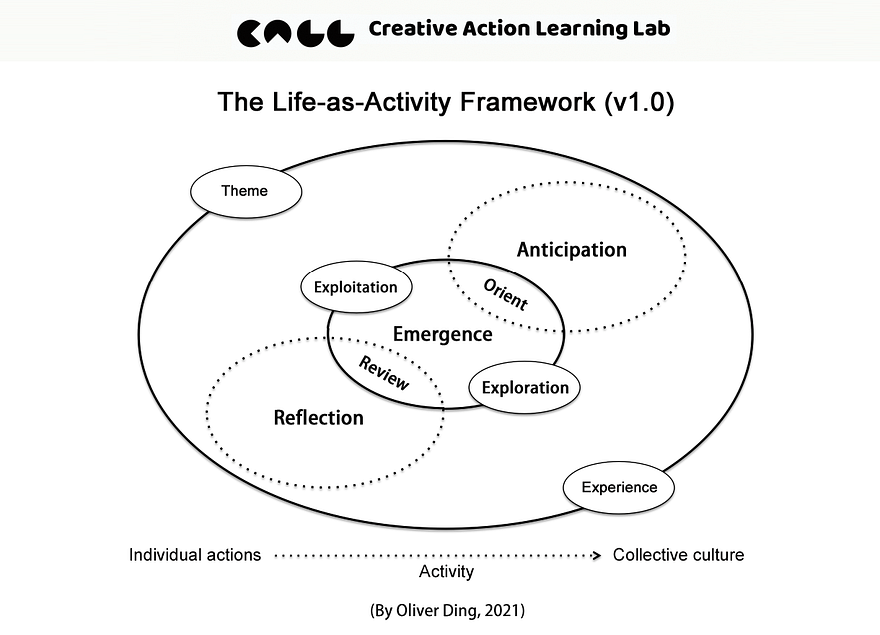
However, I was not sure it was the ideal solution for the new version of the Life-as-Activity framework (v1.0) because it was inspired by Robert Rosen’s Anticipatory System theory, too.
Later, I officially renamed it the Path of Creative Life. In 2022, it became the meta-framework of Creative Life Theory (v1.0).
Focus
The Thematic Foci of the Activity Analysis Center
Over the past two weeks, my focus has been on a set of ideas introduced in the last issue:
- Re-engagement
- Creative Dialogue
- Generative Anticipation
- Co-becoming
- Anticipatory Cultural Sociology
- Anticipatory Activity
In this issue, several articles feature the “Revisiting–Rebuilding” pattern, which belongs to the broader theme of Re-engagement.
In August 2017, I developed a 72-slide conceptual deck introducing Mindentity—a proposed organizational form for understanding talent ecosystems from a developmental–resource perspective. After a period of dormancy from 2018 to 2025, the concept was re-engaged in January 2026 and strategically integrated into the Anticipatory Cultural Sociology (ACS) framework, specifically within the “Culture as Thematic Enterprise” model.
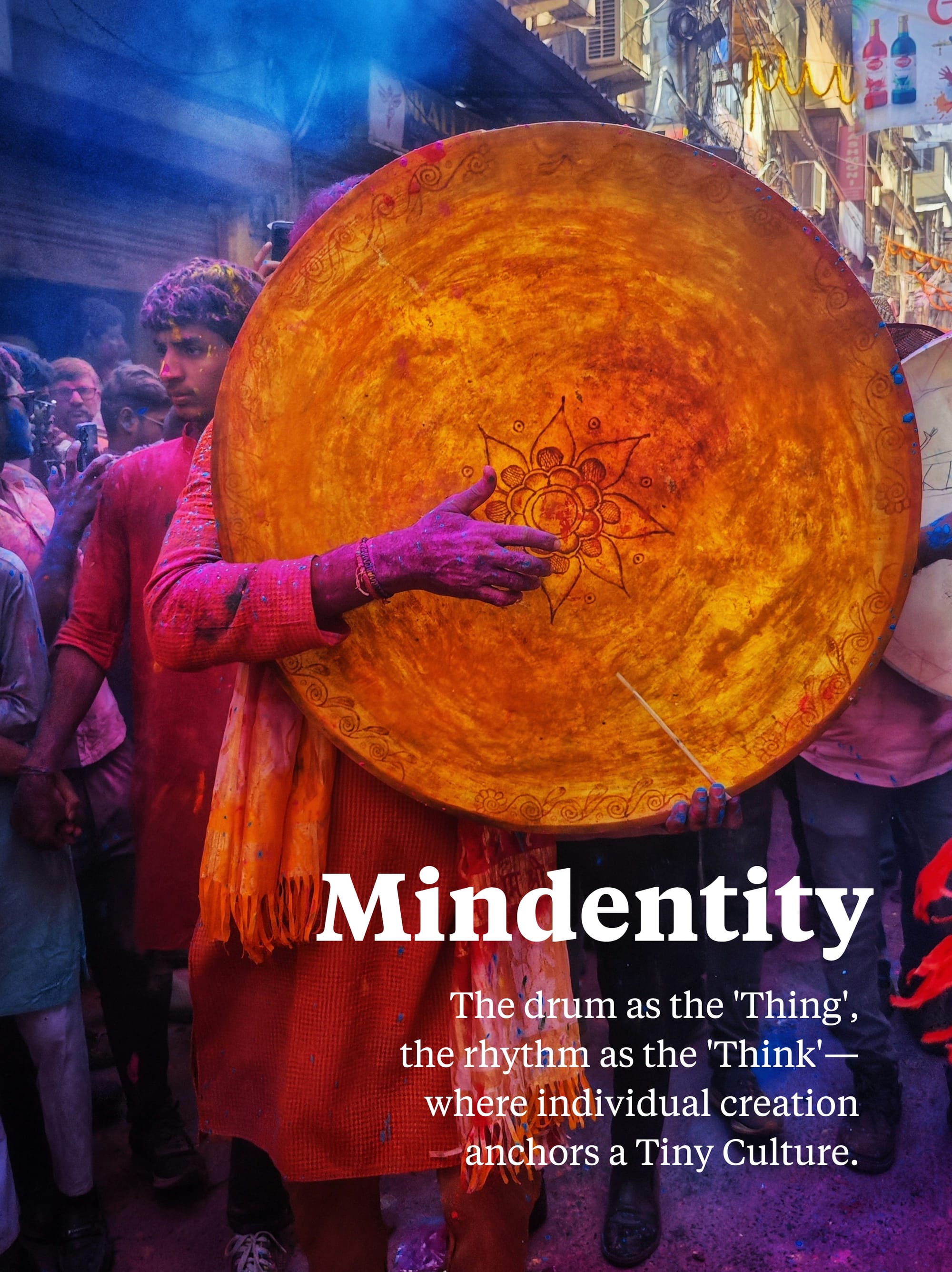
Inspired by this experience, I conducted a case study on the “Revisiting–Rebuilding” pattern: a creative–cognitive heuristic for re-entering earlier conceptual work, re-situating it within an evolved theoretical ecology, and reconstructing its contemporary meaning and function.
A thematic collection based on this work has been published on Possible Press, a partner of the Activity Analysis Center. Building on this case, I then conducted a second case study examining the development of the LARGE Method.
Where the Mindentity case exemplified a single ontological breakthrough followed by long latency and dimensional construction, the LARGE Method case reveals multiple accumulative breakthroughs, active parallel development, and progressive elevation from method to meta-method. Together, these two cases provide complementary perspectives on how intellectual innovation operates across extended time scales through situated cognitive mechanisms.
CENTER
The Core of the Activity Analysis Center
Currently, the Activity Analysis Center hosts two major theoretical enterprises:
- The Life-as-Activity Approach (the Project Engagement Approach belongs to this family)
- The World of Activity Approach
Over the past two weeks, I explored two models, each belonging to one of these two enterprises.
- Agency Cascade: Education as Anticipatory Activity
First, I developed a model called Agency Cascade, emerging from a case study on Education as Anticipatory Activity. Building on the Activity Circle, a core model of the Life-as-Activity Approach, I constructed a new framework for understanding education as a nested anticipatory activity system.
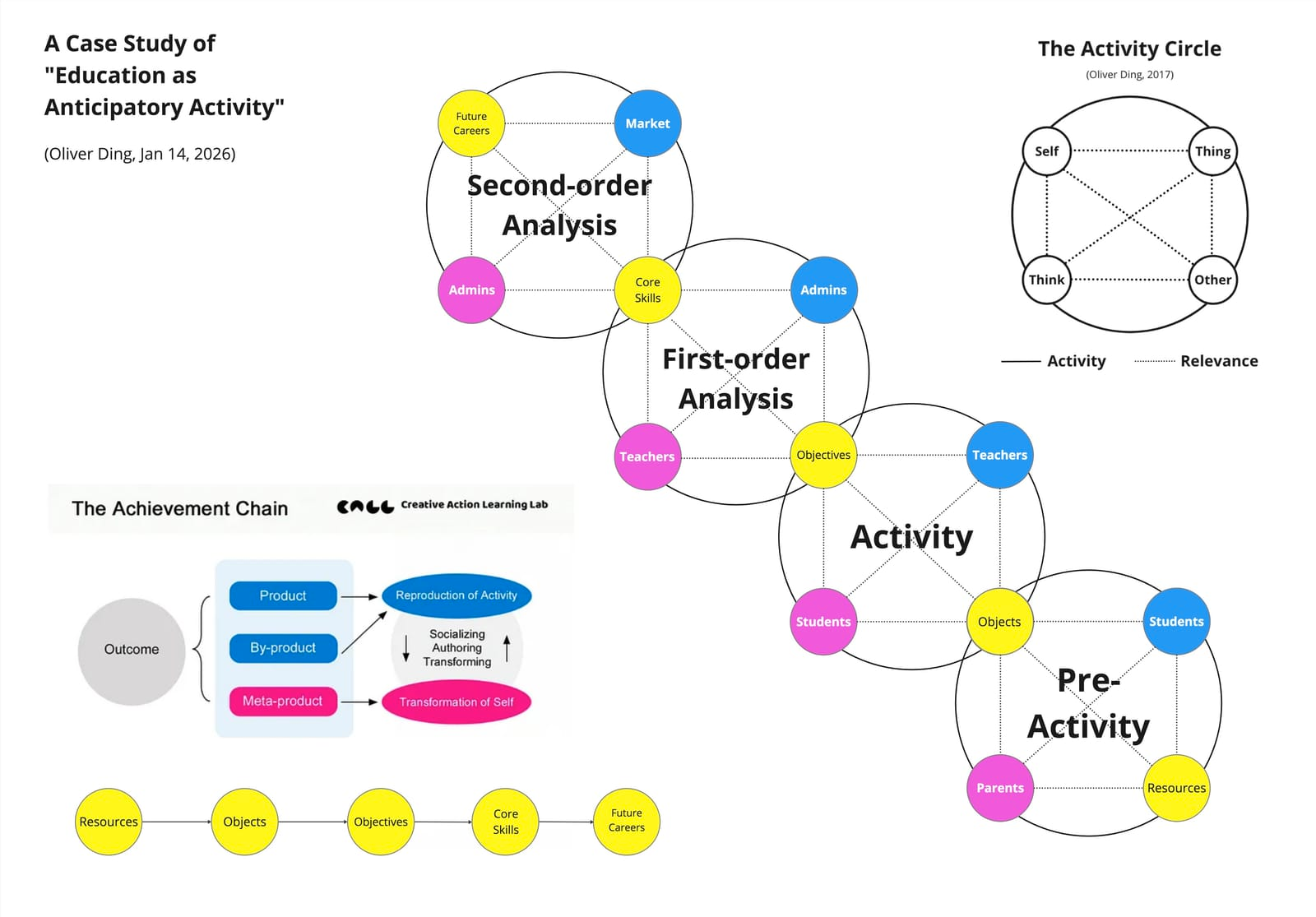
The educational system operates as a nested anticipatory activity system across four distinct yet interconnected levels. A striking feature of this nested structure is how agency cascades through the levels:
- Parents are agents who anticipate for Students
- Students (as Other to Parents) become agents who engage with Objects
- Teachers (as Other to Students) become agents who design Objectives
- Admins (as Other to Teachers) become agents who define Core Skills
- Market (as Other to Admins) becomes the ultimate reference point
At each level, the "Other" of the current level becomes the "Self" of the next level. This cascade reveals how individual agency is always embedded within larger anticipatory systems.
What makes this structure genuinely anticipatory rather than merely sequential?
Each level operates with a predictive model of the next level:
- Parents hold predictive models of what Objects their children will encounter
- Students internalize predictive models of what Objectives teachers expect
- Teachers develop predictive models of what Core Skills the job market requires
- Admins maintain predictive models of Future Careers and societal needs
These predictive models are not passive predictions but active guides for present action. The "future" at each level structures the "present" at that level.
Moreover, the Future of one level becomes the Present of the next level:
- Parents' anticipated Objects become Students' actual learning materials
- Students' pursued Objectives become Teachers' working goals
- Teachers' targeted Core Skills become Admins' policy focus
- Admins' envisioned Future Careers become Market realities (or fail to)
This nested relationship creates a complex web of anticipations, where misalignments between levels generate tensions and opportunities for educational innovation.
- Extending the Agency Cascade Across Domains
After publishing the article Education as Anticipatory Activity on January 14, 2026, I detached the four-level structure from its original educational diagram and applied it to other domains.
On January 23, I applied the model to Culture, while working on the Mindentity case study.
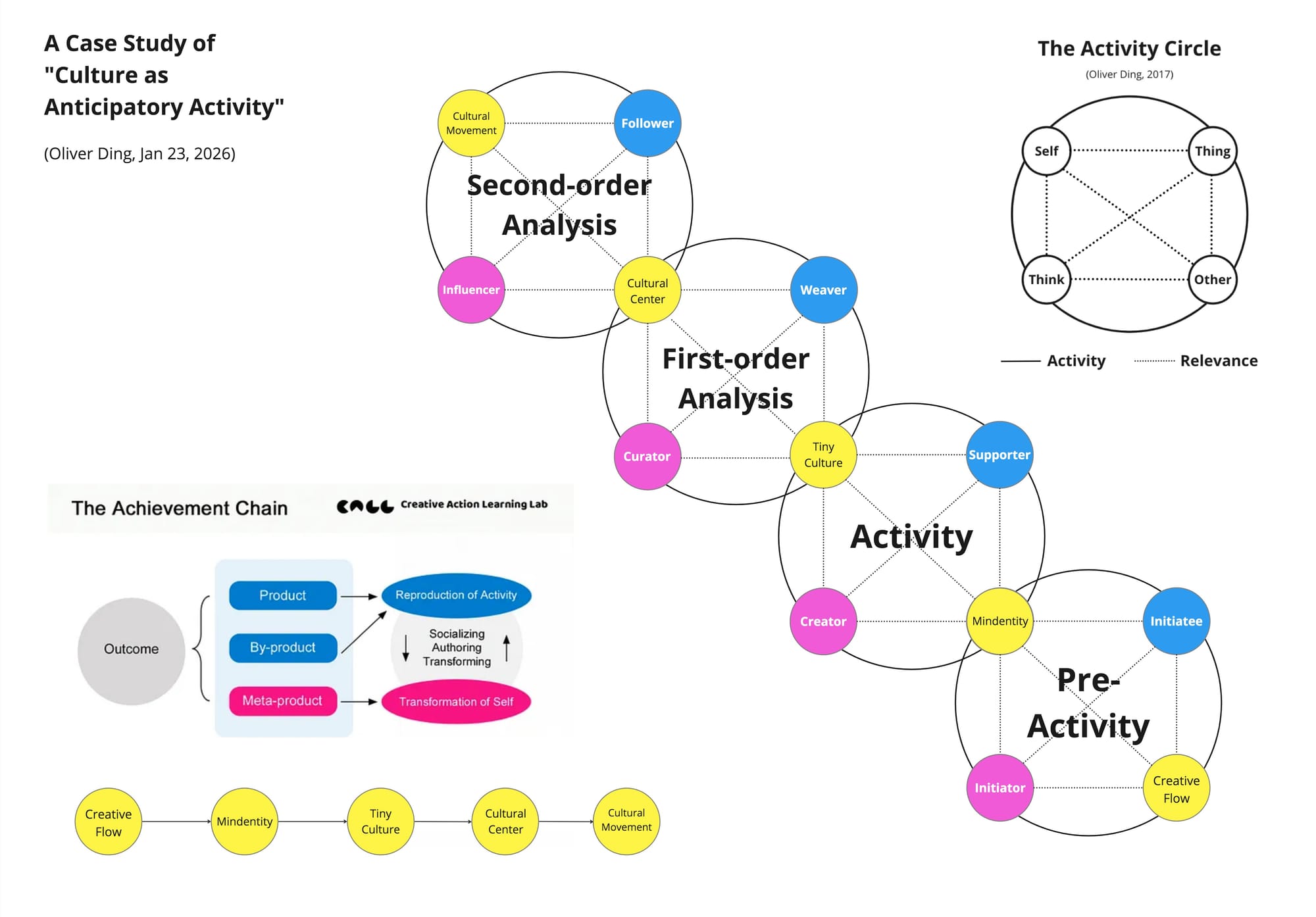
In the case of Culture as Anticipatory Activity, the Achievement Chain consists of:
- Creative Flow
- Mindentity
- Tiny Culture
- Cultural Center
- Cultural Movement
On January 25, I extended the model to the field of Narrative (see the diagram below).
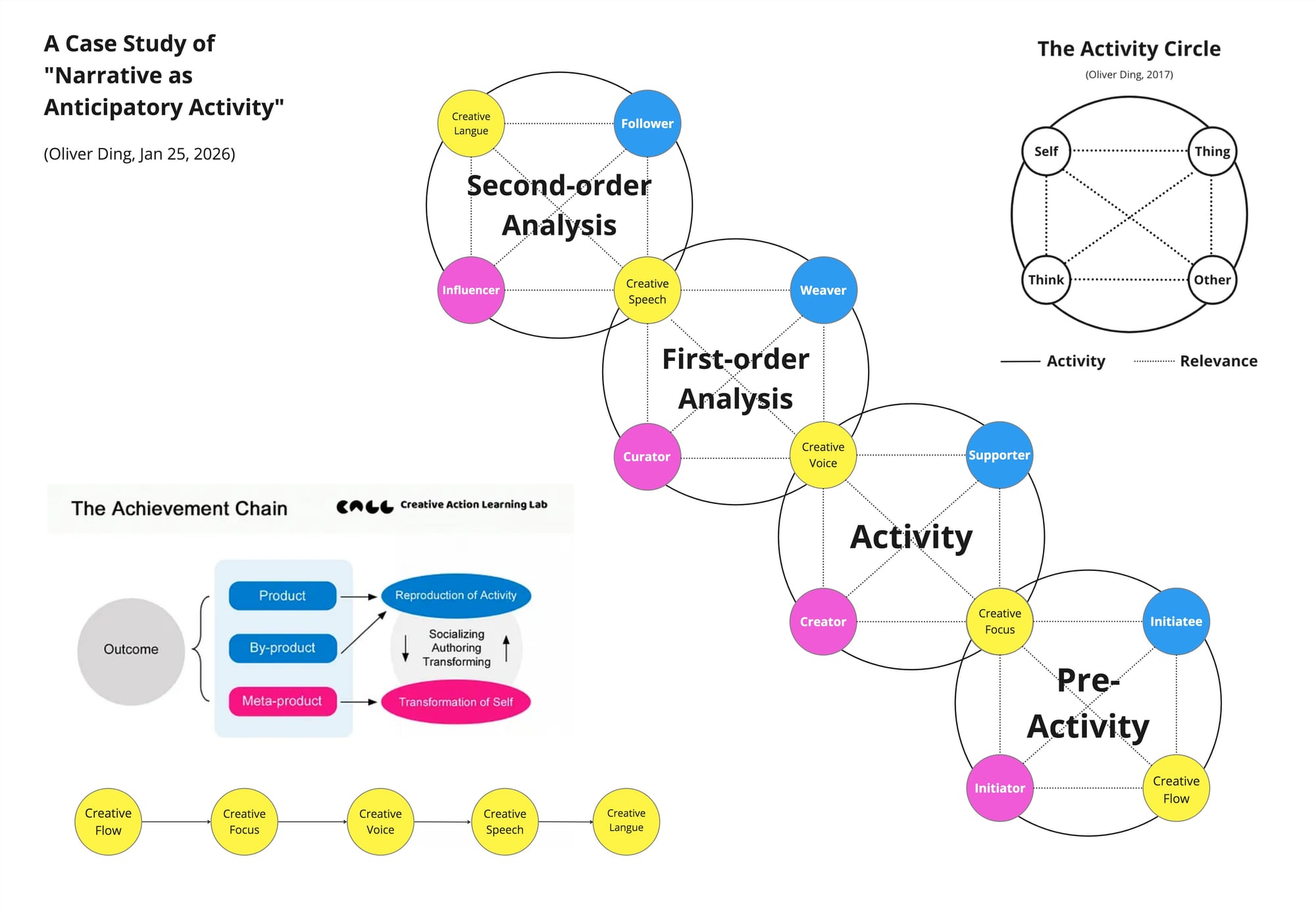
In this case, the Achievement Chain includes:
- Creative Flow
- Creative Focus
- Creative Voice
- Creative Speech
- Creative Langue
I also tested these two models through several additional case studies. Further details will be shared in future issues.
3. The Living Coordinate Model
The second model I explored is the Life Coordinate Framework, a sub-framework of the World of Activity Approach.
As mentioned in the previous issue, I released a thematic brief on the “Lake 42” theme on January 2, 2026. Shortly thereafter, I began working on a new possible book documenting the unfolding of a Cenerative Confluence journey from June to December 2025.
While working on the Lake 42 project, the primary challenge has been to develop a general model of the “Generative Confluence” pattern and incorporate it into my existing knowledge system.
On January 9, 2026, I addressed this challenge by developing an intermediate framework, called the Living Coordinate Model, to connect the Theorizing Creative Life Landscape diagram (a situational model) with the Life Coordinate Framework (a meta-framework), forming a hierarchy of models:
- Meta-framework: Life Coordinate Framework
- Framework: Living Coordinate Model
- Situational Model: Theorizing Creative Life Landscape
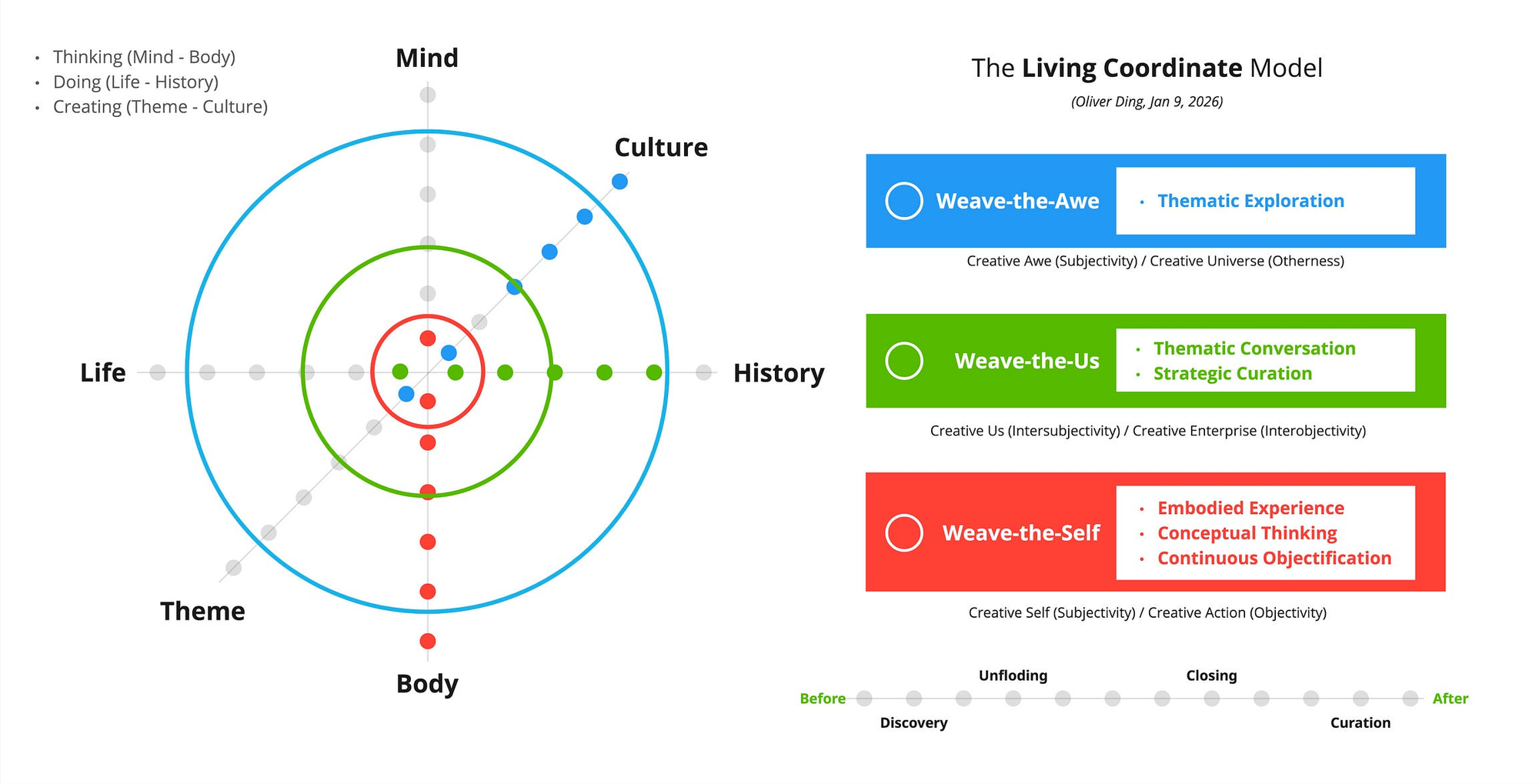
More details can be found in [World of Activity] The Living Coordinate Model (2026).
Notably, the Living Coordinate Model quickly found its first application. On January 28, 2026, while working on the LARGE Method, I used it to visualize the conceptual structure of the method.
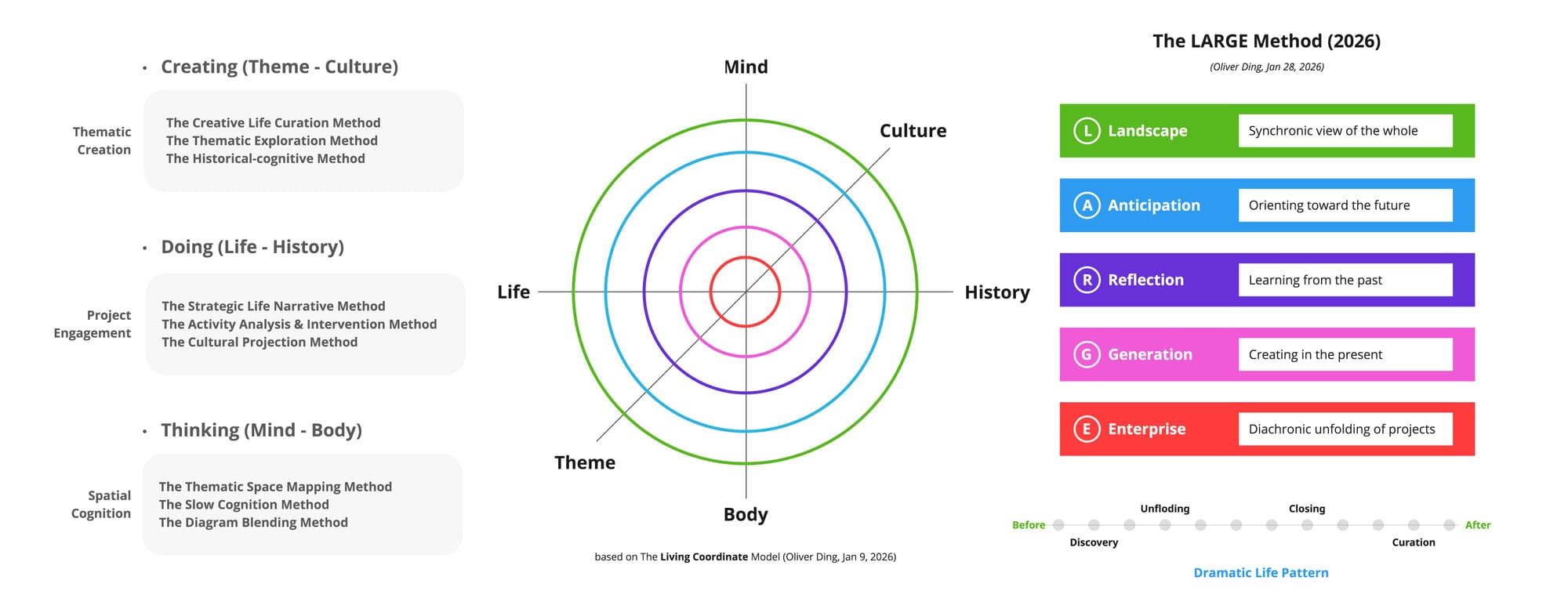
Further discussion can be found in Appropriating Activity Theory #10: The GREAT Method (2018 - 2026).
CIRCLE
The Context of the Activity Analysis Center
Over the past several years, I worked on several theoretical projects, such as the Ecological Practice Approach, Curativity Theory, Creative Life Theory, and Thematic Space Theory.
Inspired by creativity researcher Howard Gruber's idea of "Network of Enterprises," I used the "Knowledge Center" approach to manage this large knowledge system. Each knowledge center hosts one or two related theoretical approaches.
- CALL (Creative Action Learning Lab): the Ecological Practice Approach and Creative Life Theory
- Curativity Center: Curativity Theory
- TALE (Thematic Analysis Learning Engagement): Thematic Space Theory
- Frame for Work: A theory about Knowledge Frameworks
As mentioned above, I initiated the Lake 42 project on January 2, 2026. The Lake 42 theme represents a new possible project: it narrates the background of a six-year creative journey that produced more than 42 possible books, while also documenting the unfolding of a Generative Confluence journey within a concentrated six-month period.
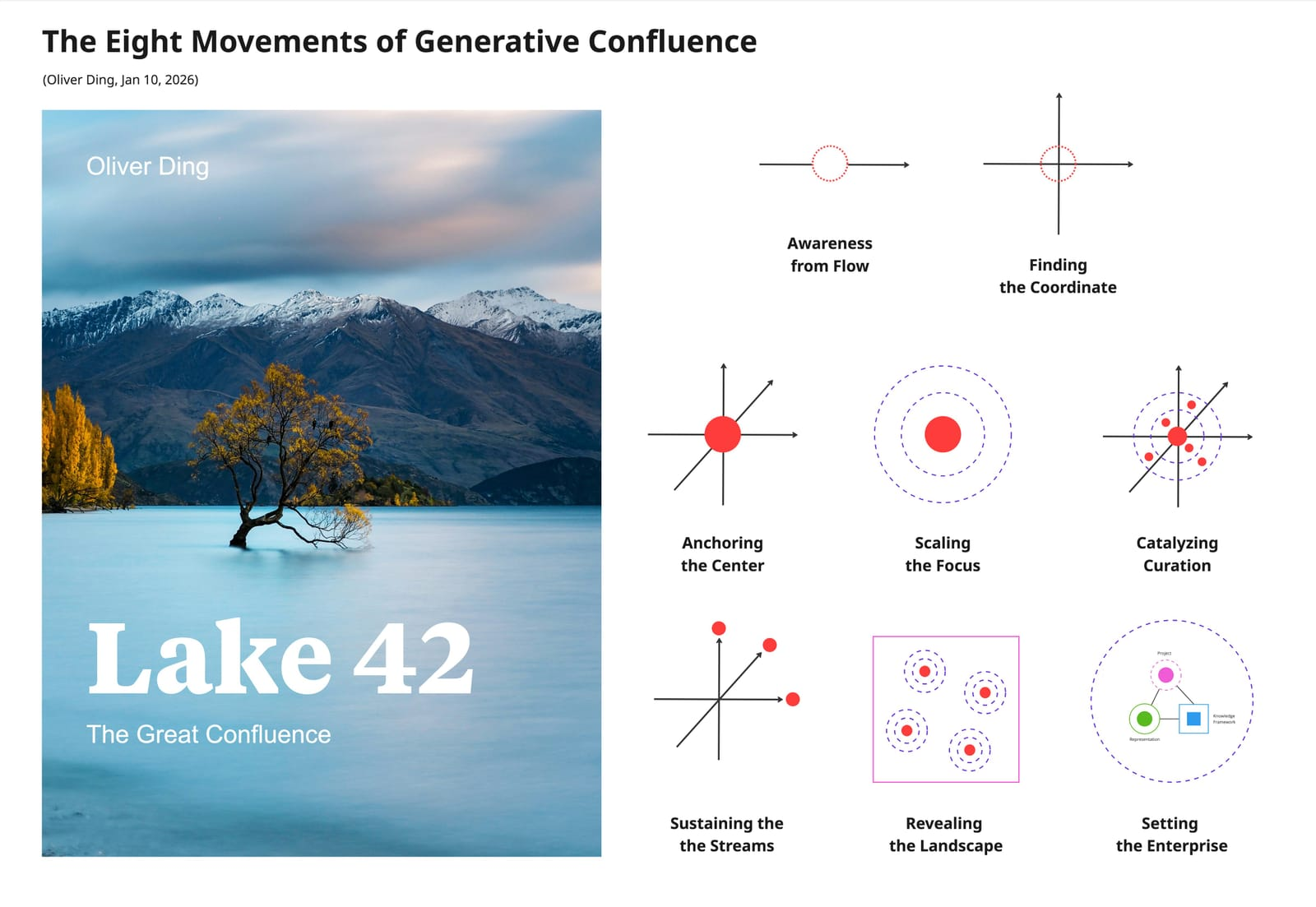
Over the past two weeks, I have begun writing a new possible book to detail the eight movements of the Generative Confluence Journey. The book is planned as a short Kindle publication consisting of ten chapters. To date, I have completed draft versions of the first five chapters:
- Jan 11 - Chapter One: Alice's Coordinate (4,451 words)
- Jan 12 - Chapter Two: Awareness from Flow (6,284 words)
- Jan 22 - Chapter Three: Finding the Coordinate (5,527 words)
- Jan 24 - Chapter Four: Anchoring the Center (5330 words)
- Jan 26 - Chapter Five: Scaling the Focus (5,960 words)
This new possible book serves as a follow-up to Homecoming: A Thematic Trip and The World of Activity Approach, where I reflect on my early life and career activities prior to 2015.
World
Me, You, and We
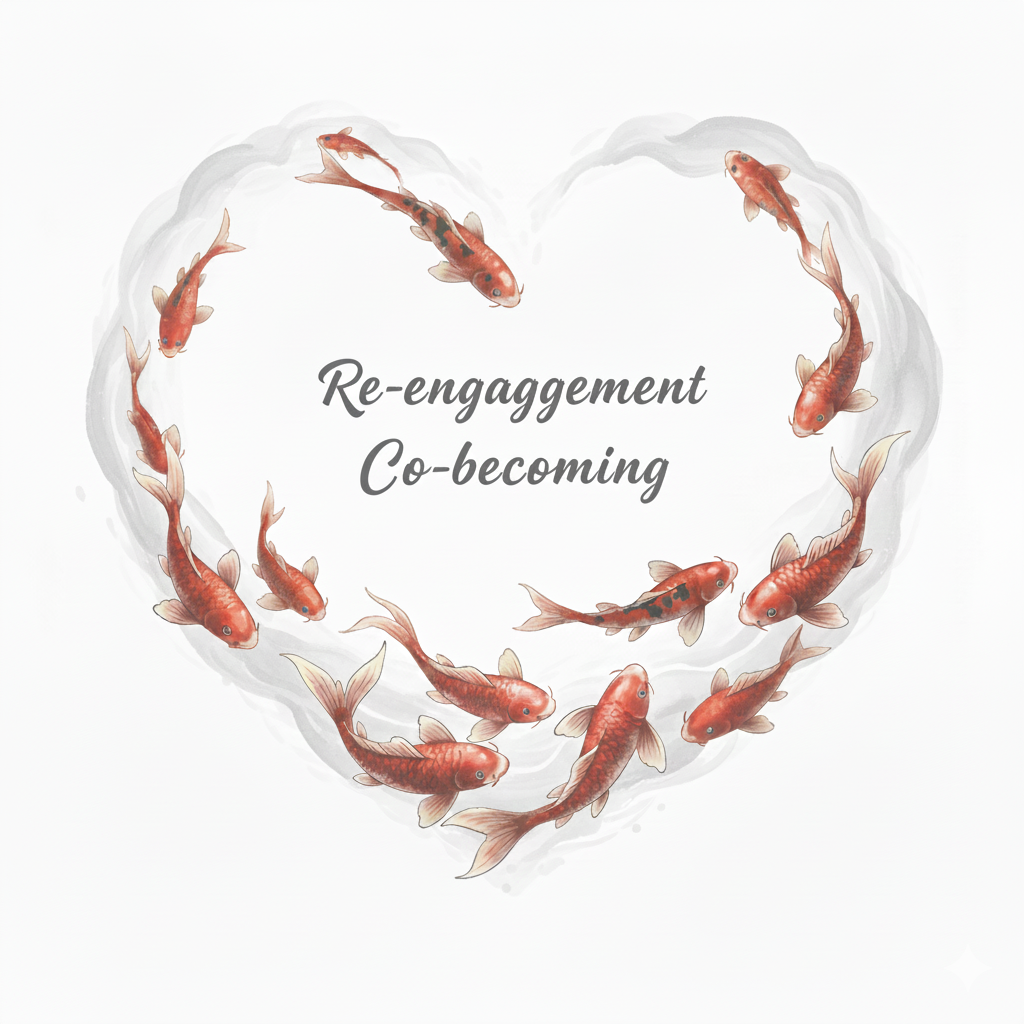
As 2026 unfolds, let us embrace the spirit of Re-engagement—to rediscover the unforgettable people, moments, and things from our past, and cherish them as the delicate culture of our lives.
With beautiful anticipations, let us journey into Co-becoming—creating a shared path alongside the uncertainties of the future.
Oliver Ding
Founder of the Activity Analysis Center
January 30, 2026
p.s. I am based in Houston, Texas, US. Where are you?
v1.0 - January 30, 2026 - 1,846 words