
Activity Analysis Network #11: Boundary, Givenness, and Agency Threshold

This is the 11th issue of the Activity Analysis Center newsletter
by Oliver Ding
February 15, 2026
Hi, and welcome to Activity Analysis Network, a newsletter hosted by the Activity Analysis Center.
Each issue is organized around the "Flow - Focus - Center - Circle" schema, the primary model of the World of Activity Toolkit (v1, 2025).
As a biweekly newsletter, I share summaries of new articles from the Activity Analysis Center, along with updates on related activities, including some of my own published work elsewhere.
In this issue (#11), seven new articles have been added to the site:
- #1 - Concepts: The Concept of World of Activity
- #2 - Frameworks: The World of Activity (v1.0, 2022) Framework: Theoretical Foundation and Generative Confluence
- #3 - World of Activity: Alien Land: Geographical Expansion
- #4 - Concepts: The Concept of "World of Life"
- #5 - Concepts: Worldentity: The Cultural Givenness of Thematic Creation
- #6 - Case Studies: A GAP Project and a Generative Confluence Journey
- #7 - Appropriating Activity Theory #11: When Two Students Aren't Enough (2023)
These articles can be seen as a special issue centered on three related themes: Boundary, Givenness, and Agency Threshold.
#1, #2, and #3 are part of the World of Activity framework. #4 introduces a new concept called World of Life, which serves as the large context of World of Activity.
Building on the four boundaries of World of Life, a new concept called Worldentity was developed as a new member of the Anticipatory Cultural Sociology (ACS) framework. Together, Mindentity and Worldentity set a new ontology of thematic creation - a theoretical framework for understanding how thematic creations come into being, develop, and settle into the social world.
In addition, #6 and #7 focus on the concept of Agency Threshold.
Flow
The historical development of the Activity Analysis Center and my experience of daily life
For several years, I had been taking my two sons to a local Chinese weekend school every Saturday for Chinese language classes and other enrichment courses. As a parent, I spent many hours waiting in hallways and lounges while they attended their classes.
Education has long been a central research domain for Activity Theory scholars. The classroom, with its complex interplay of teachers, students, tools, and institutional rules, offers rich terrain for understanding how human development unfolds through structured activity.
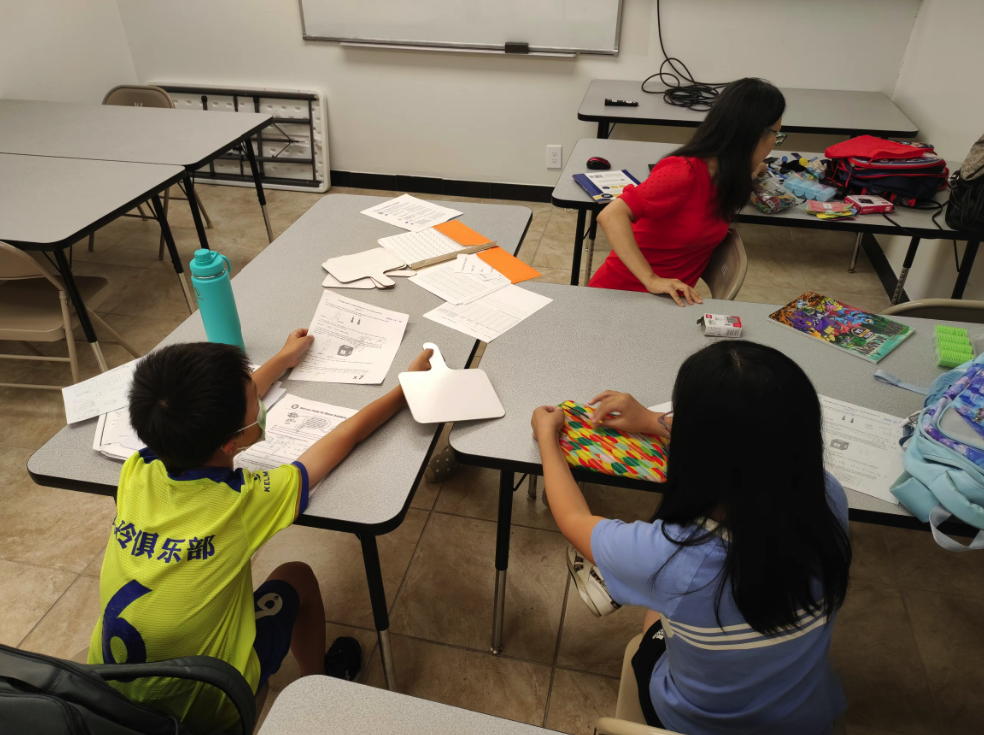
In Fall 2023, I realized I could use this school as a research site — a place to develop my empirical research skills in Activity Theory. Not as a formal academic project with institutional backing, but as an informal, personal inquiry into how activities actually work in educational settings.
That fall, a math class opened this journey. In Appropriating Activity Theory #11, I share four stories of puzzling moments I encountered within the school ecology.
Two years later, in January 2026, my theoretical work crystallized around a new conceptual framework I call the Four Bureaus of Agency — a set of structural patterns that describe how agency operates differently in different domains. One of these patterns is Agency Threshold.
Looking back at these four moments from the school, I now see them as variations on the Threshold pattern — situations where agency operates at structural boundaries, and where transformation most powerfully occurs.
Focus
The Thematic Foci of the Activity Analysis Center
Over the past two weeks, my focus has been on the Anticipatory Cultural Sociology (ACS) framework. In the last issue, I introduced a new concept called "Mindentity" as the ontological status of creative results before they enter systems of exchange, evaluation, or formal organization.
In the past two weeks, I continued this ontological exploration. Using symmetry heuristics grounded in the Four Boundaries of the World of Life, I introduce Mindentity's symmetrical counterpart: Worldentity.
If Mindentity represents the moment when thematic creations enter the social world from the Individual side, Worldentity represents their ultimate arrival on the Collective side—when they settle into the World of Life as autonomous, given structures that subsequent generations encounter as "already there."
To support this work, a new article focused on the concept of World of Life was published on the site.
The concept of "World of Life" was introduced as the context of "World of Activity" in September 2025. Later, I used it to name a new curated knowledge system in December 2025. Finally, the four boundaries of the "World of Life" were introduced as well.
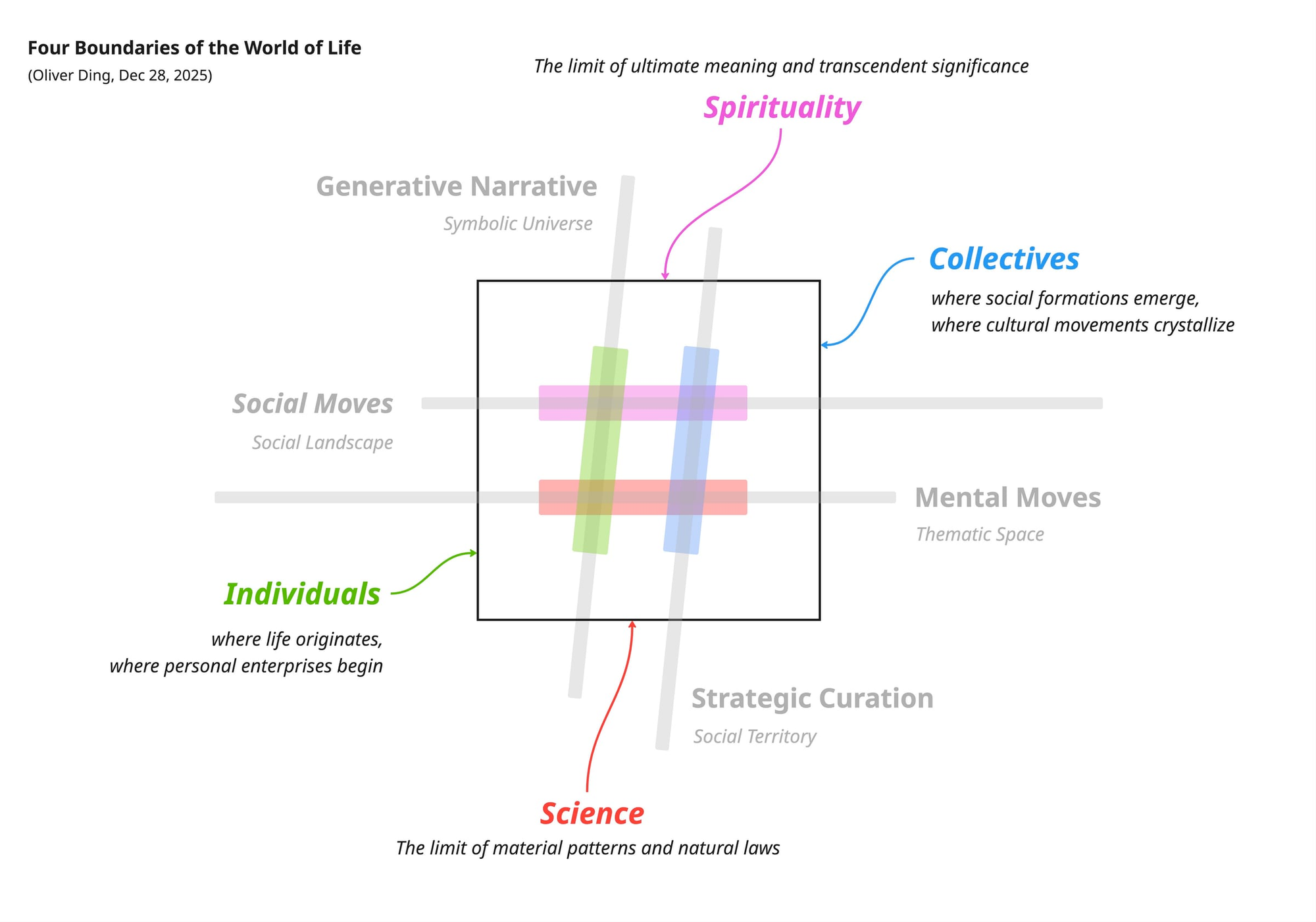
The diagram above shows the four boundaries of World of Life:
- Upper boundary: Spirituality (the limit of ultimate meaning and transcendent significance)
- Lower boundary: Science (the limit of material patterns and natural laws)
- Left side: Individuals (where life originates, where personal enterprises begin)
- Right side: Collective (where social formations emerge, where cultural movements crystallize)
Now this model has become a meta-framework for developing new concepts for the Anticipatory Cultural Sociology (ACS) framework.
CENTER
The Core of the Activity Analysis Center
Currently, the Activity Analysis Center hosts two major theoretical enterprises:
- The Life-as-Activity Approach (the Project Engagement Approach belongs to this family)
- The World of Activity Approach
In December 2025 and January 2026, the World of Activity Approach has been expanded to a nested structure: World of Life (World of Activity).
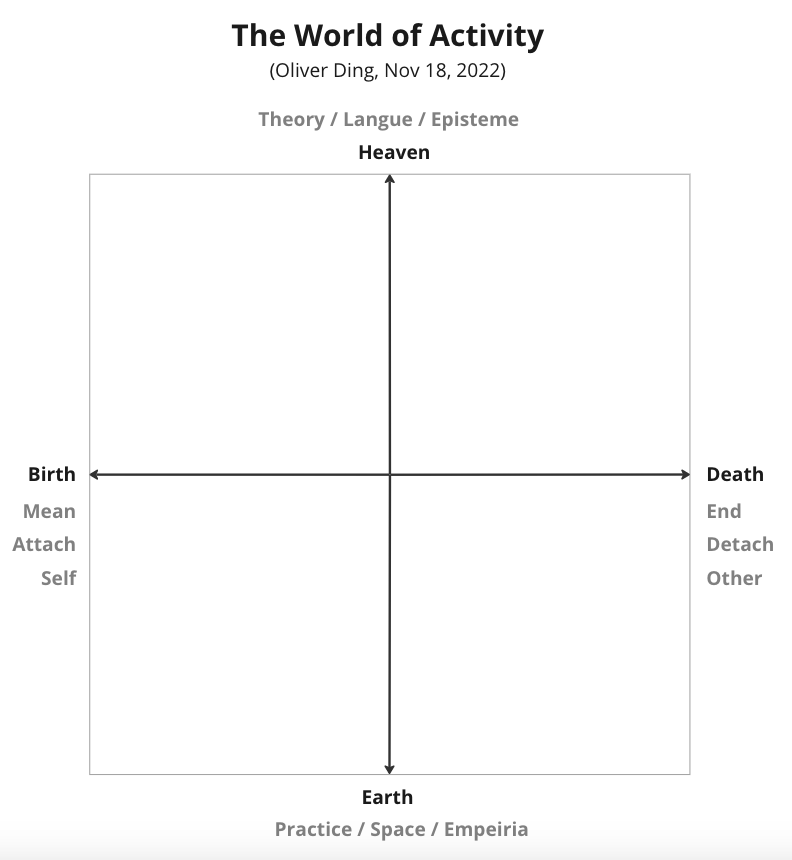
The World of Activity framework has been employed in recent work on creative life to understand how individuals navigate their experiential horizons bounded by four dimensions—Heaven, Earth, Birth, and Death. However, the theoretical genealogy of this framework has not been fully articulated, leading to potential misunderstandings about its relationship to Alfred Schutz's phenomenological sociology and other theoretical traditions.
A new article titled The World of Activity (v1.0, 2022) Framework: Theoretical Foundation and Generative Confluence was published on the site to clarify the theoretical foundations. The article addresses three key questions:
- What is the precise relationship between the World of Activity and Schutz's "World of Working"? While Schutz provided initial inspiration, the World of Activity represents a fundamental reconceptualization rather than an extension.
- How did the four-boundary framework actually emerge? The framework resulted from a generative confluence of three independent sources, not a Schutzian derivation.
- What is the nature of "givenness" in this framework? The distinction between Natural Givenness and Cultural Givenness is purpose-built for specific theoretical needs, not derived from phenomenological tradition.
The World of Activity (v1.0, 2022) framework identifies four boundaries that define every individual's experiential horizon: Heaven (天), Earth (地), Birth (生), and Death (死). This four-dimensional structure emerged from the convergence of three independent theoretical and empirical sources between November 2021 and November 2022.
The development of the World of Activity (v1.0, 2022) framework exemplifies a creative pattern I later identified and named "Generative Confluence" (June 2, 2025). This concept emerged from reflecting on my multi-year "Theorizing Creative Life" project, which involved various theoretical explorations that intersected in unexpected ways.
Generative Confluence describes the creative pattern where distinct theoretical approaches—such as Activity Theory (Means-End Spectrum), Chinese cosmology (San Cai meta-framework), and diagram research (Universal Reference)—intersect and generate a new central theoretical enterprise while maintaining their original developmental paths.
In 2025, I further developed the World of Activity Toolkit by curating a series of frameworks.
From late June to July 2025, I traveled to China, spending most of my time in Fuzhou, also known as Foochow. Before moving to the U.S., I had lived in Fuzhou for nearly 20 years. This journey became a deeply meaningful re-engagement with familiar places, old friends, and the memories that had shaped my earlier life.
At the beginning of the trip, I revisited Wuyi Mountain, searching for a symbolic object that had inspired my son Peiphen’s name. This moment led me to re-read my 2015 autobiography, A Freesoul.
Immersed in this rich experiential context, I began connecting the World of Activity approach with my situational experiences.
While in Fuzhou, I mainly used the World of Activity model, also known as the “Flow — Focus — Center — Circle” schema, to reflect on my 2015 autobiography.
I discovered several distinct forms of “World of Activity,” corresponding to different developmental stages of life:
- Hometown: Primordial Situatedness @ World of Activity
- Alien Land: Geographical Expansion @ World of Activity
- Domain: Professional Development @ World of Activity
- Internet: Digital Engagement @ World of Activity
- Foreign Land: Cultural Reconstruction @ World of Activity
These insights have been introduced in my first Kindle book Homecoming: A Thematic Trip and the World of Activity Approach.
Chapter 4 of the book, Alien Land: Geographical Expansion, was published on the site. This chapter shares the story of my adolescence.
The geographic expansion from mountains to sea demonstrated how creative individuals can engage with the Environment. Rather than simply accepting geographical constraints as limitations, I found myself in creative resonance with the landscape itself.
The Min River system became more than a transportation route — it became a teacher. The concepts of upstream and downstream, knowledge inheritance and knowledge sharing, the convergence of many streams into one great flow — these ideas that would later become central to my theoretical work were first discovered through creative dialogue with the river’s natural patterns.
Looking back through the lens of the World of Activity model, my adolescent experience demonstrates how creative individuals can simultaneously engage with these forms of givenness, transforming inherited constraints into creative resources.
CIRCLE
The Context of the Activity Analysis Center
Over the past several years, I worked on several theoretical projects, such as the Ecological Practice Approach, Curativity Theory, Creative Life Theory, and Thematic Space Theory.
Inspired by creativity researcher Howard Gruber's idea of "Network of Enterprises," I used the "Knowledge Center" approach to manage this large knowledge system. Each knowledge center hosts one or two related theoretical approaches.
- CALL (Creative Action Learning Lab): the Ecological Practice Approach and Creative Life Theory
- Curativity Center: Curativity Theory
- TALE (Thematic Analysis Learning Engagement): Thematic Space Theory
- Frame for Work: A theory about Knowledge Frameworks
As mentioned in the last issue, I initiated the Lake 42 project on January 2, 2026. The Lake 42 theme represents a new possible project: it narrates the background of a six-year creative journey that produced more than 42 possible books, while also documenting the unfolding of a Generative Confluence journey within a concentrated six-month period.
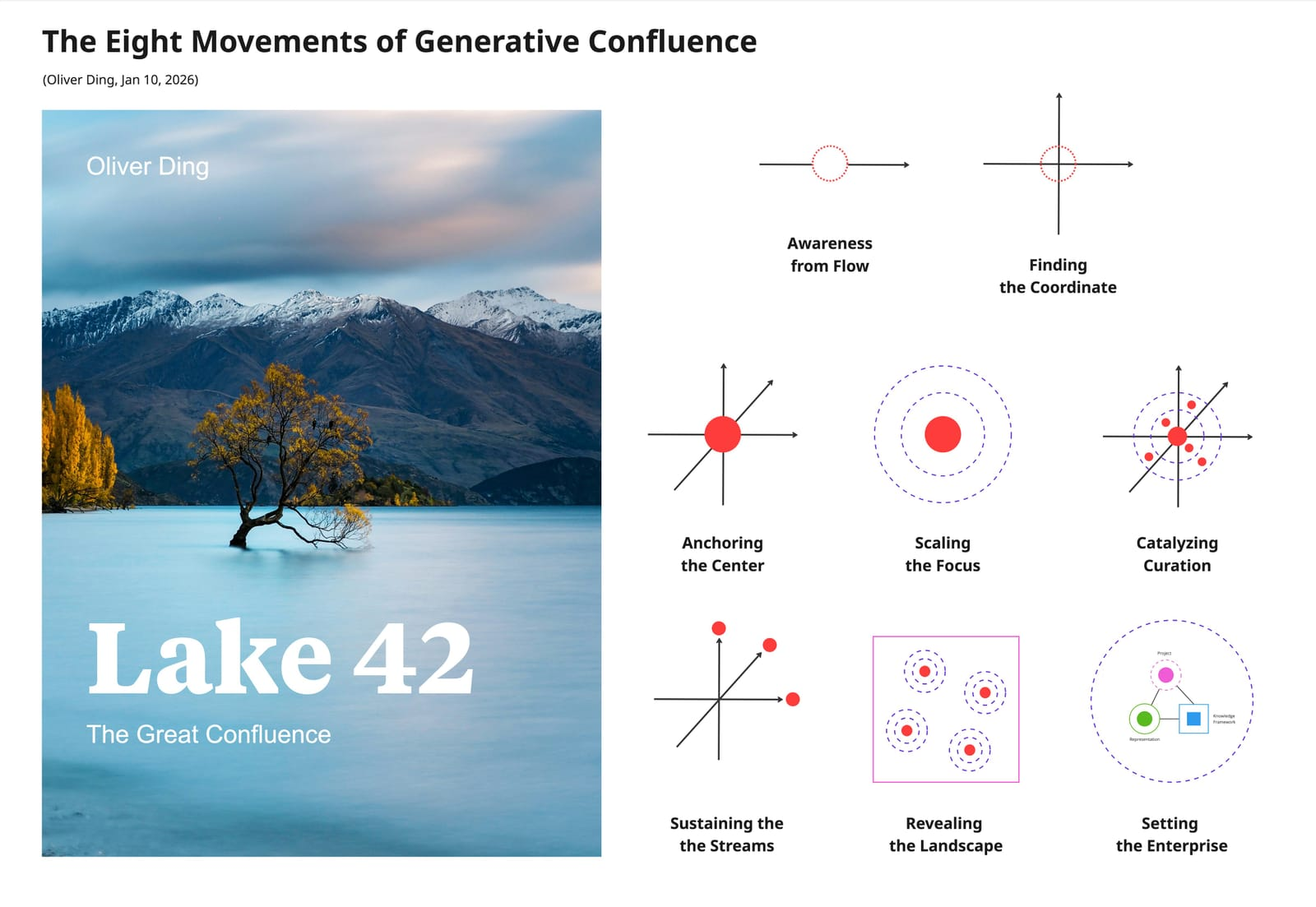
Over the past several weeks, I have begun writing a new possible book to detail the eight movements of the Generative Confluence Journey. The book is planned as a short Kindle publication consisting of twelve chapters.
Two days ago, I completed draft versions of the possible book:
- Jan 11 - Chapter One: Alice's Coordinate (3,873 words)
- Jan 12 - Chapter Two: Awareness from Flow (5,845 words)
- Jan 22 - Chapter Three: Finding the Coordinate (5,528 words)
- Jan 24 - Chapter Four: Anchoring the Center (5,330 words)
- Jan 26 - Chapter Five: Scaling the Focus (6,250 words)
- Feb 1 - Chapter Six: Sustaining the Streams (4,505 words)
- Feb 3 - Chapter Seven: Catalyzing Curation (4,933 words)
- Feb 4 - Chapter Eight: Revealing the Landscape (4,189 words)
- Feb 5 - Chapter Nine: Setting the Enterprise (5,158 words)
- Jan 21 - Chapter Ten: Living Coordinate (4,402 words)
- Feb 6 - Chapter Eleven: Fractal Confluence (5,811 words)
- Feb 9 - Chapter Twelve: Aristotle, Dragon, and Pearl (4,486 words)
- Feb 7 - Epilogue: Cognitive Hydrology (2,651 words)
This new possible book serves as a follow-up to Homecoming: A Thematic Trip and The World of Activity Approach, where I reflect on my early life and career activities prior to 2015.
Chapter Four of the book, Anchoring the Center, was published on the site as a case study of a GAP Project and a Generative Confluence Journey.
In every creative journey, there are "gaps"—informal, liminal spaces between formal projects. A gap is not just a rest; it is an Agency Threshold. When a project ends, you face a choice: stay with the given routines, or initiate a new GAP project, such as an "After" project for creative life curation, or a "Before" project for creative life discovery.
In June 2025, I crossed this threshold by launching a Before project: The “Theorizing Creative Life” Project, exploring a question:
Is my creative journey merely a collection of isolated creative actions?
After weaving together isolated thematic insights from the Wonder and Wander project — along with persona notes, conversations with a mentor and friends, and social media posts — I realized that my creative journey is a story with the “Theorizing Creative Life” theme.
This insight triggered a six-month "Generative Confluence" journey. By anchoring a new creative center within this GAP project, I moved beyond the boundaries of my previous work to develop Creative Life Theory v3.0. This journey shows that the gaps between formal projects are fertile grounds.
By intentionally occupying this gap, I turned a quiet transition into a vibrant space for theoretical exploration, setting the stage for a much larger unfolding. When we exercise our agency to bridge these gaps, we allow diverse theoretical streams to converge and generate an entirely new landscape of knowledge.
World
Me, You, and We
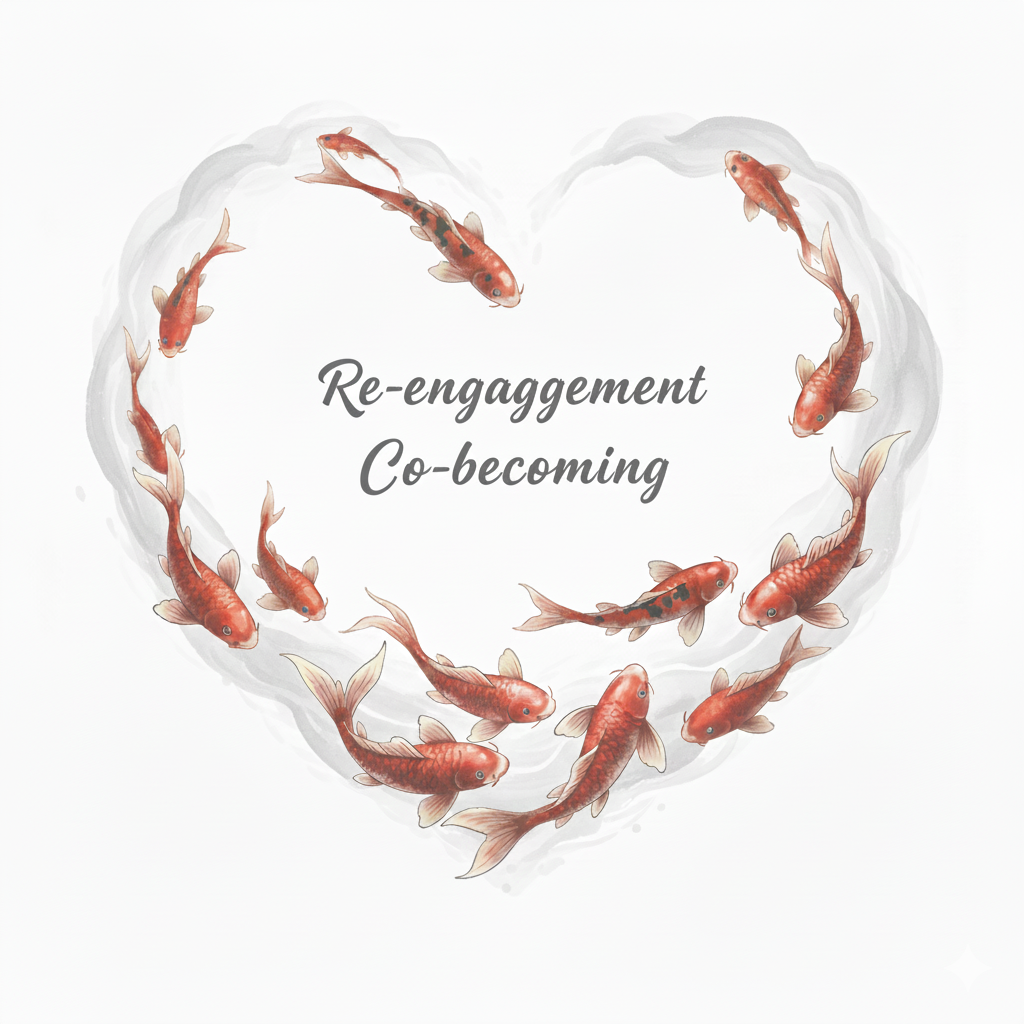
As 2026 unfolds, let us embrace the spirit of Re-engagement—to rediscover the unforgettable people, moments, and things from our past, and cherish them as the delicate culture of our lives.
With beautiful anticipations, let us journey into Co-becoming—creating a shared path alongside the uncertainties of the future.
Oliver Ding
Founder of the Activity Analysis Center
February 15, 2026
p.s. I am based in Houston, Texas, US. Where are you?
v1.0 - February 15, 2026 - 2,243 words