
Activity Analysis Network #13: Learn, Weave, and Agency Frontier

This is the 13th issue of the Activity Analysis Center newsletter
by Oliver Ding
March 15, 2026
Hi, and welcome to Activity Analysis Network, a newsletter hosted by the Activity Analysis Center.
Each issue is organized around the "Flow - Focus - Center - Circle" schema, the primary model of the World of Activity Toolkit (v1, 2025).
As a biweekly newsletter, I share summaries of new articles from the Activity Analysis Center, along with updates on related activities, including some of my own published work elsewhere.
In this issue (#13), 10 new articles have been added to the site:
- #1 - Frameworks: The L3D Model (v1.0, 2026)
- #2 - Frameworks: Learning Landscape: Revisiting from the World of Life Perspective
- #3 - Frameworks: The Significant Themes Framework (2026)
- #4 - Case Studies: Revisiting and Rebuilding: The Significant Themes Framework (2015–2026)
- #5 - Diagrams: World of Life: Four Negative Frontiers of Knowledge Engagement
- #6 - Diagrams: World of Life: Four Positive Frontiers of Project Engagement
- #7 - Z Lab: The Landscape of ACS 1.2 and a New Model of the Actor
- #8 - Methods: Spatial Heuristics: Developing a Pedagogy for Cognitive Hydrology
- #9 - Methods: Spatial Heuristics: From the Margins to the Center
- #10 - Appropriating Activity Theory #13: Agency Frontier Behind the Hierarchy of Human Activity (2020)
These articles collectively mark a significant expansion of the World of Life framework, introduce Spatial Heuristics as a new methodological stream, and advance ACS to version 1.2 with a refined model of the actor.
Flow
The historical development of the Activity Analysis Center and my experience of daily life
Over the past few issues, I have been working through the four patterns of the Bureaus of Agency framework, dedicating one issue to each: Cascade, Resonance, Threshold, and now Frontier. Each bureau describes a distinct structural configuration through which agency operates — not a personality type or a strategy, but a pattern in the terrain of activity itself. Agency Frontier is the fourth and final bureau in this cycle. As the name suggests, it describes the condition of working at frontiers — operating at the edges of established territory, where familiar frameworks reach their limits and something not yet named begins.
In my recent works, a central reference point is the World of Life — a framework I have been developing over the past weeks that maps the social world through four boundaries: Spirituality above, Science below, Collectives to the right, Individuals to the left. These boundaries have been generative in a particular way: they have guided a sequence of concept curation work, opening questions about where different frameworks live within this larger structure, and where they reach their limits.
When I sat down to write this issue's column, the "Appropriating Activity Theory" series, I found myself asking a question I hadn't asked before: Does the tradition of Activity Theory have anything analogous to the four boundaries of the World of Life? The more I thought about it, the more it seemed the answer was no — not quite. Activity Theory, across its various generations, has been primarily focused on the developed, functional structures of social practice and collective activity. It has powerful tools for analyzing what is already in motion. It rarely touches the edges, the frontiers, the zones where established practice meets what has not yet become practice.
And yet, when I went back to look at an article I wrote in 2020 — on the Universal Hierarchy of Human Activity — I found something unexpected. That article had, in fact, been working at precisely those edges. It had reached upward beyond what Activity Theory normally handles, and downward into territory the tradition had deliberately left to one side. At the time, I had no name for what I was doing. I was not thinking about Agency Frontier. I was just following the logic of the inquiry wherever it led.
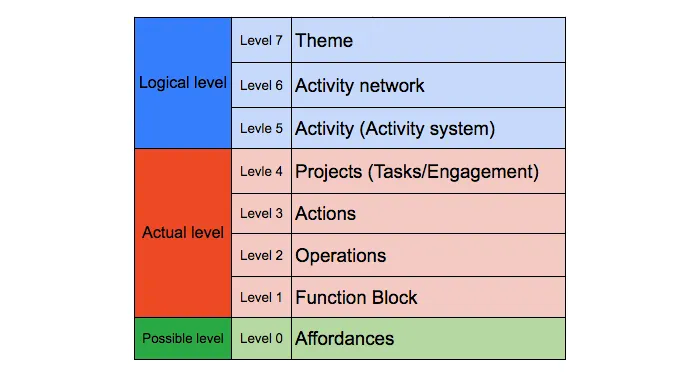
This case study examines the hierarchical structure of activity and traces how the choices to reach beyond Activity Theory's traditional boundaries were early expressions of Agency Frontier. Read the full article here.
Focus
The Thematic Foci of the Activity Analysis Center
The past two weeks have brought the ACS framework to v1.2, marked by two significant developments: the expansion of the method-orientations from three to five, and the completion of the Bureaus of Agency sequence with Agency Frontier.
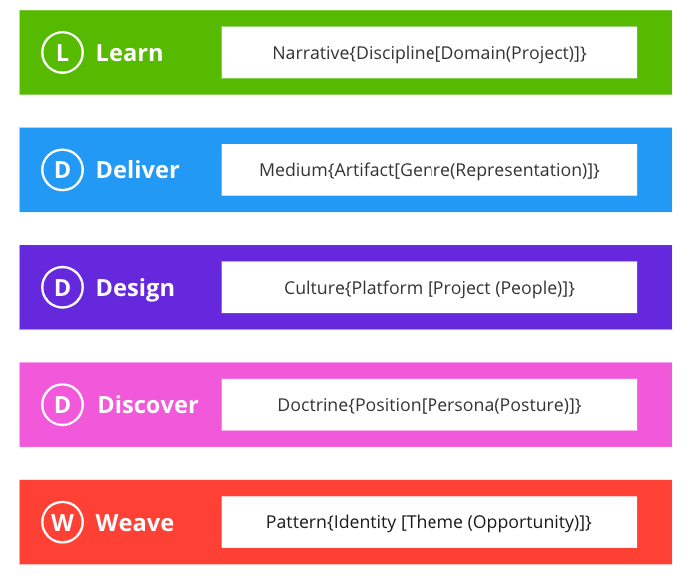
Learn + Weave: The Five Orientations
Where ACS v1.1 (February 27) organized the center around Discover, Design, and Deliver, v1.2 adds two new rings to the diagram:
- Learn — positioned at the outermost ring. This is not merely an additional orientation. It marks the condition of possibility for all the others: an actor who cannot learn cannot act. Knowledge and skill are the necessary antecedents of every cultural engagement. Learn is where the world enters the actor—the interface between interiority and the cultural resources that surround us.
- Weave — positioned at the innermost ring. This names the integrative action that holds everything together. Real practice is never single-mode. A cultural actor always simultaneously discovers, designs, delivers, and learns—and the action that weaves these into coherent practice is Weave. Its position at the center is its meaning.
Three Days in March: The Birth of Cognitive Hydrology Pedagogy
The addition of Learn was not merely theoretical. Between March 1 and March 3, a concentrated creative episode brought it to life.
It began with "Bob"—a reader of the Lake 42 manuscript navigating anxiety around AI's acceleration. Reflecting on his situation, I recognized he was at the pre-activity stage: not yet ready to receive theoretical frameworks without prior cognitive preparation. This insight named the Learn stage, which joined the existing Discover-Design-Deliver model to form the L3D framework (Learn → Discover → Design → Deliver).
That evening, revisiting the Learning Landscape—a framework from 2015–2016—I anchored its four perspectives into the four boundaries of the World of Life. The structural fit was precise: Disciplinary at Science, Domain at Collectives, Project at Individuals, Narrative at Spirituality. This configuration produced an unexpected insight: learning is the internalization of the four boundaries; Discover-Design-Deliver is their externalization. A complete breath.
The next day, tool selection followed. The FFCC schema (Flow-Focus-Center-Circle) called out to four tools from the archive—Thematic Matrix Canvas, The ECHO Way, Generative Confluence, Weave the Theory—each finding its natural position. The architecture of Cognitive Hydrology Pedagogy was taking shape.
On the third day, a single paragraph that would not settle forced a deeper clarification. Through dialogue with DeepSeek, Thematic Space Theory provided the key: FFCC is Form (where you are), L3D is Method (what you do), and the six Slow Cognition operations are Moves (how you act). The three-level structure resolved. Later that day, while reviewing materials, an unexpected discovery: the same spatial logic extended to Discover, Design, and Deliver—three independently developed ACS v1.1 articles already shared the structure. The toolbox had been waiting, unrecognized.
Agency Frontier: The Fourth Bureau
This issue completes the Bureaus of Agency sequence, introduced one per issue since #10:
- Issue #10: Agency Cascade — agency flowing through nested levels
- Issue #11: Agency Threshold — agency operating at structural boundaries
- Issue #12: Agency Resonance — multiple circles activating simultaneously
- Issue #13: Agency Frontier — creative engagement with unchangeable structural constraints
Agency Frontier describes the condition of working at the edges of established territory, where familiar frameworks reach their limits and something not yet named begins. It operates at the outermost structural level—engaging with the fundamental boundaries of existence itself.
At the end of Appropriating Activity Theory #13: Agency Frontier Behind the Hierarchy of Human Activity (2020), a new diagram was introduced:
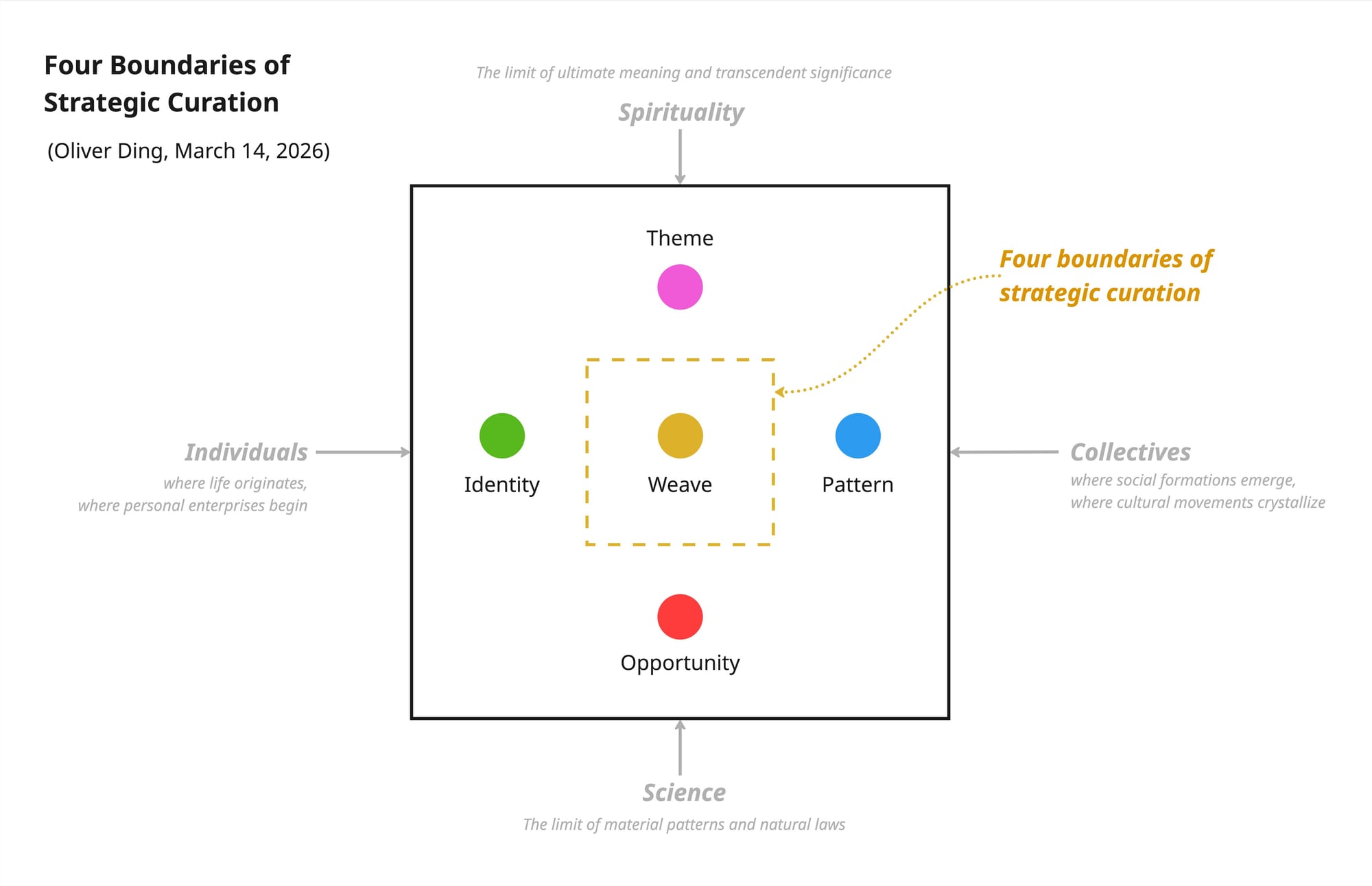
The diagram above maps this dynamic spatially — I call it the Four Boundaries of Strategic Curation. Weave sits at the center, surrounded by the four concepts that correspond to the four boundaries of the World of Life: Theme above, Opportunity below, Identity to the left, Pattern to the right.
Why Strategic Curation? In the Nine Aspects of Strategic Agency — the cognitive-level framework that mirrors the Four Bureaus of Agency — Strategic Curation is the core. The Nine Aspects describe how agency operates at the level of individual cognition; the Four Bureaus describe how agency is structurally positioned in the social world. These two frameworks are mirrors of each other: one maps the inner capacity, the other maps the outer configuration.
Agency Frontier is the Bureau that operates at the outermost structural level — engaging with the fundamental boundaries of existence itself. Strategic Curation is its cognitive counterpart — the inner practice of gathering, connecting, and making whole. The Four Boundaries of Strategic Curation is where these two meet: a map of how the innermost practice (Weave) is oriented by the outermost conditions (the four boundaries).
Agency Frontier, understood this way, is not a single dramatic act. It is the ongoing pattern of how we respond to the exploratory, frontier-facing opportunities that social life continuously presents. Our choices at those frontiers are never made in a vacuum. They are shaped by who we are — our individual themes and identity — and by the nature of what we are working on — the themes and identity of the project itself. The four concepts hold this dynamic together: Opportunity names what is offered, Theme and Identity name what we bring, and Pattern names what gets made in the encounter.
The four boundaries of the World of Life, the four negative frontiers, the four positive frontiers — they are all elaborations of the same impulse: to work at the boundaries, to find what becomes possible there, and to stay long enough to bring something back.
Center
The Core of the Activity Analysis Center
The Activity Analysis Center hosts two major theoretical enterprises: the Life-as-Activity Approach (including the Project Engagement Approach) and the World of Activity Approach, now operating within a nested structure: World of Life (World of Activity).
This issue marks a significant milestone: the World of Life, first established as the foundational map of the social world, has now incubated The Landscape of Anticipatory Cultural Sociology (ACS) v1.2—a complete theoretical architecture that unexpectedly revealed itself as a model of the actor.
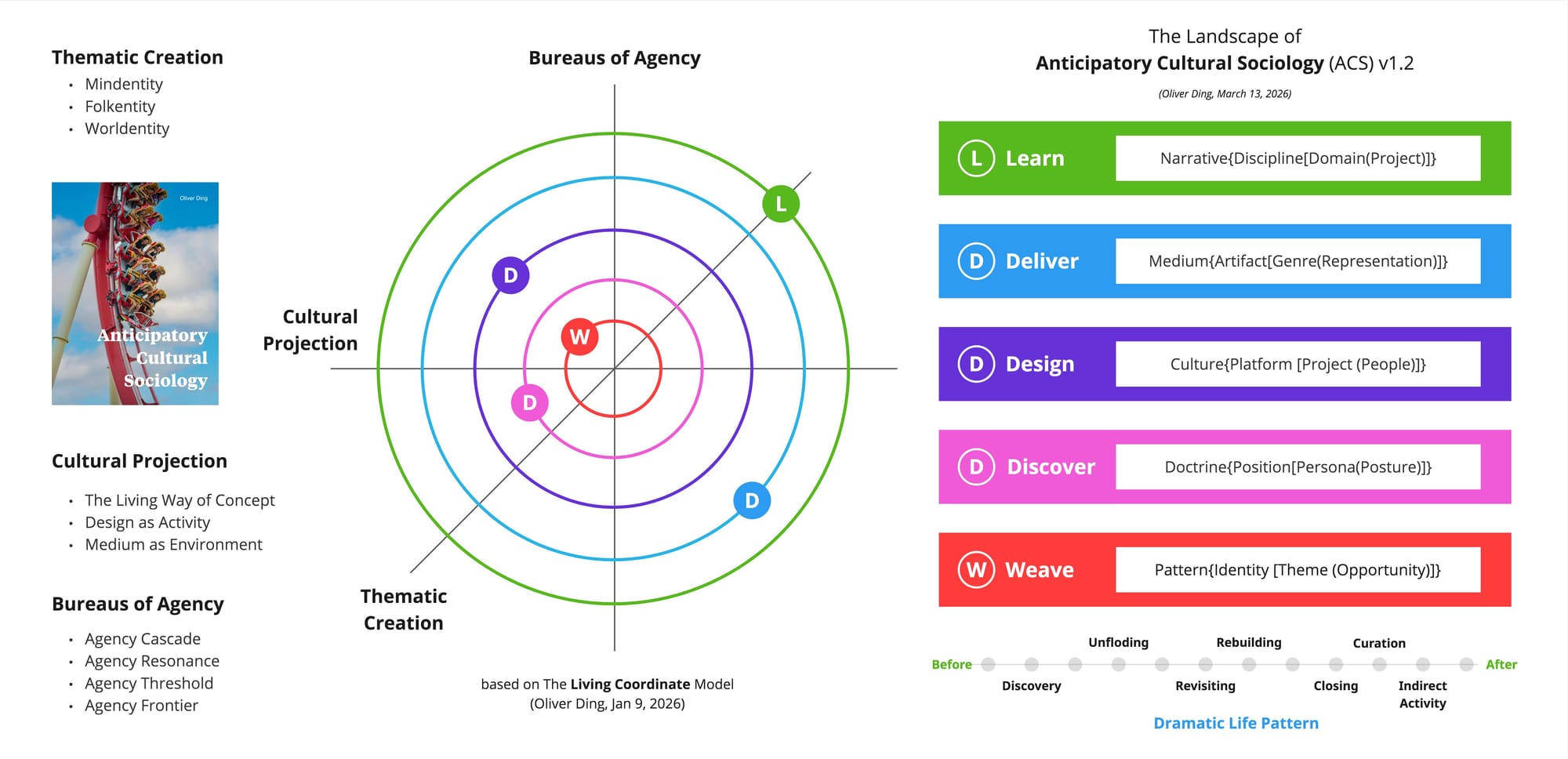
ACS did not begin with a model of the actor. It began, in January 2026, with a map of the social world—the four boundaries of the World of Life (Spirituality above, Science below, Individuals left, Collectives right). The question at v1.0 was not what is a person? but where does cultural development happen, and what are its fundamental mechanisms?
Through v1.1 (February) and into v1.2 (March), ACS advanced along three simultaneous axes: Thematic Creation (Mindentity → Folkentity → Worldentity), Cultural Projection (Discover → Design → Deliver), and the Bureaus of Agency (Cascade → Resonance → Threshold → Frontier). The method-orientations expanded from three to five with the addition of Learn and Weave. The Dramatic Life Pattern timeline reached its fuller form.
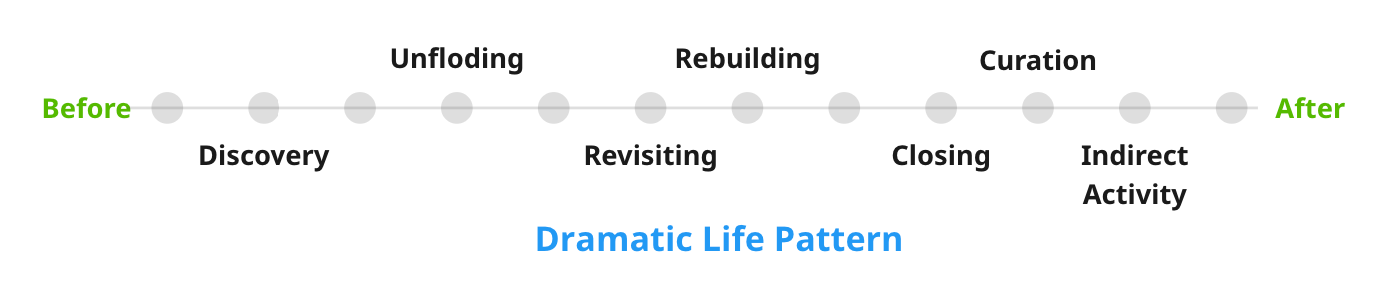
And then, when the landscape was complete, something unexpected arrived. Looking at the completed diagram—three-dimensional coordinate, five concentric rings, individual at center, world at periphery—a recognition emerged: this structure applies equally to Strategic Developmental Psychology (SDP), the mirror enterprise focused on individual life development. If the diagram describes both cultural life at the collective scale and individual life at the personal scale, then it is describing something more fundamental: the actor as such.
The ACS model of the actor is organized around three dimensions: Thematic Creation (the actor as ontological origin), Cultural Projection (the actor as operative presence), and Bureaus of Agency (the actor as positioned being). It is organized around five orientations: Learn (receptive), Discover (exploratory), Design (constructive), Deliver (contributive), and Weave (integrative). And it is spatial and visual—a Living Coordinate that can be held, examined, customized, and inhabited.
The map was drawn to understand cultural development. The figure it traced, all along, was the actor—free to move.
Circle
The Context of the Activity Analysis Center
Over the past several years, I worked on several theoretical projects, such as the Ecological Practice Approach, Curativity Theory, Creative Life Theory, and Thematic Space Theory.
Inspired by creativity researcher Howard Gruber's idea of "Network of Enterprises," I used the "Knowledge Center" approach to manage this large knowledge system. Each knowledge center hosts one or two related theoretical approaches.
- CALL (Creative Action Learning Lab): the Ecological Practice Approach and Creative Life Theory
- Curativity Center: Curativity Theory
- TALE (Thematic Analysis Learning Engagement): Thematic Space Theory
- Frame for Work: A theory about Knowledge Frameworks
As mentioned in the previous issue, I was inspired by Lake 42's Epilogue and Appendix, moved to reflect on the Creative Life Curation method and the broader landscape of Creative Life Theory and the Ecological Practice Approach. The outcome was the "Cognitive Hydrology" Trilogy (#6) and a new practice named Thematic Development Study (#3).
Since "Cognitive Hydrology" was based on Thematic Space Theory, I decided to assign it to TALE.
The three days in early March—documented in the Focus section—produced the Cognitive Hydrology Pedagogy (v1.0), a structured approach to teaching and practicing Cognitive Hydrology. Built on a three-level architecture, it distinguishes between Form (where the learner is, described by the FFCC schema), Method (what the learner does, described by L3D), and Moves (how the learner acts, described by the six Slow Cognition operations). This framework provides a systematic pathway for engaging with the theoretical work developed at the Center.
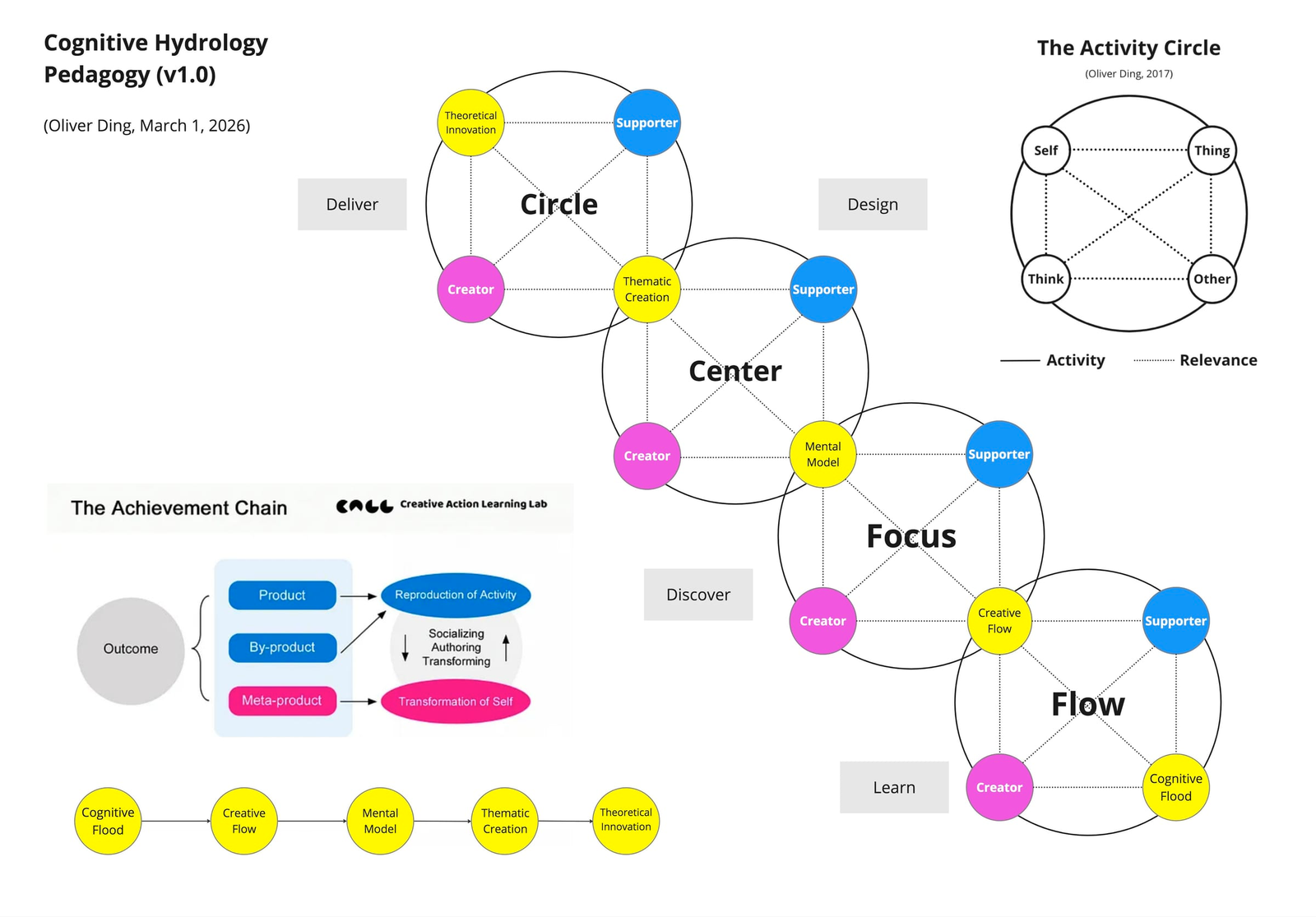
The creation of this pedagogy, however, was not separate from the development of ACS v1.2. The two processes intertwined across those three days—each informing the other, each shaped by the same spatial operations. This intertwining has led me to launch a new series: Spatial Heuristics.
With ACS v1.2 now complete, I have begun documenting, through detailed case studies, the spatial heuristics strategies that shaped its development. The article that records the three-day creation of Cognitive Hydrology Pedagogy—Spatial Heuristics: Developing a Pedagogy for Cognitive Hydrology (March 11)—serves as the first case study in this series, examining how Spatial Curation, Structural Encounter, and Analogical Extension drove the creative process.
The second case study, From the Margins to the Center (March 12), reaches back further: to a Saturday in February when the concept of Posture arrived unexpectedly in a library, setting in motion a cascade of frameworks across six weeks that became the backbone of ACS v1.1.
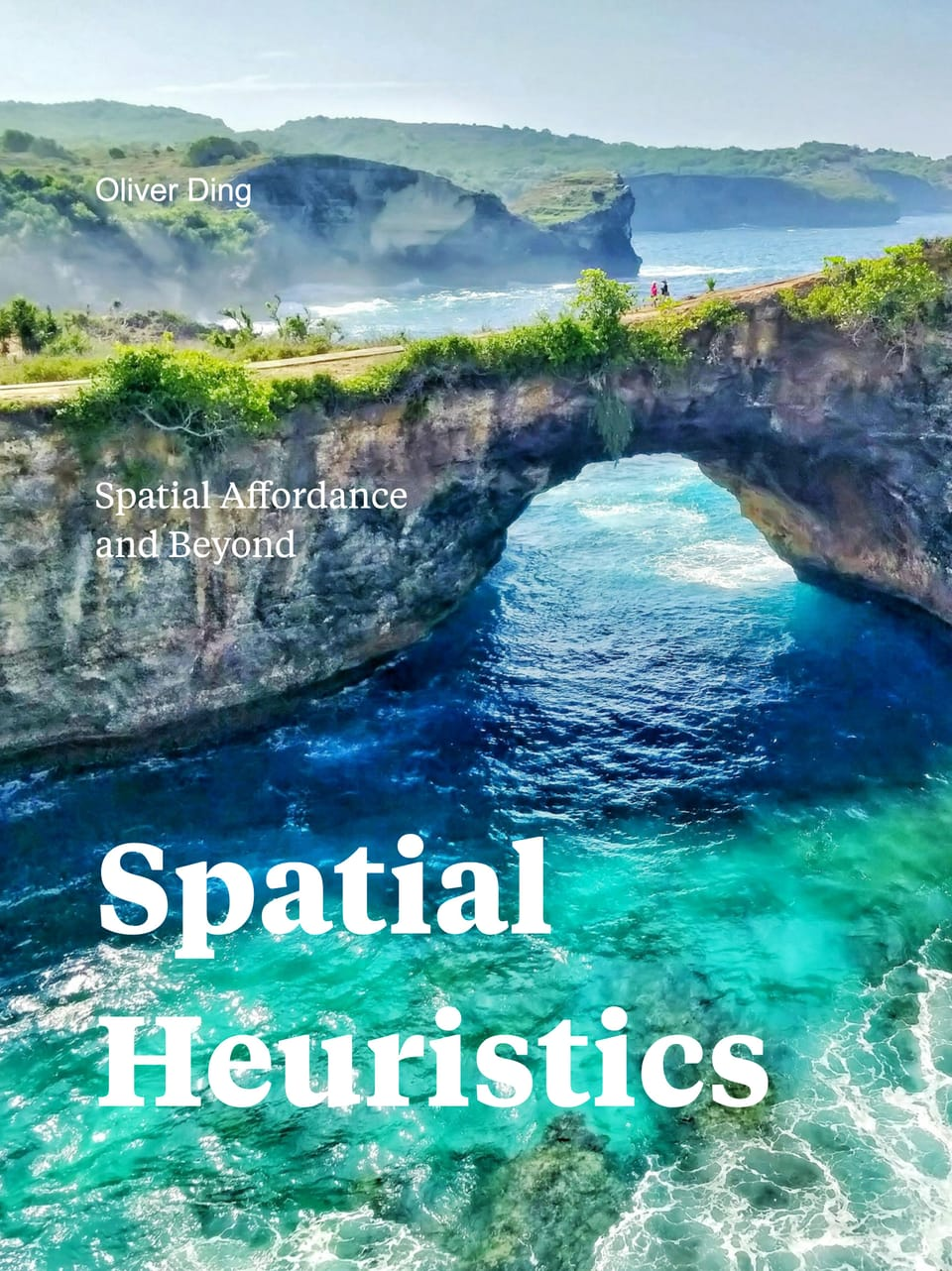
If Lake 42 documents the Generative Confluence pattern — the development of Creative Life Theory v3.0–v3.1 through the convergence of multiple streams — then the development of ACS from v1.0 to v1.1, across January and February 2026, documents a different pattern: Spatial Heuristics.
This series anticipates a new book manuscript. Like the Generative Confluence of Lake 42, this manuscript will itself be a confluence — of three distinct streams that have been developing in parallel —the Theme-Concept-Framework lineage, the Creative Diagramming inquiry, and Cognitive Hydrology —all converging at Thematic Space Theory.
As the second case study's afterword notes: "The series, like the method it documents, unfolds from the margins toward a center that is still being built."
World
Me, You, and We
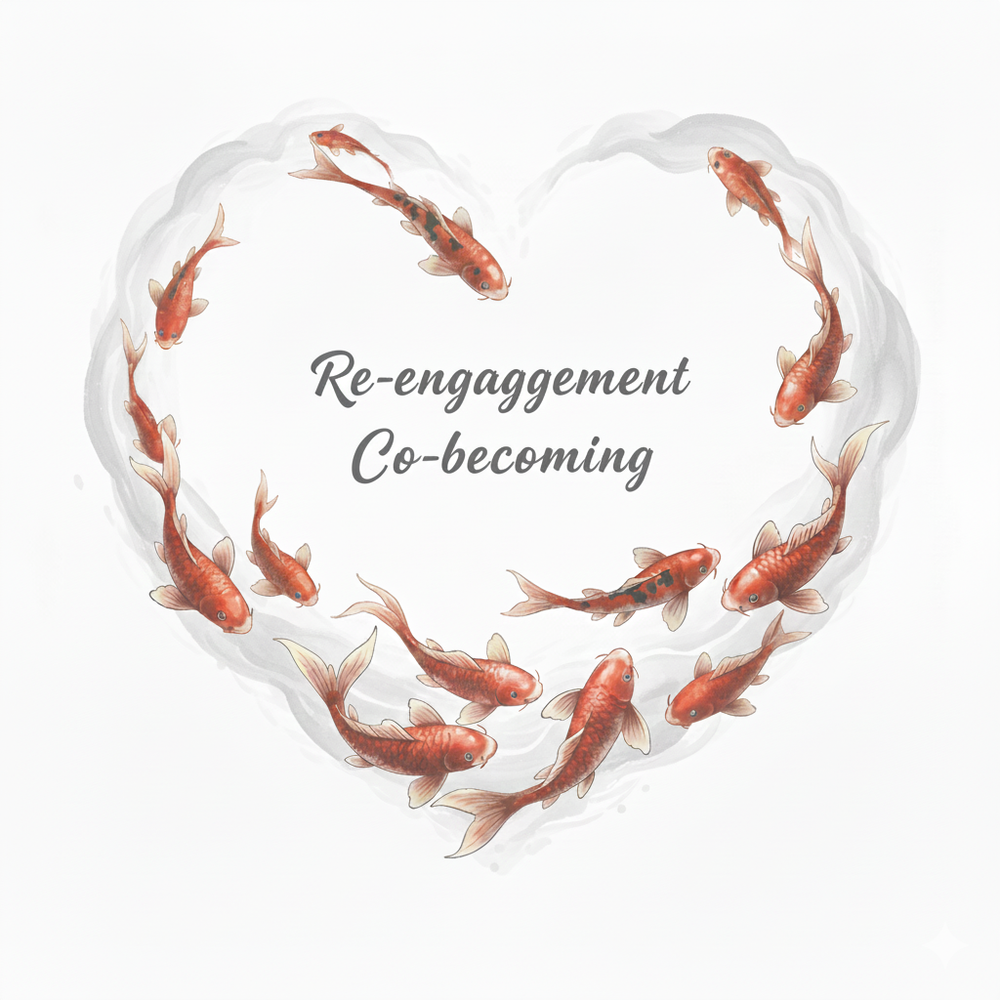
Spring in Houston. The oak trees are dropping their old leaves to make way for new growth—a reminder that shedding is not loss, but preparation.
Thank you for traveling with me through this issue's terrain: from a quiet morning revisiting a 2020 article to the four frontiers of the World of Life, from three days of intense creation to the launch of a new series that will document how the building happens.
The next two weeks will continue to explore Spatial Heuristics and its applications. If you have examples from your own life of working at the boundaries—moments when spatial recognition guided your thinking—I'd love to hear them.
Oliver Ding
Founder of the Activity Analysis Center
March 15, 2026
p.s. I am based in Houston, Texas, US. Where are you?
v1.0 - March 15, 2026 - 2,654 words