
Activity Analysis Network #14: Self, Other, and Supportive Self-Actualization

This is the 14th issue of the Activity Analysis Center newsletter
by Oliver Ding
March 31, 2026
Hi, and welcome to Activity Analysis Network, a newsletter hosted by the Activity Analysis Center.
Each issue is organized around the "Flow - Focus - Center - Circle" schema, the primary model of the World of Activity Toolkit (v1, 2025).
As a biweekly newsletter, I share summaries of new articles from the Activity Analysis Center, along with updates on related activities, including some of my own published work elsewhere.
In this issue (#14), 8 new articles have been added to the site:
- #1 - Z Lab: The Landscape of Anticipatory Cultural Sociology (v2.0)
- #2 - Concepts: Revisiting, Rebuilding, Re-engaging with Past Selves
- #3 - Case Studies: Revisiting-Rebuilding: Agency Cascade and the Transformation of Self
- #4 - Case Studies: Engaging with Others for Developing Anticipated Identity
- #5 - Concepts: Supportive Self-Actualization as Anticipatory Activity
- #6 - Appropriating Activity Theory #14: Self, Other, and Embodied Social Forms (2017, 2021, 2025)
- #7 - Library: Anticipatory Cultural Sociology: Creation, Projection, and Agency (Possible Book, 2026)
- #8 - Library: From GO Theory to ACS and Beyond
These articles collectively mark a milestone of the Anticipatory Cultural Sociology (ACS) project. With the release of the ACS manuscript and the completion of the Self–Other series, the framework has reached v2.0 — a qualitative transition that brings a complete model of the actor, integrates the Self–Other dimension, and establishes the structural alignment between ACS and its partner project, Strategic Developmental Psychology (SDP).
Three months of intensive development have found their close.
Flow
The historical development of the Activity Analysis Center and my experience of daily life
Yesterday, I published the ACS manuscript, Anticipatory Cultural Sociology: Creation, Projection, and Agency, documenting the development from v1.0 through v2.0 and the final synthesis. In that process, I developed the Agency Cascade model from the Activity Circle, which in turn brought forth the Bureau of Agency and three related agency models. Since late March, I have been focusing on the Self–Other relationship within the Activity Circle, producing a series of articles on that theme.
The #6 article (Appropriating Activity Theory #14: Self, Other, and Embodied Social Forms (2017, 2021, 2025) traces that thread from its origins. It revisits the explorations of Self, Other, and their relational structure across nearly a decade of work — from the Thing-People Relation model of 2017 through the Typology of Relevance in 2021, the birth of the Activity Circle in 2022, and now the articulation of Embodied Social Forms within the ACS project in 2025–2026.
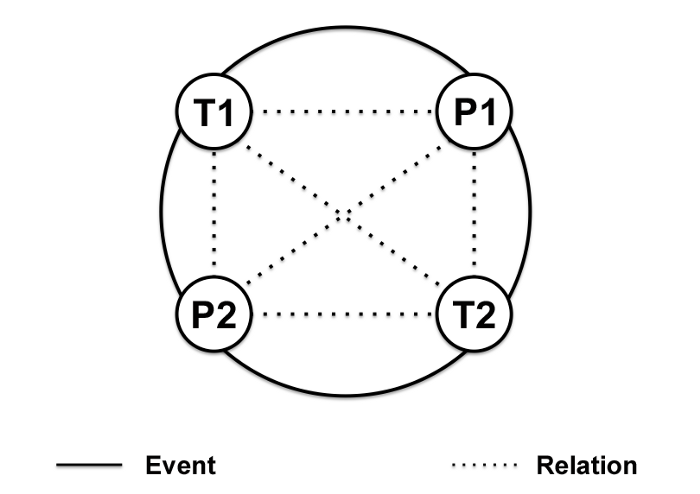
The purpose is not merely to document a history but to reveal a deeper coherence: that the practice of grounding social forms in Basic Ecological Forms was already operative in 2017 — and that what the recent work on Embodied Social Forms provides is not a new method, but the explicit naming of something that had been running beneath the surface from the very beginning.
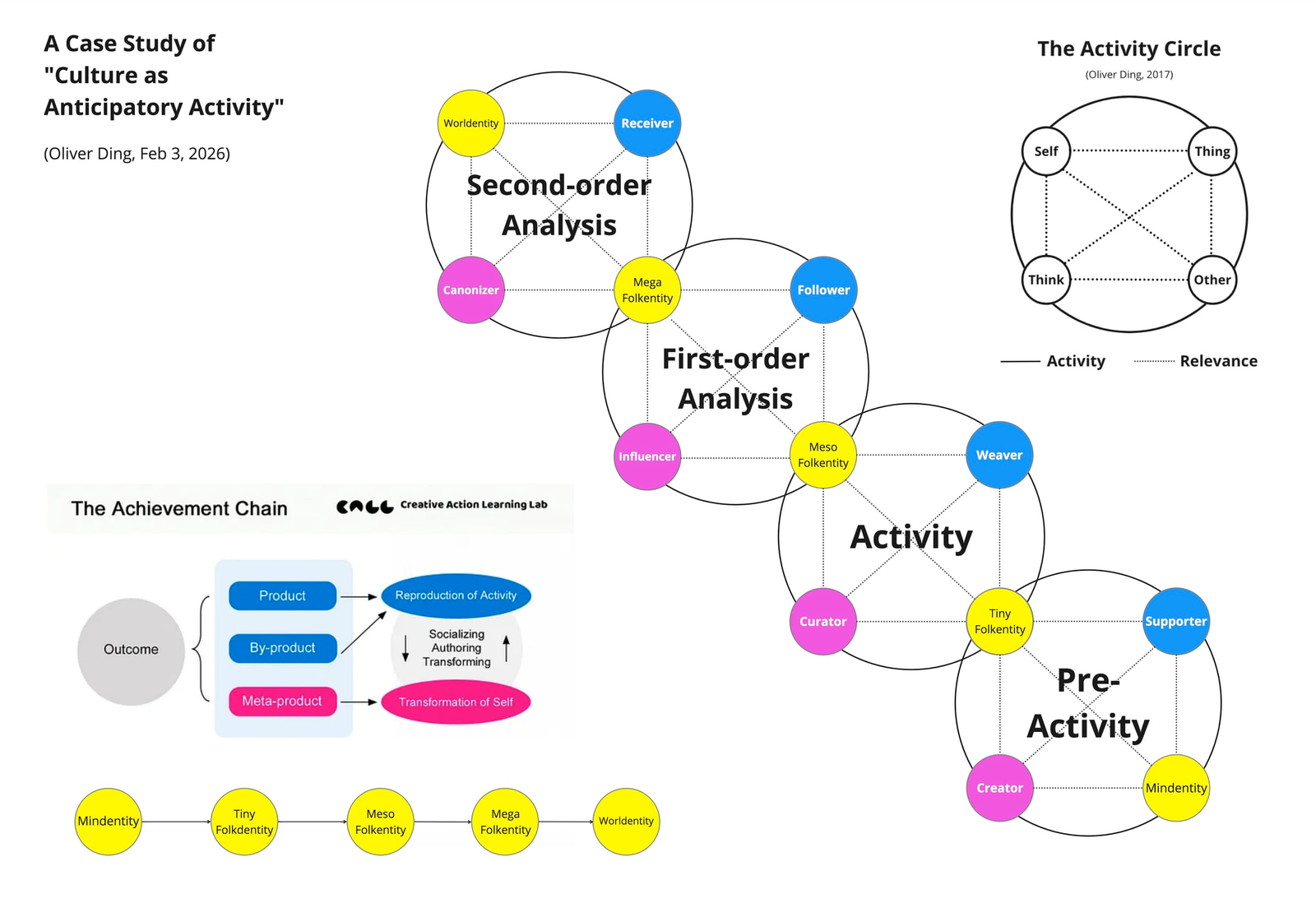
This is not a revision of previous work. It is a deepening. The earlier frameworks remain intact; what changes is our understanding of why they have the shape they do. By connecting Activity Theory's social models to the embodied basis of social forms, this line of inquiry brings interesting insights to both Activity Theory and phenomenological sociology — and opens a path toward a more unified account of how bodily life becomes cultural life.
Focus
The Thematic Foci of the Activity Analysis Center
The past two weeks have brought the ACS framework from v1.2 to v2.0.
On March 18, 2026, reflecting on the relationship between the LARGE Method and the ACS v1.2 Actor Model, it became clear that the Self–Other dimension was absent from the three-dimensional structure. The question was how to respond. The decision was to maintain the simplicity and integrity of ACS's three-dimensional model rather than expand it to four dimensions. The Self–Other dimension would continue to develop — but within Strategic Developmental Psychology (SDP), where it more naturally belongs, under the axis of Supportive Life Discovery.
The shift from ACS to SDP marks a sign: after a three-month creative sprint, it is time to edit a book to collect articles that build the ACS (v2.0).
The new book is titled Anticipatory Cultural Sociology: Creation, Projection, and Agency. It is organized around the "Flow - Focus - Center - Circle" schema, the primary model of the World of Activity Toolkit (v1, 2025).
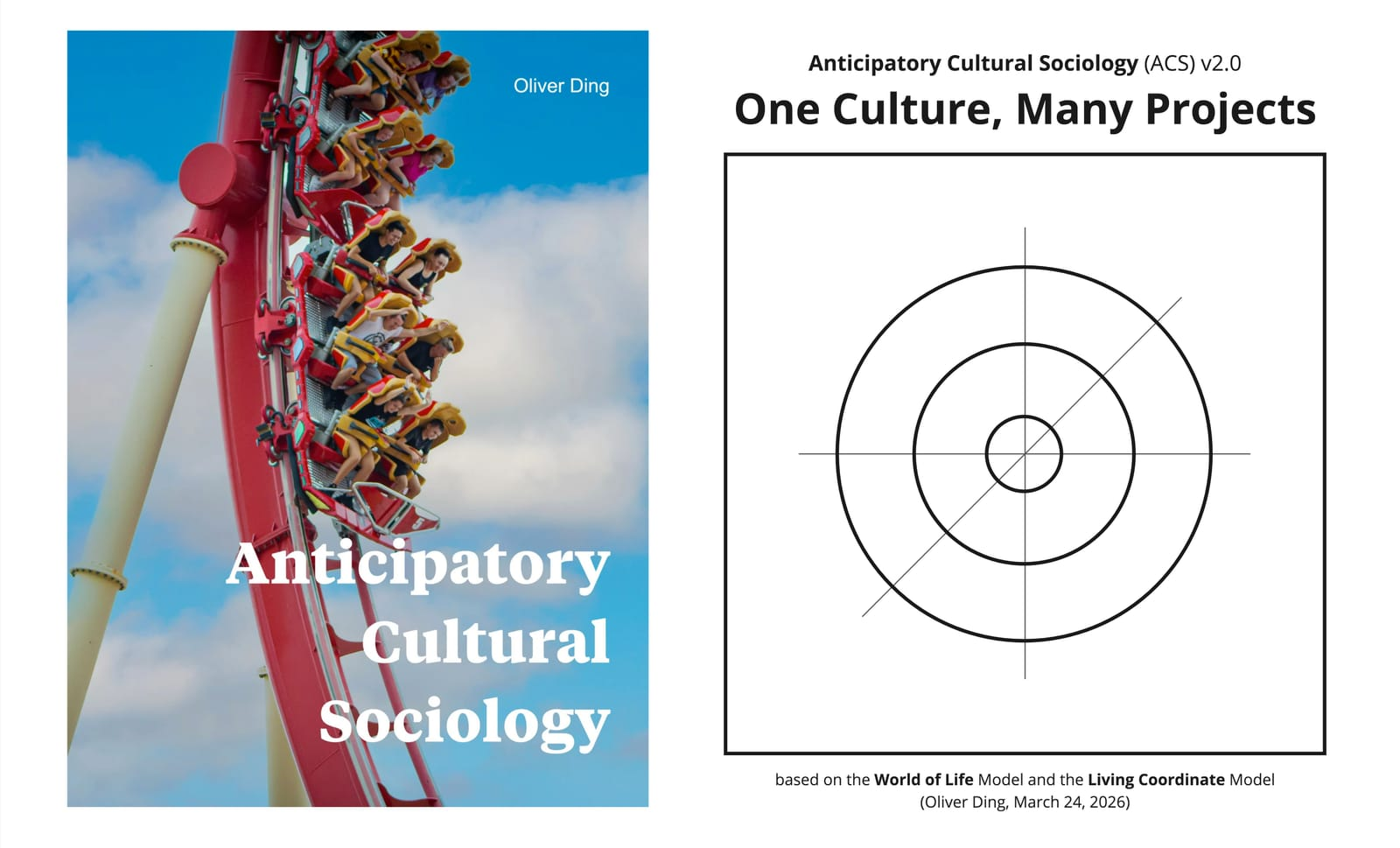
What v1.0 established was a center. What followed — across January, February, and March 2026 — was its expansion. Three axes of development advanced simultaneously: Thematic Creation, Cultural Projection, and Bureaus of Agency. A fourth development arrived through reflection: the Self–Other dimension, present in the foundations but not yet explicitly developed, was named and assigned to SDP's Supportive Life Discovery axis, while its traces within ACS were recognized and gathered. And a fifth arrived unexpectedly: as the landscape reached completion at v1.2, a model of the actor emerged from the structure itself.
ACS v2.0 marks a qualitative transition. The jump from v1.x to v2.0 is not incremental — it reflects the arrival of a complete model of the actor, the integration of the Self–Other dimension, and a structural realignment between ACS and its mirror enterprise, Strategic Developmental Psychology (SDP). The landscape that began as a map of cultural development has become, simultaneously, a portrait of the cultural actor who inhabits it.
More details can be found in #1 - Z Lab: The Landscape of Anticipatory Cultural Sociology (v2.0) and #7 - Library: Anticipatory Cultural Sociology: Creation, Projection, and Agency (Possible Book, 2026).
Center
The Core of the Activity Analysis Center
The Activity Analysis Center hosts two major theoretical enterprises: the Life-as-Activity Approach (including the Project Engagement Approach) and the World of Activity Approach, now operating within a nested structure: World of Life (World of Activity).
This issue marks a significant milestone: exploring the Self-Other relation within the Activity Circle model, a core framework of the Life-as-Activity Approach.
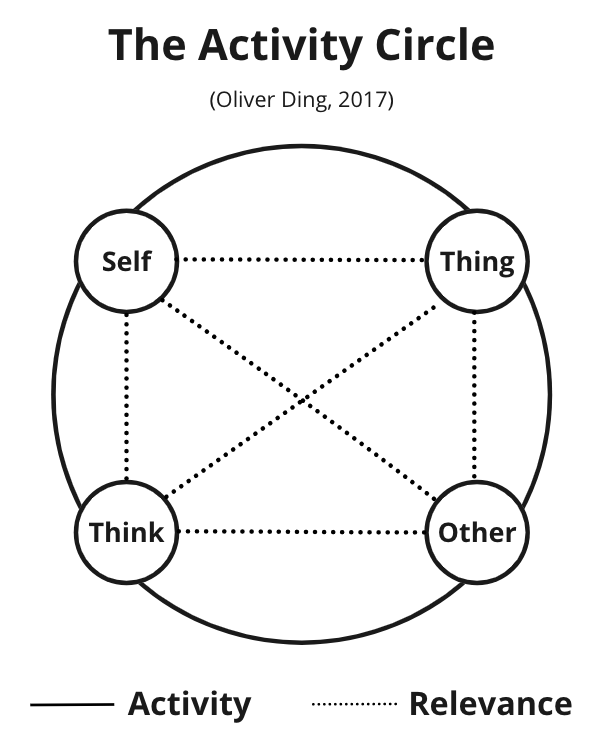
The Activity Circle focuses on “Self, Other, Thing, and Think”. It is perfect for discussing a special object that has double properties: material property and mental property. This idea was inspired by cultural-historical psychologist Lev Vygotsky’s two types of mediating tools: technological tools and psychological tools.
The original idea of the Activity Circle is called the "Activity - Relationship" perspective, which was developed in 2017.
In 2021, I used it to connect Activity Theory with Relevance Theory. The model was named The Relevance of Zone.
In 2022, I rediscovered it with several new triggers and decided to rename it Activity Circle.
ACS v1.0 through v1.2 developed along three axes — Thematic Creation, Cultural Projection, and Bureaus of Agency — all oriented toward cultural life at the collective scale. A fourth dimension was present in the theoretical foundations but had not been explicitly developed: the Self–Other relation as the primary site of social formation.
On March 18, 2026, reflecting on the relationship between the LARGE Method and the ACS v1.2 Actor Model, it became clear that the Self–Other dimension was absent from the three-dimensional structure. The decision was to maintain the integrity of ACS's three-dimensional model rather than expand it to four dimensions. The Self–Other dimension would continue to develop — but within SDP (Strategic Developmental Psychology), a companion project to ACS that focuses on the individual and relational dimensions of creative life, where it more naturally belongs.
From March 20 to 29, while writing a series of articles on the Revisiting–Rebuilding practice (1, 2, 3, 4), I took a further step and constructed a comprehensive account of the Self in its relational constitution.
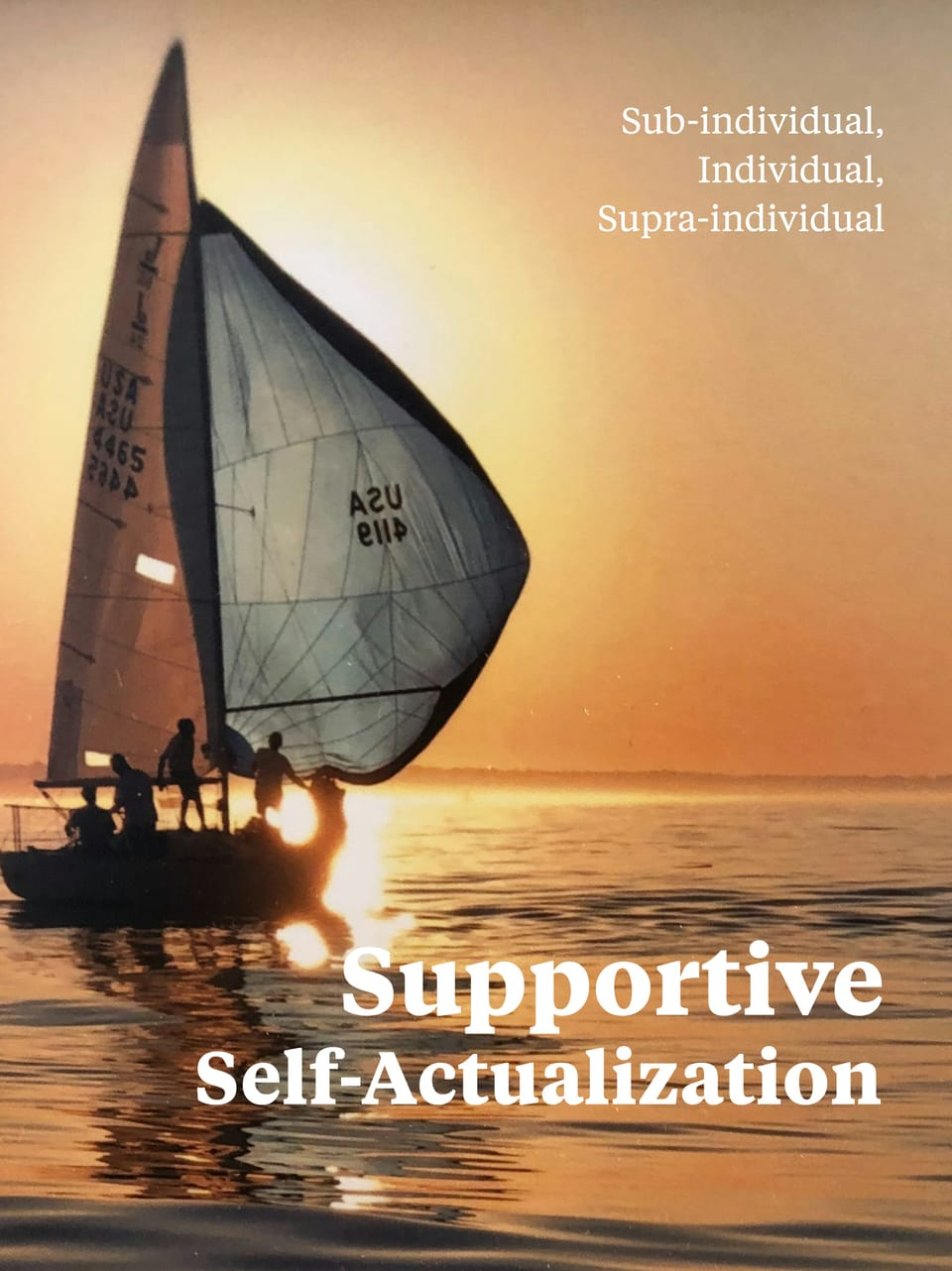
The key theoretical contributions of this series are four:
First, the three-layer architecture of Self — Sub-individual, Individual, Supra-individual — provides a model of the person genuinely adequate to the relational complexity of cultural life.
Second, the concept of Persons Acting in Concert, grounded in the concrete legal-practical phenomenon of aligned action and its consequences, names the specific structure through which the Self–Other whole constitutes itself as a Supra-individual.
Third, the Principle of Double Genidentity — the simultaneous development of the Genidentity of Creative Life and the Genidentity of Things — shows how self-actualization and cultural contribution are not two separate activities but two faces of the same anticipatory movement.
Fourth, the extension of this framework to a person and their own AI agents gives the Self–Other dimension immediate relevance to the emerging conditions of creative practice in the age of AI.
Within ACS, this dimension is carried by the Supportive Life Discovery series and the foundational concepts already present in ACS v1.0: Embodied Social Forms, Supportance, Double Genidentity, Social Moves, and the AAS framework's Self–Other–Present–Future structure. These concepts name the relational conditions of cultural creation — the way in which Other is not merely an audience but a constitutive presence in the unfolding of any thematic enterprise.
Circle
The Context of the Activity Analysis Center
Over the past several years, I worked on several theoretical projects, such as the Ecological Practice Approach, Curativity Theory, Creative Life Theory, and Thematic Space Theory.
Inspired by creativity researcher Howard Gruber's idea of "Network of Enterprises," I used the "Knowledge Center" approach to manage this large knowledge system. Each knowledge center hosts one or two related theoretical approaches.
- CALL (Creative Action Learning Lab): the Ecological Practice Approach and Creative Life Theory
- Curativity Center: Curativity Theory
- TALE (Thematic Analysis Learning Engagement): Thematic Space Theory
- Frame for Work: A theory about Knowledge Frameworks
Around October 2024, I set three goals for the GO Theory project. The initials GO stand for Genidentity and Opportunity.
The first was to launch a book draft around the concept of Genidentity. The second was to run a creative dialogue between Creative Life Theory and the Ecological Practice Approach. The third — the most ambitious — was to move into the field of cultural development by building the Cultural Genidentity Framework. The ambition behind all three goals was the same: to broaden the scope of my theoretical work from individual life development toward Social Life Development.
In practice, the first half of 2025 unfolded differently than planned. Rather than pursuing these goals directly, I worked on them through Indirect Activity — developing adjacent projects whose by-products fed into GO Theory. The most significant outcome was the World of Activity toolkit, which included a systematic exploration of the dialectical relationship between Theme and Identity. These were genuine achievements. But they remained at the level of individual development. The third goal — entering the territory of cultural development — had not yet been reached.
On June 18, 2025, I curated these outcomes into GO Theory: Genidentity, Opportunity, and World of Activity (book, v1.0) and declared it Phase I. The subtitle names what had actually been accomplished: Genidentity, Opportunity, and World of Activity. Phase II — the move into cultural development — remained ahead.
On January 5, 2026, the Anticipatory Cultural Sociology (ACS) project was formally named. In the months since, the work has centered on deep exploration of the World of Life — including the landscape you are reading now.
I did not plan it this way. But looking back, it is now clear: ACS is actually Phase II of GO Theory. The third goal set in October 2024 — moving into cultural development — is now being pursued in earnest. The vocabulary is the same: Genidentity, Opportunity, World of Activity. But the container has expanded. The question is no longer only how a creative individual develops within their life course. It is how cultural enterprises develop within the World of Life.
And looking further still, a larger picture has come into view. GO Theory is not only the name for Phase II. It is the name for the theoretical platform itself — now carrying a fuller title:
GO Theory: The World of Life (World of Activity) Approach
The initials GO — originally standing for Genidentity and Opportunity, now expanded to Generation and Orientation — name the two directions that define the platform's theoretical character. Generation names the productive, emergent, forward-moving dimension of cultural and individual life: things are created, enterprises unfold, meaning accrues. Orientation names the positional, directional, sense-making dimension: actors are always somewhere, always facing some directions rather than others, always situated within a World of Life that both enables and limits — and always anticipating, projecting themselves toward futures that are not yet given but are already shaping present action.
This platform has its own knowledge ecosystem, built on three meta-frameworks completed between November 2025 and February 2026:
- Ontology: The History{Life[Self(Body)]} Framework (HLS Framework, v3.0, 2025) — the map of the social world, introduced in Meta-frameworks: Creative Heuristics for Individual and Social Development (book, v1.0, 2025), December 2025
- Epistemology: The Ecological Formism Framework (v2.0, 2025) — the structure of knowledge systems, introduced in Ecological Formism (book, v1, 2025), November 2025
- Methodology: The LARGE Method (v3.0, 2026) — the meta-method governing all methods within the platform, February 2026
These three meta-frameworks are not external scaffolding. They are the internal architecture of GO Theory itself — the ontological, epistemological, and methodological foundations on which the five theoretical enterprises build.
On this platform, five theoretical enterprises operate, each occupying a distinct position within the World of Life: Life as Activity (including the Project Engagement Approach), Anticipatory Cultural Sociology (ACS), Strategic Developmental Psychology (SDP), Cognitive Hydrology, and Platform Ecology.
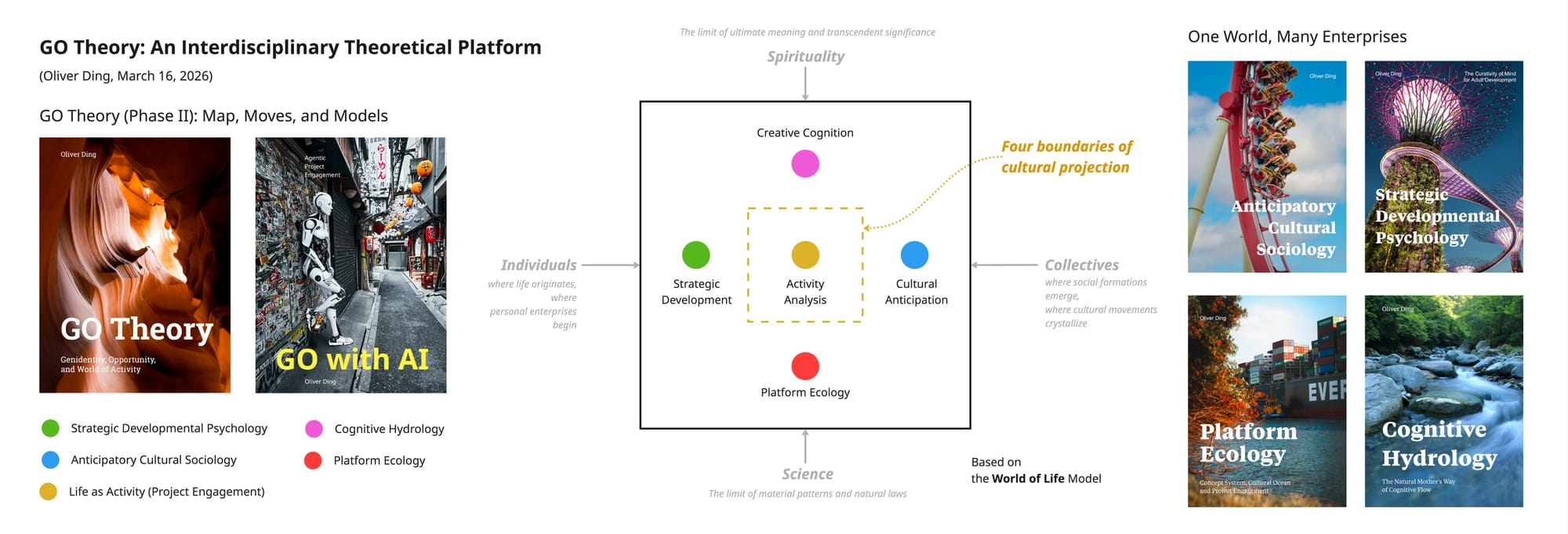
These five enterprises are equal. None is the foundation of the others. Each occupies a different position within the World of Life, which means each brings a genuinely different theoretical perspective. And because they share the same spatial foundation — the same map, the same boundaries, the same operating concepts — they naturally support one another, forming a network of enterprises rather than a hierarchy.
The development of GO Theory can now be read as a trilogy:
- GO Theory: Genidentity, Opportunity, and World of Activity (June 2025) — Phase I, the individual level
- Meta-frameworks: Creative Heuristics for Individual and Social Development (December 2025) — the ontological foundation, World of Life as a social world map
- Anticipatory Cultural Sociology: Creation, Projection, and Agency (March 2026) — Phase II, the cultural level
Three books, three movements, one theoretical platform still unfolding.
One World. Many Enterprises. The platform is open.
World
Me, You, and We
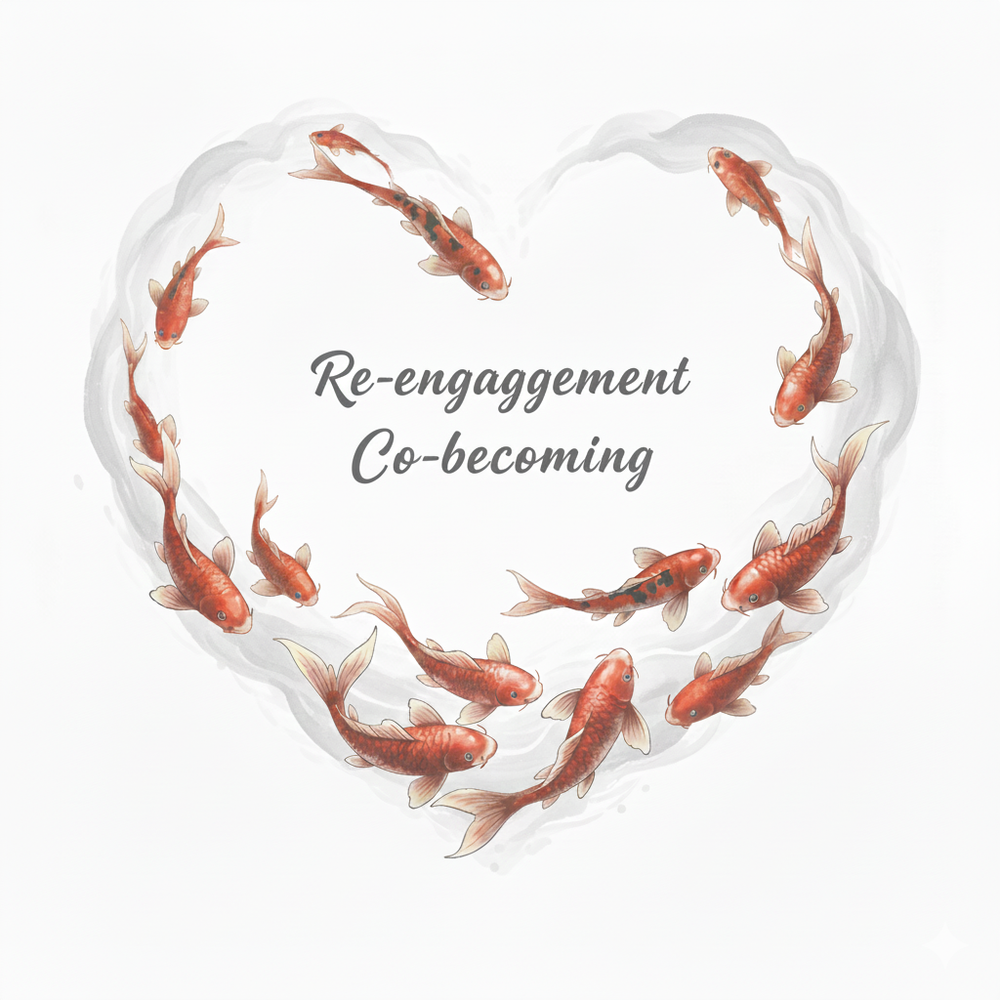
The image above is my New Year's greeting card — and also my annual theme for 2026: Re-engagement and Co-becoming.
Three months later, looking back at what has actually been written, something unexpected is visible. Those two slogans did not stay as slogans. They quietly seeded concrete work. Re-engagement became the Revisiting–Rebuilding series: returning to past selves, past projects, past theoretical moments — not to repeat them, but to find in them what had not yet been seen. Co-becoming became the Self–Other series: the three-layer architecture of Self, Persons Acting in Concert, the Principle of Double Genidentity, and the extension of all this to a person and their AI agents.
The connection was not planned. It became visible only in retrospect.
This is, perhaps, how themes work. You place them at the threshold of a year. You do not yet know what they will ask of you. Then, month by month, they find their way into the work — not as topics chosen from a list, but as questions that turn out to have been active all along, pulling the thinking in directions you recognize only after you have already arrived.
Re-engagement and Co-becoming. I placed them there in January. The year answered.
Oliver Ding
Founder of the Activity Analysis Center
March 31, 2026
p.s. I am based in Houston, Texas, US. Where are you?