
Activity Analysis Network #7: The Piano House, Activity, and Mind

This is the 7th issue of the Activity Analysis Center's newsletter
by Oliver Ding
Hi, and welcome to Activity Analysis Network, a newsletter hosted by the Activity Analysis Center.
Each issue is organized around the "Flow - Focus - Center - Circle" schema, the primary model of the World of Activity Toolkit (v1, 2025).
As a biweekly newsletter, I'll share summaries of new articles from the Activity Analysis Center, along with updates on related activities, including some of my own published work elsewhere.
In this issue (#7), two new articles explore the Activity as Container conceptual deck I created in 2017, and the story behind it. The 242-slide deck introduced a series of models, with the primary one being the Thing-People Relation model, which served as the seed of the Activity Circle Model.
I also introduced a new possible book titled The Curativity of Mind: Mental Curation, Mental Platforms, and Mental Moves. The core of the book is organized by the "Function - Context - Knowledge - Activity" Framework.
Flow
The historical development of the Activity Analysis Center and my experience of daily life
In my ongoing series, "Appropriating Activity Theory," I share the Piano House story and the Activity as Container Framework.
On the afternoon of August 26th,2017, I stayed in the waiting room of a piano school with my son. The teacher had not come yet, so my son began to play with a LEGO transformer, flipping it around and placing it in a music stand. He also turned the toy to face me as if on a miniature stage. I responded with encouraging facial expressions, and an emergent game was born.
My son experimented with different poses for his transformer, and I escalated the play by covering my eyes, asking my son to set up a new "scene," and calling out when he was ready for the reveal.
A week later, on September 2nd, the scene repeated itself. Father and son were once again in the waiting room, but this time, my son had not brought his LEGO toy. Undeterred, upon entering the room, he immediately declared, "Let's play the guessing game!" He instructed me to cover my eyes, and using his own body along with a nearby chair, he began creating poses for me to guess. The game had evolved, its core identity persisting even as the objects and specific actions changed.
This story was told in my 2017 conceptual deck: Activity as Container.
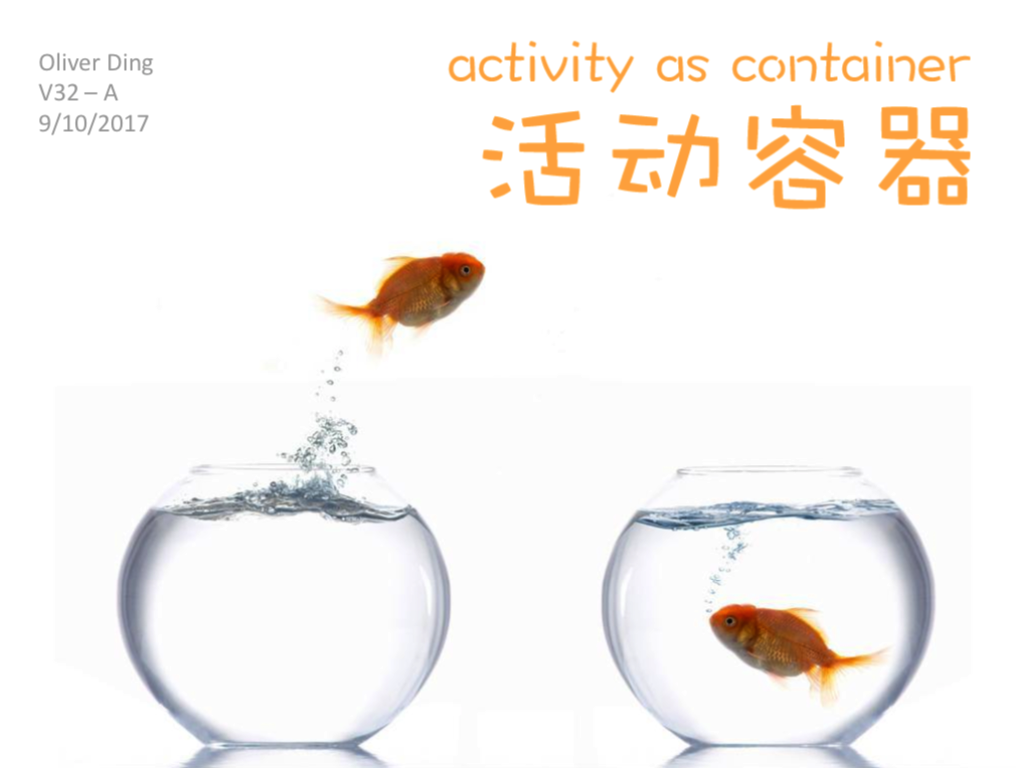
In the 242-slide deck, the core idea treats Activity as the Container where people develop their Relationships with dynamic Situational Events. My theoretical resources include Activity Theory, Ecological Psychology, Distributed Cognition, and other social theories.
The Piano House narrative reveals interactions that are both structured by their context and creatively emergent within it. To analyze this duality, we need a core metaphor that can account for both boundary and potential—a role I assign to the "Container."
Focus
The Thematic Foci of the Activity Analysis Center
In the past two weeks, my focus has been on the "Function - Context - Knowledge - Activity" Framework.
At the core of the framework is the “Perception — Action — Conception — Curation” schema. Researchers often discuss mind-related topics using the keywords “perception, conception, and action.” From the perspective of Curativity Theory, I propose expanding the foundation of these mind-related topics from three to four keywords. See the diagram below.
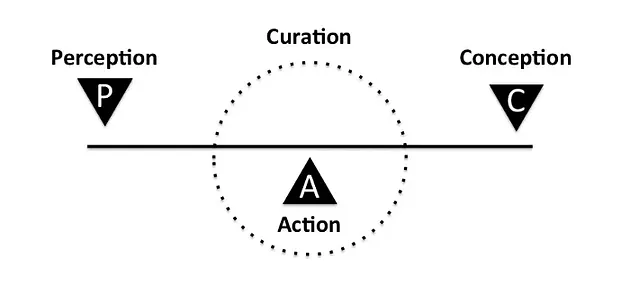
- Perception: How we sense and experience the world
- Conception: How we understand and think about the world
- Action: How we engage with and change the world
- Curation: How we turn pieces into meaningful wholes
The addition of Curation as a fourth foundation reflects a key insight: mind is not merely passive (perception) or active (action) or representational (conception). Mind is fundamentally curatorial — constantly selecting, organizing, integrating, and synthesizing experiences, concepts, and actions into coherent wholes.
This curatorial function operates across all three traditional foundations:
- In Perception, Curating sensory experiences into meaningful patterns.
- In Conception, Curating concepts into knowledge frameworks.
- In Action, Curating actions into purposeful projects.
Curation is thus both a fourth foundation and a meta-function that synthesizes the other three.
I originally named the above diagram “Epistemology of Curation.” I now refer to it as the “Curativity of Mind.”
The model above serves as a meta-framework, providing inspiration and guidance for the creation of various knowledge frameworks. The curatorial perspective allows us to see how mental elements, models, and platforms emerge through ongoing processes of organizing pieces into wholes — whether those pieces are perceptions, concepts, or actions.
Based on the core, I used the “Function — Context — Knowledge — Activity” schema to expand it into a practical framework for the Creative Life Theory (v3.0) project.
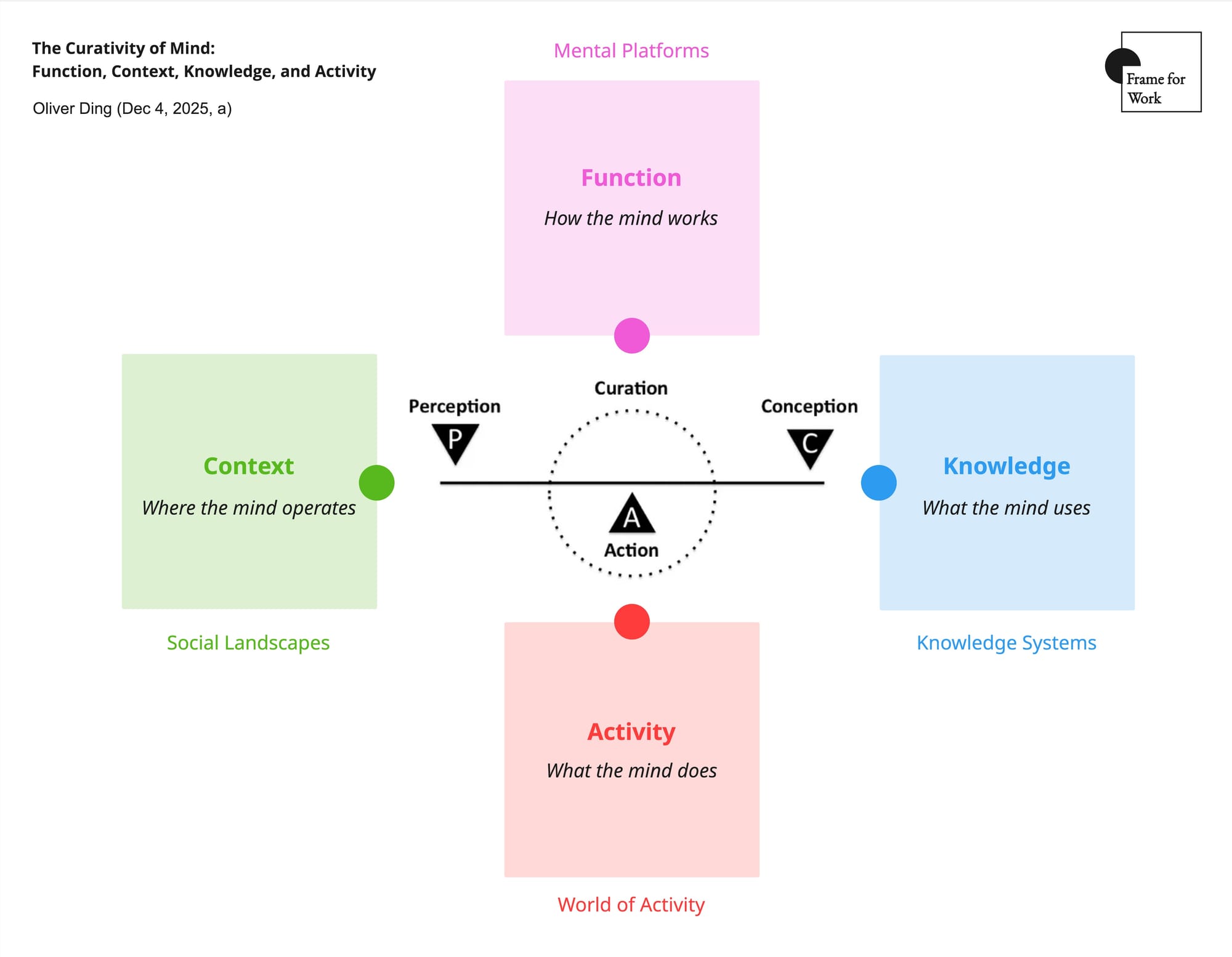
The framework is built on four dimensions:
- Function: How the mind works (by curating)
- Context: Where the mind operates (in social landscapes)
- Knowledge: What the mind uses (conceptual systems)
- Activity: What the mind does (developmental projects)
Over the past several years, I have been exploring relevant ideas in various knowledge projects. By using the “Function-Context-Knowledge-Activity” schema as a meta-framework, I can curate my articles on Mental Curation, Mental Platform, and Mental Moves into a new book.
More details can be found in The Curativity of Mind: Function, Context, Knowledge, and Activity.
CENTER
The Core of the Activity Analysis Center
Currently, the Activity Analysis Center hosts two major theoretical enterprises:
- The Life-as-Activity Approach (the Project Engagement Approach is part of this family)
- The World of Activity Approach
In addition to general theoretical development, I also investigate several types of specific activity and apply the knowledge frameworks of these approaches to case studies.
Over the past two weeks, I conducted a small case study on the AAI program and identified a new, specific type of activity: Building a Mental Platform.
The Activity Analysis & Intervention (AAI) Project aims to turn Activity-centered theoretical knowledge into applied, practical knowledge.
It was designed in two types of programs:
- First-order Analysis
- Second-order Analysis
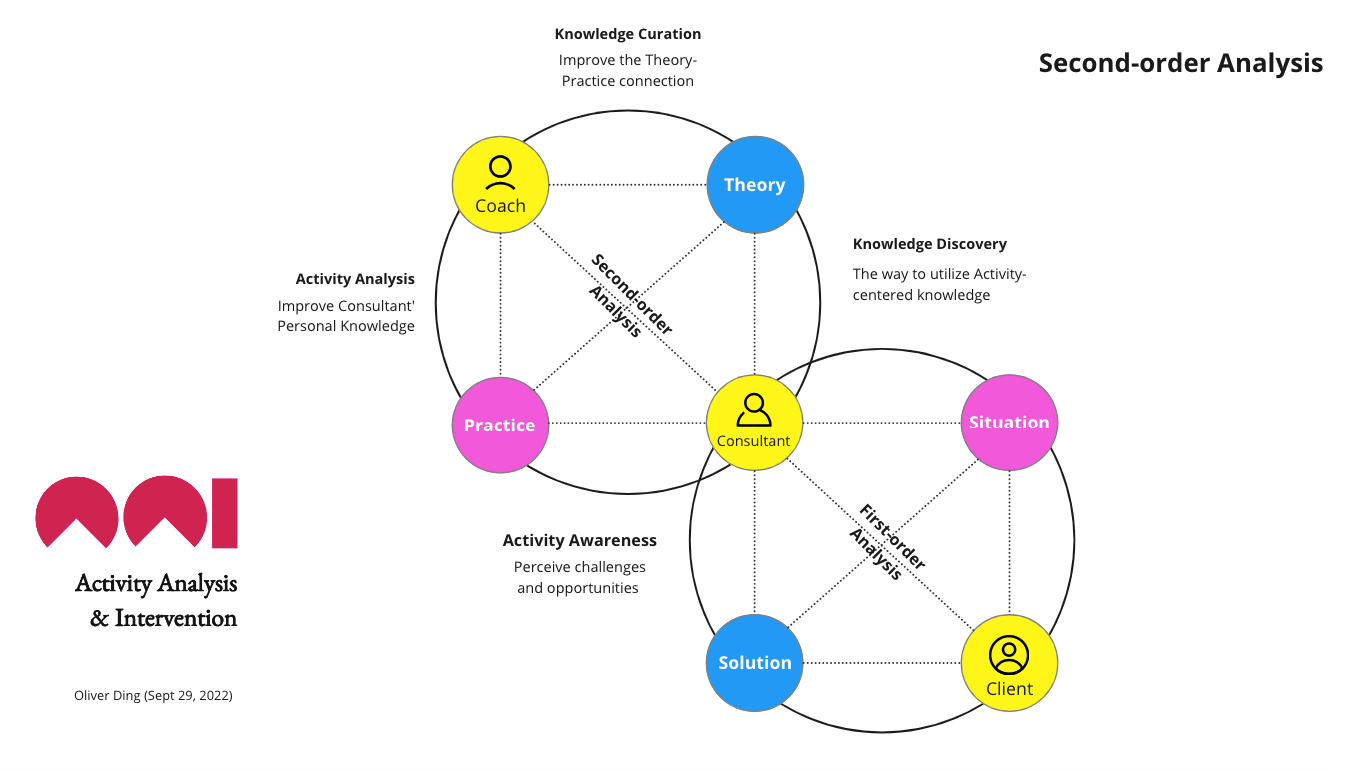
The program was designed based on the Activity Circle model. More details can be found in The Activity Analysis & Intervention (AAI) Project.
On December 11, 2025, I conducted a case study using the AAI framework. It turned out to be an intriguing project because it involved only me and three LLM-based AI tools.
The structure of the case study was straightforward. I began by reading a LinkedIn post and discussing it with ChatGPT. This constituted the “Activity” level in the AAI model.
Next, our conversation was analyzed by Gemini, which identified several creative patterns that emerged in the interaction between ChatGPT and me. This phase represented the First-order Analysis.
Finally, Claude conducted a second layer of analysis on Gemini’s creative-pattern report, and I then discussed Claude’s insights to develop a new theory about human–AI collaboration. This corresponded to the Second-order Analysis.
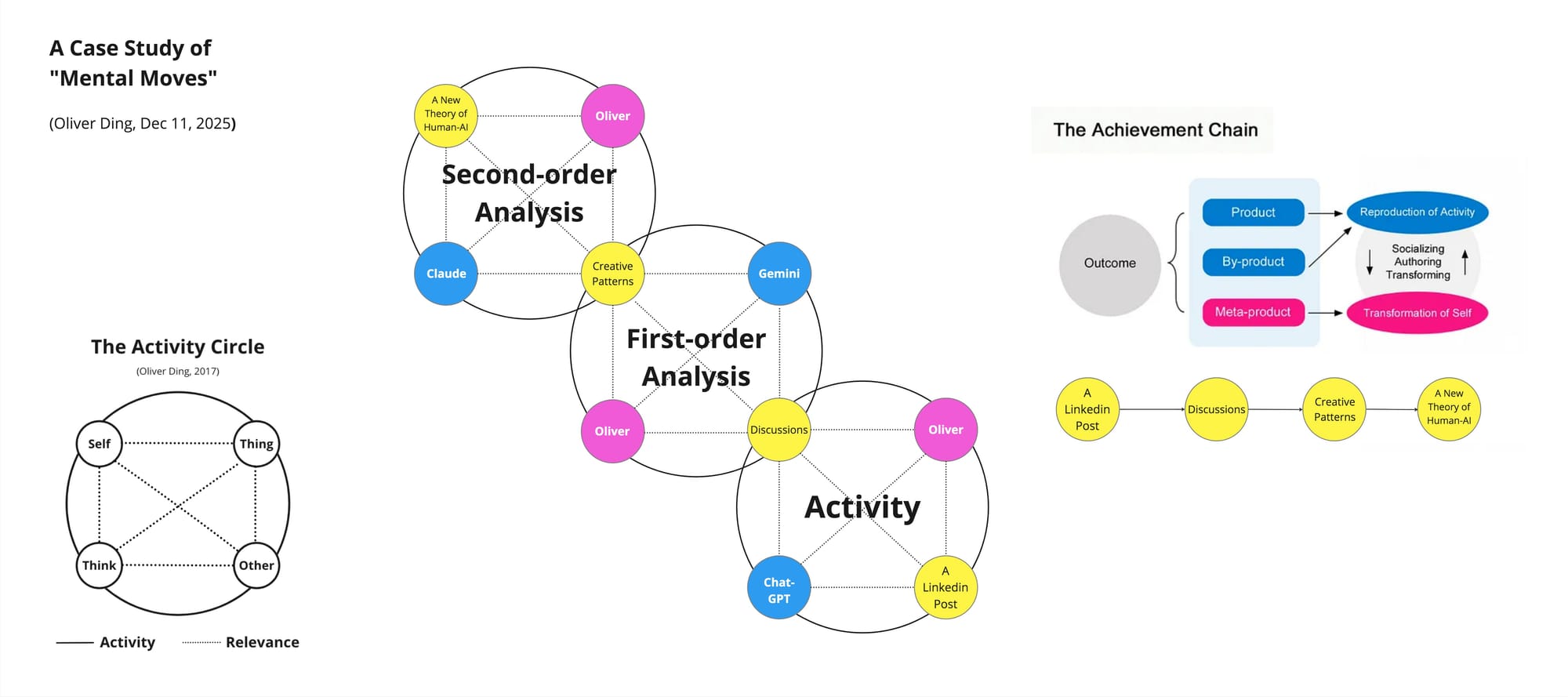
The AAI model itself was developed from the Activity Circle model, a foundational component of the Life-as-Activity Approach. See related links
- The Activity Analysis & Intervention (AAI) Project
- The Activity Circle (Oliver Ding, 2017)
- Psychological Counseling Platform: A Case Study of “Social Moves”
In 2022, I defined the "Building a Knowledge Enterprise" activity, which led to the Knowledge Enterprise journey. This journey continues with the “Building a Mental Platform” activity.
When a concept system supports the development of a Creative Enterprise, it functions as a Mental Platform. This idea echoes the "Project - Concept" connection within Andy Blunden's approach to "Activity as Formation of Concept," if we see a creative enterprise as a series of projects.
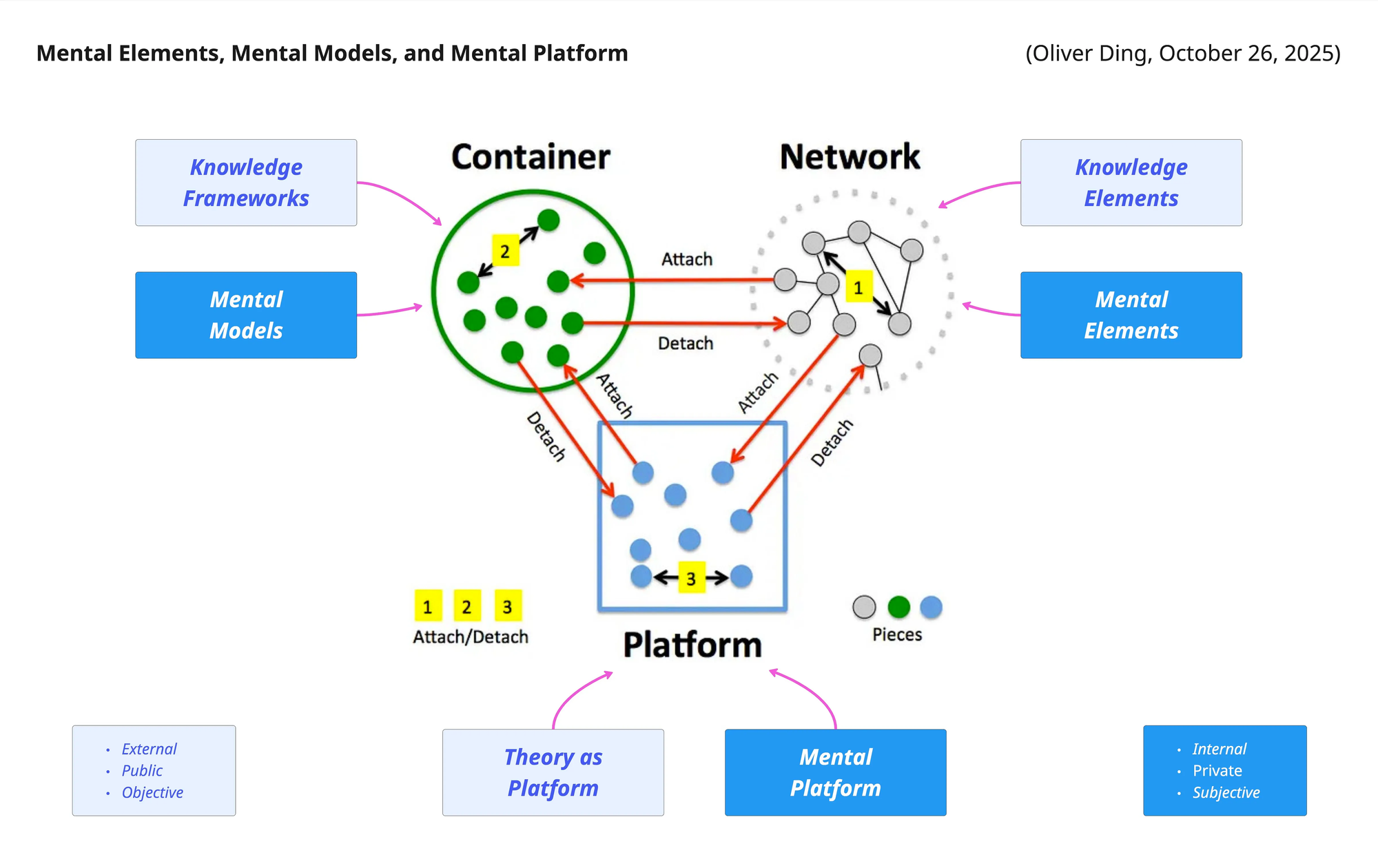
The diagram above lists a series of concepts that are related to the Mental Platform. They are defined by the Inside-Outside principle, echoing the Activity Theory’s internalization-externalization principle.
- Mental Platform → Spontaneous Concept System → Concept System as Means
- Theory as Platform -> Scientific Concept System → Concept System as End
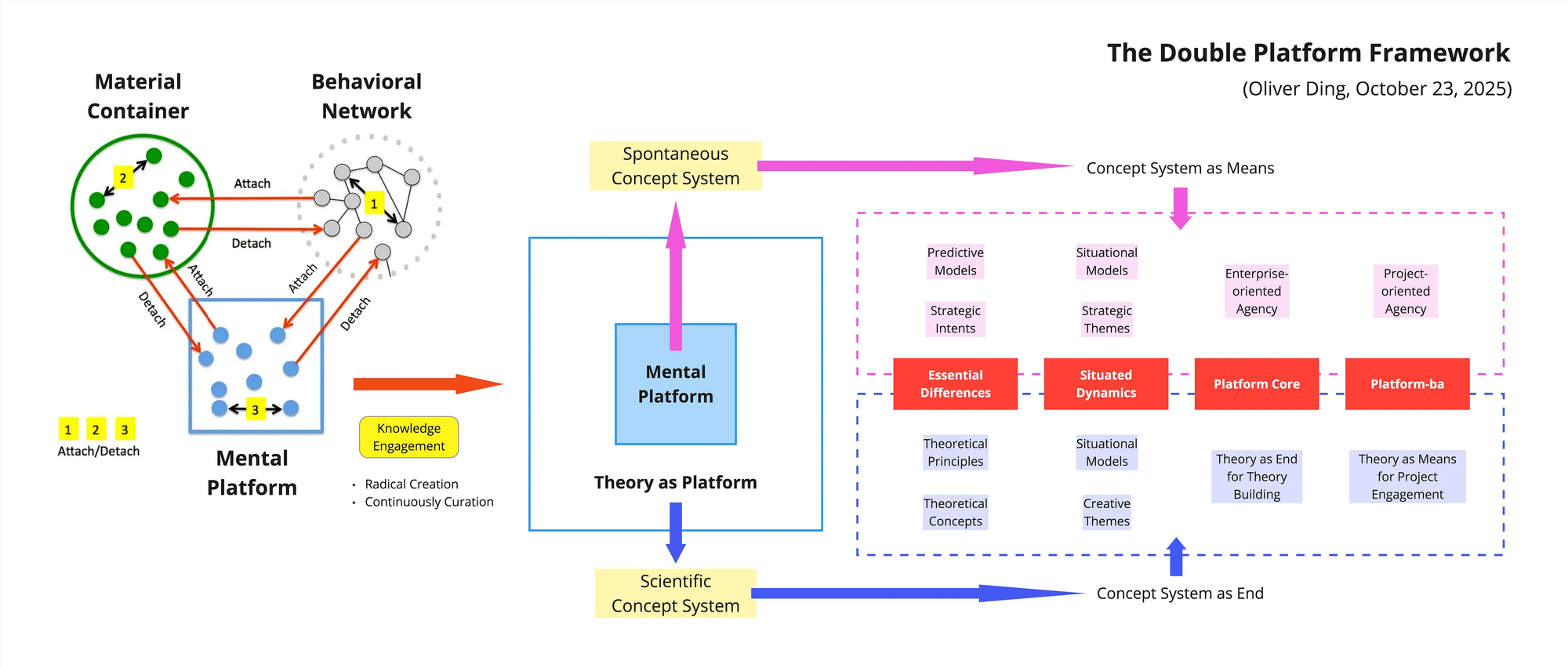
More details can be found in the articles below:
- Mental Platform Theory: Building a Mental Platform
- The Double Platform Framework (v1, 2025)
- Weave the Concept: Mental Elements, Mental Models, and Mental Platform
- [Situational Map] Knowledge System, Mental Platform, and Strategic Agency
CIRCLE
The Context of the Activity Analysis Center
Over the past several years, I worked on several theoretical projects, such as the Ecological Practice Approach, Curativity Theory, Creative Life Theory, and Thematic Space Theory.
Inspired by creativity researcher Howard Gruber's idea of "Network of Enterprises," I used the "Knowledge Center" approach to manage this large knowledge system. Each knowledge center hosts one or two related theoretical approaches.
- CALL (Creative Action Learning Lab): the Ecological Practice Approach and Creative Life Theory
- Curativity Center: Curativity Theory
- TALE (Thematic Analysis Learning Engagement): Thematic Space Theory
- Frame for Work: A theory about Knowledge Frameworks
Within the past two weeks, Curativity Theory released a new book draft, The Curativity of Mind: Mental Curation, Mental Platforms, and Mental Moves on December 13, 2025.
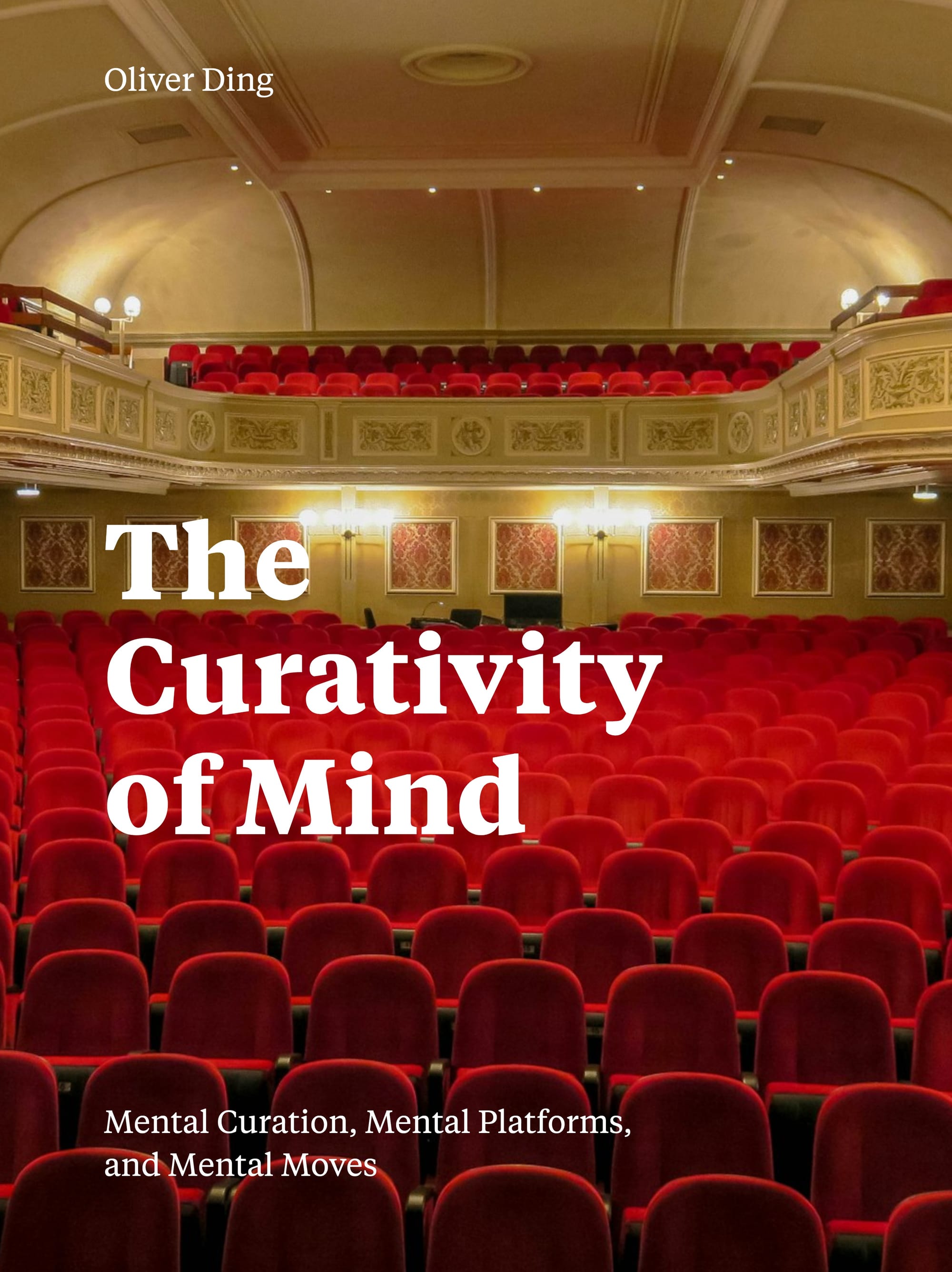
I have broadly used the “Curativity of Mind” theme to describe my exploration of applying Curativity Theory to a set of themes, including Mind, Meaning, Mindsets, Mental Models, Tacit Knowledge, Self-knowledge, Personal Epistemology, and other similar themes.
These themes can be seen as an evolving concept system.
This book marks a key milestone in my creative journey. It offers a hierarchical concept system to organize my creations around these ideas.
- The “Meta” level: The “Perception — Action — Conception — Curation” schema
- The “Framework” level: The “Function — Context — Knowledge — Activity” schema
- The “Work” level: The “Mental Curation — Mental Platforms — Mental Moves” triad
- The “Situations” level: concrete practices such as Developing Tacit Knowledge; Curating Knowledge Systems; Creative Life Curation; Exploring Meaning Discovery; Engaging with Mindsets; and Advancing Meta-Curation.
In parallel, I use the Self — Life — Mind schema to structure the Creative Life Theory (v3.0) project. This book corresponds specifically to the “Mind” component of that larger framework.
A Light Edition of the possible book, for readers who want to grasp the essential frameworks quickly, was published on Possible Press.
World
Me, You, and We

My name is Oliver Ding. I am the founder of the Activity Analysis Center. I am based in Houston, Texas, US.
Where are you?
v1.0 - December 15, 2025 - 1,704 words