
Activity Analysis Network #8: Re-engagement and Co-becoming
This is the 8th issue of the Activity Analysis Center's newsletter
by Oliver Ding
Hi, and welcome to Activity Analysis Network, a newsletter hosted by the Activity Analysis Center.
Each issue is organized around the "Flow - Focus - Center - Circle" schema, the primary model of the World of Activity Toolkit (v1, 2025).
As a biweekly newsletter, I'll share summaries of new articles from the Activity Analysis Center, along with updates on related activities, including some of my own published work elsewhere.
In this issue (#8), three new articles have been added to the site.
- Appropriating Activity Theory #8: Stage, Map, and Moves
- Concepts: The Essence of the Concept System
- Case Studies: A Case Study of The Weave-the-Theory Framework
On the final day of 2025, marking the close of the first quarter of the twenty-first century, I write this newsletter to release a new possible book, Meta-frameworks: The Self-Life-Mind Schema and Other Creative Heuristics, to close a multi-year journey of theorizing creative life.
The core of the book is organized by the History{Life[Self(Body)]} framework (also known as the HLS framework), which is mentioned in Appropriating Activity Theory #8.
Flow
The historical development of the Activity Analysis Center and my experience of daily life
In my ongoing series, "Appropriating Activity Theory," I share the development of my personal epistemological frameworks from 2016 to 2025.
On April 17, 2024, I created the History [Life(Self)] Framework in the morning. Later that day, after dinner, I realized that it echoed a framework I had created in 2021. See the diagram below.
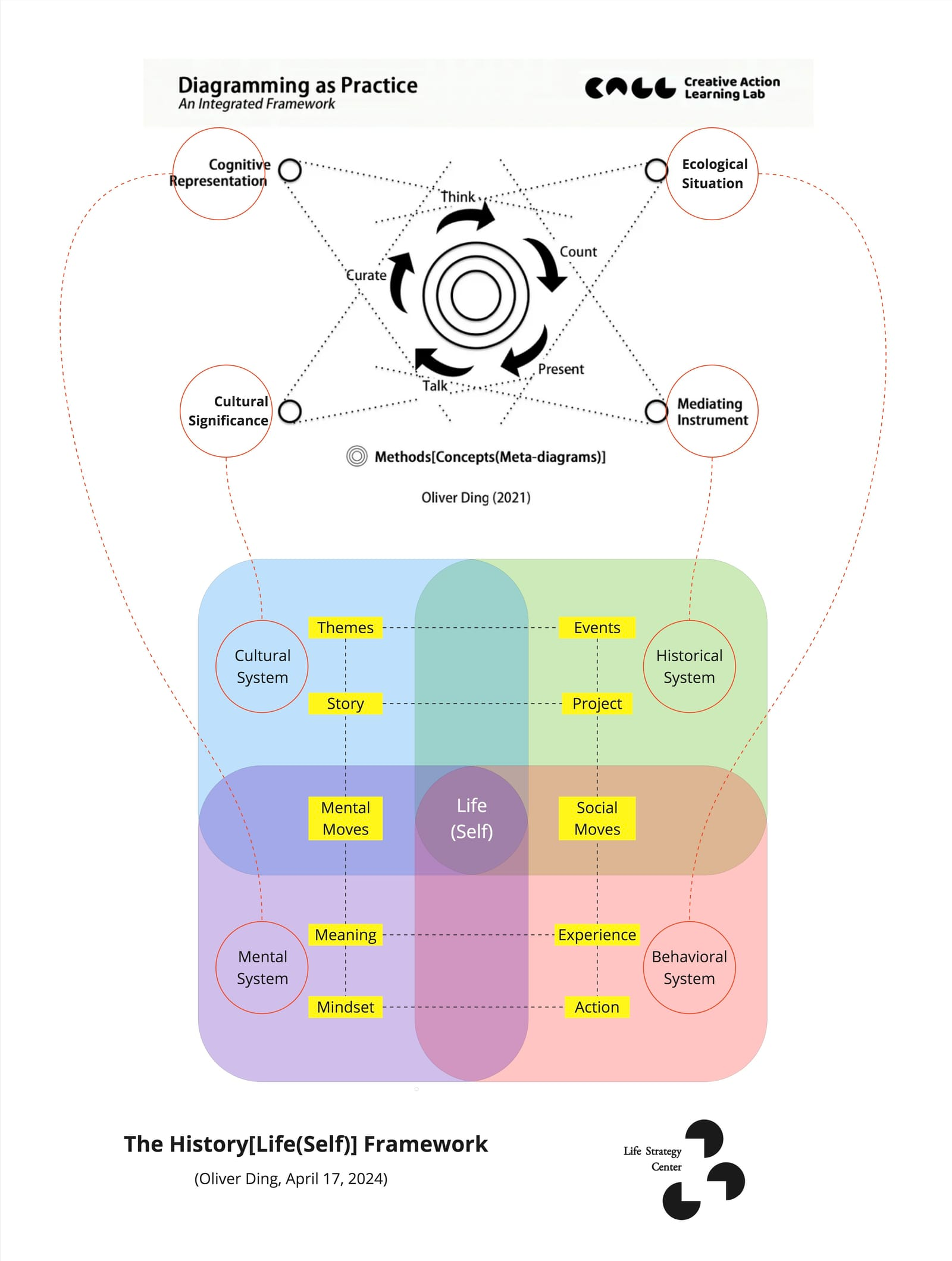
Back to the past, the four perspectives of the Diagramming as Practice framework were adopted from an integrated epistemological framework I developed in mid-2017, which had its seeds in 2016.
Focus on the present, the History [Life(Self)] Framework is the seed of the History{Life[Self(Body)]} framework (v3.0), which is used to guide the Meta-frameworks project.
I also shared a case study of the "Thematic Identity Curation" framework. On April 17, 2024, after reflecting on the long journey, I found that there was a thematic blend of "Psychological Knowledge Engagement" in my creative journey.
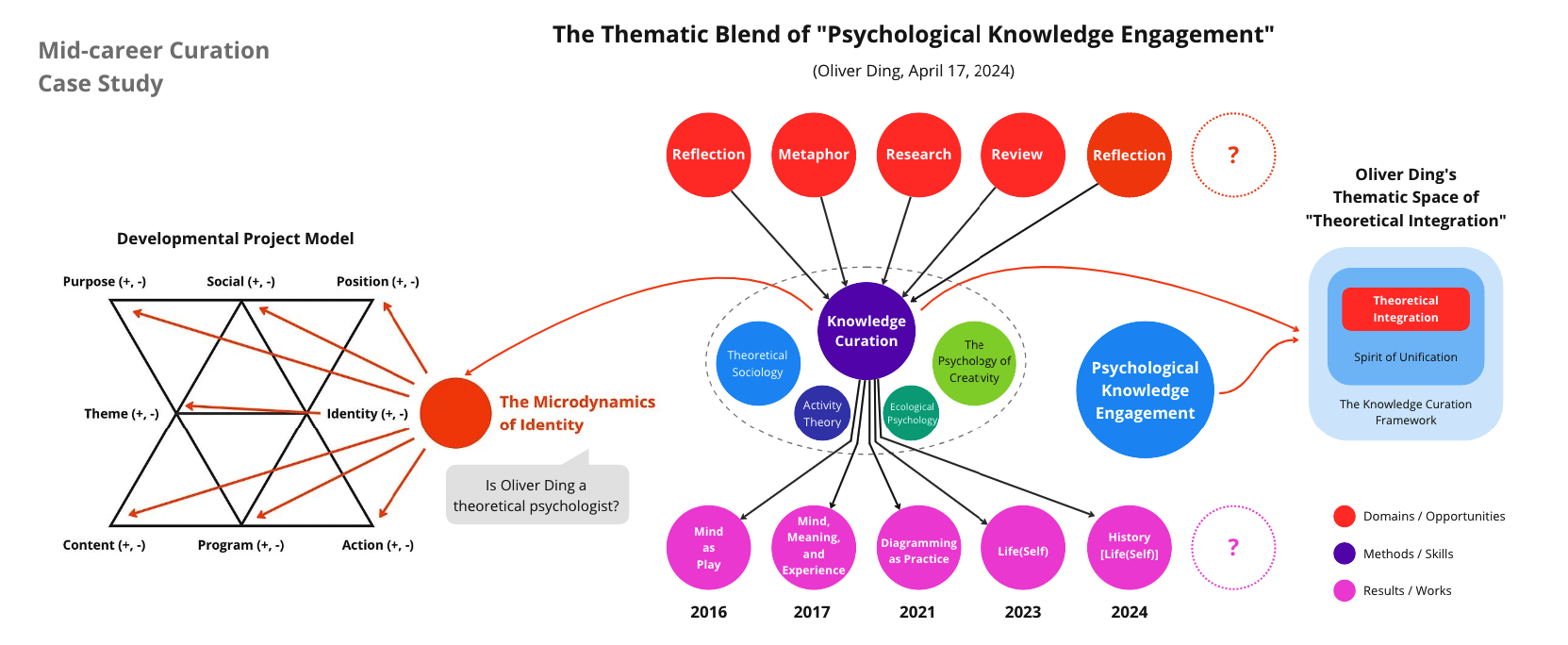
- 2016: The Mind as Play Project
- 2017: The Mind, Meaning, and Experience Project
- 2021: The D as Diagramming Project
- 2023: The Life(Self) Project
- 2024: The History [Life(Self)] Project
These five projects use the "Knowledge Curation" method, which is similar to the "Theoretical Integration" method.
- Appropriating Activity Theory #8: Stage, Map, and Moves
Focus
The Thematic Foci of the Activity Analysis Center
In the past two weeks, my focus has been on Concept Systems, the Meta-frameworks project, and the History{Life[Self(Body)]} framework (v3.0).
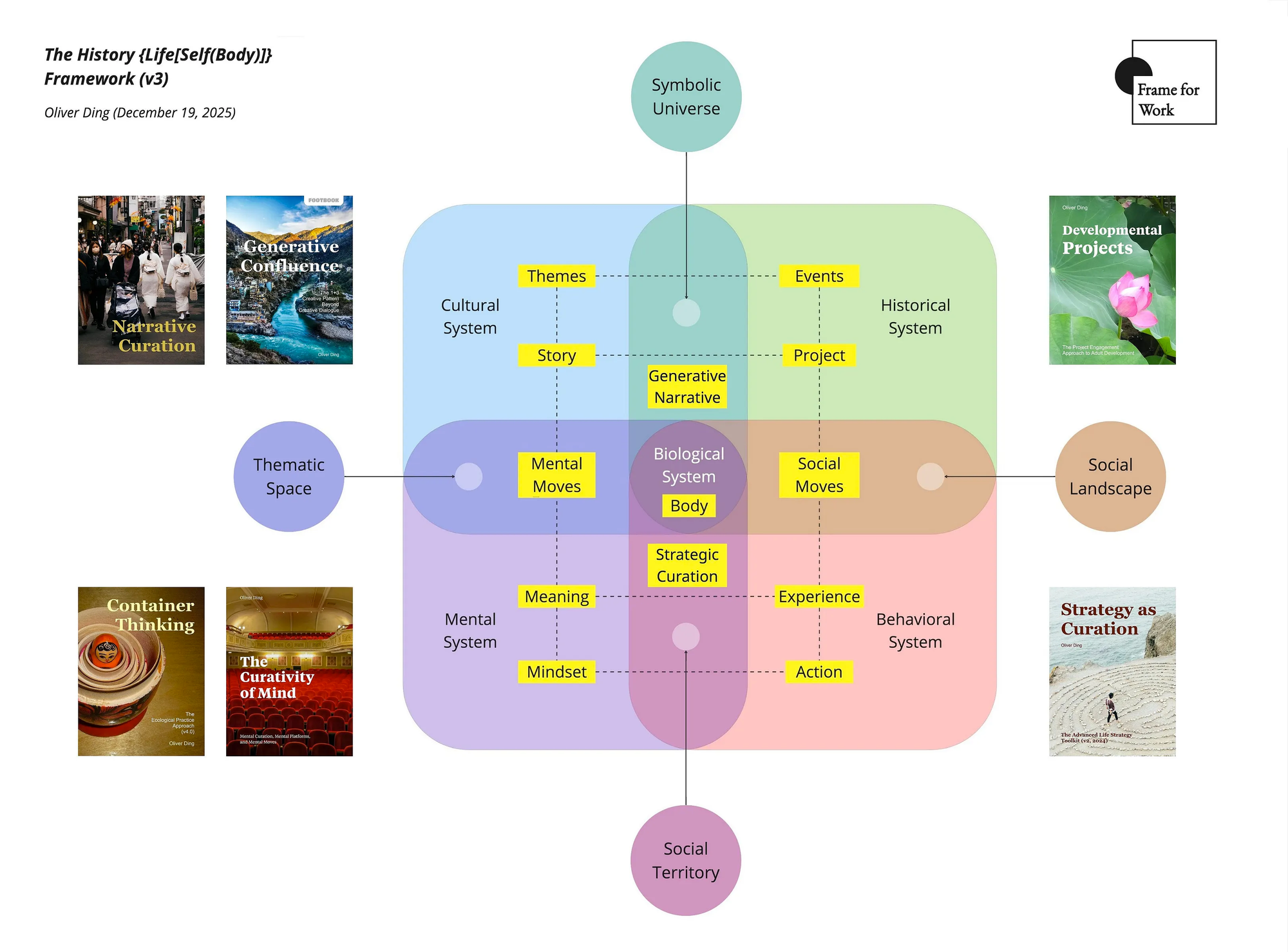
To understand how concept systems impact social life, I adopted the HLS framework to understand the social world through a five-system lens:
- Body System
- Mental System
- Behavioral System
- Cultural System
- Historical System
The HLS framework was inspired by Robert Rosen’s Anticipatory System Theory, particularly his concepts of Natural Systems and Formal Systems. It conceptualizes the social world as a nested Anticipatory Activity System (AAS):
- Micro-AAS corresponds to the Mental System (Natural System).
- Macro-AAS corresponds to the Cultural System (Historical System).
Robert Rosen’s distinction between Natural Systems and Formal Systems, along with his concept of Predictive Models, provided a powerful theoretical lens that fundamentally shaped the HLS framework’s architecture. The insight that a natural system contains an internal formal system (predictive model) that allows it to anticipate future states became the conceptual engine behind the double-AAS structure.
First applied at the micro level in the Mental Tuning Framework — where Mindset serves as the predictive model of the Behavioral System (Mental System) — this logic later scaled up to the macro level, where Cultural System anticipates Historical System. Rosen’s theory enabled me to see Life and History, Self and Culture, not as separate domains but as nested anticipatory systems, each containing its own predictive models (Mindsets and Themes). This insight was crucial for understanding how individuals and cultures shape their futures through internal modeling.
The two-level structure of the HLS Framework gives rise to the Double Anticipation principle.
At the micro level, the Anticipation is situated within the “Self — Other” relationship.

At the macro level, anticipation leads to a specific activity, encompassing a series of actions:
- The actualization of ecological opportunities through perception, action, and curation.
- The social appropriation of this actualization is guided by generative narratives.
- Archivization, which transforms the realities of the activity — whether fortunate or unfortunate — into the Historical System.
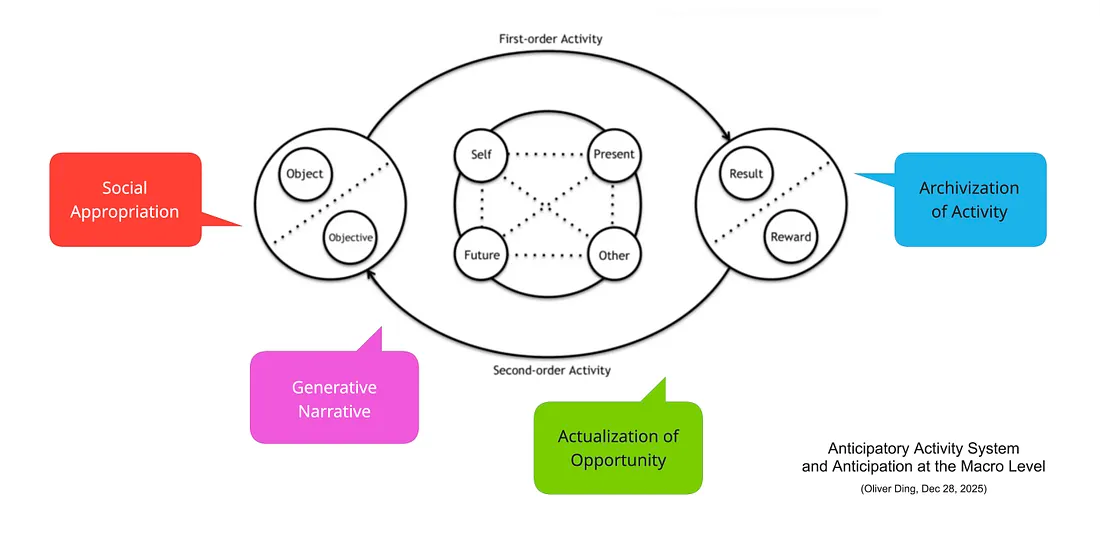
For the Meta-frameworks project, the HLS framework provides a theoretical ontology of the social world, offering a structured context in which concept systems can be understood and mapped.
The connection between the HLS framework and the AAS framework is a by-product of the Meta-frameworks project. While the HLS framework offers an ontological map of the social world, the AAS framework offers the Double Anticipation principle and related models.
- The History{Life[Self(Body)]} Framework (v3.0) — Part 1
- The History{Life[Self(Body)]} Framework (v3.0) — Part 2
- The History{Life[Self(Body)]} Framework (v3.0) — Part 3
CENTER
The Core of the Activity Analysis Center
Currently, the Activity Analysis Center hosts two major theoretical enterprises:
- The Life-as-Activity Approach (the Project Engagement Approach is part of this family)
- The World of Activity Approach
Within the past two weeks, a major update on the World of Activity Approach was the World of Life toolkit.
In the Epilogue of the new possible book, Meta-frameworks, I briefly review the development of Creative Life Theory from v2.0 to v3.1. The switching from the Self-Life-Mind schema to the HLS framework marks a strategic pivot from Individual Life Development to Cultural Life Development, framing meta-frameworks as living systems that grow through dialogue and evolve through practice.
Looking back, my exploration of Activity Theory has long been anchored in individual life development, with both the Project Engagement Approach and the World of Activity Approach rooted in the perspective of adult development. This new strategic pivot, however, represents a profound homecoming. By shifting the focus toward Cultural Life Development, I am bringing my work back into the mainstream of CHAT (Cultural-historical Activity Theory)—realigning the individual project with the larger currents of cultural-historical evolution.
From September 2025 to the present, a new set of knoweldge framework emerged, offering a refined way to understand the social world. Reflection on the HLS framework revealed that this set could be called the World of Life Toolkit:
- HLS framework (v3.0) → Provides a five-system structure of the social world, including individual and social life.
- Weave-the-Culture Framework (2025) → Highlights four mechanisms of cultural development.
- Cultural Projection Model (2025) → Connects Mental Platforms and Cultural Frameworks via the Projecting mechanism and Developmental Projects.
- Function — Context — Knowledge — Activity Schema (2025) → Explors Mental Platforms and Mind within the Context (Mind) layer.
- Meta-Frameworks — in — Context Framework (2025) → Identifies six faces of concept system in the social world.
- Embodied Social Forms Framework (2025) → Connects body-scale experience with deep social cognition.
Together, these knowledge frameworks provide a way to zoom in on the details of the Social World while connecting micro-AAS and macro-AAS.
Within this system, the World of Activity toolkit primarily addresses the Life(Self) layer, whereas the World of Life encompasses broader layers, including History (Culture) and Context (Mind), highlighting the hierarchical and interconnected nature of the knowledge ecosystem.
The Body System, initially presented as the Ecological Basic Forms in my book draft Homecoming: A Thematic Trip and the World of Activity Approach, has now evolved into the Embodied Social Forms Framework, which will be introduced in a forthcoming book draft on Meta-Frameworks.
The developmental loop is now complete: beginning with the Body’s flow and the Self’s focus, moving through the Centers of our developmental projects and enterprises, we ultimately locate our activities within the Historical Circle. In this way, the World of Activity has been curated into the World of Life.
During the 2024 Christmas holiday, I had a reflective conversation with a mentor, revisiting my work on HELLO THEORY, GO Theory, and the Strategic Life Narrative project. Through this reflection, I realized my newest focus had shifted toward Cultural Life Development, marking a detachment from Individual Life Development. This strategic move was encapsulated in the theme of “Cultural Grounding/Cultural Growing.”
Over the past 12 months, while I worked on closing my multi-year journey of Knowledge Engagement and Individual Life Development — culminating in Creative Life Theory v3.1 — I simultaneously unfolded a new journey of Cultural Development.
The birth of the World of Life (World of Activity) approach marks a nexus-point where the act of Closing a rich history meets the act of Unfolding a new future.
The exploration reveals a fundamental truth: meta-frameworks are not static tools, but living systems that grow through dialogue, evolve through practice, and ultimately form ecosystems supporting both individual creative life and cultural development.
As I move forward into the Cultural Development journey, the World of Life (World of Activity) approach will serve as my mental platform, while the Weave-the-Culture framework will guide the exploration of the four mechanisms of cultural development.
The World of Life Toolkit goes beyond the individual perspective of Creative Life Theory. The past six-month journey of Generative Confluence now leads to a new thematic space: Generative Narrative, where the cultural anticipation evolving into human history.
The story continues.
CIRCLE
The Context of the Activity Analysis Center
Over the past several years, I worked on several theoretical projects, such as the Ecological Practice Approach, Curativity Theory, Creative Life Theory, and Thematic Space Theory.
Inspired by creativity researcher Howard Gruber's idea of "Network of Enterprises," I used the "Knowledge Center" approach to manage this large knowledge system. Each knowledge center hosts one or two related theoretical approaches.
- CALL (Creative Action Learning Lab): the Ecological Practice Approach and Creative Life Theory
- Curativity Center: Curativity Theory
- TALE (Thematic Analysis Learning Engagement): Thematic Space Theory
- Frame for Work: A theory about Knowledge Frameworks
Over the past two weeks, I worked on the Meta-frameworks project. Today, a possible book was released by the Frame for Work knowledge center.
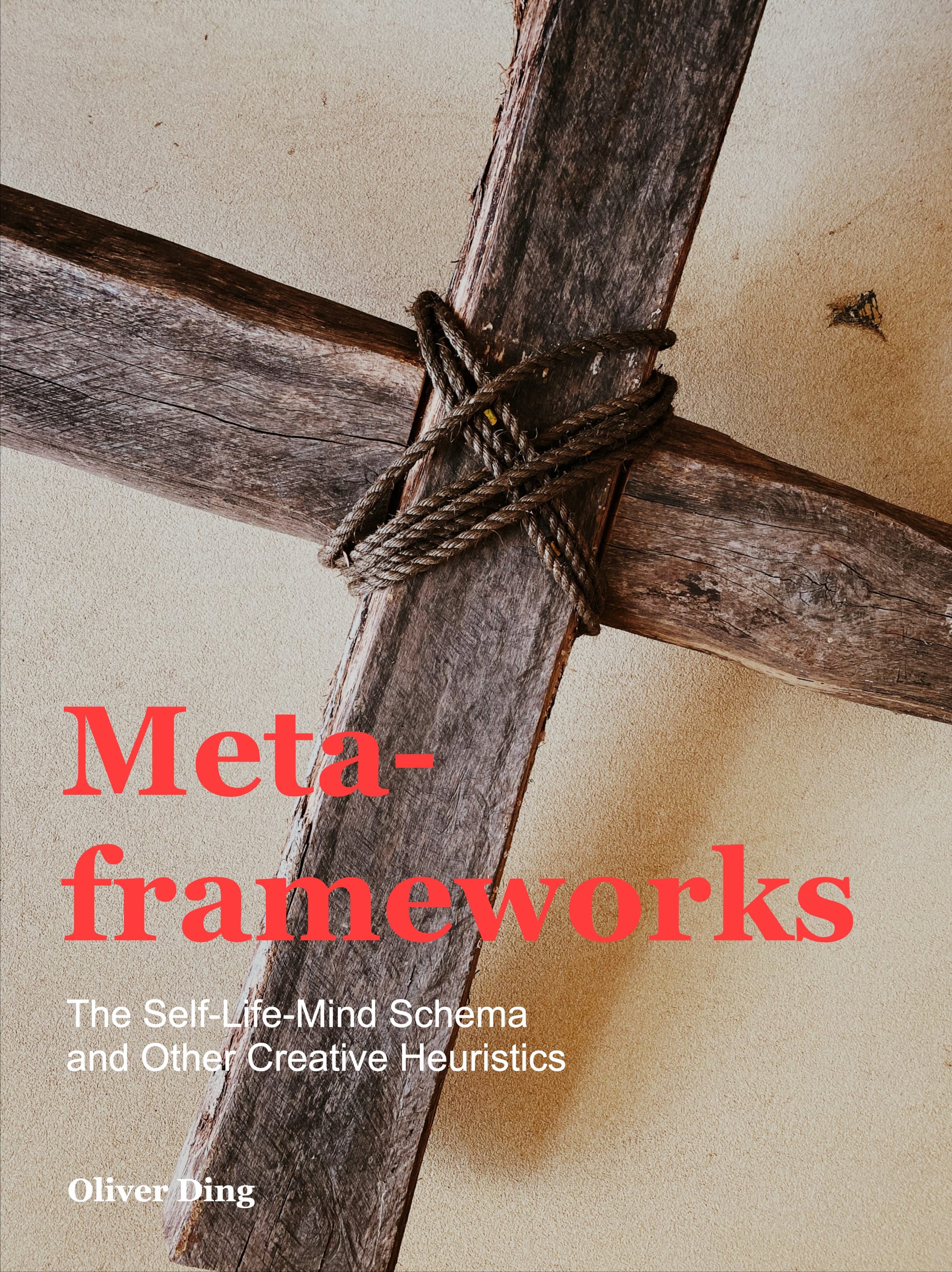
This book grows out of a long-term engagement with themes, concepts, knowledge frameworks, and creative work. Its starting point was not an abstract interest in meta-frameworks, but a practical problem: how individuals and groups work with concept systems over time, how frameworks emerge through use, and how they evolve as projects accumulate. As this journey continued, my work gradually moved toward meta-frameworks as a response to increasing complexity — not as finished systems, but as tools for orientation, dialogue, and sustained inquiry.
Moving beyond traditional views of meta-frameworks as purely cognitive instruments, this book situates them within the social world. It examines how meta-frameworks function as creative heuristics — how they are formed, tested, revised, and sometimes outgrown — and how these processes support both individual creative life and broader cultural development.
World
Me, You, and We
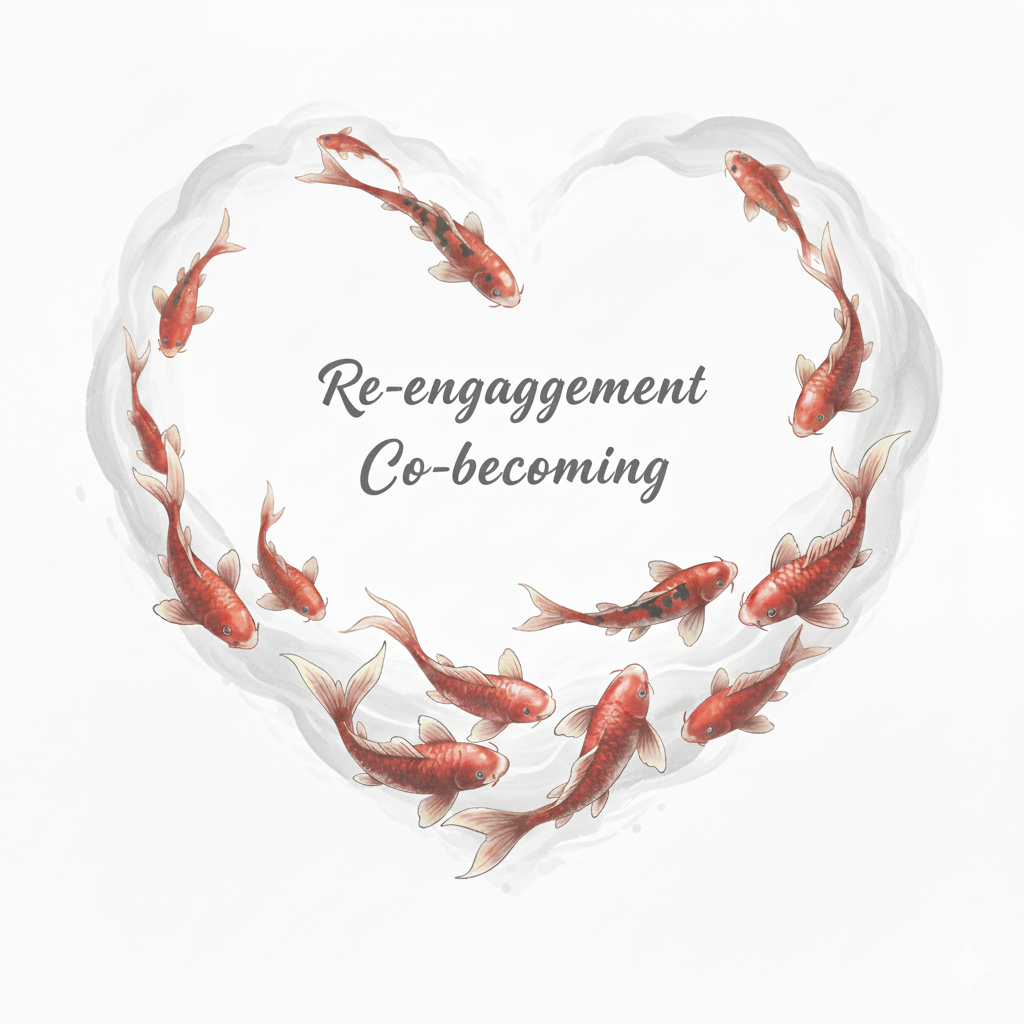
As we welcome the New Year, let us embrace the spirit of Re-engagement—to rediscover the unforgettable people, moments, and things from our past, and cherish them as the delicate culture of our lives.
With beautiful anticipations, let us journey into Co-becoming—creating a shared path alongside the uncertainties of the future.
May 2026 be a year of profound connection and collective creation. Happy New Year!
Oliver Ding
Founder of the Activity Analysis Center
December 31, 2025
p.s. I am based in Houston, Texas, US. Where are you?
v1.0 - December 31, 2025 - 1,977 words