
Activity Analysis Network #9: Anticipation, Culture, and Education

This is the 9th issue of the Activity Analysis Center newsletter
by Oliver Ding
January 15, 2026
Hi, and welcome to Activity Analysis Network, a newsletter hosted by the Activity Analysis Center.
Each issue is organized around the "Flow - Focus - Center - Circle" schema, the primary model of the World of Activity Toolkit (v1, 2025).
As a biweekly newsletter, I share summaries of new articles from the Activity Analysis Center, along with updates on related activities, including some of my own published work elsewhere.
In this issue (#9), four new articles have been added to the site.
- Appropriating Activity Theory #9: The ECHO Way (2021)
- Activity as Practice: Education as Anticipatory Activity
- Library: Meta-frameworks (book, v1.0, 2025)
- Z Lab: The Landscape of Anticipatory Cultural Sociology
In the last issue, I mentioned a new possible book, Meta-frameworks: The Self-Life-Mind Schema and Other Creative Heuristics, along with the History{Life[Self(Body)]} framework (also known as the HLS framework).
Over the past two weeks, a by-product of the book has been curated as Anticipatory Cultural Sociology, which has further led to applications in the field of education.
Flow
The historical development of the Activity Analysis Center and my experience of daily life
Recently, I had a conversation with a friend who is an education researcher at a university. Her recent focus is on the development of the Ed.D. program at the university and general reflection on educational practice.
Both Ed.D. (Doctor of Education) and Ph.D. (Doctor of Philosophy) provide the doctoral degree, yet they differ in purpose and program design. While the Ed.D. focuses on professional development, the Ph.D. guides students toward an academic pathway. In my friend's case, the Ed.D. program is designed as a part-time learning program for educational professionals.
This conversation echoes my long-term interest in the connection between Theory and Practice. More specifically, she mentioned Donald Schön and his metaphor of the "high ground" and the "swamp." It inspired me to revisit what I wrote in my 2021 manuscript, The ECHO Way: When Theory Meets Practice.
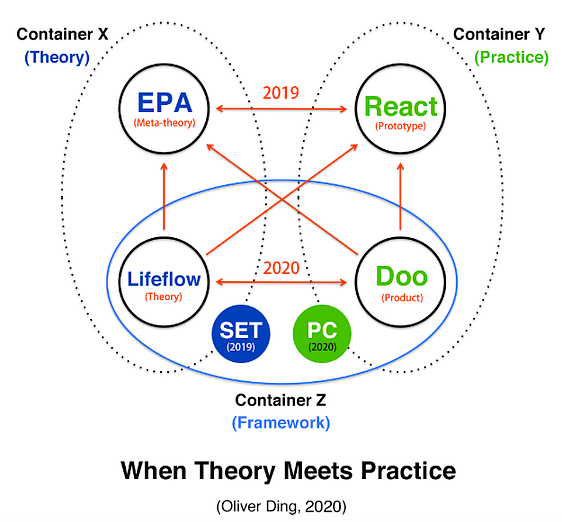
In my ongoing series, "Appropriating Activity Theory," I share the story about the ECHO Way (2021).
This issue marks a milestone for the column. Previously, I focused on revisiting the past and writing its story. Now, the column immerses in the present, returns to the past, and moves toward the future.
The once singular Re-engagement movement has expanded into a series of flows:
- Re-engagement: Discussing Donald Schön’s ideas inspired a return to the ECHO Way (2021).
- Creative Dialogue: Exploring the theory–practice connection and other themes.
- Generative Anticipation: Our conversation sparked the theme Education as Anticipatory Activity.
- Co-becoming: Debating key issues led to new insights for both of us.
Inspired by this experience, I designed a set of thematic cards.
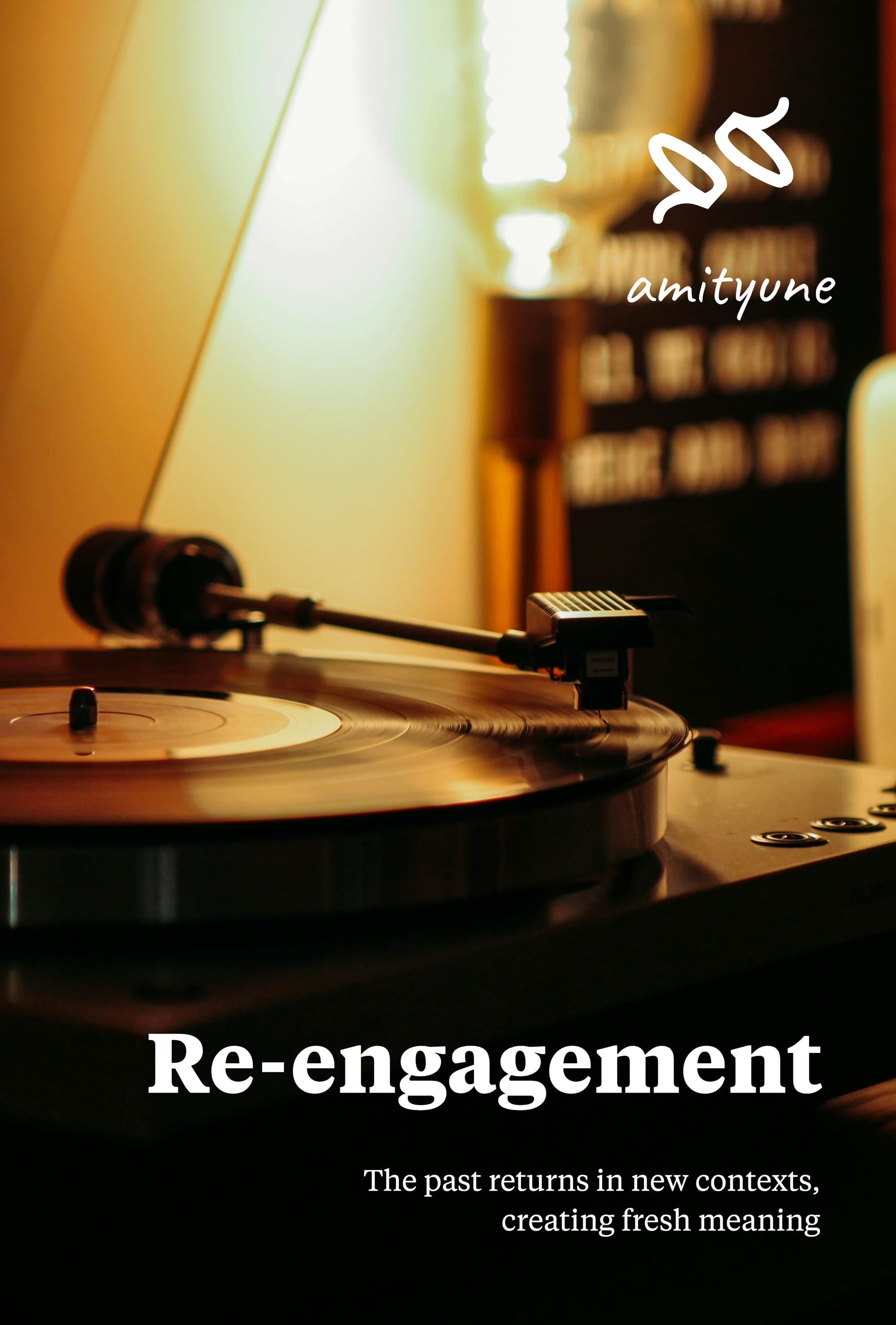
More thematic cards can be found on Possible Press.
Focus
The Thematic Foci of the Activity Analysis Center
In the past two weeks, my focus has been on the "Ed.D." theme and my conversation with a friend who is an education researcher.
In Appropriating Activity Theory #9: The ECHO Way (2021), I revisited my 2021 book draft and related models. While the HERO U model from 2021 successfully explains how an individual navigates the "High Ground" and the "Swamp," my recent conversation about Ed.D. programs reminds us that the "Swamp" is more complex than I previously imagined. It is not merely a matter of cognitive complexity, but of social complexity.
This is where the ECHO Framework evolves. In my recent work, Developmental Projects: The Project Engagement Approach to Adult Development (released on November 30, 2025), I expanded the framework to address this complexity. This approach, inspired by Andy Blunden’s notion of the "project as a unit of analysis," seeks to establish the "Project" as a conceptual foundation for cross-disciplinary research.
The Cultural Projection Model expands Activity Theory’s internalization-externalization principle by introducing the "Outside — Projecting — Inside" triad as a basic ecological form. Although initiated in 2021, the newest version curates my latest thinking on social engagement.
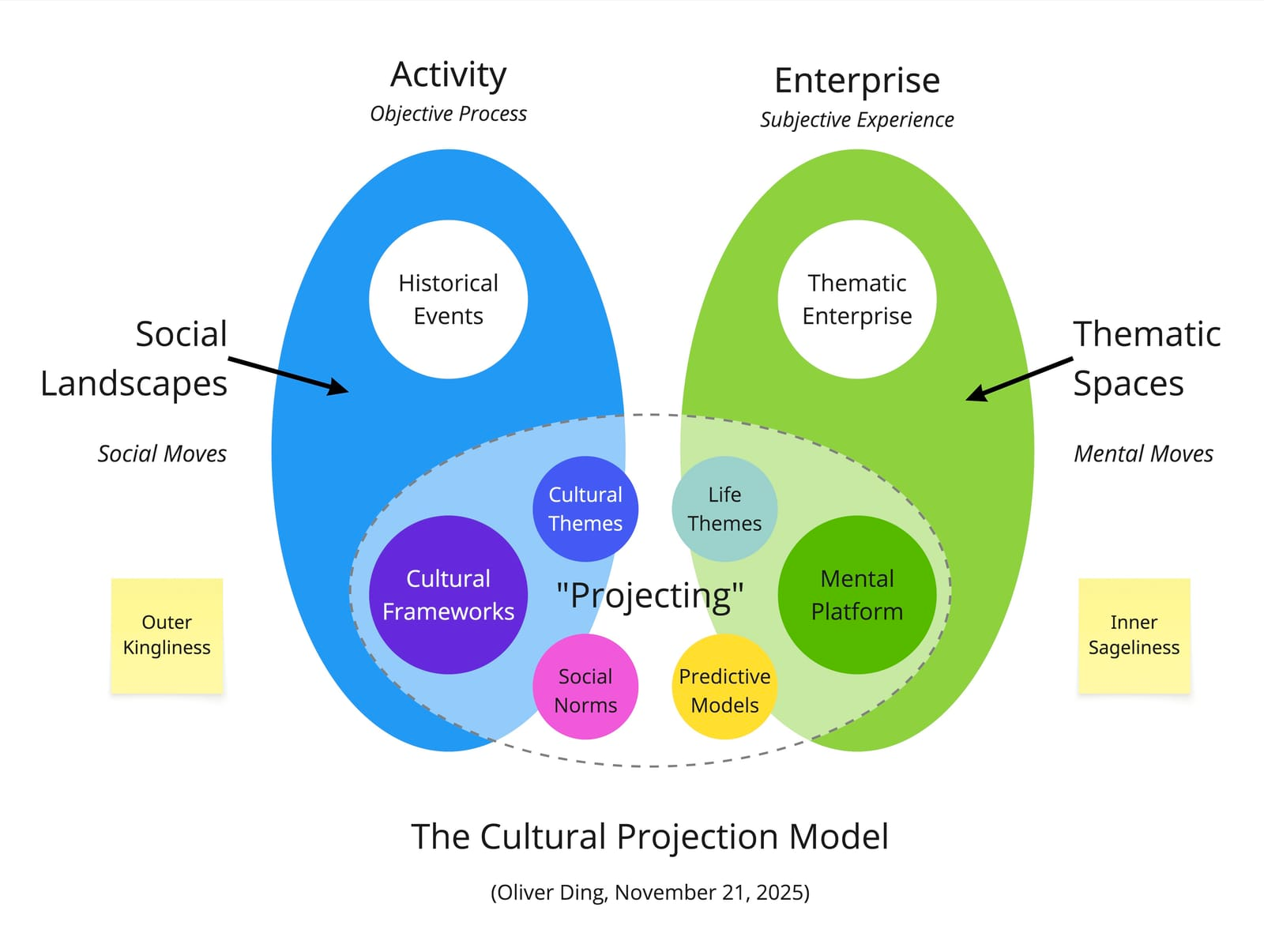
The model is indeed a direct application of the ECHO Framework. If we compare it to the 2021 WXMY (When X Meets Y) model, we discover a profound structural mapping:
- Outside (Outer Kingliness) maps to Container X: It represents the Social Landscapes and Objective Processes of the world, where Cultural Frameworks and Cultural Themes frame social moves.
- Inside (Inner Sageliness) maps to Container Y: It represents the individual's Mental Platform and Thematic Enterprise, where Predictive Models and Life Themes guide mental moves.
- Projecting maps to Container Z: This is the most critical realization—Projecting IS the Echozone.
In both the 2021 and 2025 versions, the Echozone (Z) is not a static space for organizing notes; it is a dynamic process of "doing" and "acting." It is here that "Echoness" (resonance) is transformed into transformative action.
The Cultural Frameworks and Mental Platforms within the "Projecting" container act as the "acoustic tuning" of the Echozone. They determine how the "sounds" of our internal predictive models are translated into Developmental Projects—the social moves that can be heard and felt in the Outside world.
For an Ed.D. researcher or any professional practitioner, this means their "Project"—be it a dissertation or a workplace intervention—is the Echozone where their internal intellectual growth (Inside) meets social reality (Outside). The ECHO Way is not just about reflecting on the past; it is about the power of projecting your internal resonance to shape the future social landscape.
Furthermore, this model offers a lens for policymakers. By designing programs that alter Cultural Frameworks, Themes, and Social Norms, they are essentially shaping the social environments for these developmental projects. In turn, how practitioners launch and perform their projects provides the necessary feedback to inspire the next generation of social settings.
CENTER
The Core of the Activity Analysis Center
Currently, the Activity Analysis Center hosts two major theoretical enterprises:
- The Life-as-Activity Approach (the Project Engagement Approach is part of this family)
- The World of Activity Approach
As mentioned in the last issue, a major update on the World of Activity Approach was the World of Life toolkit.
Over the past 12 months, while I worked on closing my multi-year journey of Knowledge Engagement and Individual Life Development — culminating in Creative Life Theory v3.1 — I simultaneously unfolded a new journey of Cultural Development.
The birth of the World of Life (World of Activity) approach marks a nexus-point where the act of Closing a rich history meets the act of Unfolding a new future.
A major by-product of the Meta-frameworks project is the History{Life[Self(Body)]} Framework (v3.0), which understands the social world as a nested AAS (Anticipatory Activity System). The book proposes that,
Cultural development, in this view, is a continuous, dynamic anticipatory activity of creating and curating concept systems and transforming them into thematic enterprises by weaving active agency and evolving structure within the social world.
This statement goes beyond the book, but covers a series of book drafts I wrote and curated in the past year.
On January 4, 2026, I revisited an early note I wrote in April 2023. At that time, I read Ping-keung Lui's book Gaze, Actions, and the Social World (2007) and wrote 15 reading notes.
Chapter 8 of The Gaze is titled “The Conditionality of Social Structures: The Next Theoretical Task.” Its main content concerns the empirical reality and autonomy of social structures. Professor Lü argues that a “social structure” cannot possess empirical reality and autonomy unconditionally, but that it can, under certain conditions, temporarily possess—or nearly possess—them. This idea is referred to as the conditionality of social structures.
One of my notes reviewed Professor Lü’s discussion of empirical reality and autonomy, applying it to the Knowledge Engagement project and the Creative Life Theory project. In addition, starting from the theme of the next theoretical task, I also explored the potential of anticipatory sociology.
Now, that note appears as an early anticipation of my creative journey over the past six months. Interestingly, I framed the journey as the "closing" of my several-year journey on Knowledge Engagement, and the result as Creative Life Theory v3.1. If we detach the HLS framework from the Meta-frameworks project, it can be used as a large map of the social world, further curating my other frameworks together.
On January 5, 2026, I created a new diagram to curate the HLS Framework (v3.0) and other related frameworks, forming a new landscape of a thematic enterprise: Anticipatory Cultural Sociology.
This landscape (see the diagram below) echoes the early anticipation I made in April 2023.
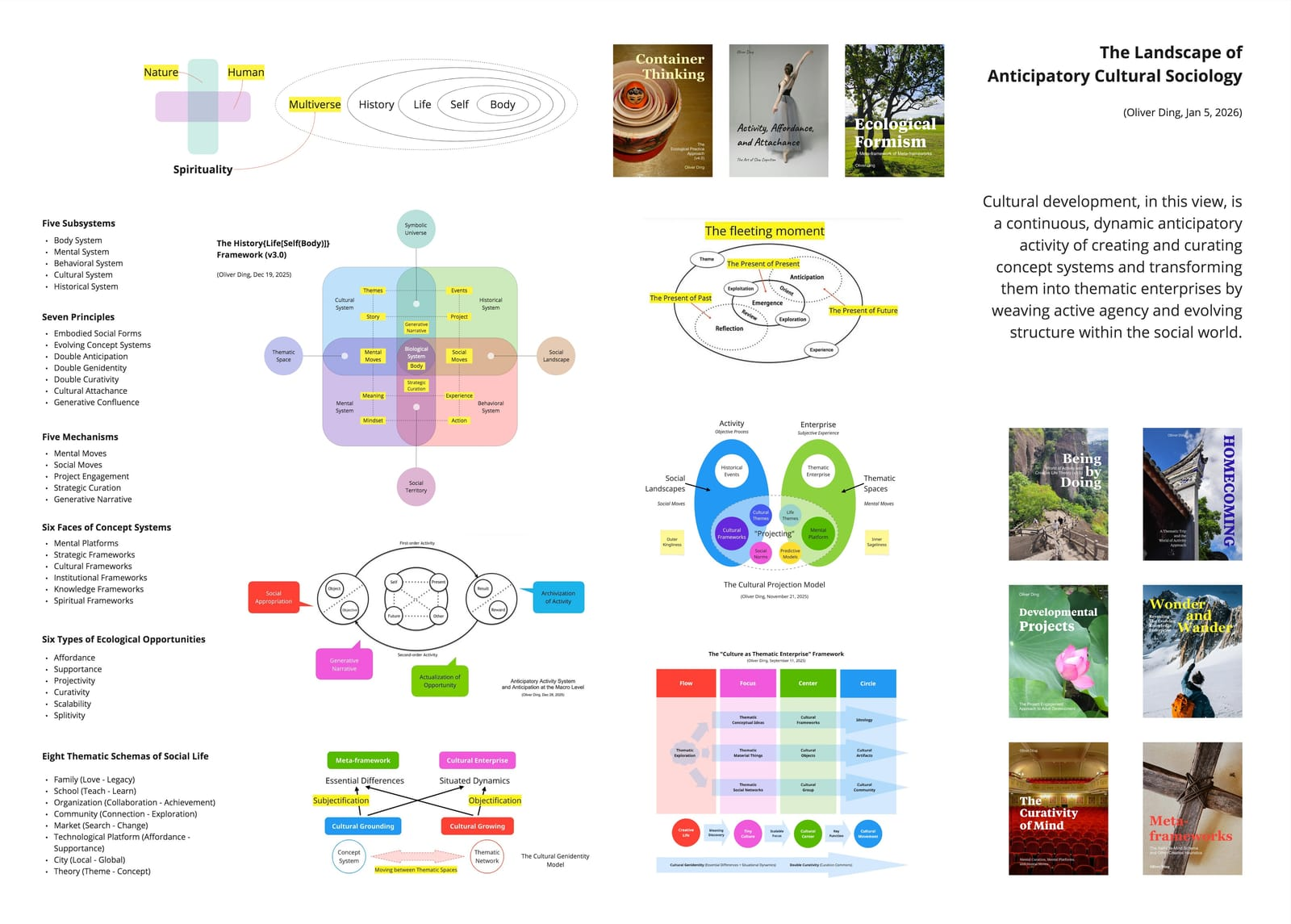
The HLS framework was inspired by Robert Rosen’s Anticipatory System Theory, particularly his concepts of Natural Systems and Formal Systems. While Rosen's approach provides a systematic framework to understand life as an anticipatory system, it remains within the field of theoretical biology.
In 2021, drawing on Rosen’s distinctions and ideas from Activity Theory, I developed the Anticipatory Activity System (AAS) to understand adult life development. Later, in 2024, I developed the HLS framework, which conceptualizes the social world as a nested Anticipatory Activity System (AAS):
- Micro-AAS corresponds to the Mental System (Natural System).
- Macro-AAS corresponds to the Cultural System (Historical System).
For the Meta-frameworks project, the HLS framework provides a theoretical ontology of the social world, offering a structured context in which concept systems can be understood and mapped.
If we focus on the AAS framework, we see the strategic moves among three disciplines: Theoretical Biology, Theoretical Sociology, and Anticipatory Sociology.
- AS (1985) refers to Robert Rosen's Anticipatory System Theory, which belongs to Theoretical Biology
- AAS (2021) refers to the creative dialogue between my AAS framework and Lui's Theoretical Sociology, which occurred between 2022 and 2203.
- HLS (2025) refers to the landscape of Anticipatory Cultural Sociology, which should be situated within the field of Anticipatory Sociology.
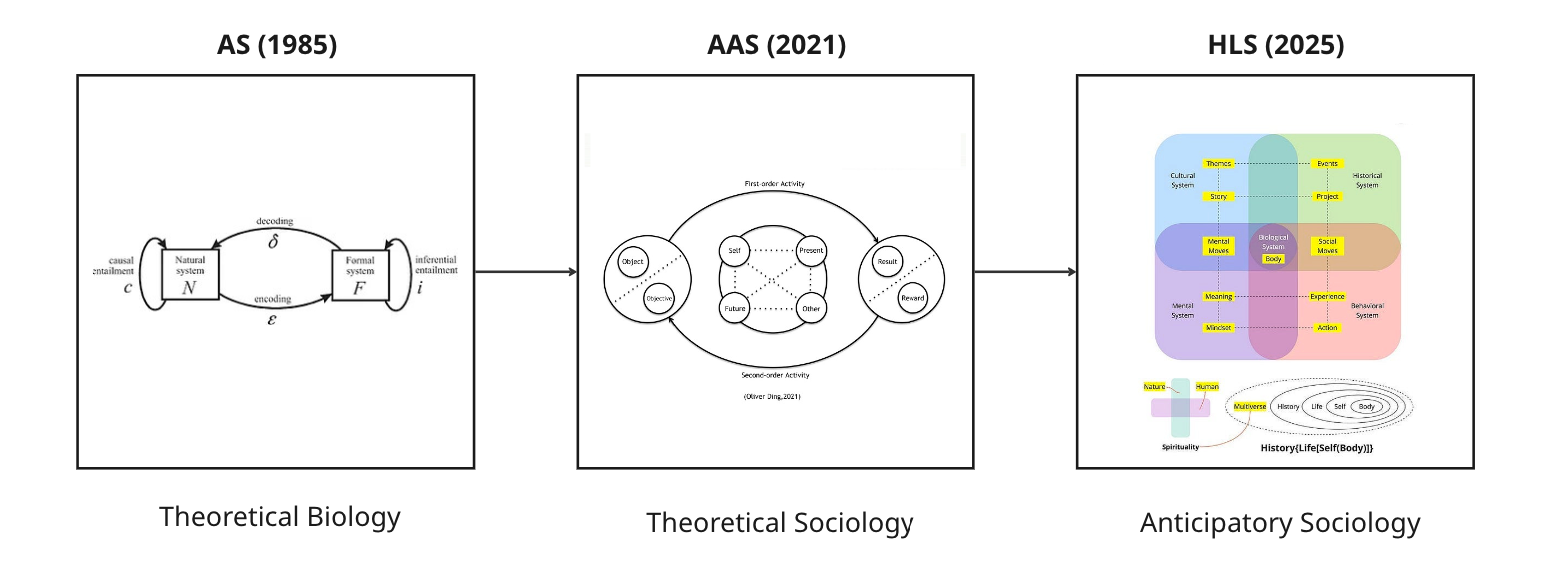
In The Landscape of Anticipatory Cultural Sociology, I share the story behind these moves and the resulting landscape.
Email exchanges with Lui and the friend mentioned earlier encouraged me to explore further. Immersed in conversations around the Ed.D. theme and related educational topics, I eventually developed the "Education as Anticipatory Activity" theme and wrote a long article sketching a framework for further study.
Thus, the Activity Analysis Center is not run by me alone, but with the support of mentors and friends. In fact, this issue almost feels like it features a guest contributor—my conversation with the education researcher significantly shaped many of the themes and insights shared here.
CIRCLE
The Context of the Activity Analysis Center
Over the past several years, I worked on several theoretical projects, such as the Ecological Practice Approach, Curativity Theory, Creative Life Theory, and Thematic Space Theory.
Inspired by creativity researcher Howard Gruber's idea of "Network of Enterprises," I used the "Knowledge Center" approach to manage this large knowledge system. Each knowledge center hosts one or two related theoretical approaches.
- CALL (Creative Action Learning Lab): the Ecological Practice Approach and Creative Life Theory
- Curativity Center: Curativity Theory
- TALE (Thematic Analysis Learning Engagement): Thematic Space Theory
- Frame for Work: A theory about Knowledge Frameworks
Over the past two weeks, I reflected on the entire network of centers.
On the first day of 2026, I walked around a lake near my home with my wife. As we reflected on the past year, I revisited my long journey of writing and curating more than 42 possible books between 2019 and 2025.
That evening, a new idea emerged: the lake could serve as an ecological metaphor for what had gradually taken shape through these 42+ possible books—a point of convergence rather than a destination.
On January 2, I created a thematic card to crystallize this insight. The creative clue, “The Great Confluence,” echoes my experience of unfolding a Generative Confluence journey from June to December 2025.

Alongside the card, I wrote a 17-minute thematic brief that unfolds the story and conceptual landscape of Lake 42, including the following sections:
- A “Generative Confluence” Journey
- A Network of Ecological Metaphors
- The Meaning of 42
- Waterfall, Bridge, and Lake
- Natural Mother as Teacher
- Creative Engagement with Givenness
- Creative Life Curation
- Lake 42: A New Possible Book
The Lake 42 theme represents a new possible project. It narrates the story behind a six-year creative journey of producing 42+ possible books, while also documenting the unfolding of the Generative Confluence journey within a concentrated six-month period.
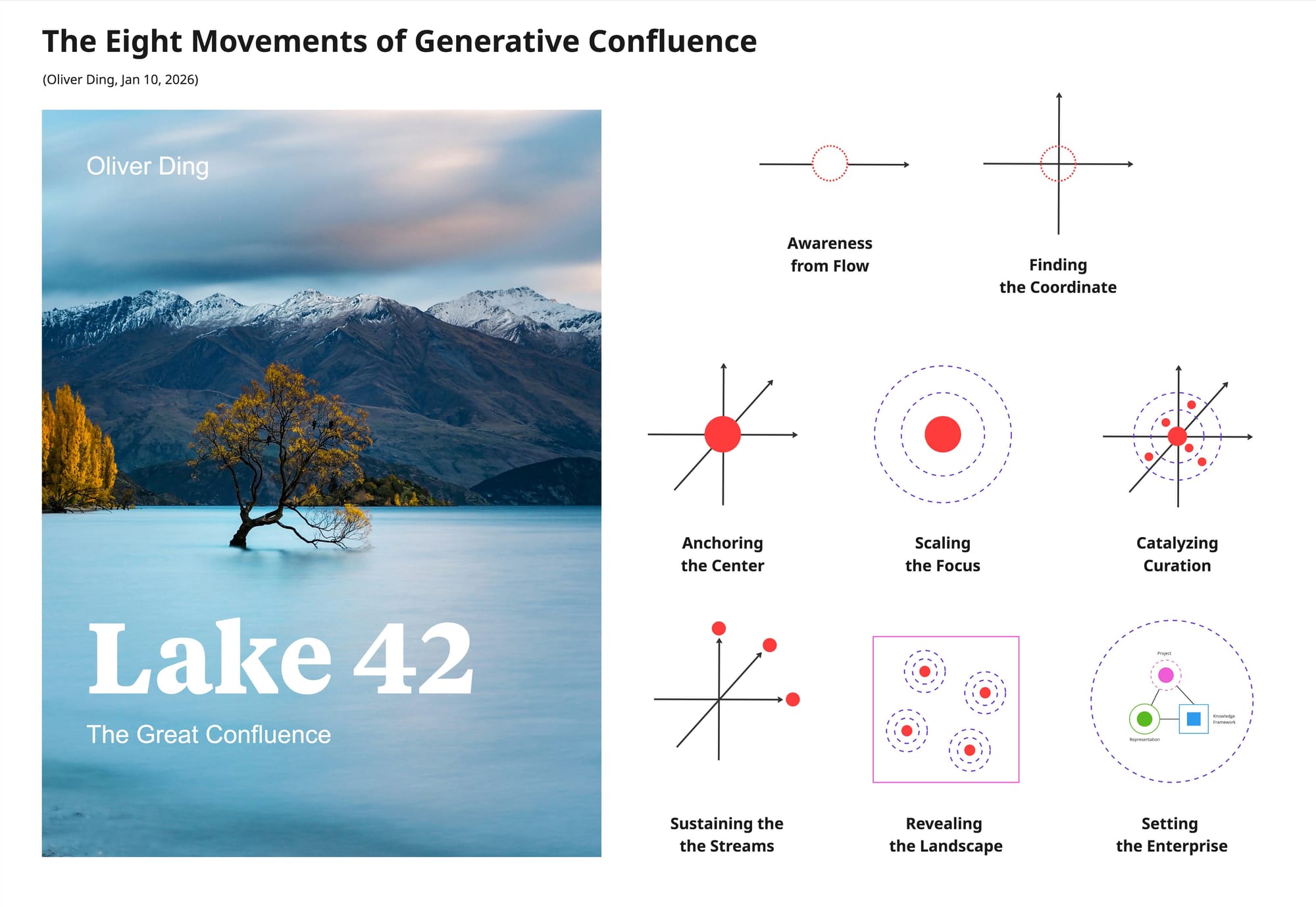
This new possible book serves as a follow-up to Homecoming: A Thematic Trip and The World of Activity Approach, where I reflect on my early life and career activities prior to 2015.
While Homecoming focuses on several forms of World of Activity, Lake 42 will introduce eight movements of a Generative Confluence journey.
World
Me, You, and We
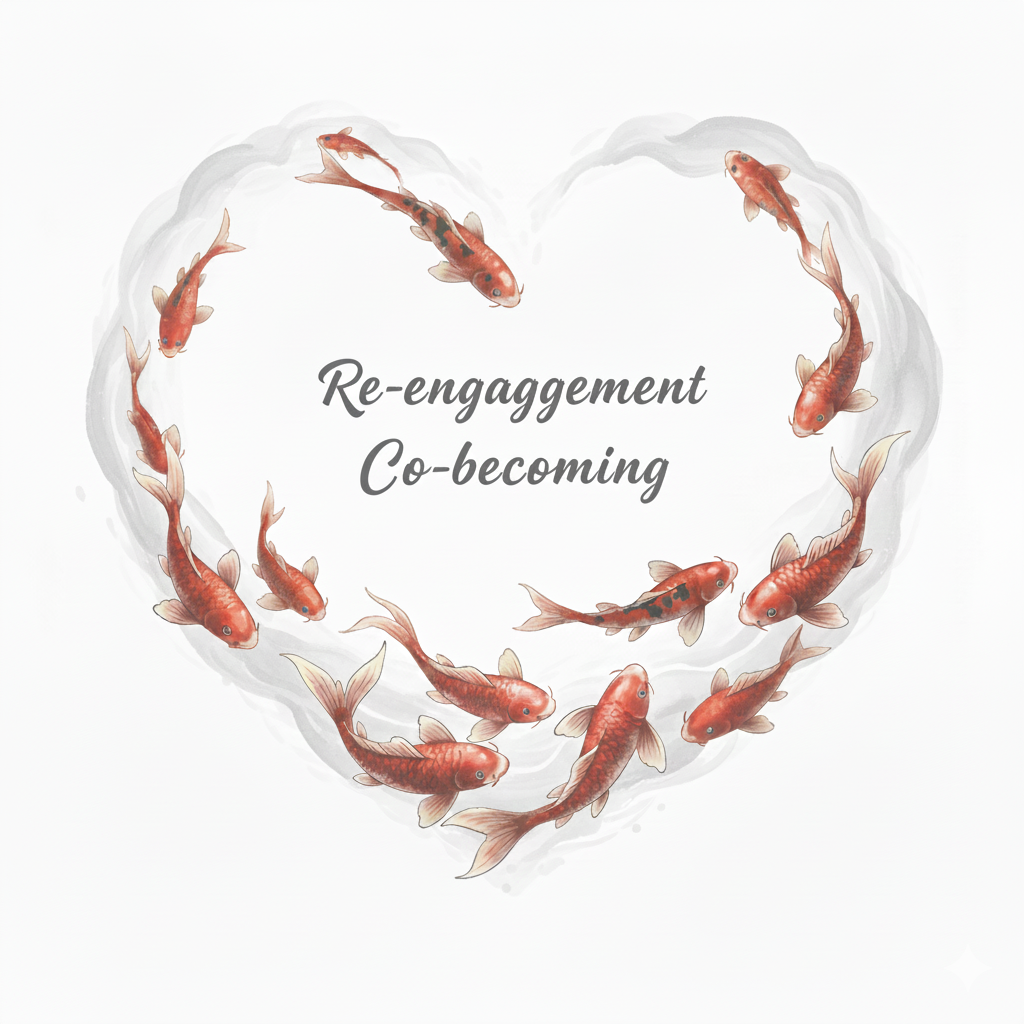
As 2026 unfolds, let us embrace the spirit of Re-engagement—to rediscover the unforgettable people, moments, and things from our past, and cherish them as the delicate culture of our lives.
With beautiful anticipations, let us journey into Co-becoming—creating a shared path alongside the uncertainties of the future.
Oliver Ding
Founder of the Activity Analysis Center
January 15, 2026
p.s. I am based in Houston, Texas, US. Where are you?
v1.0 - January 15, 2026 - 2,246 words