
Appropriating Activity Theory #10: The GREAT Method (2018 - 2026)

This post is part of the "Appropriating Activity Theory" series, which reflects my creative journey of engaging with Activity Theory from 2015 to 2025.
by Oliver Ding
January 29, 2026
In the last issue, I mentioned Donald Schön and his method of Reflection. From January 26 to 27, 2026, I reflected on several methods I had developed over the past years and wanted to develop a meta-framework that would serve as the principles underlying these methods.
Eventually, I found a model whose name perfectly inspired this discovery: the LARGE Method. Originally developed in 2018 as a meta-framework for the learning and reflection project (LAR), it consisted of six words—Learn, Action, Reflect, Generate, Explore, and Exploit—forming the acronym LARGE.
This project was highly influenced by Donald Schön and Chris Argyris. Although I later moved to Ecological Psychology, Activity Theory, and Theoretical Sociology, I now see that their early impact on my creative thoughts and creations was the seed of the Life-as-Activity approach and Creative Life Theory.
In this issue, I will share the story of the LARGE Method and trace its development over the years. Finally, I will show how it has evolved into L(A·R·G)=E—not just one method among many, but the meta-method that serves as the governing principle for my entire family of methods.
Contents
Part 1: The Genesis (2018)
Part 2: The Anticipatory Turn (2021)
Part 3: The Theoretical Curation (2022)
Part 4: The Great Confluence (2025-2026)
Part 5: L(A·R·G)=E (2026)
1
On December 6, 2018, I sent a note to my wife through email and mentioned an idea that I had just gotten after arriving at the office.

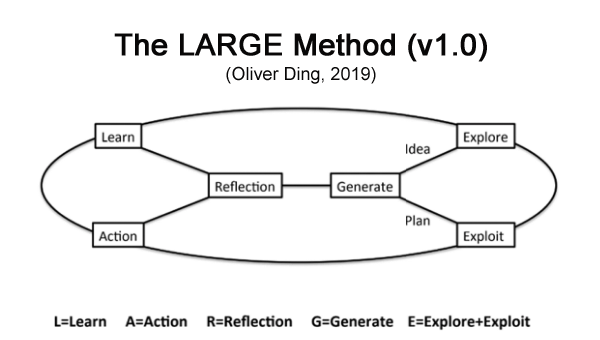
The picture shows a diagram of the idea. It was formed by six words:
- Learn
- Action
- Reflect
- Generate
- Explore
- Exploit
Following the popular naming convention, I named this model LARGE. The last two words both start with the letter E. When drawn as a diagram, these seven words formed three sections: the first section consisted of Learn and Action, the second section of Reflect and Generate, and the third section of Explore and Exploit.
Learn and Action are concrete practices in daily life, belonging to the first-order category. Reflect and Generate, on the other hand, involve reviewing, examining, and comparing Learn and Action, operating at the meta-cognitive level—the second-order category.
After reflection, new things are generated: either ideas or plans. These return to the first-order of Learn and Action. Ideas correspond to Explore, which leads back to Learn. Plans correspond to Exploit, which leads back to Action.
But how did I arrive at this seven-word framework? In the email to my wife, I traced back through three years of exploration—the Learning and Reflection Project (LAR) that began in 2015.
I wrote my first learning autobiography in 2015 and was attracted to biographical studies and adult learning and development. In 2016, I developed a framework called Career Landscape, which is inspired by Activity Theory, Communities of Practice, and other ideas. I also developed a series of tools, such as the Learning Autobiography Guide, Learning & Reflective Cards, Learning & Reflective Canvas, Learning & Reflective Monthly Report Template, etc.
This line of exploration, which I called the LAR project, led me into three theoretical streams that would later form the foundation of the LARGE method: narrative approaches in social sciences, personal epistemology, and action science with reflection-in-practice. Working on LAR as a side project through fragmented time, I gradually accumulated practical tools, including guidelines for writing learning autobiographies, learning-reflection cards, dialogue methods, and conceptual frameworks for personal epistemology.
As both a practitioner and researcher—following the principles of action science and reflection-in-practice—I conducted a comprehensive review of my LAR journey in June 2018. By examining my work against academic discussions on personal epistemology, metacognition, and conceptual change, I developed the idea of "Epistemic Development", elevating LAR from mere reflection to active expansion. This review sparked deeper methodological thinking.
The LARGE Method emerged from this background as a spontaneous creative insight. Naming it "LARGE Method" generated a new framework that elevated the LAR project to a higher methodological level, establishing a more solid theoretical foundation for future practice. At that moment in December 2018, I saw it not just as a reflection tool, but as a meta-framework that could curate ideas and creations I had been exploring in the LAR journey.

A month later, in January 2019, I created a conceptual deck called "The Startup PIE" as part of my own reflection while working at a startup. In this work, I applied the LARGE Method as a framework for understanding founders' learning and growth mindset, distinguishing between first-order thinking (Learn and Action) and second-order thinking (Reflection and Generate), while emphasizing the balance between Exploration and Exploitation—concepts borrowed from organizational theorist James March.
Looking back now, these early insights—the distinction between first-order and second-order activities, the dynamics between exploration and exploitation—would later become foundational to the Anticipatory Activity System (AAS) framework. But at that moment in early 2019, I didn't yet see these connections. Within a few months, my focus would shift dramatically toward theoretical development, and the LARGE Method would be set aside, waiting for the right moment to return.
2
After creating the LARGE Method in early 2019, something significant happened: I largely forgot about it. This wasn't accidental—it was a necessary shift. In March 2019, I completed Curativity Theory, marking my transition from practitioner to theorist. This required total immersion, and the LARGE Method receded into the background.
For the next two years, I devoted myself entirely to theoretical exploration. I delved deeper into Activity Theory, Ecological Psychology, and began engaging with theoretical sociology and anticipatory systems theory. This period was what I would later understand as an extended Second-order Activity: not improving existing practices, but exploring entirely new theoretical territories and discovering new objects of inquiry.
In August 2021, I worked on an empirical research project about an adult development and life discovery program. At that time, I first discovered the "Self-Other-Present-Future" structure and developed the iART framework, which later expanded into the Anticipatory Activity System (AAS) framework.
At 5:37 PM on August 19, 2021, I designed the diagram below as a part of the iART framework.

Two hours later, I expanded it to the diagram below at 7:19 PM on August 19, 2021.

The new diagram was named The Life-as-Activity Framework (v1.0). Why did I use this name for this diagram? In fact, I wrote an email to a friend and told her the name for this diagram is not the final solution. I just needed a name for this diagram.
I also told her that another option is The LARGE Method (v2.0) because the above diagram highlights three keywords: Reflection, Exploitation, and Exploration. These keywords are the core of the LARGE Method (v1.0), which was developed in 2019.
The Life-as-Activity Framework (v1.0) has more concepts than the LARGE Method (v1.0). Thus, I could call it the LARGE Method (v2.0) too. However, the acronym “LARGE” can’t cover all concepts of the framework.
The Life-as-Activity framework aims to adopt Activity Theory for discussing life development. The v0.3 of the framework was published on Nov 29, 2020. I started writing articles about Project-oriented Activity Theory on Dec 26, 2020, and edited these articles into a book draft on Jan 24, 2020.
The Life-as-Activity framework (v0.3) was based on a branch of Activity Theory: the Activity System model. However, the book Project-oriented Activity Theory focused on the Project-oriented approach.
Though I had suggested a solution for balancing the Activity System model and the Project-oriented approach in the book, at that time, I had not yet conducted a solution to upgrade the Life-as-Activity framework (v0.3).
The Life-as-Activity framework (v1.0) used the same diagram, which was originally designed for Project-oriented Activity Theory. So, I just used the name for the new diagram.
However, I was not sure it was the ideal solution for the new version of the Life-as-Activity framework (v1.0) because it was inspired by Robert Rosen’s Anticipatory System theory, too.
On August 30, 2021, I downloaded two papers about Vygotsky and Creativity from the Academia.edu platform.
- Creativity in Drama: Explanations and Explorations (Susan Davis, 2010)
- Creativity in the making: Vygotsky’s contemporary contribution to the dialectic of creativity & development (Seana Moran, Vera John-Steiner, 2000)
The second paper mentions the relationship between Vygotsky and Howard E. Gruber. This reading experience guided me to reflect on the Life-as-Activity framework (v0.3).
In fact, I used a special method to develop the Life-as-Activity framework(v0.3). First, I adopted several theoretical aspects from Activity Theory as a foundation for the framework. Second, I curated several concepts from other theoretical resources about motivation, mental complexity, creative work, cultural life, organizational development, and self-knowledge to expand the framework.
One of the non-activity theoretical resources is the evolving systems approach to the study of creative work (Howard E. Gruber, 1974,1989). I really love this approach because it is about creative careers.
That day, I realized that what I wanted to develop was not a general framework for everyone. What I wanted to develop is a framework for Creative Life. That was the reason why I love Howard E. Gruber’s approach.
Thus, the diagram was renamed the Path of Creative Life.

This temporal structure came from multiple sources: Donald Schön's concept of reflection, James March's distinction between exploration and exploitation, complexity theory's notion of emergence, and now, crucially, Robert Rosen's anticipatory systems theory. The concept of "feedforward"—how anticipation of the future guides present action—became central to understanding how people navigate their creative lives.
I used Emergence to mediate between Exploitation and Exploration. Rather than seeing these as opposing tendencies that must be balanced, I recognized a third state: the spontaneous, unplanned opportunities that arise through interaction with the environment. This insight came from ecological psychology and from creativity researcher Howard Gruber's emphasis on "byproducts" of creative work.
What made 2021 a turning point was my encounter with anticipatory systems theory through the work of theoretical biologist Robert Rosen (1934-1998). I had been reading about Niklas Luhmann's self-organizing systems and scholars' critiques of the "system" concept in Activity System Models. This reading led me to Rosen's groundbreaking work on anticipatory systems.
Rosen defined an anticipatory system as "a natural system that contains an internal predictive model of itself and its environment, allowing the system to change its present state based on predictions about the next moment." This was fundamentally different from reactive systems that could only respond to what had already happened in the causal chain. As Rosen explained, "the anticipatory system's present behavior involves past, present, and future. The emergence of the predictive model pulls the future into the present."
This theoretical insight was transformative. I had been looking for a more fundamental theoretical foundation for my ecological practice approach, and anticipatory systems theory provided exactly that. More importantly, it offered a way to connect individual biography with broader cultural development—a connection I had been seeking.
This was the anticipatory turn: the moment when anticipation became central to my understanding of human activity, creative life, and cultural development. It would take several more years—and additional theoretical work—before I would see how this turn had transformed everything, including the forgotten LARGE Method itself.
3
From 2020 to 2022, my engagement with Activity Theory deepened. In 2020, I developed the Activity U project and began writing Project-oriented Activity Theory, introducing Andy Blunden's concept of "project as a unit of analysis." This work evolved into the Life-as-Project approach and eventually Project Engagement v2.0 by mid-2022.
But the real turning point came in the second half of 2022. I closed the Knowledge Curation project and moved to Life Curation. This shift brought the Path of Creative Life back to my creative situation—and led to an unexpected theoretical confluence.
In the second half of 2022, I closed the Knowledge Curation project (phase 1, 2020 - 2022) and moved to Life Curation. This shift brought the Path of Creative Life back to my creative situation and led to a theoretical curation, which led to Creative Life Theory (v1.0).

Interesting, I rediscovered the value of the Path of Creative Life from other perspectives.
In April 2022, I contact Ping-keung Lui who is a theoretical sociological theorist. Lui aims to build a brand new theoretical sociology as a candidate for the paradigm of sociology. According to Lui, “There are three kinds of theories in sociology, namely, social theory, sociological theory, and theoretical sociology. ”
"In the following months, as I read Lui's books and papers, I learned about his approach to theoretical sociology. His fundamental starting point is an Ontology of action, inspired by Saint Augustine, Martin Heidegger, and Maurice Merleau-Ponty.
According to Lui, "This moment is Augustinian, it comprises at the same time the Present of the Past, the Present of the Present, and the Present of the Future. The actor Remembers in the present of the past, Pays Attention in the present of the present, Expects in the present of the future." (p.235–236, 2010, The Scientific Project of Sociology)
Then something struck me.
I looked at the Path of Creative Life diagram again—the diagram I had created in August 2021, drawing on Activity Theory, Ecological Psychology, and Robert Rosen's anticipatory systems. And there it was: the same temporal structure.
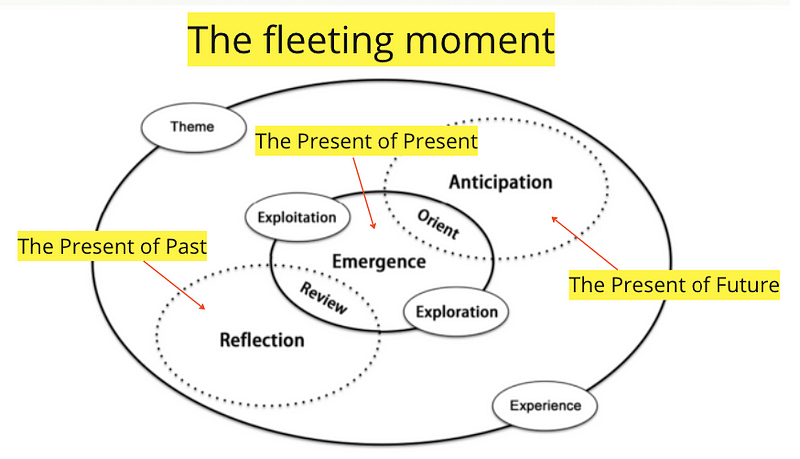
- Reflection: Remembers in the present of the past
- Emergence: Pays Attention in the present of the present
- Anticipation: Expects in the present of the future
The body is in action, action is in the fleeting moment, the fleeting moment is in the body.
This was not a coincidence—it was a structural resonance. From completely different theoretical traditions—Activity Theory and phenomenology, Rosen's biology and Augustine's philosophy—I had arrived at the same understanding of the temporal structure of human action. This echo between the Path of Creative Life and Lui's ontology of "The Fleeting Moment" revealed something profound: I could use his approach as a frame to curate my frameworks as a meaningful whole.
On October 25, 2022, I conducted a one-day, tiny theoretical curation project, but it made a huge impact on my creative work.
Let me trace the journey that led to this moment.
On Sept 18, 2022, I designed a cover image for a possible book Knowledge Curation, and used it to close the Knowledge Curation project (phase 1).
Then, I moved to a new journey: the Life Curation project for Life Strategy Center.
On Oct 20, 2022, I reflected on the Knowledge Curation project and published the Creative Life Curation Framework.
Moreover, I used “Subjectification=Experience 1=Second-order Activity” and “Objectification=Experience 2=First-order Activity” which led to a creative dialogue between three theoretical frameworks.
On Oct 25, 2022, I made the diagram below for a theoretical curation project. I wanted to curate three paths and four sub-frameworks together.
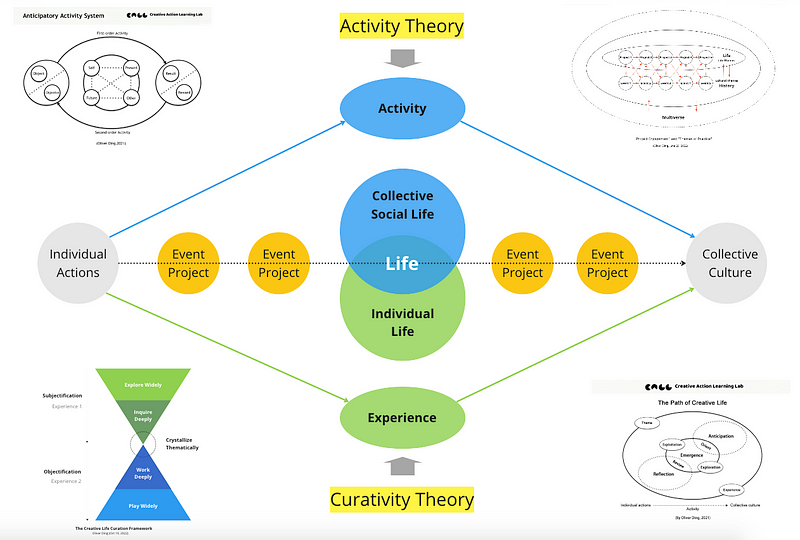
While the primary theme is claimed, the concrete solution is not clear. The primary theme is the transformation between individual actions and collective culture.
From three different theoretical approaches, I developed three paths for understanding the primary theme. How can I curate these paths into a meaningful whole?
The above diagram is not the final answer.
I need a new knowledge container to contain these three pieces.
The solution is clear. I can use a meta-theory as the container. Lui’s theoretical sociology is a such meta-theory.
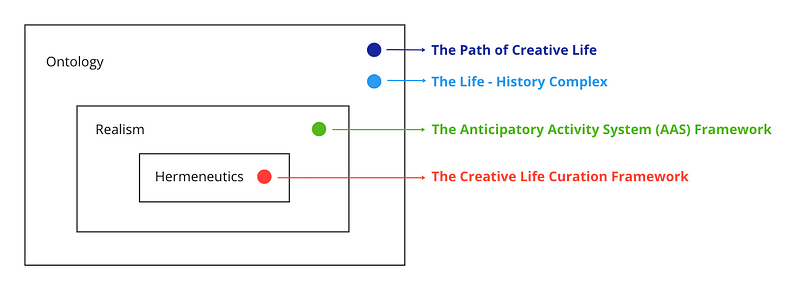
The starting point of this solution is the echo between the Path of Creative Life and Lui’s ontology “The Fleeting Moment”. On Oct 2, I sent an email to Lui and mentioned this insight.
In fact, I mentioned the echo between “First-order Activity / Second-order Activity” and Lui’s realism “Weberian course of action / Giddensian course of action” in an email I sent to Lui on Sep 26, 2022.
On Oct 25, 2022, I realized that the Creative Life Curation framework is located in the Hermeneutics part. Finally, I complete a puzzle.
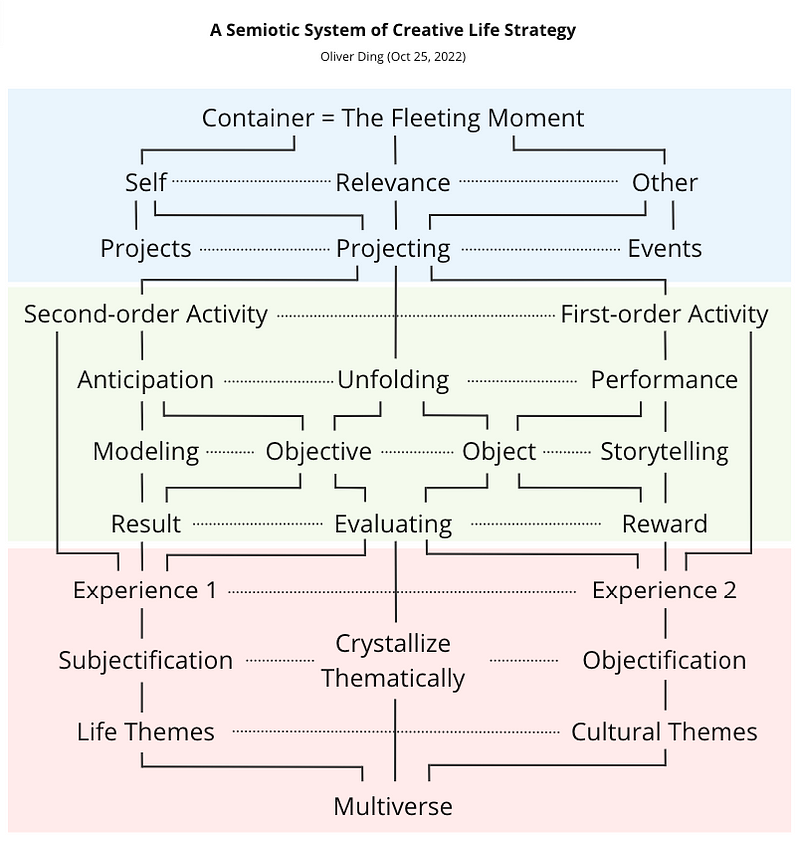
The final outcome was amazing! What a beautiful semiotic system diagram!
At the end of 2022, I curated four book drafts I created within the year and formed the Aspects of Creative Life series. This was version 1.0 of Creative Life Theory.

The Path of Creative Life model serves as a meta-framework of Creative Life Theory (v1.0), which is followed by a series of units of analysis. The four book drafts correspond to four units of analysis.
Ecological Practice Design > Creative Actions
Project Engagement > Creative Projects
Creative Life Curation> Creative Journeys
Advanced Life Strategy > Creative Life
Each book draft also introduces a theoretical framework.
Ecological Practice Design > The Lifesystem Framework
Project Engagement > The Developmental Project Model
Creative Life Curation > The Creative Life Curation Framework
Advanced Life Strategy > The Anticipatory Activity System (AAS) Framework
,

- PCL: The Path of Creative Life
- LHC: The Life—History Complex
- AAS: The Anticipatory Activity System (AAS) Framework
- CLC: The Creative Life Curation Framework
The ECHO Way is a three-space model: Container X, Container Y, and Container Z. In the diagram above, we see:
- Container X: Reference Space is actual
- Container Z: Problem Space is actual
- Contaienr Y: Solution Space is potential
How does Reference Space work? It offers the aspect of Form for Solution Space.
How does Problem Space work? It offers the aspect of Content for Solution Space.
How does Solution Space work? It curates Form and Content together.
How did I work with Reference Space and Solution Space?
The problem space was born on Oct 20, 2022. In fact, Solution Space was born before Problem Space. Before working on this theoretical curation project, I was learning Lui’s approach by playing with the semiotic system diagram.
I used a technique called “Deep Analogy” to transfer a Form from Reference Space to Solution Space. The notion of “Deep Analogy” is inspired by Arthur L. Stinchcombe, who is a leading practitioner of methodology in sociology and related disciplines.
Now, this story can be understood as an early example of the "Generative Confluence" model I recently discovered.
4
Unlike traditional confluence in geography, where streams merge and lose their individual identities, the term “Generative Confluence” is used in Creative Life Theory with a new meaning.
It describes a pattern where ideas inspired by distinct theoretical approaches evolve from separate into interconnected, generating a new center for a brand-new possible theoretical enterprise. As the new one emerges, the original theoretical approaches still keep their developmental trajectories.
The Generative Confluence pattern goes beyond the Creative Dialogue pattern, where some new ideas are born from dialogue between two theoretical approaches.
The pattern was discovered on June 2, 2025, when I used the Self-Life-Mind schema as a meta-framework to reflect on my creative journey (2014–2025), focusing on three lines of exploration, each grounded in a theoretical approach. I first created the diagram below to represent my "theorizing creative life" journey.

What is the major trend in this trajectory?
It represents a three-phase exploration, centered on three disciplines at each phase. Rather than being strictly sequential, these three phases reflect shifting but overlapping centers of theoretical focus.
- Early phase (2014–2020): Psychology, especially Ecological Psychology.
- Middle phase (2019–2024): Sociology, especially activity-based social practice theories.
- Late phase (2022, 2023, 2025): Philosophy, especially self and subjectivity.
The diagram only highlights my mental focus on exploring a new discipline at different periods. It does not represent my actions and projects. For example, I actively worked on the Ecological Practice Approach from 2021 to 2025.
If we use the Creative Thematic Curation Framework as a meta-framework, this three-phase journey can be seen as a different story:
- First-wave: Focusing on one approach, the Ecological Practice Approach.
- Second-wave: Engaging with multiple approaches — three in total.
- Third-wave: Moving to a large creative dialogue between Western Philosophy and Eastern Philosophy.
On the same day, based on the diagram above, I used a coordinate diagram to represent this landscape. See the diagram titled “Theorizing Creative Life Landscape” below.

Then something unexpected happened. As I looked at the coordinate diagram, I was shocked by what I saw: a 3+1 structure I had never consciously designed.
Over the past several years, I have drawn on three theoretical traditions as resources to develop three theoretical approaches. While I maintained boundaries between these approaches, across time, I applied them to study how a person achieves a creative life, resulting in different perspectives and knowledge frameworks.
My engagement with these traditions is neither a matter of inheritance nor linear expansion. Instead, I treat each as a creative resource — a reservoir of concepts, metaphors, and structural tensions that can be activated in context-specific knowledge work. This dialogical strategy is at the core of Creative Life Theory and is elaborated in one of my book drafts, Mapping Creative Dialogue.
Although I even did several creative dialogues to make new knowledge frameworks, I never thought about integrating them into one.
However, the “Theorizing Creative Life” landscape presents a new pattern to me. At some point, a set of related ideas has already been curated as a new, meaningful whole. It emerged as a new approach, not replacing any of the old approaches.
The three approaches could still be developed by following their original trajectory. The new one starts at a coordinate origin, defining a position of a new center, with the potential to grow into a new theoretical enterprise.
Inspired by geography, I named this pattern Generative Confluence.
The discovery of the Generative Confluence pattern in June 2025 was just the beginning. Over the following six months (June to December 2025), this pattern continued to unfold in my daily work—but I didn't fully understand its dynamics until later.
In January 2026, I started the Lake 42 project to systematically reflect on that six-month journey. After examining my daily work and notes, I discovered that the unfolding had followed eight distinct movements.

While working on the Lake 42 project, I focused on writing stories that happened in 2025. However, I also discovered that I actually conducted several cases of "Generative Confluence" in my early journey.
The Oct 25 theoretical curation project is also a "Generative Confluence" project.
At the "Finding the Coordinate" movement, I used the Path of Creative Life model as a meta-framework to set the living coordinate, framing the "Creative Life" theme as the primary focus of my creative journey at that time.
At the "Anchoring the Center" movement, I used Lui's framework as a meta-framework to curate three paths of creative life together, framing a theoretical framework for version 1.0 of Creative Life Theory.
From 2022 to 2025, the "Scaling the Focus" movement unfolded. I continued developing Creative Life Theory. In 2023, the outcome was version 2.0. In 2025, version v2.0 became a one-dimensional source of a great "Generative Confluence" journey.
What a factual confluence!
5
The story now reaches the present movement.
One week ago, I revisited a thematic conversation on my methods with a friend via email. This reflection encouraged me to develop a meta-framework that would untitled vasious methods I developed over the past years as a meaningful whole.
Eventually, I revisited the LAR project in 2018 and traced its development over the years. I found that the name LARGE Method is perfect for the new meta-framework. However, this time, I redefined it as a formula:
L(A·R·G)=E

Now it represents five themes:
- L: Landscape
- A: Anticipation
- R: Reflection
- G: Generation
- E: Enterprise
These themes refer to five methodological principles, forming a meta-method:
- Landscape: Synchronic view of the whole
- Anticipation: Orienting toward the future
- Reflection: Learning from the past
- Generation: Creating in the present
- Enterprise: Diachronic unfolding of projects
The diagram below uses the Living Coordinate model to create a framework of the LARGE Method (2026).

The Living Coordinate model was made with two parts: a 3D coordinate and a series of circles. The diagram above shows the model at the center, while the two sides offer details of two parts.
On the right side, five methodological principles are presented within five different color boxes, which correspond to five circles within the center diagram.
On the left side, three dimensions are unfolded into three thematic spaces, which are used to place my methods. The diagram shows nine examples of my methods:
Creating (Theme - Culture) | Theamtic Creation
- The Creative Life Curation Method
- The Thematic Exploration Method
- The Historical-cognition Method
Doing (Life - History) | Project Engagement
- The Strategic Life Narrative Method
- The Activity Analysis & Intervention Method
- The Cultural Projection Method
Thinking (Mind - Body) | Spatial Cognition
- The Thematic Space Mapping Method
- The Slow Cognition Method
- The Diagram Blending Method
It reveals three focuses of my methods: Thematic Creation, Project Engagement, and Spatial Cognition.
Five principles and three focuses frame a LARGE method for my own creative life.
From 2018 to 2026, the LARGE Method has traveled a long journey. It began as a spontaneous insight—six words scribbled down and sent to my wife in an email. It was forgotten for years while I pursued theoretical explorations that seemed unrelated. Yet all along, its core concepts were evolving, reappearing in new frameworks, waiting for the right moment to return.
That moment came when I recognized the pattern: Generative Confluence. The LARGE Method had never truly disappeared—it had been transforming, appropriating new theoretical resources, curating insights from Activity Theory, Ecological Psychology, Anticipatory Systems, and Theoretical Sociology. Now it returns, not as one method among many, but as the meta-method that governs my entire creative system.
This is what appropriating Activity Theory means to me: taking theoretical resources and transforming them through lived practice, until they become something new—something that carries forward the creative life.
v1.0 - January 30, 2026 - 4,404 words