
Appropriating Activity Theory #11: When Two Students Aren't Enough (2023)
This post is part of the "Appropriating Activity Theory" series, which reflects my creative journey of engaging with Activity Theory from 2015 to 2025.
by Oliver Ding
February 15, 2026
For several years, I had been taking my two sons to a local Chinese weekend school every Saturday for Chinese language classes and other enrichment courses. As a parent, I spent many hours waiting in hallways and lounges while they attended their classes.
Education has long been a central research domain for Activity Theory scholars. The classroom, with its complex interplay of teachers, students, tools, and institutional rules, offers rich terrain for understanding how human development unfolds through structured activity.
In Fall 2023, I realized I could use this school as a research site — a place to develop my empirical research skills in Activity Theory. Not as a formal academic project with institutional backing, but as an informal, personal inquiry into how activities actually work in educational settings.
That fall, a math class opened this journey.
Contents
- An Email from Teacher Yvette
- The Peculiar Structure of Our "Non-Class"
- The Third Student: Crossing the Boundary
- My Position as Observer-Parent
- Schrödinger's Lunch
- When an Informal Project Becomes Formal Knowledge
- The Invisible Course
- Looking Back: Four Moments at the Boundary
Note: Names and some identifying details have been changed to protect privacy.
1
On September 14, 2023, I received an email from Teacher Yvette at a local Chinese weekend school. The message was brief but consequential:
Hello, parent,
It looks like we don't have enough students enrolled to open this class.
I wanted to ask about your thoughts and your child's situation and goals.
I have a fifth-grade daughter myself, about the same age as your son. We're also free during that Saturday afternoon time slot at school. If it works for you, we don't need to formally register for the class or pay fees. I can lead them together to keep each other company, learn and practice, and cultivate their interest and learning ability. Fifth grade is a critical age. Teaching one child requires effort anyway; with two together, I can flexibly adjust the content based on their situation and needs.
We can start by working through a set of past problems and see which topics they need to deepen, as well as expand to topics they might need for middle school later, including some statistics topics that kids are usually less familiar with.
Of course, this depends on you and your child's interest. If you're interested, I can discuss with the principal about finding an empty classroom to use.
Thanks, Yvette
The situation was clear: the school required three students to open a class. Only two had registered — my son and Teacher Yvette's daughter. According to institutional logic, the class should not exist.
But Teacher Yvette proposed something else entirely.
Not a formal class, but an informal gathering. Not paid instruction, but companionship. She would borrow an empty classroom. The registration fees would be refunded. The children would still learn, still practice, still grow — just not within the official structure.
I replied immediately:
Teacher Yvette, hello!
Thank you for this arrangement. During that time slot, he has nothing else to do at the school. If you can guide him in practice and inspire his interest, that would be wonderful. We'd be happy to pay you privately.
Oliver
Teacher Yvette responded:
Then we'll meet Saturday afternoon, 2-3 PM in Room 302. The room looked empty last Tuesday, so let's plan to meet there. If there's any change, we'll adjust.
No need to pay me anything. Just have him bring a pen, notebook, and other usual class supplies, and complete homework on time.
If you and your child want to participate in November's Noetic fifth-grade math competition, and his school hasn't organized group registration, I can register a team through the school (total cost around $70). Depending on registration numbers, we can share the cost. At worst, with just our two students, it's about the same as individual registration fees. The benefit is having a companion, plus an extra medal for the best performer on the team.
Then I added a question:
Would it be convenient for me to observe your classes? I have nothing else to do during that time, and perhaps I could conduct an informal Activity Theory research project by observing your class.
I run a website called Activity Analysis Center, an independent knowledge center dedicated to spreading and exploring Activity Theory and similar social practice theories.
Activity Theory originated from Soviet psychologists like Vygotsky and Leontiev. After spreading to North America, it gradually developed into a cross-disciplinary philosophical inquiry framework with wide applications in education, organization, entrepreneurship, interaction design, and other fields...
Teacher Yvette agreed without hesitation.
What I didn't fully recognize at that moment — what would only become clear through observation and later theoretical reflection — was that this arrangement existed at a remarkable boundary. Not quite formal, not quite informal. Not quite teaching, not quite mentoring. Not quite institutional, not quite personal.
This was something operating at the edge itself.
2
Room 302 at the school became our meeting place. Saturday afternoons, 2:00-3:00 PM. Two students, one teacher, one observer sitting in the back.
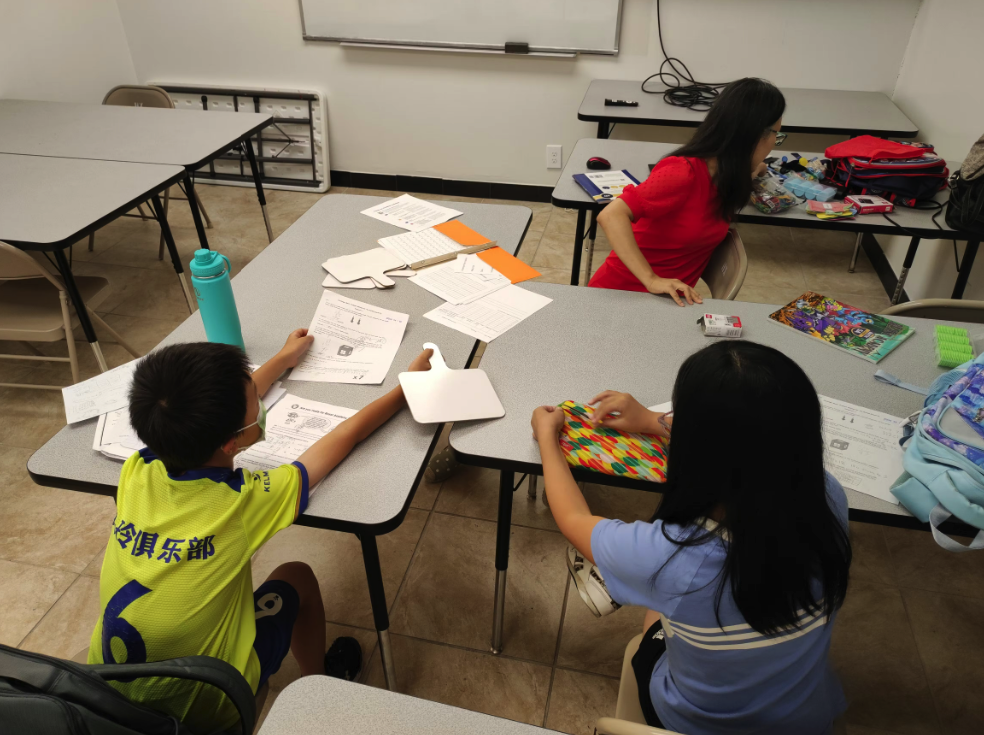
The arrangement carried an interesting internal logic:
What made it informal:
- No official enrollment
- No tuition payment
- Borrowed classroom space
- Flexible curriculum
- Personal motivation (teacher's own daughter participating)
What kept formal elements:
- Regular meeting time and place
- Structured problem-solving sessions
- Homework assignments
- Preparation for an official competition (Noetic Math)
This was not simply "informal learning." It was something more specific: a structure that existed because it operated at institutional boundaries, not despite them.
Teacher Yvette had identified the gap between institutional requirements (three students) and actual need (two motivated students). Rather than accept the binary choice — open a formal class or do nothing — she created a third option by working at the boundary.
The paradox was elegant: by stepping outside formal structures, she could still use institutional resources (the classroom, the competition framework, the community context). By accepting no payment, she freed herself from institutional constraints while maintaining professional teaching quality.
I found myself using phrases like "liminal space," "boundary arrangement," "neither-nor structure" in my notes. Something about this situation felt significant, though I couldn't yet articulate why.
3
By the third week, something shifted. A third student joined. Now we had three.
Suddenly, the class met official requirements. It could be formalized. The boundary moment had passed.
I watched this transition with fascination. On October 7th, at the fourth class meeting, I took detailed observational notes:
Three students now. The classroom felt different — it had returned to the appearance of a normal teaching activity. The teacher opened the large screen and began having students come to the whiteboard to communicate and discuss.
This change was unexpected.
2:07 — Teacher arrived late. Three students present. The third student's father sat in the back of the classroom, passing time on his phone.
2:12 — Teacher left the classroom to get the remote control.
2:14 — Teacher returned, began using the projector to display her laptop screen on the large screen.
2:19 — Teacher began explaining using the whiteboard.
2:22 — Teacher asked my son to come to the whiteboard to work on problems.
2:30 — All students came to the whiteboard to work on problems, exchanging ideas and discussing.
2:35 — Teacher and students sat around the table, playing games and discussing.
2:47 — Students returned to their seats. Teacher summarized the class.
The same teacher, the same approach, the same content — but now it existed within institutional recognition rather than at its edge.
What had changed? The activity itself remained remarkably consistent. What changed was its position relative to institutional structures.
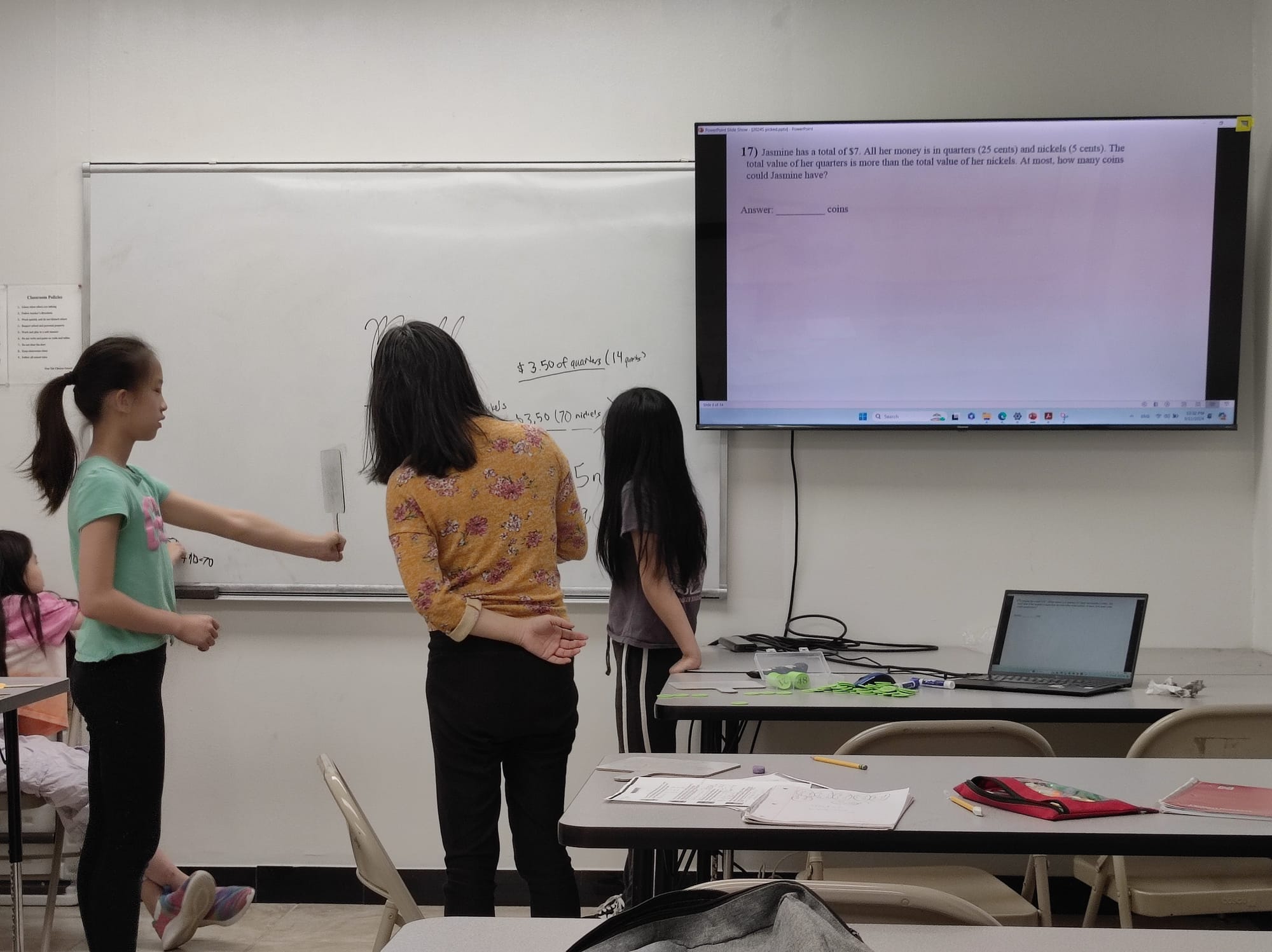
This observation sparked something: the boundary is not just a line to cross; it is a space where things operate differently.
At the boundary:
- Rules become visible (because they must be negotiated)
- Creativity becomes necessary (because standard paths are blocked)
- Structures become malleable (because their contingency is exposed)
- New possibilities emerge (because alternatives must be invented)
Once inside the formal structure, these qualities recede. The class becomes more stable, more predictable, and more institutional, which brings both benefits and constraints.
4
Sitting in the back of Room 302, I occupied my own boundary position.
I was there as a parent — my son was one of the two students. I was also there as a researcher — observing classroom interaction through the lens of Activity Theory. I was simultaneously inside the activity (as participant-parent) and outside it (as observer-researcher).
This dual position created its own productive tensions. I could not be purely objective; my son's learning mattered to me personally. I could not be purely subjective; I was actively analyzing patterns and structures.
The first semester, Fall 2023, I attended nearly every class, taking notes, watching how Teacher Yvette introduced problems, how she scaffolded student thinking, how she balanced individual work with collaborative discussion. The second semester, Spring 2024, I stopped attending but continued following the email communications, test results, and competition outcomes.
This was an informal research project in the truest sense. I had no specific research agenda, no predetermined questions, no formal methodology. I was simply curious about what would happen in this peculiar arrangement.
I was observing informally, in an informal class, at an informal school (weekend enrichment program), while maintaining my informal role as parent-observer.
Looking back, I realize that my entire research approach existed within its own boundary.
5
The first math class took place on September 16, 2023. That day, I encountered another puzzling moment.
Before the class started, I went to buy lunch from a nearby Chinese restaurant. The owner and I had become friendly over many visits. I ordered dumplings and one dish.
When I returned to the school and opened the takeout bag, I found three containers instead of two. Besides the dumplings and the dish I'd ordered, there was stir-fried chives with eggs (韭菜炒蛋) — something I hadn't ordered.

I assumed the restaurant owner had made a mistake. Someone else's order had ended up in my bag. I drove back to return it.
When I walked into the restaurant, the owner looked surprised to see me. "Is something wrong?"
"I think you gave me someone else's dish by mistake," I said, holding up the container of chives and eggs.
She laughed. "That's for you! I packed it as a gift. You come here often, and I wanted to give you something extra."
I stood there, container in hand, experiencing a strange moment of cognitive dissonance.
In that interval — between leaving the restaurant and returning to it — who owned the dish?
From the owner's perspective, she had given it. The transfer was complete. It was mine.
From my perspective, I hadn't received it. I didn't know it was given. It belonged to someone else, mistakenly in my possession.
The dish existed in a peculiar state. Neither fully given nor fully received. Neither hers nor mine. A gift that hadn't yet become a gift.
I immediately thought of Schrödinger's Cat — that famous thought experiment where a cat in a box is simultaneously alive and dead until someone observes it. The chives and eggs were like that: simultaneously given and not-given, mine and not-mine, until the communication gap was resolved.
This was Schrödinger's Dish.
What made this moment so strange was that both understandings were simultaneously true. She had given; I hadn't received. The ownership was genuinely ambiguous — not because either of us was confused, but because the structure of giving has a gap built into it.
The Schrödinger's Cat analogy is more than wordplay. In quantum mechanics, the cat genuinely exists in superposition — both alive and dead — until observation collapses that state. The lunch dish existed in a similar superposition: both given and not-given, both mine and not-mine. Not because we lacked information, but because the social structure itself contained multiple coexisting states.
Giving requires two moments: the giver's act and the receiver's awareness. Normally, communication bridges these two moments seamlessly. But when communication breaks down — when the giver gives without informing, or the receiver doesn't realize they've been given something — the structure becomes visible. Between these two moments, the lunch dish was neither fully hers nor fully mine. The communication failure revealed what's usually invisible: that giving is not a single act but a relationship between two moments.
I thanked her profusely, feeling both grateful and slightly embarrassed. As I drove back to the school (again), I kept thinking about this incident. It shared something with the math class situation — some quality of existing between states, of not fitting neatly into established categories.
Two different moments, two different contexts, but both felt like they were on the edge of something.
6
The math class continued through Fall 2023 and Spring 2024. By summer 2024, the course had ended. My son and the other students had learned problem-solving strategies, participated in the Noetic competition, and developed their mathematical thinking.
I had pages of observation notes, but no clear sense of what to do with them.
Then, on May 18, 2024, something clicked.
It was a Sunday afternoon. I'd gone to Costco to buy groceries, came home, and was processing meat and ribs in the kitchen. My mind wandered to Teacher Yvette's math class. The previous Saturday had been the school's graduation ceremony — I'd taken photos and videos for her. I'd just sent them to her the day before, and earlier today, she'd replied with thanks.
Her reply triggered a cascade of memories: last semester's classroom observations, the parent lounge at the school, thoughts about how the space could be better used, reflections on parent education and development.
And suddenly, I saw it.
At that time, I was working on developing what I called the Project Engagement framework v3.0 — a theoretical model for understanding how individuals engage with projects in ways that transform both self and project. The framework emerged from my ongoing work with Project-oriented Activity Theory.
This v3.0 represented a significant evolution from earlier versions. Version 1.0 had focused on entering and exiting projects. Version 2.0 emphasized project transformation. Now, v3.0 was addressing something new: inside and outside the project — the relationship between a project and its broader social ecology.
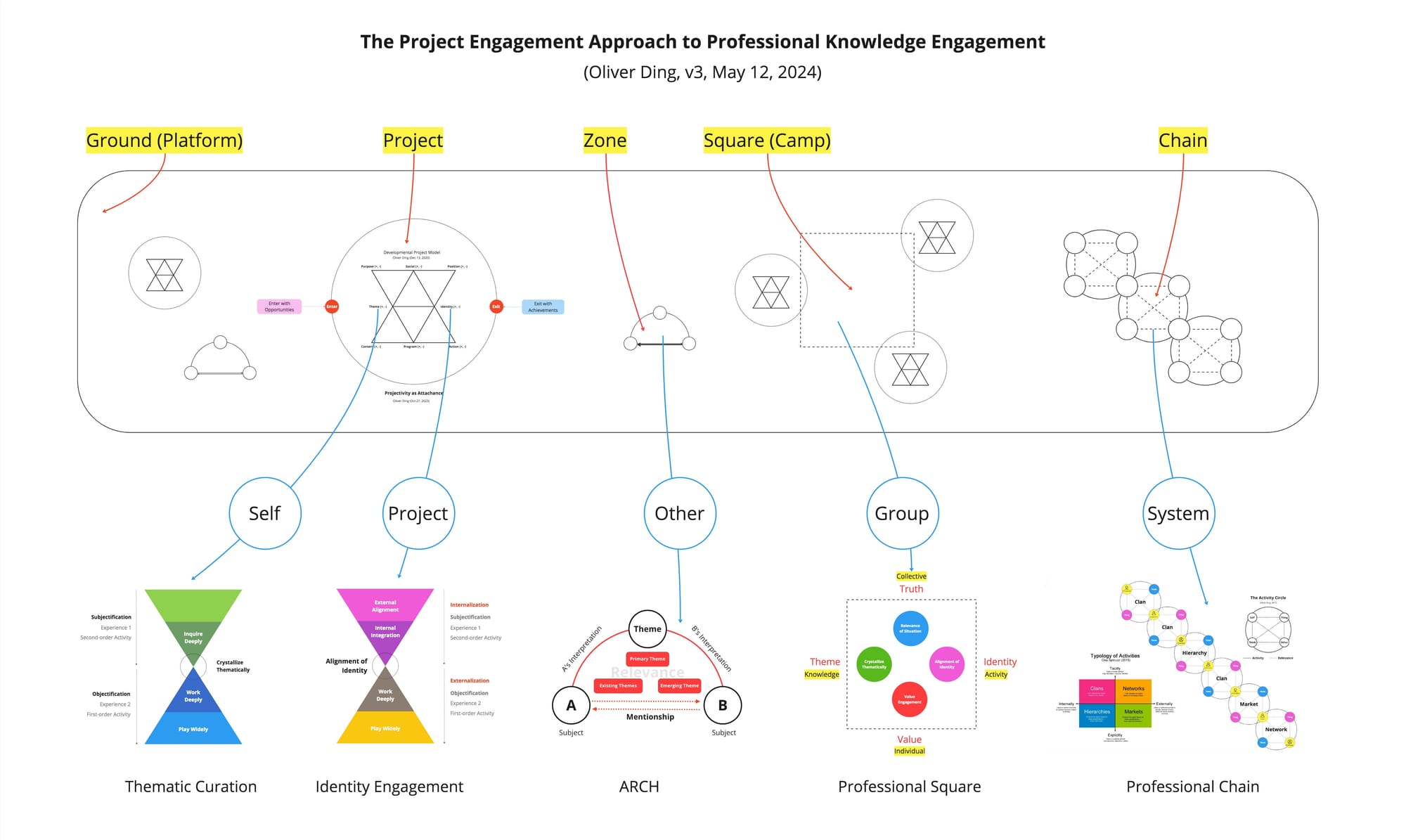
The framework emphasized five key dimensions for mapping this ecology:
- Ground (Platform): The broader social spaces that enable projects
- Project: The focal activity that organizes engagement
- Zone: The boundary relationships between different roles (1:1 connections)
- Square (Camp): The physical/social gathering spaces (small-scale publics)
- Chain: The network connections to larger systems (multi-level linkages)
As I stood there in my kitchen, I realized: Teacher Yvette's math class perfectly mapped onto this structure.
- Ground: The school and other social spaces in our community
- Project: The one-year math problem-solving course
- Zone: Teacher-parent, teacher-student, local-global relationships
- Square: The parent lounge in the school's common area
- Chain: The Noetic competition system connecting to broader networks
The case wasn't just compatible with the framework. It exemplified every element.
Teacher Yvette's email, her creative solution, the boundary arrangement, the transformation when the third student joined, the parent lounge where families gathered, the connection to the national Noetic competition — all of it mapped precisely onto the theoretical structure I was developing.
What had begun as a casual observation project, with no research agenda, had become an empirical demonstration of a theoretical framework.
Six days later, on May 24, 2024, I wrote to Teacher Yvette to share this discovery. I explained how her math class had unexpectedly become a perfect case study for Project Engagement v3.0. I even created slides using the photos I'd taken in her classroom to illustrate the framework.
But here's what struck me as most significant: my research project itself had crossed a boundary.
It started informally:
- No research questions
- No methodology
- No institutional backing
- Just curiosity and notes
It became formal knowledge:
- A case study
- Theoretical exemplification
- Potential publication material
- Contribution to Activity Theory
The research project itself enacted the same boundary-crossing that it was observing. My informal observation became a formal analysis. My parent-notes became research data. The casual project became legitimate scholarship.
This was not just serendipity. It was something more structural. The informal approach enabled insights that a formal research design might have missed. By not having predetermined questions, I remained open to what the situation revealed. By occupying a boundary position (parent-researcher), I could see things that might be invisible from either position alone.
In my email to Teacher Yvette on May 24th, I tried to articulate this: "My research method differs somewhat from current academic research methods. I prioritize the researcher's own experiential expansion." This is what informal research means to me — not research without rigor, but research that begins with experience rather than hypothesis, that values the expansion of understanding over the production of predetermined findings.
The informal project didn't become formal despite its informality. It became valuable because of its informality.
Later, I continued developing the framework into v3.1, adding Settings as a sixth dimension to capture how physical and social spaces shape project engagement. The school provided validation for this addition — I could observe how spatial arrangements like hallways, the parent lounge, and physical boundaries like doors and rooms actually functioned as Settings within the project ecology.
7
Fast forward to January 2026.
The new semester was starting. I went online to register my children for weekend enrichment classes at the school. I wanted to sign them up for several courses they'd enjoyed the previous semester.
I found most of the courses easily. But one specific course — AP Physics, which my son particularly wanted to take again — was nowhere to be found on the registration form.
I searched carefully. Different tabs, different categories. Nothing.
I thought perhaps the teacher wasn't offering it this semester, so I emailed him:
Hello, is your course being offered this semester? I can't find it on the registration website. [I attached a screenshot of the registration form]
He replied quickly:
Yes, it's being offered. Here's the registration form. [He attached his own screenshot, clearly showing his course listed]
Now I was genuinely confused. I tested different browsers. Different computers. I asked my wife to check on her device.
The course simply wasn't visible to us.
On January 17, 2026, the first day of the new semester, I went directly to the school's front desk.
"I'm trying to register for a course, but I can't find it on the website."
The staff member checked her computer. "Let me get the principal."
The principal, a kind and efficient woman, listened to my problem and pulled up the system. She immediately understood what had happened.
"Ah, I see the issue. This course is full. Once a course reaches its enrollment cap, our system automatically removes it from the public registration form."
She showed me the backend. The course was there, fully enrolled, but invisible to prospective students.
"I didn't realize the system worked that way," I said. "Neither did the teacher — when I emailed him, he could see the course and didn't understand why I couldn't."
The principal nodded sympathetically. "Yes, this confuses people sometimes." She immediately adjusted the enrollment cap in the system — from 12 to 15. The course reappeared on the registration form.
What struck me was this: three people — me, the teacher, and the principal — were operating with different knowledge. The teacher and I didn't know about the automatic hiding rule. The principal knew but didn't realize we didn't know. The system embodied knowledge that was visible only to administrators.
From a user experience perspective, the design created an unnecessary mystery. A full course shouldn't vanish; it should remain visible with a note: "Full — Registration Closed — Contact Office for Waitlist."
But what interested me more was the structure of the situation itself. The course existed at a boundary:
- Visible to administrators ↔ Invisible to users
- Officially offered ↔ Practically inaccessible
- Systemically present ↔ Experientially absent
The system's logic created a boundary that blocked communication. The course was neither fully present nor fully absent. It existed in a liminal state, depending on who was looking and from where.
This was the third time in this school context that I'd encountered something existing at an edge, in an ambiguous state, neither fully one thing nor another.
8
It is now February 15, 2026, nearly two and a half years since that first email from Teacher Yvette.
Recently, in January 2026, my theoretical work crystallized around a new conceptual framework I call the Four Bureaus of Agency — a set of structural patterns that describe how agency operates differently in different domains. One of these patterns is Agency Threshold.
The Four Bureaus emerged from comparing multiple cases like the ones described here. I noticed that the agency doesn't just operate at the cognitive level (how individuals think strategically) but also at the structural level (where individuals are positioned within larger configurations). Each "Bureau" represents a distinct structural domain:
- Cascade: Agency within hierarchical flows
- Resonance: Agency through aligned rhythms
- Threshold: Agency at structural boundaries
- Frontier: Agency at the edge of emergence
The term "Bureau" is provisional — I'm still searching for the right English term to capture what the Chinese call 格局 (geju), a word that suggests both structure and situation, both position and possibility.
In fact, this naming challenge itself exemplifies Agency Threshold. The concept exists between languages, between cultural frameworks, not quite captured by "structure" or "configuration" or "bureau," yet needing to operate across these linguistic boundaries. The term stands at a threshold, awaiting the right translation that will allow it to cross from one conceptual world to another.
Looking back at these four moments from the school, I now see them as variations on the Threshold pattern — situations where agency operates at structural boundaries, and where transformation most powerfully occurs.
The Pattern
The math class (September 2023): A boundary between formal and informal institutional arrangements. Teacher Yvette's creative navigation of the "three student minimum" rule created a space where learning could happen outside official structures while still accessing institutional resources.
The lunch dish (September 16, 2023): A boundary between giving and receiving. The chives and eggs existed in an ambiguous state of ownership because the structure of gift-giving contains a gap — the giver's intention and the receiver's awareness don't automatically align.
The research project (2023-2024): A boundary between informal observation and formal knowledge. My casual parent-notes transformed into theoretical exemplification, crossing from personal curiosity to scholarly contribution without ever being designed as "research."
The invisible course (January 2026): A boundary between system logic and user experience. The course existed but couldn't be accessed, visible to administrators but invisible to users, present in the database but absent from the interface.
What Makes These "Threshold Moments"?
I use the term Agency Threshold to describe situations where:
- Structural ambiguity exists: The situation doesn't fit neatly into established categories. It's neither fully A nor fully B, but exists between or across boundaries.
- Multiple logics coexist: Different participants operate with different understandings, rules, or assumptions that don't perfectly align.
- Standard procedures don't apply: Normal ways of acting are blocked, inadequate, or unclear, requiring creative navigation.
- Transformation becomes possible: Precisely because the situation is ambiguous, new possibilities can emerge. The boundary is not just a constraint but a creative space.
At these thresholds, agency operates differently than it does within stable structures. It becomes:
- Visible: Because standard rules don't automatically apply, we must actively figure out how to act. Agency stops being automatic and becomes conscious.
- Creative: Because normal paths are blocked, we must invent new approaches. Teacher Yvette's informal arrangement wasn't just "breaking rules" — it was creating a new form.
- Negotiated: Because multiple logics coexist, we must navigate between them. My research existed at a boundary precisely because it was both personal and theoretical, both informal and formal.
- Transformative: Because structures are revealed as contingent, change becomes possible. The boundary shows us that things could be otherwise.
Why Boundaries Matter
Activity Theory has always been interested in contradictions, breakdowns, and transitions — moments when established activities reveal their tensions and limitations. But I think we need a more specific concept for these boundary phenomena.
The threshold is not just a moment of transition from one stable state to another. It is a space with its own logic, where things operate differently than they do on either side of the boundary.
Teacher Yvette's class wasn't just transitioning from "no class" to "formal class." It existed as a boundary form — neither fully one nor the other — and this boundary existence enabled things that wouldn't have been possible in either stable state.
My observation project wasn't just transitioning from "casual notes" to "research data." It existed as boundary practice — neither fully personal nor fully scholarly — and this boundary position enabled insights that a purely formal research design might have missed.
A Methodological Note
These four stories illustrate my actual experience as a researcher learning to develop empirical research capabilities in Activity Theory.
As I mentioned at the beginning, I came to this school in Fall 2023 wanting to develop my research skills. I didn't have predetermined research questions or established methodologies. I prioritized expanding my own experiential understanding — what I call "the researcher's own experiential expansion."
I don't know how other Activity Theory researchers work. Perhaps they begin with clear research objectives. Perhaps they don't prioritize their own experiential development in the same way.
But I do know this: the Activity Theory tradition has always paid attention to what actually happens in real activities — the contradictions, deviations, anomalies, and breakdowns. It's precisely these "abnormalities" that reveal the need for change and drive ongoing development.
In my experience, I learned to notice:
- Things that don't go smoothly
- Puzzling details and surprising moments
- Situations that violate common sense or expectations
- Events at rule boundaries
- Contradictions, conflicts, and breakdowns
- Arrangements that seem to exist "between" established categories
These moments are not just problems to be solved. They are windows into structure. When things work smoothly, structures are invisible. When things break down or exist at boundaries, we see how structures actually operate, where their edges are, how they might be otherwise.
The chives and eggs shouldn't have been interesting. It was just a small miscommunication. But it revealed the gap built into the structure of giving — a gap that's always there but usually invisible.
The course registration system shouldn't have been interesting. It was just a design choice. But it revealed how systems can create boundaries between knowledge and access — boundaries that affect who can participate and who is excluded.
Teacher Yvette's arrangement shouldn't have been interesting. Schools make informal accommodations all the time. But it revealed how institutional rules create constraints that creative practitioners must navigate — and how that navigation creates new forms of practice.
Over these two and a half years, I've learned to recognize threshold moments more quickly. When something feels puzzling, when categories don't quite fit, when I'm not sure whether something is A or B — that's when I pay attention.
The boundary is where agency must respond creatively.
These four threshold moments at the school have taught me something fundamental about agency and structure.
We often think of agency as operating within structures — following rules, achieving goals, making choices within given constraints. And we think of transformation as breaking out of structures — resisting rules, overthrowing systems, creating entirely new forms.
But the most interesting agency, and perhaps the most common, happens at the boundaries of structures — where established forms start to blur, where multiple logics coexist in tension, where neither conformity nor resistance quite captures what's happening.
At the threshold, agency becomes both more visible and more creative. We see structure's edges and imagine what lies beyond them. We see that things could be otherwise — not in some distant revolutionary future, but right here, in the small creative acts of teachers borrowing classrooms, restaurant owners giving gifts, researchers taking notes, and systems both enabling and blocking access.
The threshold is not just a place to cross. It is a place to dwell, to work, to transform.
And perhaps, to notice.
v1.0 - February 15, 2026 - 4,661 words