
Appropriating Activity Theory #6: Engaging with Andy Blunden's Creative Ideas
A Story of Appropriation, Practice, and Teach (2020–2025)
This post is part of the "Appropriating Activity Theory" series, which reflects my creative journey of engaging with Activity Theory from 2015 to 2025.
by Oliver Ding
November 30, 2025
1
In late May 2024, something unexpected happened. A friend from California began participating in activities at the Activity Analysis Center I had established. This casual involvement prompted me to formalize what would become the Fellow Project, with her as the Center's inaugural Fellow member.
Her research interests centered on cross-cultural communication and cultural concepts. When discussing potential theoretical frameworks, I immediately thought of Andy Blunden's Project-oriented Activity Theory — specifically his proposition that "Activity is Formation of a Concept," which he developed by integrating Hegel's concept theory with Vygotsky's cultural-historical psychology.
What began as a simple mentoring relationship would soon reveal something profound about my own intellectual journey.
In mid-June, I began compiling learning materials on Project-oriented Activity Theory for my first Fellow. On June 16, while organizing relevant articles, I edited a new book draft: Activity as Formation of Concept. The manuscript collected 22 articles with a total reading time of 463 minutes (approximately 245 pages).
After completing the draft, I made an unexpected discovery that would fundamentally reshape my understanding of my own theoretical development.
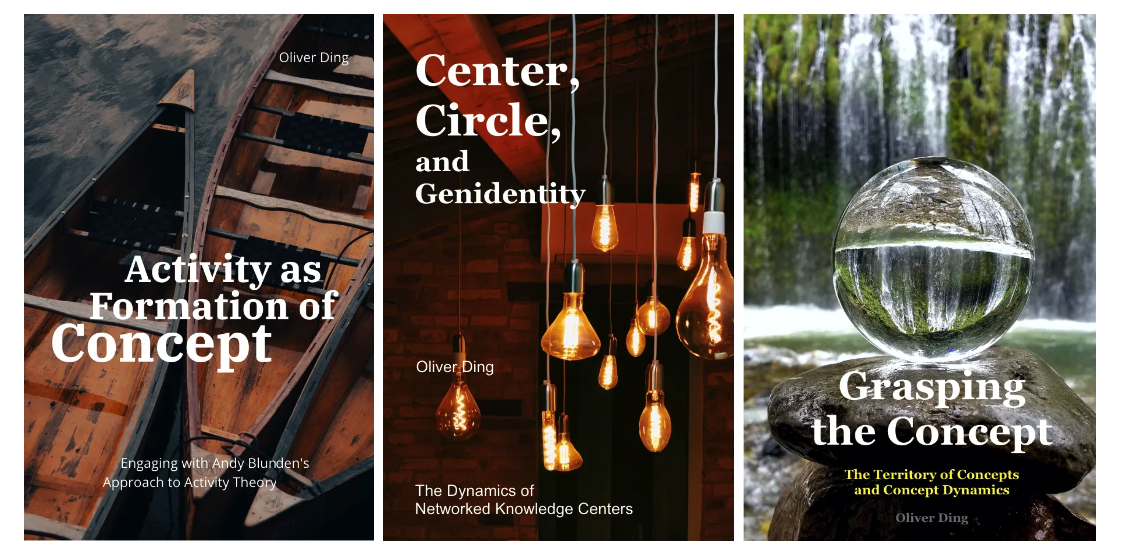
I realized this new book formed a trilogy with two other manuscripts I had written:
- Grasping the Concept: The Territory of Concepts and Concept Dynamics (November 2023)
- Center, Circle, and Genidentity: The Dynamics of Networked Knowledge Centers (June 2024)
- Activity as Formation of Concept: Engaging with Andy Blunden's Approach to Activity Theory (June 2024)
But here was the striking revelation: the chronological order of their editorial completion was the exact reverse of my actual creative journey.
2
This discovery revealed what I would later call the "Double Trajectories of Concept Development":
The Developmental Trajectory of PRACTICE (how I actually lived and worked):
- Phase 1: Appropriating Activity Theory (2020–2022)
I learned Blunden's notion of "Activity as Formation of Concept" and began exploring how to apply it. - Phase 2: Running Knowledge Centers (2022–2023)
I practiced the "Formation of Concept" approach by developing actual concepts like "Knowledge Center," "Value Circle," and "Platform Genidentity." - Phase 3: Evolving Concept System (2023–2024)
I expanded from developing single concepts to understanding entire concept systems and their dynamics.
The Developmental Trajectory of THEORY (how I documented and theorized):
- November 2023: Grasping the Concept — my mature theoretical framework about concepts and concept systems
- June 2024: Center, Circle, and Genidentity — the middle-ground synthesis
- June 2024: Activity as Formation of Concept — the foundational theoretical resources
The theoretical books were completed in reverse chronological order from the practice!
This temporal inversion is not merely a curiosity — it reveals something fundamental about knowledge development and appropriation.
When I first encountered Blunden's "Activity as Formation of Concept" in 2020-2021, I didn't fully understand its depth. I absorbed it as a theoretical proposition and began using it as a heuristic tool for my projects. Only through years of practice — actually forming concepts like "Knowledge Center" and "Value Circle" — did I gradually develop my own theoretical insights about concept development.
By 2023, I had accumulated enough practical experience to write Grasping the Concept, which presented my own framework for understanding concepts. Only then, in 2024, when I needed to teach someone else about Blunden's original framework, did I return to systematically curate the foundational materials.
This is the essence of appropriation: not merely learning a theory, but living through it, transforming it through practice, and eventually developing something new that both honors and transcends the original.
3
To understand this moment, we need to step back further.
I first encountered Activity Theory in 2015, but my serious engagement began in 2020 with the Activity U project. At that time, I was exploring Activity Theory through a "six levels of analysis" framework, examining how different theorists had developed the concept of "Activity" from different angles.
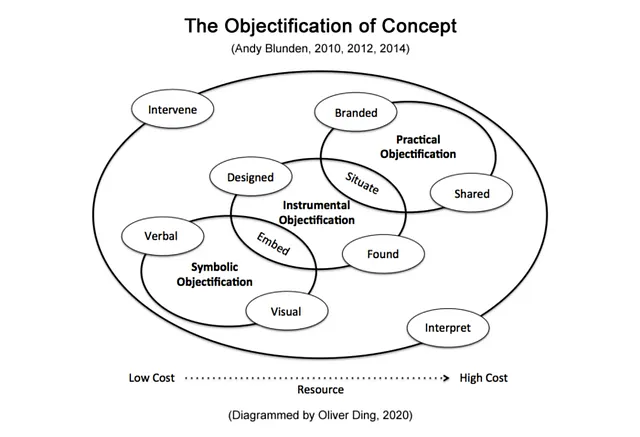
In 2020, I also designed a series of diagrams to represent Blunden's approach. One diagram particularly captured my attention — it showed how "Activity as Formation of Concept" worked through three types of objectification:
- Symbolic Objectification: "Verbal" and "Visual"
- Instrumental Objectification: "Designed" and "Found"
- Practical Objectification: "Branded" and "Shared"
Another diagram represented the landscape of culture using a three-phase development model, connecting Individual mind (Idea) and Collective theme (Zeitgeist) through Collective Projects (Concept).
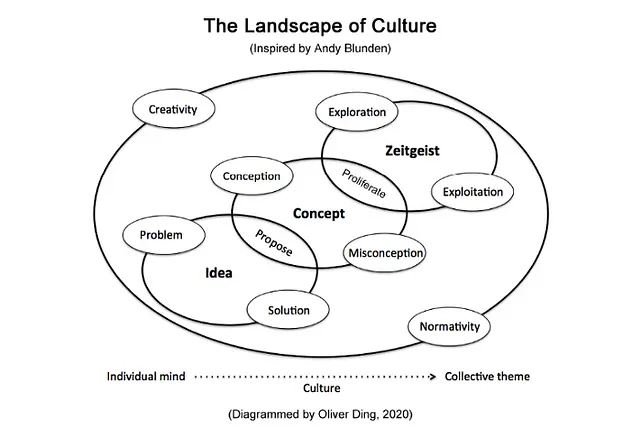
These diagrams weren't just illustrations — they were conceptual tools that would guide my next four years of practice.
4
In 2021, I wrote my first major book draft on Blunden's approach: Project-oriented Activity Theory. This was my attempt to understand and systematize his vision of Activity Theory, which centered on two key propositions:
- Project as a unit of analysis of Activity Theory
- Activity as a project of formation of a concept
Blunden's approach was distinctive. While mainstream Activity Theory (following Engeström) focused on "Activity System" as the unit of analysis, Blunden argued for "Project" as the fundamental unit. Moreover, he claimed that the essential nature of human activity is concept formation — people work together on projects to form shared concepts.
This was deeply influenced by:
- Hegel's Logic: especially the notion that concepts develop through dialectical contradiction
- Marx's historical materialism: viewing concepts as products of social practice
- Vygotsky's cultural psychology: understanding concepts as mediating tools
At this stage, I was primarily a student and translator of Blunden's ideas. I was trying to understand his vision and make it accessible.
But I didn't just theorize. I began applying the "Formation of Concept" framework to analyze real-world cases. In 2021, I developed the "Platform Innovation as Concept-fit" framework and applied it to understand how technological concepts and cultural concepts work together in the innovation of brand-new platforms.
5
In 2022, something shifted. I moved from analyzing others' concept formation to actively forming my own concepts. The context was the "Knowledge Center" project I had initiated in February 2022.
The Knowledge Center concept emerged from a practical need: how to organize my growing network of theoretical projects? Following Blunden's framework, I conceived "Knowledge Center" as:
- Symbolic Objectification: The name "Knowledge Center," logo designs, visual identity
- Instrumental Objectification: Digital platforms (websites, blogs), knowledge frameworks
- Practical Objectification: Actual activities at centers like CALL, Activity Analysis Center, TALE
From 2022 to 2023, I developed a network of seven knowledge centers:
- Curativity Center
- CALL (Creative Action Learning Lab)
- Activity Analysis Center
- Platform Ecology Center
- Life Strategy Center
- ARCH Center
- TALE (Thematic Analysis Learning Engagement)
Each center developed its own concepts: "Value Circle," "Platform Genidentity," "Thematic Engagement," and more.
Eventually, I connected the notion of “Formation of Concept” with my other ideas, such as “Themes of Practice”, “Thematic Exploration”, and “Evolving Concept System”.
- Formation of Concept: It was introduced by Andy Bluenden. I wrote a book (draft) titled Project-oriented Activity Theory in 2021.
- Themes of Practice: It was part of Curativity Theory. In 2021, I edited a book (draft) about it.
- Thematic Exploration: It introduces a practical framework for exploring potential themes for developing concept systems. In 2023, I wrote a book (draft) about it.
- Evolving Concept System: It introduces a framework to understand the dynamics of the development of a concept system.
6
By 2023, I had accumulated enough experience forming individual concepts that a new question emerged: How do concepts relate to each other? How do they form systems?
This led to Grasping the Concept (November 2023), where I introduced:
- Spontaneous Concept System: everyday concepts formed through personal experience
- Scientific Concept System: formal concepts learned through education
- Defined Concept System: designed concepts created for specific purposes
I also developed the Evolving Concept System model, which showed how concept systems develop through:
- Mental Platform: How do you think?
- Behavioral Network: How do you do?
- Material Container: What do you make?
This model revealed that forming a concept system involves not just thinking (Mental Platform) but also acting (Behavioral Network) and making (Material Container) — a complete integration of mind, practice, and artifact.
7
In June 2024, just before editing Activity as Formation of Concept, I completed Center, Circle, and Genidentity. This book explored how a network of knowledge centers maintains both uniqueness (Genidentity of each center) and synergy (Value Circle connecting centers).
The concept of Genidentity — "the existential continuity of an object through successive phases of development" — came from Kurt Lewin. I applied it to understand how my knowledge centers evolved while maintaining their distinct identities.
This was no longer just about forming a single concept (like "Knowledge Center"), but about understanding the dynamics of a network of concepts — how they interact, support, and generate each other.
8
And then came June 16, 2024.
When I edited Activity as Formation of Concept for my first Fellow, I was essentially curating the theoretical foundations that I had internalized years ago but never systematically documented. The book collected:
- Background on Activity Theory
- Detailed exposition of Blunden's approach
- My Project Engagement framework (v1.0, v2.0, v3.0)
- Case studies of concept formation
- My evolved understanding of concept systems
What struck me was this: I edited this foundational book after I changed my role from a student to a teacher.
Only after forming my own concepts, developing my own frameworks, and building my own theoretical contributions could I properly understand and present Blunden's original vision. The student had to become a creator before he could adequately teach the teacher's ideas.
9
This entire discovery happened because I was preparing to teach.
The act of organizing materials for my Fellow forced me to:
- Curate scattered knowledge I had absorbed over years
- See patterns in my own development I hadn't consciously recognized
- Understand the reversal between practice trajectory and theory trajectory
- Appreciate the recursive nature of learning, practicing, and teaching
This is what I call "teaching-learning reciprocity" — the teacher learns through teaching, not despite it. Sometimes we only understand the structure of our own development by turning back to teach what we have learned.
The Fellow Project became not just a pedagogical initiative, but a mirror revealing the architecture of my own theoretical journey.
10
Now I could see the three books as a complete system:
Book 1: Activity as Formation of Concept
- Function: Foundational theoretical resources
- Content: Blunden's framework + my early applications
- Represents: Phase 1 of practice (Appropriating)
Book 2: Center, Circle, and Genidentity
- Function: Middle-ground synthesis
- Content: Network dynamics of knowledge centers
- Represents: Phase 2 of practice (Running centers)
Book 3: Grasping the Concept
- Function: Mature theoretical framework
- Content: Theory of concept systems and their evolution
- Represents: Phase 3 of practice (Evolving systems)
But they were written and edited in reverse order (3→2→1), revealing that theoretical understanding lags behind practical experience.
This is itself a theoretical insight: appropriation is not linear absorption but recursive transformation.
11
The Fellow Project, which began this reflection, continues to evolve. My first Fellow's exploration of cross-cultural communication may yet generate new insights that transform both her understanding and mine.
This is the nature of Collaborative Project Engagement: not a teacher transmitting to a student, but co-becoming through mutual exploration of shared themes.
As I write this on November 30, 2025, working on Developmental Projects: The Project Engagement Approach to Adult Development, I see how far the journey has taken me from that first encounter with Blunden's "Activity as Formation of Concept" in 2020. Yet the core insight remains: we form concepts through sustained engagement with projects.
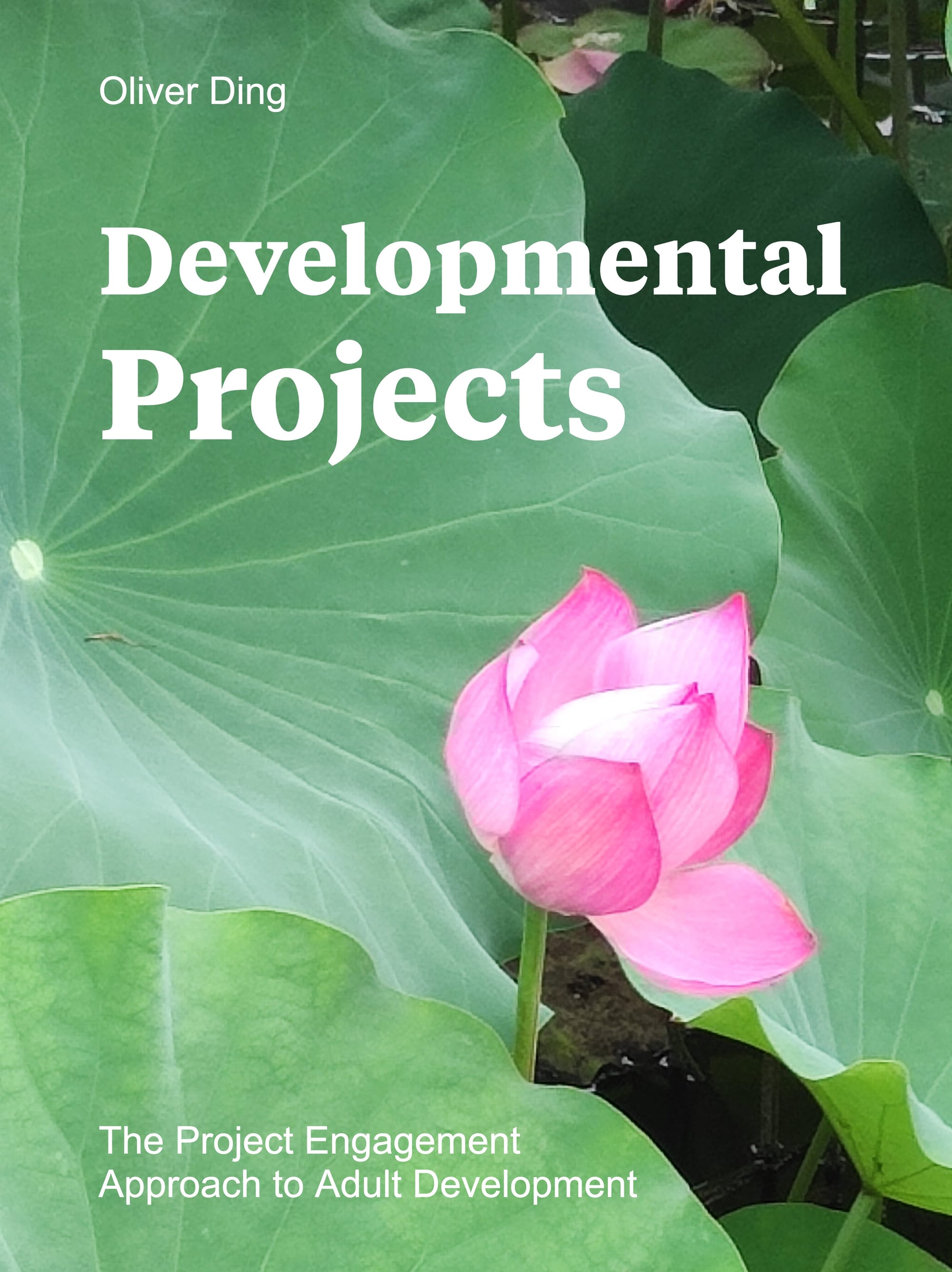
Several months ago, I travelled to China, spending most of my time in Fuzhou. One day, after meeting a friend, I returned home and was told that the children were playing at a nearby community park. I decided to go there. At first, I assumed the park would be unremarkable, but to my surprise, it contained a large lotus pond. About a third of the water was covered with lotus leaves, dotted with blooming lotus flowers.
Seeing this familiar yet beautiful scene, I suddenly recalled that lotus ponds, leaves, flowers, and seeds were cherished memories from my childhood — details I had never fully noticed before.
After returning to Houston, I applied this ecological metaphor to design a thematic card illustrating the nine aspects of strategic agency. I am now using it in a new book draft, Developmental Projects: The Project Engagement Approach to Adult Development. Within this new context, the metaphor maps onto key concepts in Developmental Projects:
- Lotus flower: Corresponds to Theme in the Developmental Project Model, guiding the three elements of Developmental Resources. The visible, beautiful blossom mirrors how the Theme is the most salient and appealing part of a project.
- Lotus leaf: Corresponds to Identity. Each leaf has its own shape and position, reflecting its “identity” and governing the three elements of the Situational Context.
- Lotus seed: Corresponds to Project Outcomes and the Enterprise generated across a series of projects. Seeds mark both an ending (the flower fades) and a beginning (new life). When a seed falls into the mud, it grows into a new lotus, forming a cycle. Likewise, one project’s outcome can give rise to new projects, eventually developing into an enterprise.
- Lotus rhizome: Represents the Network of developmental projects. Hidden underwater, the rhizome connects different flowers, forming a network. Though invisible, it is essential for connection and resource flow.
- Lotus pond: Represents the broader Social Context in which developmental projects are embedded.
Moreover, this ecological metaphor reveals the living nature of the “Developmental Project” concept, which itself is like a lotus flower, blossoming within its environment. Originally, the concept was tied to the Developmental Project Model — a foundational framework of the Project Engagement Approach, first introduced in 2021. Since then, it has been applied across a series of knowledge projects in diverse contexts, linking to a range of related concepts. This ongoing evolution has expanded both its meaning and its significance, especially in its “developmental” dimension, an aspect that was largely overlooked in the early stages.
In Collaborative Projects: An Interdisciplinary Study (2014), Blunden wrote a long introduction titled “Collaborative Project” as a Concept for Interdisciplinary Human Science Research, highlighting several key ideas of his project-oriented approach to human activity:
- Project as a Unit of Activity and Human Science
- A Project is a concept of both Psychology and Sociology
- Identity is a Collaborative Project
- Project as Formation of Concepts
- Social Group as Product of Projects
Although I use the “Developmental Projects” concept as my core idea of the ecological approach to adult development, my approach echoes Andy Blunden’s vision to some degree. More details can be found in The Living Way of the “Developmental Project” Concept.
Concepts do not stop developing when we write about them. They continue to grow, reveal new aspects, and open new questions. The “Developmental Project” concept is not finished — it is in the process of becoming.
The lotus continues to blossom.
Version 1.0 - November 30, 2025 - 2,508 words