
Appropriating Activity Theory #7: The Piano House and Activity as Container
Revisiting a 2017 conceptual deck
This post is part of the "Appropriating Activity Theory" series, which reflects my creative journey of engaging with Activity Theory from 2015 to 2025.
by Oliver Ding
November 15, 2025
1
On the afternoon of August 26th,2017, I stayed in the waiting room of a piano school with my son. The teacher had not come yet, so my son began to play with a LEGO transformer, flipping it around and placing it in a music stand. He also turned the toy to face me as if on a miniature stage. I responded with encouraging facial expressions, and an emergent game was born.
My son experimented with different poses for his transformer, and I escalated the play by covering my eyes, asking my son to set up a new "scene," and calling out when he was ready for the reveal.
A week later, on September 2nd, the scene repeated itself. Father and son were once again in the waiting room, but this time, my son had not brought his LEGO toy. Undeterred, upon entering the room, he immediately declared, "Let's play the guessing game!" He instructed me to cover my eyes, and using his own body along with a nearby chair, he began creating poses for me to guess. The game had evolved, its core identity persisting even as the objects and specific actions changed.
This story was told in my 2017 conceptual deck: Activity as Container.
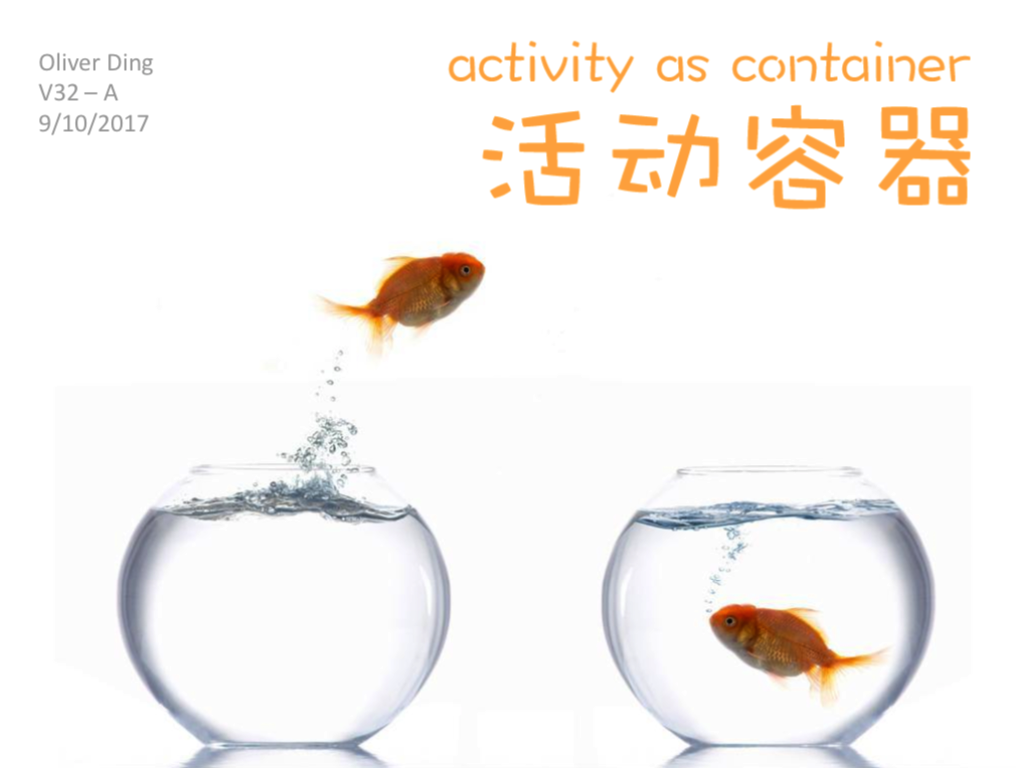
In the 242-slide deck, the core idea treats Activity as the Container where people develop their Relationships with dynamic Situational Events. My theoretical resources include Activity Theory, Ecological Psychology, Distributed Cognition, and other social theories.
The Piano House narrative reveals interactions that are both structured by their context and creatively emergent within it. To analyze this duality, we need a core metaphor that can account for both boundary and potential—a role I assign to the "Container."
The original conceptual deck was written in Chinese. Last week, I asked AI to write a report to introduce the framework in English. Today, I shared what Google Notebook LM wrote as a reference to see my early ideas. More details can be found in Revisiting the "Activity - Relation" Framework (2017).
2
The conceptual deck was part of a four-project creative journey from July 2017 to Feb 2018. The completion of this sequential, multi-layered journey was perceived as a successful navigation between several thematic spaces, corresponding to different levels of abstraction.
At the end of the journey, I used the metaphor "Transiting the Mental Passage" to describe my experience. The term "Mental Passage" was used to refer to a transitional thematic journey leading to the "Possible Self." In that case, the thematic journey includes three thematic spaces at three levels of abstraction:
- Practice
- Situational Framework
- Theoretical Framework
Let's unpack the details of this intellectual journey.
Project 1 - Practice
In July 2025, I run a thematic campaign titled "Friendship Books" to celebrate International Friendship Day on July 30. Inspired by Matt Cutts' Try something new for 30 days, the campaign was designed to run for 30 days. Each day, I selected one book or two books and mentioned one or two friends who are relevant to the books on a social media platform.
The theme "Friendship Books" didn't refer to books about friendship. The book selection itself was a medium to highlight a personal connection to a friend, regardless of the book's content.
The primary environment of the campaign was a social media platform, not a book club or an offline event.
The most important aspect of the project is the temporal setting: 30 days. It refers to the creative theme "Try something new for 30 days," instituted by Matt Cutts. Many people followed this theme and took real actions. Matt didn’t point to a particular type of action, instead suggesting a theme.
Project 2 - Situational Framework
After finishing the Friendship Books project, I realized that it was time to take the opportunity to reflect on the Book - Human Relation since the Object - Subject Relation had been my favorite theme for many years.
On August 22, 2017, I finished a 95-slide conceptual deck titled The Book-Human Relation. The cover of the deck highlights a theme of the framework: situational affordances.
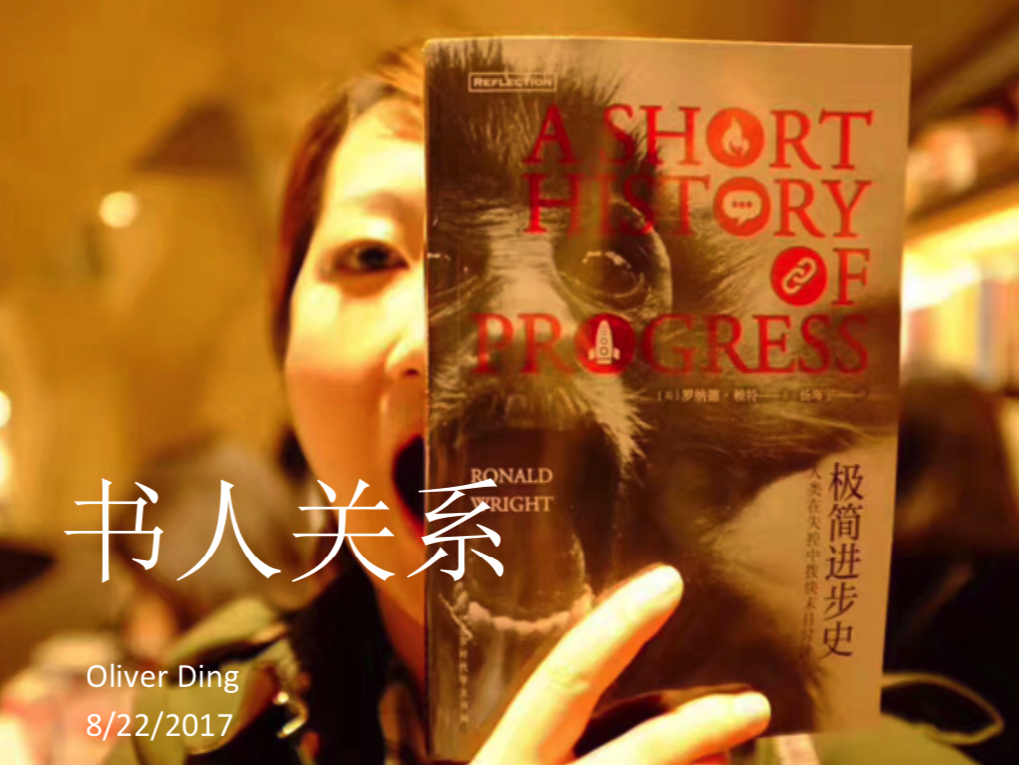
My goal was to challenge the traditional perspectives on books by introducing the lens of the Book-Human Relation. A core assertion is that a book possesses a dual nature: both an informational attribute and an object attribute.
The conventional view tends to center on the informational attribute, thus overlooking the crucial role of the object attribute. The object attribute of a book is not merely its physical properties; rather, it emphasizes the unique relation formed between one specific book and one specific person. This personalized relation is fundamentally invisible when viewed solely through the informational lens.
This novel perspective, The Unique Relation between a Specific Book and a Specific Person, represents a conceptual breakthrough. This naturally leads to the practical question: Can this new relational perspective inspire the birth of new products, services, tools, or communities within the industry?
Interestingly, subsequent work discussions with colleagues later that year revolved around topics intimately related to this framework. These real-world experiences served to validate the practical, heuristic value of creative works like the Book-Human Relation Framework.
The deck proposed a simple mode using the following terms:
- This Person
- This Book
- That Person
- That Person
At the end of the deck, I went further to suggest an abstract model, also called the Thing-People Relation model. See the diagram below.
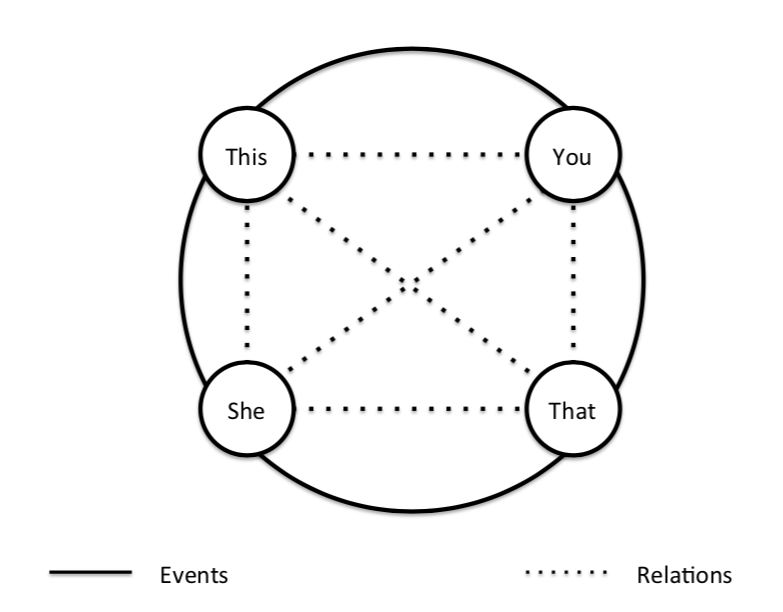
This model further inspired me to work on the "Activity as Container" project.
Project 3 - Theoretical Framework
The "Activity as Container" project went beyond the Thing-People Relation model, becoming a reflection on my engagement with Activity Theory, Ecological Psychology, Distributed Cognition, and other social theories from 2014 to 2018. While reflecting on the theoretical concepts I learned, I also reflected on the real-life experience I captured during that period. The piano house was an example of observation.
The final result is a 242-slide deck with a series of models. The primary model was the Thing-People Relation model. See the diagram below.
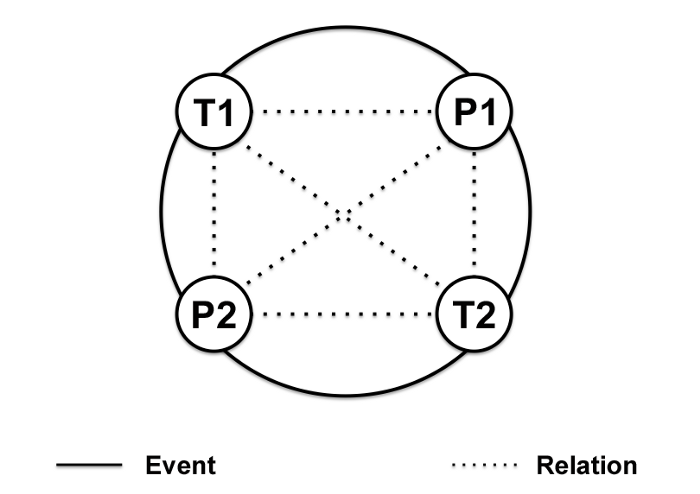
T means Thing while P means People. 1 means Here, while 2 means There. The circle means one event.
This model defines a meta-diagram that presents six types of relations. There are four dimensions behind these six types of relations. The table below offers a full configuration. The pair of “Homogeneous — Heterogeneous” refers to Categorical Difference, while the pair of “Close — Remote” refers to Spatial Difference.
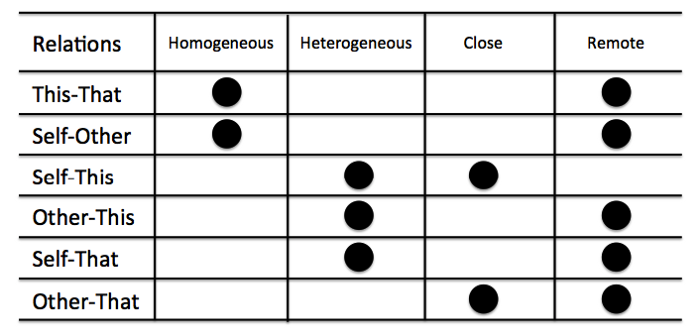
Later, I renamed it the Activity Circle. Now it is part of the Life-as-Activity Approach.
The deck also introduced a three-level hierarchical structure to understand situational events:
- Event
- Episode
- Move
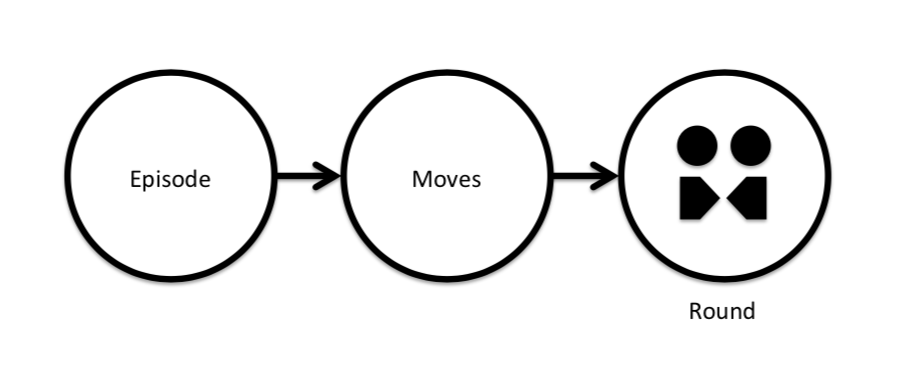
I also identified five aspects of situational events and the activity - relation dynamics:
- Theme: The Search for Meaning
- Composition: The Part-Whole Experience
- Distribution: The Interplay of Inside and Outside
- Openness: The Dynamics of Boundaries
- Genidentity: The Duality of Change and Invariance
More details can be found in Revisiting the "Activity - Relation" Framework (2017).
Project 4 - Curation
At the beginning of 2018, I refelcted the development of my creative thoughts and selected the "Activity - Relation" Perspective as the annual perspective of 2017.
The reflection also led to a framework, a conceptual deck, and a long article. This was a knowledge curation project.
4
This four-project creative journey marked a significant development of my creative thoughts, transforming me from a practical reflector to a theoretical thinker. It highlighted the key exercise of moving from a concrete level to a higher abstract level, for growing a theoretical mind.
Noted, there are two types of the abstraction hierarchy within the journey.
The first hierarchical structure is about the development of the "Activity as Container" Framework, as discussed in the previous section.
The second hierarchical structure is about the "Friendship Books" campaign.
- Level 1: my "Friendship Books" Campaign -> A specific 30-day creative practice—the most concrete item in this sequence.
- Level 2: Matt Cutts' Challenge + Friendship Day -> Contextual Vehicle
- Level 3: Matt Cutts' Challenge --> Try something new for 30 days, a creative theme for taking action
- Level 4: Open Action Wisdom --> An action methodology I developed
- Level 5: Activity as Container --> A theoretical approach to support the Open Action Wisdom
These five levels illustrate how I utilize the principle of Situated Reflection on Action, transforming a seemingly simple personal action (the "Friendship Books" campaign) into a layered validation of my most abstract theories.
This multiple-level Practice - Theory dialogue transformed me from a practical reflector who often stays at the situational framework level to a theoretical thinker who actively reflects at the general abstract theoretical level.
Finally, I used the metaphor "Transiting the Mental Passage" to describe my experience during that period. The term "Mental Passage" was used to refer to a transitional thematic journey leading to the "Possible Self."
Now, we can use the term "Thematic Space" to describe my "Transiting the Mental Passage" experience. Mental Passage can be understood as a special type of group of linked thematic spaces.
5
The Piano House story highlights the idea of Main/Side Episodes. The "Activity-as-Container" Framework proposes a hierarchical structure for analyzing the temporal flow of any situational event.
- The 3E Structure: At the highest level, any event can be broken down into three phases: Enter (the beginning), Event (a series of Episodes), and Exit (the conclusion).
- Main Episodes are activities that align with the pre-established goal or primary purpose of the event. In the Piano House case, the Main Episode is the piano lesson itself.
- Side Episodes are emergent, often unintentional actions that are not aligned with the main goal. The play that unfolded in the waiting room is a classic Side Episode. While goal-oriented theories like mainstream Activity Theory struggle to account for such moments, my framework gives them a formal place, recognizing them as fertile ground for creativity, learning, and relationship-building.
Today, after revisiting the deck, I created a new Weave diagram to highlight this idea with the "Product/By-product" idea. See the diagram below.
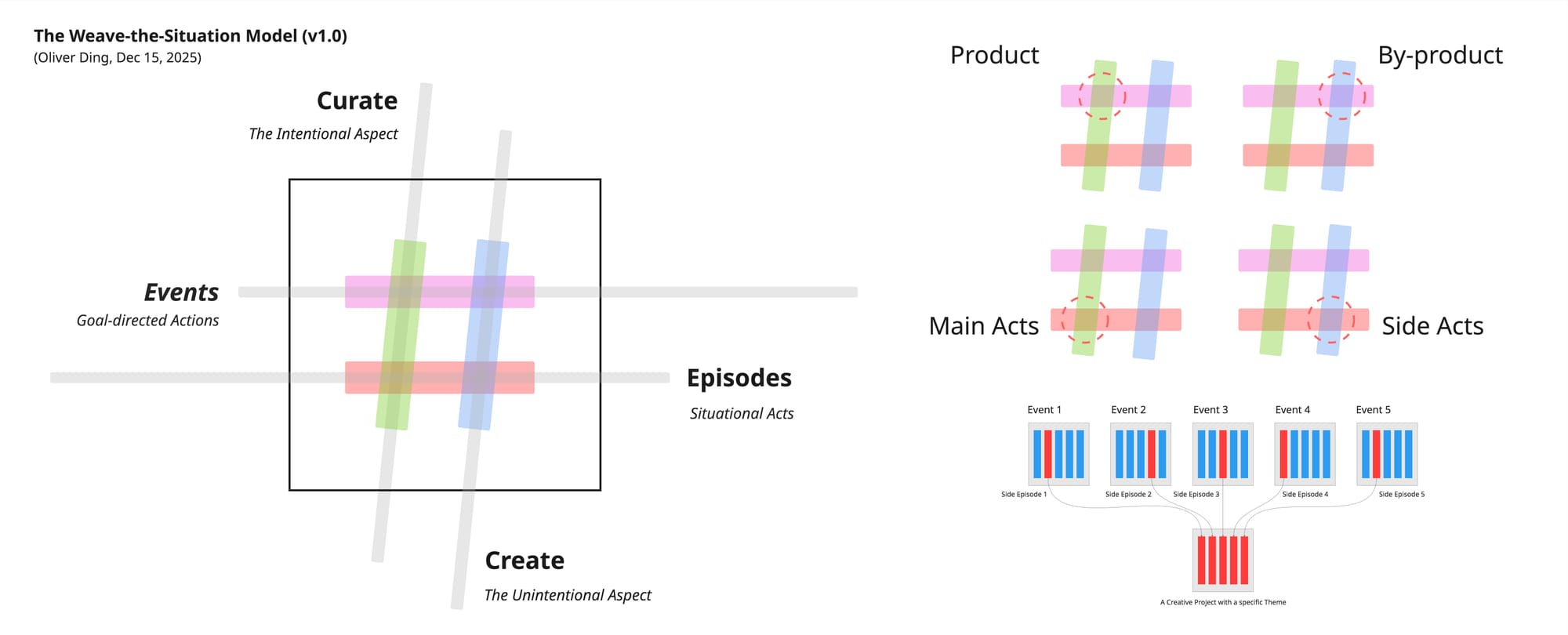
The Weave Basic Form is a super-simple diagram that frames the activity within the World of Activity as the synthesis of two diachronical dimensions and two synchronical dimensions. The model consists of four Weave-points (S1D1, S1D2, S2D1, S2D2), each representing a structural nexus where one synchrony dimension intersects with one diachrony dimension.
In the diagram above, the two diachronical dimensions correspond to Events and Episodes, highlighting two levels of one process:
- Events: Goal-directed Actions
- Episodes: Situational Acts
The two synchronical dimensions correspond to Curate and Create, highlighting intention and untention:
- Curate: The Intentional Aspect
- Create: The Unintentional Aspect
The Weave-the-Situation Framework also emphasizes four key knowledge elements located at the four Weave-points:
- Events × Curate = Product
- Events × Create = By-product
- Episodes × Curate = Main
- Episodes × Create = Side
This framework will be added to the Weave-the-Life Framework (v2.0). In this way, we find a way to curate the "Main - Side" pair into the present theoretical approach.
6
The human being, as the "containee" entity, experiences life as a continuous flow—a "Life Stream"—that moves through various containers. This concept, inspired by Henri Bergson's philosophy of "duration," views life as an authentic, unbroken whole. However, social structures and objective containers (like projects, meetings, or social roles) often break this flow into discrete segments, a process I term "fragmentation."
In the "Activity as Container" deck, I also discussed the curation of life experience under the "Theme" section and the "Composition" section. The diagram below appeared in the deck.
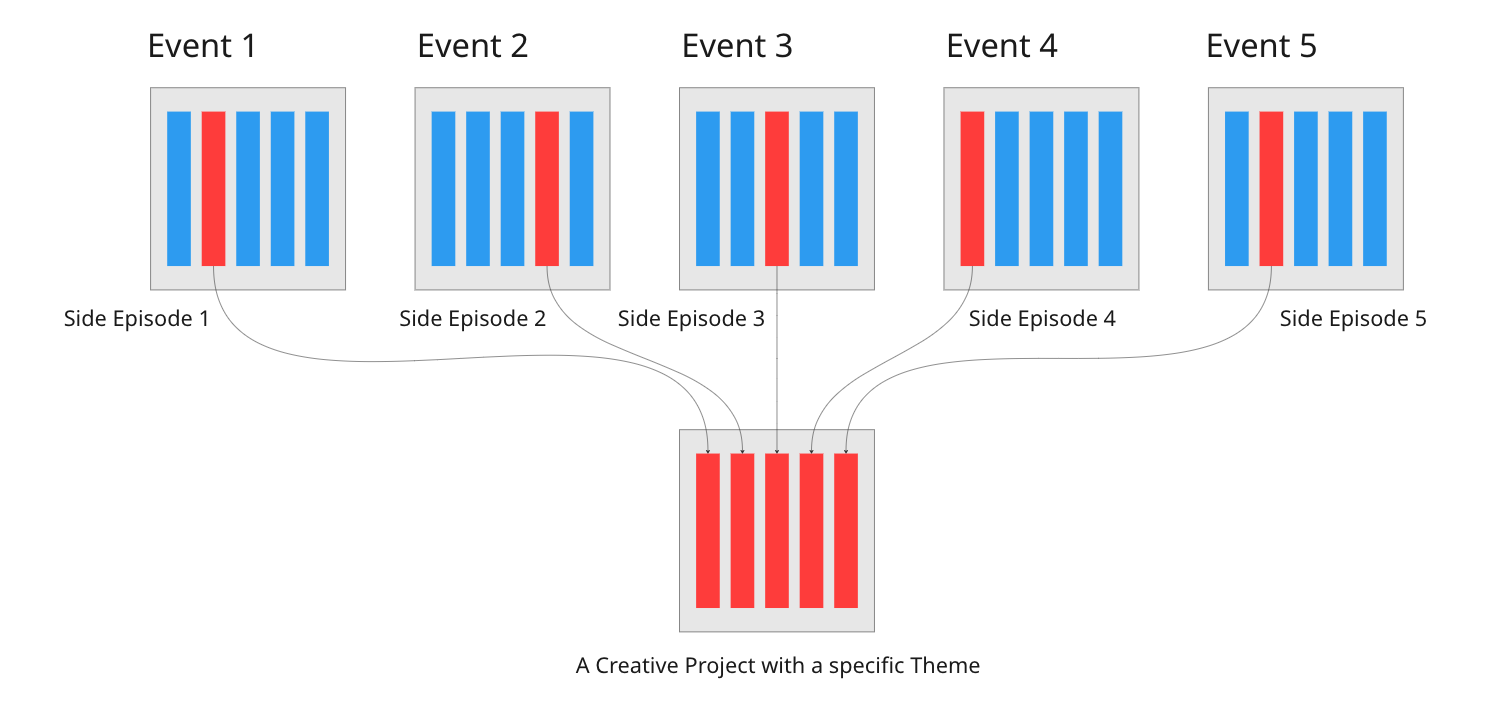
A theme can be explicit, as in the designed theme of a conference (Design Theme) or the culturally understood theme of a wedding (Native Theme). It can also be implicit, requiring interpretation, especially in emergent Side Episodes.
If a person can find a specific theme across a series of side episodes distributed at several events, they can perceive a creative project with the theme, curating these episodes together.
This was the seed of the Creative Life Curation method I developed in late 2022.
More details can be found in Creative Life Curation (Possible Book, v1, 2022).
v1 - December 15, 2025 - 2,066 words