
Appropriating Activity Theory #8: Stage, Map, and Moves
From the Mental Stage to a Map of the Social World
This post is part of the "Appropriating Activity Theory" series, which reflects my creative journey of engaging with Activity Theory from 2015 to 2025.
by Oliver Ding
December 31, 2025
1
On April 17, 2024, I created the History [Life(Self)] Framework in the morning. Later that day, after dinner, I realized that it echoed a framework I had created in 2021. See the diagram below.
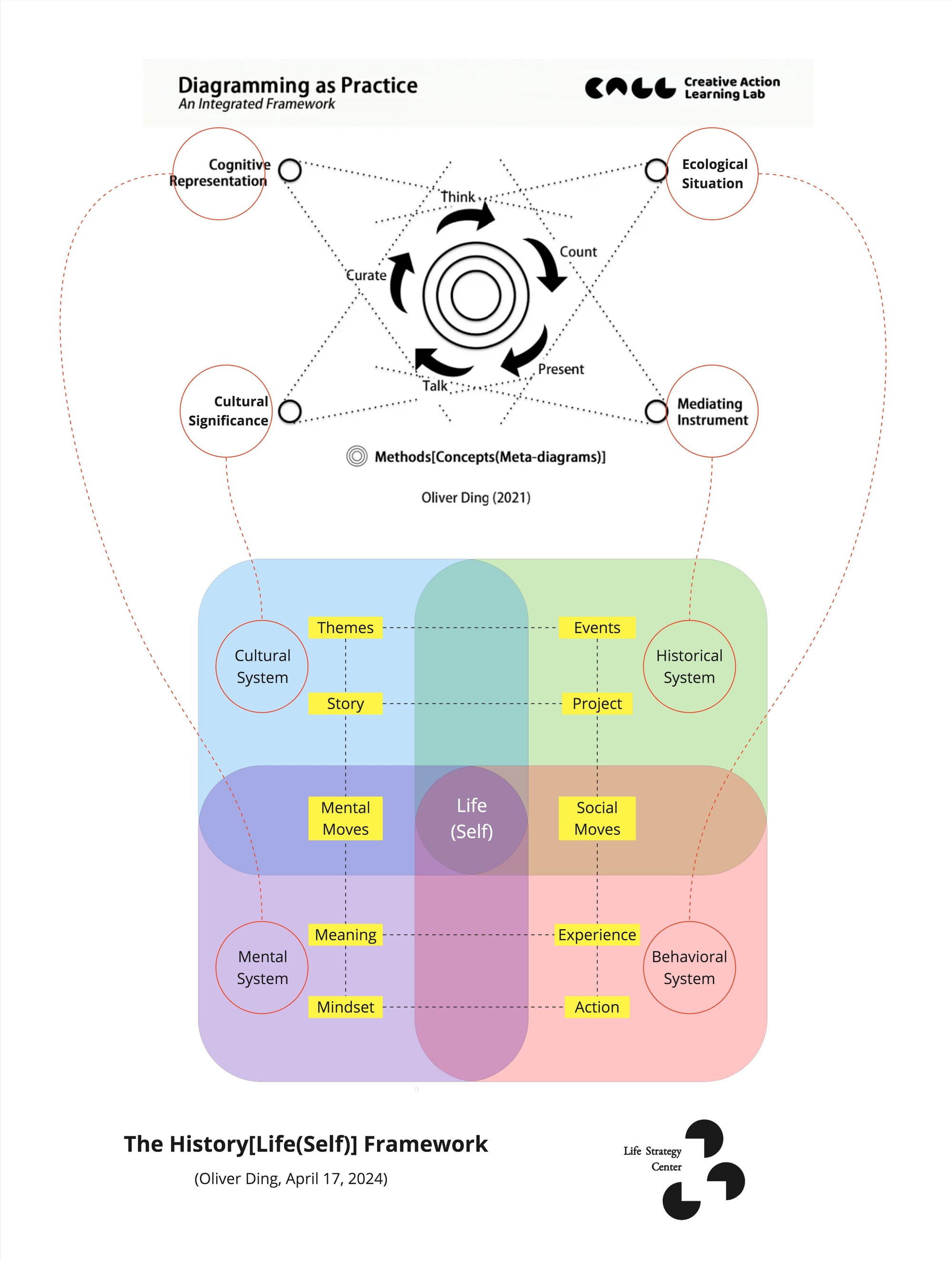
In 2021, I adopted four practical perspectives to develop the Diagramming as Practice framework in order to close the D as Diagramming project.
- Cognitive Representation
- Cultural Significance
- Ecological Situation
- Mediating Instrument
These perspectives echoed four areas of the History[Life(Self)] framework:
- Mental System > Cognitive Representation
- Behavioral System > Ecological Situation
- Cultural System > Cultural Significance
- Historical System > Mediating Instrument
This was a fantastic insight!
2
In 2021, I used the canvas below to create the Diagramming as Practice framework. In fact, it was named "The Psychology of Diagramming and Beyond."
Why did I name it in this way?
Although it was a project about diagramming, I realized that this framework summarized my psychological theoretical knowledge. It clearly showed four major areas of my engagement with psychological knowledge:
- Cognitive Psychology
- Cultural Psychology
- Activity Theory (Activity Psychology)
- Ecological Psychology
To be honest, I did not pay much attention to Personality Psychology or Psychotherapy. You can find more details in The Diagramming as Practice Framework.
3
The four perspectives of the Diagramming as Practice framework were adopted from an integrated epistemological framework I developed in mid-2017, which had its seeds in 2016.
In mid-2016, I took the pictures below while visiting Children’s Museum Houston with my two sons.
That was an aha moment for me. I realized two things:
1) Mind as Play. The museum is all about play, but these forms of play are cognitive activities for children. Thus, we can understand the mind as a process of play.
2) Perspective is not Reality. The picture above shows two perspectives of one object. Although perspectives are not reality, we do rely on perspectives to know reality.
These two ideas inspired me to develop a metaphor for the mind and knowing. Later, this metaphor became my framework for cognition and the terminus of my learning journey in cognitive psychology.
Inspired by the American sociologist Erving Goffman’s The Presentation of Self in Everyday Life, I named my metaphor Mind as Play. Goffman viewed theatre as a metaphor and developed the dramaturgical analysis method for sociological study. For Goffman, everyday life is a theatre. For me, everyday cognitive activities are a play.
The Mind as Play metaphor has three core elements:
- Objects of Knowing = Actors
- Perspectives = Stage Lights
- Domain = Stage
Objects of Knowing are what we think about. There are four layers of Objects of Knowing:
- Situational: a shopping list, travel, negotiation, sending a gift, cooking a meal, etc. These are all about concrete daily life activities.
- Emotional: joy, fear, surprise, sadness, anger, disgust, etc. These are all about feelings and intuitions.
- Rational: form, category, relation, change, causality, probability, degree, frequency, cycle. These are all about the laws behind things.
- Foundational: time, space, matter, information, and trust.
Why did I add the Foundational layer to the framework? Why did I select only the five objects of knowing listed above? My goal was not to develop a scientific framework for everyone. It was simply my own summary of my learning journey in cognitive science in 2016. I selected five objects of knowing from the rational layer and placed them in a deeper layer in order to highlight their importance to me. Others may select different objects of knowing for their own foundational layer.
If we adopt the Mind as Play metaphor, then each Object of Knowing is an Actor, while a cognitive activity is a Play.
The second element of Mind as Play is Perspectives. The picture above shows three stage lights, which refer to three perspectives. Everyday life is complex, and a simple way to understand it is by adopting multiple perspectives. Each perspective represents a unique point of view, a mental frame, a cultural significance, and so on. I made a distinction between spontaneous or naïve perspectives and scientific or theoretical perspectives.
- The former refers to common sense, such as “the teacher’s perspective / the parent’s perspective,” “the inner perspective / the outer perspective,” and “the process perspective / the outcome perspective.”
- The latter is adopted from academic theories, for example, the cognitivist perspective, the 4E perspective, the affordance perspective, the activity-theoretical perspective, and the autopoiesis perspective.
The last element is Domain, which is understood as the Stage. A play must be performed in a place where actors can act. Objects of Knowing should be placed within a particular domain that provides the necessary boundaries for guiding inquiry.
I completed the Mind as Play framework at the end of 2016 and began applying it to my learning journey with theoretical perspectives. In mid-2017, I selected four theoretical perspectives and curated them together as an epistemological framework for myself.
4
In July 2017, I designed a diagram to curate four theoretical perspectives together. The diagram below is an updated version of the 2017 diagram. While the new version retains the four basic conceptual spaces and the visual layout, the major change lies in the names of two conceptual spaces. The “Relevance” area was named “Interface” in the old version, while the “Opportunity” area was named “Affordance.”
I considered the diagram above an integrated framework for understanding “Mind, Meaning, and Experience.”
It is an epistemological framework for curating my learning outcomes and reflecting on my work experiences. As a lifelong thinker, I was satisfied with this practical framework as an outcome in mid-2017. Basically, the four conceptual spaces refer to four ways of connecting theory and practice.
- The “Architecture” area connects my work experience in Information Architecture with my learning in cognitive science.
- The “Relevance” area connects my work experience in advertising, media, and marketing with my learning in semiotics, communication studies, and cultural studies.
- The “Opportunity” area connects my life experience during my children’s childhood with my learning in ecological psychology’s affordance theory and with my own work on the Ecological Practice approach, which emerged in 2018.
- The “Activity” area connects my work experience across various domains with my learning of Activity Theory.
The diagram above is not a traditional 2×2 matrix. The major difference between my diagram and a 2×2 matrix lies in the process of diagram construction. In a traditional 2×2 matrix, one defines two dimensions first and then generates four conceptual spaces by assigning two values to each dimension. In my diagram, by contrast, I began with four conceptual spaces and then identified similarities and differences among them. In other words, the four conceptual spaces in my diagram cannot be generated by calculating dimensions. For example, one cannot derive “Opportunity” from “Self, Concrete, Rational, Dynamic.”
In fact, there are two hidden dimensions behind my diagram: situational and social.
- Situational: abstract vs. concrete
- Social: self vs. other
The path of my learning journey started with individual cognitive psychology, which is located in the “Architecture” area, and then expanded to other areas. Although ecological psychology (affordance theory) focuses on concrete environments, it remains at the level of individual analysis.
The “Activity” area refers to Activity Theory and social practice theories more broadly. Its unit of analysis is neither individual behavior nor macro-social structure or cultural meaning alone. Since 2001, a group of philosophers, sociologists, and scientists have rediscovered the practice perspective and used it as a lens to explore and examine the role of practices in human activity. Researchers have referred to this shift as the Practice Turn in Contemporary Theory. As Schatzki pointed out, “there is no unified practice approach” (2001, p. 2). Davide Nicolini adopted a toolkit approach to introduce six different ways of theorizing practice in his 2013 book Practice Theory, Work, & Organization. Activity Theory is considered one of these six social practice–theoretical approaches.
The “Relevance” area refers to abstract cultural meanings across interpersonal interactions, group activities, and large-scale social movements. It goes beyond dynamic situational activities and focuses instead on stable common sense, general cultural significance, signs, symbols, and collective social representations.
This epistemological framework was not intended to create a single theoretical approach, but rather to curate my thinking in a visual order. Each visual area represents a thematic space, and each thematic space corresponds to a group of theoretical approaches. In this way, I can easily review the landscape of my learning journey and conduct a mapping process of my own epistemic development.
5
In 2023, my primary knowledge center was TALE (Thematic Analysis Learning Engagement). I also worked on several projects related to CALL (Creative Action Learning Lab) and the Curativity Center. My “Life” thematic space was developed through work on multiple knowledge projects under CALL, TALE, and the Curativity Center. I found that the following themes underlay these knowledge projects.
On April 17, 2024, I reflected on these ideas and created the History[Life(Self)] framework.
As mentioned at the beginning of the article, I discovered that it was connected to a framework I had developed in 2017.
- Mental System > Cognitive Representation > Cognitive Psychology
- Behavior System > Ecological Situation > Ecological Psychology
- Cultural System > Cultural Significance > Cultural Psychology
- Historical System > Mediating Instrument > Activity Theory (Activity Psychology)
This has been a long journey of psychological knowledge engagement.
6
On April 17, 2024, after reflecting on the long journey, I conducted a case study of the "Thematic Identity Curation" framework. I found that there was a thematic blend of "Psychological Knowledge Engagement" in my creative journey.
- 2016: The Mind as Play Project
- 2017: The Mind, Meaning, and Experience Project
- 2021: The D as Diagramming Project
- 2023: The Life(Self) Project
- 2024: The History [Life(Self)] Project
These five projects use the "Knowledge Curation" method, which is similar to the "Theoretical Integration" method.
7
The journey continues.
Ten days ago, I created the History{Life[Self(Body)]} framework v3.0 (also known as the HLS framework), utilizing it as a meta-framework for the Meta-frameworks project.
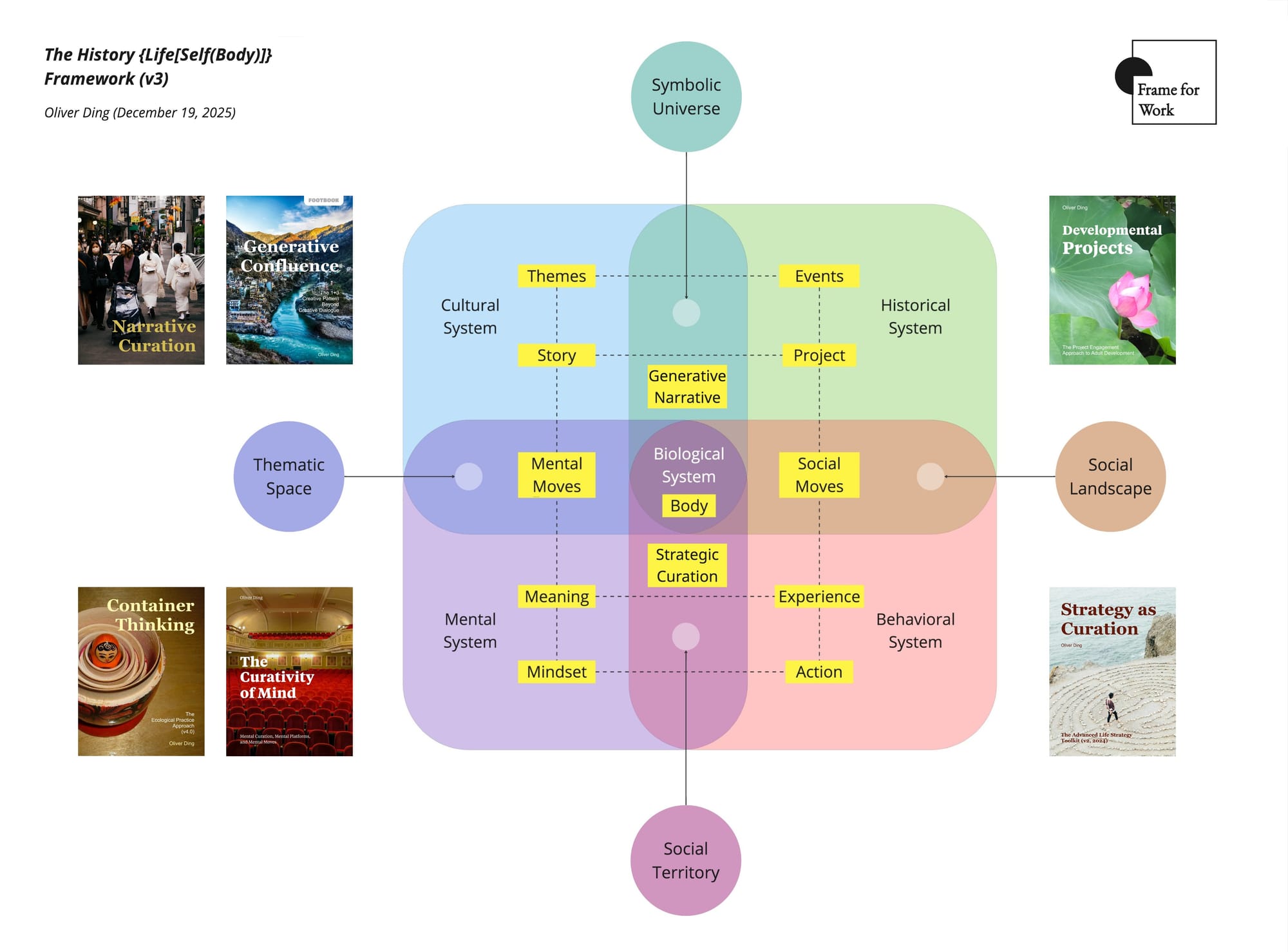
After connecting the new framework (v3.0) with the Meta-frameworks project, I realized that the following four concepts represent the Four Mechanisms of Cultural Development:
- Mental Moves
- Social Moves
- Strategic Curation
- Generative Narrative
On December 21, 2025, I created the Weave-the-Culture Model to highlight these four mechanisms (see the diagram below).
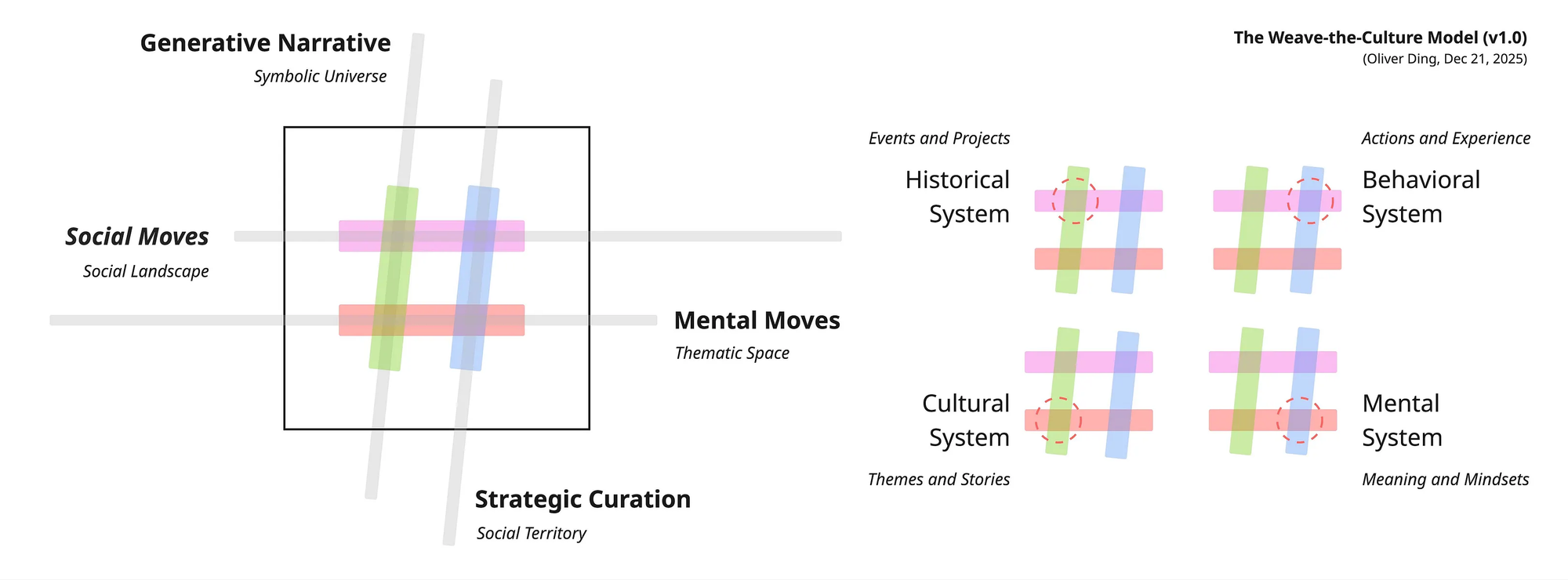
The diagram above is based on the Weave Basic Form, a super-simple diagram that frames the activity as the synthesis of two diachronic dimensions and two synchronic dimensions. The model consists of four Weave-points (S1D1, S1D2, S2D1, S2D2), each representing a structural nexus where one synchronic dimension intersects with one diachronic dimension.
In the Weave-the-Culture Model, Mental Moves and Social Moves are two diachronic dimensions, while Strategic Curation and Generative Narrative are two synchronic dimensions.
The central object of these four mechanisms is the Cultural Framework, which is a type of concept system. The central context is not only the Cultural System, but all five systems as a whole.
The “Four Mechanisms of Cultural Development” view is similar to the Context (Mind) view adopted in The Curativity of Mind; the two projects can be understood as mirror strategies, neither confined to traditional boundaries.
The development of Cultural Frameworks is situated not only within the Cultural System but also across the Mental, Behavioral, Historical, and Body Systems as a whole.
Starting in December 2024, I gradually shifted from Knowledge Engagement to Cultural Development. Over the past 12 months, I have worked on several projects related to Cultural Development, such as the Tiny Culture project (see the diagram below), the “Culture as Thematic Enterprise” Framework, the Frame-for-Work Canvas, and the Cultural Projection Model (2025).
On December 20, 2025, I formally started the Meta-frameworks project. After reflecting on the landscape, the journey, and the situation, I wrote three new articles to set the theoretical foundation for the new possible book:
- The History{Life[Self(Body)]} Framework (v3.0) — Part 1, Part 2, Part 3
- Six Faces of the Concept System
- Weave the Culture: One Meta-Framework and Four Mechanisms of Cultural Development
Finally, centered around the Weave-the-Culture Model, I curated a series of related knowledge models and methods, forming a comprehensive Weave-the-Culture toolkit.
Today I released a new possible book: Meta-frameworks: Creative Heuristics for Individual and Social Development.
The seed from 2017 has now grown into the History {Life[Self(Body)]} Framework (v3.0), a meta-framework for the Meta-frameworks project.
Within the HLS map, this framework serves as a guiding structure, showing how different paths of inquiry unfold. The mental platforms explored in The Curativity of Mind trace one path, focusing on individual cognition, social context, knowledge, and activity. The cultural frameworks highlighted in Meta-frameworks trace another path, examining cultural systems and their transformations in relation to other concept systems, including mental platforms.
Together, these paths reveal how meta-frameworks function as living systems, growing through dialogue and evolving through practice. Individual exploration and cultural development are not separate domains; they are merely different expressions of concept systems in varying contexts. The HLS map provides a perspective on these functional shifts, showing that what appear as distinct paths—mental platforms or cultural frameworks—are simply different trajectories within the same landscape, leaving open the possibility for further movement and discovery.
v1.0 - December 31, 2025 - 2,257 words